1. Introduction to the issue
One of the most influential theses in Southeast Asian history in recent decades has been that put forward by Anthony Reid in his Southeast Asia in the Age of Commerce.Footnote 1 In this work, Reid suggests that the age of commerce had its roots in changes which occurred during the fifteenth century. The commercial boom and the emergence of port cities as hubs of commerce,Footnote 2 he avers, spurred the political, social and economic changes which marked the Age of Commerce in the region, extending from the fifteenth to the seventeenth century. He points to changes in the spice and aromatic wood trade, a trade boom beginning some time around 1400, and new systems of cash-cropping across the archipelago.Footnote 3 With the booming maritime trade came the emergence of the Southeast Asian junk as well as new navigational techniques. Increased commercialisation and the growth of cosmopolitan urban centres, usually port cities, were accompanied by the demand for more money and the emergence of new common means of exchange. This brought demand for more sophisticated financial systemsFootnote 4 and promoted the emergence of mercantile elites.Footnote 5 Other social manifestations of the Age of Commerce as depicted by Reid included a religious revolution, with the introduction of Islam and Christianity in the region,Footnote 6 and a military revolution with new war technologies aiding in the strengthening of new regimes.Footnote 7
But how new were the changes described in Reid's Age of Commerce? Can we trace their roots back even further into the Southeast Asian past? Or can we even posit an Early Age of Commerce where external changes stimulated a burgeoning maritime trade in the region, which in turn gave rise to social and economic changes in the Southeast Asian polities and societies themselves? This paper will argue that the four centuries from circa 900 to 1300 CE can be seen as an ‘Early Age of Commerce’Footnote 8 in Southeast Asia. The thesis is that the collocation of a number of changes external to what is commonly referred to as Southeast Asia, impacted the region and provided an environment where maritime trade boomed, and that this trade boom induced political, social and economic changes throughout the region. It is thus proposed that the period from 900 to 1300 be considered the Early Age of Commerce in Southeast Asian history.
2. The major external factors affecting Southeast Asia 900–1300 CE
2.1. Financial and trade policies under the Song and Yuan dynasties in China
The first series of changes to be examined is those which occurred in the polities and societies of China over this period. The northern and southern Song dynasties (960–1279), which existed for more than three of the four centuries examined here, constituted a period of great commercial and industrial growth in China, so much so that the changes which occurred during this period have been referred to as the ‘medieval economic revolution’.Footnote 9 The period saw expanded money supply, creation of bills of exchange, new forms of credit and paper money, as well as new foreign trade policies.Footnote 10 In the 1060s, as a result of Wang An-shi's reforms,Footnote 11 the Song state pursued an expansionary monetary policy and in the 1070s and 1080s, state mints were producing 6 billion copper cash annually, the highest level at any time in Chinese history. The changes that most affected Southeast Asia were those tied to financial and trade policies, the two aspects being intimately linked.
2.1.1. Financial policies in China
With the end of the Tang dynasty in the early tenth century and the emergence of competing polities (a period generally known as the Five Dynasties), many of these states pursued what Richard Von Glahn calls ‘bullionist’ policies, whereby they accumulated copper coins and issued debased versions for commerce.Footnote 12 The emergence of the Song as the dominant polity among the competing states in the 960s saw various polities making efforts to prevent the flow of copper coins to the northern Tangut (Xi-xia) and Khitan (Liao) kingdoms. At the same time, the Song began minting large volumes of copper cash. In 996, 800,000 strings of cash (nominally 800 million coins)Footnote 13 were minted, well exceeding the maximum annual output of 327,000 strings during the Tang dynasty.Footnote 14 This expanded to 1.83 million strings in 1007, but mining restraints limited further growth and, in 1021, a fixed output of 1.05 million strings per year was decided upon. However, much of this coinage disappeared as quickly as it was produced, because the value of the metal was greater than the face value of the coin.
Silver also flowed out of the Chinese economy and this outflow was blamed on merchants from the South SeasFootnote 15 as well as the steppes.Footnote 16 Von Glahn notes that the price of silver against gold was low in China compared to Japan and the Muslim world, which naturally induced outflow. But the demand for copper coins in Southeast Asia must have been enormous as Southeast Asian merchants brought silver to the ports of southern China to trade for coin, reportedly offering one liang of silver for one string of coins, triple the domestic price.Footnote 17 The inability of the Song to keep their copper coins in circulation was exacerbated in the twelfth and thirteenth centuries through further outflow via the maritime trade routes. This was stimulated by the increasing monetisation of Asian economies from Korea and Japan to Southeast Asia, despite these economies producing little money of their own. The Song banned the export of coin to Korea and Japan in 1199, but with minimum effort. In the early 1250s, it was reported that 40 to 50 ships laden with nothing but coin departed Ningbo for Japan each year.Footnote 18 The Sinan wreck, found off the Korean coast and dated to the early fourteenth century, carried a cargo of about 8 million copper coins.Footnote 19
It was during the Mongol Yuan dynasty (1271–1368) that the coin economy was really replaced by one in which silver and paper money were intimately linked. The silver ingot initially became the monetary standard of the Mongol empire. Despite the efforts of the capital administrators, it appears that the localities continued to utilise copper coin. In 1303, it was noted that in what is today Fu-jian, Guang-dong, Jiang-xi and Hu-nan, coin still prevailed as instruments of exchange despite having been demonetised 40 years previously.Footnote 20 It is certainly no coincidence that the two first mentioned were the provinces most intimately tied by maritime trade to Southeast Asia.
2.1.2. Foreign trade policies in China
The major changes in the financial system over the Song/Yuan period were exceeded by even greater changes in the trade regime, and especially the foreign trade systems.Footnote 21 The importance of trade for the Song state was evident from its very beginnings, with the first emperor setting down regulations to govern trade in 960, the first year of his reign. With increasing control over the southern ports, the Song began to systematically utilise maritime trade for its fiscal advantage. Song maritime trade provided revenue to the Song through three avenues:Footnote 22
1. Taxes were imposed on ocean-going ships. This income was devoted solely to military expenses.
2. Duties were levied on imports. In 1136, this was set at one-tenth of fine quality goods and one-fifteenth of coarse quality goods.
3. The majority of revenue came from purchase and sale of products, some of which were subject to government purchase monopolies.
To coordinate the overseas trade and its taxation, the Song established maritime trade supervisorates at various ports.Footnote 23 These maritime trade supervisorates had a range of functions, including inspection of incoming ships and their cargoes, assessing the cargoes and charging duty, purchasing government monopoly products, registering Chinese ships going abroad, issuing certificates for merchants, enforcing prohibitions against export of controlled commodities such as copper, and providing accommodation for maritime merchants.Footnote 24 The large profits they made for the state are well attested.Footnote 25 Wheatley also notes how the southern Song developed new ports along the coast in the twelfth century, including one at Tong-zhou near the mouth of the Yangtze and a new port in Hai-nan at Sha-jin.Footnote 26
In addition to establishing these maritime trade offices, the Song state also actively encouraged foreign maritime traders to come to the Chinese ports. In 987, four missions were sent abroad with imperial credentials to encourage ‘foreign traders of the Southern Ocean and those who went to foreign lands beyond the seas to trade’ to come to the southern Chinese ports in order to obtain preferential licences.Footnote 27 It is pertinent to note that in the texts which described these missions, the first mention was to traders from places we today refer to as Southeast Asia.
The second part of the appeal seems to have been aimed at Chinese who had left to trade abroad. It is perhaps relevant that this action should have been taken just two years after 985 when Chinese merchants were banned from travelling abroad.Footnote 28 Other restrictions were imposed as part of the management of foreign trade. In 982, for example, an edict required that certain aromatics be restricted to ships calling at Guang-zhou, Quan-zhou and Zhang-zhou. There were also efforts to prevent officials from directly engaging in the obviously very lucrative trade. A 995 imperial order addressed to the Guang-zhou Maritime Trade Supervisorate prohibited officials, both central and local, from sending their servants abroad.Footnote 29
As noted above, from 1069 onwards, economic and fiscal reforms were promulgated for the purpose of expanding and monetising Chinese economic activities. One of the effects of this was that Song overseas trade in the eleventh century saw increasing monetisation — that is, an increased use of copper cash. Three years later, further reforms relating to maritime trade were implemented as part of the restructuring of the Trade and Barter Regulations. These changes were aimed at expanding economic exchange between the Song and economies beyond China, thereby benefiting the Song through taxation of maritime trade and sale of foreign products that were subject to state monopoly. The following year, in 1074, a ban on the export of copper coins, which had been instituted in 960, was lifted to further encourage maritime trade. This resulted in massive exports of copper coins to Southeast Asia. In response, the minting of copper cash had to be greatly increased from 1.3 million strings annually at the beginning of the eleventh century to 6 million strings by 1078.
By the late eleventh century, envoys to Song China were paid for their goods in copper coin and silver bullion, and no longer in the gold, silver or copper objects previously provided.Footnote 30 Such payments were provided to, for example, missions from Champa (1072 and 1086), an Arab polity (1073), the Cōla polity (1077) and Srivijaya (1078). In 1087, a new maritime Trade Supervisorate was opened in Quan-zhou and the year 1090 saw further liberalisation of maritime shipping regulations.
After the Song were forced to retreat to their new capital of Hang-zhou, south of the Yangtze, more conservative trade policies were pursued by the court. In 1127, the first year of the new administration, the export of copper coins was banned and quotas were instituted for goods imported from the South Seas.Footnote 31 Foreign traders who came to the Song polity were still paid in copper cash, but they were expected to convert their cash into other Chinese products before leaving.Footnote 32 This reversal of maritime trade encouragement was to bite hard over the following century with the result that ‘Song China's once-thriving maritime trade with Japan and Korea, Southeast Asia and the Indian Ocean withered in the thirteenth century.’Footnote 33
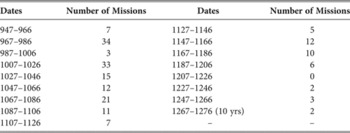
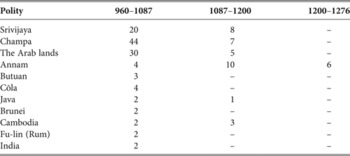
It is obvious that the enthusiasm for maritime trade so evident in northern Song policies, the opening of the various maritime trade offices and the pursuit of the diverse financial policies, had a great promotional effect on maritime trade throughout the major port cities of Southeast Asia. It is equally obvious that the withdrawal of encouragement by the southern Song Court after 1127 had a major braking effect on official trade to those ports. These trends are directly reflected in the figures in Table 1 which show the relative frequencies of the Southeast Asian (both mainland and maritime polities') missions to the Song by 20-year periods. The major partners in this official trade are detailed in Table 2.
Official Southeast Asian missions to the Song court (by 20-year periods)

Source: Hans Bielenstein, Diplomacy and trade in the Chinese world 586–1276 (Leiden, Boston: Brill, 2005), pp. 80–1.
Maritime polities which sent official trade missions to the Song court

Note: The Arab lands (Da-shi), the Cōla polity, India and Rum (Byzantium) are included in this list as there are indications that the envoys claiming to represent these places traded through or from ports in Southeast Asia.
Source: Based on Billy K.L. So, Prosperity, region and institutions in maritime China, p. 56, adjusted through reference to Hartwell, Tribute missions to China 960–1126.
The range of products traded into and out of China by merchants – foreign and Chinese – during the Song has been dealt with in detail by Paul Wheatley.Footnote 34 Ceramics were one of the Chinese products apparently in high demand in Southeast Asia during this period. One major effect of the increased overseas markets for Chinese ceramics was a growth in kiln sites in China, a diversification of products, increased adjustment for market demand and great influence on ceramic industries in Southeast Asia. A useful study of the role of ceramics in the expansion of Chinese trade with Southeast Asia during the Song period has been made by John Guy.Footnote 35 Another important side-effect of the increased interest in maritime trade by the Chinese state during the Song was the rise of a powerful merchant class in coastal regions. It was these people who were to continue to push the southern provinces toward the ocean and attract traders from beyond China's shores.
Following the defeat of the southern Song by the Mongols, the Yuan established their own Maritime Trade Supervisorates, with the first being established in Quan-zhou in 1277, under Pu Shou-geng, the ex-Song Maritime Commissioner. By 1293, there existed seven such bureaus, in obvious efforts to copy the Song and derive increased revenue from maritime trade.Footnote 36 But their efforts were not to be equally rewarded, due to a number of factors.
Much of the maritime trade during the Yuan was controlled by the foreign, mainly Muslim, merchants resident in the southern ports, often in ortogh (wo-to 斡脫) partnerships with Mongol imperial families or government officials. There was a joint-venture system established, combining government ships with merchant expertise, and with profits being shared in a 7:3 ratio. In 1285, the Yuan government allocated 100,000 ding (more than 20 tons) of silver to build ships for joint ventures.Footnote 37 In an interesting proposal of 1286, which foreshadowed what was to happen 100 years later under the early Ming dynasty, one of Khubilai Khan's advisers, Lu Shi-rong, urged the banning of all private foreign trade, so as to allow a monopoly of this by the government and ortogh merchants. The proposal did not proceed, but the fact that it was suggested at all indicates something of the importance of these ortogh partnerships.Footnote 38
At the same time, trade in Chinese copper cash had declined to a low level by the second half of the thirteenth century and yet, the Yuan still issued edicts in 1283 and 1286 prohibiting the use of copper coins in maritime trade. The decline in maritime trade in the second half of the century was a product of diverse factors, but the Yuan military missions which were sent throughout the seas of East and Southeast Asia during the last decades of the century were to seal the fate of maritime trade in this period. These missions appear to have been aimed at both achieving political domination of the maritime realm and gaining monopoly control of maritime trade. Both efforts were to fail, and East Asian maritime trade seems to have experienced a hiatus from the end of the 1200s through to the first half of the 1300s.
2.2. Socio-economic changes in southern China
In tandem with the changes in state monetary and trade policies discussed above, a great many changes were occurring locally in various parts of China during this period, with some of the most profound being seen in southern Fu-jian. As noted above, the period between 750 and 1250 is referred to by some as a period of economic revolution in China,Footnote 39 and during this period, there was a great explosion in the population of areas south of the Yangtze, with Hartwell giving figures for the population of southeast China, which included the Fu-jian coastal regions, of 286,000 households in the year 742 CE, 654,000 households in 980, 1,537,000 in 1080 and 1,777,000 in 1290.Footnote 40 The population density of the core of this region, centred on Quan-zhou, increased from 2.61 households per square kilometre in 742 to 16.71 in the year 1200.Footnote 41 This enormous growth was both a product of and a stimulus for increased maritime trade with the regions to the south and beyond.
Associated with this great population growth was a new vibrancy in markets. As von Glahn, in summarising the accumulated researches of Katō Shigeshi, Miyazaki Ichisada, Robert Hartwell and Mark Elvin, puts it, ‘the monetary and fiscal innovations of the Song dynasty (960–1276) complemented advances in agricultural and industrial productivity in creating a vibrant market economy’.Footnote 42 Mark Elvin specifically wrote of a ‘financial revolution’ where ‘the volume of money in circulation vastly exceeded that in earlier times, and the monetary economy reached right down into the villages’.Footnote 43
2.2.1. Southern Fu-jian
For the specifics of how south China changed during this age, Billy So's study of southern Fu-jian over the period from c. 950 to 1350, published as Prosperity, region and institutions in maritime China: The South Fukien pattern, 946–1368,Footnote 44 is highly instructive, as is Hugh Clark's Community, trade and networks: Southern Fujian province from the third to the thirteenth century.Footnote 45 So stresses the local growth which began in the latter half of the tenth century, proceeding from changes in agriculture and the increased surpluses, and the relationship of this with commercial expansion.Footnote 46
Firstly, in southern Fu-jian, agriculture saw development in the tenth century through the widespread planting of double-harvest rice, the introduction of Champa rice (an early-ripening variety) and new transplantation techniques. More economic crops such as hemp, ramie, silk, cotton and lychees were also intensively developed. It has further been suggested that the concentrated ownership of much agricultural land in the hands of monasteries at this time had a promotional effect on agricultural development.
Secondly, in this tenth to eleventh century period, we see a shift of the maritime trade centre from Guang-zhou to Quan-zhou. In 1087, a major change occurred with an official Song maritime trade supervisorate being established in the latter city. This suggests that maritime trade was already well developed and that the Song state was recognising the importance of the southern Fu-jian merchants in the overseas trade economy. The maritime trade situation in Quan-zhou in about 1100 is described in a funerary inscription of the period:
Maritime merchants visited this port twice a year. Each voyage comprised twenty ships. Exotic goods and government-monopoly items were so abundant as to be piled up like hills. Those officials who privately traded with them were able to pay but one-tenth or one-fifth of the regular price. Who could possibly refuse such a fortune! Officials of the entire prefecture rushed to trade with these merchants.Footnote 47
It appears that the economic prosperity which was reflected in the establishment of the maritime trade supervisorate in Quan-zhou toward the end of the eleventh century continued through to the end of the twelfth century, with evident effects on the markets and other aspects of the southern Fu-jian economy, as well as markets abroad. The increased external commerce in the twelfth century seems to have been associated with commercialisation of agriculture in southern Fu-jian, and the growth of local industries including ceramics, textiles, wine, sugar, minerals and salt.
During the twelfth century, the relations of Quan-zhou merchants with Southeast Asia were intensified. Links with Muslim merchants obviously burgeoned and the recorded relations between Srivijaya, Champa and Quan-zhou suggest a special relationship, with Muslims from Srivijaya and Champa, as well as places further west, taking up residence in Quan-zhou. The person who built a cemetery for foreigners in Quan-zhou in the 1160s was named Shi Na-wei and he, like many other merchants in the city, had his origins in Srivijaya.Footnote 48
Concurrently with these changes in southern China, there was an expansion of Hokkien maritime trade into both Southeast Asia and into northeast Asia. Chang Pin-tsun suggests that some Hokkiens were travelling to Southeast Asia on Muslim ships by the late tenth century and that great Hokkien merchants only began to emerge in the eleventh century.Footnote 49 The people of southern Fu-jian were verifiably venturing abroad in large numbers by the eleventh century, with Champa as a major destination, and foreign merchants were also frequenting Quan-zhou. Quite a few Chinese textual references to Hokkien people venturing abroad during this period have come down to us. According to the Song shi, the year 992 saw Mao Xu (毛旭), a wealthy Hokkien merchant, providing a guide for the tribute mission from the kingdom of She-po in Java.Footnote 50 This was done on the basis that Mao Xu had travelled repeatedly to She-po. Similar records are seen for Champa. In 1166, a Hokkien merchant Chen Ying (陳應) led five ships from the Fu-jian coast to trade with people in Champa. The ships returned to Fu-jian in the following year loaded with frankincense, ivory and tribute envoys from the ruler of Champa. At least one other Hokkien merchant group, headed by Wu Bing (吳兵), was also involved in maritime trade with Champa during this period.Footnote 51
But it is with Korea that we have evidence of the most intense Hokkien trading contacts in the eleventh century. James Chin provides data showing that between 1013 and 1091, on at least 23 occasions, Hokkien merchants, including some groups of up to 200, sailed to Korea to engage in commerce.Footnote 52 The size of the trade transacted can only be guessed at, but the networks, connecting Korea, southern China and Southeast Asia, presaged similar later commercial networks. Some of these Hokkien maritime merchants apparently controlled large fortunes. When Fo-lian, the son-in-law of Pu Shou-geng, died in 1293, his assets included 80 ships and 130 dan Footnote 53 of pearls.
There is also evidence that it was during this period that some of the Hokkien began to sojourn overseas. Chin provides the account of Wang Yuan-mao who travelled to Champa in the 1170s. He had reportedly learned the Cham language in a mosque in Quan-zhou and later became a trusted confidante of the ruler of Champa and married a princess in that country. He made a fortune there and then returned to Quan-zhou to trade, organising a large group of Hokkiens to trade overseas. This supports the idea of an Islamic/Hokkien nexus during the twelfth century in Fujian and Southeast Asia.
That Chinese were also resident in Cambodia in the thirteenth century is attested by Zhou Da-guan, whose work Zhen-la feng-tu-ji (‘An account of the customs of Cambodia’), which was completed in the early fourteenth century, details the trading activities of Chinese persons at Angkor, some of whom had been there for many decades. Fukami SumioFootnote 54 suggests that, by the thirteenth century, settlements of Chinese persons could be found on the Malay peninsula and, by 1267, even across the Bay of Bengal in Nagapattinam on the Coromandel Coast of southern India.Footnote 55 He suggests that the Cinam, mentioned in the Pandya inscription of 1265 as a polity conquered by King Vira-Pandya, referred to one of these overseas Chinese communities. He further suggests that forces from one of these communities were used by Chandrabhanu Sridhamaraja of Tambralinga in his attack on Sri Lanka.
The Hokkiens were also apparently involved in the politics of the Southeast Asian polities where they operated. Persons from Fu-jian were operating commercially in eleventh-century Vietnam and Chinese texts record that a Hokkien named Li Gong-yun, known in Vietnamese as Lý Công Uẩn, became the first Lý dynasty ruler in 1010 (Lý Thai To).Footnote 56 Later Vietnamese texts claim that Lý was from Jiao-zhou (modern Vietnam), but regardless of where he was from, it appears that there were intimate links between the Lý court and the Hokkiens, both merchants and literati,Footnote 57 presumably bolstering commercial links between southern China and the maritime trade routes passing through Đại Việt. A Hokkien origin is also assigned by both Chinese and Vietnamese sources to the founder of the Vietnamese Trần dynasty (1225–1400). At the end of the thirteenth century, the Chinese encyclopaedist Ma Duan-lin (馬端臨, 1245–1322), wrote in his Wen-xian Tong-kao of the Vietnamese polity as follows:
The local people are generally illiterate, and therefore the Hokkien merchants who travel to the kingdom by sea-going vessel will be given exceptionally good treatment and will be appointed as court officials and participate in policy-making. All the official documents of this kingdom have thus been drafted by these sojourners.Footnote 58
2.3. The burgeoning of Islamic trade to Southeast Asia and southern China
Let us now turn our view westward. André Wink argues that the eighth to eleventh centuries constituted a period of expansion of Muslim (Arab and Persian) commerce on all major routes in the Indian Ocean, turning the Indian Ocean into an ‘Arab Mediterranean’, but suggesting that the Islamic influence during this period was essentially of a commercial nature.Footnote 59 Initially settling in Konkan and Gujarat, the Persians and Arabs extended their trading bases and settlements to southern India and Sri Lanka by the eighth century, and to the Tamil lands of the Coromandel Coast by the ninth century,Footnote 60 with the trade route extending to Guang-zhou in southern China. The tenth century saw the development of further trade linkages between the Middle East and Southeast Asia through these ports of the Indian subcontinent, with Arabs, Persians and Jews trading along these routes. One of the few named tenth-century Jewish traders was Ishaq ibn Yahuda, a merchant from Sohar in Oman, who is mentioned by Buzurg ibn Shahriyar, in his Kitab ‘Aja'ib al-Hind (‘Book of the wonders of India’, c. 950 CE), as having travelled to China from Sohar between the years 882 and 912, returning to Oman with great wealth. He then departed for China again but was killed en route in Sumatra.Footnote 61 George Hourani notes that this route must have grown in importance in the tenth century, ‘when Egypt was gradually replacing Mesopotamia as the center of population and wealth in the Islamic world’. He quotes al-Maqdisi, who wrote not long after the Fātimid conquest of Egypt (969) as follows: ‘Know further that Baghdād was once a magnificent city, but is now fast falling to ruin and decay, and has lost all its splendour … Al-Fustāt of Misr in the present day is like Baghdād of old; I know of no city in Islam superior to it.’Footnote 62 Muslim merchants established convoy merchant fleets (Karim) for trading to the Indian Ocean and beyond, and the new Fātimid caliphate provided armed escorts for these fleets. The increased security and thus growth of the merchant participants in this endeavour – the so-called Karimis – meant that the convoy system extended further through the Arab lands and that trade between this region and the Indian Ocean increased.Footnote 63 At the same time, there is much evidence of a growth in Islamic connections between China and Southeast Asia. Chinese texts of the tenth century record the arrival at the northern Song court (at Kai-feng) of missions from Da-shi (the Arab lands), the Cōla empire, Zabaj/ZabagFootnote 64 (likely Srivijaya) and Champa, all comprising envoys who bore names which can be reconstructed as being Islamic. These arrivals reflect the great maritime trade route which connected the Arab lands with China, passing through southern India, Zabaj/Srivijaya in Sumatra, and Champa in what is today central Vietnam. Arab texts also provide us with details of the Southeast Asian ports visited by Middle Eastern traders during this period.Footnote 65 Claudine Salmon has detailed the trade of Arabs and Persians to China through the ports of India and Southeast Asia.Footnote 66 Some evidence of Jewish traders in Indian Ocean trade, extending to Southeast Asia, over the eleventh to thirteenth centuries can be gleaned from the letters found in the Cairo Geniza and translated by S.D. Goitein.Footnote 67
It appears that many of the Muslim trader-envoys who are ‘surnamed’ Pu in the Chinese texts were based in Champa, from where some hundreds moved to Hai-nan, others to Guang-dong and still others to Fu-jian over the late tenth to twelfth centuries. The Champa Muslims who settled in Hai-nan appear to have been key links between Islamic communities in Champa and those in China. A seventeenth-century Chinese encyclopaedia Gu-jin tu-shu ji-cheng, which brings together much earlier material, informs us of the following about Ai-zhou, which was located on the southern coast of Hai-nan:
The foreigners [here] were originally from Champa. During the Song and Yuan dynasties (10th–13th centuries), because of great disorder, they brought their families in ships and came to this place. They settled along the coast and these places are now called ‘foreigners’ villages' or ‘foreigners' coast’. The people now registered in San-ya village are all of this tribe. Many of them are surnamed ‘Pu’ and they do not eat pork. Within the home, they do not worship their ancestors, but they have a deity hall, where they chant scriptures and worship their deity. Their language is similar to that of the Hui-hui.Footnote 68 … They do not marry the natives and the latter do not marry them.
Here, then we have strong evidence of a Muslim community in Hai-nan, including many members of the Pu clan, tied by kinship and trade to both Champa and China and located on the maritime route linking southern China with Southeast Asia.Footnote 69
The last envoy from San-fo-qi to China for the eleventh century was in 1028, just after the early Tamil raids on that area, while missions to China from Da-shi (the ‘Arab lands’) saw a hiatus from 1019 until the 1050s. It thus appears that Islamic trading links with the Straits were affected by the attacks on and possible capture of the major ports in the region by Cōla forces, even though Arabs appear to have been the suppliers of horses to the Cōlas to support their cavalry.Footnote 70 We also have evidence for the expansion of Tamil guilds in Southeast Asia during the eleventh century.Footnote 71 These will be further discussed below.
By the second half of the eleventh century, envoy-merchants from the Arab lands were again arriving in China by sea, through Southeast Asia. This period also saw a major shift in the region's maritime trade, with the Fu-jian port of Quan-zhou eclipsing the former trade centre of Guang-zhou.Footnote 72 Quan-zhou quickly became the site of mosquesFootnote 73 and a Tamil temple, as the maritime merchants from lands extending all the way to west Asia brought trade products to China and took Chinese products on their return journeys through the Southeast Asian archipelago. By the late twelfth century, the ‘southern sea trade’ was essentially in the hands of Muslim traders. Further, Wink, following Andrew Forbes, suggests that ‘it is from 1200 AD that the number of emigrants from Southern Arabia to many parts of the Indian Ocean littoral, especially South India, but also, slightly later, East Africa and Southeast Asia, becomes large’.Footnote 74 These diverse maritime links cannot but have had promotional effects on the commerce of the Southeast Asian ports. Links between Quan-zhou and the eastern archipelago through Brunei during this period are evidenced by material remains.Footnote 75 A grave of a Song dynasty official surnamed Pu and likely from Quan-zhou has also been found in Brunei. Dated to the equivalent of 1264 CE, it is the earliest Chinese-script gravestone in Southeast Asia as well as one of the earliest Muslim gravestones.Footnote 76
By the thirteenth century, when the Mongols ruled over China, it appears that Quan-zhou was being administered as an almost independent polity, funded through its trade with Southeast Asia and beyond. The boom in maritime trade during the twelfth and thirteenth centuries underwrote Islamic power in Quan-zhou, and in this, Pu Shou-geng (蒲壽庚)Footnote 77 and his family were major players. Reportedly for his assistance in suppressing pirates in the region of Quan-zhou, Pu Shou-geng was rewarded by the Song court in 1274 with the position of maritime trade supervisor in the port. All maritime trade through Quan-zhou was subject to his control and as this was the major port of the entire Chinese coast, the opportunities for gain would have been enormous. He and his brother also operated many ships. Pu Shou-geng was subsequently appointed to even higher office with a provincial post, only a few years before the Yuan armies crushed the southern Song capital at Hang-zhou and the Song dynasty came to an end. Even before they took Hang-zhou, the Yuan generals had recognised the power of Pu Shou-geng and his brother in south-eastern China and had sent envoys to invite them to side with the Yuan. The Pu brothers knew where their future lay and they gave their allegiance to the incoming Mongols, probably by 1276. Pu was then tasked with assisting the Mongols in promoting maritime trade as well as providing ships and personnel for some of the Mongol invasions of overseas polities. It is not surprising that the first countries to respond to Pu Shou-geng's invitation to resume trade were Champa in Southeast Asia and Ma'abar on the subcontinent — both major trading polities with large Muslim populations. One of the latest reports we have of Pu Shou-geng, dating from 1281, notes that he had been ordered by the Yuan emperor to build 200 ocean-going ships, of which 50 had been finished.
After the decline resulting from the Yuan naval expeditions at the end of the thirteenth century, Quan-zhou went on to become a great port again in the fourteenth century.Footnote 78 The Arabs knew it as Zaitun and Ibn Battuta spoke in the mid-fourteenth century of the harbour of Zaitun as ‘one of the greatest in the world – I am wrong: It is the greatest!’Footnote 79 Merchants from here sailed as far as the port of Quilon in India in the middle of the fourteenth century, as attested by Ibn Battuta,Footnote 80 and we might consider these revived interactions from the fourteenth century as the beginnings of Anthony Reid's Age of Commerce.
At approximately the same time, on the other side of the archipelago, we begin to see evidence for the emergence of Muslim rulers in northern Sumatra. There seems little doubt that the emergence of such Islamic rulers in Sumatra was intimately tied to their control over the maritime trade connecting the subcontinent ports and perhaps the Middle Eastern ports with Southeast Asia. Why Islamic polities should have emerged in northern Sumatra precisely in the thirteenth century remains an enigma. It is obvious that Muslim traders had been passing and stopping at these port-polities for centuries before this. It is likely that the rise of Islamic states in Sumatra was linked with the decline of the Cōla dynasty in southern India, the collapse of that country into war and the end of the integrated regional economy which incorporated the northern Sumatran polities, allowing the independent Muslim polities to arise.
2.4. The Tamil trade networks
The ports of the subcontinent were key in the commercial links between the Middle East, Southeast Asia and China. Maritime trade between the Indian subcontinent and what is today southern China extends back at least 2,000 years. Inhis seminal work The Nanhai trade,Footnote 81 Wang Gungwu references the texts which describe early Chinese voyages to Huang-zhi (likely Kancipuram) on the subcontinent. More recently, Haraprasad Ray has brought together a collection of Chinese historical texts describing links over the last two millennia between polities which today are parts of India and China.Footnote 82
It was through their earlier links with Southeast Asia that the Tamil and other Indian merchants were to reach China. Tamil merchants had spread through Southeast Asia from likely the beginning of the Common Era, leaving inscriptions on the peninsula. The existence of south Indian communities in the southern Chinese ports is recorded from at least the sixth century,Footnote 83 and large communities existed in Guang-zhou by the eight century. A Tamil inscription was erected at Takuapa in the present southern Thailand by a trade guild in the ninth century.Footnote 84
With the emergence of the Cōla polity in southern India during the tenth century, a major new player entered into Asian maritime trade. Wink stresses the external factors of this change, suggesting that the shift of political power from the Rāshtrakūtas of the Deccan to the Cōlas on the Coromandel coast in the final quarter of the tenth and early eleventh centuries can be traced to global processes occurring at this time — the deterioration of the Persian Gulf trade and the Abbasid Caliphate as well as the ascendancy of Song China and the expansion of Chinese maritime commerce, which gave greater weight to Southeast Asia.Footnote 85 Tansen Sen suggests that ‘some credit for the “emergence of a world market” must go to the Cōla kingdom’. The trading ports and mercantile guilds of the Cōla kingdom, he proposes, played a significant role in linking the markets of China to the rest of the world.Footnote 86 He cites the following passage from a Cōla ruler as the rationale for participating in and encouraging maritime trade:
Make the merchants of distant foreign countries who import elephants and good horses attach to yourself by providing them with villages and decent dwellings in the city, by affording them daily audience, presents and allowing them profits. Then those articles will never go to your enemies.Footnote 87
While Nilakanta Sastri suggests that the Cōlas developed a centralised bureaucratic state,Footnote 88 Burton Stein put forward the idea that there existed more localised and dispersed administrative nadus, with powerful secular Brahman authority, held together by a ritual sovereignty of the Cōla dynasty. Regardless of which scenario is subscribed to, Meera Abraham rightly notes that intimate links among the Cōla state, merchant guilds and religious institutions was one of the ‘vital elements of the Cōla state synthesis of the eleventh century’.Footnote 89 The powerful Cōla guilds and corporations which engaged in trade during the eleventh and twelfth centuries are described by Sastri,Footnote 90 while ChampakalalakshmiFootnote 91 has detailed the process of the emergence and development of the commercial towns (nagaram) and stressed their expansion in the period 985–1150. Subbarayalu discusses the activities of the guilds in Southeast Asia and specifically that at Barus in the first third of the eleventh century.Footnote 92 Sen also notes the intimate relationship between the temples, merchant guilds, Brahman communities and the Cōla rulers, how the Cōla rulers frequently turned over conquered regions to Brahman communities for developmental purposes and how these communities then involved the merchant guilds in temple construction.Footnote 93 To support and protect the Aiññurruvar, Vaḻanjīyar and Nānādeshi merchants both at home and abroad, bodies of Tamil fighters were drawn from both the Valangai and Idangai caste groups.Footnote 94
The relationship between the state and the merchant groups indeed appears to have been close. The conquest of southern Karnataka by the Cōla ruler Rājēndra in 1032 was likely aimed at securing internal trade routes in southern India for the Tamil merchant guilds. At the same time, there seems little doubt that the Cōla attacks waged on Southeast Asia port polities in the early part of the eleventh century and again in the 1070s, as well as the occupation of Sri Lanka in 1080, were all intended to expand the commercial interests of the polity's merchants and thereby of the polity itself.Footnote 95 Sarkar suggests that in collaboration with the Cōla ruler Rājarāja I, another southern Indian ruler sent forces against Java in the early eleventh century. He proposes that the ruler of the polity of Baruvara/Varuvari, which he locates in southern India, attacked and defeated the Javanese kingdom of Dharmmavamśa in 1007 CE, but was himself ultimately defeated and killed by King Airlangga of Mataram. Sarkar further posits that this was the reason Airlangga imposed restrictions on the trade of foreigners in the temple zone.Footnote 96 Champakalakshmi puts the Southeast Asian expansion in a broader context, claiming: ‘guild activities spread to the Andhra and Karnataka regions in the wake of Chola conquests and in Sri Lanka and South-East Asia due to conscious Chola policy of facilitating the movement of traders and acquiring a trading presence in these regions’.Footnote 97 The commercial towns of the Cōla polity appear to have reached a zenith between the late twelfth and mid-thirteenth, possibly as a result of the wealth realised through these overseas markets.
It is also likely that the Cōla-China links reached an apex at about the same time. From the mid-thirteenth century, we have the Dao-yi zhi-lue account which records that the Chinese-sponsored pagoda at Nagapattinam bore an inscription in Chinese, also noting that it was completed in the equivalent of 1267. This was balanced by a Tamil temple in Quan-zhou dated by inscription to 1281, suggesting quite a community of Tamils in the city during this period of effervescence.Footnote 98 The trade between the ports of south China and the Cōla polity is also evidenced by the eleventh to twelfth-century Chinese ceramic remains found widely in Sri Lanka and Tamil Nadu.Footnote 99 Classical Chinese texts also inform us that the Chinese obtained all of their pepper from Indian ports, and there was apparently a strong trade in textiles travelling both ways.Footnote 100
Tansen Sen notes that:
In fact, Tamil merchant guilds may have been as active on the Sino-Indian circuit of Indian Ocean commerce as were their Arab counterparts. More importantly, however, the coastal region of India and northern Sri Lanka under Cōla rule provided a well-organised trading mechanism through which commodities could flow from China, on the one end of the global market, to the Persian Gulf and Mediterranean ports on the other.Footnote 101
Here then we have a further factor promoting Asian maritime trade in the tenth to twelfth centuries.
3. Manifestations of change in Southeast Asia
Interregional maritime trade connecting the ports of West Asia to those of East Asia and through the myriad hubs along the route has been an element of the global economy for at least 2,000 years. But how do we periodise maritime trade as it affected Southeast Asia? Jan Christie suggests a succession of trade booms in western maritime Southeast Asia, each larger than the former, interspersed with trade depressions. She sees this pattern as already established in the seventh to eighth century, when there was minor expansion of trade in response to Chinese interest in Southeast Asian exports and Southeast Asian interest in South Asian exports. Most relevant to the present investigation, she suggests that ‘between the early tenth and mid-thirteenth centuries, a boom occurred in the trade linking the seas of maritime Southeast Asia to the Indian Ocean and the South China Sea’.Footnote 102 After the mid-thirteenth century, she suggests, maritime trade fell due to domestic problems in both China and India. This was followed by a resurgence beginning in the fifteenth century, and which ended with the seventeenth-century crisis — the Reid Age of Commerce. The present investigation tends to support the aspect of her thesis that posits a trade boom between the tenth and thirteenth centuries.
In addition to the increased trade, we see the emergence of new trade ports and/ or trade-based polities. These included the Sumatran ports, the new peninsular ports, Thị Nai (modern Quy Nho'n) in the Cham polity of Vijaya, the Viet port of Vân Ðồn and the ports of Java, all in the eleventh to twelfth centuries.
Evidence of the diversity of commodities transported between these ports is becoming increasingly available as maritime archaeologists discover more shipwrecks. Five wrecks provide us with a variety of Southeast Asian trade evidence extending from the ninth to the thirteenth centuries. All were linked to Southeast Asian ports, and carried products from Southeast Asia, China, the Middle East and South Asia. The descriptions below reflect the breadth of commodity sources which supplied the elites in Southeast Asia during the Early Age of Commerce.
3.1. The Batu Hitam/Belitung/Tang wreck (ninth century)
The Belitung wreck was discovered off the Indonesian Island of Belitung in 1998, and appears to be the only example of an ancient Arab or Indian ship ever found, an origin reflected in the hull of this ship having been stitched. The wreck has been dated to c. 826 through a dated ceramic bowl found in the cargo. On board was a huge volume of Chang-sha bowls, possibly produced specifically for an Islamic market. In addition, the ship carried a range of other Chinese ceramics, including some of the earliest blue and white wares known, as well as exquisite gold and silverwork.Footnote 103
3.2. Five dynasties/Cirebon wreck (tenth century)
A ‘lashed-lug’ vessel,Footnote 104 this Southeast Asian ship was carrying cargo from throughout Asia when it sank in the second half of the tenth century. The range of goods usefully reflects the broad commercial links Southeast Asia enjoyed during this period. Again, Chinese ceramics formed the major part of the cargo, but Fātimid glassware from the Middle East, many thousands of pearls and precious stones probably from Indian Ocean ports, bronzes from India, Javanese polished bronze mirrors, Southeast Asian kendi and even an Islamic jewellery mould show the diversity of the origins of the trade goods carried by this ship.
3.3. Intan wreck (tenth century)
The Intan wreckFootnote 105 is apparently the oldest Southeast Asian wreck found with its cargo virtually complete. Through ceramic analysis, coins and carbon dating, a tenth-century CE date is suggested. Michael Flecker proposes that the ship was an Indonesian lashed-lug craft, possibly bound from the Srivijayan capital of Palembang to Java. The recovered cargo was extremely diverse, comprising thousands of Chinese ceramic items, Thai fine-paste-ware, base metal ingots of bronze, tin, lead and silver, Indonesian gold jewellery, bronze religious and utilitarian artefacts, Chinese mirrors, Arab glass, iron pots, and a wide range of organic materials. It has been suggested that it was supplying metal-deficient Java with a range of material necessary for its religious, ceremonial and commercial life.Footnote 106 The wreck is a wonderful laboratory for examining the diverse range of commodities being traded throughout the archipelago during this Early Age of Commerce.
3.4. Pulau Buaya wreck (twelfth/thirteenth century)
This shipwreck, found in the Riau archipelago, was likely of Southeast Asian origin, but may have been travelling from southern China to a port in Southeast Asia, possibly in Sumatra or Java. The vessel was laden with Chinese products, including ceramics, iron wares, bronze gongs and lead slabs. Cast-iron cooking vessels as well as bundles of iron blades were found on board, but few coins were found.Footnote 107 One of the interesting facets of this wreck is the silver ingots which were found in the cargo. The inscriptions on the silver ingots indicate that these were salt tax payments intended for submission to a local authority in China. These were then redirected, legally or otherwise, for maritime trade purposes.
3.5. Java Sea wreck (thirteenth century)
The Java Sea wreck is thought to have been an Indonesian lashed-lug craft of the thirteenth century.Footnote 108 She was likely voyaging from China to Java with a cargo of iron and ceramics. As much as 200 tonnes of iron was shipped in the form of cast-iron pots and wrought iron bars.Footnote 109 The original ceramics cargo may have amounted to 100,000 pieces. Thai fine-paste-ware kendi and bottles were also recovered. The level of consumption necessary to support the cargoes detailed above can be imagined.
4. Specific regional manifestations and responses to the Early Age of Commerce
How then did the societies and economies of Southeast Asia participate in or respond to the age of commerce? Some of the specific responses to the changes are suggested below, divided by region or polity.
4.1. Vietnam
It has, in recent years, been increasingly proposed that the Vietnamese polities have long been tied intimately to the maritime trade networks of East and Southeast Asia.Footnote 110 The major questions which arise are how this began and why. Both John Whitmore and Li Tana, on the basis of materials contained in the Vietnamese history Việt sử lu’ợc, argue that even in the eleventh and twelfth centuries, the coastal areas of what is today northern Vietnam were partly under polities controlled by rulers other than the Lý (1009–1225).Footnote 111 It is suggested that the division between the ‘upper’ and ‘lower’ delta of Đại Việt was broken down only in the thirteenth century as the Lý moved closer to the coast. The process was continued by the Trần (1225–1400) rulers who built another set of palaces at today's Nam Ðịnh, closer to the sea than was Hanoi. It is here to be suggested that this process was in fact a gradual political incorporation of the coastal areas driven by the Early Age of Commerce.
The Đại Việt polity was obviously rich in the twelfth century, where the ‘tribute’ offered to the Song court included 1,200 taels of gold wares, pearls as big as aubergines, huge amounts of aromatic woods, textiles and other products.Footnote 112 Much of this wealth appears to have come from maritime trade. How did the polity achieve this? A convenient trade port was a major requirement. It was at Vân Ðồn on the estuary of the Bạch Ðằng River, the main waterway connecting the Đại Việt capital with the sea, that the new trade port was to grow. It may well have emerged in the eleventh century, but certainly burgeoned in the twelfth and thirteenth centuries, serving Đại Việt trade with Hai-nan, southern China and ports to the south in Southeast Asia until at least the Trần Dynasty (1225–1400).Footnote 113 Li stresses the importance of the links between maritime Đại Việt and the port of Qin-zhou (in today's Guang-xi) during the twelfth century, where traders came from as far afield as Si-chuan to trade with maritime merchants, and from where many of the trade goods used by the Vietnamese were traded in. With the inflow of Song copper cash, the increasing power of Chinese networks in the South China Sea and the movement of Chinese people into the region, the region of Vân Ðồn was also tied into both international and internal markets. The participation of Muslims in this Vietnamese trade, at least in the thirteenth century, is suggested by Li Tana, as are the links of these merchants to the island of Hai-nan.Footnote 114
Both Momoki and Whitmore describe the eleventh to twelfth century movement of royal outposts further down the delta towards the coast as the Lý attempted to consolidate and strengthen their polity by gaining some control over maritime trade.Footnote 115 Whitmore, following Lieberman, also sees the development of temple networks as key in agricultural and economic expansion. But even more important was the Song economy to the north, with its capital moving south of the Yangtze in 1126. Whitmore describes it thus: ‘As the Song trade surge reached along the coastal zone of Đại Việt, it interacted strongly with the inland economic forces in the mid-river area as well as providing an even greater pull on the upriver zone for the greatly desired highland goods.’Footnote 116
Whitmore concludes that through the twelfth and into the thirteenth centuries, two major economic forces were at work in Đại Việt: (1) agricultural development linked to the rise of the Lý state and the Buddhist temples and estates which provided the foundation for the state; and (2) activities linked with the surge of trade out of and into Song China. The first created the demand for foreign goods; the second responded to that demand. External forces included the Chinese economy. While the Viet had produced coins in the first half of the eleventh century, undoubtedly as part of this new commercial boom, by the twelfth century, Song copper cash had become the major form of exchange.
Large numbers of Song refugees appear to have fled from China to Đại Việt in the thirteenth century, providing further markets and market operators for the products of maritime commerce. Over the period c. 1200–1340, we see a doubling of the population, which likely increased labour specialisation and the development of handicraft production, particularly ceramics for Southeast Asian and Muslim markets.Footnote 117
A question which presents itself is to what degree were the changes in the Trần (1225–1400) administrative systems, and adoption of more Sinic forms, a result of the coastal origins of the Trần and their connections with maritime trade networks?Footnote 118 The Trần certainly developed a scholarly bureaucracy with scholars coming from the coast, and pursued new scholarly examinations. In 1253, they established a National College and in 1272, the compilation of an official chronicle was ordered. They additionally extended the Đại Việt agricultural base downwards toward the delta. The Trần also adopted a more contemporary form of Buddhism – Dhyana/Chan/Thiền – from the coastal region and there was strong integration of this Buddhism with classical Chinese thought.Footnote 119
4.2. Champa
The Song Hui-yao, a Chinese text compiled in the twelfth or thirteenth century, provides us with a useful account of Champa extending over the period from the tenth to the twelfth centuries. It records, inter alia, that Champa was connected by sea to San-fo-qi,Footnote 120 Ma-yiFootnote 121 and Butuan. These were presumably the places with which Champa engaged in maritime trade. While agriculture is noted as a key element of the economy, it is also obvious that trade across the seas was also a major component of the Champa economy.
In terms of local manufactures during this tenth to twelfth-century period, the Chinese recorded for Champa floral cloth, damask, white fine cotton cloth, rattan mats, palm-leaf mats, as well as gold, silver and iron ingots. But also given attention was the procurement, collection and trade of aromatics, medicinal plants and other forest products. We are told that various types and qualities of gharu wood, as well as pinang (betel-nut), sapan wood, ebony, cane, bee's wax and kapok, were produced locally.Footnote 122 The medium of exchange was gold and silver, but at some point through the 250 years which the text covers, Chinese copper cash were introduced into the economy. This again argues for a new period in Southeast Asian commerce during the tenth to thirteenth century.
There was an apparent shift of the Cham capital southwards, away from the Viet, at some date prior to 1007. How this would have affected participation in or control over maritime trade is not clear. Certainly a new port arose. Whitmore notes that the new Champa port of Thị Naị (modern Quy Nho'n) in Vijaya arose about the same time as the Viet port of Vân Ðồn, in the mid-twelfth century, and that these ports thrived on the burgeoning trade between eastern Java and China.Footnote 123 He notes Thị Naị and its hinterland of Vijaya linked up with elements in Angkor in an attempt to dominate Champa (by taking trade away from the port of Hội An and the northern political centre at Amaravati) and to dominate international maritime trade. Champa was also hugely important for Song China in the procurement of aromatics. Ptak's study of the trading of cloves into China over the tenth to twelfth centuries shows that the vast majority of this product came through either Champa or Butuan.Footnote 124 Large numbers of sherds of Islamic ceramics from the ninth and tenth centuries have been found on Cù lao Chàm Island opposite the Thu Bồn River estuary, underlining the existence of trade to the west.Footnote 125
There was a large foreign presence in Champa's trade system, and it appears that Cham, Arab and Persian Muslim traders were operating out of Champa in the tenth century and onwards. Champa envoys to the Song court at various times also represented the Arab lands — Da-shi (大食). Pu Ma-wu, for example, who was recorded as an envoy of Champa in 1068, appears again at the Song court in 1076 as the envoy of the country of Da-shi.Footnote 126 The Cham connections with the Arabs were to last until at least the twelfth century. A northern Song source from that century notes: ‘Many people of Champa and Da-shi come annually from across the seas and trade in China. Fathers and sons will come in the same year to Fu-zhou.’Footnote 127
The types of commodities traded to the Song court by the Champa missions can be divided into three groups. The first was locally procured commodities, which included rhinoceros horns, elephant tusks, pea-fowl, gharu wood, rattan mats, local Champa thin silks and other textiles, peacock feathers, umbrellas, gourds, coconuts, and ‘wu-li’ aromatic, with 55,000 jin (approximately 33 tonnes) of the last-mentioned delivered by one mission.Footnote 128
The second group was commodities obtained from other parts of the archipelago and traded into and out of Champa, which included various types of camphor, textiles, gums and resins, aromatic woods such as sandalwood, lac, pinang, Javanese silks, tortoise shell, cardamom, pepper, nutmeg, kingfisher feathers, birds and coral. It is impossible to state precisely from where all the respective commodities derived, but it can be affirmed that these came from areas within the archipelago. Thirdly, those trade goods likely obtained from more distant suppliers or markets were frankincense, textiles from the Arab world; ‘beacon iron’ (烽鐡),Footnote 129 myrrh, rose-water, lions, aniseed, putchuk, glass and West Asian ceramics.
It is obvious from the above listings that Champa was intimately tied into long-range trade networks, which connected it ultimately to the Middle East. Even accepting the long maritime traditions of Champa, it seems likely that it was Arabs or Persians who were the managers of the trade along the long-distance routes from the Middle East and to China, although not necessarily of the routes which connected Champa with the various archipelagic collection and trading centres.
4.3. Cambodia
The name Fu-nan first appears in Chinese historical texts of the third century CE, as a polity apparently centred on an entrepôt along the trade route connecting China to Southeast Asia and then to India. However, by the fifth to sixth centuries CE, a new, more direct Nusantara–China ocean route weakened the Cambodian maritime economy and inland centres became prominent on a strong agricultural base, creating the basis for the Angkor polity. Following the emergence of this polity in the ninth century and initial concentration on economic opportunities to the east, there was subsequently expansion westwards by Sūryavarman I (r. 1002–1050) into the Lopburi region and further down the peninsula, pushed to some degree by economic imperatives.Footnote 130 Sūryavarman I also maintained links with the Cōla ruler Rājendrachola I, presenting him with a chariot, a relationship which would likely have had a trade dimension.Footnote 131 Lieberman describes the diverse forest exotica exported by Angkor in exchange for Chinese and Indian products, and suggests that,
with the growth of Southern Song and Yuan seafaring, the Chinese community at Angkor became particularly prominent, as shown in illustrations of Chinese junks on the bas reliefs of Angkor Thom, in extensive finds of Chinese porcelains, and in the graphic, often amusing description of Chinese immigrants provided by Zhou Da-guan, a Chinese envoy to Angkor in 1296–97.Footnote 132
By the twelfth century and in the wake of the surge in regional maritime trade, there was increased conflict between Angkor and Champa. Michael Vickery suggests that the conflict derived from rivalry over access to the valuable products desired by China and the ports used for transporting them. The culmination of this rivalry was the twelfth-century wars in which Angkor invaded Champa, first under Sūryavarman II (r. 1113?–1145/50?), then under Jayavarman VII (r. 1181–1220?), almost certainly for control of the central Champa ports, especially Vijaya / Thị Nại (modern Qui Nho'n). The apparently fierce Cambodia–Champa conflicts seem to have ended toward the end of the thirteenth century. Vickery suggests that this was perhaps due to political decline within Cambodia, the Mongol invasions of Vietnam and Champa, and the Vietnamese expansion into Champa.Footnote 133 However, the coincidence of this cessation with a period when maritime trade saw a downturn is such that we cannot ignore this as a possible factor.
What is particularly apparent about the Cambodian economy during the period from the ninth to the fourteenth centuries is the fact that ceramics went through a remarkable transformation. Bernard Groslier speaks of ‘the Angkorian ware “deluxe” that developed roughly from the end of the 9th century to the end of the 13th century’.Footnote 134 He suggests Chinese influence (and even Chinese potters) in the development of the Khmer glazed ceramic tradition. Dawn Rooney in her study of Khmer ceramics is more direct: ‘Present evidence indicates that Chinese potters may have come directly to Kampuchea in the ninth century from southern China. Recent finds in the Xicun kilns in Guangdong province show striking similarities to Khmer wares and indicate a connection between the two ceramics producing centres.’Footnote 135 In addition, there have been literally tonnes of Chinese ceramics found in and around Angkor dating from the second half of the tenth century. We thus have evidence of direct trade, stylistic influence and perhaps even movement of skilled craftsmen between southern China and Cambodia in the first part of our Early Age of Commerce. A study of the links and interactions between Guangdong wares and Khmer ceramics over the ninth to thirteenth centuries is now being conducted at the National University of Singapore by Sharon Wong Wai-yee, and this work will undoubtedly throw more light on how this new Khmer ceramic production was tied into the Early Age of Commerce.
4.4. Burma
The inhabitants of the polities of what is today referred to as Burma had been engaged in both maritime and overland trade long prior to the tenth century. The Irrawaddy and Salween Rivers provided routes for the transport of people and trade goods by linking the Bay of Bengal with Yun-nan, while overland trade between Bengal, Assam and Yun-nan also passed through these areas. Lieberman notes that Pagan's authority expanded in the tenth and especially the eleventh century, but does not see trade as a major element of the Pagan economy or of this expansion.Footnote 136 He notes that
If growing commerce dominated Pagan's southern strategy and furnished the court with revenues and prestige goods (coral, pearls, textiles) valued for political redistribution, one would be hard pressed on present evidence, to claim that such trade was fundamental to Pagan's political economy or provided the main motor of economic growth, least of all in the early or mid-Pagan era.Footnote 137
Janice Stargardt argues that there was a southward orientation of Pagan in this period as a result of the disorder following the fall of Nan-zhao in the early tenth century, blocking Irrawaddy links to southern China and forcing Pagan to seek trade benefits from the coast.Footnote 138 Lieberman does agree that ‘from the 11th through the 13th centuries, inscriptions and votive tablets testify to Burmese royal interest in peninsular ports, which were transit points between the Indian Ocean and China’.Footnote 139 Hall and Whitmore claim that Pagan, as well as Angkor and Sri Lanka, sought to control the Malay peninsula ports following the Cōla attacks in the eleventh century, and also detail the southwards military expeditions by the Pagan ruler Anirruddha (r. 1044–77) in an attempt to actually impose such control, while maintaining maritime links with Sri Lanka and the Cōla lands.Footnote 140 Hall and Whitmore opine that
As Burma came to dominate the Takuapa region and as ‘Kalah’ shifted to the Kedah coast, the Pagan empire became a focal point of regional commerce. In this case, South Indian merchants who were formerly active at Takuapa may have moved their activities either south to Kedah or north to the regional commercial centres of the Burma coast.Footnote 141
Trade contention continued into the twelfth century, with a raid in the 1160s by Singhalese ships on Kusumīya in coastal Burma being recorded in the Cūlavamsa. This appears to have been premised on the Mon or Burmans blocking trade through ports on the west coast of the peninsula, and the Cūlavamsa specifically refers to Sri Lanka's concern that Pagan was obstructing its communication links with Angkor.Footnote 142 Hall and Whitmore see this raid as ‘the high point of the twelfth century competition for control of the Isthmus’.Footnote 143
4.5. Menam Valley
One of the least-well-recorded areas of Southeast Asia during this period is the Menam valley, but we can identify the emergence of several polities at this time. The enigmatic texts we possess today relating to the Mon state of Dvāravatī from the seventh century CE give little evidence as to the type or scope of the polity so titled. The Khmer ruler Sūryavarman I extended Khmer rule westwards to the Menam by the early eleventh century, a period also marked by the increasingly frequent mention of merchants in the inscriptions.Footnote 144 By the early twelfth century, Chinese texts begin to refer to a new polity of Luo-hu (羅斛), recording the arrival in the Song court of a mission from this polity in 1115.Footnote 145 The Zhu-fan-zhi of 1225 records that Luo-hu (which is often considered to represent the name Lavo and to refer to what later became Lopburi) was a dependency of Zhen-la (the Khmer polity).Footnote 146 The Yuan history records a few further missions to the Yuan court by this polity. Later in that century, the new northern Thai capital of Sukhothai is recorded.
Another polity which came to prominence in the Menam Valley during this period is Xian/Siam.Footnote 147 Yamamoto TatsuroFootnote 148 notes that the Canton gazetteer Da-de Nan-hai zhi from about 1304 CE records that the ‘country of Xian controls Shang-shui Su-gu-di’ (暹國管上水速孤底). The ‘Shang-shui’ can be considered either a place-name or simply ‘up river’, while ‘Su-gu-di’ is unquestionably Sukhothai. Professor Yamamoto argues that if Xian controlled (or managed) Sukhothai, the two cannot be considered to have been equal terms. He considers that Ayudhya is the best identification for references to Xian. Other information also suggests a maritime-connected polity. Xian is recorded as having expanded southward and clashed with the polity of Malayu in Sumatra in the 1290s. A further coastal polity, known as Phetchaburi ((必察不里), is recorded in the Yuan history as having sent a mission to the Yuan capital in 1294.
Here then we have four new polities, three of which are closely linked to the sea, arising in the twelfth to thirteenth centuries in the Menam valley. It appears, again, that these polities arose as responses to burgeoning maritime trade opportunities in the Gulf of Siam. As in Cambodia, ceramic technologies developed powerfully in the Menam valley at this time. Based on excavations in Si-Satchanalai, Don Hein and Mike Barbetti note that: ‘it can be shown that the production of the wares used for export (LASW) occurred from about the middle of the 13th century, and it follows that production at Si-Satchanalai must have begun around the tenth or eleventh century’.Footnote 149
4.6. Java
Jan Christie has argued that the impact which the maritime trade boom of the tenth to thirteenth centuries had on the Javanese economy was profound. She posits that ‘the expansion of the Chinese market, in particular, for the produce of Java and its archipelago trading network led to changes in Javanese agricultural practices, patterns of domestic marketing and regional trade, and the monetary and tax system’.Footnote 150 At the Southeast Asian nodes, the long-distance sea trade generated wealth which ‘financed the growth of states in the strategically-located Malacca Straits region and on the more fertile islands of Java and Bali’.
Javanese external trade can be traced back to before the Common Era, linking the island to the rest of Southeast Asia, southern China, South Asia and onwards to the Mediterranean empires. By the fifth century CE, the Javanese were engaged in intense exchanges with Indic political, religious, artistic and literary cultures. By the ninth century, the Javanese state of Mataram had grown to prominence, with economic surpluses being channelled into large stone temple complexes. Christie suggests that:
By the ninth century, on the eve of the Asian sea trade boom, the major states on the islands of Java and Bali – the most important of which was the central Javanese state of Mataram – had developed broadly similar economic infrastructures, which integrated significant sectors of their expanding and diversifying agricultural bases into a complex web of regional and long-distance trade networks.Footnote 151
Further, early in the tenth century, as sea trade burgeoned with the Early Age of Commerce, the ‘balance of economic power within Mataram shifted in favour of the Brantas region of east Java’.Footnote 152 There was a related population movement toward the delta/coastal region.
The period of trade boom from the tenth to thirteenth centuries also saw changing patterns of production and consumption in Java. Christie suggests that double cropping of rice which subsequently occurred in the Brantas delta resulted from the demands of export trade.Footnote 153 Rice was a major export commodity by the eleventh century and the mid-eleventh-century charter of the Brantas delta port community of Manañjung placed rice at the head of the list of commodities stored in the port's warehouses. Also mentioned were black pepper, beans, fennel, salt and sugar.Footnote 154 Safflower and pepper, likely originally from India, were apparently planted in Java after the ninth century as cash crops. By the twelfth century, Java had supplanted southern India as China's major supplier of pepper, and Bali and Java became China's main suppliers of safflower dye.
Between the tenth and thirteenth centuries, private consumption replaced public building as the main outlet for surplus wealth. A large proportion of east Java's surplus in rice and other crops – particularly those planted in the catchment regions of the ports – was exported to pay for imported luxuries and industrial materials.Footnote 155
What did Java import? By the eleventh century, sumptuary restrictions were imposed as the courts attempted to maintain differentials in status markers within the increasingly wealthy and socially fluid east Javanese society, as was also experienced in Song China.Footnote 156 Zhao Ru-gua lists the Javanese imports in the thirteenth century as gold, silver and copper currency, gold and silver utensils, ceramics, iron goods, lacquer-ware, silks and damasks, as well as a range of industrial raw materials – orris root (used for perfume-making), cinnabar (used in cosmetics and dyes), copperas (dyeing), alum (dyeing), arsenic (metal-working) and borax (glass and glazing).Footnote 157
The effects of these imports on domestic industries can be observed particularly in their influences on the ceramic, textile and metal-working industries. The late tenth and early eleventh century Java sites show imported Chinese ceramics widely distributed within Mataram, as well as all along the north coast of Java. Christie notes that:
The indigenous Javanese pottery of late tenth and eleventh century date, found at the same sites, appears to have been profoundly affected by Chinese styles and Chinese techniques of manufacture. By the turn of the millennium, in the north coast region to the east of Semarang, not only were shapes of professionally made pottery beginning to imitate those of the imported Chinese ceramics, but Javanese potters appear to have begun to abandon their older indigenous paddle-and-anvil potting techniques in favour of Chinese wheel-throwing techniques. By the thirteenth and fourteenth centuries, east Javanese potters were producing a range of exact copies of the more popular Chinese ceramic shapes.Footnote 158
Cotton cultivation had been introduced to Java from India, as had indigo cultivation. During the ninth century, the ikat method (tie-dying warp threads before they are placed on the loom) was introduced. In the tenth to thirteenth centuries, a series of innovations occurred in the Javanese textile industry, paralleling those occurring in south India.Footnote 159 Looms had been modified by the tenth century to produce finer cloth, and during the tenth and eleventh centuries, the patterns on valued textiles began to change and began to duplicate those of India from the same period. The extant inscriptions also record: (1) new names for textile patterns; (2) new techniques for creating the patterns; (3) new dye colours. During this period, the Javanese were also importing ready-dyed silk from China and exporting finished silk textiles to China.
Money, a key aspect of the Early Age of Commerce, also came into widespread use in Java during this period. A native iron bar currency (known as iket wsi) circulated in the island in the ninth century and possibly earlier.Footnote 160 There were also indications of standardised weights of gold and silver which obviously functioned as a type of currency or even money.Footnote 161 These were the so-called suvarna (38.6 grams), masa (2.4 grams) and kupang (0.6 grams),Footnote 162 which gave rise to the ‘sandalwood’ flower coinage which were used from 900 to 1300, struck in silver, gold and electrum. Robert Wicks suggests that these were produced in three centres — the west coast of Sumatra, peninsular Thailand and central and eastern Java, with the earliest coming out of Java in the early ninth century.Footnote 163 Christie makes the observation that although these coins were not copies of Indian coins, they bear nāgarī script aksara, and that this was unusual as the script was otherwise rarely used in Java.Footnote 164 This might suggest that their use was very much tied to activities of persons from the Indian subcontinent. Half, quarter and one-eighth masa coins began to appear during the tenth century. By the eleventh century, however, pressure from Javanese and Balinese markets for quantities of even smaller denomination coinage led to large-scale imports of Chinese copper coinage. Heng notes that the Javanese sites in the Brantas Delta have yielded large quantities of copper coins, dating from the Tang until the northern Song dynasties. This suggests to him massive import of copper coins into Java in the late eleventh century until 1126, when the northern Song capitulated and the Song capital moved south.Footnote 165 He considers that even prior to the official adoption of Chinese cash for low-value transactions in Java in the thirteenth century, that there had been much use of cash for market transactions, particularly after the lifting of the Song ban on the export of copper coins in 1074. As supply of Chinese coin became unpredictable, the Javanese began to cast their own imitations, called pisis, which were recognised by the court as official currency for tax payment purposes.
The trade boom, as noted, appears to have produced many changes in the Javanese trade sphere. The tenth-century inscriptions provide details of a wide range of foreigners active in the trading sphere, but it is only the east Javanese inscriptions that mention foreigners from specific foreign lands.Footnote 166 The Kaladi inscription of 909 CE was found in the Brantas Delta and mentions the existence of foreigners including those from Kalingga (Kalinga), the Singhalese, Dravidians, the Campa (Chams), the Kmir (Khmer) and the Rman (Mons).Footnote 167 That from Palĕbuhan (928 CE) notes persons engaged in royal tax collection from Singhala, Pandikira people (likely from southern India) and the Rĕmĕn (Rāmañña).Footnote 168 An earlier ninth-century copper plate inscription from Kuti also included mention of a range of foreigners present in the area including those from Cĕmpa (Champa), Kling (Kalinga), Singha (Sri Lanka), Gola (Bengal), Malyalā (Malabar), Rĕman (Rāmañña) and Kmir (Khmer).Footnote 169 The references were generally restrictions on these foreigners from entering the sima, or engaging in particular activities, and Himanshu Sarkar has suggested that the restrictions on these foreigners suggest that they were found in quite some numbers.Footnote 170 It appears thus that east Java in the tenth century was a quite international society. By the eleventh century, major ports had emerged in the Brantas River delta, from modern Japara to Tuban and Gresik, while new modes of collecting port taxes were instituted. At one of these ports, the Kalmalgyan inscription (1037 CE) informs us that work to repair river dykes was necessary as the changing river flow had badly affected ‘the parahu owners and commanders who collect merchandise at Hujung Galuh, including ship captains (puhawang) and seafaring merchants (banyāga) from other lands (dwīpāntara)’.Footnote 171 Again from the eleventh century there is a range of other inscriptions noting the existence of foreigners. The Cane inscription (1021 CE) records foreigners from Kling, Aryya, Singhala, Pandikira, Drawida, Campa, Remen and Kmir. The addition of the category Drawida (replaced in the middle of the century by Colika = Cola) reflects the rising power and interest of the Cōla in maritime trade. Chinese do not appear in the list of foreigners until 1305 CE.Footnote 172 There is no evidence of a royal monopoly on trade. Instead, privileges were assigned to highly capitalised merchants and merchant associations (banigrāma). These merchant associations appear in inscriptions of the tenth and eleventh centuries and this Indian name suggests close links with the ports of southern India, as does the name Kali Keling for a tributary of the Brantas River, by which goods were transported inland.Footnote 173 These merchant associations appear to have had royal sanction and have been linked to the abakul wholesalers, who were purchasers and wholesalers of agricultural produce.Footnote 174
4.7. Sumatra
In some ways, the ports on Sumatra and on the peninsular side of the Straits of Malacca can be seen as having long been maritime trade polities par excellence. They appear to have grown out of and thrived through maritime trade, from the early period when the Kedah and mid-coast Sumatran ports (Po-luo-suo and Gan-Tuo-li) dominated, to the heyday of Srivijaya and through the years of Temasik, Melaka and later Singapore.Footnote 175
During the period we are examining – 900 to 1300 CE – the Chinese note the existence of a polity they knew by the name of San-fo-qi (likely a rendering of the Arabic term Zābaj) and previously was known as Shi-li-fo-shi (frequently rendered as Srivijaya), in southern Sumatra.Footnote 176 Oliver Wolters' Early Indonesian commerce Footnote 177 provides a helpful historical background to the polity.Footnote 178 Pierre-Yves Manguin has detailed ninth-century Guang-dong ceramics (and later Chang-sha wares) excavated in the Srivijayan centre of Palembang, suggesting that this Sumatran port was already a node in long-distance trade networks at the beginnings of the Early Age of Commerce.Footnote 179 The Arabs were well aware of the importance of Srivijaya by the early tenth century, with al-Mas'udi recording:
One finds here the kingdom of the Mahārāja, the king of the islands, who commands an empire without limits and with innumerable troops. The fastest vehicle could not in two years make the tour of the islands which are under his domination. The lands of this king produce all kinds of spices and aromatics, and no other sovereign in the world extracts as much wealth from his country.Footnote 180
So Kee-long suggests that the trade pattern of Srivijaya comprised three levels:
the principal entrepôt of Srivijaya (Palembang); sub-regional entrepôts; and the lesser ports serving as feeder points. The regional entrepôts included the Kra ports of Takuapa (probably early Kalah in Arabic sources), Chaiya (Pan Pan), Kedah (probably the earlier Jie-cha in Chinese records and the later Kalah in Arabic) on the western coast of the Peninsula and the Sumatran ports of Jambi-Malayu, Lampung, Kota Cina, the Sungei Emas area in the Muda Valley, Kampar, Barus and Lamuri.Footnote 181
The structure he suggests is that under Srivijayan hegemony, these ports
had to pay regular tribute to the king and refrain from making any challenges to the concentration of international trading activities in Palembang. In short, the Srivijayan bhumi relied heavily on a domination of international trade that resulted from its control of the peripheral vassals; these in turn were subjugated by a Srivijayan navy that was maintained by the wealth derived from the international trade itself.Footnote 182
The Cōla naval raids of the eleventh century appear to have greatly changed the political topography of the area. The Srivijayan inscription of 1079 in Guang-zhou notes the ruler of Srivijaya as bearing the name Di-hua-ka-luo (Devakara), the same name as that recorded in the Song Shi as being used by the ruler of the Cōla empire when sending missions to China,Footnote 183 which questions the entire relationship between Srivijaya and the Cōlas in the eleventh century. Wolters suggests that at some time after 1079 CE there may have been a shift of the Srivijayan capital from Palembang to Jambi,Footnote 184 an issue which continues to engender debate.
A Chinese text informs us that at c. 1100,
the land has a great deal of sandalwood and frankincense that are traded to China. San-fo-ch'i [San-fo-qi] ships send the frankincense to China and the Chinese Maritime Trade Office at the port of call would handle such goods as a government monopoly and purchase the entire shipment after receiving a proportion of it as customs duty. In recent years San-fo-ch'i has established its own monopoly in sandalwood and the ruler orders merchants to sell it to him…. The country is exactly at the centre of the southern ocean. The Ta-shih [Arab] countries are far away to its west…. Merchants from distant places congregate there. The country is thus considered to be the most prosperous one.Footnote 185
While it is obvious that Srivijaya was commercially vibrant, what means of exchange mediated the trade in the Srivijayan capital? Derek Heng notes that archaeological investigations in Jambi and Palembang, the capitals of Srivijaya, reveal few Chinese copper coins, and concludes that such coins were probably not much used before the beginning of the eleventh century.Footnote 186 By the mid-eleventh century, with the policy changes in China vis-à-vis foreign trade and copper cash exports, we see a Srivijayan mission of 1078 being rewarded for their shipment of camphor, frankincense and other foreign products with 64,000 strings of cash and 10,500 taels of silver.Footnote 187 The nine missions sent from Srivijaya to the Song in the last three decades of the eleventh century suggest much inflow of copper cash to the Straits of Melaka during this period. Non-state-sponsored trade through Guang-zhou and later Quan-zhou would also likely have seen more copper cash moving into the Straits. Yet, despite this, by the early thirteenth century, the Chinese text Zhu-fan-zhi notes that ‘They have no stringed copper cash, but use chopped off lumps of silver in their business transactions.’Footnote 188
Claudine Salmon has detailed the entrepôt, its links with Song China and the role of Chinese merchants in regional trade of the tenth to twelfth centuries.Footnote 189 Beginning with the arrival of Srivijayan envoys in the Song capital in 960, Salmon then examines how Chinese persons were involved in the building of a Buddhist temple in Srivijaya in honour of the Song emperor in the early eleventh century, and details further visits to China by Srivijayan envoys, the restoration of a temple in Guang-zhou by Srivijaya in the eleventh century and the seeking from China of 30,000 copper tiles by Srivijayan envoys in the twelfth century. The role of China-based merchants in maintaining these links is also underlined. It was likely the booming trade of the Srivijayan entrepôt which induced the attack on the polity by Javanese forces in 992,Footnote 190 and the later attacks by the contending Cōla empire in the early eleventh century. Coedès suggests that in ‘the tenth century … the maritime domination of Çrivijaya increases as a result of her complete control over the straits’.Footnote 191 That the Javanese and Cōla polities were attempting to control the commercial trade which Srivijaya enjoyed both regionally and with China is powerfully suggested. Wolters asserts that these wars weakened the political authority of Srivijaya, citing the Song emperor's words in 1028 that ‘in recent years foreign shipping rarely came to Canton’,Footnote 192 and suggests that over the next 200 years, smaller ports emerged on the island of Sumatra vying for a share of the maritime commerce. He further suggests that the increased expansion of Song traders weakened the polity of Srivijaya as these Chinese traders took on many of the functions which those of Srivijaya had previously fulfilled as regional traders.Footnote 193 Wolters concludes his study of the polity by claiming that ‘By the end of the 13th century, Srivijaya was no longer an extensive imperial power’,Footnote 194 and its demise seems to have been almost concurrent with the end of the Early Age of Commerce in Southeast Asia.
It is interesting to note that excavations in the highlands of southern Sumatra behind these trade ports also suggest connections between the ports and the highlands during the eleventh to twelfth centuries. Excavations in the highlands near Kerinci, by a team led by Dominik Bonatz, reveal that the megalithic sites had been occupied during the period of the Chinese ceramics found there, dating from eleventh to twelfth centuries.Footnote 195
At the north of the island of Sumatra, we observe a number of other major trading centres which flourished during the period from 900 to 1300. That of Kota Cina, on the east coast of north Sumatra and which has been excavated by McKinnonFootnote 196 and Miksic,Footnote 197 appears to have flourished from the eleventh to fourteenth centuries, possibly thriving with the decline of Srivijaya. Kota Cina also provided many indications, including coins and statuary, suggesting very close links with Sri Lanka and southern India. Heng suggests that
the ports in the immediate economic region within which Kota Cina was located – the north Melaka Straits region – appear to have been oriented towards the Indian Ocean, suggested by the presence of Indian Ocean and Middle East coins at these port sites, and from the minting of gold coins with Islamic script that were modelled after the Middle Eastern dinar by the thirteenth century.Footnote 198
And yet, a large number of Chinese coins, dating from the early eleventh until the late thirteenth century, were also found there, suggesting Chinese cash as a basic currency.Footnote 199 Milner, McKinnon and Luckman Sinar associate Kota Cina with the Aru noted in Chinese texts.Footnote 200 It is likely also that the polity included the next northern estuary Jian-bi (or Gan-bei = Kompei), of which the Zhu-fan-zhi says: ‘it was formerly a dependency of San-fo-qi, but following a battle it set up a king of its own’.Footnote 201
Miksic notes that the first archaeological evidence of urban sites in Sumatra appears during the Middle Classic period (1000–1300) and he tentatively ascribes this to the arrival of Chinese immigrants. He suggests that this begins in the early twelfth century, and notes Marco Polo's thirteenth-century record of the practice of establishing fortified settlements in their ports.Footnote 202
This is how we spent our five months. We disembarked from our ships and for fear that these nasty and brutish folk who kill men for food we dug a big trench around our encampment, extending down to the shore of the harbour at either end. On the embankment of the trench, we built five wooden towers or forts; and within these fortifications we lived for five months. There was no lack of timber. But the islanders used to trade with us for victual and the like; for there was a compact between us.Footnote 203
Very recently, excavations in Aceh near Ladong have revealed typical Guangdong stonewares of the twelfth century or even earlier, together with Long-quan and Fu-jian wares. The area on the northern tip of Sumatra was demonstrably a major trade port in the twelfth and thirteenth centuries. Zhao Ru-gua in 1225 noted how foreign ships travelling from Quan-zhou to the Arab lands would stop at Lan-li (Lamuri/Lambri) to trade and then, in the following year, take to sea again on their westward journey.Footnote 204
We also need to examine the Sumatran port-polity of Barus for what it tells us of regional trade in the tenth and eleventh centuries. References to Barus/Fansur, famed as a port for camphor exports, date back to the eighth century.Footnote 205 Barus was also already well known to the Arab geographers in the tenth century as the source of excellent camphor, the Fansuri camphor.Footnote 206 We can certainly thus assume that merchants traded through this port during its heyday in the ninth to eleventh centuries in their quest for camphor and other Sumatran products.Footnote 207 The ninth to eleventh-century Islamic glass and ceramics excavated at the site also suggest linkages with the Middle EastFootnote 208 and these correlate with the Chinese ceramics of the same period discovered there.Footnote 209 An important piece excavated in Barus is a glass seal of the tenth to eleventh centuries, likely deriving originally from Iran, and bearing a Kufic-style inscription, ‘Allāh.Muhammad’.Footnote 210 This and the other Middle Eastern trade products certainly suggest Islamic influence in, and trade with, west Sumatra, during these centuries. Overall, the various textual references to and archaeological discoveries in Sumatra from the 900–1300 period strongly suggest burgeoning commerce, driven by diverse communities, during this Early Age of Commerce.
4.8. The peninsula
One of the main polities to emerge in the peninsula during the period from 900 to 1400 was Tambralinga, known to the Chinese as Dan-ma-ling.Footnote 211 Hall and Whitmore suggest of the early eleventh-century attacks on Srivijaya by the Cōlas that ‘by removing Srivijaya's presence in the ports of the upper Malay Peninsula, the Cōlas cleared the way for the expanding mainland states to fill the resulting power vacuum’.Footnote 212 They suggest that on the west coast of the peninsula, Kedah replaced the former entrepôt of Takuapa as the major port of the Kra Isthmus as a result of Burmese troops having been stationed in Takuapa and the Cōlas attacking the area again. On the western coast, Fukami Sumio sees Tambralinga as one of the subordinate polities of San-fo-qi, as recorded in Zhao Ru-gua's Zhu-fan-zhi of 1225.Footnote 213 It appears to have been centred on Nakhon Si Thammarat and was a coastal polity undoubtedly engaged in the exploitation of maritime trade. It can be suggested that this polity was a major power in the peninsula during the twelfth and thirteenth centuries,Footnote 214 and at some stage in the thirteenth century, broke away from a dominating San-fo-qi.Footnote 215
Tambralinga's importance appears to have grown during the thirteenth century, with it gaining control over polities on the peninsula. Fukami suggests that by the late thirteenth century, it controlled polities along the east coast of the peninsula extending from Chaiya in the north down to Pahang in the south,Footnote 216 but by the middle of the fourteenth century it had lost its dominant position.Footnote 217
Partly on the basis of researches by Sirisena, Fukami also suggests that Chandrabhanu, who is noted as the ruler of Tambralinga in the Chaiya inscription of 1230, was the same Chandrabhanu who attacked Sri Lanka in 1247 and then again in 1262 and ties this in with the question of the conversion of those parts of the peninsula linked to Theravada Buddhism. Was this conversion a thirteenth-century phenomenon or later? Fukami proposes the idea, which is supported by the Lanna chronicle Jinakālamālī, that Theravada came to Sukothai from Sri Lanka via Tambralinga/Nakhon Si Thammarat in the thirteenth century through the efforts of Chandrabhanu.Footnote 218
The commercial role of the polity of Tambralinga and the trade boom it experienced in the twelfth to thirteenth centuries are examined in the study by Michel Jacq-Hergoualc'h. He notes the major increase in Chinese ceramics found for the twelfth and thirteenth centuries in the Tambralinga areas around Nakhon Si Thammarat as well as Satingphra,Footnote 219 suggesting this as evidence of increased trade with China. Likewise, positing a concurrent commercial boom in Kedah in the twelfth and thirteenth centuries, he offers in support of his claim archaeological evidence of new temples, Middle Eastern glassware, imported ceramics and beads connecting the site with China, India and the Middle East.Footnote 220 This commercial boom, Jacq-Hergoualc'h suggests, was to dissipate in the peninsula at the end of the thirteenth century, and the remaining trade would concentrate in Temasek in the fourteenth century, ‘in an entirely different phase of the entrepôt port civilization of the Malay Peninsula’.Footnote 221
4.9. Philippines
The burgeoning of trade in what are today referred to as the Philippine Islands during this Early Age of Commerce is evidenced in a number of spheres. Firstly, one of the most obvious markers of commerce – a currency – was is circulation. Cut bullet-shaped gold pieces, conventionally known today as piloncito coins, circulated between the ninth and the twelfth centuries. These were similar to those which circulated in Java over the same period.Footnote 222
In the Song Chinese texts, the polity of Butuan (蒲端) appears from a date equivalent to 1001 CE, and missions from there to China are recorded for the first decade of the eleventh century. It is described as a small country to the east of Champa. An account of the polity, taken from the Song hui-yao, has been translated by William Henry Scott.Footnote 223 This notes that the traders from Butuan brought camphor, tortoise-shell, cloves, mother-of-pearl and other aromatics to China during this period. They took back from China gold and silver as well as flags and pennons. Butuan is indicated to have been a supplier of cloves to the Song in the eleventh century, which suggests that it was a port on the route linking the southern Chinese ports and Champa with the Spice Islands, in what is today eastern Indonesia.Footnote 224
The brief burgeoning of Butuan as a major trade port between Southeast Asia and China suggests that it was taking advantage of the mercantilism of the Song prior to being replaced by Champa and Brunei as the main suppliers of these products to the Song ports in probably the twelfth century. However, there is evidence that trade to the Philippines by Indic traders had a fairly long history. The earliest writing systems were all Indic-inspired and many of the trade terms derive from Sanskrit.Footnote 225 Such influences may well also have been part of the Early Age of Commerce.
5. Conclusions
This paper has argued that the four centuries from c. 900 to 1300 CE can be seen as an ‘Early Age of Commerce’ in Southeast Asian history. That is to say, it posits that the collocation of a number of changes external and internal to what is commonly referred to as Southeast Asia provided an environment where maritime trade boomed, and that this trade boom induced political, social and economic changes throughout the region. As Jan Christie notes, this ‘dramatic growth in the volume of sea trade in the 10th century, which continued at a high level until the mid-13th century’, was partly in response to the opening of Chinese ports and a boom in sea trade in the Indian Ocean.Footnote 226 I have suggested that the changes in the region derived collectively from the economic revolution which occurred during the Song dynasty (960–1276) in China, social changes in southern China, the burgeoning of Islamic trade in Southeast Asia and southern China, and the increased role of both Tamil and Chinese merchants and communities in the region.
But did this trade boom truly constitute an Early Age of Commerce? In considering this question, we can examine the generic changes it brought about to the polities, economies and societies of Southeast Asia during the tenth to thirteenth-century period in a number of categories.
5.1. The movement of administrative centres closer to the coast in order to benefit from and further control maritime trade
The trade boom of this period encouraged the Việt state to incorporate polities closer to the sea and also to move their own political centres closer to the sea. This was true of both the Lý (1009–1225) and the Trần (1225–1400). We also see a similar process occurring in Java, where the activities of the Mataram state shifted coastward into the Brantas delta. This seems in both cases to have played a role in polity consolidation.
In the Menam valley during the twelfth century, we observe the emergence of new polities near the coast, including Luo-hu (Lavo), Xian and Phetchaburi. We can reasonably assume that their sudden emergence at this time in a coastal location was aimed at drawing benefit from maritime trade.
Further down the peninsula, Tambralinga (Nakhon Si Thammarat) provides a useful example of how the booming maritime trade of the period allowed this formerly minor port to throw off the control initially exercised by Srivijaya and establish its own dominance over coastal polities extending from Chaiya in the north down to Pahang in the south during the twelfth and thirteenth centuries. However, with the strengthening of the Menam valley polities and the end of the early age of commerce, Tambralinga lost its glory.
5.2. The emergence of new ports as entrepôts for the booming sea trade
It is certainly the case that new ports were established along the southern coast of China in the twelfth century to exploit booming maritime trade. We also observe the new port of Vân Ðồn being established in Đại Việt in the eleventh century as a channel through which to manage maritime trade between the Việt polity and the ports of southern China. In Champa, the new port of Thị Naị (modern Quy Nho'n) emerged in Vijaya in the mid-twelfth century, and it thrived on the trade between eastern Java and China, as well as through tapping the upland suppliers of forest products.
In Java, the shift of the capital to the Brantas River delta also saw new ports emerge at the modern Japara, at Tuban and at Gresik. In Sumatra, ports like Kota Cina emerged and lasted only from the twelfth to early fourteenth century. Some of these ports would have been the earliest urban centres in these areas. Also, given their linkages to the subcontinent, the Middle East, the China coast as well as the port cities of the rest of Southeast Asia, these new ports would likely have experienced a hybridity and cosmopolitan nature unprecedented in the region up until that time.
5.3. Population expansion
The southern coastal regions of China saw huge population increases during this period, as did Đại Việt. This was, admittedly, partly a result of the agricultural innovations, but in part it must be attributed to the newly flourishing economies which thrived on the burgeoning maritime trade. Increased population almost inevitably would have promoted labour specialisation and the development of handicraft production. Population figures for the remainder of Southeast Asia in this period are too sparse to further expand this claim.
5.4. Increased maritime links between societies
What is obvious, but very difficult to quantify, is the great increase in the maritime interactions between societies of southern China, Southeast Asia itself and the societies of the subcontinent. All evidence suggests that new trade routes were being opened and new links were being created by societies which had earlier not been so closely linked. The growing links between Champa, Cambodia, Java, Đại Việt and southern China, the direct links between Butuan and the Song, as well as between the various ports of the eastern seaboard of the peninsula, suggest that this must have been a time of great cultural flux and indeed the beginnings of the cultural cosmopolitanism which marked ports cities during Reid's Age of Commerce.
5.5. The introduction of new religions
The burgeoning of Muslim trade activities in both Southeast Asia and southern China over these several centuries meant a slow but very obvious growth in Islamic communities in these areas. The region around Quan-zhou saw great Islamic influence and conversion, while Srivijaya, Champa and Kalah (likely the area around Kedah) all had thriving Muslim populations. Toward the end of the Early Age of Commerce, we observe the first Southeast Asian Islamic rulers appearing in Sumatra, in polities which were intimately tied with the maritime trade routes.
Another religious phenomenon was the introduction of Theravada Buddhism into the region, particularly through links with Sri Lanka. It is suggested that Tambralinga played quite some role in the Theravada-isation of the peninsula and Siam during these centuries.
5.6. Increased monetisation
The increased monetisation of economies and trade is an obvious characteristic of this period. We see economies in Java, the Philippines and the peninsula adopting coinage based on fixed weights of precious metals, which gave rise to the ‘sandalwood’ flower coinage used from 900 to 1300, struck in silver, gold and electrum.
The increase in money supply by the Song was also to have profound effects on neighbouring economies, with copper cash becoming a major element in many Southeast Asian economies. Song cash had become the major currency of Đại Việt by the twelfth century, and was an important component of the Champa economy in the eleventh to twelfth centuries. By the eleventh century, pressure from Javanese and Balinese markets for quantities of even smaller coinage denomination than that provided by the silver coinage, also led to large-scale imports of Chinese copper coinage and later, local production of a similar coinage.
5.7. Development of ceramic industries
One of the major commodities to be carried by the ships involved in the burgeoning maritime trade was ceramics, and it was in this sphere that China enjoyed a marked technological advantage. To feed the increased demand for Chinese ceramics in Southeast Asia, more and more kilns were opened or further developed in the provinces along the Chinese coast.
In addition, the influence of Chinese ceramic design and technology was felt through many of the societies of Southeast Asia during the period. The ceramic industries of Đại Việt, Angkor and Java were all essentially changed through either copying the Chinese ceramic forms, importing Chinese labour to produce local copies, or both. The Cambodian ceramics of the tenth century onwards are so similar to those of Guang-dong that researchers agree that there must have been intimate links between the respective producers. In the area of what is today Thailand, the kilns of Si-Satchanalai developed and began to produce export wares over this period. In Java, by the eleventh century, not only were shapes of professionally made pottery beginning to imitate those of the imported Chinese ceramics, but Javanese potters seems to have moved away from traditional paddle-and-anvil technique and adopted the potting wheel.
5.8. Development of textile industries
Another of the major commodities traded extensively through the maritime trade of this age was textiles. Market demand commonly induces change, and the copying of the most successful textile technologies and designs of both the Indian and Chinese handicraft specialists appears to have been common in the Southeast Asian economies. Java is an obvious example, but the Chams and the Khmers were certainly affected by this trend. Of Java, Christie informs us that from the tenth to thirteenth centuries, a series of innovations occurred in the Javanese textile industry, paralleling those occurring in south India at that time. Looms were modified by the tenth century to produce finer cloth and, during the tenth and eleventh centuries, the patterns on valued textiles began to duplicate those of India from the same period.
5.9. Development of cash-cropping
While obviously not as highly developed as it was to become under the later Age of Commerce, there is evidence that commercialised growing of rice and pepper were seen in at least the Javanese economy as a result of the growing markets opened by this new phase of maritime interactions. The double cropping of rice was likely intended to feed exports, and by the twelfth century, Java had supplanted southern India as China's major supplier of pepper, of which much would have been grown locally. The revolution in agriculture along the south China coast during this period – involving double-cropping and new rice breeds – was also intimately tied to the Early Age of Commerce.
5.10. Maritime trade-related warfare
It has been suggested that, following the emergence of Angkor in the ninth century, the frequent conflicts between the Khmer polity and Champa were predominantly related to access to China trade products and control of ports (remembering that much of what is today the southern Vietnamese coast was at this time subject to the Khmer polity of Angkor). These battles appear to have ceased with the ending of the Early Age of Commerce.
In the Straits of Malacca, attacks on Srivijaya were initiated by Java in the tenth century and then by the Cōlas in the eleventh century. The important location and role of the Srivijayan polity on the maritime trade routes was undoubtedly a major factor in inducing these attacks.
5.11. New modes of consumption
The new wealth derived from the maritime trade, as well as access to commodities previously unavailable, certainly prompted changes in Southeast Asian consumption patterns. While much of this change has been lost to us through a dearth of sources, at least in Java, there is evidence that increased state revenue over this period was ploughed not into temple construction, but into trade-related businesses and consumption of foreign luxuries, much as what happened on the Chinese coast. Comparative studies of Cōla society and that of Fātimid Egypt related to consumption changes during this period would be informative.
5.12. Emergence of new mercantile organisations
While we lack general documentary evidence for what was happening among the mercantile elite during this period, Christie does provide us, at least for Java, with some evidence that new forms of collecting port taxes were instituted and that the royal monopoly on trade had been revoked. Instead, privileges were assigned to highly capitalised merchants and merchant associations (banigrāma). These merchant associations are recorded in inscriptions of the tenth and eleventh centuries and appear to have had royal sanction and to have been linked to the abakul wholesalers, who were purchasers and wholesalers of agricultural produce. The Indian name suggests that these merchants had close links with the ports and mercantile guilds of southern India. It is in fact quite possible that the system derived from the intimate state-merchant structures which characterised the Cōla Empire, and further research might be conducted to examine the links between the Tamil commercial towns (nagaram) with their merchant guilds, and the commercial organisational forms which emerged in Java during this period.
* * *
The various facets of change over the tenth to the thirteenth centuries noted above suggest that we can truly consider this period to have been much more than simply a trade boom. It was a period of great political, economic and social change, deriving from and further fuelling the expansion of trade, and it is truly deserving of an epithet such as the ‘Early Age of Commerce’. While Victor Lieberman does note that ‘the first synchronized [political] consolidation, which saw extremely rapid demographic and commercial growth across much of Europe and Southeast Asia, began in the 10th or 11th centuries’,Footnote 227 he downplays ‘international trade’ as a major factor in Pagan's political economy,Footnote 228 and as a major element in Khmer patronage structures or the general economy.Footnote 229 Further, he suggests that, in the Red River delta during this period, maritime exchange of export manufactures did not have ‘more than a marginal impact on demography or rural production’.Footnote 230 Instead, Lieberman sees the mainland Southeast Asian polities during his ‘charter era’ prior to 1350 as being characterised by domestic pacification, agricultural colonisation, increased population and marked religious edifice and water control construction. Maritime trade, in his thesis, is relatively unimportant prior to 1350. The materials presented above do, I feel, suggest that this aspect of Lieberman's thesis needs to be re-examined, with the aim of recognising an important and burgeoning maritime trade during this period, and the social changes which can be associated that trade.
In another respect, while Janet Abu-Lughod paints a picture of booming maritime trade across Eurasia from 1250 to 1350 CE,Footnote 231 her thesis can be critiqued from two angles vis-à-vis Southeast Asia. Firstly, the later half of this period (1300–1350 CE) appears to have been a period of relative depression in Southeast Asian maritime trade, for reasons discussed above. Secondly, she suggests that during the thirteenth century, the maritime commerce zone which included Southeast Asia (her Circuit III) ‘was primarily “Hinduized” in culture, at least within its ruling circles, although there were also Buddhist connections and Chinese influences. Although Islam made major inroads from the 14th century onward, during the thirteenth century Muslim influences were still decidedly secondary.’Footnote 232 The evidence I have presented above suggests that much of the maritime trade being transacted through Southeast Asia and into the ports of southern China during the period over the tenth to thirteenth centuries, was in fact in the hands of Muslims, even if the religion was not being widely adopted in Southeast Asia at this time.
What then gave rise to the Southeast Asian Early Age of Commerce from the ninth century? George Coedès claimed that the rise of powerful empires in Indianised Southeast Asia usually correlated with a decline in Chinese centralised power. Thus, ‘the blossoming of Angkor in the 10th century, the return of the Cham central power to the northern provinces and the growth of Çrivijaya … coincided with a weaker period in China, that of the end of the T'ang dynasty and of the Five Dynasties’, and that ‘the growth of the Khmer, Cham and Burmese kingdoms at the end of the 11th century coincides with the decline and fall of the Sung dynasty’.Footnote 233 Commerce has, however, imperatives separate from (but sometimes overlapping with) those of state-building, and the Early Age of Commerce in Southeast Asia appears to have derived not from any state weakness, but rather from a combination of new state policies, greater merchant knowledge of markets, improved nautical technologies and greater demand for luxuries in various societies across Eurasia. Tansen Sen also suggests the complementary role of blocked overland trade routes through central Asia, Tibet and Burma in promoting the use of maritime routes.Footnote 234 The enthusiasm for commerce among the rulers and bureaucrats of Song China, the Cōla state's support for merchants and creation of new nagaram, as well as the growth of Fātimid power and that Caliphate's reliance on maritime trade, were all major external factors. The collocation of these political/commercial changes across maritime Asia was the key element producing the Southeast Asian Early Age of Commerce from the early tenth century.
This Early Age of Commerce was to last for approximately four centuries, bringing to Southeast Asia the great changes detailed above. It is also apparent from observing both the Chinese and Southeast Asian evidence that the period from the last decades of the thirteenth to the first few decades of the fourteenth century was likely a period of stagnation in Southeast Asian maritime trade, possibly as a result of the years of warfare the Mongols waged against the southern Song in China, the Yuan efforts to tightly manage maritime trade and the major Yuan military missions launched in the maritime realm. Coedès saw the thirteenth century as ‘une periode critique’ in Southeast Asia, as the classical states declined, the Mongols expanded, Tai polities burgeoned and Islam began to spread in the maritime realm, but it was also hugely important in terms of this period marking the end of the Early Age of Commerce.
Might Reid's Age of Commerce in Southeast Asia be seen to have begun, following a hiatus, with the flight of merchants from Quan-zhou, following warfare and the purges of the Muslims in Fu-jian in the 1360s and 1370s, and the re-establishment of their commercial bases in Southeast Asia. In conjunction with the relative stability seen in early Ming China, and the Chinese state-sponsored maritime voyages of the early fifteenth century, this may well have provided the conditions for renewed commercial innovation and the burgeoning of trade. This brings us finally to the issue of how the Early Age of Commerce relates to the later Age of Commerce detailed so fully by Anthony Reid. It appears that, as described above, we can trace genealogies of many of the phenomena which Reid details as characterising the fifteenth to seventeenth-century Age of Commerce back into the tenth to thirteenth centuries. Was this Early Age of Commerce, then, the beginning of an extended Age of Commerce which lasted from the tenth to the seventeenth century, with a hiatus between the last decades of the thirteenth century and early decades of the fourteenth as a result of Yuan maritime policies and subsequently the collapse of that regime? Or was the Early Age of Commerce a period of a very different nature to that seen in the fourteenth to seventeenth centuries? The question will remain unanswered until much more research is conducted on the various aspects of the Early Age of Commerce in Southeast Asia.