Introduction
Natural resource management has evolved towards an adaptive approach that integrates social and ecological systems through iterative learning under uncertainty (Holling Reference Holling1978, Berkes & Folke Reference Berkes, Folke, Berkes, Folke and Colding2000, Williams Reference Williams2011). Adaptive responses involve behavioural, institutional or livelihood adjustments developed by stakeholders in response to ecological, social, economic or governance changes (Folke et al. Reference Folke, Hahn, Olsson and Norberg2005, Williams Reference Williams2011). Collaborative processes can foster these responses by facilitating social learning, building trust and supporting collective decision-making. Action research reinforces this perspective by linking theory and practice through participatory decision-making and collective problem-solving (Thiollent Reference Thiollent2011, Toledo & Jacobi Reference Toledo and Jacobi2013). By valuing local knowledge, these collaborative processes can improve the effectiveness of management initiatives (Olsson et al. Reference Olsson, Folke and Hahn2004, de Souza et al. Reference De Souza, Kubo and de Andrade2008, Williams Reference Williams2011).
Long-term participatory management initiatives worldwide have shown that biodiversity conservation is strengthened when local communities actively participate in decision-making. Examples include adaptive co-management of wetlands in Sweden (Olsson et al. Reference Olsson, Folke and Hahn2004) and community-based management of non-timber forest products in Latin America (de Souza et al. Reference De Souza, Kubo and de Andrade2008). Together, these experiences underscore the role of social learning, trust-building and collaborative governance in promoting both conservation and local livelihoods.
However, examples involving endemic species and informal extractive economies remain poorly documented. In the Brazilian Cerrado, agribusiness-driven deforestation threatens ecosystem services and biodiversity, including the giant earthworm minhocuçu (Rhinodrilus alatus), which has been harvested for nearly a century as live bait for recreational fishing (Drumond et al. Reference Drumond, Guimarães, El Bizri, Giovanetti, Sepulveda and Martins2013, Reference Drumond, Guimarães and Da Silva2015). Its extraction and trade support thousands of people and constitute the main source of income for rural communities such as the Quilombola Community of Pontinha (Minas Gerais, Brazil). Despite its cultural and economic importance, harvesting remains illegal and is associated with property invasions, seizures and fines (Drumond et al. Reference Drumond, Guimarães and Da Silva2015). Although initially listed as Endangered based on limited ecological information (State Decree Nº 41/1995; Normative Instruction Nº 03/2003), subsequent assessments documented the worm’s occurrence over c. 20 000 km2 and an area of occupancy exceeding 2000 km2 (Drumond et al. Reference Drumond, Brown and Marini-Filho2012). These findings supported its reclassification to Least Concern and informed the development of adaptive management strategies.
In 1994, the Brazilian Institute of the Environment and Renewable Natural Resources (IBAMA) initiated conflict-reduction measures, which it later halted. Thus, in 2001, we engaged with extractors, traders and institutions, leading to the creation of the Minhocuçu Project in 2004. A public hearing and civil inquiry convened by the State Public Ministry led to the formation of a taskforce that conducted socio-ecological studies and established collective agreements. A key measure was suspending extraction during the rainy season reproductive period. To offset this income loss, we promoted alternative livelihoods, such as processing Cerrado fruits, including those of the endemic pequi tree (Caryocar brasiliense), which is one of the most culturally and economically important native species of the Brazilian Cerrado. Its fruits are widely consumed and commercialized, generating income for thousands of rural and traditional families. In the Quilombola Community of Pontinha, pequi is abundant, culturally valued and harvested during the reproductive closed season of R. alatus, making it a suitable alternative livelihood compatible with conservation objectives.
This work synthesizes over two decades of action research involving the management of these two endemic Cerrado species. The study aimed, first, to assess the socio-ecological and economic dynamics of R. alatus extraction and trade; second, to investigate how sustained collaboration among stakeholders generated adaptive responses to socio-ecological conflicts, regulatory uncertainty and external shocks; and third, to examine the role of livelihood diversification, particularly through C. brasiliense processing, in expanding conservation pathways in socio-biodiverse landscapes such as the Brazilian Cerrado.
Methods
Study area
The study was conducted in the Cerrado biome in Minas Gerais (south-eastern Brazil), focusing on municipalities where R. alatus extraction and trade are concentrated. The Quilombola Community of Pontinha, a recognized Afro-descendant territory, served as the main site for action research and was primarily associated with R. alatus extraction. Shopping da Minhoca, a major sales hub along the BR-040 highway in the municipality of Caetanópolis, is located in an area with the highest concentration of R. alatus trade points (Fig. 1).
Map of the study area, showing locations of the Quilombola Community of Pontinha, the Shopping da Minhoca trading hub, the Córrego do Feijão tailings dam and the municipalities where Rhinodrilus alatus has been recorded (Minas Gerais state, Brazil).

Figure 1. Long description
The map shows the study area in Minas Gerais state, Brazil, with municipal boundaries, water bodies, and different types of vegetation such as Cerrado and Atlantic Rainforest. Key locations include the Quilombola Community of Pontinha, the Shopping da Minhoca trading hub, and the Córrego do Feijão tailings dam. Municipalities with Rhinodrilus alatus occurrence are also marked. The map includes a legend explaining the symbols used, such as red circles for Shopping da Minhoca, red triangles for the Córrego do Feijão tailings dam, and a red square for the Quilombola Community of Pontinha. An inset map shows the location of the study area within Brazil.
Socio-ecological and economic assessment of giant earthworm extraction and trade
Within the Minhocuçu Project, ecological, ethnoecological and production chain assessments were conducted between 2004 and 2007. Data were collected through structured, semi-structured and unstructured interviews, seasonal calendars, participant observation and field surveys (Chambers Reference Chambers1994, Borrini-Feyerabend & Buchan Reference Borrini-Feyerabend and Buchan1997).
The assessment involved 252 extractors (67 women and 185 men), 38 traders and 150 fishers. Participants were selected through purposive and snowball sampling, beginning with key actors identified by local associations, traders and community leaders (Appendix S1 Table S1).
Between 2007 and 2015, 10 of the traders provided monthly information on sales volumes and income. In 2014, 17 semi-structured interviews were conducted at Shopping da Minhoca to assess market trends and perceptions of future demand.
To evaluate the impacts of the January 2019 collapse of the Córrego do Feijão tailings dam in Brumadinho (Minas Gerais) on the giant earthworm production chain, we analysed meeting records and market information collected between 2019 and 2020. The dam failure released c. 12 million m3 of mining waste into the Paraopeba River basin, causing severe environmental, social and economic impacts, including disruptions to regional fishing activities.
In 2021, 231 residents of the Quilombola Community of Pontinha (Appendix S1 Fig. S1) were interviewed to assess the socio-economic importance of giant earthworm extraction, including dependence on extraction activities, labour division and perceptions regarding resource availability.
Stakeholder collaboration and adaptive management process
Action research guided the entire process, integrating diagnosis, planning, implementation, monitoring and dissemination. The research team facilitated continuous dialogue among extractivists, traders, public institutions, researchers and community organizations.
In 2006, a participatory workshop involving 83 stakeholders validated the socio-ecological diagnosis, identified major threats and defined management measures, including suspending extraction during the reproductive season. Participants also emphasized the need for alternative sources of income during the closure period. The resulting management plan was submitted to the environmental authorities in 2011. Institutional meetings involving public prosecutors, environmental agencies, universities, community representatives and traders throughout the study supported the adaptive management process.
Livelihood diversification through the Pequi Project
In 2012, to identify alternative income sources under restrictions on giant earthworm harvesting, we engaged with the Quilombola Community of Pontinha to explore alternative Cerrado resources. Community members identified the endemic pequi tree (C. brasiliense), whose fruiting coincides with the earthworm reproductive period and is locally abundant (Appendix S1 Fig. S2). The Pequi Project was subsequently initiated to assess the feasibility of fruit processing using the same action research approach.
To support the development of pequi-based livelihoods, previous ecological, ethnoecological and market studies that had investigated local knowledge, resource availability, population structure, productivity and opportunities for commercialization were assessed, providing the basis for the project’s design (Pinto et al. Reference Pinto, Rodrigues and Drumond2019, Silva et al. Reference Silva, Pinto, Teixeira and Drumond2020).
Between 2012 and 2016, community meetings, technical training and participatory workshops supported the development of pequi processing initiatives. Activities included artisanal oil extraction, food processing, labelling and training in solidarity economy principles (Esteves et al. Reference Esteves, Genus, Henfrey, Penha-Lopes and East2021, Guarascio Reference Guarascio2022). These efforts led to the establishment of a community-based agroindustry and the adoption of sustainable technologies, including renewable energy, ecological sanitation and rainwater harvesting.
Results
Socio-ecological and economic dynamics of giant earthworm extraction and trade
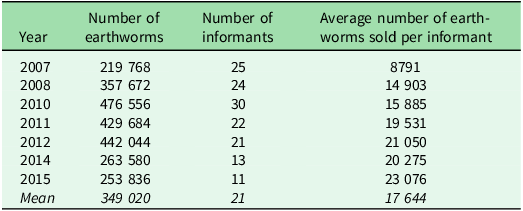
Extractors accounted for the largest segment of the production chain, employing c. 2800 people by 2007. Among the 252 interviewed extractors, 42% depended exclusively on earthworm harvesting, while others combined it with informal activities in agriculture, livestock or forestry. Among women, 25.4% also worked as seamstresses, cleaners, hairdressers or in charcoal factories and eucalyptus plantations. Interviews with 150 fishers in 2006 confirmed the widespread use of earthworms as bait; 82.7% recognized the socio-economic importance of the earthworms. Sales peaked at nearly 480 000 earthworms in 2010 (Table 1); the lower value in 2007 reflects initial trust-building with traders rather than reduced extraction. In the Quilombola Community of Pontinha, earthworm harvesting remained a key source of income: in 2021, 36.8% of 231 residents identified as full-time extractors of R. alatus outside its reproductive period (36.5% of women and 38.5% of men). Monitoring ended in 2015, when IBAMA initiated the process for official recognition of the management practice.
Number of giant earthworms (Rhinodrilus alatus) sold between 2007 and 2015 based on data reported by traders in the municipalities of Paraopeba, Caetanópolis and Curvelo, Minas Gerais state, Brazil.

Table 1. Long description
The table presents data on the number of giant earthworms sold, the number of informants, and the average number of earthworms sold per informant from 2007 to 2015. The table has three columns: Year, Number of earthworms, Number of informants, and Average number of earthworms sold per informant. It has nine rows, including the header row and a mean row. Row 1: Year, 2007; Number of earthworms, 219768; Number of informants, 25; Average number of earthworms sold per informant, 8791. Row 2: Year, 2008; Number of earthworms, 357672; Number of informants, 24; Average number of earthworms sold per informant, 14903. Row 3: Year, 2010; Number of earthworms, 476556; Number of informants, 30; Average number of earthworms sold per informant, 15885. Row 4: Year, 2011; Number of earthworms, 429684; Number of informants, 22; Average number of earthworms sold per informant, 19531. Row 5: Year, 2012; Number of earthworms, 442044; Number of informants, 21; Average number of earthworms sold per informant, 21050. Row 6: Year, 2014; Number of earthworms, 263580; Number of informants, 13; Average number of earthworms sold per informant, 20275. Row 7: Year, 2015; Number of earthworms, 253836; Number of informants, 11; Average number of earthworms sold per informant, 23076. Row 8: Year, Mean; Number of earthworms, 349020; Number of informants, 21; Average number of earthworms sold per informant, 17644.
In 2020, 27 of the 42 Shopping da Minhoca commercial establishments sold giant earthworms; this is probably an underestimate, as all interviewed traders reported a decline in sales after fishing was reduced following the collapse of the Córrego do Feijão tailings dam. Larger traders in the municipalities of Paraopeba and Caetanópolis were less affected, as they sold large volumes to other states.
Interviewees identified multiple threats to R. alatus: agricultural chemicals, including pesticides, fertilizers, pH correctors and insecticides used for zoonosis control, were considered particularly harmful. One reported episode involved the loss of more than 20 000 stored earthworms after insecticide application for dengue control. Agricultural machinery can also damage adults, juveniles and eggs during rainy season soil preparation, when earthworms are near the surface. During the dry season, increased forest fires coincide with estivation, and extractors reported higher mortality from ash contact during extraction or emergence. They also identified prolonged drought, higher temperatures and lower humidity as major threats, reporting high mortality in estivation chambers during dry years.
Stakeholder collaboration and adaptive responses to socio-ecological conflicts
Based on the socioecological diagnosis, the management plan proposed strategies for trade monitoring, information dissemination and alternative livelihoods during the species’ closed season. Submitted to IBAMA and the State Forestry Institute in 2011, the plan faced prolonged bureaucratic delays, as both institutions disputed regarding whose responsibility it should be for its implementation. Although discussions resumed in 2020 and resulted in a draft Normative Instruction based on community agreements, the proposal has remained under review at IBAMA since 2021. Despite the absence of formal regulation, extractivists and traders continued observing the reproductive closed season. This locally embedded governance was further recognized in 2024, when Shopping da Minhoca was officially acknowledged as a traditional extractive community by the State Commission for the Sustainable Development of Traditional Peoples and Communities.
To expand public awareness of regulated sustainable use and document the participatory process, knowledge dissemination and environmental education activities, the project included documentary films, booklets and media outreach (Appendix S1 Table S2).
Livelihood diversification through Caryocar brasiliense and its contribution to conservation pathways
In 2019 and 2020, a modular agro-industrial facility for the processing of pequi and other Cerrado fruits was established at a public school in the Quilombola Community of Pontinha. After COVID-19-related sanitary upgrades in 2021, sustainable sanitation and renewable energy systems were installed in 2022–2023, including evapotranspiration and flood-septic tanks, photovoltaic panels, solar heating and rainwater harvesting to reduce costs and improve sustainability. The production group, composed predominantly of women, was formally established as the Associação Produtiva Pontinha de Sabor in 2025, and it operates through an internal governance structure. The association oversees decisions on production routines, investments, priorities and commercialization, strengthening local leadership and supporting the long-term viability of the enterprise. The experience has also inspired other communities that have visited the facility to develop similar production systems in their own territories.
New markets helped redefine roles within the group and revealed individual skills. During the COVID-19 pandemic, oil production shifted to individual households to meet demand from the cosmetics industry. Artisanal oil extraction is labour-intensive: producing 1 L of oil requires c. 400 pyrenes, and output is limited to 2 L per person per day. In 2022, the group concluded that cosmetic oil yielded low returns (USD 16.4/L), and that large-scale production (e.g., 300 L) was incompatible with the project’s goals. Consequently, in 2023, the group shifted to higher-value food products, such as preserved pulp and candied nuts, generating c. USD 164 from the same 400 pyrenes.
In giant earthworm extraction, a collector averages 48 earthworms/day, worth USD 57.4/day, while pequi processing can match or exceed this income during the worm’s closed season.
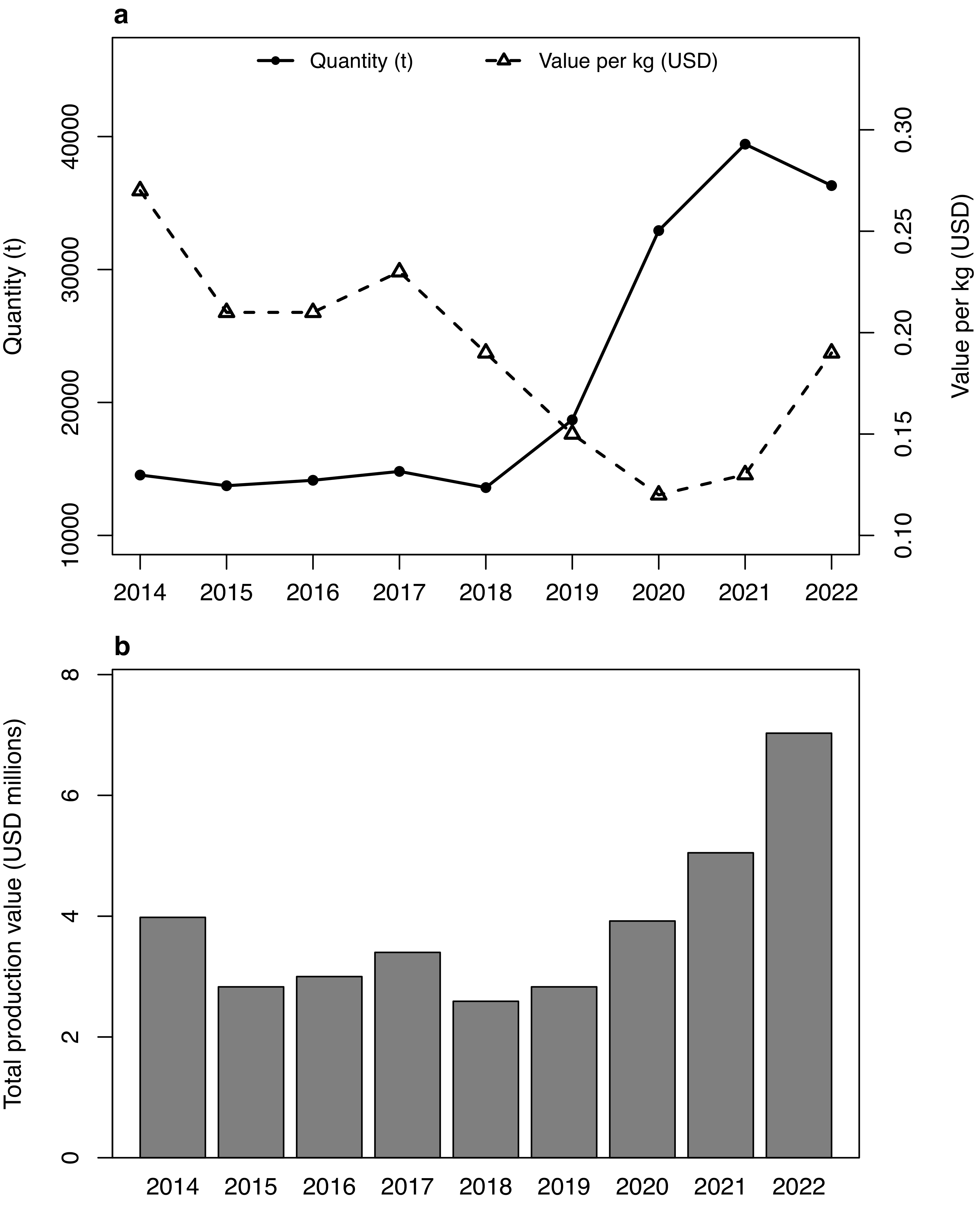
Pequi pyrene prices declined from USD 0.27/kg in 2014 to USD 0.12/kg in 2020 (Fig. 2), before recovering to USD 0.19/kg in 2021. Sales remained stable between 2014 and 2018 (mean 14 170 t, standard deviation (SD) = 517 t) but increased sharply thereafter, reaching 35 000 t in 2021. Production value showed a similar pattern, remaining stable between 2015 and 2019 (mean USD 2.93 million, SD = USD 0.30 million) before increasing to USD 7.03 million in 2022. These trends suggest an expanding regional market, creating opportunities for community-based production in the Quilombola Community of Pontinha.
Annual production of pequi pyrenes sold in the state of Minas Gerais, Brazil, from 2014 to 2022, according to the Plant Extraction and Forestry Production reports of the Instituto Brasileiro de Geografia e Estatística (2022). (a) Quantity sold in tonnes and value per kilogram (USD). (b) Total production value (USD million).

Figure 2. Long description
Two graphs depict the annual production of pequi pyrenes sold in Minas Gerais, Brazil, from 2014 to 2022. Panel A: A line graph shows the quantity sold in tonnes and the value per kilogram in USD. The quantity sold is represented by a solid line with circular markers, while the value per kilogram is represented by a dashed line with triangular markers. The x-axis represents the years from 2014 to 2022, the left y-axis represents the quantity in tonnes, and the right y-axis represents the value per kilogram in USD. Panel B: A bar graph shows the total production value in USD millions. The x-axis represents the years from 2014 to 2022, and the y-axis represents the total production value in USD millions.
Discussion
This study shows that conservation-orientated management can persist under prolonged institutional uncertainty. Despite the lack of formal regulation for over a decade, extractivists and traders maintained voluntary harvest suspension and fire restrictions for R. alatus. This suggests that socially legitimized agreements grounded in ecological knowledge and livelihood realities can sustain conservation outcomes without immediate state enforcement. Similar outcomes have been reported in community-based management initiatives involving fisheries, wetlands and non-timber forest products, where long-term collaboration fostered adaptive governance despite institutional uncertainty (Armitage et al. Reference Armitage, Berkes and Doubleday2007, Cockburn et al. Reference Cockburn, Cundill, Shackleton and Rouget2018, Folke et al. Reference Folke, Polasky, Rockström, Galaz, Westley and Lamont2021).
Although adaptive management is commonly defined as an iterative learning process under uncertainty (Holling Reference Holling1978, Williams Reference Williams2011), its implementation often depends on institutional stability and regulatory clarity. This case shows that adaptive processes can instead emerge from participatory engagement and long-term trust-building (Appendix S1 Table S3). Through repeated cycles of socio-ecological diagnosis, negotiation and monitoring, local actors incorporated ecological evidence into their extraction practices, reflecting the dynamic, co-evolving nature of social–ecological systems (Berkes & Folke Reference Berkes, Folke, Berkes, Folke and Colding2000, Levin et al. Reference Levin, Xepapadeas, Crépin, Norberg, de Zeeuw and Folke2013).
This experience contributes to discussions on adaptive governance by highlighting multi-actor collaboration and cross-scale linkages (Olsson et al. Reference Olsson, Folke and Hahn2004, Folke et al. Reference Folke, Hahn, Olsson and Norberg2005). Jurisdictional ambiguity among environmental agencies delayed formal recognition of the management plan but did not disrupt community compliance with agreed-upon rules. Governance thus operated through negotiated arrangements embedded in local practice rather than centralized command-and-control regulation.
From a governance perspective, this case reflects key principles of common-pool resource management (Ostrom Reference Ostrom2009), including clearly defined seasonal boundaries, collectively negotiated rules, user-based monitoring and socially reinforced compliance. Notably, these arrangements emerged before formal state recognition, suggesting that effective conservation governance can originate within resource-user communities and later be strengthened by public institutions. This highlights the importance of supporting locally developed management systems rather than imposing regulations disconnected from the social context.
Here, ecological evidence helped recalibrate conservation policy. The initial classification of R. alatus as Endangered was based on limited data, but subsequent field surveys revealed a broader distribution and higher abundance, supporting its reclassification and the regulation of sustainable use. This case illustrates how integrating ecological research with local knowledge can reduce regulatory uncertainty and avoid conservation strategies that inadvertently promote conflict or illegality. At the same time, local perceptions identified land-use practices, fire and climatic stressors as significant threats to R. alatus, with potential consequences for mortality and population persistence. These findings highlight the need to integrate habitat protection and fire management into conservation strategies.
Diversification into C. brasiliense processing highlights the link between conservation and livelihood security. The seasonal closure of earthworm harvesting created income gaps that could have undermined compliance. By developing an activity aligned with ecological cycles, the community experienced reduced vulnerability to regulatory restrictions and external shocks, including the Córrego do Feijão tailings dam collapse and the COVID-19 pandemic, which exemplifies how these crises disrupt extractive chains. This suggests that conservation in extractive landscapes is more likely to persist when supported by viable economic alternatives.
Over two decades, sustained engagement built trust, strengthened local organization and enabled adaptive responses to ecological and market changes. In socio-biodiverse landscapes such as the Brazilian Cerrado, conservation outcomes may depend less on prescriptive regulation and more on long-term collaboration and adaptive learning among resource users and institutions.
These findings highlight the importance of recognizing and supporting community-based governance systems. In socio-biodiverse landscapes such as the Brazilian Cerrado, long-term collaboration, ecological knowledge and livelihood diversification can provide durable pathways for reconciling biodiversity conservation with rural livelihoods.
Supplementary material
To view supplementary material for this article, please visit https://doi.org/10.1017/S0376892926100551.
Acknowledgements
We thank the Quilombola Community of Pontinha and Shopping da Minhoca, the Socioecological Systems Laboratory, the Postgraduate Program in Ecology, Conservation, and Wildlife Management at UFMG, the Sustentar Institute and FAPEMIG.
Financial support
This work was supported by Fundação de Amparo à Pesquisa de Minas Gerais (FAPEMIG, APQ-03647-22), Conselho Nacional de Desenvolvimento Científico e Tecnológico (CNPq), Coordenação de Aperfeiçoamento de Pessoal de Nível Superior (Capes) and Instituto Chico Mendes de Conservação da Biodiversidade (ICMBio).
Competing interests
The authors declare none.
Ethical standards
Approved by the UFMG Ethics Committee (protocols 0388812.2.000.5149, 03329412.1.0000.5149, 29328819.8.0000.5149), with free, prior and informed consent, in compliance with Brazilian legislation on traditional communities.