Implications
This study contributes to the understanding of the valine (Val) requirement in piglets in relation to the supply of the other branched-chain amino acids. Providing a Val-deficient diet to piglets has an important effect on feed intake, thereby affecting growth. Val deficiency affects feed intake more than it affects feed efficiency. An excessive supply of leucine aggravates the effect of Val deficiency, although it does not seem to affect the Val requirement per se.
Introduction
The use of crystalline amino acids in animal nutrition allows reducing the CP content in the diet. This leads to an improvement of dietary amino acids profile relative to the requirement of the animal and thereby results in a reduction in the nitrogen (N) excretion. The response of pigs to diets with crystalline amino acids such as l-lysine (l-Lys), l-threonine (l-Thr), l-tryptophan (l-Trp) and dl-methionine (dl-Met) has been largely studied. When low-protein diets are formulated to contain crystalline amino acids, it is likely that several amino acids are co-limiting for performance. It is generally assumed that Val is the fifth-limiting amino acids in corn–soyabean meal-based diets in growing pigs (Figueroa et al., Reference Figueroa, Lewis, Miller, Fischer and Diedrichsen2003). Barea et al. (Reference Barea, Brossard, Le Floc'h, Primot, Melchior and van Milgen2009b) estimated the Val requirement expressed on a standardized ileal digestible (SID) basis and relative to Lys to be at least 70% using performance as a response criterion. Compared with information on Lys, Thr, Trp, Met and methionine + cysteine (Met + Cys), information on Val, and to a lesser extent for Ile, is scarce.
This study is part of a series of experiments to determine the Val and Ile requirements in post-weaned piglets (10 to 20 kg BW). Val, Ile and Leu are branched-chain amino acids (BCAA). When supplied in excess to requirements, BCAA are degraded. The first two steps of BCAA catabolism involve enzymes common for the three BCAA (Harper et al., Reference Harper, Miller and Block1984). The first step is reversible and is catalysed by branched-chain aminotransferase (BCAT), whereas the second step is an irreversible oxidative decarboxylation involving a multienzyme complex (a decarboxylase, a transacylase and a dehydrogenase). The regulation of this complex determines BCAA homeostasis and is assumed to be the rate-limiting step of BCAA catabolism (Matthews et al., Reference Matthews, Bier, Rennie, Edwards, Halliday, Millward and Clugston1981). An increased supply of Leu is known to stimulate the activity of the enzyme complex and may therefore increase the catabolism of Val and Ile (Wiltafsky et al., Reference Wiltafsky, Pfaffl and Roth2010) and thus their requirements. This may explain why the addition of Val and Ile can overcome the growth-depressing effects of excessive Leu (Spolter and Harper, Reference Spolter and Harper1961). The purpose of this study is to further evaluate the Val requirement in piglets and its relation to the supply of the other BCAA.
Material and methods
Experimental procedures and animal care were carried out according to current French legislation, and authorization to experiment on living animals was provided by the French Ministry of Agriculture (certificate numbers 35-64, 7704 and 7719 for Ludovic Brossard, Jaap van Milgen and Nathalie Le Floc'h, respectively).
General
Totally, four experiments were performed. For all experiments, 6-week-old Pietrain × (Large White × Landrace) barrows and female piglets from the experimental herd of Institut National de la Recherche Agronomique (INRA; St-Gilles, France) were used. These piglets were weaned at approximately 4 weeks of age and during the first week after weaning they were housed in groups of two. At 5 weeks of age, blocks of piglets were formed on the basis of BW, sex and genetic origin (siblings or half-siblings), and from then on, piglets were housed individually. Piglets within a block were allotted to different treatments. Feed was offered ad libitum, except for the N balance experiment (Experiment 1). In all experiments, animals had free access to water from low-pressure nipple drinkers. During the first 10 days post-weaning, a commercial starter diet was offered, which was gradually (i.e. in 3 days) replaced by the experimental diets so that from 12 days post-weaning onwards, piglets were only offered the experimental diets. Piglets were weighed after an overnight fast at the beginning and at the end of the experimental period to determine the average daily gain (ADG). Feed refusals were collected weekly. Samples of the feed were taken weekly to determine the dry matter (DM) content and these samples were pooled at the end of the experimental period for further analysis. Ambient temperature was maintained at 28°C the first week after weaning and was decreased by 1°C per week thereafter.
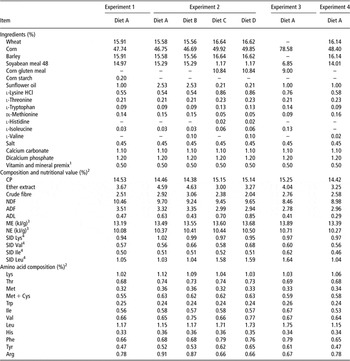
All diets were based on a mixture of cereals and soyabean meal with an SID Lys content of 1.0% (Table 1). This level of Lys was shown to be limiting for performance in piglets (Barea et al., Reference Barea, Brossard, Le Floc'h, Primot, Melchior and van Milgen2009b). Supply of other essential amino acids met or exceeded requirements of 10 to 20 kg piglets (NRC, 1998). Experiments 1, 3 and 4 were Val dose–response studies in which at least five different levels of Val were created by adding l-Val to a basal diet. Experiment 2 was a 2 × 2 factorial design using two protein sources (soyabean meal and corn gluten meal) with or without addition of l-Val. Nitrogen retention between 6 and 8 weeks of age was used as the response criterion in Experiment 1, whereas average daily feed intake (ADFI), ADG and gain-to-feed ratio (G : F) between 6 and 9 weeks of age were used as response criteria in the other experiments.
Composition of experimental diets (as-fed basis)

Lys = lysine; Thr = threonine; Trp = tryptophan; Met = methionine; His = histidine; Ile = isoleucine; Val = valine; Leu = leucine; Cys = cysteine; Phe = phenylalanine; Tyr = tyrosine; Arg = arginine; ME = metabolisable energy; NE = net energy; SID = standardized ileal digestible; DM = dry matter.
1Supplied per kilogram (as-fed basis) of diet: vitamin A, 10 000 IU; vitamin D3, 2000 IU; vitamin E, 20 mg; vitamin K3 (menadione), 2 mg; vitamin B1 thiamin, 2 mg; vitamin B2 riboflavin, 5 mg; vitamin B3 niacin, 20 mg; vitamin B5 pantothenic acid, 10 mg; vitamin B6 pyridoxine, 5 mg; vitamin B8 biotin, 0.2 mg; vitamin B9 folic acid, 1 mg; vitamin B12 cyanocobalamin, 0.03 mg; chloride de choline, 600 mg; vitamin C ascorbic acid, 40 mg; Fe, 100 mg; Cu, 20 mg; Zn, 100 mg; Mn, 40 mg; I, 0.6 mg; Se, 0.3 mg; and Co, 1 mg.
2Values analysed and adjusted for 87.3% DM.
3Values for ME and NE were calculated according to Noblet et al. (Reference Noblet, Fortune, Shi and Dubois1994).
4Standardized ileal digestible Lys, Val, Ile and Leu, calculated from the analysed amino acids and the digestibility of feed ingredients (Sauvant et al., Reference Sauvant, Perez and Tran2004).
Experiment 1
Experiment 1 was performed to determine the effect of Val supply on N retention in piglets at constant feed intake. Twenty-four barrows were allotted to one of six diets with SID Val : Lys contents of 60%, 64%, 68%, 72%, 76% and 80%. From 1 week post-weaning onwards, the commercial starter diet was gradually replaced by the diet containing 80% SID Val : Lys to ensure sufficient Val supply. Three days before the start of the experiment, piglets received their respective experimental diets and a feed restriction was applied corresponding to approximately 3.5% of BW. During the experiment, feed allowance was adjusted by taking into account the anticipated increase in BW. The experiment lasted 2 weeks during which urine and faeces were collected daily. Faeces were pooled by week, weighed and subsamples were freeze-dried for analysis. Urine was collected in a 10% H2SO4 solution (∼10 ml/l urine), pooled by week, weighed and a sample was taken for further chemical analyses. Piglets were weighed weekly after an overnight fast.
Experiment 2
The second experiment was designed to determine whether the response to Val supply was influenced by a large supply of Leu (by replacing soyabean meal by corn gluten meal). In a 2 × 2 factorial design, variation in the supply of Leu was combined with a low or sufficient supply of Val. Sixty-four piglets were allotted to one of the four treatment groups and received diets based on a cereal mixture with either soyabean meal (diets A and B) or corn gluten meal (diets C and D) as main protein source, supplemented or not with l-Val. Diets mainly differed in SID Val : Lys (60% or 70%) and Leu : Lys (111% or 165%), depending on the protein source.
Experiment 3
The response to Val in combination with a large supply of Leu was studied in a dose–response study. Seventy-five piglets were allotted to one of five diets containing 60%, 65%, 70%, 75% and 80% SID Val : Lys. Excess Leu was obtained by using corn gluten meal as the main protein source in combination with corn as the only cereal. Two batches of feed were manufactured with 60% or 80% SID Val : Lys and the other diets were manufactured by mixing the appropriate quantities of these two diets.
Experiment 4
If the Ile requirement would be considerably lower than current recommendations, a Val dose–response study with 50% SID Ile : Lys would provide a similar Val requirement estimate compared with that obtained in studies using higher levels of Ile. The objective of Experiment 4 was therefore to test the response to Val supply in combination with low Ile supply. Seventy-five piglets were allotted to one of five diets containing 60%, 65%, 70%, 75% and 80% SID Val : Lys and all diets provided 50% SID Ile : Lys.
Chemical analysis
Diets and faeces were analysed for DM, ash, N, ether extract, fibre fractions and gross energy, whereas urine was analysed for N. DM and ash contents were analysed following procedures from the International Organization for Standardization (www.iso.org; ISO 6496-1999 and ISO 5984-2002, respectively). Ether extract was determined according to the method V18-117, 1997 of the French Association Francaise de Normalisation (AFNOR) group (www.afnor.org/en), and the gross energy content was measured with an adiabatic bomb calorimeter (ISO 9831-1998; IKA C2000 and IKA C5000, Staufen, Germany). Nitrogen content was analysed according to the Dumas procedure (method V18-120, 1997 of the AFNOR group) using a Rapid N cube (Elementar France, Villeurbanne, France). The NDF and ADF fractions were determined using a Ankom 2000 Fiber Analyzer (Ankom Technology, Macedon, NY, USA), whereas the ADL content was determined according to the method of Van Soest and Wine (Reference Van Soest and Wine1967). Dietary amino acid content was analysed by the AJINOMOTO EUROLYSINE S.A.S. laboratory in Amiens, France, by a JLC-500/V AminoTac Amino Acid Analyzer (Jeol, Croissy-sur-Seine, France) using the AFNOR method (standard NF EN ISO 13903). Methionine and cysteine were hydrolysed after oxidation with performic acid. Amino acids were separated by ion exchange chromatography and determined by photometric detection after derivatization by ninhydrin. Total Trp was analysed by HPLC after an alkaline hydrolysis with barium hydroxide using the AFNOR method (XP V18-114, 1998).
Data analysis
Data were analysed using the PROC MIXED procedure (SAS Institute Inc., Cary, NC, USA) with diet as a fixed effect and block as a random effect and results are reported as least-square means. In Experiment 2, the Val and Leu content and their interaction were used as main effects. In Experiment 3, response to Val supply was also analysed by regression analysis using linear-plateau (LP) and curvilinear-plateau models (CLP) using the PROC NLIN procedure of SAS (Robbins et al., Reference Robbins, Saxton and Southern2006). Both models were parameterized to include a plateau for each block, the minimum SID Val : Lys required to attain the plateau (i.e. the requirement) and the response at 60% SID Val : Lys relative to the plateau value (Barea et al., Reference Barea, Brossard, Le Floc'h, Primot, Melchior and van Milgen2009b). The latter two parameters were assumed to be common for all blocks. With this analysis, scale differences between different blocks of animals can be accounted for (e.g. due to differences in initial BW or genetic potential) while ensuring a general response to Val supply within a block.
To test whether the parameters of the CLP model (i.e. the SID Val : Lys requirement and the response at 60% SID Val : Lys relative to the plateau) varied between Experiment 3 and those obtained by Barea et al. (Reference Barea, Brossard, Le Floc'h, Primot, Melchior and van Milgen2009b), a sum of squares reduction test was used (Ratkowsky et al., Reference Ratkowsky, Lowry, McMeekin, Stokes and Chandler1983). This test compares a ‘full model’ where all parameters are different for both experiments with a ‘reduced model’, which has common parameters for the requirement, for the response at 60% SID Val : Lys relative to the plateau or for both. An F-test was used to test whether the models were statistically different (Ratkowsky et al., Reference Ratkowsky, Lowry, McMeekin, Stokes and Chandler1983).
Results
In general, piglets appeared to be healthy. Some cases of diarrhoea occurred and piglets then received colistin orally (CEVA Santé Animal, Libourne, France). In Experiments 1, 2 and 3, one piglet fed diet B had no or very low feed intake for several days and results of these animals are not included in data analysis. The analysed and calculated composition of the experimental diets is given in Table 1.
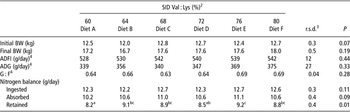
In Experiment 1, there were no differences in ADFI, ADG and G : F between treatments (P > 0.20; Table 2). Nitrogen retention in piglets offered the diet containing 60% SID Val : Lys was lower compared with those receiving the diets containing 64%, 68%, 76% and 80% SID Val : Lys (P = 0.01).
Effect of the SID Val content of the diet on performance and nitrogen balance in piglets (Experiment 1)Footnote 1

SID = standardized ileal digestible; ADFI = average daily feed intake; ADG = average daily gain; G : F = gain-to-feed ratio; Val = valine; Lys = lysine; DM = dry matter.
1 Data are presented as least-squares means. Diet n = 6; block n = 4. Values with a different superscript letter are different by pairwise comparison, P < 0.05.
2 Anticipated SID values. The analysed SID Val : Lys from the Lys and Val contents measured and the estimated SID values from feed ingredients (Sauvant et al., Reference Sauvant, Perez and Tran2004) were 61%, 66%, 68%, 71%, 73% and 79% for diets A, B, C, D, E and F, respectively.
3 n = 23.
4 ADFI; ADG; G : F; adjusted for 87.3% DM.
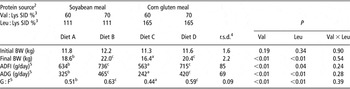
In Experiment 2, diets B and D were formulated to provide an adequate Val supply (70% SID Val : Lys). The ADFI, ADG and G : F were lower (P < 0.01) in piglets receiving diets with 60% SID Val : Lys compared with those receiving 70% SID Val : Lys (Table 3). On average, a large supply of Leu resulted in a reduction in ADFI, ADG and G : F (P < 0.05). There was no significant interaction between Val and Leu, and performance was lowest when a low supply of Val was combined with a large supply of Leu (Table 3). The ADFI, ADG and G : F were respectively 11%, 26% and 14% lower in piglets receiving diet C compared with those receiving diet A. When the diet provided 70% SID Val : Lys, ADG was 10% lower in piglets receiving a large supply of Leu compared with those receiving a moderate supply of Leu.
Effect of the SID Val and Leu content of the diet on performance in piglets (Experiment 2)Footnote 1

SID = standardized ileal digestible; Val = valine; Leu = leucine; Lys = lysine; ADFI = average daily feed intake; ADG = average daily gain; G : F = gain-to-feed ratio; DM = dry matter.
1 Data are presented as least-squares means, values with a different superscript letter are different by pairwise comparison, P < 0.05.
2 Main protein source causing the difference in Leu contents (see Table 1 for details).
3 Anticipated SID values. The analysed SID Val : Lys from the Lys and Val contents measured and the estimated SID values from feed ingredients (Sauvant et al., Reference Sauvant, Perez and Tran2004) were 55%, 67%, 60% and 71% for diets A, B, C and D, respectively.
4 n = 63.
5 ADFI; ADG; G : F; adjusted for 87.3% DM.
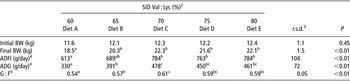
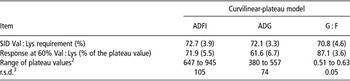
In Experiment 3, the SID Val : Lys values (on the basis of measured Val and Lys contents) were slightly lower than anticipated, but progressed in a linear way between diets A and E (Table 4). From 60% SID Val : Lys to 70% SID Val : Lys (anticipated values), ADG increased by 45%, ADFI by 28% and G : F by 13%. Although the analysis of variance indicated a clear response to the increasing Val supply, the LP model failed to converge and it was not possible to estimate the Val : Lys requirement with this model. This problem did not occur with the CLP model, and SID Val : Lys requirement estimates to reach the plateau were 72.7%, 72.1% and 70.8% for the ADFI, ADG and G : F, respectively (Table 5). Plateau values (i.e. for each block) ranged from 647 to 945 g/day for ADFI, from 380 to 557 g/day for ADG and from 0.51 to 0.63 for G : F.
Effect of the SID Val content of the diet in combination with a large supply of Leu on performance in piglets (Experiment 3)Footnote 1

SID = standardized ileal digestible; Val = valine; Leu = leucine; Lys = lysine; ADFI = average daily feed intake; ADG = average daily gain; G : F = gain-to-feed ratio; DM = dry matter.
1 Data are presented as least-square means, values with a different superscript letter are different by pairwise comparison, P < 0.05.
2 Anticipated SID Val : Lys values. The analysed SID Val : Lys from the Lys and Val contents measured and the estimated SID values from feed ingredients (Sauvant et al., Reference Sauvant, Perez and Tran2004) were 62%, 66%, 70%, 76% and 79% for diets A, B, C, D and E, respectively. All diets contained 169% SID Leu : Lys.
3 n = 74 for intake and performance.
4 ADFI; ADG; G : F; adjusted for 87.3% DM.
Parameter estimates of the response of piglets to an increasing SID Val : Lys supply as analysed by the curvilinear-plateau model (Experiment 3; parameter estimates obtained with asymptotic SE given in parentheses)Footnote 1

SID = standardized ileal digestible; Val = valine; Lys = lysine; SE = surface energy; ADFI = average daily feed intake; ADG = average daily gain; G : F = gain-to-feed ratio.
1 The model was parameterized to include the SID Val : Lys requirement, the response at 60% SID Val : Lys relative to the plateau and a plateau value for each block (i.e. the model included 1 + 1 + 15 = 17 parameters). The SID Val : Lys contents estimated from analysed Lys and Val contents were used in the model.
2 ADFI and ADG are in g/day and G : F is in g/g.
3 n = 74.
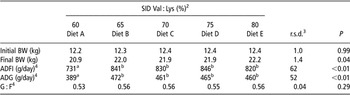
In Experiment 4, the SID Ile : Lys ratio based on analysed amino acid values was slightly lower than anticipated (48% v. 50%), due to Ile content that was lower than expected. The ADFI and ADG of piglets that were offered the diet providing 60% SID Val : Lys were significantly lower than those of piglets offered the other diets (P < 0.05; Table 6). There was no improvement in performance above 65% SID Val : Lys and the maximum values for ADG and ADFI were close to 470 and 830 g/day, respectively. The G : F was not affected by the Val content of the diet (P = 0.29) and averaged 0.55. Because performance was lower with only one diet, the response to Val supplementation could not be analysed by regression analysis.
Effect of the dietary SID Val content in the diet in combination with a low supply of Ile on performance in piglets (Experiment 4)Footnote 1

SID = standardized ileal digestible; Val = valine; Ile = isoleucine; Lys = lysine; ADFI = average daily feed intake; ADG = average daily gain; G : F = gain-to-feed ratio; DM = dry matter.
1 Data are presented as least-square means, values with a different superscript letter are different by pairwise comparison, P < 0.05.
2 Anticipated SID Val : Lys values. The analysed SID Val : Lys from the Lys and Val contents measured and the estimated SID values from feed ingredients (Sauvant et al., Reference Sauvant, Perez and Tran2004) were 57%, 64%, 67%, 74% and 78% and the SID Ile : Lys was 48% for diets A, B, C, D and E, respectively.
3 n = 75.
4 ADFI; ADG; G : F; adjusted for 87.3% DM.
Discussion
Previous findings from our laboratory indicated that the Val requirement is at least 70% SID Val : Lys in piglets using ADFI, ADG and G : F as response criteria (Barea et al., Reference Barea, Brossard, Le Floc'h, Primot, Melchior and van Milgen2009b). The reduction in ADG seems to be mainly due to the reduction in ADFI. By limiting feed allowance, it is possible to estimate the direct effect of Val deficiency on growth, independent of that caused by the reduction in feed intake. A direct effect of Val deficiency on ADG is likely mediated by a reduction in protein retention, and the N balance technique is more appropriate than a growth trial to estimate protein retention. Results of Experiment 1 indicated that Val supply above 64% SID Val : Lys did not improve N retention. A similar estimate (65%) was observed in 8 to 25 kg piglets by Wiltafsky et al. (Reference Wiltafsky, Schmidtlein and Roth2009b). The Val requirement as estimated in the present N balance study and with restricted feeding is considerably lower than those obtained in our growth trials. It appears that the first response of the animal to deficient Val supply is to reduce its feed intake, resulting in a reduction in growth rate. The reason why and how feed intake is affected by a deficient amino acid supply is not fully elucidated.
At a constant feed intake, a deficient amino acid supply often results in a reduction in N retention (Dourmad and Etienne, Reference Dourmad and Etienne2002). In the factorial approach of amino acid utilization, protein and amino acid retention are the result of the maintenance amino acid requirement, the efficiency with which the supply of absorbed amino acids (above maintenance) can be retained, and the amino acid composition of retained protein. The amino acid composition of retained protein is often considered to be constant; although there are indications that this is not always the case (e.g. Conde-Aguilera et al., Reference Conde-Aguilera, Barea, Le Floc'h, Lefaucheur and van Milgen2010), the Val supply does not seem to affect the amino acid composition of retained body protein (Barea et al., Reference Barea, Brossard, Le Floc'h, Primot, Melchior and van Milgen2009b). Estimates of the efficiency with which a limiting amino acid can be retained are variable between studies and between amino acids. For Lys, assumed marginal efficiency values range from 55% (Susenbeth, Reference Susenbeth1995; NRC, 1998) to 85% (de Lange, Reference de Lange1995). The lack of a clear linear response in our study makes it difficult to estimate the maintenance requirement and the marginal efficiency for Val. However, piglets receiving diet A consumed on average 3.49 g SID Val/day and retained 2.35 g Val/day, resulting in a gross efficiency of Val utilization of ∼76%. This value, which does not include a maintenance requirement, is in the high-end range of reported efficiency values, which may be due to an overestimation of protein and Val retention by the N balance technique. It is also possible that the marginal efficiency of Val is greater than that of Lys.
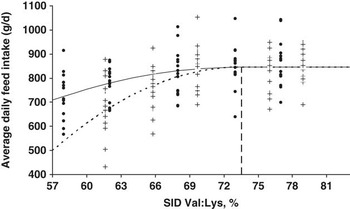
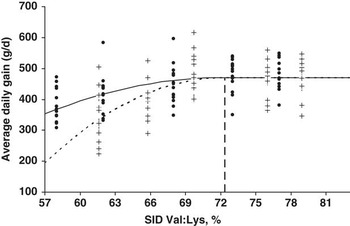
A possible factor that influences the response to Val supplementation is the antagonism with Leu. An excessive Leu supply can exert growth-depressing effects in low-protein diets (Aftring et al., Reference Aftring, Block and Buse1986). This effect is generally observed when Val or Ile are supplied below the requirement and the addition of Val and Ile suppresses the growth-depressing effect (Spolter and Harper, Reference Spolter and Harper1961). It was for this reason that we investigated the response of piglets to increasing Val content in the diet in combination with a high supply of Leu. As expected, excess supply of Leu strongly reduced performance when provided in combination with a Val-deficient diet. In Experiment 3, when 60% SID Val : Lys was provided, the estimated ADFI, ADG and G : F were, respectively, 22%, 31% and 11% lower than the plateau value. The Val requirement estimated in this study averaged 72% SID Val : Lys for ADFI, ADG and G : F using a CLP model. These estimates were not different (P > 0.65) from those estimated by Barea et al. (Reference Barea, Brossard, Le Floc'h, Primot, Melchior and van Milgen2009b) using similar pigs in the same facilities. It was anticipated that excess supply of Leu increased the Val requirement through an increase in the catabolism of Val. Surprisingly, the estimated Val requirement did not seem to be affected by the supply of Leu. Nevertheless, the reduction in ADFI and ADG when 60% SID Val : Lys was supplied was more important (P < 0.01) in this study compared with Barea et al. (Reference Barea, Brossard, Le Floc'h, Primot, Melchior and van Milgen2009b). Figures 1 and 2 illustrate the response to Val supplementation in combination with a moderate (Barea et al., Reference Barea, Brossard, Le Floc'h, Primot, Melchior and van Milgen2009b) or large supply of Leu (Experiment 3 in this study). In Experiment 3, the excessive supply of Leu corresponded to ∼175% of the requirement, and this supply of Leu appeared to be insufficient to increase Val requirement. Our results also contrast with studies dealing with the Ile–Leu antagonism where the requirement for Ile appears to increase when Leu is supplied in excess (Dean et al., Reference Dean, Southern, Kerr and Bidner2005; Wiltafsky et al., Reference Wiltafsky, Bartelt, Relandeau and Roth2009a). These authors observed an important response to Ile supply when blood cells were used in the diet. Blood cells are rich in Leu and Val and using blood cells as a protein source may induce antagonism between BCAA, resulting in an increase in the Ile requirement. The reason why an excess supply of Leu seems to increase the Ile requirement, but not the Val requirement, remains unclear and also demonstrates the complexity of the BCAA antagonism.
Effect of increasing the standardized ileal digestible (SID) Val : Lys supply with (Experiment 3; + and - - - ) or without (Barea et al., Reference Barea, Brossard, Le Floc'h, Primot, Melchior and van Milgen2009b; • and – ) a large supply of Leu on average daily feed intake in piglets. Data and the response curves were adjusted for a common plateau value of 846 g/day. The estimated SID Val : Lys requirement did not differ between both studies and was estimated at 73.5%.

Effect of increasing the standardized ileal digestible (SID) Val : Lys supply with (Experiment 3; + and - - -) or without (Barea et al., Reference Barea, Brossard, Le Floc'h, Primot, Melchior and van Milgen2009b; • and – ) a large supply of Leu on average daily gain in piglets. Data and the response curves were adjusted for a common plateau value of 471 g/day. The estimated SID Val : Lys requirement did not differ between both studies and was estimated at 72.4%.

In a recent literature review, van Milgen et al. (Reference van Milgen, Gloaguen, Le Floc'h, Brossard, Primot and Corrent2010) showed that the response of pigs to Ile supplementation depended to a large extent on the usage or not of blood products in the diet. Although there are some reports of a growth response to Ile in diets without blood products (e.g. Wiltafsky et al., Reference Wiltafsky, Bartelt, Relandeau and Roth2009a), others failed to obtain such a response (e.g. Barea et al., Reference Barea, Brossard, Le Floc'h, Primot and van Milgen2009a). Consequently, the Ile requirement in diets without blood products is still unclear. The lack of response to Val supplementation beyond 65% SID Val : Lys in Experiment 4 may be due to the fact that not Lys, but another amino acid was second-limiting after Val. For example, if Ile would have been second-limiting, the plateau value of the response curve would be determined by the supply of Ile and not by Lys. The minimum Val supply to attain the plateau should then be expressed relative to Ile and expressing this value relative to Lys would underestimate the actual Val : Lys requirement. The SID Val : Ile ratio for diet B in Experiment 4 was 130%, whereas the SID Ile : Lys content was well below the current recommendation of the NRC (1998). If the NRC value of 55% SID Ile : Lys is assumed to be ‘true’, the SID Val : Lys requirement would be 0.55 × 130% = 72%. There is of course no direct proof that the NRC value is appropriate (especially for diets based on soyabean meal and cereals) or that the level of Ile we used (50% SID Ile : Lys) is actually below the requirement. However, it illustrates the complexity and delicacy of designing amino acid requirement studies, especially when the requirements are to be expressed relative to Lys.
As discussed before, Val deficiency reduces feed intake and Leu aggravates this effect. Injection of l-Leu, but not of l-Val, in the third ventricle of the brain activated the mammalian target of rapamycin and resulted in a decrease in feed intake (Cota et al., Reference Cota, Proulx, Smith, Kozma, Thomas, Woods and Seeley2006). These observations suggest that there is a specific mechanism that is sensitive to brain Leu concentration that regulates feed intake. Nevertheless, young pigs can tolerate high levels of Leu without a decrease in voluntary feed intake, and plasma Leu concentrations only increased by 1.5-fold when 4% supplemental Leu was added to a balance diet. This result contrasts with the response to the addition of Thr or Met, which resulted in increases in plasma concentrations of 14- and 135-fold, respectively (Edmonds and Baker, Reference Edmonds and Baker1987). Thus, compared with other amino acids, the catabolic capacity to degrade Leu may be high, allowing to maintain homeostasis even at high levels of intake. This may indicate that the high intake of Leu in the present study was insufficient to induce an anorectic response.
We hypothesize that low Val intake results in a metabolic situation that serves as a signal for the anorectic response and that Leu accentuates this signal. When Leu is supplied in excess, the concentration of Val in plasma is reduced (Langer et al., Reference Langer, Scislowski, Brown, Dewey and Fuller2000). This decrease in the most limiting amino acid in the plasma is also observed in the brain and is thought to be the metabolic signal responsible for the anorectic response (Peng et al., Reference Peng, Tews and Harper1972; Feurte et al., Reference Feurte, Nicolaidis, Even, Tome, Mahe and Fromentin1999). BCAA readily pass across the blood–brain barrier (Hargreaves and Pardridge, Reference Hargreaves and Pardridge1988) and could reach the anterior piriform cortex of the brain, which is thought to host a chemosensor of an amino acid imbalance (Leung and Rogers, Reference Leung and Rogers1971). Deficiency of an amino acid may increase its uncharged transfer RNA (tRNA) that is sensed in the piriform cortex (Hao et al., Reference Hao, Sharp, Ross-Inta, McDaniel, Anthony, Wek, Cavener, McGrath, Rudell, Koehnle and Gietzen2005). As shown in rats fed a Val-free diet, the intracerebroventricular administration of Val restored the cerebrospinal fluid concentration of Val and increased feed intake (Goto et al., Reference Goto, Nagao, Bannai, Takahashi, Nakahara, Kangawa and Murakami2010). The effect of Leu may also be explained by its role in protein synthesis and degradation. As discussed by Harper and Rogers (Reference Harper and Rogers1965), Leu stimulates hepatic protein synthesis and inhibits hepatic protein degradation. The stimulation of protein synthesis by Leu has also been observed in skeletal muscle in neonate pigs (Escobar et al., Reference Escobar, Frank, Suryawan, Nguyen, Kimball, Jefferson and Davis2005). Thus, the stimulating effect of Leu on protein synthesis may aggravate the imbalance of plasma amino acids.
Amino acids such as Met, histidine (His), Trp, Ile, phenylalanine (Phe), tyrosine (Tyr), Leu and Val are transported into the brain through a common transporter, the l-system transport (Hawkins et al., Reference Hawkins, O'Kane, Simpson and Vina2006). Theoretically, an excess of one of these amino acids can also lead to a depletion of amino acids pool in the brain due to the competition for the l-system transport. Moreover, the BCAA degradation in the liver is nearly absent due to a low BCAT activity. Thus, dietary Leu may escape first-pass catabolism in the liver ensuring a rapid flow to the brain. As shown by Peng et al. (Reference Peng, Gubin, Harper, Vavich and Kemmerer1973) in rats, ingestion of a diet high in Leu resulted in lower Val, Ile, Met, Phe, Tyr and His concentrations in the brain and in a decrease in the feed intake. It is therefore possible that the excess of Leu competed with Val for transport into the brain, aggravating the effect of Val deficiency in the brain. This also suggests that excess of Met, His, Trp, Ile, Phe, Tyr or Leu can potentially inhibit the Val uptake into the brain. All these mechanisms may be involved in the detection of Val deficiency and in the control of feed intake. The reason why feed intake is affected by an amino acid deficiency is not known but it could serve as a preventive mechanism and as an adaptive advantage to animals to avoid damage when a deficient diet is ingested (Gietzen, Reference Gietzen1993).
The current study showed that the Val requirement in 10 to 20 kg BW piglet does not seem to depend on the intake of Leu but that excess Leu in combination with low Val supply aggravates performance. The first response of the animal to Val deficiency is to reduce its feed intake, resulting in a subsequent reduction in growth. The effects of Val deficiency independent of that mediated through the reduction in feed intake (e.g. reduction in feed efficiency and nitrogen retention) appear to occur at lower levels of Val.
Acknowledgements
The authors wish to thank Y. Jaguelin, A. Pasquier, M. Eudaimon, C. Cornée, H. Demay, P. Touanel, B. Carrissant, F. Le Gouevec, R. Janvier, G. Guillemois and J. F. Rouaud for their skilful technical assistance and helpful collaboration.