1. Introduction
Transparency and monitoring have become increasingly important features of the global trading system. The WTO's system of notification requirements has progressively been complemented by a system of regular and systematic review of measures and policies adopted by its Members.Footnote 1 These reviews take place through the reports written by the Secretariat and WTO Members and through the regular work of WTO committees. WTO committees provide a forum where Members can exchange information about measures that affect trade and discuss the implementation and the interpretation of WTO rules.
Current discussions around WTO reforms have led to renewed attention over the role of WTO committees and bodies in enhancing transparency and monitoring as well as in resolving trade tensions non-litigiously. Information exchange taking place in the committees and discussions over concerns countries raise regarding each other's measures (laws, regulations, or practices) are in fact the first step to diffuse conflicts. Concerns can be resolved in committees’ discussions without ever being raised as formal disputes.
Our paper enhances understanding of the dual role of WTO Committees and bodies in strengthening transparency and monitoring. It shows how transparency and monitoring are different, and how they make separate contributions to dispute avoidance. To this purpose, we focus on specific trade concerns (STC) raised in the work of the TBT committee. The STC mechanism developed in the TBT committee has caught the attention of Members in the context of current discussions on WTO reform and is viewed by some as an example of good practice that could be used in other committees. Existing studies on the effectiveness of the STCs’ system have shown that STCs cover a wide range of issues (WTO, 2020), that the number of formal disputes are only a small share of the STCs, and that STCs are a small share of the comments raised through national enquiry points (WTO and OECD, 2019). The European Union (EU), for example, raised only about 20% of the comments on notifications it filed through national enquiry points of other members as STCs (Karttunen, Reference Karttunen2020).
Building on existing literature (Wolfe, Reference Wolfe2003; Wijkström et al., Reference Wijkström, Horn and Mavroidis2012; Wolfe, Reference Wolfe2013; OECD, 2017; Holzer, Reference Holzer2018; Karttunen, Reference Karttunen2020), we use a novel approach to analyze the content of 555 STCs raised in the TBT committee from March 1995 to March 2018 by distinguishing between STCs addressing transparency issues and those monitoring compliance with TBT agreements, as well as draft versus non-draft TBT measures.Footnote 2 We try to answer three questions. First, how does the STC mechanism relate to the other transparency and monitoring instruments of the TBT agreement, including the TBT requirement to notify measures at a draft stage (thereafter referred to as the ex-ante notification requirement)? Second, how and to what extent does the STC mechanism enhance transparency and monitoring? Third, how and to what extent does the STC mechanism contribute to solving trade issues without resorting to the dispute settlement mechanism?
This novel approach of STCs allows us to establish three important findings. First, we provide evidence that the STC mechanism in the TBT Committee enhances transparency by providing new and more in-depth information than that available only with notifications. Second, the system makes Members more accountable for their measures and, in turn, contributes to good regulatory practices by allowing officials to discuss issues related to the interpretation and implementation of the rules. Third, the transparency and monitoring functions of the STC mechanism facilitate the resolution of trade concerns non-litigiously. STCs raised at the draft stage of a new domestic regulation are less likely to escalate to a formal dispute than STCs raised on adopted measures, which shows the relevance of the TBT requirement for ex-ante notification.
The rest of the paper is organized as follows. The next section discusses the economic rationale for transparency and monitoring. Section 3 reviews the content of 555 STCs raised in the TBT Committee between 1995 and 2018. We look at four aspects of STCs (the topic discussed, the duration of the discussion, the type of document under discussion, and the outcome of the discussion) and assess the effectiveness of the discussions in the committee in terms of transparency, monitoring and their success in diffusing trade disputes. Section 4 concludes.
2. The Economic Rationale for Transparency and Monitoring
Let us first clarify some terminology. Transparency can be seen as an aspect of good regulatory practices. In particular, the WTO Glossary defines transparency as the ‘degree to which trade policies and practices, and the process by which they are established, are open and predictable’. This definition covers both regulatory transparency and procedural transparency. Regulatory transparency refers to the incorporation of transparency principles into national administrative law. It includes the availability of information on countries’ trade regulations (OECD, 2009; Collins-Williams and Wolfe, Reference Collins-Williams and Wolfe2010; Wolfe, Reference Wolfe2013). Transparency can also be considered as the absence of information asymmetry, as a situation where policy makers and economic agents have the same information (WTO, 2012). This definition covers operational transparency, i.e. the way domestic measures are implemented. Procedural transparency refers to the way policy decisions are taken, including the scope for public consultations and access to independent adjudication, as well as the publication and notification of measures and the establishment of enquiry points (WTO, 2012).
Monitoring involves the tracking of trade-related developments, trade policies, and measures, whether or not notified to the WTO. Monitoring covers issues related to compliance but leaves it to WTO Members to judge whether particular actions conform to WTO rules. Often, monitoring relies on internal transparency outputs, i.e. information issued through notifications and publication requirements spelled out across WTO agreements. WTO monitoring practices include the Trade Policy Review Mechanism, multiple WTO Secretariat independent reports, and multilateral discussions in WTO committees, whereby Members clarify, discuss, and monitor each other's practices and regulations.
2.1 Transparency and Monitoring Reduce Trade Costs
Traditional international trade theory usually assumes that trade partners have perfect information and, therefore, has little to say about transparency of trade regimes and international trade agreements (WTO, 2012). It considers that traders incur no transaction costs to acquire or process information. However, trade regimes are by nature complex and heterogeneous across countries, leading to imperfect information and frictions, which make gathering and processing trade information difficult and costly. Transparency and monitoring play a key role in facilitating trade by reducing search and transaction costs. They provide greater access to market and regulatory information thereby allowing economic operators to better allocate their resources in conducting their business operations.
Information frictions affecting trade have been an increasing area of focus in recent years. Empirical literature has shown that lack of information about demand in the destination market and murky regulation can be an important obstacle to trade and to gains from trade. For example, Steinwender (Reference Steinwender2014) shows that information delays cause inefficiencies and reduce trade and welfare. She used the construction of the transatlantic telegraph connection in the nineteenth century, a milestone from which communication speed increased, to look at the price differences between identical goods in different locations before and after the introduction of the telegraph. She found that the mean and volatility of the price difference fell after the introduction of the telegraph and estimated that this improved flow of information increased exports and welfare. Welfare gains were roughly equivalent to abolishing a 6% ad valorem tariff. In short, the elimination of information delays enables producers and exporters to better anticipate the demand and, therefore, to better plan their level of production and exports.
Looking at the fishing industry, Jensen (Reference Jensen2007) shows that the introduction of a search technology on mobile phones improved fisherman welfare, by enabling them to observe prices at any of the numerous markets spread out along the coast while being at sea. Increased access to information enabled them to better allocate their resources resulting in welfare gains.
Focusing on information frictions in the search of legal and regulatory frameworks, Van Tongeren (Reference Van Tongeren2009) demonstrates that lack of regulatory transparency can have the same economic effects as protectionism, lowering competition and increasing costs. It increases costs of production (for example, when a stricter environmental regulation requires more costly production processes) or of compliance (for example, conformity assessment and certification costs or other administrative costs). Lejárraga and Shepherd (Reference Lejárraga and Shepherd2013) found that each additional transparency commitment negotiated in a Regional Trade Agreement is associated with an increase in bilateral trade flows of more than 1%.
2.2 Transparency and Monitoring Improve Regulatory PracticesFootnote 3
Transparency and monitoring are key aspects of good regulatory practices (GRP), and there is evidence that GRP fosters trade and economic growth (OECD, 2009; OECD and WTO, 2019).
Transparency and monitoring allow that the interests of all relevant stakeholders are taken into account while designing and implementing government measures. Lack of transparency or monitoring creates opportunities for the inappropriate exercise of official discretion and for collusion. In their study on trade facilitation in Asia and the Pacific, the ADB and UNESCAP (2013) found that lack of transparency created opportunities for collusion between customs officials and traders where agents extract rent from traders. Because it allows all stakeholders to be treated equally, regulatory transparency ensures a level playing field as well as fair and equal conditions for competition.
Transparency and monitoring also provide governments with the opportunity to improve their policies and practices in light of the comments received from interested stakeholders (Wolfe, Reference Wolfe2003; Wijkström et al., Reference Wijkström, Horn and Mavroidis2012; Wolfe, Reference Wolfe2013; Holzer, Reference Holzer2018; Karttunen, Reference Karttunen2020). Governments can tap into the technical knowledge and legal expertise of different stakeholders about trade policies and practices. At the WTO, the TBT Committee enables Members to discuss STCs on TBT measures at their drafting stage. This enables WTO Members to take concerns into account when designing their new measures.
Moreover, transparency and monitoring contribute to the protection of consumers’ interests. The need to restore consumers’ confidence in public authorities and food producers has led to an increase in transparency in the operation of the supply chain (Böcker and Hanf, Reference Böcker and Hanf2000; Mazzocchi et al., Reference Mazzocchi, Lobb, Bruce Traill and Cavicchi2008; WTO, 2012). Public and private food safety standards, for instance, have proliferated as tools to guarantee such levels of transparency (Henson and Humphrey, Reference Henson and Humphrey2010; WTO, 2012). Conformity assessment procedures for verifying that products conform with certain requirements give confidence to consumers. Thus, transparency and monitoring mechanisms give consumers greater certainty as to the quality of the products they purchase.
There is evidence that GRP fosters trade. De Groot et al. (Reference De Groot, Linders, Rietveld and Subramanian2004) found that an increase in regulatory quality of one standard deviation from the mean leads to an estimated increase of 16%–26% in trade. Their study also found that lower corruption results in 16%–34% extra trade. Increasing the overall quality of institutions by one standard deviation above its mean level would raise bilateral exports by 44% and bilateral imports by 30%. The quality of institutions appears to influence not only the quantity of trade, but also its quality. By embedding cross-country institutional differences affecting contract enforceability in a general equilibrium model of trade, Levchenko (Reference Levchenko2007) shows that higher institutional quality in the exporting country is associated with a higher degree of trade specialization in complex products, that is products that are institutionally intensive due to the need to contract for intermediate goods.
2.3 Transparency and Monitoring Build and Sustain Trust, which Is a Key Driver of Trade Cooperation
Transparency and monitoring build and help sustain a trusting and predictable environment among nations. This enhances adherence to rules, including WTO rules, and guarantees that the cooperation equilibrium reached through WTO rules is stable. Lack of transparency or monitoring creates uncertainty, which affects predictability and trust among nations potentially leading to prisoner's dilemma situations where both parties are motivated by the fear of what the other might do – each party has an incentive to defect from their agreed upon strategy, fearing the other might do so. Lack of predictability and trust can thus result in beggar-thy-neighbor policies. In the absence of cooperation and trust, both parties may end up with the less preferred equilibrium outcome (WTO, 2007).
Empirical studies have demonstrated that countries with greater transparency enjoy greater technical assistance and cooperation (Lejárraga, Reference Lejárraga2013) and are more likely to be invited to form trade agreements and to be granted preferential market access (Baccini, 2008, Reference Baccini2012). In addition, policy predictability and credibility boosts investors’ confidence and raises long-term capital, thereby stimulating investment and economic growth (Francois and Manchin, Reference Francois and Manchin2007).
3. STCs in the TBT Committee
In order to provide new evidence on the effectiveness of STCs as a tool for WTO Members to exchange information, monitor the implementation of trade agreements, and solve trade concerns without escalating into a formal dispute, we rely on a new analytical approach. We split STCs according to two dimensions: the status of the measure to which they apply (whether STCs concern a draft or an adopted measure, a measure notified or not at WTO), and the content of the STCs. With respect to the latter, following the rationales for STCs identified by the economic literature, we distinguish between STCs that relate to transparency – intended as a way to merely exchange information – and STCs more strictly related to the monitoring of the agreement – that is, compliance-related STCs. In this section, we explain our mapping and provide some descriptive statistics.
3.1 The Legal Basis of the STC Mechanism
The TBT Agreement includes various transparency provisions, one of which is a requirement that Members notify draft measures that are likely to be trade restrictive and that are not in accordance with the technical content of existing relevant international standards (thereafter referred to as the ex-ante notification requirement). This requirement is a novelty and only exists in the TBT and SPS Agreements.
The ex-ante notification requirement allows Members to submit comments on draft measures being notified and encourages the Member concerned to take these comments into account when designing and implementing TBT measures. In practice, such comments are often submitted bilaterally.
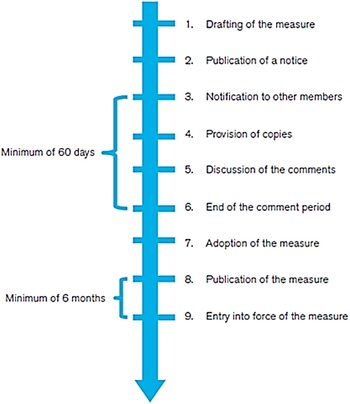
Figure 1 illustrates the process resulting from this ex-ante notification requirement. First, Members are required to publish a notice, before notification, specifying their intentions to introduce a measure. Second, Members must notify their draft measures whenever these draft measures are not in accordance with relevant international standards and if these measures may have a significant effect on international trade (Article 2.9.2 of the TBT Agreement). Notifications are meant to be made at an early stage, when amendments can still be introduced, and comments taken into account. From 1995 to 2017, 96% of TBT notifications were made on the basis of this ex-ante notification requirement (WTO, 2019). The remaining 4% corresponded to notifications of technical regulations made under urgent circumstances (Article 2.10) or measures introduced by local governments (Article 3.2). Third, Members are required to discuss and take into account concerns on their notified-draft measures. Fourth, adopted measures are to be published before their entry into force in order to facilitate governments and traders to become acquainted with them.

Another transparency and monitoring instrument, which was developed through practice in the TBT Committee, is the so-called specific trade concerns mechanism (STCs).Footnote 4 Such concerns were originally raised under the agenda item entitled ‘Statements on Implementation and Administration of the Agreement’.Footnote 5 STCs became a formal and stand-alone agenda item in 2004 only under the name of ‘Specific Trade Concerns’. The STC mechanism consists of formal queries to a Member to obtain further information about that Membeŕs action or inaction, and, in some cases, to encourage the Member concerned to change its behavior. STCs are given a unique identifier to facilitate the tracking of issues raised over time. Over the years, efforts have been made to improve the efficiency of STC discussions held at the TBT Committee.
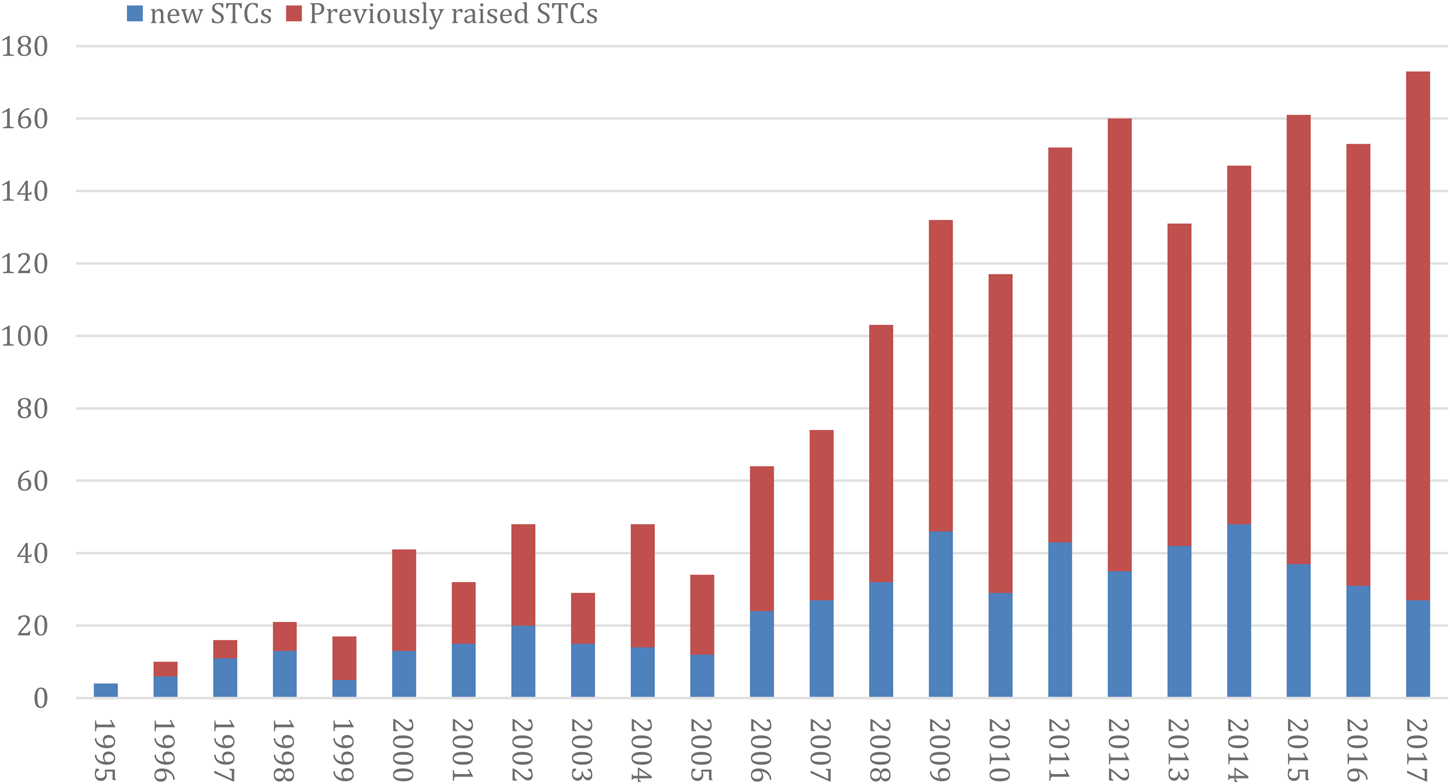
The use of the STC mechanism has grown over time. As shown in Figure 2, the number of STCs raised has increased in the second decade (2006–2017) compared to the first ten years of existence of the WTO and of the STC mechanism.
New and previously-raised STCs, 1995–2017
Note: New STCs refer to new trade concerns raised at a TBT committee meeting in a given year. Previously-raised STCs refer to concerns already raised at previous TBT committee meetings and raised again in the given year. Distinguishing between new and previously raised STCs gives a more accurate reflection of the number of concerns actually discussed in the TBT committee. For instance, if an STC was raised three times before being resolved, it will be counted three times: one time as a new STC at the date at which it was raised for the time and twice as a previously raised STC. Before the introduction of this counting methodology in 2016, the TBT committee would have counted this three-time-raised STC only one time (i.e. as a new STC).
Source: TBT information management system (2019).

3.2 Classifying STCs by the Status of TBT Measures (Draft, Adopted, Notified or Not)
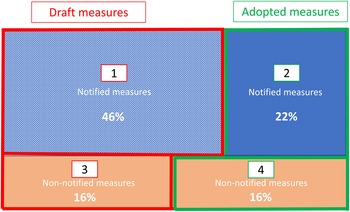
STCs can be raised for measures that have been notified or not notified at the WTO as well as for measures that are in their draft stage or have already been adopted by the country concerned (see Figure 3). Figure 3 shows the share of STCs over the period 1995–2017 according to the status of the measure. Interestingly, close to half (46%) of STCs raised over the review period related to draft measures notified under the ex-ante notification requirement. In addition, 32% are STCs on non-notified measures (including measures already adopted) and 22% are STCs on measures that have been notified after their adoption (late notifications).
STCs by status of the measure
Note: The size of each square reflects the share of each type of measure among all measures challenged through STCs from 1995 to 2017.

As shown in Figure 3, close to half of STCs are on notifications of draft measures suggesting that the STC mechanism benefits from the ex-ante notification requirement (Article 2.9.2 of the TBT Agreement). The figure also shows that 54% of STCs are on measures that are not notified at the draft stage, thus suggesting that a large number of TBT measures are either notified late or not notified (that is the ex-ante notification requirement is only partially implemented by WTO Members). Hence, the STC mechanism goes beyond the ex-ante notification requirement and complements it.
The following two STCs illustrate two examples of a concern related to an adopted measure or a request for the notification of a non-notified draft measure.
Adopted measures: ‘The representative of the United States pointed out that the Korean National Tax Service published an official notice under the number 2011–2017 on 11 July 2011 requiring both, imported and domestic whiskey bottles to have a radio frequency identification tag or an RFID. The US invited Korea to notify this measure to the WTO and to establish a reasonable period of time for comments by interested parties.’ (The STC ID is 329. See paragraph 46 of document G/TBT/M/55. Original emphasis removed, emphasis in italics added).
Non-notified draft measures: The representative of the European Union noted that ‘the purpose of the draft Protocol was to support the implementation of Malaysian compulsory standard MS 1500 of 2009 on “halal food preparation, production, handling and storage, general guidelines”, making the standard, in effect, a technical regulation; it should, hence, have been notified in accordance with Malaysia's WTO transparency obligations. The EU therefore invited Malaysia to also notify this mandatory standard to the WTO and make it freely available to economic operators.’ (The STC ID is 317. See paragraph 135 of document G/TBT/M/54. Original emphasis removed, emphasis in italics added).
3.3 A New Content-Based Classification of STCs: Transparency and Monitoring STCs
Building on the TBT Committee's taxonomy of issues being raised in STCs,Footnote 6 we map existing STCs on the basis of their content. We classify these issues into two types of specific trade concerns: STCs that aim at collecting information (thereafter referred to as ‘transparency-related STCs’ – see Box 1 for relevant examples) and STCs that query the legal consistency of a measure (thereafter referred to as ‘monitoring-related STCs’ – see Box 2).
Classification of transparency issues raised in STCs
We classify STCs into two categories: transparency- and monitoring-related STCs depending on the type of concern (e.g. a request for more information or a compliance issue, respectively), independently of whether the issue relates to a technical regulation or conformity assessment. In a few instances, STCs can also address issues other than transparency or monitoring issues, such as concerns about special and differential treatment, technical assistance, non-product related processes, and product methods or intellectual property. Since this paper focuses on transparency and monitoring issues, we do not cover these other issues. This box illustrates STCs addressing transparency issues.
TRANSPARENCY ISSUES
Transparency issues comprise five types of concerns, as follows:
-
(a) A request for notification can be made after the publication of a notice indicating the intention of a government to design a new measure (see example 1). The request for notification can also be made due to a lack of notification (see example 2).
Example 1: ‘The representative of the United States pointed out that the Korean National Tax Service published an official notice under the number 2011–2017 on 11 July 2011 requiring both, imported and domestic whiskey bottles to have a radio frequency identification tag or an RFID. The US invited Korea to notify this measure to the WTO and to establish a reasonable period of time for comments by interested parties.’ (The STC ID is 329. See paragraph 46 of document G/TBT/M/55. Original emphasis removed, emphasis in italics added).
Example 2: ‘The representative of the United States raised an issue regarding Malaysian requirements for hologram stickers on pharmaceutical products. It was the US understanding that on 26 June 2004, Malaysia's Ministry of Health had announced that it had approved implementation of a directive requiring the use of hologram stickers on pharmaceuticals, over-the-counter medications and certain herbal products. That regulation had never been notified as a proposal under the TBT Agreement and Members had therefore not been given an opportunity to comment. The US government and industry had raised the issue with their Malaysian counterparts, and, in fact, implementation had been delayed on two separate occasions. Nevertheless, it was now scheduled for 5 May 2005. While the representative of the United States welcomed the cooperation that Malaysia had shown, she remained of the view that a notification needed to be made under the TBT Agreement.’ (The STC ID is 119. See paragraph 10 of document G/TBT/M/35. Original emphasis removed, emphasis in italics added. This STC addressed an adopted but non-notified measure (see the fourth quadrant in Figure 3).
-
(b) A request for translation:
‘Australia also asked Viet Nam to provide an official translation of the proposed Decree 40 in order to allow WTO Members to become acquainted with this technical regulation’ (The STC ID is 349. See paragraph 37 of document G/TBT/M/57).
-
(c) A request for an update can be made after the submission of comments with a view to obtaining a response to such comments. Likewise, a request for an update can be made to monitor how a Member manages the resolution of a concern raised.
‘The representative of the United States stated that comments had been submitted prior to the last meeting, which went into detail on many questions and concerns, including the treatment of abbreviations, illustrations on labels, registration numbers, certain font requirements, and implementation periods. He asked for an update on the process for taking these, and other concerns, into account in the publication of the final measure.’ (The STC ID is 263. See paragraph 46 of document G/TBT/M/53. Original emphasis removed).
‘The representative of New Zealand was particularly concerned about the discussion between the Commission and Cyprus with respect to the application for the ‘special reserve’. She reminded the Committee that New Zealand had raised issues on the matter of traditional terms use for some time. Regarding the special reserve application, New Zealand had been assured by the Commission that it expected to resolve the matter in the near future. She requested an update on the matter.’ (The STC ID is 39. See paragraph 124 of document G/TBT/M/52. Original emphasis removed).
-
(d) A request for clarification can be made to obtain technical information about a measure, the objectives for the adoption of a measure, and/or information related to the implementation of a measure.
‘[T]he representative of Barbados drew the Committee's attention to Brazil's new draft technical regulation outlining minimum quality requirements for spirituous beverages, notified in G/TBT/N/BRA/160, on 3 September 2004. Her delegation, in conjunction with the governments of the Dominican Republic, Jamaica, and Trinidad and Tobago on 13 October 2004 had submitted written comments to the Brazilian authorities on this new draft. They had also requested that Brazil suspended the implementation of the new draft technical regulation for a reasonable interval, so that amendments accommodating the concerns raised could be made. She believed that this new regulation in its current form would have significant adverse effects on trade in distilled spirits on Caribbean rum producers. Generally, her delegation's concerns were similar to those raised in relation to G/TBT/N/BRA/135. More specifically on G/TBT/N/BRA/160, she sought clarification on: (i) why a definition for rum and other distilled spirits had not been included in the new draft technical regulation; (ii) the technical aspects in the new draft regulation concerning the distillation processes, and the absence of language on fermentation; and, (iii) the content outlined in the new draft regulation on aged sugar cane.’ (The STC ID is 102. See paragraph 88 of document G/TBT/M/34. Original emphasis removed. This STC addressed a notified measure at the draft stage (the first quadrant in Figure 3).
The representative of the United States requested ‘clarification on the rationale for these measures and their relationship with the EC's environmental and health objectives so that the consistency with international obligations could be assessed.’ (The STC ID is 35. See paragraph 41 of document G/TBT/M/22. Original emphasis removed).
‘The representative of China expressed concern about the use of certain hazardous substances in electrical and electronic equipment. He requested information on the status of implementation of RoHS (it was implemented in 2003) and on how the European Union monitored the state of compliance of enterprises. He also requested clarification on the conformity assessment procedure after RoHS and how it conducted market surveillance and government supervision and if there was any difference between the procedures of different European Union member States.’ (The STC ID is 35. See paragraph 165 of document G/TBT/M/54. Original emphasis removed).
-
(e) A concern about a too short time to comment can be made when Members are not provided enough time to comment on notified measures. The timeframe for the submission of comments should be at least 60 days.
‘The representative of the European Communities noted that at the beginning of 2006, China had made the above-mentioned TBT notifications after the adoption of the corresponding technical regulations. He stressed that the transparency provisions laid down in Articles 2.9.2 and 5.6.2 of the TBT Agreement provided that a notification of a proposed technical regulation or conformity assessment procedure should be made at an early appropriate stage, when amendments could still be introduced, and comments taken into account. In particular, the notifications related to the Wireless Local Area Network (WLAN) products (G/TBT/N/CHN/187 to 189) were dated 31 January 2006 and the corresponding measures’ date of entry into force was 1 February 2006, thereby preventing WTO Members from the possibility to assess the relevant documents and provide comments.’ (The STC ID is 103. See paragraph 32 of document G/TBT/M/38. Original emphasis removed. This STC addressed an adopted measure, which was notified after its adoption (second quadrant in Figure 3)).
-
(f) A concern about a too fast implementation can be made when the time between the notification of a measure and its implementation is so short that a Member could not take into account comments submitted by other Members. Likewise, if the time between the publication of an adopted measure and its implementation is too short, governments and traders cannot adapt to new requirements.
‘While New Zealand welcomed the delay provided for the implementation of the Regulation, it was disappointed at the short time period between publication and notification of the amending Regulation 316/2004 and its implementation, which was not sufficient for Members’ comments to be taken into account in accordance with Article 2.9 of the TBT Agreement. Furthermore, many of New Zealand's concerns had not been addressed by Regulation 316/2004 and a written response had never been received.’ (The STC ID is 39. See paragraph 54 of document G/TBT/M/33. Original emphasis removed, emphasis in italics added. This STC addressed a draft, notified measure).
Classification of monitoring issues raised in STCs
This box illustrates STCs addressing monitoring issues.
1. MONITORING ISSUES
Members use the STC mechanism to raise issues of compliance with the WTO TBT obligations. Examples of this type of monitoring issues include, and are not limited to, STCs related to compliance with international standards or with national treatment, MFN obligations, or unnecessary barriers to trade. For instance:
-
(a) Members have raised STCs to ensure that other Members comply with existing relevant international standards (Article 2.4 or 5.5 of the TBT Agreement) in designing and implementing their TBT measures.
‘The representative of the European Communities was concerned about a proposal from Korea regarding safety criteria on 47 different products, in particular with respect to proposed requirements on tires and safety glass for road vehicles. The European Communities informed the Committee that Korea was a signatory party to the UNECE Agreement of 1958 and that the UNECE regulation Number 43 was about safety glass and the regulation Number 30 concerned tires. These two UNECE regulations were considered to be international standards, and, therefore, in line with Article 2.4 of the TBT Agreement, Korea was invited to adopt a specification of those standards instead of adopting specifications which were purely of national origin’ (The STC ID is 158. See paragraph 12 of document G/TBT/M/41. Original emphasis removed).
‘The representative of the European Communities referred to the proposed revision of the US standards for grades of olive oil and olive pomace oil. Written comments had been submitted to the United States, which pointed out that some of the items covered by the proposed standards, such as aspect, colour, odour and flavour were requirements or limits of certain chemical components in the oil were not in line with the Codex standards for olive oil and olive pomace oils. She invited the United States to provide a written reply to the comments and looked forward to continued discussion on this issue’. (The STC ID is 210. See paragraph 17 of document G/TBT/M/46. Original emphasis removed).
-
(b) Members have also used the STC mechanism to raise concerns about violations of national treatment and/or MFN obligations (as required by Article 2.1 or 5.1 of the TBT Agreement) with respect to other Members’ TBT measures.
‘The representative of the United States remained concerned by what seemed to be a wide- spread effort by China to impose ‘secure and controllable’ requirements, largely based on the Multi-Level Protection Scheme (MLPS) system, on ICT products. The United States said that the MLPS was inflexibly prescriptive and could restrict the ability of consumers to purchase technologies established as safe everywhere else in the world. Additionally, in the view of the United States, the requirements raised national treatment concerns by mandating domestic IP and equipment usage in sectors deemed ‘critical’. This was of particular concern given the extensive scope of projects classified as level 3 or above. The United States hoped that China would take into account all stakeholder comments made on the draft standards related to MLPS, but more broadly, encouraged China to adopt international standards instead of creating country-specific ones’ (The STC ID is 534. See paragraph 2.220 of document G/TBT/M/74. Original emphasis removed).
(c) As another example, Members have raised issues related to unnecessary barriers to trade and/or to the rationale of TBT measures concerned (article 2.2 or 5.1.2 of the TBT Agreement). Complaints include, for instance, (i) a measure that hurts trading partners unnecessarily; (ii) a measure that appears to be more trade restrictive than necessary; (iii) the burdensome nature of a measure; (iv) concerns about the costs resulting from a measure; (v) the scientific rationale of a draft measure that is not solid enough:
‘The Japanese representative emphasized that the procedure for conformity assessment should be fully consistent with the TBT Agreement and other WTO agreements, including Article 5 of the TBT Agreement and the general principle of national treatment. He stated that Japan was concerned that Thailand's conformity assessment procedure was very complicated and created unnecessary obstacles in the distribution of steel products. He noted that discussions between Japanese steel importers and TISI for clarifying the procedure had been conducted in Bangkok. However, it was Japan's understanding that work had not been sufficiently developed’ (The STC ID is 230. See paragraph 140 of document G/TBT/M/50. Original emphasis removed, emphasis in italics added).
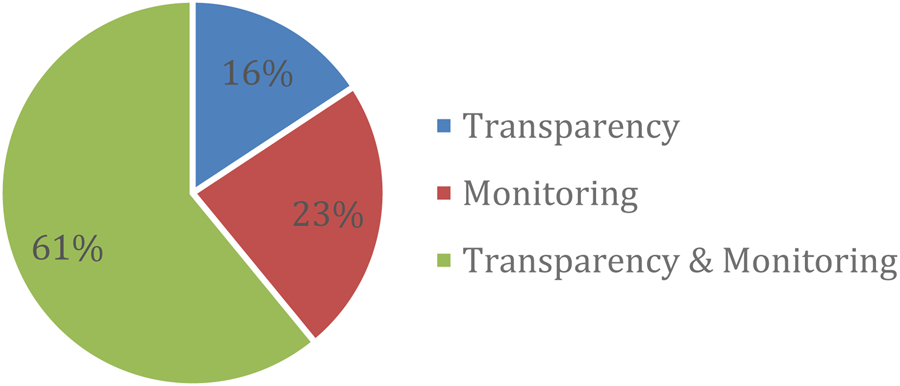
We understand that in a broad sense any question, including a question that asks merely to notify a measure, is a way to enhance the implementation of the commitments. In fact, most STCs include both transparency and monitoring considerations, as shown in Figure 4. Nevertheless, we make this distinction and use a narrower definition of transparency and monitoring STCs to be able to argue more persuasively that STCs do enhance the flow of information and that they do enhance government accountability.
Share of STCs by type of issue

4. The Effectiveness of STCS in the TBT Committee
4.1 The STC Mechanism Enhances Transparency through More and Better-Quality Information
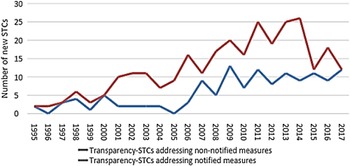
In our strict definition, transparency relates to the increased flow of information. In line with existing literature (Wolfe, Reference Wolfe2003, Reference Wolfe2013, Reference Wolfe2021; Wijkströmet al., Reference Wijkström, Horn and Mavroidis2012; OECD, 2009; Holzer, Reference Holzer2018; Karttunen, Reference Karttunen2020), our analysis supports the claim that STCs enhance transparency, but also qualifies it. In fact, like in Karttunen (Reference Karttunen2020), we show that STCs bring to the public attention new measures. As shown in Figure 3, 32% of STCs are on non-notified measures. STCs raised on non-notified measures (whether transparency or monitoring related) act as a sort of ‘reverse notification’, permitting a minimum level of transparency on measures on which we would not have had information otherwise.
In particular, we also show that transparency-STCs are often (27%, as shown in Figure 6) requests for notifications – usually to remind Members to notify their draft measures in accordance with the ex-ante notification requirement, and to request updates – usually remind Members to respond to comments submitted bilaterally. Example 1(c) featured in Box 1 illustrates a request for an update.
But, most importantly, by focusing on transparency-STCs, we are also able to go beyond the mere claim that STCs bring to the public attention new measures and show that STCs also improve the quality of information already available, which as we have seen in Section 2 reduces trade costs, improves regulatory practices, and builds trust. In fact, like in Wolfe (Reference Wolfe2021), we show that a larger number of transparency-STCs relate to notified measures (Figure 5). These measures are featured in Figure 3 in the first and second quadrants. This would seem to suggest that the (ex-ante) notification requirement on its own does not provide a sufficient level of transparency.
Transparency-STCs by status of notification, 1995–2017

In particular, the fact that 41% of transparency-STCs concern requests for clarification indicates that information provided by notifications, in particular the quality of such information, is not sufficient (see Figure 6). The quality of notifications is one of the issues on the agenda of current WTO reform discussionsFootnote 7. A recent WTO reform proposal suggests that the WTO Secretariat could make a more qualitative assessment on notifications in order to make them more informative. Example 1(d) featured in Box 1 illustrates a request for clarification.
Transparency-STCs by issue

4.2 The STC Mechanism Makes Members More Accountable for Their Measures and, in Turn, Contributes to Good Regulatory Practices
Overall, 24% of all STCs raised between 1995 and 2017 only addressed monitoring issues and 60% of all STCs addressed monitoring issues in addition to transparency issues. The proportion of STCs addressing monitoring issues, i.e., issues related to unnecessary barriers to trade and/or the rationale of the measure concerned, has increased significantly over the years as shown in Figure 7. This section analyses these monitoring issues with a view to assessing the role of the STC mechanism's monitoring function.
The proportion of STCs addressing monitoring issues has been growing

Two conclusions can be drawn from the analysis of monitoring-STCs. First, as monitoring opens the domestic regulatory process to scrutiny for trade effects (OECD, 2009), the prevalence of monitoring issues in STCs suggests that the STC mechanism plays an important role in making Members more accountableFootnote 8 for their domestic TBT measures in front of their peers. Since most monitoring-STCs (63% on average) address unnecessary trade restrictions of TBT measures (see Figure 8), this accountability function encourages Members to design, adopt, and implement less trade restrictive measures and to take into account the comments and concerns of their trading partners. In sum, the accountability function of monitoring-STCs builds and sustains predictability of other WTO Members’ measures by preventing them from introducing deceptive practices or from applying measures in a manner which would constitute a means of arbitrary or unjustifiable discrimination, thereby fostering trust (Section 2.3).
Monitoring-STCs primarily address trade restrictiveness of measures
Note: Since 1996, STCs raised on the ground of unnecessary barriers to trade have constantly represented between 50% and 74% of monitoring-related STCs.

Second, TBT Committee discussions on STCs likely facilitate the design and implementation of regulatory measures that are compliant with TBT rules. It can therefore be argued that the STC mechanism encourages good regulatory practices. These two conclusions are further developed below.
4.2.1 Accountability
The STC mechanism enhances Members’ accountability for their trade measures in two ways.
First, the STC mechanism encourages the Member introducing a measure to justify the objectives, necessity, and non-discriminatory nature of its trade measures. A contrario, in the WTO dispute settlement mechanism, the complaining Member has to prove non-compliance of another Member´s measure with a specific covered agreement. Example 2(c) featured in Box 2 illustrates how a Member can use the STC mechanism to express concerns regarding compliance of a measure with the TBT agreement.
Second, the STC mechanism allows to bring an alleged compliance concern to the attention of all Members of the TBT Committee. Peer pressure makes Members more accountable for their trade measures. Other Members may support the concern raised by a Member and ask additional questions. As already noted, Members also use the STC mechanism to make known to the full membership that compliance concerns have already been shared bilaterally with the concerned Member. By doing so, they likely increase the likelihood of a response to the said concerns.
‘The representative of Indonesia requested that the EU respond to its written enquiry sent [to] the EU TBT Enquiry Point on 25 June 2016.’ (the STC ID is 513. See paragraph 2.309 of document G/TBT/M/70. Original emphasis removed, emphasis in italics added).
4.2.1 Good Regulatory Practices (GRP)
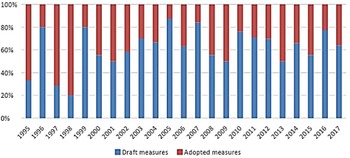
As briefly discussed in Section 2, the STC mechanism encourages Members to adopt GRP in two ways. These points are further elaborated here. First, the fact that the STC mechanism can be used at the design stage of TBT measures permits to reduce restrictive and/or discriminatory regulatory barriers to trade, thus improving regulatory quality. Indeed, 62% of all monitoring-STCs address draft measures (Figure 9). At the drafting stage, concerns raised under the ex-ante notification requirement or as part of the broader STC mechanism can still be taken into account in the design of TBT measures. The STC mechanism acts like an ex-ante impact regulatory assessment tool. It provides WTO Members further information to design their TBT measures adequately at the right moment (Karttunen, Reference Karttunen2020). As noted earlier, the STC mechanism goes beyond the ex-ante notification requirement and makes it possible for Members to raise comments and concerns on non-notified draft measures.
The majority of monitoring-STCs address draft measures

Second, the STC mechanism nurtures collective knowledge on how to implement TBT rules, thereby facilitating implementation of regulatory measures. It provides a basis for cooperation through the sharing of experience and of scientific and technical knowledge (OECD and WTO, 2019; Karttunen, Reference Karttunen2020). International regulatory cooperation resulting from STC discussions can also take the form of technical assistance. In some instances, STCs led to the provision of technical assistance and advice to facilitate the compliance with a newly adopted TBT measure (Holzer, Reference Holzer2018). For instance, in the STC about the European Union's chemicals regulation governing registration, evaluation, authorization, and restriction of chemicals (REACH), the EU responded to the continuous concerns of its trading partners through the adoption of additional measures, to assist small and medium-sized enterprises to comply with REACH requirements and the provision of technical assistance and advice to developing countries. Such exchange of information and technical knowledge help WTO members work towards greater coherence in regulatory approaches and limit costs of regulatory divergences, as suggested by existing literature (OECD, 2017; OECD and WTO, 2019; Karttunen, Reference Karttunen2020).
The fact that there are monitoring-STCs on draft measures per se can only be suggested as evidence that STCs are used to improve regulations. Ideally, one would like to have information on potential regulatory changes resulting from the discussions in the TBT committee substantiate this claim robustly. However, this information is not available.
4.3 The STC Mechanism Facilitates the Resolution of Trade Concerns without Having Recourse to the WTO Formal Dispute Settlement System
Several authors (Wolfe, Reference Wolfe2003; Wijkström et al., Reference Wijkström, Horn and Mavroidis2012; Holzer, Reference Holzer2018; Karttunen, Reference Karttunen2020) have argued that WTO committees play an important role in mitigating trade conflicts and have brought in support of this claim the fact that formal WTO disputes are small number in number compared to all notifications and trade concerns raised in committees (Wolfe, Reference Wolfe2003). We use the classification of STCs in the TBT committee introduced earlier in this paper to provide additional and stronger evidence in support of this argument. By providing a forum for discussion and exchange of information in a transparent way, the STC mechanism fosters a trustworthy and constructive environment wherein cooperation can effectively de-escalate trade conflicts.
There are four facts that support the claim that the STC mechanism is effective in resolving trade tensions non-litigiously.
First, the vast majority of STCs are resolved without escalating into a formal dispute. As shown in Figure 10, out of the 535 STCs raised from March 1995 to March 2018 and that did not result in a formal dispute, 475 STCs (89%) were presumably resolved non-litigiously.Footnote 9 Only 11% of STCs are ongoing. While these figures do not necessarily indicate whether an STC has been definitely resolved, they provide anecdotal evidence that an important proportion of the STCs discussed in the TBT Committee are no longer on the agenda. One can assume that some form of progress has been achieved and that positive developments have occurred – but it could also be that Members pursued the issue through other means or in other fora (OECD and WTO, 2019). Karttunen (Reference Karttunen2020) also suggests that Members use the STC mechanism as a substitute for dispute settlement since a majority of trade concerns are resolved before measures are adopted or before their trade effects escalate. According to Karttunen (Reference Karttunen2020), STCs serve as a more appropriate tool to achieve timely reactions to a trade concern that has immediate consequences but which does not have a substantive economic impact.
Most (88%) of STCs have been resolved
Note: This Figure does not necessarily mean that STCs are definitely resolved. Members can decide to withdraw a STC from the Committee's agenda because they consider that pursuing discussions is not worthwhile and can live with an unresolved underlying issue. Rather, this Figure provides anecdotal evidence that STCs can help resolve trade frictions.

Second, concerns raised in the TBT committee appear to be resolved quickly. Among the 475 resolved STCs, 82% were resolved within one year or less, meaning that after having been raised during one year or less, they have not been raised again for a period of at least 24 months, as illustrated in Figure 11.
STCs are mainly resolved within one year or less

Third, only a small share of STCs were subsequently raised as a formal dispute. Since 1995, out of 555 concerns, only 20 ended up in disputes (there were 22 TBT-related formal disputes preceded by STCs, because some concerns ended up in more than one formal dispute). Among these 20 disputes, there are only seven fully-fledged disputesFootnote 10 ending with Panel and Appellate Body reports (and two panel reports under appeal). STCs turning into a fully-fledged dispute are therefore scarce.
Fourth (and our key contribution), STCs raised at the draft stage of new technical regulation measures are less likely to end up as a formal WTO dispute. As shown in Table 1, while 5% of STCs raised on adopted TBT measures have led to a dispute, only 2% of STCs related to draft TBT measures resulted in a formal dispute.
Share of STCs followed by a dispute

Note: The difference between the number of TBT-related disputes (22 disputes) and the number of STCs preceding TBT disputes (20 STCs) is due to the fact that some concerns discussed under one STC identifier lead to several and distinct WTO disputes. This is the case of DS434, DS435, DS441, DS458, and DS467, all of which concerned Australia – Certain Measures Concerning Trademarks and Other Plain Packaging Requirements Applicable to Tobacco Products and Packaging. These disputes were discussed under the same STC number (STC 304). Although some concerns discussed under different STC identifiers led to one WTO dispute only (as was the case with DS135 European Communities – Measures Affecting Asbestos, which was discussed under three different STC numbers (STC 12, 22, and 25)), taking these situations into account leads to an overall number of disputes that is higher than the number of STCs (22 vs 20).
The reason is intuitive. When concerns are raised on drafts, it is easier for the legislator or regulator to adapt a measure and take concerns into account. This points to the critical role played by the ex-ante notification requirement in supporting the effectiveness of the STC mechanism in resolving trade disputes non-litigiously. By requiring that Members notify their draft measures, the ex-ante notification requirement increases the likelihood of potential concerns being addressed at an early stage, before the measure is adopted, thereby contributing to the effective use of the STC mechanism as a tool to resolve disputes non-litigiously.
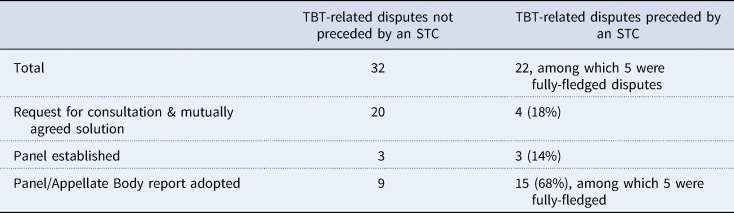
Finally, the fact that some concerns did end up in a dispute does not need to be interpreted as evidence of the failure of the STC system rather as evidence of the fact that these were particularly difficult cases. The statistics in Table 2 help support this claim. Table 2 shows the legal outcome of all 54 TBT related disputes and compares the outcome for the 22 disputes preceded by STCs and the 32 that were not. As argued by Karttunen (Reference Karttunen2020), the fact that some TBT disputes were not preceded by STCs shows that Members do not always use STCs as a substitute for dispute settlement. In fact, in comparing content raised in TBT-related requests for consultation and in STCs, she finds that issues are not systematically the same, thus suggesting that the two different mechanisms have different purposes and may be used in different circumstances. That said, she finds that the trend leans more consistently towards the use of the STC mechanism to address TBT-related concerns.
What was the legal outcome of TBT-related disputes?

Table 2 shows that very few (18%) of these disputes ended at the consultation stage. Rather, most of them (68%), including all fully-fledged TBT-related disputes, were resolved after the adoption of the Panel report or the Appellate Body's report, including three which were resolved after a compliance review under Article 21.5 of the Understanding on Rules and Procedures Governing the Settlement of Disputes (DSU). These three disputes are the only disputes out of the 54 TBT-related disputes that underwent a compliance review. In contrast, the 32 disputes that were not preceded by STCs largely (20 out of 32) ended at the request for consultation stage. This suggests that it would be more efficient to go through a discussion of the concern within the relevant committee before filing a formal dispute settlement case than going directly to a dispute.Footnote 11
These different patterns point to the fact that the unresolved STCs that ended up as disputes were particularly difficult cases (Holzer, Reference Holzer2018; Karttunen, Reference Karttunen2020). Holzer (Reference Holzer2018) puts forward two explanations. One is the fact that some of the STCs preceding TBT-related disputes were strongly backed by public opinion, making the WTO Members concerned reluctant to cooperate in lifting or modifying their measures (Holzer, Reference Holzer2018). For instance, the public perception of health risks associated with asbestos made the European Union unwilling to lift or adjust its measures at the request of other WTO Members in the STC EC–Asbestos. Another explanation is that some of the STCs preceding TBT-related disputes involved Members encountering a general deterioration of trade and political relations between themselves (Holzer, Reference Holzer2018). The Bans on Specific Products, which is linked to five STCs, started with a ban on confectionary products, and then grew into a series of bans on products of other exporting industries. Had political tensions between the two Members been resolved, these STCs might have been resolved. According to Karttunen (Reference Karttunen2020), some disputes, like the EC–Hormones, concerned diametrically opposed cultural and scientific approaches, thus requiring third-party adjudication. In EC–Hormones, for instance, the EU's traditional precocious approach to risk on the one side and the innovative approaches to agriculture in the Americas on the other reflects the complexity of the WTO adjudicator's role in reconciling issues that cannot be solved through mutually acceptable solutions in the TBT Committee.
5. Conclusion
Using a novel classification of STCs raised in the TBT Committee, we provide new evidence in support of the common claim that the STC mechanism contributes to more transparency, better monitoring, and faster and cost-efficient resolution of concerns compared to having recourse to the dispute settlement mechanism.
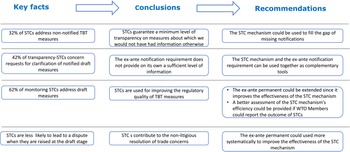
Our analysis supports three key findings (see Figure 12).
Key facts, conclusions, and recommendations

First, as already pointed out in the literature, STCs enhance transparency by making available to all membership information not notified. In fact, STCs raised on non-notified measures represent 32% of all STCs. They act as a sort of reverse notification, guaranteeing a minimum level of transparency by making information available that would have otherwise not been known.
By singling out transparency-STCs, we show that STCs also improve the quality of information already available in notifications. Indeed, 42% of transparency-STCs concern requests for clarification regarding notified draft measures, suggesting that the (ex-ante) notification requirement on its own does not provide a sufficient level of information and points to the de facto complementarity of these two tools.
Greater access to information has a significant economic value. It reduces information search costs thus increasing efficiency and making it easier for firms to trade. In the context of TBT measures, it may also help countries to develop measures compatible to those adopted by their trading partner, thus reducing unnecessary barriers to trade. The establishment of a reporting system on the outcome of STCs would permit to know whether STCs have led to changes in trade policies, and thereby reduce trade costs.
Second, our analysis shows that the majority of monitoring-STCs address draft measures, which suggests that STCs are used to promote accountability and improve good regulatory practices. Ideally, one would want to know whether the WTO member concerned did change or improve its regulation to take account of the concerns expressed. Unfortunately, such information is not available. This is an improvement we recommend.
Greater accountability and adoption of good regulatory practices contribute to the reduction of trade barriers, as well as to enhanced predictability of the trading environment and to greater trust among Members, both of which are key drivers of trade growth and trade cooperation.
Third, our analysis provides a quantitative analysis that supports the claim often found in the literature that STCs contribute to the resolution of trade concerns without having recourse to the WTO dispute settlement mechanism. In some cases, Members use the STC mechanism as a substitute for dispute settlement. In addition to existing literature, by distinguishing between STCs raised on draft and adopted measures, we are able to show that STCs are less likely to lead to a dispute when they are raised at the draft stage – as one would expect given that it is easier to find a compromise solution at the draft stage. This points to the critical role played by the ex-ante notification requirement in supporting the effectiveness of the STC mechanism in addressing trade disputes.
By preventing the escalation of trade tensions into WTO disputes, which are costly and undermine trade relationships, the STC mechanism helps to build and sustain trust among WTO Members. In the current context of increased pressure on the WTO dispute settlement system, the STC mechanism provides an interesting alternative mean to resolve trade tensions non-litigiously. In turn, this trusting environment likely stimulates trade cooperation.
One limit of our analysis of the benefits of the STC mechanism in the TBT Committee is the absence of information about the effective resolution of an STC. Nevertheless, it does help us to provide some guidance as to actions that could be considered to further improve the STC mechanism, and more generally the administration of trade concerns in other committees.
First, introducing a reporting system on the outcome of STCs would permit us to know whether STCs have led to changes in trade policies and/or to the non-litigious resolution of trade concerns. A better assessment of the STC mechanism's efficiency could be provided if WTO Members could report the outcome of STCs raised in the TBT Committee, as they do in the SPS Committee.
Second, STCs raised in committees could be used to fill the gap of missing notifications. This would help maintain a more up-to-date database of measures adopted.
Third, a more systemic use of the STC mechanism at the stage of draft measures would likely result in a higher resolution rate of trade concerns. Our findings show that STCs on draft measures are correlated with fewer disputes and that STCs fill the gap of missing notifications. Further research may be needed to deepen the analysis of causality between STCs, notifications, and disputes.
Last but not least, it may be important to build-in more generally in the dispute settlement system the need to first raise the matter and discuss it within the relevant committee before filing a formal dispute settlement case – deally combining it with an ex-ante mechanism requiring notification at a draft stage. This is the advantage of the STC process in the TBT Committee. In this respect, Wolfe (Reference Wolfe2021) shows that most committees only have a basic review of notification compliance and only some committees provide opportunities for questions about notifications or requests for information about measures that ought to have been notified. Implementing approaches similar to the STC mechanism in other WTO committees, including ex-ante notification, would contribute to greater transparency and help diffuse trade concerns.