Introduction
Soft robotics, an emerging subfield of robotics, aims to provide simpler and more robust interactions with humans in complex and unpredictable environments. For our purposes, we define soft from a human perspective—as a structure that would deform readily upon the application of a contact pressure, which would typically cause harm to a user. There are two ways to achieve softness, extrinsically or intrinsically. Here, we will consider only the latter case: Robots that are soft regardless of their shape and are composed of elastomeric organic materials Reference Ilievski, Mazzeo, Shepherd, Chen and Whitesides1–Reference Anderson, Gisby, McKay, O’Brien and Calius4 with tangent elastic moduli below 1 MPa (similar to that of the human skin epidermal layer of ∼100 kPa). Reference Liang and Boppart5 These robots are able to demonstrate natural, continuous deformation with their mobility only limited by the extensibility of the constituent materials. Reference Ilievski, Mazzeo, Shepherd, Chen and Whitesides1 Examples of the complex motions they demonstrate from simple fabrication and control inputs include bending, twisting, extension, and conformation to arbitrary geometries using infinite passive degrees of freedom. Reference Saunders, Golden, White and Rife6,Reference Polygerinos, Wang, Galloway, Wood and Walsh7
Variants of soft robots can be categorized by the actuation mechanisms used. In this article, we limit our focus to fluidic elastomer actuators (FEAs). Reference Rus and Tolley8 The fabrication technique of these robots involves intentionally embedding interconnected channels in silicones or other elastomers. Reference Ilievski, Mazzeo, Shepherd, Chen and Whitesides1,Reference Shepherd, Ilievski, Choi, Morin, Stokes, Mazzeo, Chen, Wang and Whitesides9–Reference Mosadegh, Polygerinos, Keplinger, Wennstedt, Shepherd, Gupta, Shim, Bertoldi, Walsh and Whitesides11 By simply pressurizing via either gas (pneumatic) Reference Wehner, Tolley, Menguc, Park, Mozeika, Ding, Onal, Shepherd, Whitesides and Wood12–Reference Shepherd, Stokes, Freake, Barber, Snyder, Mazzeo, Cademartiri, Morin and Whitesides15 or liquid (hydraulic), Reference Polygerinos, Wang, Galloway, Wood and Walsh7,Reference Marchese, Onal and Rus16,Reference Katzschmann, Marchese, Rus, Hsieh, Khatib and Kumar17 the channels inflate in regions with lowest stiffness and generate complex shapes and motions in three-dimensional (3D) space. Reference Ilievski, Mazzeo, Shepherd, Chen and Whitesides1 Recently, our group developed a new class of FEAs based on molding stochastic networks of open-cell organic elastomeric foams. Using this technique, we can now form complex 3D actuators without the need for 3D printed fugitive channels (ink scaffolds that can be removed afterward), Reference Mac Murray, An, Robinson, Van Meerbeek, O’Brien, Zhao and Shepherd18,Reference Argiolas, Mac Murray, Van Meerbeek, Whitehead, Sinibaldi, Mazzolai and Shepherd19 or even without 3D printing at all. Reference Van Meerbeek, Mac Murray, Kim, Robinson, Zou, Silberstein and Shepherd20
A characteristic of most soft robots is that they demonstrate complex motions through simple open-loop control, Reference Bicchi and Tonietti21 realizing complex tasks such as walking on irregular terrains, Reference Shepherd, Ilievski, Choi, Morin, Stokes, Mazzeo, Chen, Wang and Whitesides9 grasping unpredictable shapes, Reference Brown, Rodenberg, Amend, Mozeika, Steltz, Zakin, Lipson and Jaeger22 and manipulating fragile objects. Reference Ilievski, Mazzeo, Shepherd, Chen and Whitesides1 This control mechanism, simple as it is, is unable to achieve accuracy, or actively interact with its environment—eliminating the possibility of autonomy. Reference Bekey23 In order to continuously regulate the output signals based on external circumstances, closed-loop controls are necessary, where sensors are used to obtain information from the environment (exteroception) and also to monitor their internal states (proprioception). Reference Bekey23 These data are subsequently provided to the controller to self-correct errors and yield smart human–robot interactions. Reference Lu and Kim24 Hence, sensors with high repeatability and resolution, fast speeds, and mechanical compatibility with soft robots are required to achieve these goals.
Flexible and stretchable sensors for FEA soft robots
A key challenge of creating sensory apparatus for soft robots is to work with highly deformable and mechanically nonlinear materials. Reference Bauer, Bauer-Gogonea, Graz, Kaltenbrunner, Keplinger and Schwödiauer25 Conventional sensors lack the compliance and extensibility to remain electrically functional under large strains. In this section, we briefly discuss some recent developments in flexible and stretchable sensors that have been or can be readily employed in FEA soft robots based on their sensing mechanisms.
Resistive sensors
Resistive sensors operate via dimensional changes (e.g., length or cross-sectional area) that cause a change in current flow through electrically conductive materials embedded in an insulating elastomeric matrix. A typical embodiment of these sensors is liquid-phase conductors embedded in molded microchannels of soft silicone elastomer. By patterning the microchannels into different shapes, it is feasible to apply this principle in multiple sensing modes, including applied force, Reference Park, Chen and Wood26,Reference Hammond, Menguc and Wood27 strain, Reference Park, Chen and Wood26,Reference Yeo, Yap, Xi, Wang, Yeow and Lim28,Reference Muth, Vogt, Truby, Menguc, Kolesky, Wood and Lewis29 and curvature. Reference Majidi, Kramer and Wood30 Stacking several layers of the sensing elements also enables a blend of sensing types such as normal and shear forces. Reference Vogt, Park and Wood31 The fabrication of this class of sensors includes, but is not limited to, soft lithography, Reference Park, Chen and Wood26,Reference Majidi, Kramer and Wood30–Reference Menguc, Park, Martinez-Villalpando, Aubin, Zisook, Stirling, Wood and Walsh33 3D printing, Reference Muth, Vogt, Truby, Menguc, Kolesky, Wood and Lewis29 and planar printing/coating. Reference Marchese, Onal, Rus, Desai, Dudek, Khatib and Kumar14,Reference Yeo, Yap, Xi, Wang, Yeow and Lim28,Reference Lee, Jug and Meng34–Reference Manandhar, Calvert and Buck36 The conductors generally comprise stretchable, mostly organic composites, including those with a continuous phase (e.g., eutectic gallium-indium, Reference Park, Chen and Wood26,Reference Hammond, Menguc and Wood27,Reference Majidi, Kramer and Wood30–Reference Menguc, Park, Martinez-Villalpando, Aubin, Zisook, Stirling, Wood and Walsh33 conductive polymers, Reference Manandhar, Calvert and Buck36 and hydrogels) Reference Pan, Chortos, Yu, Wang, Isaacson, Allen, Dauskardt and Bao37 and those that possess a dispersed phase with solid particles (e.g., carbon black, Reference Muth, Vogt, Truby, Menguc, Kolesky, Wood and Lewis29,Reference Lu, Lu, Yang and Rogers38 carbon nanotubes, Reference Lee, Jug and Meng34 and silver nanoparticles Reference Yeo, Yap, Xi, Wang, Yeow and Lim28 and nanowires Reference Xu and Zhu35 ).
Capacitive sensors
Capacitive sensors, consisting of a thin dielectric layer sandwiched between a pair of conductors, provide an alternative approach to measuring strain, Reference Lipomi, Vosgueritchian, Tee, Hellstrom, Lee, Fox and Bao39–Reference Yao and Zhu41 force, Reference Lipomi, Vosgueritchian, Tee, Hellstrom, Lee, Fox and Bao39,Reference Yao and Zhu41–Reference Roberts, Damian, Shan, Lu and Majidi44 bending, Reference Lucarotti, Totaro, Sadeghi, Mazzolai and Beccai45 and shear. Reference Viry, Levi, Massimo, Mondini, Mattoli, Mazzolai and Beccai43,Reference Roberts, Damian, Shan, Lu and Majidi44 As capacitance variation only relies on the change in dielectric thickness and effective overlapping surface area, compared to resistive sensors, this method overcomes hysteresis and other issues caused by the electrical resistivity of conductors, demonstrating higher sensitivity, higher repeatability, and better temperature stability. Reference Puangmali, Althoefer, Seneviratne, Murphy and Dasgupta46 Most capacitive sensors are produced by aligning conductive films on an elastomeric substrate. Frutiger et al., however, have recently demonstrated a fiber-shaped capacitive sensor fabricated via multicore-shell printing. Reference Frutiger, Muth, Vogt, Menguc, Campo, Valentine, Walsh and Lewis40
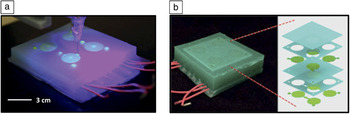
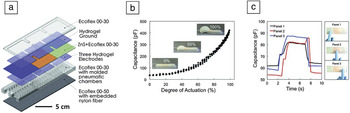
We recently used stretchable capacitors for feedback control of soft robots. Robinson et al. demonstrated a highly extensible organic capacitive skin comprising hydrogel electrodes and silicone dielectrics directly 3D printed on soft pneumatic actuators. Reference Robinson, O’Brien, Zhao, Peele, Larson, Mac Murray, Van Meerbeek, Dunham and Shepherd47 This overlaid structure enabled both tactile sensing from external compression and kinesthetic sensing from internal pressurization ( Figure 1 ). Reference Robinson, O’Brien, Zhao, Peele, Larson, Mac Murray, Van Meerbeek, Dunham and Shepherd47 Larson et al. recently presented a hyperelastic light-emitting capacitor (HLEC) composed of a silicone dielectric embedded with ZnS phosphors and sandwiched between transparent hydrogel electrodes. Reference Larson, Peele, Li, Robinson, Totaro, Beccai, Mazzolai and Shepherd48,Reference Li, Peele, Larson, Zhao and Shepherd49 These HLECs act as sensors of internal and external stimuli and display pixels that can accommodate uniaxial strains up to 480% without compromising illumination. Reference Larson, Peele, Li, Robinson, Totaro, Beccai, Mazzolai and Shepherd48 We used this intrinsically compliant and extensible configuration to construct an electroluminescent skin for a soft mobile robot to impart both tactile sensing and optical signaling ( Figure 2 ). Reference Larson, Peele, Li, Robinson, Totaro, Beccai, Mazzolai and Shepherd48
(a) Three-dimensional printing of a capacitive sensor on top of a pneumatic actuator for tactile and kinesthetic sensing; (b) exploded view of the printed layers with green showing conductive hydrogel and blue showing insulating silicone. Reference Robinson, O’Brien, Zhao, Peele, Larson, Mac Murray, Van Meerbeek, Dunham and Shepherd47

(a) An exploded view of electroluminescent skin integrated in a soft mobile robot with capacitance measurements that demonstrate sensing for (b) internal and (c) external stimuli. (Ecoflex 00-30 is a commercially available silicone elastomer; ZnS is an electroluminescent phosphor powder [∼25 μm]). The intensity of illumination indicates relative capacitance change and serves as a tool for optical signaling in a soft, mobile robot. Reference Larson, Peele, Li, Robinson, Totaro, Beccai, Mazzolai and Shepherd48

Magnetic sensors
Magnetic sensors based on the Hall effect measure the magnetic flux density around a magnet and generate an output voltage in response to a deformation. Reference Li, Peele, Larson, Zhao and Shepherd49 Tuning the position and orientation of the magnet with respect to the Hall element would result in mapping of measured data for sensing curvature of a bending segment Reference Ramsden50,Reference Ozel, Keskin, Khea and Onal51 and determining multiple other object properties (object tracing, contact localization, and detecting exerted force). Reference Ozel, Skorina, Luo, Tao, Chen, Pan and Onal52–Reference Luo, Pan, Skorina, Tao, Chen, Ozel and Onal54 The integration of these sensors in soft robots, however, is constrained by the stiffness of the miniature magnet and the semiconductor-based Hall element, which are rigid components assembled with metal circuit traces printed on a plastic substrate. Reference Ozel, Keskin, Khea and Onal51,Reference Ozel, Skorina, Luo, Tao, Chen, Pan and Onal52 Their parts require molding to an inextensible central layer of the bending actuator that may lead to practical issues such as pressure leakages due to a mismatch of moduli at the interface. Reference Ozel, Skorina, Luo, Tao, Chen, Pan and Onal52
Optoelectronic sensors
Optoelectronic sensors, in particular, fiber-optic sensors, detect applied deformations in a path between a light source (usually a light-emitting diode [LED]) and a photodetector by translating the shift in the physical characteristics of light (e.g., intensity, frequency, and phase) to electrical signals through a waveguide medium. Owing to the high quality and low price of fibers and optoelectronic components, optical sensors have found broad implementation in sensing curvature, Reference Ryu, Quek, Renaud, Black, Daniel and Cutkosky55,Reference Cianchetti, Renda, Licofonte and Laschi56 shape, Reference Cianchetti, Renda, Licofonte and Laschi56–Reference Yi, Zhu, Shen, Sun, Jiang, Li, Li, Ma and Irwin58 and force, Reference Polygerinos, Ataollahi, Schaeffter, Razavi, Seneviratne and Althoefer59–Reference Jiang, Low, Costa, Black and Park61 as well as contact localization. Reference Jiang, Low, Costa, Black and Park61 The main advantages of this sensing scheme are (1) nonelectrical method of operation that shows immunity to electromagnetic interference; (2) low density and good flexibility; and (3) easy interface with data systems. Reference Righini, Tajani, Cutolo, Righini, Tajani and Cutolo62
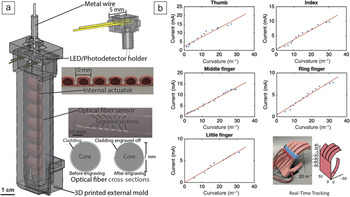
We have used fiberoptic sensors and FEAs for force-augmented grasping in hand orthotics—assistive devices that help rehabilitate and improve hand functions. Reference Zhao, Huang and Shepherd63,Reference Zhao, Jalving, Huang, Knepper, Ruina and Shepherd64 In this work, the sensors were incorporated in each finger actuator to monitor shape and realize closed-loop control. We used engraved plastic optical fibers to enhance sensitivity to bending, and along with an LED light source and photodetector, we embedded them into each finger actuator to enable strain sensing in a hand orthosis ( Figure 3 ). Relying on the light intensity change, these solid-state optical sensors outperform most resistive and capacitive sensors in terms of precision, repeatability, and signal-to-noise ratio, and have been applied to real-time position sensation in feedback control loop for soft robotic systems. However, flexible, solid-state optical sensors are inextensible and can only be placed into nonstretching regions of FEAs. Thus, there is a need for stretchable waveguide sensors based on the same mechanism (intensity modulation of light signal).
(a) A schematic of a hand orthosis (an assistive glove that helps restore hand functions), where various components (light-emitting diodes [LEDs], pressure chambers, optical fibers, photodetectors, nylon fabric, clamps, air-supply tubes, and optical-component holders) were monolithically cast into one finger. (b) Demonstration of integrated solid-state optical sensors that can monitor the curvatures of all five finger actuators via current output, and track real-time finger positions (bottom right inset has units in mm). Reference Zhao, Jalving, Huang, Knepper, Ruina and Shepherd64

Future perspectives
Soft robots are rapidly opening up new possibilities for safely assisting humans in everyday tasks, improving health, or imparting new abilities with applications ranging from exosuits, Reference Wehner, Quinlivan, Aubin, Martinez-Villalpando, Baumann, Stirling, Holt, Wood and Walsh65,Reference Asbeck, Schmidt and Walsh66 ventricular assist devices, Reference Park, Mehandru, Lievano Beltran, Kraus, Holland, Polygerinos, Vasilyev and Walsh67 orthotics/prosthetics, Reference Zhao, Jalving, Huang, Knepper, Ruina and Shepherd64,Reference Zhao, O’Brien, Li and Shepherd68 and wearable devices. To realize their full potential, fundamental developments in sensory apparatus, including materials, structural designs, processing strategies, and integration schemes will be required and be indicative of progress in soft robotics. We believe that optics will play a critical role in the sophistication of soft robotics and robotics in general. A next step toward this goal is organic stretchable waveguides Reference Zhao, O’Brien, Li and Shepherd68–Reference To, Hellebrekers and Park70 and their future integration into soft robots. Current efforts have already revealed promising results in terms of fabrication and characterization of this class of sensors. A near-term goal would be decoupling signals from various deformation modalities and building smart interfaces that communicate the information to users. We believe that in the long-term, these highly extensible optical sensors, with multispectral capabilities and full 3D integration with soft robots, will circumvent issues such as hysteresis from particle-laden electrically conductive material or real estate problems from routing hundreds of conductive traces.
Acknowledgments
The authors acknowledge support from the Air Force Office of Scientific Research, Army Research Office, National Science Foundation, and 3M Non-Tenured Faculty Award.

Shuo Li is a PhD candidate in the Department of Materials Science and Engineering at Cornell University. He received his BS degree from the University of Illinois at Urbana-Champaign in 2014 and MS degree from Cornell University in 2016. His current research interests include developing flexible/stretchable electronics for applications in next-generation display and sensing technologies. Li can be reached by email at sl2699@cornell.edu.

Huichan Zhao is a PhD candidate in the Sibley School of Mechanical and Aerospace Engineering at Cornell University. She received her BS degree from Tsinghua University, China, in 2012. Her current research interests include developing new fabrication techniques and sensors for soft robots. Zhao can be reached by email at hz282@cornell.edu.

Robert F. Shepherd is an assistant professor in the Sibley School of Mechanical and Aerospace Engineering with affiliation in the Department of Materials Science and Engineering at Cornell University. He received his PhD degree from the University of Illinois at Urbana-Champaign in 2010, and completed postdoctoral research at Harvard University in 2012. His current research focuses on the materials and mechanical designs of organic robots. Shepherd can be reached by email at rfs247@cornell.edu.