INTRODUCTION
The mussel Perumytilus purpuratus is found from Ecuador (2°00′S 77°30′W) south down the Pacific coast of South America and round onto the Atlantic coast of Argentina, as far north as La Lobería (41°80′S 63°10′W) (Prado & Castilla, Reference Prado and Castilla2006). It forms extensive beds in the mid-intertidal of the central Chilean coast (Alvarado & Castilla, Reference Alvarado and Castilla1996) providing an important habitat for a wide variety of small macrofaunal (Prado & Castilla, Reference Prado and Castilla2006) and meiofaunal species (M. Lee, personal observation). These extensive mussel beds can be considered a stable state that results from an anthropogenic impact. In this case the anthropogenic impact is not pollution or physical destruction, but human predation. A number of large mollusc species are intensively collected along most of the Chilean coast, both commercially and recreationally (Durán et al., Reference Durán, Castilla and Oliva1987; Leiva & Castilla, Reference Leiva and Castilla2002; Castilla & Gelcich, Reference Castilla, Gelcich, Townsend, Shotton and Uchida2008). The most prized of these molluscs is the keystone predator Concholepas concholepas, the ‘loco’, whose principal prey is intertidal mussels (Castilla & Duran, Reference Castilla and Durán1985; Castilla Reference Castilla1999).
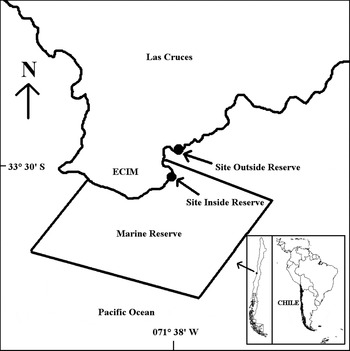
A coastal human exclusion experiment has been conducted, starting in 1982, by enclosing an area of headland, approximately 500 m in length, on the Punta del Lacho in Las Cruces, central Chile (Figure 1; 33°31′S 071°38′W), at the same time the Estacion Costera de Investigaciones Marinas (ECIM), part of the Pontificia Universidad Católica de Chile, was established (Castilla & Duran, Reference Castilla and Durán1985). The enclosed area was designated a National Marine Reserve in 2006 (see Fernández & Castilla, Reference Fernández and Castilla2005; Navarrete et al., Reference Navarrete, Gelcich and Castilla2010). In the absence of human predation the abundance of C. concholepas increased and they consumed most of the mussel beds within the Reserve (Power et al., Reference Power, Tilman, Estes, Menge, Bond, Scott Mills, Daily, Castilla, Lunchenco and Paine1996; Botsford et al., Reference Botsford, Castilla and Peterson1997; Castilla, Reference Castilla1999). This made space available for macroalgae (Ulva lactuca rigida, Gelidium chilense, Centrosceras clavulatum, Corallina officinalis var. chilensis, Hildenbrandtia lecannellieri, Adenocystis utricularis, Scytosiphon lomentaria, Ralfsia confusa and Colpomenia sinuosa) and barnacles (Jehlius cirratus and Notochthamalus scabrosus) to occupy (Durán & Castilla, Reference Durán and Castilla1989; Castilla, Reference Castilla1999). The absence of human predation pressure also resulted in the increase of fissurelid limpets (Fissurella lambata and Fissurella crassa), herbivores also consumed by humans. These fissurelids introduced grazing pressure reducing the macroalgal cover in the mid-intertidal (Oliva & Castilla, Reference Oliva and Castilla1986). What appears to be an alternate stable state for the mid-intertidal was then observed with the domination of the barnacle species, a sparse cover of macroalgae, and P. purpuratus confined to crevices and other spatial refuges. This situation persists to this day within the Reserve (Durán & Castilla, Reference Durán and Castilla1989; Castilla, Reference Castilla1999; authors, personal observations).
Map showing the location of the Marine Reserve in Las Cruces and the sampling sites, inside and outside the Reserve.

The question that this paper seeks to address is: does the absence of extensive mussel beds in the mid-intertidal within the Marine Reserve at Las Cruces significantly reduce the species richness of small mobile macrofauna and meiofauna that typically inhabit the mid-intertidal microhabitats? Artificial substrates in the form of ‘live’ artificial mussel beds on plates were used to assess the species richness as no destructive sampling is allowed within the Reserve at Las Cruces. Therefore, in addition, the efficacy of this methodology for assessing the species richness of small mobile macrofauna and meiofauna species was also tested by comparing the species richness associated with the plates with the species richness associated with natural mussel beds.
MATERIALS AND METHODS
‘Live’ artificial mussel beds were created by placing live mussels onto plastic plates for deployment in the field on the Punta del Lacho, Las Cruces, central Chile (Figure 1). Each mussel plate consisted of a 110 mm diameter PVC plate (34.6 cm2) with a 10 mm high lip at the edge and a 12 mm high lip in the centre surrounding the central fixing hole. The plate was secured to the rock surface by means of a single 8 mm diameter stainless steel screw. The mussels were arranged on the plate and secured in place by a 10 mm plastic mesh. The covering mesh was secured in place by nylon fishing line which passed through the mesh and the perforated sides of the plate. The plate was placed inside a plastic cage of 10 mm mesh (150 mm in diameter and 60 mm high), this was to prevent mussel predators such as the starfish Heliaster helianthus or the gastropod Concholepas concholepas consuming the mussels on the plate. Given that the majority of the organisms targeted for sampling are meiofaunal, defined as those that can pass through a 1 mm sieve, it is unlikely that the 10 mm mesh used to protect the mussel plates acted as an impediment to colonization.
Mussels (between 20 and 30 mm in length) were collected from the shore during the first low-tide of the day and the plates were deployed during the second low-tide of the day. The mussels were thoroughly washed in freshwater to remove all fauna associated with them. The mussels were then added to the plates in the form of a mono-layer and maintained in aerated filtered (45 µm) seawater until deployment.
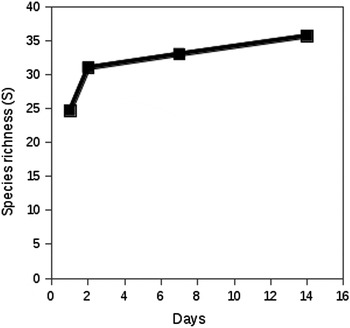
Four replicate plates were placed at each of two mid-intertidal sites. The first site was within the Marine Reserve at Las Cruces at a location where there were no mussel beds and where the presence of the mussel Perumytilus purpuratus was infrequent (less than 5% cover) and restricted to crevices. Primary cover at this site consisted of bare rock, encrusting algae and the barnacle Jehlius cirratus. The second site was outside the Marine Reserve (approximately 100 m distant) where the mid-intertidal is dominated by extensive mussel beds. The plates at the outside site were placed into 150 mm diameter spaces cleared in the mussel bed. The mussels and organisms removed from the cleared area were retained in order to compare the ‘mature’ species richness present in the mussel bed and the species richness encountered on the plates. The mussel plates were deployed for a period of two weeks. Rapid colonization of artificial and defaunated natural substrates by meiofaunal organisms is known to occur (Atilla et al., Reference Atilla, Wetzel and Fleeger2003). Plastic pan-scrubs (‘Tuffys’) placed in the intertidal in the marine station were rapidly colonized by meiofauna and small mobile invertebrates (Figure 2; M. Lee, unpublished data).
Colonization of ‘Tuffys’, plastic pan scrubs, over time by mobile fauna.

At the end of the two week period the mussel plates were returned to the laboratory for processing. The mussels and associated fauna were stripped and washed from the plate into a plastic container and fixed with 10% formalin for at least four days. Organisms were removed from the dismantled mussel matrix by decantation with the heavier organisms being picked out by hand. Animals were then sorted into groups (i.e. polychaetes, molluscs, crustaceans, etc.) and then further sorted into morphospecies for identification. Meiofauna are typically defined as animals small enough to pass through a 1 mm sieve. However, this definition was not taken literally in this study. Many vermiform species, polychaetes, turbellarians and nemertines for example, can expand and contract their bodies to a considerable degree in order to move through the interstitial spaces of the mussel bed matrix. Thus some species may well be able to pass through a 1 mm sieve whilst alive but not once dead, as fixation in formalin usually causes the specimen to both contract and stiffen. Therefore the ability of the species to take advantage of the interstitial space when alive was taken into consideration when classifying it as either macro- or meiofauna. Due to the nature of the experimental set up only animals small enough to pass through the cages were sampled, this set an upper limit on macrofauna as species whose smallest body dimension was less than 10 mm. This will have excluded the adults of many mollusc, decapod and echinoderm species commonly encountered on mussel beds, but which have been extensively studied in this context elsewhere (Durán & Castilla, Reference Durán and Castilla1989; Prado & Castilla, Reference Prado and Castilla2006). Multivariate statistical analyses, including cluster, non-metric multidimensional scaling (nMDS), analysis of similarities (ANOSIM) and similarity percentage (SIMPER) tests were conducted using PRIMER (ver.6, Primer-E, Plymouth). Finally, one-tailed t-tests were conducted using R (R Core Development Team, 2010).
RESULTS
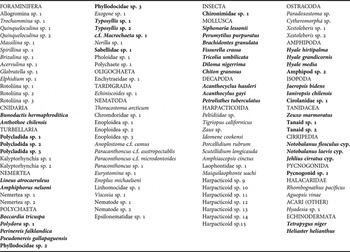
One hundred and five species, or morphospecies, were identified in total (Table 1) of which 64% were classified as meiofaunal. The most abundant macrofaunal species were the amphipods Hyale grandicornis and Hyale hirtipalma. The most abundant meiofaunal groups were the harpacticoid copepods and the nematodes. All the species identified to species, rather than morphospecies, are included in the lists associated with a recent review of the diversity of benthic fauna in Chile (Lee et al., Reference Lee, Clarke, Fernandez, Gonzalez, Rozbaczylo, Valdovinos, Hermosilla, Prado and Castilla2008). Those identified only to morphospecies, may or may not be new records for Chile or new species to science, only further research will determine their status.
List of the macrofauna and meiofauna associated with mussel beds, both natural and on plates, from the Marine Reserve at Las Cruces and from an adjacent rocky shore. Species defined in this study as macrofaunal are highlighted in bold.

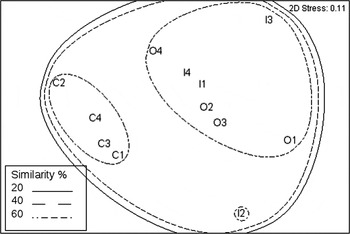
The natural mussel bed samples had maximum species richness (Smax) of 83 and the plates, both inside and outside the Reserve, had maximum species richness of 70. The mean species richness (Smean) for the natural mussel beds was 51.75, for the plates outside the reserve it was 40.25, and for the plates inside the reserve it was 40.75. The percentage of the species richness recorded as meiofaunal was 79% for the natural mussel beds and 67% for the plates, both inside and outside the Reserve. nMDS analysis (Figure 3) indicated that the species richness on the plates inside and outside the Reserve were not significantly different. However, the natural mussel bed samples form a distinct group separate from the plates. The contour lines on the plot indicate that all the samples exhibit over 40% similarity in composition. SIMPER analyses indicated that the similarities between the natural mussel bed samples and the samples from plates outside and inside the Reserve were 58.38% and 56.05% respectively. Within each of the sample groups similarity was generally in excess of 60% with one inside sample (I2) being clearly distinguished from the rest. However, despite this SIMPER analysis indicated 60.66% similarity within the inside plate samples. ANOSIMs indicated that there were significant differences between the samples (Global R = 0.429, P = 0.003). However, in pairwise comparisons the differences between the natural mussel bed samples and the outside and inside plates were identical and marginally significant (R = 0.688, P = 0.029). Furthermore, there was no significant difference between the two sets of plates, outside and inside the Reserve (R = −0.094, P = 0.800).
Non-metric multidimensional scaling analysis of the species richness of assemblages associated with natural mussel beds (C) and ‘live’ artificial mussel beds on plates, placed inside (I) and outside (O) a Marine Reserve.

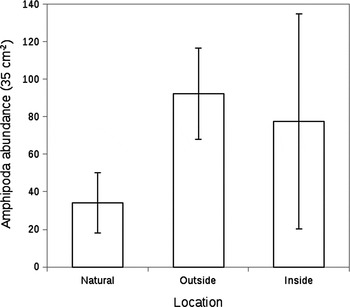
A one-tailed t-test comparing the amphipod abundances in the natural mussel bed samples with the amphipod abundances on the plates outside the Reserve (Figure 4) indicates that abundances on the plates were significantly higher than in the natural mussel bed samples (t 0.0005,7 = 5.41, P = < 0.0005).
The abundance of Amphipoda on the plates inside and outside the Marine Reserve and in the natural mussel bed samples.

DISCUSSION
The results of this study suggest that the ‘live’ artificial mussel beds become populated by a large number of species of meiofauna and small mobile macrofauna which have a similarity to natural mussel beds in excess of 50%. Species richness was higher in the natural mussel bed samples than on the plates. However, we cannot be sure whether this suggests a genuine reduction in species richness of the assemblages within the Reserve or is simply due to sampling artefact. Species richness on the plates outside and inside the Reserve was not significantly different. Therefore, it is possible that the differences with the natural mussel beds were due to sampling artefact; the assemblages on the plates did not reach maturity due to the absence of more sedentary invertebrates, such as tube dwelling polychaetes.
The species richness described in this study compares well with the study of Prado & Castilla (Reference Prado and Castilla2006) conducted in the same area. In their samples they identified 92 species, mainly small macrofauna, compared with 105 in the current study, both small macrofauna and meiofauna. Of the species identified by Prado & Castilla (Reference Prado and Castilla2006) 61 were not identified in the current investigation, suggesting that the true diversity associated with P. purpuratus beds in central Chile could be in excess of 166 species, of which around 38% could be classed as meiofaunal. Many of the species found by Prado & Castilla (Reference Prado and Castilla2006), but not found in this investigation, fall into two categories. Firstly, sessile fauna, typically tube dwelling polychaetes that do not move from one microhabitat to another after recruitment. Secondly, large mobile grazers and predators too large to pass through the 10 mm mesh of the cages used to protect the plates; these are predominantly molluscs and decapod crustaceans which made up 48% of the fauna found by Prado & Castilla (Reference Prado and Castilla2006).
We could not find any reference in the literature to the biodiversity of meiofauna associated with mussel beds where an attempt to identify all species had been conducted. However, there are a number of studies analysing the diversity of meiofauna associated with the phytal habitat, which contains a number of complex microhabitats which may share many species in common with the mussel beds (M. Lee, personal observation). Gee & Warwick (Reference Gee and Warwick1994) looked at how diversity was related to the fractal dimensions of algae on the Isles of Scilly, south-western United Kingdom. They found a total of 253 species, both meiofauna (158) and macrofauna (95), with harpacticoid copepods and nematodes dominating the meiofauna, 131 species out of 158. Atilla et al. (Reference Atilla, Wetzel and Fleeger2003) examined the immigration of meiofauna on to artificial substrates in Louisiana, southern United States. They recorded a total of 44 species of nematodes and harpacticoid copepods compared to 32 in the current study. Frame et al. (Reference Frame, Hunt and Roy2007) used ostracods in turf forming algae as a representative group to study the biodiversity of rocky shore meiofauna in southern California, western United States. They recorded 22 species of ostracods compared to only 4 in the present study, however more than 15 species of ostracods have been seen in mussel bed samples from central Chile (M. Lee, unpublished data) and Frame et al. (Reference Frame, Hunt and Roy2007) did state that they thought that the turf forming algae may be disproportionately important in terms of overall meiofaunal biodiversity. Clearly, meiofauna are an important component of rocky shore biodiversity, but there is a need for more studies to determine how important they are, and their ecological roles. Currently we lack a comprehensive species list for meiofauna in different habitats, which greatly increases the difficulty and time required for analysing samples. This issue is currently being addressed, for nematodes at least (M. Lee, Fondecyt Proyecto No. 1080033).
The species richness of meiofauna and small mobile macrofauna within various microhabitats in the intertidal seems to be related to the complexity of the habitat available rather than being habitat specific (Hicks, Reference Hicks1977; Gee & Warwick, Reference Gee and Warwick1994; M. Lee, unpublished data) and supports the idea of redundancy of habitat provision outlined by Kelaher et al. (Reference Kelaher, Castilla and And Prado2007) for micro-mollusc assemblages along the coast of central Chile. The microhabitats provide a spatial refuge for many fauna from the physical stress of life in the intertidal and larger predators. These microhabitats also trap organic material which forms the base of a food web that includes detritivores, biofilm grazers, herbivores and predators. The lack of a significant difference between the species richness on plates outside and inside the Marine Reserve suggests that though the mussel bed is largely unavailable as a microhabitat within the Marine Reserve there are sufficient other microhabitats available, predominantly the various species of macroalgae and mussels confined to crevices, that support a similar species richness of fauna to that found outside the Marine Reserve.
The findings of this study suggest that the radical changes in the structure of the intertidal rocky shore in central Chile do not necessarily result in a loss of species richness. The alternative stable state for the structure of the mid-intertidal in the absence of human predation of the keystone predator Concholepas concholepas, as found at ECIM, supports a similar species richness of fauna to the dominant stable state of extensive mussel beds that results from the removal of C. concholepas. Therefore, sites physically disturbed by human activity may lose some of the large macrofaunal species, but as long as sufficient complex micro-habitats remain the majority of the faunal diversity will also remain at the site. Conservation strategies should therefore focus on maintaining habitat diversity as the best way of safeguarding overall biodiversity. This study did not address the impact that the differences in the structure of the mid-intertidal and the availability of microhabitats have on the abundance, biomass or productivity of the small mobile macrofauna and meiofauna. The overall meiofaunal contribution to the rocky intertidal in South Africa was calculated by Gibbons & Griffiths (Reference Gibbons and Griffiths1986). They suggested that meiofauna account for 99% of the abundance of fauna in the rocky intertidal, 8% of the biomass and 25% of the productivity. Clearly these figures will vary depending on the cover of suitable microhabitats in the intertidal, but they indicate the importance of the meiofaunal taxa to the intertidal ecosystem.
One of the advantages of the ‘live’ mussel beds as sampling devices is that they allow different areas to be assessed using a uniform sampling strategy, irrespective of the nature of the intertidal. The results presented here show that the target fauna will migrate to the plates within a short period of time and be representative of the fauna generally inhabiting the area. The use of plates also allows sampling to take place in areas that are sensitive to disturbance as it avoids the need for destructive sampling, it can also be used in impacted sites where the mussel beds may have been destroyed to assess further the extent of the impact. As illustrated in this paper, the plates are a better way of sampling the small highly mobile macrofauna, specifically the amphipods, when compared to the standard methodology of scraping a sample of the habitat off the rock. That physical disturbance of scraping induces an escape response in the amphipods (M Lee, personal observation) reducing the number that will be captured, and thus an underestimate of their abundance. With the plates there is no opportunity for the amphipods to escape. Finally there is a suggestion that the plates could be used to study the recruitment of the macrofauna which are most commonly associated with mussel beds, for example the Acanthocyclus crabs (E. Weiters, personal communication). The samples in this study contained abundant juveniles and recent settlers of these genera.
ACKNOWLEDGEMENTS
M. Lee received FONDAP—Chile support under a Postdoctotal Fellowship, also the Mellon Foundation—PUC Research Program (S. Navarrete and J.C. Castilla), contributed to this study. We acknowledge financial support from Program FONDECYT–FONDAP Center for Advanced Studies in Ecology and Biodiversity (Project No. 1501-0001) to the Pontificia Universidad Católica de Chile.