The significant concern presented in this work is the ‘openness’ of information and how it presents as learning material on BowerBird's Djurrwirr Project, developed with Kathy Guthadjaka at Charles Darwin University's Northern Institute and in collaboration with Dr Gary Kong of the Plant Biosecurity Cooperative Research Centre (PBCRC) (http://www.pbcrc.com.au/), based in Darwin, Australia and the creator of BowerBird and senior curator of entomology at Museum Victoria, Dr Ken Walker.
Djurrwirr is Guthadjaka's project page on BowerBird where, much like Facebook or other social media platforms, corresponding information about biodiversity sightings can be added by others. The design of the site calls into question the ways Traditional Ecological Knowledge (TEK) can be presented and how information is organised due to the diversity in how western and Yolŋu epistemologies inform processes of learning. These multiple forms of knowledge organisation, representation and transmission can offer learning platform designers opportunities to extend the benefits of sharing valuable local knowledge into deeper, applied learning processes which motivate a range of learner populations. The openness of the site also calls into question the extent to which TEK can and should be presented on an open educational resource (OER) like BowerBird.
Because Djurrwirr's content is presented in compartmentalised categories, yet is traditionally taught by placed-based ‘learning on country’ (Fogarty & Schwab, Reference Fogarty and Schwab2012; Ford, Reference Ford2010) methods, the learning design of sites such as BowerBird can potentially be inspired by this knowledge.
Definitions of ‘Open’
Because open education could be considered a fairly broad concept, some refining of what niche of the context this paper is concerned with will now follow. The United Nations Educational, Scientific and Cultural Organisation (UNESCO) defines OERs as: ‘any type of educational materials that are in the public domain or introduced with an open license. The nature of these open materials means that anyone can legally and freely copy, use, adapt and reshare them’ (UNESCO, 2015).
‘Openness,’ in this case, is of concern to TEK whereby the learning it can afford on an open platform could very well deepen the learning experience and appreciation of knowledge from a range of backgrounds. The copying, adapting and reuse of resources, however, could put this in danger of misuse. It is in this sense that the appropriately designed and ‘opened’ learning of TEK is of concern in this paper. Additionally, open educational practices (OEPs) have been defined in a number of ways, and have been emphasised by many as central to distinguishing learning content from learning processes. OEPs are defined as practices which support the (re)use and production of high quality OERs through institutional policies, promote innovative pedagogical models, and respect and empower learners as co-producers on their lifelong learning path (Ehler, Reference Ehlers2010). This emphasis on processes and practices complements the learning approaches outlined below in the literature review.
This paper uses this definition of OEP with specific focus on innovation in pedagogy. The practices and resources which we attempt to further refine convey TEK so that the integrity and beneficial purpose of OEP can co-exist with the multidisciplinary presentation of bio-science and TEK. In this way, it is hoped that traditional owners and learners that share this knowledge may continue to benefit from this practice and use of resulting OERs, and that the openness of the resources protects and respects, as well as presents in ways that align with their sources in a collaborative way.
This is significant because the TEK which Guthadjaka has shared on the website could be classified as intellectual property of the language and knowledge authorities of the Country (meaning the land) from which it has grown over thousands of years. Open access to this knowledge can therefore place it in jeopardy by misappropriation of others while promoting and preserving it in scientifically-informed presentation. As this TEK and language is endangered, it could be argued that it requires different management from other forms of knowledge that are openly shared and repurposed in this transdisciplinary learning environment.
Gadgil, Berkes, & Folke (Reference Gadgil, Berkes and Folke1993) discuss Indigenous knowledge for biodiversity preservation, outlining how TEK's diachronic knowledge could complement western science's synchronic knowledge for the benefit of increased resilience and biodiversity of fragile environments. They also acknowledge that, from a western scientific point of view, there are limitations in framing TEK beyond utilisation-focused information, and that this can be addressed by Indigenous people managing their own information and resources. This western framing of Indigenous epistemology and the potential for evolution of this relationship is a significant theme of this paper.
Principles which are in Effect in this Context
A number of principles are at work here. First, Traditional Knowledge should be protected. Given its history of being assimilated and appropriated, but also ignored, undermined and dismissed by the western academic mainstream until fairly recently, the survival of the knowledge that remains in practice on Country demands its respect more than ever (Nakata, Nakata, Keech, & Bolt, Reference Nakata, Nakata, Keech and Bolt2012; Rigney, Reference Rigney2001). Secondly, education is a universal entitlement. Open education and university initiatives, as with distance education, were developed on the foundation that everyone should have access to an education (Maslow, Reference Maslow1943; Moore, Reference Moore and Keegan1993). The incorporation of TEK with western science can also greatly benefit western science and conservation/land management in its effort to protect biodiversity in fragile environments, preserve native species and record changes in various ecosystems. As BowerBird's Djurrwirr page is designed as an informal, crowd-sourced learning tool, the presentation of TEK in this context is beneficial to public learning audiences in raising awareness of the depth of Yolŋu knowledge. Thirdly, we exist in a knowledge economy and this has implications for how we value information. The methods of western scientific and technocratic knowledge management (Nakata et al., Reference Nakata, Nakata, Keech and Bolt2012; Rigney, Reference Rigney2001) can also have a marginalising effect on the knowledge from other world views. Nakata et al. (Reference Nakata, Nakata, Keech and Bolt2012) state that the approaches to incorporate Indigenous knowledge into academia have been rushed and tokenistic and that this approach has produced a dualistic, positivist view that is reductionist in nature. Making this ‘effort to think about’ (Nakata et al., Reference Nakata, Nakata, Keech and Bolt2012, p. 133, citing Gordon, 2006) is an invitation to work beyond this dualism and reductionist approach to diverse epistemologies with integrity that honours them. The tension created by the first two principles in seeming opposition to each other is enhanced by their positioning within the knowledge economy.
The use of TEK in contexts such as open learning platforms has implications for how it is presented, positioned and respected. This also points to the instructional directive the TEK presented on BowerBird has for the design of these and other resources.
Literature Review
A number of learning approaches and concepts will now be presented for their relevance to this situation. Freire (Reference Freire1970, p. 74) speaks of authentic education being a collaborative process carried out with the learner, and that ‘. . . education is . . . the organised, systematised and developed representation to individuals of the things about which they want to know more’. He goes on to say that: ‘One cannot expect positive results from an education or political action program which fails to respect the particular view of the world held by people. Such a program constitutes cultural invasion, good intentions notwithstanding’ (p. 76).
While this could be read as respect for learners’ views, it also applies to the views of people from which the knowledge comes. Freire's presentations of these types of educational programs can echo the potential for the scientific management of TEK to constitute an invasion of sorts. Without the ‘effort to understand’ (Nakata, et al., Reference Nakata, Nakata, Keech and Bolt2012) and ‘represent’ (Freire, Reference Freire1970, p. 74) information such as TEK authentically and collaboratively, there is a potential for misrepresentation and misunderstanding of this knowledge. Knowledge can then be compartmentalised without presenting it embedded in its original context; that is, the process of learning on country. This method and epistemology is steeped in complexity that has developed over millennia, and this paper attempts the ‘effort to understand’, albeit incrementally, and inquire into knowledge representation beyond that which it critiques in Djurrwirr's page design.
Yolŋu and Warramirri Learning
Djurrwirr's author, Guthadjaka (Reference Guthadjaka and Christie2010) speaks about the direction of learning in Yolŋu teaching and learning environments, and how learning on country embodies a strong connection to the place where the learning process happens. Without this, the knowledge gained has no grounding. Guthadjaka describes the learning that happens on country as similar to a joining of tributaries; that learning comes from a series of places and sources, as opposed to the one learning object, teacher, book or whiteboard. This could be interpreted to mean that we need to learn from our environments, so the more rich that environment is with information, senses and stories, the deeper the learning can be: ‘the children will learn the land, and who she/he is, and the stories, and where the breeze is blowing from and where it is going, because that child has breeze on his skin, he knows’ (Guthadjaka, Reference Guthadjaka and Christie2010, p. 30). This directs the design of learning objects and open resources to collaborate with the complex world views of disciplines such as Yolŋu science and ecology and ‘represent’ the knowledge to people in a way that can collaborate with a range of learning approaches.
Guthadjaka's framing of learning aligns with the participatory approach to situated learning (Lave & Wenger, Reference Lave and Wenger1991), particularly the sense of belonging which arises from participating in learning in an (open) community of practice. As opposed to being a passive recipient in the banking (Freire, Reference Freire1970) model of teaching and learning, legitimate participation in learning as a collaborative endeavour, in this sense, includes the attempt to understand the world view and learning processes of the knowledge system from which the TEK content has been sourced. As illustrated below, one such source of learning practice which can complement Yolŋu learning on country is outdoor education.
Outdoor Education
Outdoor education emphasises relationships of people to their environment as a most important feature of successful learning experiences (Priest, Reference Priest1986). Taken online to an open platform, the potential for the features of one's surroundings to be mirrored by the learning environment expands the possibilities for learning design. In his doctoral thesis, Fogarty (Reference Fogarty2010) discusses the synergies perceived between school and ceremonial, on-country learning that is highly prevalent in the town of Maningrida in the Arnhem Land region of the Northern Territory (NT). He reiterates that pedagogy of learning on country is a discourse that should include those that are doing the learning, and frames the highly legitimate learning and lawful education gained in family structures in the region. How this can add value to this study of the BowerBird platform is that it is another layer of inspiration that aligns with place-based meaning co-creation, in harmony with the features of the environment as a guide.
Distance Education
The theory of transactional distance (Moore, Reference Moore and Keegan1993) can also come to bear on this work, as distance education could be said to have informed open educational approaches. The ‘interplay amongst the environment, the individuals and the patterns of behaviour in a situation’ (Apps, Reference Apps1980; Boyd, Reference Boyd1966) occurs in a special distanced relationship between teacher and student. This ‘open platform of transaction’ can afford rich learning while at the same time allowing for misdirected presentation of some learning material because of its apparent shapelessness. The transactional distance in the context of this work on BowerBird, then, could be seen to be determined not just by the openness of the platform which serves as a communication tool, but also in the framing and behaviours of how the information is communicated and organised. These behaviours can also be seen to affect and determine the extent of legitimate participation and therefore deeper learning in BowerBird. Means of communicating the instructional dialogue is an important feature of the site (Moore, Reference Moore and Keegan1993). While Moore contends that interactive dialogue, despite the media, is more likely in the social sciences and that courses in sciences do not lend themselves to this kind of interaction, the potential for the more interactive design of BowerBird could lead to a more fertile transactional distance if collaborative theories and approaches were taken to develop a more directive use of this social media. This is despite it being an informal and voluntary community, which could be characterised by the inherent motivation of its members. Given this mirroring of some of Moore's suggestions for structured design (student creation of knowledge, supporting motivation and the presentation of information), contextualised interaction in a community of open practice on platforms like BowerBird is more likely.
In more recent studies of online education, a key problem for distance learning is its ability to engage learners. Xiao (Reference Xiao2012) and King (Reference King2012) showed that online student attainment was lower than on-campus students’. Xiao cited distance language learners’ need to have an affective element to their learning to bolster performance. King's (Reference King2012) work also suggests that the demands of distance learners may also be in conflict with lecturers’ online delivery skills. This reinforces the educators’ and learning designers’ role as collaborators, taking into account the needs of the students. The motivating, cooperative elements associated with learning about and engaging in open practice and flexible delivery could provide this affective support and enhance outcomes and engagement for online learners. Such engagement could stem from a shift in emphasis towards deeper learning practices such as OEPs defined above and explored in more detail below.
Open Education Practice: Is the Power in Resources or Practices?
Geser (Reference Geser2012) emphasises OEPs as requiring distinction from the emphasis on content and tools reflected in the range of literature in the OER landscape, mirroring the distinction Freire (Reference Freire1970) made between systematic education and educational projects. This ‘dominat(ion) by a traditional understanding of education as well as relevant content and tools’ (Geser, Reference Geser2012, p. 23) reinforces prescriptive content- and assessment-focussed learning design due to ‘national policies and statutory laws, particularly curriculum and qualification frameworks’ (McGreal, Kinuthia, Marshall, & McNamara, Reference McGreal, Kinuthia, Marshall and McNamara2013, p. 34). In keeping with the required shift in power to engage the learners in taking responsibility for their own learning design, the use of resources in open practice would seem to be the evolution which would lead to more authentic learner participation and competence in emergent workforces via informal learning projects like BowerBird. In these shifting power dynamics, then, there could be room for knowledge systems and learning approaches having power and direction over design of platforms.
21st Century Competence
Lee, Lau, Carbo, & Gendina (Reference Lee, Lau, Carbo and Gendina2013) outline 21st century competences. These skills could be argued to be beneficial in many workplaces, social situations and learning environments, but how they are taught in content- and assessment-dominated systems could pose more questions not just about pedagogy, but what content and skills have been valued in educational provision up to this point in time. The potential for the situated knowledge from Guthadjaka's Djurrwirr page to incorporate these skills can drive collaborative innovation in how learning environments are designed, leading to a more authentic learning experience that Freire, Moore, Lave and Wenger, outdoor educationalists, learning on country teachers, and OEP proponents endorse. Flipping power dynamics in these ways could enhance the collaborative nature of learning design to ensure that the knowledge and its authorities govern the learning required. This attempts to acknowledge and respect cultural variations in approaches to learning.
The Cultural Interface and Learning Processes in New Regions
Taking care to acknowledge the positioning of ourselves in relation to how we work with learning design, TEK and the western scientific constructs, as recommended by Nakata (Reference Nakata2007), are key to attempting a respectful interaction with knowledge systems in the cultural interface (Nakata, Reference Nakata2007). Nakata emphasises the importance of being aware of the conceptualisation of Indigenous Knowledge in teaching contexts as potentially being simplistically perceived by ‘scientific paradigms as everything that is “not science”.’ He highlights the ‘disintegrations and transformations (that) occur when it is redistributed across western categories of classification, and managed in databases via technologies,’ (Nakata, Reference Nakata2007, p. 9) and the need for ‘curriculum design to . . . create opportunities for learners to achieve a balance of knowledge, skills and processes for exploring disciplinary boundaries’ (Nakata, Reference Nakata2007, p. 13). Thus, more emphasis is placed on those working amongst the knowledge systems, not in one or the other. Nakata's call for ‘a more sophisticated view of the tensions’ (Nakata, Reference Nakata2007, p. 12) in an effort to mediate the tendency to reduce our conceptualisation of diverse knowledge systems into dualisms can also be aligned with Christie and Verran’ s (Reference Christie and Verran2013) promotion of using digital practices to ‘see digital files not as containing knowledge (through the conventional practice of representation) but as artefacts as previous knowledge-making episodes that were being enlisted and configured for very lively conversations’ (Christie & Verran, Reference Christie and Verran2013, p. 307). This reinforces digital records and transmissions of TEK not as ‘things’ but process-driven and directed practices. This practice serves as a directive to be paralleled in learning platform design which we are promoting for sites such as Bowerbird.
Cultural Border Crossings
Le Grange (Reference Le Grange2007) discusses the education of scientific concepts in Indigenous communities in South Africa. Addressing the teaching of these concepts which may cause cognitive dissonance in students from different knowledge systems, Le Grange argues, is key to successful interaction between western and (in this case) South African world views. Learning designers’ potential understanding of this interaction and their ability to manage discourses related to this matter is what Le Grange (Reference Le Grange2007, p. 581) says effective learning depends on. This also parallels with Freire's respect for world views (Reference Freire1970) and Cummins’ (Reference Cummins1996, Reference Cummins2000) collaborative relations of power in that an acknowledgement of the realities of the students and their identities (and the nature of the knowledge) can lead to a more equal positioning of world views.
Le Grange also discusses the performative and representative natures of scientific knowledge. One can regard knowledge in this way as ‘theories and laws’; or as ‘the doing of science, that is, science is a human and social activity that is messy, heterogeneous and situated.’ (Le Grange, Reference Le Grange2007, p. 587). This also ‘enables seemingly disparate knowledge traditions to be integrated so as to disrupt the dichotomy between western science and African indigenous knowledge’ (p. 587). It aligns with the call for practices which acknowledge the cultural interface (Nakata, Reference Nakata2007) and ‘knowledge-making episodes’ (Christie & Verran, Reference Christie and Verran2013, p. 307).
So, it could be up to learning designers to make the border crossing into another paradigm in an ‘effort to understand’ (Nakata et al., Reference Nakata, Nakata, Keech and Bolt2012, p. 133) and therefore collaborate more with a range of thinking held by traditional knowledge holders and learners alike. Systemically, then, there is a call for a positioning of Indigenous knowledges as mentioned above; one which addresses the complexity and depth required to reconcile western scientific approaches with Indigenous knowledge systems in an ‘effort to think about’ (Nakata et al., Reference Nakata, Nakata, Keech and Bolt2012, p. 133). However, in contexts such as open learning platforms, the delivery depends on learning designers’ abilities to recognise, embody and scaffold this effort as well.
The relevance this point has to the BowerBird context is that it is transferrable to how any body of knowledge can be either stated as representative of reality, or as a performance that requires social interaction. Le Grange (Reference Le Grange2007) argues that making this distinction allows for the social aspect of teaching and learning to be acknowledged. It therefore can be interpreted as inclusive of a multiplicity of knowledge systems, not a dichotomy that simplifies and reduces knowledge systems to agency-like or tokenistic formats which the western scientific and academic approach would have categorised and ‘answered.’ This acknowledgement of differing world views may seem a simple step but enables more collaborative relations between participants in the learning exchange that hold parallels with the English as Another Language or Dialect (EAL/D) theories outlined in the next section.
English as Another Language (EAL) Theory
Cummins’ (Reference Cummins1996, Reference Cummins2000) concepts of context embedded and cognitively demanding learning adds to the approaches which aid further innovative learning design involved in OEP and resources such as BowerBird. The immersion of 21st century competences (Lee et al., Reference Lee, Lau, Carbo and Gendina2013) in learning design enhances the contextual significance and cognitive demand on learners. While Cummins’ focus was second language acquisition, the application of this concept to any skill could illustrate the layering of innovative pedagogical approaches that interactive and ever-evolving social media can facilitate. Given multilingual learners’ likely use of OERs due to their increasing availability worldwide, this application seems an appropriate practice. Cummins also argues that this embedding approach fosters a more collaborative relation of power, in contrast to coercive relations of power (Cummins, Reference Cummins1996, Reference Cummins2000). These collaborative power relations could enhance online and open learning and perhaps bring about more ‘on earth’ outcomes for participants in these communities of practice, via more motivating approaches, such as those mentioned next.
Audience and Motivation
Mirroring Moore's (Reference Moore and Keegan1993) contention that allowing for student motivation is central to successful distance learning programs, motivation could also play a large role in participation in an open community of practice. Bruning and Horn (Reference Bruning and Horn2010), and Magnifico (Reference Magnifico2010) discuss aspects of motivation to learn and identify the need for authentic contexts and goals, supportive skill development and positive emotional environments, as well as the role of audience in fostering motivation. In using OEP, the authentic contexts possible, as well as motivational aspects of having an immediate audience for one's sharing, could be a motivator for participant learners as they come to see the relevance of learning to cultivate specific workforce, learning participation and 21st century competences.
This dynamic grants learners the opportunity to assert power over their learning. Teacher-learning designers, too, have an opportunity to adapt their roles into a more collaborative form, embodying a different balance of power relations. This can also be illustrated through Crowd Learning such that the ‘role for the educator in a system of crowd sourced and self-directed learning is to indicate what resources are available, help learners to diagnose their needs, and support a variety of study methods’ (Sharples et al., Reference Sharples, McAndrew, Weller, Ferguson, FitzGerald, Hirst and Gaved2013, p. 22).
The variety of methods here are the use of more innovative, embedded layers of design that utilise the richness of technology; attempting to emulate on-country, outdoor and context-embedded learning as much as possible. These practices reinforce the contextual potential of using digital resources. It is not sufficient to merely use a digital resource and assume that the medium it is in will enhance educational outcomes. According to Wallace (Reference Wallace, Pachler, Pimmer and Seipold2011, p. 120): ‘Technologies cannot be used uncritically; rather they are used within social contexts. It is important to understand the relationship between social, cultural and physical contexts in which learners and (mobile) technologies operate’.
Wallace goes on to note that the ‘role of digital technologies in improving the educational opportunities for Indigenous learners is dependent on the way they are used and connected to people's own lives and purposes (Wallace, Reference Wallace, Pachler, Pimmer and Seipold2011, p. 124). This aligns with the theories discussed above in that collaborative, purposeful, situated and motivating functions need to be added to open platforms in order to meet the specific requirements of a knowledge creating group. This also aligns well with the complexity of biological systems from which the content on the wider BowerBird site is sourced. It is with this in mind that we now turn to the story of how BowerBird's Djurrwirr page was populated, and what we learned about how we could innovate on the design.
Method
The Djurrwirr page was developed as a part of a larger research project focused on engaging remote Indigenous communities in biosecurity surveillance methods as a way to build resilience through functional engagement. Guthadjaka's involvement in developing the Djurrwirr page for BowerBird was borne out of the PBCRC's research theme for Building Resilience through Remote Indigenous Engagement (http://www.pbcrc.com.au/research/secure-future). The hypothesis was that the design of the website would work with Warramirri epistemologies for the purposes of illustrating value in community engagement with biosecurity surveillance.
We felt that demonstrating the potential for remote communities to engage with social media for the purposes of participation in biodiversity research would enhance the findings of the larger project which focused on building a secure future by working with community, government and industry to build engagement in remote northern Australian communities. The pilot idea was to use BowerBird as a tool for gathering some baseline data on the biodiversity of Gäwa and to use BowerBird as a surveillance tool for biosecurity in Indigenous communities. We hoped that what was done at Gäwa could serve as a model for other communities and provide some biosecurity intelligence on remote regions of Australia through Indigenous communities. The outcome of this engagement remains to be seen and the team is still seeking opportunities to develop the design of the page for this purpose. The outcome of conducting this pilot, however, has led to a critical reflection on how the surveillance directive of this pilot highlights the design features of the site as not working with Warramirri epistemology. It therefore could add limited value to surveillance outcomes, by way of restricted engagement of knowledge authorities from which the information has been sourced. Some groups have expressed interest in the resource, but we are also seeking opportunities for a design extension to further engage community groups so they may benefit from the resource.
Reflection on the Process of Recording Information
As part of this pilot, Guthadjaka had photographed biodiversity at Gäwa and posted these as sightings to the Djurrwirr project in BowerBird. Guthadjaka's information about each sighting was recorded with her photographs and this information was uploaded to the appropriate fields. Guthadjaka mainly talked about uses in Yolŋu culture, and the moiety or clan each species belongs to (see Figure 1).
A sample of the information shared by Guthadjaka in the available fields.

When the developers initially started working with Guthadjaka, it became apparent that BowerBird should be able to record aspects of cultural information in order for the sightings to have some meaning for Indigenous communities. This was seen as a motivator to use BowerBird for traditional learning purposes. After receiving this feedback, the developers then included the specific fields in the Description Menu (Figure 2) that relate to traditional information. The design of the page then started to reveal the conflicting principles outlined earlier in this paper, and illustrated in the ‘outcomes’ section below.
Options of fields into which data can be entered.
The existing fields in BowerBird gave guidance as to the kind of information that could be shared about the sightings. These included seasonal variation, stories associated with the species, what the organism marks for other events in the environment (e.g., when a certain flower appears, it signals that stingray hunting season is approaching) and how it is used in Yolŋu culture. Each sighting includes fields for other members to add taxonomy information, ‘like’ a sighting, share a sighting, or add comments or questions.
Guided by these design structures, Guthadjaka shared the Yolŋu season for each species as it appears on the Gurrwilyun seasonal calendar she produced (seven seasons altogether- (Guthadjaka, Reference Guthadjaka2013), and Guthadjaka and Funk added the English months which approximately correspond thereafter. Sightings were recorded using the Yolŋu names and font for each species, and the English equivalent, added in parentheses afterwards. Some fields we left completely blank; such as the ‘Traditional stories’ sections (see Figure 2). This presented the conflicting values and apparent valuing of information for which there were fields and that for which there were none (based on the design of the page).
Outcomes of the Process of Recording
There were pieces of information for which there were no available fields, such as which moiety the species belong to. We added this in the ‘other comments’ section at the bottom of each sighting entry (as seen in Figure 1). This illustrates the apparent disconnect between the design of the fields on the site and Guthadjaka's Warramirri epistemology.
Some sharing has resulted in rare species being discovered. A scientific expert on the species wrote some taxonomy information for the site (Figures 3 and 4). Currently, the distribution of this genus is known from only four records as seen below in Figure 5. This illustrates the biodiversity surveillance value of Bowerbird and its benefit to that knowledge community and evoked some feedback on behalf of its members, via the link to the ALA (Figure 6). How it is valued by Guthadjaka as a food source, however, illustrates how the fields and links to valued information by way of design in this site can highlight the regions where the cultural interface (Nakata, Reference Nakata2007) can offer opportunities for process-directed ‘knowledge-making episodes’ (Christie & Verran, Reference Christie and Verran2013) and innovative design.
The Bäba sighting.
Taxonomy entries led to the finding that the Gäwa sighting was quite rare.
Atlas of Living Australia entries.
Members of the BowerBird community expressed their appreciation.
Discussion
What is notable is that the predesigned fields did not fit the information Guthadjaka decided to share. This raised the concern that perhaps the site design was not in collaboration with Yolŋu epistemology. Yolŋu cultural protocols determine the level of openness with which stories and information are shared with others. The fields provided were not filled exhaustively, and there was information that was consistently given for each sighting for which there was no field. This pointed to the possibility that the western epistemologies and epistemologies inherent in the site's design were in some ways conflicting with the values through which Indigenous Knowledge systems operate and share learning. This is also the conflict which led to this critical reflection paper being written.
While BowerBird was not designed specifically to cater for TEK other than in a ‘knowledge sharing’ way, the fertile tension which presents here is an invitation to make the ‘effort to understand’ (Nakata et al., Reference Nakata, Nakata, Keech and Bolt2012) it further by engaging in reflection on the site's design potential, rather than defer to a reductionist and dualistic representation of knowledge.
In populating the page, we (Guthadjaka and Funk) could have used the predesigned fields to prescribe the information sharing process. However, the platform did not always provide the right boxes for what was shared, so fields that were not relevant were left blank. These factors raised the potential for design change based on what information was deemed valuable or appropriate by all parties. This situation also illustrated how a more process- rather than content-driven design could be conceived.
Guthadjaka, rather than the site design, guided this process, which is respectful of the knowledge system and culture from which the information was coming (Freire, Reference Freire1970). Taking the effort to honour the principles of learning in context, and from country was beneficial to the situation by respecting Guthadjaka's position as an elder and teacher with experience spanning over 40 years. This is upheld by Freire's (Reference Freire1970) contention that collaboration with world views is most likely to be successful, and Fogarty's (2010) notion of pedagogy as a discourse that requires participation with the learner, or in this case, the source of that learning. Freire's successful ‘representation’ (Reference Freire1970) of knowledge to the interested learner in this case can also align well with Guthadjaka's (2010) notions of learning on country by linking the learning that happens online to ‘on earth’ realities and outcomes, hopefully bringing the online learner in these communities closer to the reality of ‘feeling the breeze on his/her skin’ (Guthadjaka, Reference Guthadjaka and Christie2010, p. 30).
This also speaks to the process of acknowledging the cultural interface (Nakata, Reference Nakata2007) in which the process-driven design of learning is situated. Shifting our perception from objectifying knowledge as a thing contained by digital structures to artefacts of knowledge-making episodes (Christie & Verran, Reference Christie and Verran2013) can inform further exploration of disciplinary boundaries via more innovative and respectful learning design of open platforms.
Wallace's (2011) promotion of embedding technologically enhanced and mobile learning in a social context that acknowledges the learner's realities also has relevance here. The knowledge (in this case an elder, a Yolŋu epistemology and on country practices and learning processes) directs the learning so that it has meaning for those who are doing the learning. It is hoped that this is enriched by attempting to reconcile the fertile tension presented between the learning design, western and Yolŋu epistemologies in the knowledge economy.
The theories’ application to further learning design of BowerBird would –– up to this point –– mean that a more interactive and collaborative development of sites like this could be considered. Due to the apparent tensions presented between the scientific-technocratic design of information gathering and dissemination, and the embedded, contextualised and relational learning from on-country processes, there is room to explore possibilities for design. A learner's relationship to his/her environment, supported by outdoor learning theory (Priest, Reference Priest1986) as well as Lave and Wenger's (1991) situated learning and legitimate participation can also be a way to conceive of different design options which would enrich the transactional distance between a learner and learning delivery. Using motivating, project-based (Freire, Reference Freire1970) and structured behaviours (Moore, Reference Moore and Keegan1993), carefully designed transactional distance can house the special relationship between teacher and student and allow for a more collaborative relation of power that emphasises OEP and learning processes rather than just content and resource domination over learning. This also reinforces the need for technology's use to be critically engaged within the social, cultural, and environmental contexts for which they are intended (Wallace, Reference Wallace, Pachler, Pimmer and Seipold2011).
Xiao (Reference Xiao2012) and King's (Reference King2012) concerns regarding distance learners’ attainment and relation to instructors' technical competence sheds light on implications for learning design of open platforms. Learning designers have the technical skills to create an interactive knowledge sharing platform that collaborates with a range of learner identities and aligns with the above theories. This also points to the significance of instructional design representing learning in a range of ways, decentralising the authority from the resource content and emancipating the ability of learners to access information in a range of ways.
Making cultural border crossings in order to relieve cognitive dissonance (Aikenhead & Jegede, Reference Aikenhead and Jegede1999) extends the potential of the instructional designer to present and organise learning platforms differently and acknowledges the complex differences in how people learn and make meaning. The effort to embody socio-cultural aspects of learning from TEK could enhance instructional design from modelling knowledge based on western frameworks to those that are determined by knowledge authorities themselves, as Gadgil et al. (Reference Gadgil, Berkes and Folke1993) suggest.
BowerBird shares its information with the ALA, and from there, people can search the ALA data for specific purposes; meaning the information sharing power is extended and benefits more people. This illustrates its power as a data collection tool for surveillance purposes. However, the direct relationship the Djurrwirr participant has with the learning material and processes the technology affords, can still be extended for use of BowerBird as a learning tool. The information from ALA could be shared back in a more interactive process, enhancing participants’ engagement, as illustrated by the enthusiastic feedback from the participants in Figure 6.
Other projects operated by the PBCRC (Pest Point, e.g., https://www.pestpoint.org.au/) use a more directive, purposeful and enquiry-based approach to information sharing, despite being a private community due to intellectual property and security measures required. Our attempt to use BowerBird to record and share TEK has led to a desire to develop it into a more interactive, dialogic and collaboratively designed, crowd-sourced learning tool. It would then meet the increasing needs of learners, honour the contextualised nature of the source of the information mirrored in the design of the site, as well as reconcile the scientific information management skills required of participants in bio-cultural and biodiversity knowledge systems. This ambitious design plan also embodies much of the motivational, distance, outdoor and on country learning theory discussed earlier by providing authentic, collaborative, demanding, relational, relevant and context-embedded learning experiences which not only share information, but encourage participants to use it for a purpose.
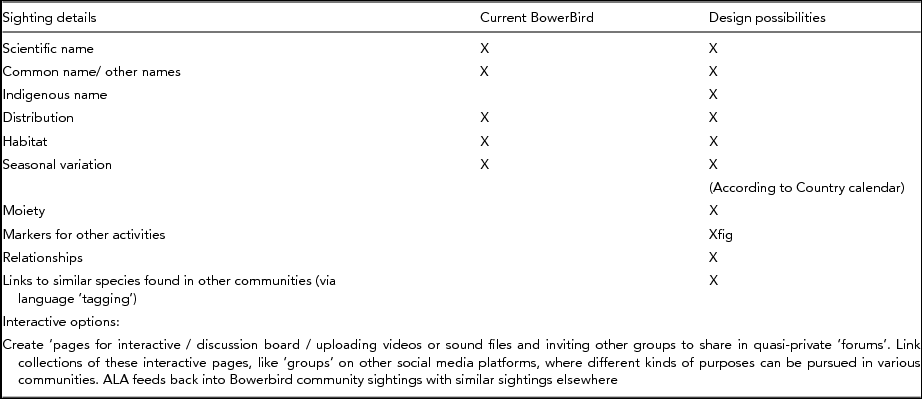
A more directive approach which uses similar design features for problem solving such as the methods ‘Pest Point’ uses would further embed the 21st century competences into the design, be more collaborative with the world view and experience of the knowledge system as well as the learners by addressing their concerns and need for authentic and motivating learning relationships and dialogue. Table 1 above, represents the kind of designs possible for more interactive practices.
Options for Design
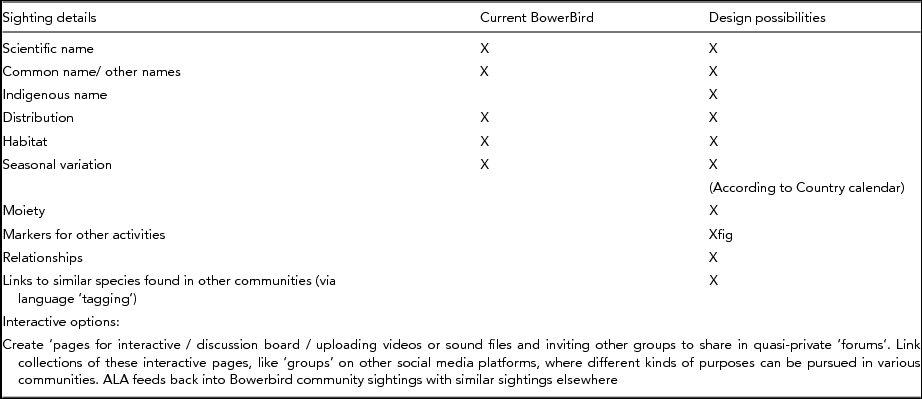
The skills required of 21st century learners could act as an additional design layer of tasks and enquiry based learning experiences which link the variety of content available on crowd-sourced learning platforms like BowerBird to ‘on-earth’ realities for participants. Tasks which involve sourcing iterative cycles of information from the community, for example, rather than just one sighting that people can comment on, could utilise social media technology to create digital pathways for the topics which interest participants the most. The suggested interactive link to the ALA could work in both directions in this context; mirroring the same potential that retweets on Twitter have for information dissemination and sharing, but making it process-focussed rather than content focussed. This can enable exponential sharing of knowledge making episodes (Christie & Verran, Reference Christie and Verran2013), but with a layer of purpose and scaffolded scientific enquiry processes based on local TEK and the desired outcomes of that group. The interactivity would further enhance the need for the process of learning to take precedence, not just the sharing of content.
Future Research Recommendations
We acknowledge that not everyone prefers to learn in the ways described above, and that for some, the content on its own sparks engagement in a learning process that mirrors how information is used and applied ‘on earth.’ Without the layering of 21st century skills and theories mentioned here though, in a purposeful and directive use of information and technology, the capacity for deeper learning and application of knowledge for a wider cohort, is lost. More research into ways this can be self-scaffolded could benefit self-directed learners to adjust the amount of learning design that is required for their own learning. Determining the interests of users and their experiences in engaging with these forms of knowledge could also enhance the design as a connective tool between school and community groups, conservation land management professionals, agriculturalists or biosecurity surveillance networks.
Given the differences in world view perceived by some at the interface between learning design, Yolŋu contextualisation, and scientific information management, it could be easy to see the disciplinary differences as an obstacle to how information is managed. The complexity involved in developing an open platform for sharing TEK and biodiversity, and taxonomical information can also inspire a multidisciplinary approach which could work closely with a range of world views and embrace the complexity that both epistemologies inhabit. The further design of open platforms such as BowerBird could challenge antiquated dualisms and honour the knowledge's source. Ecology-inspired learning design can also offer developments which incorporate more digital pathways between learners, content and processes, and collaborate with different learning and teaching methods.
Conclusion
The potential for dualistic and reductionist positioning of western and Yolŋu epistemologies, presents an opportunity to design interactive websites based on cultural protocols. These sites allow for some scientific data-gathering and means we are moving closer to incrementally merging western scientific practices within an increasingly culturally appropriate practice. Whether this can preserve the scientific integrity of the information gathered and respect the knowledge's authority depends on its accuracy from all perspectives, and the platform's ability to honestly acknowledge that interface in its design and purpose. It also depends on its function as a mutually beneficial exercise for knowledge authorities. Ethically, the positioning and guardianship of TEK also requires diligent logistical effort above and beyond theory. This is a subject too broad to cover extensively in this work. However, by making the ‘cultural border crossing’ into a more collaborative and contextualised approach to open learning of diverse content, we can hope that technology will make use of the fertile tensions in the complex knowledge systems we are privileged to work amongst.
Acknowledgments
The authors first and foremost acknowledge the traditional custodians of the Country that this work was conducted on past, present and future. The authors would also like to acknowledge the work of Dr Ken Walker and the BowerBird Development Team for designing the site and housing Djurrwirr. The inspiration for the design potential would not have been possible without this rich resource.
About the Authors
Johanna Funk is a Research Associate and PhD Candidate at the Northern Institute at Charles Darwin University. As an education professional with experience in inner city schools in London, Johanna began to research how to support the development of marginalised learners within educational structures. Observing how learner identities and language skills can be appreciated and nurtured within these contexts led to her interest in how closely learning systems progress in line with a growing acknowledgement of diversity. Her recent and current work with the Northern Institute has highlighted for her how learning can be expedited by technologies which enable access and engagement for teachers and learners in various contexts.
Kathy Guthadjaka is an Elder on Country Senior Research Fellow at the Northern Institute at Charles Darwin University. Kathy (Gotha) is a senior elder from Gäwa, a small family community on Elcho Island in east Arnhem Land in the Northern Territory. She has worked as an educator since the mid 1960s and has always had a strong interest in research. Gotha is interested in collaborative research projects where she can share her Aboriginal knowledge and expertise. Gotha's research focus is on Warramirri knowledge, language, culture and country, Aboriginal education, both ways education, spirituality, identity and religion.
Gary Kong is a senior scientist at the PBCRC at Charles Darwin University. Gary has worked on PBCRC projects since 2005 taking particular interest in the design and development of digital systems for pest identification. His pioneering work on digital systems for remote identification of plant pests has earned him and his team, Innovation Awards from The Australian Innovation Challenge and the Cooperative Research Centre Association and in 2011, a Premiers Award for Excellence in the State of Queensland. His current interest is in the development of Pestpoint, a mobile app to facilitate the creation of virtual networks for remote pest identification.