Theory and research suggest that variations in parenting contribute to differences in child development (Baumrind Reference Baumrind1991; Maccoby, Reference Maccoby2000). Positive parenting is associated with a number of healthy, adaptive outcomes, whereas low levels of positive parenting may contribute to psychopathology (Bugental & Grusec, Reference Bugental, Grusec, Damon, Lerner and Eisenberg2006; Steinberg, Reference Steinberg2001). In addition, research in developmental and personality psychology over the last several decades has increasingly emphasized the individual's role in influencing his or her own environment, including the rearing environment (e.g., Sameroff, Reference Sameroff and Kessin1983). Developmental systems theories assert that individuals not only passively respond to external stimuli but also actively contribute to the shaping of their environment (Cox & Paley, Reference Cox and Paley1997; Gottlieb, Wahlstein, & Lickliter, Reference Gottlieb, Wahlsten, Lickliter and Lerner2006; von Bertalanffy, Reference von Bertalanffy1968). Personality psychologists argue that individuals' personality characteristics and behavior influence their experiences (Caspi, Reference Caspi, Damon, Lerner and Eisenberg1998; Lerner, Reference Lerner1982). It follows from these theories that individuals likely influence, to some extent, their exposure to risk environments (e.g., lack of supportive parenting or negative parenting) versus optimal environments (e.g., warm and sensitive parenting) for development.
In addition, developmental scientists have increasingly attended to genetic influences on the variability in exposure to particular environments, a phenomenon known as gene–environment correlation (rGE; Plomin, DeFries, & Loehlin, Reference Plomin, DeFries and Loehlin1977; Scarr & McCartney, Reference Scarr and McCartney1983). The majority of evidence for rGE primarily comes from behavioral genetic studies (Plomin & Daniels, Reference Plomin and Daniels1987). Such studies show that a number of experiences, including interpersonal life events and circumstances such as divorce, marital quality, propensity to marry, and social support, are at least moderately heritable (see Jaffee & Price, Reference Jaffee and Price2007, for a review). Behavioral genetic studies among children also show that characteristics of the rearing environment, such as parental discipline, parent emotional overinvolvement, and parental negativity and positivity, are moderately heritable (Narusyte et al., Reference Narusyte, Neiderhiser, D'Onofrio, Reiss, Spotts and Ganiban2008; Neiderhiser, Reiss, Lichtenstein, Spotts, & Ganiban, Reference Neiderhiser, Reiss, Lichtenstein, Spotts and Ganiban2007; Neiderhiser et al., Reference Neiderhiser, Reiss, Pedersen, Lichtenstein, Spotts and Hansson2004; Plomin & Bergeman, Reference Plomin and Bergeman1991; see review by Horwitz & Neiderhiser, Reference Horwitz and Neiderhiser2011).
However, despite the importance of behavioral genetic studies for demonstrating the existence of rGE, heritability estimates cannot indicate which specific genes may be associated with particular environments. For this reason, molecular genetic studies can be especially informative. In particular, molecular genetic studies investigating rGE among youth can advance knowledge on how genetic influences may bring about exposure to different rearing environments. Unfortunately, molecular studies investigating rGE are lacking. Moreover, potential moderators may reduce correlations between measured genetic variants and the environment, making rGE difficult to detect (Jaffee & Price, Reference Jaffee and Price2007). Research efforts generally have not considered moderators that may influence rGE. We hypothesized that parent characteristics, namely, personality traits, might affect associations between child genetics and the rearing environment. Therefore, the main purpose of the present study was to investigate whether an a priori hypothesized association between allelic variability in youths' catechol-O-methyltransferase (COMT) and positive parenting (i.e., rGE) exists and whether this association is moderated by parental personality traits.
Features of Positive Parenting: Effects on Child Development
The general construct of positive parenting has been referred to by a number of diverse labels, including acceptance, support, and affection. A common theme underlying these constructs is the idea that expressions of genuine care and regard are the foundation of quality parenting (Rohner, Reference Rohner1976). Empirical evidence shows that variation in the extent to which parents exhibit positive parenting toward their children is consistently associated with individual differences in child development (Maccoby & Martin, Reference Maccoby, Martin, Mussen and Hetherington1983; Skinner, Johnson, & Snyder, Reference Skinner, Johnson and Snyder2005). High levels of positive parenting are associated with emotion regulation abilities, social competence, and academic success (Bugental & Grusec, Reference Bugental, Grusec, Damon, Lerner and Eisenberg2006; Leerkes, Blankson, & O'Brien, Reference Leerkes, Blankson and O'Brien2009; Steinberg, Elmen, & Mounts, Reference Steinberg, Elmen and Mounts1989). In contrast, low levels are linked with externalizing problems, including aggression and delinquency (Caron, Weiss, Harris, & Catron, Reference Caron, Weiss, Harris and Catron2006; MacDonald, Reference MacDonald1992; Rothbaum & Weisz, Reference Rothbaum and Weisz1994). Low levels of positive parenting are also associated with internalizing problems, including social withdrawal, depressive symptoms, and anxiety (Caron et al., Reference Caron, Weiss, Harris and Catron2006; Cummings & Davies, Reference Cummings and Davies1994; Wood, McLeod, Sigman, Hwang, & Chu, Reference Wood, McLeod, Sigman, Hwang and Chu2003). Positive parenting has also been shown to longitudinally predict social and cognitive adaptive functioning, as well as lower levels of behavioral problems, independently of shared genetic factors between children and parents (Stams, Juffer, & van IJzendoorn, Reference Stams, Juffer and van IJzendoorn2002). Thus, there is support for the idea that parenting behaviors influence child outcomes, ranging from healthy, adaptive functioning to psychopathology.
Although most researchers have investigated the effects of positive parenting as a global construct, others have argued for the advantages of differentiating among multiple dimensions of positive parenting behaviors (Davidov & Grusec, Reference Davidov and Grusec2006; Goldberg, Grusec, & Jenkins, Reference Goldberg, Grusec and Jenkins1999; Grusec, Goodnow, & Kuczynski, Reference Grusec, Goodnow and Kuczynski2000). The parenting literature suggests that parent responsiveness (prompt, contingent, and appropriate responses to child cues) and parent warmth (expressions of positive affect, affection, and approval) are two important features of positive parenting (Baumrind, Reference Baumrind1991; MacDonald, Reference MacDonald1992). Warmth and responsiveness have been shown to be differentially associated with aspects of child outcomes (Davidov & Grusec, Reference Davidov and Grusec2006). Parental warmth has been specifically linked to regulation of positive affect and peer acceptance (Davidov & Grusec, Reference Davidov and Grusec2006; Isley, O'Neil, Clatfelt, & Parke, Reference Isley, O'Neil, Clatfelter and Parke1999; Isley, O'Neil, & Parke Reference Isley, O'Neil and Parke1996), whereas parental responsiveness has been linked to regulation of negative emotion, empathy, attachment security, and academic competence (Davidov & Grusec, Reference Davidov and Grusec2006; George, Cummings, & Davies, Reference George, Cummings and Davies2010; Roberts & Strayer, Reference Roberts and Strayer1987). These findings suggest that it is useful to distinguish between parental responsiveness and warmth because each of these components of positive parenting has specific associations with particular aspects of child outcomes.
Evidence for rGE: Associations Between Child Genotype and Parenting Environments
The literature on rGE has distinguished among passive, active, and evocative rGE (Scarr & McCartney Reference Scarr and McCartney1983; see Rutter, Moffitt, & Caspi, Reference Rutter, Moffitt and Caspi2006, for a review). Passive rGE refers to the influence of parents' genetics on the rearing environment they provide to their children. This particular type of rGE occurs independently of the individual child's actions. Active rGE refers to effects of the child's genes on the selection of environments experienced. Finally, evocative rGE is similar to active rGE, but it more specifically describes the idea that heritable characteristics of individuals may shape how others respond or react to them. All types of rGE affect the variability that individuals experience in their rearing environment, ranging from risky to optimal, and such environments in turn can contribute to individuals' developmental course.
To our knowledge, four studies have examined potential rGE involving measured child genotype and parenting quality, and all focused on polymorphic variants of the dopamine receptor D2 gene (DRD2). Findings show that the A allele in exon 8 and the A1 allele of the Taq1 polymorphism of DRD2 are associated with more paternal rejection and less observed maternal sensitivity/supportive presence, respectively (Hayden et al., Reference Hayden, Klein, Dougherty, Olino, Laptook and Dyson2010; Lucht et al., Reference Lucht, Barnow, Schroeder, Grabe, Finckh and John2006; Mills-Koonce et al., Reference Mills-Koonce, Propper, Gariepy, Blair, Garrett-Peters and Cox2007; Propper et al., Reference Propper, Moore, Mills-Koonce, Halpern, Hill-Soderland and Calkins2008). These findings provide promising evidence that allelic variability in DRD2 is associated with positive parenting behaviors. Such data suggest that genetically influenced child characteristics evoke the type of parenting received. Consistent with an evocative rGE model, Mills-Koonce and colleagues further demonstrated that maternal sensitivity was associated with children's, but not mothers', DRD2 allelic variation.
Yet, rigorous examination of rGE from molecular genetic studies is still scant and limited. First, two of these studies (Mills Koonce et al., 2007; Propper et al., Reference Propper, Moore, Mills-Koonce, Halpern, Hill-Soderland and Calkins2008) reported on data collected from the same sample within one larger longitudinal study. Second, Lucht and colleagues' (Reference Lucht, Barnow, Schroeder, Grabe, Finckh and John2006) study used a retrospective design in which adults recalled past parenting they received during their childhood. Such designs are problematic owing to known biases in recall (Henry, Moffitt, Caspi, Langley, & Silva, Reference Henry, Moffitt, Caspi, Langley and Silva1994). Third, all studies primarily focused on DRD2, and it is unknown whether other dopamine-related child genes are associated with positive parenting. Overall, it is surprising that very little is known about how measured genetic variants among youth may influence exposure to particular rearing environments, given extensive behavioral genetic research demonstrating these rGE.
Associations Between COMT and Behaviors
Dopamine is associated with emotional expression, goal-directed activity, and executive functioning (Thase, Reference Thase, Gotlib and Hammen2009). Therefore, dopamine-related genes may reflect underlying variability in a range of phenotypic characteristics. In addition, stress alters dopamine levels (Nestler & Carlezon, Reference Nestler and Carlezon2006), suggesting that dopamine genes may influence behavior under conditions of stress. The current study investigated the COMT gene because of evidence suggesting that COMT plays an important role in neurobiological processes involved in dopamine signaling that may contribute to phenotypic variation in emotion regulation (Bilder, Volavka, Lachman, & Grace, Reference Bilder, Volavka, Lachman and Grace2004; Dickinson & Elvevag, Reference Dickinson and Elvevag2009; Savitz, Solms, & Ramesar, Reference Savitz, Solms and Ramesar2006).
COMT encodes for the enzyme that modulates dopamine levels primarily in the prefrontal cortex. The methionine (met) allele of the val158met polymorphism is associated with a significant reduction in enzymatic activity compared to the valine (val) allele, which suggests that the methionine allele is associated with higher dopamine concentrations (Meyer-Lindenberg & Weinberger, Reference Meyer-Lindenberg and Weinberger2006; Tunbridge, Harrison, & Weinberger, Reference Tunbridge, Harrison and Weinberger2006). There are conflicting findings about which particular allele is associated with risk, particularly among children (Savitz et al., Reference Savitz, Solms and Ramesar2006). Researchers have theorized that COMT allelic variation results in a trade-off between cognitive efficiency and emotional resiliency, which has been referred to as the “warrior/worrier model” (Goldman, Oroszi, & Ducci, Reference Goldman, Oroszi and Ducci2005). Studies have shown that the valine allele is associated with cognitive problems and poor performance on executive functioning tasks (Akil et al., Reference Akil, Kolachana, Rothmond, Hyde, Weinberger and Kleinman2003; Bilder et al., Reference Bilder, Volavka, ál Czobor, Malhotra, Kennedy and Ni2002; Diamond, Briand, Fossella, & Gehlbach, Reference Diamond, Briand, Fossella and Gelhbach2004; Goldberg et al., Reference Goldberg, Egan, Gscheidle, Coppola, Weickert and Kolachana2003; Tunbridge et al., Reference Tunbridge, Harrison and Weinberger2006), whereas the methionine allele has been implicated in poor emotion regulation (Mier, Kirsch, & Meyer-Lindenberg, Reference Mier, Kirsch and Meyer-Lindenberg2010; Montag et al., Reference Montag, Buckholtz, Hartmann, Merz, Burk and Hennig2008).
In particular, the methionine allele has been linked to negative emotionality and anxiety (Enoch, Xu, Ferro, Harris, & Goldman, Reference Enoch, Xu, Ferro, Harris and Goldman2003; Olsson et al., Reference Olsson, Anney, Lotfi-Miri, Byrnes, Williamson and Patton2005; Reference Olsson, Byrnes, Anney, Collins, Hemphill and Williamson2007; Stein, Fallin, Schork, & Gelernter, Reference Stein, Fallin, Schork and Gelernter2005), elevated startle response (Armbruster et al., Reference Armbruster, Mueller, Strobel, Lesch, Kirschbaum and Brocke2011; Montag et al., Reference Montag, Buckholtz, Hartmann, Merz, Burk and Hennig2008), and increased limbic and prefrontal activation in response to negative stimuli (Drabant et al., Reference Drabant, Hariri, Meyer-Lindenberg, Munoz, Mattay and Kolachana2006; Rasch et al., Reference Rasch, Spalek, Buholzer, Luechinger, Boesiger and de Quervain2010; Williams et al., Reference Williams, Gatt, Grieve, Dobson-Stone, Paul and Gordon2010). The COMT methionine allele has also been shown to be associated with a greater stress response to laboratory stressors, such as the Trier Social Stress Test in adults (Alexander et al., Reference Alexander, Osinsky, Mueller, Schmitz, Guenthert and Kuepper2011; Jabbi et al., Reference Jabbi, Kema, van der Pompe, te Meerman, Ormel and den Boer2007) and in children (Armbruster et al., Reference Armbruster, Mueller, Strobel, Lesch, Kirschbaum and Brocke2011).
Thus, prior research has linked COMT to emotion regulation problems and negative affect. Other studies show that child negative affect is associated with aspects of positive parenting, including warmth and responsiveness (Latzman, Elkovitch, & Clark, Reference Latzman, Elkovitch and Clark2009; Lengua, Reference Lengua2006; Maccoby, Snow, & Jacklin, Reference Maccoby, Snow and Jacklin1984; Owens, Shaw, & Vondra, Reference Owens, Shaw and Vondra1998). In addition, other prior rGE studies have implicated dopamine-related genes (Hayden et al., Reference Hayden, Klein, Dougherty, Olino, Laptook and Dyson2010; Lucht et al., Reference Lucht, Barnow, Schroeder, Grabe, Finckh and John2006; Mills-Koonce et al., Reference Mills-Koonce, Propper, Gariepy, Blair, Garrett-Peters and Cox2007; Propper et al., Reference Propper, Moore, Mills-Koonce, Halpern, Hill-Soderland and Calkins2008). As such, we hypothesized that allelic variation in COMT may be involved in an evocative rGE, influencing parenting behaviors, especially positive parenting.
Moderators of rGE: Potential Associations Among Child Genetics, Parent Personality Traits, and Positive Parenting
Jaffee and Price (Reference Jaffee and Price2007) have identified several challenges in molecular rGE research. In particular, direct main-effect associations between measured genes and complex behaviors are typically small, perhaps because of moderating variables. In the case of an evocative rGE, one possibility is that others' characteristics may moderate the association between an individual's genetically influenced behaviors and the environment. Therefore, it is possible that certain characteristics of the parent moderate the effect of child genetics on parenting. Mills-Koonce and colleagues (Reference Mills-Koonce, Propper, Gariepy, Blair, Garrett-Peters and Cox2007) tested whether maternal characteristics (i.e., stress or depressive symptoms) moderated the effect of child DRD2 on maternal sensitivity, but they found no moderation for these particular variables. To our knowledge, this hypothesis still remains virtually unexplored in the rGE literature.
Personality traits influence social functioning and interpersonal relationships, such as the quality of friendships and intimate relationships (Caspi, Roberts, & Shiner, Reference Caspi, Roberts and Shiner2005). Relatively few studies have investigated whether parent personalities shape parenting behaviors and parent–child relationships in particular. However, Belsky (Reference Belsky1984) hypothesized that parent personality is a major influence of parental functioning in his process model of the determinants of parenting. In the past decade, an emerging body of research has shown that parent personality affects the mood, thoughts, and actions of parents (Belsky & Jaffee, Reference Belsky, Jaffee, Cicchetti and Cohen2006; Kochanska, Friesenborg, Lange, & Martel, Reference Kochanska, Friesenborg, Lange and Martel2004); this work supports the theory that individual differences in parenting behaviors are related to personality characteristics (Belsky & Barends, Reference Belsky, Barends and Bornstein2002; Prinzie, Stams, Dekovic, Reijnjes, & Belsky, Reference Prinzie, Stams, Dekovic, Reijnjes and Belsky2009).
Based on this, we hypothesized that parent personality would affect the strength of the association between parenting quality and child genetic variants. We focused on the traits of neuroticism and extraversion because these are the most consistently replicated personality traits across factor analytic models (Watson, Clark, & Harkness, Reference Watson, Clark and Harkness1994; Zuckerman, Kuhlman, Joireman, Teta, & Kraft, Reference Zuckerman, Kuhlman, Joireman, Teta and Kraft1993), are strongly correlated with affect (Clark, Watson, & Mineka, Reference Clark, Watson and Mineka1994), and have been shown to be especially relevant for relationship processes and parenting behaviors (Belskey & Barends, Reference Belsky, Barends and Bornstein2002; Robins, Caspi, & Moffitt, Reference Robins, Caspi and Moffitt2002; Wilson & Durbin; Reference Wilson and Durbinin press). Although most studies have been conducted among parents of infants and young children, findings from these studies suggest that parents with higher levels of extraversion and lower levels of neuroticism are more likely to provide overall positive parenting (Belsky, Crnic, & Woodworth, Reference Belsky, Crnic and Woodworth1995; Caspi et al., Reference Caspi, Roberts and Shiner2005; Prinzie et al., Reference Prinzie, Stams, Dekovic, Reijnjes and Belsky2009; Smith et al., Reference Smith, Spinrad, Eisenberg, Gaertner, Popp and Maxon2007).
Extraverted individuals are more active, expressive, social, and experience more positive moods (Caspi et al., Reference Caspi, Roberts and Shiner2005; McCrae & John, Reference McCrae and John1992). Therefore, extraverted parents likely are more able to exhibit energy, enthusiasm, and positive affect while actively engaging with their children (Prinzie et al., Reference Prinzie, Stams, Dekovic, Reijnjes and Belsky2009). Low extraversion, also referred to as introversion, is associated with reserved, withdrawn behavior, as well as emotional blandness and overcontrol of impulses (McCrae & John, Reference McCrae and John1992). This suggests that introverted parents are likely to be more reticent and less expressive and demonstrate low positive affect or flat affect toward their children. Individuals high on neuroticism are more easily distressed and frustrated and experience more general negative affect (Caspi et al., Reference Caspi, Roberts and Shiner2005; McCrae & John, Reference McCrae and John1992). In contrast, individuals low on the dimension of neuroticism (i.e., high emotional stability) are calm, unperturbed, and even-tempered (McCrae & John, Reference McCrae and John1992). Parents exhibiting high neuroticism likely find it more difficult to respond appropriately and positively to children (Prinzie et al., Reference Prinzie, Stams, Dekovic, Reijnjes and Belsky2009), whereas emotionally stable parents may be more able to respond positively in response to child cues.
There is some evidence to suggest that child traits interact with parent personality to predict parenting behavior (Clark, Kochanska, & Ready, Reference Clark, Kochanska and Ready2000; Coplan, Reichel, & Rowan, Reference Coplan, Reichel and Rowan2009; Koenig, Barry, Kochanska, Reference Koenig, Barry and Kochanska2010; Latzman et al., Reference Latzman, Elkovitch and Clark2009; Prinzie et al., Reference Prinzie, Dekovic, van den Akker, de Haan, Stoltz and Hendriks2011), although empirical investigations are still sparse. The few studies in this area have examined a range of child traits (e.g., negative temperament, extraversion, and shyness) and parent traits (e.g., parent empathy and optimism; or Big 5 traits; Goldberg, Reference Goldberg1990) that vary from study to study, or have measured several different aspects of parenting (e.g., power assertive techniques, overprotective behaviors, and warm parenting). Given the diversity of constructs measured across studies, it is currently difficult to identify one coherent pattern of results that consistently describes the way in which parent personality may moderate the association between child traits and parenting behaviors. Some researchers have argued that because personality traits influence one's reaction to adversity or challenge (e.g., Watson & Hubbard, Reference Watson and Hubbard1996), parents who may be challenged by difficult youth (e.g., high on negative emotionality) might exhibit greater positive parenting to such youth when they possess higher levels of positive traits (e.g., optimism; Clark et al., Reference Clark, Kochanska and Ready2000; Koenig et al., Reference Koenig, Barry and Kochanska2010). However, some studies have found that parents demonstrate greater positive parenting toward “easy” youth (e.g., low levels of negative temperaments) when the parents have higher levels of positive personality traits (e.g., extraversion andemotional stability; Karreman, van Tuijl, van Aken, & Deković, Reference Karreman, van Tuijl, van Aken and Deković2008; Latzman et al., Reference Latzman, Elkovitch and Clark2009; Prinzie et al., Reference Prinzie, Dekovic, van den Akker, de Haan, Stoltz and Hendriks2011). These latter studies suggest that among dyads in which both children and parents have traits associated with greater positive affect and behaviors, and/or traits associated with lower risk for emotional problems, children are more likely to elicit parenting that promotes healthy socioemotional functioning.
However, no study has examined whether parents' personality traits interact with youth genetic variability to predict parenting behaviors. We reasoned that variation in youths' allelic variability in the COMT gene, which is thought to be associated with emotion regulation, particularly negative emotionality, would be differentially associated with positive parenting based on the personality of the parent. Given that this is the first study, to our knowledge, to explore parent personality as a moderator of rGE and that there is still a small literature base on how interplay between parent and child traits influences parenting, our investigation of the way in which parent personality moderates the association between COMT and positive parenting behaviors is exploratory. One possibility is that parents higher on extraversion and low on neuroticism, personality traits characterized by more positive affect/engagement and lower levels of negative affect respectively, are warmer and more responsive to youth with genotypes associated with poor emotion regulation. This would be consistent with the idea that personality traits are most influential under conditions of stress (Watson & Hubbard, Reference Watson and Hubbard1996), and thus extraverted and emotionally stable parents are better able to respond in positive, appropriate ways to difficult or challenging youth.
Conversely, it is possible that extraverted and emotionally stable parents provide higher levels of positive parenting to youth with COMT genotypes associated with greater emotion regulation ability/low negative affect. Studies examining main effects of child emotionality on parenting show that lower levels of negative affective is associated with greater optimal parenting (Latzman et al., Reference Latzman, Elkovitch and Clark2009; Lengua, Reference Lengua2006; Maccoby et al., Reference Maccoby, Snow and Jacklin1984; Owens et al., Reference Owens, Shaw and Vondra1998). It is reasonable to suggest that youth who are genetically predisposed to lower negative affect may receive the most optimal parenting from extraverted and emotionally stable parents, because these parents have the greatest capacity for expressing positive affect and behaviors. Such youth may not be able to elicit the same high levels of positive parenting behaviors from introverted and neurotic parents, who inherently express lower levels of enthusiasm and engagement or are more likely to show greater frustration and distress when interacting with their children.
Current Study
The concept of an evocative rGE is in line with developmental theory stating that individuals play an active role in shaping their environment by eliciting behavioral responses from others. It is likely that the way in which others respond is influenced by their own traits and characteristics, as suggested by theory and research on marital interactions (Asendorpf & Wilpers, Reference Asendorpf and Wilpers1998; Cuperman & Ickes, Reference Cuperman and Ickes2009) as well as parent–child interactions (Clark et al., Reference Clark, Kochanska and Ready2000). Thus, environmental shaping may be influenced by the coaction between child and parent effects. Gene–environment interplay between multiple factors, such as child genotype and the rearing environment (usually adverse environments), has been frequently explored when directly predicting child outcomes (e.g., Audrain-McGovern & Tercyak, Reference Audrain-McGovern, Tercyak, Jaffee, Kendler and Romer2011; Eley, Reference Eley, Jaffee, Kendler and Romer2011; Rutter et al., Reference Rutter, Moffitt and Caspi2006). Recently, a nascent body of work has begun to examine how parent–child interplay may affect the rearing environment itself; these studies include investigations of interactions between parent personality and child temperament (Clark et al., Reference Clark, Kochanska and Ready2000; Coplan et al., Reference Coplan, Reichel and Rowan2009; Koenig et al., Reference Koenig, Barry and Kochanska2010), which is thought to be at least moderately heritable (Goldsmith et al., Reference Goldsmith, Buss, Plomin, Rothbart, Thomas and Chess1987), as well as interactions between parent genotype and child risk factors (e.g., temperament and disruptive behaviors; Fortuna et al., Reference Fortuna, van IJzendoorn, Mankuta, Kaitz, Avinun and Ebstein2011; Kaitz et al., Reference Kaitz, Shalev, Sapir, Devor, Samet and Mankuta2010; Lee et al., Reference Lee, Chronis-Tuscano, Keenan, Pelham, Loney and Van Hulle2010).
However, to our knowledge, almost no attention has been given to how measured child genes may interact with parent traits to influence the rearing environment, which has potentially important implications for rGE research. In the present study, we tested the novel rGE hypothesis that effects of child genetics on parenting, specifically warm and sensitive parenting behaviors, vary based on parental personality characteristics.
As previously noted, we examined COMT, a candidate gene involved in neurobiological processes influencing dopamine transmission, which has been shown to be associated with emotion regulation. In order to clarify what youth behavioral phenotypes may be eliciting parenting responses in our proposed evocative rGE, we first examined associations between COMT and youth observed emotions during a laboratory stressor task. Given prior findings linking the methionine allele to greater stress reactivity in children (Armbruster et al., Reference Armbruster, Mueller, Strobel, Lesch, Kirschbaum and Brocke2011) and negative emotionality (Olsson et al., Reference Olsson, Anney, Lotfi-Miri, Byrnes, Williamson and Patton2005, Reference Olsson, Byrnes, Anney, Collins, Hemphill and Williamson2007), we hypothesized that the methionine allele would be associated with greater observed negative affect during the stressor task.
In addition, it is essential to specify and measure the environment well to detect rGEs (Jafee & Price, Reference Jaffee and Price2007). Given our focus on positive parenting behaviors as our measure of environment in our hypothesized rGE, we used observational methods to assess two main components of positive parenting in particular: expressions of warmth (e.g., positive regard or affection) and sensitive responsiveness to child-centered cues. Observational methods assessing parenting behaviors have yielded larger effects compared to self-report measures (Rothbaum & Weisz, Reference Rothbaum and Weisz1994). One important advantage of observational methodology is the ability to take into account contextual information that informs assessment of positive and appropriate parenting. For example, parent behaviors that might typically be considered expressions of warmth (e.g., hugging) could be instead inappropriate and intrusive in some contexts where the timing of such behaviors are out of place or expressed against the child's will. By definition, parental responsiveness is also largely determined by considering parent behaviors within the context of child cues and needs at any given moment. Thus, observational methods allow for particularly sensitive and precise measurement of dimensions of positive parenting that is consistent with the operational definitions of these constructs and is not subject to the limitations of questionnaire methods (Holden & Edwards, Reference Holden and Edwards1989).
In sum, the current study is the first to explore whether parent personality traits moderate a hypothesized evocative rGE between the measured candidate gene, COMT, among youth and observed positive parenting behaviors (i.e., warmth and responsiveness). We expected that the parental personality traits of extraversion and neuroticism would moderate the association between child COMT genotype and positive parenting. We further expected that the interaction between child COMT and parent personality traits of extraversion and neuroticism would be differentially associated with aspects of positive parenting in a way that is consistent with personality theory. We hypothesized that parent extraversion would interact with child COMT genotype to predict warm parenting in particular, and we thought this would be the case because extraversion is associated with greater social engagement, expressiveness, and positive affect. Therefore, extraverted parents are likely able to respond with energy and affection, in particular, to certain youth. However, we hypothesized that parent neuroticism would interact with child COMT to predict responsive parenting, instead of warm parenting. Low neuroticism/high emotional stability is associated with the ability to remain calm and even-tempered, so these parents are likely more able to consistently provide well-timed and appropriate responses to particular youth. It follows that introverted parents may have difficulty responding with greater engagement and enthusiasm to youth in general, and thus show less warmth, in particular, whereas neurotic parents may be generally more likely to respond with frustration and negative affect to youth.
Beyond these specific, a priori hypotheses, the theoretical and empirical literature is not established sufficiently to motivate a clear pattern of how this moderated rGE might be exhibited. We hypothesized two possible ways in which parent personality traits might moderate the association between youths' allelic variability in COMT and observed parenting. Extraverted and emotionally stable parents may exhibit greater warmth and responsiveness to youth with the met/met COMT genotype, the genotype most likely associated with greater negative emotionality, as compared to parents with lower levels of these traits. This would be consistent with prior theory and research positing that associations between parent personality traits and parenting behaviors are strengthened for parents of more challenging youth (Clark et al., Reference Clark, Kochanska and Ready2000; Koenig et al., Reference Koenig, Barry and Kochanska2010). In contrast, extraverted and emotionally stable parents may exhibit greater warmth and responsiveness to youth with the val/val genotype, which is thought to be associated with lower levels of negative emotionality. This is based on the reasoning that children with low negative affect elicit greater positive parenting (Latzman et al., Reference Latzman, Elkovitch and Clark2009; Lengua, Reference Lengua2006; Maccoby et al., Reference Maccoby, Snow and Jacklin1984; Owens et al., Reference Owens, Shaw and Vondra1998) and therefore may elicit the most positive parenting from parents high on extraverstion and low neuroticism (i.e., emotionally stable parents) because they have a greater capacity for demonstrating positive behaviors. In other words, youth with a genotype (e.g., val/val for COMT) associated with fewer emotional problems would receive the most optimal parenting from extraverted and emotionally stable parents, who are more likely to be able to provide positive parenting such as enthusiastic praise, engagement, and appropriate responses to child cues. Introverted and neurotic parents may have difficulty exhibiting such high levels of positive parenting to youth, regardless of the youth's genetically influenced traits.
Methods
Participants
Children and adolescents were recruited by brief information letters sent home directly by the participating school districts to families with a child in third, sixth, and ninth grades of public schools. The short letter stated that we were conducting a study on social and emotional development in children and adolescents and requested that interested participants call the laboratory to receive more detailed information on the study.
Participants were 263 youth ranging in age from 9 to 15 (M = 12.03, SD = 2.42). The sample was approximately evenly divided by sex (44% boys, 56% girls) and grade (32% third grade, 35% sixth grade, 33% ninth grade). The present sample, drawn from the general community of youth attending public schools, was representative of both the broader population of the particular geographical area and the school districts from which the sample was drawn, including socioeconomic status, ethnicity, and race. Ethnicity was as follows: Caucasian, 70%; African American, 7%; Latino, 6%; Asian/Pacific Islander, 4%; other/mixed ethnicity and race, 13%. Parents of the youth were predominantly mothers (88%). Median annual parental income was $80,000, and 20% of the youth received free/reduced lunch at school.
Procedure
The parent and youth visited the laboratory for their assessment. Parents provided informed written consent for their participation and for their child; youth provided written assent. The assessment consisted of questionnaires completed by parents and child DNA collection via saliva. Parents provided information about basic demographic information, including education level, family income, and child ethnicity. Youth participated in a videotaped psychosocial challenge in which they gave a speech to a camera. Youth were instructed to pretend to audition for a reality television show about kids. They were told their speeches would be evaluated by judges (see Hankin, Badanes, Abela, & Watamura, Reference Hankin, Badanes, Abela and Watamura2010, for more information). Youth were then videotaped giving their “audition” speech to a camera. The parent and child were also videotaped during a 5-minute parent–child conflict discussion in which they were asked to discuss a source of disagreement between them. Youth and parents were debriefed at the end of the assessment period about the stressor task. They were told that the task was designed to help understand different ways kids responded to stress and that their speeches would not be evaluated.
Measures
Parenting behaviors
Warmth and responsiveness were coded by reliable, independent raters during the videotaped parent–child discussions. One global code was given for each parenting construct on a scale between 1 and 5 (1 = not at all characteristic of parent behavior during interaction and 5 = highly characteristic of parent during interaction). Parents who exhibited high levels of warmth demonstrated genuine affection, support, and enjoyment of the child (e.g., praising, signs of physical affection, and validating). Parents who exhibited high levels of responsiveness exhibited well-timed and appropriate responses to child behaviors (e.g., noticing and reacting to child cues and demonstrating appropriate affect). Responsive parents remained focused on child behaviors throughout and were neither too aloof nor too intrusive. The parent–child conflict discussion task has been used in other studies (Feng et al., Reference Feng, Keenan, Hipwell, Henneberger, Rischall and Butch2009; Kim Park, Garber, Ciesla, & Ellis, Reference Kim Park, Garber, Ciesla and Ellis2008). Codes were based on validated parent–child observational coding systems that have been used previously and reflect theoretically grounded dimensions of positive parenting (Melnick & Hinshaw, Reference Melnick and Hinshaw2000; NICHD Early Child Care Research Network, 1999). Approximately 20% of cases were double coded (the intraclass correlation coefficient [ICC] ≥ 0.70).
Youth negative affect during stressor task
Independent coders observed and coded youth emotion during the psychosocial stressor challenge. Anger was coded using a global coding system in which one score was given to represent the child's overall level of anger during the task on a scale from 1 to 5 (1 = an absence of anger and 5 = frequent and intense anger throughout task). Youth were coded as expressing anger if they exhibited angry emotion in their voice (e.g., irritated tone or raised voice), face (scowling or contracted eyebrows), or body (clenched fists or crossed arms). Youth who scored high on this scale exhibited anger in all three domains (voice, face, and body). Our coding system is similar to other global emotion coding systems used in prior studies (e.g., Durbin, Klein, Hayden, Buckley, & Moerk, Reference Durbin, Klein, Hayden, Buckley and Moerk2005). Approximately 20% of cases were double coded (ICC ≥ 0.74).
Parent personality
Parent personality characteristics were assessed by the Big Five Inventory (BFI; John, Naumann, & Soto, Reference John, Naumann, Soto, John, Robins and Pervin2008). The BFI is a self-report measure that consists of 44 items rated on a 5-point scale (from 1 = disagree strongly to 5 = agree strongly). Summary scores were computed for extraversion (8 items; e.g., “Generates a lot of enthusiasm”; “Is outgoing, sociable”) and neuroticism (8 items; e.g., “Can be tense”; “Can be moody”). The BFI has been shown to have good validity and reliability (e.g., Benet-Martinez & John, Reference Benet-Martinez and John1998; John & Srivastava, Reference John, Srivastava, Pervin and John1999).
COMT val158met SNP (rs4680)
Youth provided buccal cells for DNA collection via Oragene® kits from DNA Genotek (Ottawa, Ontario, Canada). Assays were done using a fluorogenic 5′ nuclease (Taqman®, ABI, Foster City, CA) method on an ABI Prism® 7000 Sequence Detection System (Livak, Reference Livak1999). Primer and probe sequences are given in Haberstick and Smolen (Reference Haberstick and Smolen2004). Reactions containing approximately 20 ng of DNA were performed in 15 µl reactions with TaqMan Universal PCR Master Mix using the standard cycling conditions. Final primer and probe concentrations were 200 mM. Each 96-well plate included one nontemplate and three controls of known genotype. Genotypes were scored independently by two individuals.
The gene encoding COMT maps to 22q11.21 and codes for both the membrane-bound and the soluble forms (Mannisto & Kaakkola, Reference Mannisto and Kaakkola1999) of the enzyme that metabolizes dopamine to 3-methoxy-4-hydroxyphenylethylamine (Akil et al., Reference Akil, Kolachana, Rothmond, Hyde, Weinberger and Kleinman2003; Huotari et al., Reference Huotari, Gogos, Karayiorgou, Koponen and Forsberg2002). A nonsynonymous A → G mutation in codons 158/108 results in a valine to methionine substitution. The methionine (G allele) form of the enzyme has been associated with a fourfold reduction in enzymatic activity (Akil et al., Reference Akil, Kolachana, Rothmond, Hyde, Weinberger and Kleinman2003; Mannisto & Kaakkola, Reference Mannisto and Kaakkola1999). The presence of two valine alleles (val/val genotype) was coded as 2, the presence of one valine allele (met/val genotype) was coded as 1, and the presence of zero valine alleles (met/met genotype) was coded as 0 in our study.
Results
Preliminary analyses
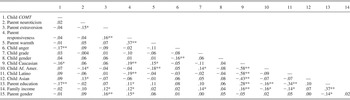
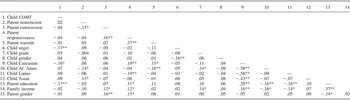
Means and standard deviations for primary variables are presented in Table 1. Correlations among all variables in the study are presented in Table 2. Ethnicity/race was dummy coded for the relevant groups in the sample (Caucasian, African American, Latino, and Asian/Pacific Islander) such that 1 indicated that a child was of that particular ethnicity/race, and 0 indicated the child was not. Both parent gender and child gender were coded as 0 = male and 1 = female.
Means and standard deviations of primary variables

Correlations among variables
Note: COMT, catechol-O-methyltransferase.
*p < .05. **p < .01.
COMT genotype frequencies were 24% for met/met, 47% for met/val, and 29% for va/val. Allelic frequencies were in Hardy–Weinberg equilibrium. A Pearson chi-square test indicated that allelic distributions did not vary by ethnicity/race, χ2 (8) = 10.15, p = .25.
Of particular relevance, child COMT was not associated with either parent personality or parenting variables. This ruled out an evocative effect of child genotype on parent personality and demonstrated no direct rGE of child COMT on parenting. Parent personality also was not associated with observed parenting variables in this study, with the exception of a small association between extraversion and responsiveness.
Association between child COMT and observed anger
To clarify the relation between child COMT and behavior, we examined associations between COMT and observed emotionality during the stressor task. Given that gender was significantly correlated with observed anger in the current study, t (261) = 2.24, p < .05, such that boys (M = 1.17, SD = 0.36) showed higher levels of anger than girls (M = 1.09, SD = 0.25), gender was controlled for in this analysis. Child anger was found to be significantly negatively associated with COMT (β = –0.17, p < .01), consistent with our hypothesis that the met/met genotype was associated with greater expressed anger, whereas the val/val genotype was associated with less anger.
Parent personality as a moderator of the association between child COMT and observed parenting
Regression analyses were conducted to test the primary hypothesis that child COMT genotype would interact with parent personality traits to predict aspects of positive parenting. Two independent regressions were conducted using parent responsiveness as the dependent variable to test the interaction between child COMT and each parent personality trait (extraversion and neuroticism). Two more regressions were conducted using parent warmth as the dependent variable. Main effects of COMT genotype and the personality trait of interest were entered in Step 1. Child gender, grade, dummy coded ethnicity/race variables, parent gender, parent education, family income, and the other parent personality traits not included in the interaction were also entered into Step 1 to control for these variables. Child ethnicity/race was controlled for as a way to address any potential concerns about population stratification (Hutchinson, Stallings, McGeary, & Bryan, Reference Hutchinson, Stallings, McGeary and Bryan2004). Because the dummy coded Caucasian variable was highly negatively correlated with the other ethnicity/race variables and therefore contributed to problems with multicollinearity, the Caucasian variable was excluded from the models. Two-way interactions of COMT × Personality Trait were entered in Step 2. All continuous predictors were centered in order to reduce multicollinearity.
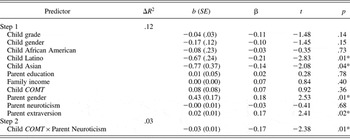
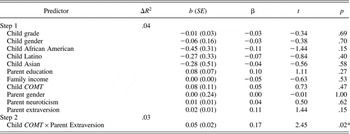
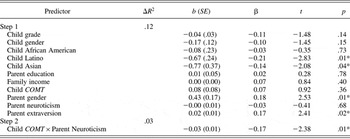
Consistent with our main hypotheses, Table 3 shows that Child COMT × Parent Neuroticism was significantly associated with observed parent responsiveness (β = –0.17, p = .01), and Table 4 shows that Child COMT × Parent Extraversion was significantly associated with parent warmth (β = 0.17, p = .02).Footnote 1 As expected, Child COMT × Parent Neuroticism was not associated with parent warmth (β = 0.02, p = .74), and Child COMT × Parent Extraversion was not associated with parent responsiveness (β = 0.06, p = .39).
Associations between Child COMT × Parent Neuroticism predicting parent responsiveness
Note: COMT, catechol-O-methyltransferase.
*p < .05.
Associations between Child COMT × Parent Extraversion predicting parent warmth

Note: COMT, catechol-O-methyltransferase.
*p < .05.
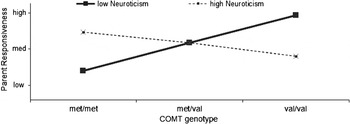
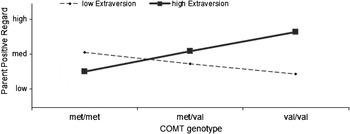
Follow-up analyses were conducted to probe Child COMT × Parent Personality interactions. Simple slopes were calculated for 1 SD above and below the mean for each personality trait. Child COMT was significantly negatively associated with observed parent responsiveness at low levels of parent neuroticism/high emotional stability (β = 0.23, p < .01), whereas there was no association between COMT and parent responsiveness at high levels of neuroticism (β = –0.10, p = .23). Figure 1 indicates that youth with the val/val genotype received the most responsive parenting from parents with low levels of neuroticism/high levels of emotional stability compared to all other groups of youth. A similar pattern emerged for Child COMT × Parent Extraversion interaction predicting parental warmth. At high levels of extraversion, there was a significant positive association between child COMT and warm parenting (β = 0.28, p < .01), whereas there was no association between COMT and warm parenting at low levels of extraversion (β = –0.15, p = .15). Figure 2 shows that youth with the val/val genotype received the warmest parenting from parents with high levels of extraversion compared to all other groups of youth.
The interaction for Parent Neuroticism × Child COMT, predicting parent responsiveness. COMT, catechol-O-methyltransferase gene.

The interaction for Parent Extraversion × Child COMT, predicting parent warmth. COMT, catechol-O-methyltransferase gene.

To test whether grade or gender moderated findings, three-way interactions (Gender or Grade × COMT Genotype × Parent Personality Trait) were entered in Step 3 of the regression analyses, after controlling for all possible two-way interactions among these variables in Step 2. None of the three-way interactions was significant, suggesting that there was no moderation by grade or gender. Moreover, none of the other demographic variables (family income, parent education, and ethnicity/race) moderated findings.
Discussion
Behavioral genetic studies suggest that environments are moderately heritable, but few molecular genetic studies have investigated the role of rGE in variability of exposure to particular types of rearing environments. Moreover, the larger literature on rGE has generally neglected to consider moderators that may affect the strength of the associations between children's measured genes and parenting behaviors. Findings from this study advance theory on the role of rGE in developmental psychopathology by emphasizing the significance of moderating variables that may influence child genetic effects on their environment, which may in turn contribute to risk and resilience for psychopathology. Results from this study show that parent personality traits moderated the association between youths' COMT genotype and observed positive parenting behaviors.
We found that the met/met COMT genotype was associated with greater observed anger among youth during a psychosocial stressor task, whereas the val/val genotype was associated with less observed anger. This finding adds to a growing body of literature demonstrating an association between the COMT methionine allele and emotion regulation. Prior research has shown this association with self-reported negative affect (Enoch et al., Reference Enoch, Xu, Ferro, Harris and Goldman2003; Stein et al., Reference Stein, Fallin, Schork and Gelernter2005), so the present study replicates and extends this pattern of findings to observed emotional expression. Taken together, our findings, in concert with previous research, suggest that parents are responding to the child phenotype of expressed anger in a way that is consistent with an evocative rGE.
Our main finding revealed that emotionally stable (i.e., low on neuroticism) and highly extraverted parents were observed to exhibit greater positive parenting to youth who carried the val/val COMT genotype, which was shown to be associated with lower levels of child observed anger. This pattern is consistent with the idea that emotionally stable and extraverted parental personality traits strengthen the association between low child negative affect and optimal parenting. This is also in line with findings from the literature examining the interaction between child traits and parent personality. This prior work has shown that low levels of child negative temperament, as well as high levels of positive child traits (e.g., extraversion), are associated with greater positive parenting when parents exhibit traits such as positive emotionality/extraversion and emotional stability (Latzman et al., Reference Latzman, Elkovitch and Clark2009; Prinzie et al., Reference Prinzie, Dekovic, van den Akker, de Haan, Stoltz and Hendriks2011).
Youth with genotypes associated with lower levels of expressed anger (e.g., val/val COMT genotype) may be able to elicit greater positive parenting from extraverted and emotionally stable parents because these parents have a greater capacity for exhibiting positive behaviors. Extraverted parents exhibited greater warmth to youth carrying the val/val genotype, whereas emotionally stable parents exhibited greater responsiveness. Extraverted individuals express greater positive affect and are more active and engaged in social interactions. It is likely that extraverted individuals are better able to respond to less angry youth with greater levels of enthusiastic affection, praise, and positive regard. Emotionally stable parents exhibit low levels of negative affect and are more even-tempered and calm, and thus they may be more in tune with child cues and better able to respond sensitively and appropriately to less angry youth.
Taken together, these results suggest that youth with a genotype associated with lower levels of anger receive higher levels of positive parenting from parents with high levels of extraversion and low levels of neuroticism/high emotional stability. It should be emphasized that youth with the val/val genotype, who also had extraverted or emotionally stable parents, received the most positive parenting compared to all other youth in our study, including other youth with one or two methionine alleles as well as those youth with more introverted and neurotic parents. Thus, the COMT genotype appears to influence exposure to caregiving environments, such that youth with the val/val genotype who have parents with certain personality traits experience the most optimal caregiving associated with adaptive functioning and healthy socioemotional development, whereas other youth encounter caregiving that is associated with relatively more risk for maladaptation.
The results showed that there was no association between child COMT genotype and observed parenting behaviors among more introverted and neurotic parents. These parents may be less able to exhibit increased positive parenting to youth. Introverted parents may have difficulty showing higher levels of warmth, such as more fervent expressions of praise and affection, in response to youths' genetically influenced behaviors. It may be challenging for neurotic parents to be more sensitive and respond appropriately to youth in a way that is contingent on youth phenotypic behaviors.
Note that there was no main effect of parent personality on parenting behaviors, with the exception of a small association between extraversion and responsiveness. This finding is in contrast to prior research demonstrating direct effects of extraversion and neuroticism on positive parenting (Prinzie et al., Reference Prinzie, Stams, Dekovic, Reijnjes and Belsky2009) and inconsistent with the hypothesis that extraversion and neuroticism would be most strongly and directly associated with warmth and responsiveness, respectively. However, some studies have similarly found no main effects or weak effects of parent personality on parenting (Clark et al., Reference Clark, Kochanska and Ready2000; Karreman et al., Reference Karreman, van Tuijl, van Aken and Deković2008; Kochanska, Clark, & Goldman Reference Kochanska, Clark and Goldman1997). There is still limited research in this area, and thus little is known about how parental personality characteristics may influence parenting behaviors directly or in interaction with other variables. Furthermore, as noted previously, the majority of studies examining these associations have used samples of infants or young children. Prinzie and colleagues (Reference Prinzie, Stams, Dekovic, Reijnjes and Belsky2009) found some evidence that child age moderated associations between parent personality and parenting, such that the older the child the weaker the associations between these variables. The three studies that included samples of adolescents in Prinzie et al.'s meta-analysis used parent self-report methods to assess parenting behaviors versus observational methods. Therefore, even less is known about associations between parent personality and parenting behaviors among older youth, especially when more sensitive observational methods are used to assess parenting behaviors. The initial evidence from the present study supports the idea that these direct associations may become weaker and nonsignificant among older children and adolescents.
The results revealed no moderation effect by grade, despite the wide age range of the youth sample. This suggests that the same rGE processes contributing to positive parenting are occurring before, during, and after the transition to adolescence for youth in this study. Studies investigating the stability of parenting during the transition to adolescence generally suggest that, although the manifest behavioral manner by which parents demonstrate warm and responsive parenting may change as children grow older, overall levels of positive parenting are relatively stable. For example, although parents spend less time with their children as they age and express less physical affection (e.g., cuddling; Hartup & Laurson, Reference Hartup, Laursen, Cohen and Siegel1991; Larson, Richards, Moneta, Holmbeck, & Duckett, Reference Larson, Richards, Moneta, Holmbeck and Duckett1996), parents still continue to express warmth, attention, and other aspects of positive parenting over time (Carrasco, Rodriguez, del Barrio, & Holgado, Reference Carrasco, Rodriguez, del Barrio and Holgado2011). Therefore, the way in which positive parenting changes over development may reflect heterotypic continuity, in that there is continuity at the latent structural and conceptual construct of positive parenting, but discontinuity in some of the specific, observed manifest behaviors that comprise the construct (Caspi & Roberts, Reference Caspi and Roberts2001). Moreover, research indicates that parents continue to be an integral source of support during adolescence, and positive parenting contributes to psychosocial development for older youth (Laursen & Williams, Reference Laursen and Williams1997; Sheeber, Hops, Alpert, Davis, & Andrews, Reference Sheeber, Hops, Alpert, Davis and Andrews1997; Steinberg, Reference Steinberg2001). Therefore, our findings are likely relevant for children in late childhood as well as adolescents. However, most other prior molecular genetic studies examining associations between child genotype and parenting have used samples of infants. It is possible that moderated rGE processes, as opposed to main effects, may be more pertinent for older youth rather than very young children, but more research is needed to investigate child genotype–parenting associations across different developmental periods.
Overall, findings from the current study can profitably be considered within a developmental psychopathology perspective that emphasizes the way in which the dynamic interplay among multiple factors influences the developmental course leading to both adaptive and maladaptive outcomes (Cicchetti, Reference Cicchetti, Cicchetti and Cohen2006). A growing multitude of studies have contributed to significant knowledge gains in how gene–environment interplay influences variability in outcomes. Most of these studies have focused on how gene–environment interactions (G × E) directly contribute to the development of positive and negative child behavioral outcomes (e.g., Bakermans-Kranenburg & van IJzendoorn, Reference Bakermans-Kranenburg and van IJzendoorn2006; Belsky & Beaver, Reference Belsky and Beaver2010; Caspi et al., Reference Caspi, McClay, Moffitt, Mill, Martin and Craig2002; Hankin, Jenness, Abela, & Smolen, Reference Hankin, Jenness, Abela and Smolen2011; Hankin, Nederhof, et al., Reference Hankin, Nederhof, Oppenheimer, Jenness, Young and Abela2011).
However, the literature to date has generally overlooked how interplay between child genotype and other factors may influence exposure to one's environment. More recently, a few studies have begun to examine how genetically influenced child traits (e.g., temperament) interact with parent genotype (Fortuna et al., Reference Fortuna, van IJzendoorn, Mankuta, Kaitz, Avinun and Ebstein2011; Kaitz et al., Reference Kaitz, Shalev, Sapir, Devor, Samet and Mankuta2010; Lee et al., Reference Lee, Chronis-Tuscano, Keenan, Pelham, Loney and Van Hulle2010) or parent personality traits (Clark et al., Reference Clark, Kochanska and Ready2000; Coplan et al., Reference Coplan, Reichel and Rowan2009; Koenig et al., Reference Koenig, Barry and Kochanska2010) to contribute to the rearing environment. A core principle of developmental psychopathology is that individuals actively shape their environment, whereas the environment is simultaneously exerting effects on the individual (Cox, Mills-Koonce, Propper, & Gariepy, Reference Cox, Mills-Koonce, Propper and Gariepy2010). Our findings add to this knowledge base in that they elucidate potential transactional processes through which an individual contributes to the emergence of particular environmental inputs relevant for adaptive socioemotional functioning and susceptibility to psychopathology.
Results specifically suggest that all parents do not respond equally to youths' genetically influenced traits and behaviors, and the type of rearing environment an individual experiences is dependent to some extent on the coaction between youths' genotype and parent characteristics. Overall, our findings contribute to an increasing body of research investigating multiple and complex pathways through which gene–environment interplay may influence individual differences that contribute to general socioemotional functioning and risk for psychopathology. Child genes may interact with the rearing environment (i.e., G × E) to directly affect behavioral outcomes, and genes may also interact with parent characteristics to shape the rearing environment (i.e., moderated rGE), which in turn can affect pathways to psychopathology and positive adjustment.
This study's results uniquely advance knowledge on genetically mediated processes through which children's environments are shaped and that clearly influence youths' environmental exposure. Considerable evidence documents that youths' environmental contexts, broadly to narrowly defined and ranging from stressful to supportive, play a significant role in socioemotional development and probability of developing psychopathology (Grant et al., Reference Grant, Compas, Thurm, McMahon, Gipson and Campbell2006; Hammen, Reference Hammen2005; Rutter et al., Reference Rutter, Moffitt and Caspi2006). Investigation of rGE processes is of considerable theoretical and translational clinical interest because elucidating more precisely the developmental processes (likely part of an overall transactional cascade model; e.g., Masten et al., Reference Masten, Roisman, Long, Burt, Obradovic and Riley2005) that contribute to individuals' overall environmental risk holds significant promise for informing developmental psychopathological models for the etiology of and intervention for youth psychopathology.
Although advancing knowledge of general molecular rGE processes is still relatively novel and important, future research investigating the particular forms of rGE for different genes, environments, and moderating influences will yield new information important for refining developmentally informed etiological models and intervention efforts. Passive rGE can affect risk of maladaptation for the child through genetically mediated parental behaviors that shape aspects of the child's rearing environment independent of the child's genotype and behaviors, and this child environment and risk can be further moderated by parent personality traits. To take an extreme example, a parent exhibiting the trait of very low conscientiousness combined with genetically influenced inattentive parental behaviors may be more likely to provide an unenriching, negligent environment for the child, and such an emotionally and materially neglectful environment would significantly increase the likelihood of poor socioemotional functioning and risk to psychopathology for the child. In addition, evocative rGE can affect the likelihood of child maladaptation through the probabilistic processes we have already discussed. For example, although not investigated in the current study, it is possible that a child with high genetic susceptibility for emotional dysregulation who is being raised by a parent with particular traits (e.g., disagreeableness or low conscientiousness) may experience an unsupportive environment, which in turn might evoke a cascade of negatively reinforcing parent–child transactions that potentially contribute to the child's emerging problem behaviors (e.g., coercion cycle; Patterson, Forgatch, Yoerger, & Stoolmiller, Reference Patterson, Forgatch, Yoerger and Stoolmiller1998). Overall, the cumulative effect of these passive, evocative, and active rGE processes may contribute to individuals' greater exposure to and experience of risky or supportive environments.
To date, there is still very little research on direct rGE associations between parenting and measured child genes. Given that molecular rGE research is relatively unchartered territory, it is possible that the examination of moderators of rGE associations is premature. However, given that effects of measured genes on complex environments, such as rearing environments, are likely small, increased attention to potential moderators may lead to greater progress in rGE research, just as consideration of moderators has brought about greater advancement in our understanding of how measured genes relate to child outcomes in G × E studies (e.g., Belsky & Pluess, Reference Belsky and Pluess2009; Caspi et al., Reference Caspi, McClay, Moffitt, Mill, Martin and Craig2002). Therefore, pursuing which rGE processes are in operation, at what points across development, for which genes, for which environments, as well as under which moderating influences, remains important for specifying more precisely the mechanisms of risk (or resilience) for youth and windows of opportunity for effective intervention.
The current study has several strengths, including observational measures of the environment and associations with a measured candidate gene. However, future research is needed to address limitations of this study. Although associations between child COMT genotype and child observed emotionality increased confidence that findings were demonstrating an evocative rGE effect, the present study does not conclusively rule out the possibility that the present data represent a passive rGE. Further studies are needed to better determine whether parent personality traits are moderating a passive or an evocative rGE. In order to better distinguish between these two types of rGE, it will be important to include assessments of parent COMT genotype in future studies. To provide a stringent test differentiating between evocative and passive effects, further studies could control for parent genetics when investigating the association between child genotype and parenting behaviors as moderated by personality traits. If the interaction between child genotype and parent personality predicting parenting behaviors is no longer significant after controlling for relevant parental genotype, then this would suggest that parent personality is moderating a passive, and not an evocative, rGE.
Although we speculated that youth behaviors, such as those associated with poor emotion regulation and greater expressed anger, may mediate rGE effects, future studies are needed to further explore all of these relations, including child genotype and behaviors along with parenting behaviors and traits. The current study was also limited by a sample comprising mostly mothers and few fathers. It is necessary for future studies to examine potential rGE for fathering more extensively, especially given that some research suggests that fathers' positive parenting is primarily influenced by evocative rGE effects, whereas mothers' positive parenting is influenced by both passive and evocative rGE effects (Neiderhiser et al., Reference Neiderhiser, Reiss, Lichtenstein, Spotts and Ganiban2007). Moreover, fathers may exhibit different parenting behaviors and may impact child adjustment in different ways (Collins & Russell, Reference Collins and Russell1991; Ge, Conger, Lorenz, Shanahan, & Elder, Reference Ge, Conger, Lorenz, Shanahan and Elder1995). Recent findings have shown that father personality traits interact with child traits to predict fathering (Prinzie et al., Reference Prinzie, Dekovic, van den Akker, de Haan, Stoltz and Hendriks2011) and that such interaction effects may differ for fathers compared to mothers (Karreman et al., Reference Karreman, van Tuijl, van Aken and Deković2008). Taken together, research indicates that rGE effects may be particularly important for fathers; it will likely be profitable to examine fathers independently of mothers when studying the influence of parent–child interplay on parenting behaviors in the future.
Finally, parent personality traits are only one possible moderator of rGE effects. We specifically hypothesized that parent neuroticism and extraversion would moderate the association between child's allelic variability in COMT and aspects of positive parenting, yet this is one initial test of moderation of measured rGE. Future studies can examine other potential parent characteristics (e.g., parent psychopathology) that might influence associations between youths' measured genes and aspects of the rearing environment.
The findings from this study have implications for the way in which research on rGE can inform intervention and prevention efforts. In particular, these findings seem most immediately relevant for parenting interventions designed to reduce symptoms of psychopathology among youth. Parent management training is a well-investigated intervention that teaches parenting behaviors shown to reduce externalizing problems among children and adolescents (Kazdin, Reference Kazdin2005). Parenting skills that are incorporated into a family group cognitive–behavioral intervention for depressed parents and their children has also been shown to be effective for decreasing internalizing and externalizing symptoms among youth (Compas et al., Reference Compas, Forehand, Keller, Champion, Rakow and Reeslund2009, Reference Compas, Champion, Forehand, Cole, Reeslund and Fear2010). Despite evidence supporting the efficacy of such parenting interventions, there are still major gaps in knowledge about what child and parent factors influence responsiveness to these interventions (Kazdin, Reference Kazdin2003). For example, Compas and colleagues' (Reference Compas, Champion, Forehand, Cole, Reeslund and Fear2010) family group cognitive–behavioral intervention led to increases in positive parenting but not reductions in negative parenting, and the positive parenting changes mediated effects of the intervention for two out of five measures of child functioning and symptoms at 12-month follow-up. Enhanced understanding of the individual difference characteristics of these parents, the varying microprocesses of these depressed parents' skills and behaviors, and the match of these parenting skills to their particular child could enhance the efficacy of this evidence-based parenting intervention.
The need for understanding factors that influence the success of parenting interventions parallels the demand for better personalized care in the mental health field as a whole (Insel, Reference Insel2009). Our findings suggest that understanding the interplay among genetically influenced child behaviors and parent traits and behaviors may help to inform how to best tailor parenting skills training to a particular parent, consistent with the idea of improved personalized treatments. Major objectives of parent management training and family group cognitive–behavioral intervention include increasing positive parenting behaviors, such as praise, positive regard, and parent engagement while reducing negative parenting behaviors, such as criticism and punitive parenting. However, only some parents with certain personality traits (e.g., neuroticism and low extraversion) who have children with certain genetically influenced characteristics (e.g., characteristics influenced by COMT) may need such interventions, or particular components of the overall treatment, to improve parenting behaviors and skills (positive and/or negative). In contrast, for other families targeting and modifying parenting skills may not be needed, so delivering parenting skills interventions to such families may not yield significant effects; an altogether different personalized intervention for such a family system may be needed to match the particular needs of the child and parent, given their strengths and weaknesses. Thus, moderated rGE studies investigating measured genes and parenting behaviors may help to increase the effect sizes of existing evidence-based interventions, advance knowledge on who actually benefits from interventions designed to improve parenting (i.e., rearing environment for youth), and facilitate progress toward more personalized care.
In conclusion, findings provide evidence for an association between a measured child gene and aspects of positive parenting behaviors as one component of the rearing environment and emphasize the importance of investigating moderators of rGE processes. Parents' personality traits significantly moderated this rGE. We look forward to future investigations that continue to examine moderated rGE and demonstrate the precise form of different rGE with various genotypes, environments, and moderators. Expanding and refining this line of inquiry holds promise for advancing etiological and translational knowledge in developmental psychopathology.