Constança Capdeville (1937–1992) is the most widely known figure of music theatre in Portugal. Capdeville’s music theatre works incorporate music, sets, movement, text, electroacoustics, images, props, costumes, and lighting. She created her own avantgarde scenic-musical language; her interdisciplinary approach reached beyond fixed genres. Capdeville’s heterogeneous counterpoint used materials with very different qualities such as magnetic tape, instrumental music, stage lighting, and movement (see Magalhães 2019). Gesture in Capdeville’s compositions responds to a dramatic musical need, which affects both sound and performance.Footnote 1
After composing Momento I (1970–71),Footnote 2 Capdeville said she had found her path, that she knew exactly where she wanted to go (see Azguime Reference Azguime1990). In order to perform in a way that suited her, in 1985 she created the ColecViva Group. In its very beginning the group included Capdeville (director, piano, percussion), Olga Prats (piano), Alejandro Erlich-Oliva (double bass), Luís Madureira (voice), João Natividade (dancer), Oswaldo Maggi (mime), and António de Sousa Dias (assistant director, sound technician, percussion). Later Pedro Wallenstein (double bass), Manuel Cintra (poet and actor), Carlos Martins (saxophone), Nuno Vieira de Almeida (piano), and Daniel Worm (lighting design) joined.
Most documentation of Capdeville’s compositions remains scattered over various sources or has been lost, hindering study and dissemination. Understanding how she worked is complicated because she improvised and developed an idiosyncratic, nonstandard notation system to communicate with her group. In addition, the magnetic tapes she used have by now deteriorated or are obsolete; and what information and material exists is not organized. Recreating her performances is problematic.
Capdeville wrote specifically for ColecViva, whose members she knew very well. It was common for her before performances to rehearse independently with each artist. Then, as the public performance approached, they came together one by one. In these individual rehearsals, each artist took notes, sometimes exchanging views on aspects of the performance with the composer. These notes were written only on that individual’s scores or scripts. The performers kept these materials in their own collections, separate from Capdeville’s archive currently housed at the Biblioteca Nacional de Portugal (BNP).
Besides gathering materials that document Capdeville’s work, it is also essential for learning about her work to understand Capdeville’s specific idea of gesture. According to her, a gesture should be an extension of the way the interpreter plays their instrument. The gesture determines what specific sounds an interpreter can get from the instrument, whether voice, piano, saxophone, etc. Capdeville’s performances usually lasted less than an hour with no breaks. Therefore, changing the scene was done by the performers moving the instruments and props during the performance (Magalhães 2019:96). Because Capdeville’s performances had either several narratives or none, following a story was difficult. According to Alain Bonardi, “the musicologist is simultaneously a listener and a composer, since studying a musical piece implies rewriting it” (2000:13). This is particularly challenging because Capdeville’s compositions, like many contemporary musical works, do not rely solely on the score. Due to the heterogeneity of the materials and the performers, Capdeville often created individualized scripts for the dancers, actors, musicians, sound technicians, and lights operators. These individual scripts replaced the score (see Magalhães and Pires Reference Magalhães and Pires2019:103).
Studying Capdeville’s art demands an interdisciplinary approach grounded in computer science, philology, performing arts documentation and preservation, and archival research. We need to connect the various domains inscribed in her works including recorded sounds on tape, movement, and gesture in order to get as close as possible to Capdeville’s intentions. The first step is to find and interview the musicians, dancers, and technicians involved in the original performances; to ask them for their materials and their testimonies about the composer’s creative process. Ultimately, the goal is to reconstruct Capdeville’s methods working backwards from the archive back to the stage. Double (1982) is a paradigmatic case study, challenging the musicologist to study the work as an archaeologist might. An experiment with two pianists has helped me to understand Capdeville’s particular notion of gesture, showing how the testimonies of people who closely collaborated with her aid in the recovery process.Footnote 3
Unconventional Sounds
Most of Capdeville’s music theatre works were conceived after the 1974 revolution in Portugal, a time of deep political changes and a thirst for freedom (Pires et al. 2018:356) following the long period of dictatorship that prevailed in Portugal for about 40 years. Because Capdeville was totally iconoclastic, most conservative musicians and critics did not accept her experiments, which broke with established musical forms.
Capdeville explored sound through the unconventional use of traditional musical instruments. She privileged the cello, the double bass, the piano, and the voice. Capdeville also explored percussion instruments: crotales (tuned cymbals), wood blocks, temple blocks (idiophones), maracas, triangles, bells, wind chimes, flexatones, different sized tin frogs, bells, timpani, and gong (a specific one that belonged to the National Conservatory in Lisbon). Capdeville also used diverse objects as sound sources: cellophane, ribbed paper, plastic boxes, marbles, glass cups, pebbles, and more. For example, in the Epilogue of Double the last effect heard is produced by the performers sliding marbles over the edges of the piano or thrown against the piano’s wooden box; the same effect is used in FE…DE…RI…CO… (1987), in Sequence 14, “Introdução e embalo do espelho adormecido” (Introduction and cradling of the sleeping mirror).
Pianist Olga Prats recalls that Capdeville had an immense respect for the piano, although this was not generally known. Capdeville saw the piano as a percussion instrument of indefinite pitch producing sound clusters either by hand on the keys or strings or by using objects on parts of the instrument. During performances, Capdeville placed the piano in a specific location, making it more visible to the audience. In both Don’t, Juan (1985) and FE…DE…RI…CO…, dancer João NatividadeFootnote 4 moved on top of the piano or even inside the piano. In Don’t, Juan, Natividade was curled up inside the piano to represent the form of a drop (of semen) and then unfurled himself and emerged. According to Natividade, Capdeville intended this as a simulation of an orgasm (2019).
For string instruments such as the cello and double bass, Capdeville used glissandi, striking the resonance box with hands and drumsticks (soft or hard), rubbing objects on strings, using various extended techniques (pizzicato and bow sul ponticello or sul tasto). For wind instruments, different types of attacks were a common practice. On the flute, she used the flutter-tongue technique; on the trumpet, keys were articulated. Musicians sang into their instruments. Usually, these practices were indicated in the score. These techniques are used in Capdeville’s early works such as Section II, “Ré, Quiem,” from Mise-en-Requiem (1979). In order to expand her sound universe, Capdeville also used sounds recorded on magnetic tape. She recorded all kinds of sounds: prepared piano, water running, someone peeing, a train, voices, and vocalized phonemes, among others. The recordings were mostly homemade with the support of some friends, also by composers who at the time were interested in sound manipulation, particularly Carlos Alberto Augusto.Footnote 5 In addition to the countless sound effects they conceived and tried to reproduce, Augusto also used to go around with a portable tape recorder recording sounds such as a train at Estoril train station.
In an interview for Revista Flama, Capdeville stated that for her the entire instrument could make sound (in Couto and Vidal Reference Couto and Vidal1972:9). Instruments were not limited to the parts that conventionally produced sound. This explains the experiments that Capdeville made on the piano. For example: pulling the piano strings with objects; playing other instruments inside the piano such as crotalums (finger cymbals) or even singing from inside the piano; sliding marbles, pebbles, or glasses on the piano strings. The prepared piano (as John Cage advocated) was a process frequently used. Capdeville put screws, sheets of paper, paper clips, or other objects between the piano strings.
The use of the magnetic tape was common in Capdeville’s music theatre works. The tapes operated as any other element, a musical instrument or an actor. In the opinion of Alejandro Erlich-Oliva, a member of ColecViva, “tapes not only held the work together they also in some cases interacted closely with the performers, sometimes even duplicating the same motifs or effects. The prepared piano served to explore the different sound possibilities, while the tapes duplicated parts of the piano, generating density in the music” (2018).
Capdeville composed most of her works during the Gulbenkian Contemporary Music Meetings (EGMC), as did many composers of that time. They had considerable support from the Calouste Gulbenkian Foundation (FCG) in Lisbon, where many works premiered. Mainly after the revolution in 1974, artists felt a need to develop new ideas, new experiments, breaking with conventions and integrating technology into their works. Capdeville is no exception. Nor did she work in a Portuguese bubble. She was influenced by what was going on in the rest of Europe and in North America. As the double bass player Erlich-Oliva says:
[t]here are influences, no composer starts from zero. Cage’s prepared piano is one of them, of course! Capdeville also addresses some of Varèse’s conceptions in what I consider to be the most important aspect of his action: having demonstrated that one can play electronic music with conventional instruments [by playing conventional instruments unconventionally]. In other words, that acoustic instrumental music can — when skillfully written for that — “imitate” electronic music, without even using electrical energy. […] I also see some influence by Mauricio Kagel and, obviously, a lot of Pina Bausch. There may be a bit of Charles Ives from Three Places in New England, in the concept of atonality produced by the simultaneity of music in different tones but not by means of direct atonal writing. (2018)
Gesture, Language, and Communicating with Performers
While always rethinking the forms of musical creation and the performance of music itself, Capdeville maintained that music was inseparable from gesture, and therefore from theatre. For Capdeville the gesture is a movement that will produce a certain sound answering a dramatic musical need. In the instrumental theatre of composer Mauricio Kagel (1931–2008), no distinction is made between theatrical action and musical performance. The sound gestures and the sounds produced must be seen as a complete musical-theatrical action that has both acoustic and visual components (Heile Reference Heile2016). The music theatre of Capdeville, even when it does not contain explicit theatrical elements, is intrinsically theatrical. Olga Prats commented that when she played Kagel’s “Unguis incarnatus est for piano and…” (1972), there was a particular piano pedal usage that Capdeville loved.Footnote 6 From then on, according to Prats, Capdeville called it “Kagel’s pedal” (Prats Reference Prats2017). Prats described that she pressed the pedal very hard and raised her foot, repeating this gesture several times, increasing strength and speed in such a way that she needed to cling to the piano to perform it. Capdeville used the same gesture (on the pedal) in Valse, Valsa, Vals; Keuchheits Waltz (1987) by Constança Capdeville (see Serrão 2006:190), a full-length composition for piano solo dedicated to Olga Prats. As she did with “Kagel’s pedal,” Capdeville often quoted parts of works, or even complete works, by other composers, painters, filmmakers, or writers. This was part of her creative process.
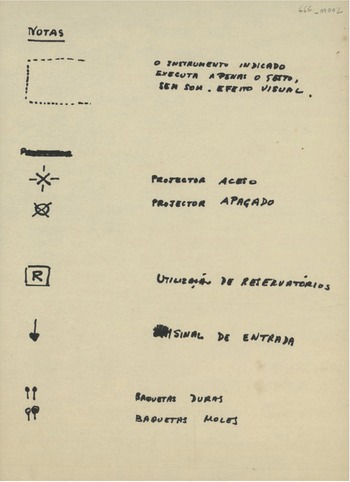
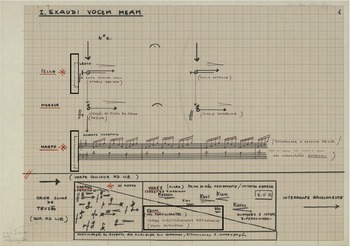
Capdeville utilized theatrical elements and specific sound-producing gestures as early as 1979 in Mise-en-Requiem. She also wrote “Notes” that included symbols guiding the musicians during the performance (fig. 1). In general, these symbols mean (from top to bottom): 1) performing only the gesture, without emitting any ordinary sound (only a visual effect); 2) light projector symbols on (above) and off (below); 3) R: indication for the musician to use reservoirs;Footnote 7 4) down arrow is an indication of the entry of a musical instrument, voice, or recording; and 5) use of hard (above) and soft (below) drumsticks. These symbols appear occasionally in the score. In figure 2, the symbols inside the black frames on the score correspond to gestures (visual effects). In the first two, the cello and the harp perform only gestures (no ordinary musical sounds associated with these instruments) as lights focus on both (indicated by the small X-shaped symbols next to “CELLO” and “HARPA”). In the third black frame (where she indicates “gesto”) Capdeville writes that musicians rapidly and automatically move their heads to the right and left.
“Notes” with symbols. (Courtesy of Dra. Helena Patricio, Biblioteca Nacional de Portugal)

Graphic score: first movement of Mise-en-Requiem. (Courtesy of Dra. Helena Patricio, Biblioteca Nacional de Portugal)

In Capdeville’s music theatre, instrumentalists are not solely musicians. They are all actors and percussionists, regardless of what else they do in the performance. Even the classically trained dancer João Natividade, who could not read musical scores, sometimes played percussion. For FE…DE…RI…CO… (1987), Capdeville insisted that he should play two tin frogs of different sizes (therefore with different timbres) aimed into the piano’s resonance box. On the score, Capdeville used different colors to distinguish the timbre and arrows to mark the articulation and syllables for the rhythm. For her it was important to make the instructions intelligible for the dancer as well as the musicians (Natividade Reference Natividade2019).
Natividade’s close collaboration with me as a musicologist has helped me understand Capdeville’s creative process. As we know, memory is often fallible; one cannot be sure that the performer is being objective so the testimonies must be compared with existing documentation. In the case of Capdeville’s music theatre works, the testimony of her performers, while this is still possible, has been fundamental for my understanding of their collaborative practices with the composer. For instance, in an interview the double bass player Alejandro Erlich-Oliva refers to the gesture used by Capdeville as something subversive for both the instrument itself and the performance practice. For a double bass, or any string instrument, usually the bow is rubbed against the string, but Capdeville wanted the opposite: to rub the string against the bow, producing a totally different effect. Erlich-Oliva commented that this gesture, made specifically to extract a different sound from the double bass, is more difficult than playing a full concert of Serge Koussevitzky (Erlich-Oliva Reference Erlich-Oliva2018).
Through an experiment conducted with two piano players I showed how a piano player with classical training faces Capdeville’s notation today. This example demonstrates the difficulty of trying to repeat Capdeville’s music theatre works, even using the piano techniques of her time. In this experiment I sought to understand in what way the piano player currently perceives the language generated by Capdeville, adapting his own performance accordingly. Is it easier or harder to decode the gestures, symbols, and interactions between the musician and the magnetic tape? Encountering Capdeville’s specific language for the first time, can a musician comprehend it? Is there enough documentation available or is there a need to find new documentation to facilitate the performance of the work? Can we convey Capdeville’s ideas to successive generations? Or do her symbols inscribed in graphic scores with no indication of time measures make it all but impossible to transmit performance knowledge through time?
A Musicological Archaeology of Double
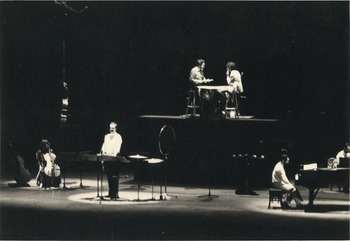
Capdeville’s Double illustrates how challenging it is to perform a musicological archaeology. Double premiered in 1982 following the 6ºs Encontros Gulbenkian de Música Contemporânea at Calouste Gulbenkian Foundation, in Lisbon (fig. 3); it has been performed only once since. This music theatre work is for voice, piano, cello, two percussionists, mute choir, magnetic tape, and lights, according to the information in the score. The work is divided into 10 sections: the Prologue; eight Interventions, each its own section and named Intervention 1, etc.; and an Epilogue. The performers were António Wagner Diniz (voice), João Paulo Santos (piano), Luísa Vasconcelos (cello), Carlos Alberto Augusto (tape editing tapes, manipulation of taped sounds, sound projection), Dança Grupo (the seven dancers of the mute choir), and Jorge Peixinho and João Heitor (who were called percussionists but literally perform as chess players onstage). Capdeville was influenced by a scene in Entr’acte (1924), a French short film directed by René Clair, in which Marcel Duchamp and Man Ray are playing chess on the roof of the Theatre des Champs Elysees, in Paris. Capdeville decided to integrate a similar scene in Double (Santos Reference Santos2019). During the performance, both performers played chess using a timpani as their table.
Premiere of Double (1982): location of the musicians onstage. (Courtesy of Dra. Helena Patricio, Biblioteca Nacional de Portugal)

Double is founded on various types of duality. The performers interact with the magnetic tape recordings, which are their doubles, but also with themselves: all the musicians had mirrors close to them reflecting and doubling their images. In Double, the tape recordings acquire an even more significant role because they are the culmination of an experimental work that Capdeville had been developing for years — one must not forget that the technological means used at the time were not easy to handle onstage. For the first time in her career, Capdeville used two recordings simultaneously in a live performance. In addition, the acoustic instruments and recorded sound are fused so well that occasionally it is not possible to distinguish between live and recorded sounds. These recordings are crucial to the reperformance of Double because although most of Capdeville’s materials are archived at the BNP, some are in the possession of the performers who closely collaborated with her.
The analysis of Double was made using: 1) scores from Capdeville’s collection and those belonging to the performers containing specific instructions for them; 2) scripts for sound, lighting, and mute choir; 3) magnetic tapes 5 and 6, both used in the original performance; 4) composer’s notes, excerpts from texts, program note, images, and other documents; 5) a recording of the live performance from 1982 (going forward: tape FCG). Even with access to these materials, I encountered difficulties retrieving widely dispersed documents; understanding the various layers of information contained in these diverse documents, including the distinction between acoustic and electronic sounds; and finding out what the gestures and movements were because I lacked information, especially for the mute choir.
In order to systematize the existing information to reconstruct the performance I took the following steps: 1) retrieve and then transfer to current formats documents and audio sources; 2) analyze the score in relation to the recording of the live concert, resolving inconsistencies by referring to the scripts of sound, light, or mute choir, themselves often dispersed and incongruous; 3) perform a study of the two tape recordings (tapes 5 and 6), identifying each sound to understand the tape inputs throughout the live performance; 4) interview the singer (António Wagner Diniz), the piano player (João Paulo Santos), the sound technician (Carlos Alberto Augusto), Dança Grupo choreographer Elisa Worm, and dancers Luísa Vendrell, Luís Carraça, and Luís Carolino.
The aural structure of Double was reconstructed from the recordings (tapes 5, 6, and FCG), and by comparing documents. As a preliminary step, I analyzed the waveforms of the sounds, particularly moments in which live sounds were mixed with recorded sounds.
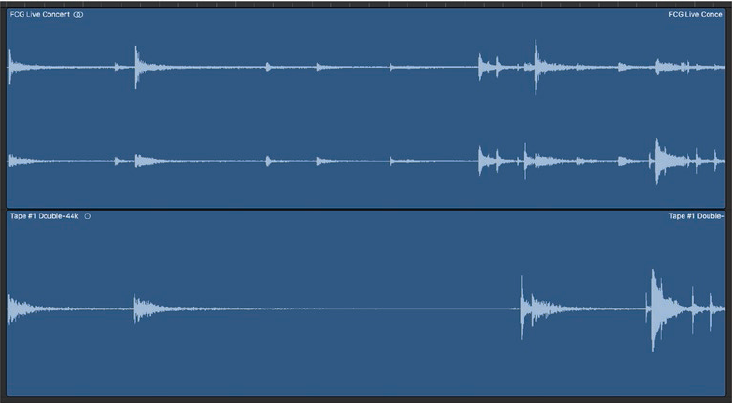
Figure 4 represents a part of Intervention 4, which features interaction between recorded and live piano. The same excerpt was extracted from the live performance tape FCG and tape 5. In this excerpt, the pianist reacts to his double (an effect recorded on tape 5). This is when the live sound is mingled with the recording. The recorded piano (tape 5) reproduces a “cadenza pedal,” and some abrupt moves such as hitting the piano strings with the hand or striking the piano beam with finger cymbals; the live piano (tape FCG) plays clusters violently and brusquely. Accordingly, the comparison of both recordings proves to be effective in differentiating acoustic sounds from recorded ones.
Intervention 4: live piano (tape FCG) and recorded piano (tape 5). (Courtesy of Filipa Magalhães)

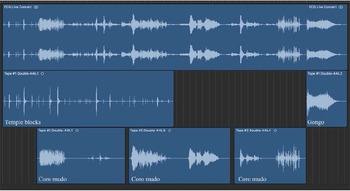
Figure 5 corresponds to Intervention 5. Here tapes 5 and 6 appear almost simultaneously; one can hear recorded sounds made by the temple-blocks (on tape 5) and by the mute choir (on tape 6).Footnote 8 In Double there was a mute choir of seven dancers (see fig. 7) who performed movements and opened their mouths as if the sound that actually came from the magnetic tape came out of the dancers. In addition, the voice of the singer interacts with the mute choir: the live voice raises questions, and the mute choir responds with interjections (through the recording on tape 6). At the end of Intervention 5 there is the sound of a recorded gong. The recorded gong (tape 5 and tape FCG), besides being heard, is perfectly identifiable when viewing its waveform in software such as Sonic Visualiser. This recorded sound of the gong is not mentioned in the scores or in the sound script. I only realized it by listening to the recordings. The recordings revealed aspects omitted from the previously available documentation.
Intervention 5 complete (tape FCG, tape 5, and tape 6). (Courtesy of Filipa Magalhães)

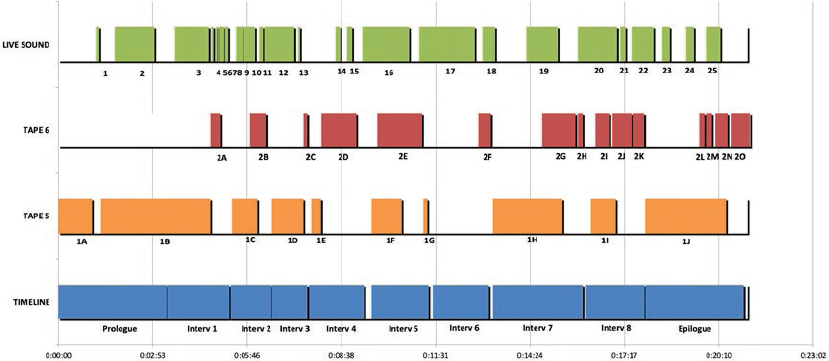
Aural structure of Double. (Courtesy of Filipa Magalhães)

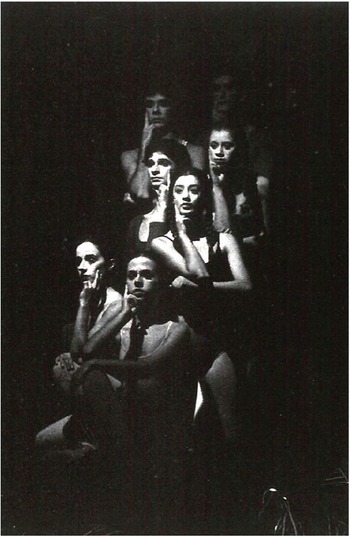
Dança Grupo. (Courtesy of Luísa Vendrell)

Figure SM1 (in Supplemental Material online)Footnote 9 is the score for the entire Intervention 5. It is a clear example of Capdeville’s unconventional musical notation. Analyzing this section using only the score would be impossible, because the information is minimal.
Using the recordings and comparing the score with the scripts, I recreated the aural structure of Double. Figure 6 shows the input of the recordings: LIVE SOUND, which derives from tape FCG; TAPE 6, TAPE 5, and tape FCG (the live performance from 1982) from which it was recreated; the Timeline, divided into a Prólogo (Prologue), Interventions 1, 2, 3, 4, 5, 6, 7, 8, and Epílogo (Epilogue). Figure 6 lacks the details of gestures, movements onstage, and lighting.
There was no video of the Double, which lasted around 21’03”, therefore, I turned to studying the available audio recordings of the performance, and interviewing artists in order to bring back hidden parts of the piece. Interviewing the main performers in the original live productions helps to articulate and systematize the existing information, facilitating my analysis of the work, and guiding its re-creation. The importance of interviews to re-creating performances is also an aspect strongly addressed by Van Saaze et al. (Reference Van Saaze, Dekker and Wijers2010:21). Hélia Marçal, Andreia Nogueira, and Rita Macedo note that this kind of research based on interviews with former performers of works operates as the “production of a document that can somehow materialize the gesture, the movement, the sensation, the ambiguity, the change, which are the fruit of the performative nature of this work, without falling into the temptation to fix it” (2018:15).
Carlos Alberto Augusto lent his score with specific indications about the inputs of both recordings used in Double. Augusto was responsible for assembling the tapes and operating the tape recorder during the performance. He clarified some doubts about the recordings. He confirmed that the chess players used the timpani only as a table; they never played it or any instrument during the live performance. Their chess game was accompanied by a recording of the second movement of Beethoven’s Third Symphony (Funeral March). The interview with choreographer Elisa Worm and the other dancers of Dança Grupo (fig. 7) was paramount. At first, focused on their interaction with the magnetic tape throughout the performance, the singer and the pianist did not remember the mute choir. But Worm confirmed that the mute choir’s movements scenically enhanced the performance. All sound from the mute choir was on tape 6.
Understanding Capdeville Today
An Experiment with Two Pianists
I wanted to understand how an interpreter not used to graphic notation with very specific indications would deal in performance with such a document. How would the artist use the available documentation combining gestures and recordings, yet lacking musical bar lines (altering its perception of time measurement)? I conducted and presented two experiments at the IV International Contemporary Piano Meeting held on 12–14 December 2019 at the School of Music and Performing Arts (ESMAE/IPPorto, Portugal) in Porto. First, I asked piano player Filipe Manzano,Footnote 10 an artist acquainted with conventional notation, to interpret two short excerpts of Double, Interventions 2 and 4. Manzano had the score (the specific parts to be played from the score stored at the BNP), the recorded sounds used in the performance (corresponding to each excerpt), and the part of the tape FCT (live performance from 1982) also corresponding to these excerpts. His performance of 8 November 2019 was recorded in audio only. Then I asked piano player João Paulo SantosFootnote 11 to perform the same excerpts. The difference was that Santos premiered Double in 1982. Santos’s reprise of 9 December 2019 was recorded on video. I wanted to find out if memory would help Santos or not. Santos had his own original score, with specific notes created for him, different from those in the score stored at the BNP. As mentioned above, Capdeville was accustomed to placing additional notes in each performer’s score, so it is common to find different indications in the various scores, even if generally they agree. As I wrote before, in Double the performers very closely interact with the tape recording, which corresponded to their doubles hindering the performance.
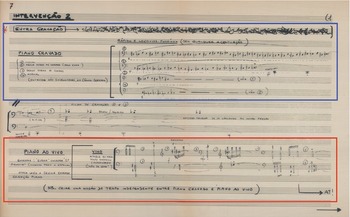
In Double’s score (fig. 8), there are two squares, which I placed to help guide Manzano during the performance. The top square highlights the recorded piano part, while the bottom square highlights the live piano part. The first audio sample (sound example 1; SM5)Footnote 12 corresponds to the recorded sound on tape 5 in which one hears only the piano part from Intervention 2 (from the original tape used during the performance in 1982). The second audio sample (sound example 2; SM6)Footnote 13 is the same excerpt from Intervention 2 but from the live performance (tape FCG) of 1982 (including both recorded and live sounds). The third audio sample (sound example 3; SM7)Footnote 14 is what Manzano played (recorded and live sound), taped on 8 November 2019. Here he is interacting with the sound recorded on tape 5 (the original one from 1982 only included the piano part) in an attempt to recreate the original performance.
Double’s graphic score: beginning of Intervention 2. (Courtesy of Dra. Helena Patricio, Biblioteca Nacional de Portugal)

Figure SM2 corresponds to Intervention 4 (live piano and recorded piano) of Double’s score. I added indications to highlight for Manzano aspects of the performance. Once more, the first audio sample (sound example 4; SM8)Footnote 15 corresponds to the recorded sound on tape 5 from Intervention 4 representing the piano part (from the original tape used during the performance of 1982). The second audio sample (sound example 5; SM9)Footnote 16 is the same excerpt from Intervention 4, which corresponds to the original recording from the live performance (tape FCG) in 1982, containing recorded and live sound. Finally, the third audio sample (sound example 6; SM10)Footnote 17 is the performance of Manzano from Intervention 4 (recorded and live sound), recorded on 8 November 2019, in which once more he is interacting with the sound recorded on tape 5.
Manzano confronted difficulties: the absence of time measures, which makes the understanding of the duration of figures or pauses difficult; and the entrances while the piano player is interacting with the electronic sound. Manzano felt that the language was somehow ambiguous, at least for someone who did not have any directions about attacks or gestures. Manzano needed to listen to the recording of the performance played in 1982 several times to understand the attacks and its potential interaction with the tape. Finally, Manzano — a rigorously trained piano player — told me that performing Capdeville was hard work. According to him, it seemed that the piece was written to be played only once. Manzano said that it would be essential to develop further documentation of the whole process in order to properly reperform both excerpts and ideally the full work (2019).
Thirty-seven years after he first performed the piece, João Paulo Santos repeated the process playing the same excerpts as Manzano. The following image belongs to the pianist himself and contain particular notes created for him, but there are also indications (squares and arrows) I drew after interviewing the pianist in order to make clear how the performance should be oriented. This added information is accompanied by an explanatory note that can be read next and seen in fig. SM4. The video (video example 1; SM11)Footnote 18 corresponds to the excerpt of Intervention 2 (fig. SM3) performed by João Paulo Santos and recorded on 9 December 2019. The video (video example 2; SM12)Footnote 19 corresponds to the excerpt of Intervention 4 (fig. SM4) interpreted by João Paulo Santos and recorded on 9 December 2019.
Santos tried at least three times before he remembered the process. He didn’t need to listen to the recording from 1982 (tape FCG). He simply asked to hear the recording of the excerpt that would be his double (tape 5). In the end he suggested that successive generations should pay attention to the space, that everything should be very spacious (Santos Reference Santos2019). At Intervention 4 for example, after performing an attack on the piano (whether striking a chord, pressing a pedal, or pulling a string), he said that one should have time to perform the gesture of placing the right hand over the lower tone strings, then listen to the recording and react. Subsequently the performer needs time to sit or stand up to prepare the gesture for the next attack. Santos advised that one should look at the score graphically, as if it were a map. There is the first attack, then a cluster to be played with the fist, then the performer looks at the mirror and this is the sign indicating that the recording input will occur. The performer reacts, touches with the right hand over the lower tone strings, and so on. Everything should take the time necessary to produce the gesture, the idea being to bring the sound out.
Thus, in Capdeville’s music, as my 2019 experiment shows, one of the greatest difficulties is to understand her idea of space as stated by Santos. Of course, without experiencing such moments, without having any essays or description of the performance — as those provided by Santos — every pianist will have trouble achieving the envisioned results.
Final Considerations
Making an in-depth study of Double using the recordings, scores, scripts, and other resources proved fundamental for the work’s recovery, while also reinforcing the importance of preserving the audio recordings, the complementary documentation about the work. Double is a complex work, mainly because during the live performance several components are controlled simultaneously: two tape recordings, performers, lighting, scenic-visual elements, gesture, movement, and so forth. Another aspect that contributes to the complexity of Double is the duplicity inherent in several elements of the performance, creating a kind of aural confusion that is perhaps intentional. Double is the culmination of sound experiments that Capdeville worked on for almost a decade. It is her only work that uses two recordings simultaneously during the live performance, something particularly convoluted considering the technological and technical means available in the 1970s–early ’80s. In addition, Double demonstrates Capdeville’s immense originality, and her imprint on Portuguese music. Capdeville’s music theatre works are structured as heterogeneous counterpoints in which several different components interact during a live performance. Constança Capdeville’s music theatre works are complex and have not yet been fully systematized, therefore her music has been avoided onstage for nearly three decades. However, I believe that it is essential to recover her works using the methodologies described above in order to renew this valuable heritage of great importance for contemporary Portuguese music. We are fighting against time, both due to the obsolescence of the means Capdeville used, but also due to the real possibility of losing much of the information that can be provided by her aging performers whose testimonies are essential for the recovery of her music’s performative aspects, as demonstrated by my experiment with Manzano and Santos.
My experiment showed the testimonies — and actual performances — of the people involved in Capdeville’s performances are crucial if we are to understand the composer’s intentions. The documentation that Capdeville left is insufficient; it does not lead to the complete work. In Capdeville’s collection one may find scores, scripts, tapes, images, sketches, program notes, composer’s notes with explanations, and so on, but so much is missing, particularly her conception of gesture. As a musical archaeologist, I must rely on the available documentation; but it’s also very important to produce new knowledge based on the experience of the musicians who worked with her. Moreover, my piano experiment provides clear evidence that more documentation is required to make Capdeville’s creative process understandable, and importantly, to bring it back to the stage. This kind of reconstruction needs people involved in her original performances; artists who can help us replicate her creative processes, and pass these on, keeping this great artist “alive.”
To view supplemental materials related to this article, please visit https://doi.org/10.1017/S1054204322000302.