Introduction
Emergency Medical Services (EMS) is a profession designed to have responders trained as emergency medical technicians (EMTs) and/or paramedics to respond, treat, and transport patients suffering from both illness and trauma.Reference Leggio1 Leaders within EMS are not limited to ensuring these types of responses from their organizations. Emergency Medical Services leaders have an interdisciplinary role with other agencies in preparing for future responses in an environment where there is uncertainty on what future responses may require. Emergency Medical Services leaders are not confined to working with other first responder agencies, but need to interact with hospital officials as well.Reference Catlett, Jenkins and Millin2 The development and role of EMS is another growing field within International Emergency Medicine as many nations have minimal to no EMS to stabilize and transport out-of-hospital patients.Reference Morton and Vu3 Therefore, EMS leaders are not only tasked with leading daily operations, but with engaging in developing response plans and being part of decision making at both the local and federal levels.Reference Catlett, Jenkins and Millin2, Reference Lester and Krejci4
Recognizing and identifying established and potential interdisciplinary leadership roles within EMS is not difficult. In contrast, questions on defining an EMS leader, or how leadership in EMS is learned in different nations, have not been answered from a scholarly perspective. Emergency Medical Services curriculum guidelines published at national levels do mention leadership, but do not delve into specific leadership skills.5, 6 MillerReference Miller7 discussed how effective leadership skills are a necessity for the EMS profession. Emergency Medical Services providers need to function in complex teams, but receive no formal training on group dynamics, communication, and how to be an effective leader.Reference Miller7 MillerReference Miller7 contended leadership skills could be learned, taught, and improved in EMS educational programs.
The historical role of EMS leadership in disaster management, response coordination, and providing patient care is known. The way in which EMS leadership is learned, taught, and developed within the profession is not known.Reference Leggio1 Leadership education and training in EMS is nearly absent. How leadership is learned in EMS requires further investigation and research. The need to better understand how EMS leadership is learned is not limited to one country, but is needed in a global context.Reference Leggio1 The objective of this research was to understand from EMS providers with multinational experiences how EMS leadership is learned. The data analyzed in this article were part of a larger study, and the other themes of that study will not be discussed in this article.
Methodology
Study Design
A phenomenological, qualitative methodology was used to interview EMS providers from multiple nations currently working in Riyadh, Kingdom of Saudi Arabia. The shared phenomenon was having international EMS experience, which was defined as studying, training, and/or providing EMS in more than one country.Reference Leggio1(pp41,42) The study design and interview questions were designed by the author to discover how EMS providers learned EMS leadership as students and throughout their careers as providers. An interview protocol was developed and consisted of 10 open-ended questions. The author sent his autobiographical statement and interview protocol to three individuals with international EMS and research experience for review and to identify leading or biased questions. The final protocol and study design were then sent to, and approved by, the Institutional Review Board at Creighton University in Omaha, Nebraska (#13-16759).Reference Leggio1(pp40,41,46)
Population and Setting
This study was conducted in Riyadh, Saudi Arabia in June 2013, where a sample of EMS providers with multinational experiences was accessible. Approximately five million people, or one-fifth of the total population of Saudi Arabia, are expatriates working in all fields of employment.8 Given the international crossroads found within Saudi Arabia, this population provided insights as to where the international community is in terms of leadership development in EMS.Reference Leggio1(pp42,43) Emergency Medical Services organizations were contacted and provided a brief study overview and selection criteria. Inclusion criteria required participants to have successfully completed EMS training or formal EMS education in a country other than Saudi Arabia, and to be actively working as an EMS provider in Saudi Arabia. Participants needed to be comfortable with being asked and answering questions in English. Study participants needed to be willing to participate in the study and allow the audio of their interview to be recorded and sent for transcription. Prior to each interview, informed consent was provided, and all participants signed a consent form.Reference Leggio1(pp43-45)
Analysis of Findings
Recorded audio from each interview was sent for transcription. The researcher manually analyzed the data and also used NVivo 10 (QRS International, Doncaster, Victoria, Australia). Transcripts were uploaded and themes and patterns that developed were assigned a code utilizing NVivo 10. Another complete review of the data was conducted, and meaningful segments from transcripts were assigned a code. A final review of all transcripts and identified themes, patterns, and codes was completed and found to be consistent with the analysis.Reference Leggio1(pp47,48)
Validating the Findings
The study author performed a bracketing session prior to collecting data to discuss his autobiographical statement and preconceived thoughts or biases with his dissertation chair. Interviews were transcribed using two different services; because of this, the researcher sent each transcription service a random interview that the other service had transcribed to compare the transcriptions. The comparison yielded minimal differences between the two transcription services. The researcher reviewed all transcriptions for accuracy and completeness. Member checking was performed by sending participants their interview transcription for review. Triangulations of artifacts found within the data were researched and analyzed. Participants also received the final analysis of the data for review. The dissertation chair served as the study auditor and reviewed all data to determine the findings and conclusions were supported.Reference Leggio1(pp47-50)
Results
A total of 19 interviews were completed, in person, during June 2013. A total of 21 interviews were originally scheduled, but a South African male paramedic and a female paramedic from the United Kingdom canceled for reasons not related to the study. They were asked to reschedule, but they did not contact the author to do so.
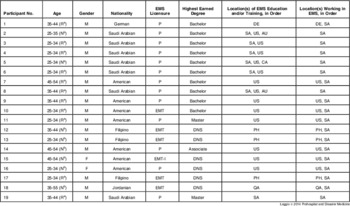
The 19 participants were from the United States, Kingdom of Saudi Arabia, Germany, Philippines, and Jordan. The collective countries these participants studied or trained in EMS were the United States, Saudi Arabia, Canada, Germany, Philippines, Australia, and Qatar. The participants reported being employed as an EMS provider in the United States, Saudi Arabia, Germany, Philippines, and Qatar. Thirteen of the participants self-identified as Paramedics, one as an EMT-Intermediate, and five as EMTs. Seventeen of the participants were male and two were female. The majority of the participants entered the profession in 2000-2004. Other participants entered the profession in 1975-1979, or 2005-2009. Ten of the participants had completed bachelor's degrees, one had completed an associate's degree, and two had completed master's degrees. The remaining six did not specify their educational achievements. Following the interviews, each participant was contacted by e-mail and asked to respond to a question on age group. Twelve of the participants responded. Seven participants were 25-34 years of age, four were 35-44, and one was in the 45-54 age group. The seven who did not respond were assigned an estimated age range based on information and dates found within their interviews. Three of the participants were estimated to be in the 25-34 age group, two were estimated to be in the 35- 44 age group, and the last two were estimated to be in the 45-54 age groupReference Leggio1(pp50-52) (Table 1).
Participant DataReference Leggio1(pp122)

Abbreviations: AU, Australia; CA, Canada; EMT, emergency medical technician; EMT-I, emergency medical technician-intermediate; DE, Germany; DNS, did not specify; P, paramedic; PH, Philippines; QA, Qatar; SA, Saudi Arabia; US, United States.
a R indicates the participant did respond to the follow up e-mail and provided a response to an age group.
b N indicates the participant did not respond to the follow up e-mail requesting a response to an age group and, therefore, an age group was selected for the participant by the researcher.
Mentoring
Participants discussed learning EMS leadership from others, which could be best described as mentoring. Participants describe both good and bad informal mentors throughout their career. The participants who had experienced a bad mentor did not blame the individual, but the organization, for the bad mentor. Participants recognized EMS as a profession of progressive steps. As one participant stated, “You just don't jump in the field and learn to be a paramedic.”Reference Leggio1(p54) Participants acknowledged first there is book knowledge to learn, then practical knowledge, then providers go into the field and be supervised.Reference Leggio1(pp52-54)
On-the-job Training and Experience
Similar to mentoring, another source of learning EMS leadership was on-the-job training. On-the-job training was described by a participant as “what they call sink or swim.”Reference Leggio1(p54) Participants described work environments that were “sink or swim,” lacked support, and in which one either failed or succeeded. Though participants experienced these types of environments, many cited the importance of experience in learning EMS leadership. As a participant stated, “You can take a lot of classes and go to conferences and things that build leadership skills; I think that more than anything else, leadership skills come from experience.”Reference Leggio1(p55)
Other Professions
Emergency Medical Services leadership is learned from military and government departments, as well as fire and police departments. The presence of learning EMS leadership from other professions was related to previous careers before being an EMS provider, or experiences of working with, and learning from, other responding organizations. Participants who previously served in the military or government before entering EMS carried leadership lessons learned and applied them to EMS. Participants described working with EMS providers, or even being one, who were cross-trained with police and or fire departments. These other departments were described as providing more hierarchical structure to learn leadership from and providing standardized protocols and response plans. Participants viewed standardized protocols and response plans as sources of leadership education.Reference Leggio1(pp55,56)
Courses
Participants described learning EMS leadership in EMT and/or Paramedic courses and textbooks. Participants described team-oriented simulated patient cases where the team was evaluated on providing patient care and the leader was evaluated. Simulations provided experiences for participants to develop team-building skills.Reference Leggio1(p58) At the end of simulated experiences, valuable feedback was given and as a participant described, “You can get a much better possibility to judge these leadership skills in simulation.”Reference Leggio1(p58)
The chapters within EMS textbooks that participants described as sources of learning leadership skills were “EMS Operations” and “Mass Casuality and Disaster Management.” In addition, some participants described learning EMS leadership from their EMS Management, EMS Education, and Critical Care courses, but not all had taken these courses.
Leadership Was Not Taught
Participants of this study stated that they did not have leadership courses during their EMS education.Reference Leggio1(pp62,63) Participants described how they would have valued having leadership courses, but as stated by a participant, “You're the paramedic. We weren't given specific leadership courses. We were told to step into it.”Reference Leggio1(p63)
A Need for Leadership Courses and Continuing Education
There is a need to have EMS leadership courses in both EMS education and continuing education. As one participant stated, “… EMS leadership, there's not enough training, there's not enough education in it, there's not enough practice.”Reference Leggio1(p83) Participants described the need for EMS leadership courses, which could be a single course, or a progression of two or three courses. Participants stressed the importance of connecting lecture and simulated scenarios, as stated by a participant, “we need to practice it, not just learn it.”Reference Leggio1(p86)
Continuing education on leadership is needed. Participants described current continuing education requirements as being focused only on medical knowledge and technical skills.Reference Leggio1 Participants favored a requirement for leadership and other professional education, and acknowledged such requirements would need support at organizational, state, and/or federal levels.Reference Leggio1 These requirements were viewed as one way to retain EMS providers and grow the profession. As one participant adamantly stated:
We have lost so many great paramedics to other areas because we haven't had that… pathway where they continue to grow further…because those guys have a certain value about themselves as eagerness to continue further, that they want to lead in the profession, or something better, but if we develop ourselves, grow, lobby for better jobs, better wages, better opportunities, I think we will be able to retain a lot of those great medics we have lost in the past.Reference Leggio1(pp87,88)
Triangulation
Emergency Medical Services courses discussed by the participants provided artifacts for triangulation. The study author reviewed the following textbooks: Emergency Care and Transportation of the Sick and Injured,Reference Pollak9Paramedic Practice Today Above and Beyond,Reference Aehlert10Critical Care Transport,Reference Pollak11 and Foundations of Education: An EMS Approach.12 The search did not yield any leadership-oriented objectives from these artifacts that went beyond a basic understanding of leadership in the field or leading patient care.Reference Leggio1(pp57-62)
The researcher triangulated Management of EMS Reference Evans and Dyar13 and discovered Chapter 3 “Manager to Leader.” This chapter had EMS leadership-oriented objectives: 3.4, Develop and define leadership activities and 3.6, Apply the concepts of values to organizational leadership.Reference Evans and Dyar13(p49) Objective 3.6 discussed commonalities and differences, establishing vision for the organization leadership styles,Reference Evans and Dyar13(pp60-63) and ethics and the leader.Reference Evans and Dyar13(p68) This chapter also discussed attributes that EMS leaders and managers share.Reference Evans and Dyar13(pp63-71)
Discussion
The absence of EMS leadership during primary EMS education supported criticisms made by MillerReference Miller7 on the National Emergency Medical Services Education Standards: Paramedic Instructional Guidelines as being “an outline of nearly 400 pages that dedicates one-half page to leadership.”Reference Miller7(p19) Participants interviewed only spoke of EMS leadership as leading patient care. Participants did not mention learning about higher levels of leadership such as organizational development, organizational change, or strategic planning.Reference Leggio1(p106) The methods by which EMS students are trained and educated to lead EMS organizations appeared largely absent.
Mentoring can be either formal or informal, and informal is the most common form in EMS.Reference Williams14 Participants shared less than optimal experiences and environments of informal mentoring in the form of on-the-job training and experience. Participants did not describe being involved in formal mentoring programs. WilliamsReference Williams14 discussed the role of mentoring as an essential way to train future leaders. Participants described mentoring or learning experiences within other professions, or from other first responders.
There is a connection between EMS leadership and leadership lessons learned from military, government, fire, and police departments. The presence of learning EMS leadership from other professions was directly related to previous careers before EMS, or experiences of working with, and learning from, other responding organizations as an EMS provider. Participants who had previously served in the military or government before entering EMS brought with them leadership lessons learned while serving. Participants also described working with EMS providers, or even being one, who were cross-trained with other departments, such as police and/or fire. These other departments were described as providing a more hierarchical structure to learn leadership from, and standardized protocols and response plans, which were all viewed as sources of leadership education.Reference Leggio1(pp55,56)
Study participants and previous articles discussed the role of simulations in developing leadership skills. Emergency Medical Services simulated education has traditionally been used for technical skill development, but it can be used to developed leadership or nontechnical skills as well.Reference Miller7, Reference von Wyl, Zuercher, Amsler, Walter and Ummenhofer15 The role of simulated education is well known, and EMS training programs should not go through complete changes, but take advantage of existing successful models in developing highly successful EMS teams.Reference Miller7 Participants supported the use of real-world simulated scenarios in leadership courses as a source of education and skill development.
Emergency Medical Services leadership courses should discuss and develop an understanding of leadership concepts and skills, such as effective leadership, communication, and exploring different leadership styles. Development of leadership courses would benefit future EMS students. Participants discussed the need to require continuing education on the topic of EMS leadership for EMS providers. Therefore, federal, state, and local levels, including EMS organizations and education programs, should proactively support leadership education and development in EMS.Reference Leggio1
Further research on the topic of EMS leadership at all levels should not go unheeded and is strongly encouraged. Similar studies could be completed for individual countries. The need to define the differences between EMS Management and EMS Leadership is strongly encouraged, as the only artifact that indicated leadership training was Management of EMS.Reference Evans and Dyar13 Many participants focused their discussions on EMS leadership at the field or provider level, and because of this, EMS leadership in the field and EMS organizational leadership should be explored and better defined. Finally, research on the development and outcomes of EMS Leadership courses, simulated scenarios, and/or continuing education is needed to further evaluate the potential to develop EMS leaders who are capable of facing the complexities of the profession.Reference Leggio1(p107)
Limitations
Limitations of this study were the EMS providers from multiple nations who participated being in Riyadh, Kingdom of Saudi Arabia in June 2013, when the study was conducted. The interviews were only completed in the English language. An additional limitation was that the participants trained or worked in EMS in a location other than Saudi Arabia.Reference Leggio1(p4)
Conclusion
The need for, and various roles of, EMS leaders are known and have been discussed. The way in which EMS students and providers are educated to become leaders does not appear to be a formal process. Emergency Medical Services leadership is learned from each other, informal mentoring, and from other professions or experiences. There is a need to develop EMS leadership courses that include simulated real-world scenarios to develop leadership skills. These courses should be developed in a fashion that supports interdisciplinary education and learning with other first responder or emergency professions.Reference Leggio1
The need for EMS leadership education and development should not go unnoticed by licensing and credentialing bodies, or EMS organizations. Licensing and credentialing bodies need to recognize the lack of EMS leadership training in primary EMS education and take proactive measures by requiring leadership education and training as continuing education. Emergency Medical Services organizations also need to recognize this, and that EMS leadership is primarily learned from informal mentoring and on-the-job experience. Emergency Medical Services organizations must change the culture within from “sink or swim” to one of formal opportunities provided by formal mentoring and education programs to better develop future leaders.Reference Leggio1
Acknowledgements
The author would like to acknowledge the efforts and support of his dissertation chair, Dr. William Raynovich, and committee members, Dr. Peggy Hawkins and Dr. James Martin, all of Creighton University. The author would like to thank Dr. Cherney, Director of the Interdisciplinary Educational Doctorate in Leadership program at Creighton University, for her support and words of wisdom. The author acknowledges the support, trust, and encouragement given by Dr. Khalid Fouda, Dean of Prince Sultan bin Abdul Aziz College for Emergency Medical Services and Professor of Surgery at King Saud University, Riyadh, Kingdom of Saudi Arabia.