The adverse effects of parental depressive symptomatology on youth adjustment have been consistently emphasized in the literature (e.g., Connell & Goodman, Reference Connell and Goodman2002; Natsuaki et al., Reference Natsuaki, Shaw, Neiderhiser, Ganiban, Harold, Reiss and Leve2014); however, extant research on the effects of parental depressive symptoms features several significant limitations. First, prior studies have tended to focus on depressive symptomatology of either mothers (e.g., Hammen, Brennan, & Kennan-Miller, Reference Hammen, Brennan and Keenan-Miller2008; Natsuaki et al., Reference Natsuaki, Shaw, Neiderhiser, Ganiban, Harold, Reiss and Leve2014) or, to a lesser degree, fathers (e.g., Kane & Garber, Reference Kane and Garber2004), but not both, despite evidence that parental depressive symptoms may have additive effects on child development (e.g., Brennan, Hammen, Katz, & Le Brocque, Reference Brennan, Hammen, Katz and Le Brocque2002: Reeb, Conger, & Wu, Reference Reeb, Conger and Wu2010). Relative to the wealth of literature examining the effects of maternal depressive symptoms on child development (e.g., Corona, Lefkowitz, Sigman, & Romo, Reference Corona, Lefkowitz, Sigman and Romo2005; Natsuaki et al., Reference Natsuaki, Shaw, Neiderhiser, Ganiban, Harold, Reiss and Leve2014), there is a dearth of knowledge about paternal depression effects (e.g., Cummings, Keller, & Davies, Reference Cummings, Keller and Davies2005; Kane & Garber, Reference Kane and Garber2004). This developmental imbalance is problematic for understanding parental depression effects generally, particularly in later development as paternal influences become more salient amidst waning physical dependence on the mother and waxing paternal involvement in parenting (Connell & Goodman, Reference Connell and Goodman2002). Second, prior studies have examined infants and young children (e.g., Cummings et al., Reference Cummings, Keller and Davies2005; Low & Stocker, Reference Low and Stocker2005) more often than adolescents (e.g., Elgar, Mills, McGrath, Waschbusch, & Brownridge, Reference Elgar, Mills, McGrath, Waschbusch and Brownridge2007; Reeb et al., Reference Reeb, Conger and Wu2010) or young adults (e.g., Hammen et al., Reference Hammen, Brennan and Keenan-Miller2008; Rohde, Lewinsohn, Klein, & Seeley, Reference Rohde, Lewinsohn, Klein and Seeley2005). This pattern is concerning given the dramatic changes in youth's social contexts across the transition from adolescence to young adulthood as platonic and romantic peer relationships take on increased salience amidst declining parental influences (Arnett, Reference Arnett2000; Furman & Buhrmester, Reference Furman and Buhrmester1992). Third, across parents and time periods, most empirical evidence linking parental depressive symptomatology to development derives from cross-sectional designs as implemented in largely clinical and predominantly European American samples. As such, there has been limited consideration afforded to the reciprocal influence of youth's symptomatology on parental depressive patterns over time (Gross, Shaw, Moilanen, Dishion, & Wilson, Reference Gross, Shaw, Moilanen, Dishion and Wilson2008) and certainly not within diverse groups. Together, these gaps in the literature have stymied efforts to understand the effect of parental depressive symptoms on youth adjustment from adolescence to adulthood and in diverse populations.
The current investigation sought to fill these knowledge gaps by evaluating concurrent and prospective relations between both mothers’ and fathers’ depressive symptoms on youth's symptomatology from adolescence to young adulthood in a community sample of European American and Mexican American families. In general, studies of parental psychopathology, and of parental depression effects in particular, have not yet documented when and for whom hypothesized relations between parent and child symptomatology will be greatest; therefore, this study evaluated whether the effects of mothers’ and fathers’ depressive symptoms on youth's symptomatology differed by family ethnicity, family structure, and child gender.
Parental depression in the family system
This investigation drew on the principles of family systems theory to understand whether, when, and for whom mothers’ and fathers’ depressive symptoms influence youth's symptomatology across adolescence and into young adulthood. Family systems theory holds that every individual is both influenced by, and reciprocally influences, other members in the hierarchical family structure (Cox & Paley, Reference Cox and Paley1997, Reference Cox and Paley2003). Moreover, drawing on the tenets of bioecological theory (Bronfenbrenner & Morris, Reference Bronfenbrenner and Morris2007), the family is recognized as nested within broader developmental and cultural systems. Therefore, this study examined the relative influence of early versus later parental symptom exposure, and the moderating effects of family ethnicity (i.e., European American vs. Mexican American), family structure (i.e., intact vs. stepfather family), and youth gender on pathways between parents’ depressive symptoms and youth's symptomatology.
Parental depression effects on youth symptomatology
Research on parental depressive symptoms has documented both short- and long-term effects on child development. For example, in a rare longitudinal study, Cummings, Cheung, Koss, and Davies (Reference Cummings, Cheung, Koss and Davies2014) found that both baseline levels of parental depressive symptoms and symptom growth over time were associated with higher rates of emotional and behavioral problems in early childhood and adolescence. Similarly, Elgar et al. (Reference Elgar, Mills, McGrath, Waschbusch and Brownridge2007) found that both the initial level and change in mothers’ and fathers’ depressive symptoms (as composited to yield a global index of parental depression) across ages 10 and 15 predicted both more internalizing and externalizing symptoms and fewer prosocial behaviors in adolescence. Given these and other studies (e.g., Cummings et al., Reference Cummings, Keller and Davies2005; Goeke-Morey & Cummings, Reference Goeke-Morey and Cummings2007; Reeb et al., Reference Reeb, Wu, Martin, Gelardi, Chan and Conger2015), the current investigation sought to extend prior findings drawn (primarily) from early childhood and adolescence to examine the contribution of mothers’ and fathers’ depressive symptoms to youth's internalizing and externalizing symptomatology from adolescence to young adulthood.
Research documenting the effects of mothers’ depressive symptoms on youth adjustment is far better developed than the literature examining the effects of fathers’ depressive symptoms on children's functioning. As discussed previously, however, additional gaps in the literature remain with most of the research on maternal depression effects centered on young children (for exceptions, see Hammen et al., Reference Hammen, Brennan and Keenan-Miller2008; Reeb & Conger, Reference Reeb and Conger2009), using cross-sectional designs (for exceptions, see Cummings et al., Reference Cummings, Cheung, Koss and Davies2014; Elgar et al., Reference Elgar, Mills, McGrath, Waschbusch and Brownridge2007; Rohde et al., Reference Rohde, Lewinsohn, Klein and Seeley2005) in predominantly European American samples (for exceptions, see Corona et al., Reference Corona, Lefkowitz, Sigman and Romo2005; Huang, Costeines, Kaufman, & Ayala, Reference Huang, Costeines, Kaufman and Ayala2014). Notwithstanding these limitations, mothers’ depressive symptomatology has been associated with a range of negative child adjustment outcomes, including elevated rates of internalizing and externalizing symptoms (Elgar et al., Reference Elgar, Mills, McGrath, Waschbusch and Brownridge2007; Goeke-Morey & Cummings, Reference Goeke-Morey and Cummings2007), decreased academic achievement (Murray et al., Reference Murray, Arteche, Fearon, Halligan, Croudace and Cooper2010), and poor social competence (Cummings et al., Reference Cummings, Keller and Davies2005). Although less common, studies with adolescents and young adults point to similarly negative effects on youth adjustment (Hammen et al., Reference Hammen, Brennan and Keenan-Miller2008; Rohde et al., Reference Rohde, Lewinsohn, Klein and Seeley2005).
Although fathers serve distinct and important roles in the lives of their children (Parke, Reference Parke1996), research on the effects of fathers’ mental health and behaviors on child adjustment is sparse in comparison to research on mothers (e.g., Connell & Goodman, Reference Connell and Goodman2002; Phares & Compas, Reference Phares and Compas1992). The need for increased consideration of paternal depression effects is supported by recent research (e.g., Reeb & Conger, Reference Reeb and Conger2009; Reeb et al., Reference Reeb, Conger and Wu2010) and shifting social ecologies that render fathers increasingly involved in their children's lives generally (Cabrera, Tamis-LeMonda, Bradley, Hofferth, & Lamb, Reference Cabrera, Tamis-LeMonda, Bradley, Hofferth and Lamb2000), and particularly as children age (Connell & Goodman, Reference Connell and Goodman2002). Of importance, fathers evidence similar rates of depression during the child rearing years as their female counterparts (Wilson & Durbin, Reference Wilson and Durbin2010), and available research on fathers’ depressive symptoms suggests that fathers’ symptomatology evidence significant effects on children's internalizing symptoms, such as depression and anxiety (Connell & Goodman, Reference Connell and Goodman2002; Phares & Compas, Reference Phares and Compas1992), and particularly strong effects on children's externalizing problems, such as attention deficit hyperactivity disorder, delinquency, and conduct disorder (e.g., Kane & Garber, Reference Kane and Garber2004; Phares & Compas, Reference Phares and Compas1992).
Overall, extant literature supports the salience of both mothers’ and fathers’ depressive symptoms for understanding youth's internalizing and externalizing symptomatology. Studies examining separate models with mothers or fathers indicate that the magnitude of the effect between mothers’ depressive symptoms and youth's internalizing symptoms tends to be larger than the effect between fathers’ depressive symptoms and youth's internalizing symptoms, with this imbalance persisting from early childhood to adulthood (e.g., Connell & Goodman, Reference Connell and Goodman2002; Natsuaki et al., Reference Natsuaki, Shaw, Neiderhiser, Ganiban, Harold, Reiss and Leve2014). In contrast, a recent meta-analysis indicated that the magnitude of mothers’ and fathers’ depression effects on children's externalizing symptoms tend to be similar, with a few studies indicating that fathers’ depressive symptoms are more strongly related to children's externalizing symptoms than are mothers’ depressive symptoms, especially during adolescence (Connell & Goodman, Reference Connell and Goodman2002).
Unfortunately, across studies of either maternal or paternal depressive symptoms, researchers have rarely considered the implications of the coparent's symptomatology on child adjustment. Of note, among the few studies to examine paternal depression effects, Reeb and Conger (Reference Reeb and Conger2009; Reeb et al., Reference Reeb, Conger and Wu2010) found that fathers’ depressive symptoms were associated with early adolescents’ adjustment even after controlling for mothers’ depressive symptoms. The current investigation addressed the ongoing need for research on maternal and paternal depression effects on development, particularly in adolescence and young adulthood, to elucidate the specific influence of mothers’ and fathers’ depressive symptoms on youth's internalizing and externalizing symptomatology.
Youth symptomatology effects on parents’ depressive symptoms
Empirical work with young children has shown that parents with children who engage in externalizing behaviors are more likely to report higher levels of child-related stress and acknowledge negative effects of children's behavior problems on their social life and feelings toward parenting (Donenberg & Baker, Reference Donenberg and Baker1993; Serbin, Kingdon, Ruttle, & Stack, Reference Serbin, Kingdon, Ruttle and Stack2015). Relative to research on the effects of parents’ psychological functioning and caregiving behavior on children's adjustment, however, fewer studies have examined the transactional effects of children's behavior problems on parenting (e.g., Davidov, Knafo-Noam, Serbin, & Moss, Reference Davidov, Knafo-Noam, Serbin and Moss2015), and even fewer researchers have examined how children's behavior may influence parents’ mental health (e.g., Gross et al., Reference Gross, Shaw, Moilanen, Dishion and Wilson2008). To address this gap, this investigation drew on repeated measures of both youth's and parents’ symptomatology to examine if and how youth's internalizing and externalizing symptoms affected mothers’ and fathers’ depressive symptoms across adolescence and into young adulthood. Despite the dearth of prior literature, we anticipated that youth's internalizing and externalizing symptoms would predict elevated rates of depressive symptoms in mothers and fathers.
Parental depression effects on youth symptomatology: Moderating factors
As reviewed earlier, the family system is situated within broader developmental and cultural systems that may qualify the expression and/or impact of parenting processes (Bronfenbrenner & Morris, Reference Bronfenbrenner and Morris2007). The current study evaluated the moderating influence of three contextual factors on the predicted relations between parents’ depressive symptoms and youth's symptomatology.
First, we evaluated the moderating influence of family ethnicity given that both parental psychopathology and parenting practices are shaped by societal and cultural belief systems (Marsiglio & Cohan, Reference Marsiglio and Cohan2000). Although most studies on parental depression effects have used predominantly European American samples (e.g., Cummings et al., Reference Cummings, Cheung, Koss and Davies2014; Reeb et al., Reference Reeb, Conger and Wu2010), some research suggests that parental depressive symptoms have stronger relations with negative parenting and, by extension, poorer youth adjustment in non-European American families (Veneziano, Reference Veneziano2000; Wilson & Durbin, Reference Wilson and Durbin2010). With regard to Mexican American families specifically, parental depression may have particularly strong effects on youth adjustment because of the heightened valuation of familial support, respect (i.e., respeto), closeness (i.e., familism), and obligation (Fuligni, Tseng, & Lam, Reference Fuligni, Tseng and Lam1999). Although mothers’ depressive symptoms are related to increased internalizing and externalizing symptoms among Latinx youth (Corona et al., Reference Corona, Lefkowitz, Sigman and Romo2005), this study was among the first to investigate these relations compared with European American youth.
Second, we evaluated transactions between parents’ and youth's symptomatology in both intact and stepfamilies. Prior research suggests that children in stepfamilies experience poorer developmental outcomes than children in intact families, including higher rates of internalizing and externalizing symptoms (Cherlin & Furstenberg, Reference Cherlin and Furstenberg1994; Perez-Brena, Cookston, Fabricius, & Saenz, Reference Perez-Brena, Cookston, Fabricius and Saenz2012). Beyond this main effect, however, the current study was among the first to examine if and how stepfamily structure, specifically stepfather families versus intact biological families, may influence relations between parents’ and youth's symptomatology.
Third, we explored the moderating influence of child gender in light of mixed findings on the effect of child gender on relations between parental depressive symptoms and youth adjustment. Most studies with younger samples have shown that maternal psychopathology is more strongly related to internalizing problems in both boys and girls, whereas paternal psychopathology is more strongly related to externalizing problems, especially for girls (Connell & Goodman, Reference Connell and Goodman2002). Additional evidence suggests that the nature of these moderating effects may change over time, with boys being more susceptible to negative family environments during childhood and girls being more vulnerable than boys in adolescence (Reeb & Conger, Reference Reeb and Conger2009).
Study overview
The current investigation evaluated the unique contributions of mothers’ and fathers’ depressive symptoms to youth's internalizing and externalizing symptoms, as well as the reciprocal effects of youth's symptomatology on mothers’ and fathers’ depressive symptoms from adolescence (age 12) to young adulthood (age 22) within and across groups based on family ethnicity, family structure, and child gender. First, we hypothesized that higher levels of mothers’ and fathers’ depressive symptoms would each contribute to elevated rates of youth's internalizing and externalizing symptoms across adolescence and young adulthood. We further predicted that mothers’ depressive symptoms would be more strongly related to youth's internalizing symptoms, whereas both mothers’ and fathers’ depressive symptoms would be related to youth's externalizing symptoms. Given research indicating that both baseline levels and change in parents’ depressive symptoms over time are related to youth's adjustment (Cummings et al., Reference Cummings, Cheung, Koss and Davies2014; Elgar et al., Reference Elgar, Mills, McGrath, Waschbusch and Brownridge2007), we hypothesized that both proximal and distal parental depressive symptoms would be uniquely related to youth's internalizing and externalizing symptoms. Second, building on the robust body of literature supporting bidirectionality in parent-child relationships (e.g., Davidov et al., Reference Davidov, Knafo-Noam, Serbin and Moss2015), we hypothesized that youth's symptomatology would influence mothers’ and fathers’ depressive symptoms, with youth's externalizing symptoms having a greater effect than internalizing symptoms on parents’ mental health. Third, we hypothesized that the effects of mothers’ and fathers’ depressive symptoms on youth's symptomatology would vary by family ethnicity, family structure, and child gender. Specifically, we hypothesized that effects from parental depressive symptoms to youth's adjustment, and from youth's adjustment to parental depressive symptoms, would be stronger for Mexican American families in comparison to European American families given the relatively higher degree of cohesion and interdependence among Mexican American families compared with European American families. Although research suggests that children fare worse in stepfamilies than in intact families (Cherlin & Furstenberg, Reference Cherlin and Furstenberg1994; Coleman, Ganong, & Fine, Reference Coleman, Ganong and Fine2000), we hypothesized that the link between both parents’ depressive symptoms and youth's adjustment would be stronger in intact families given the shared genetic and environmental history in biological families. We did not expect that family structure would significantly influence reciprocal relations from youth's symptomatology to parents’ depressive symptoms. Finally, we hypothesized that child gender would moderate associations between parents’ depressive symptoms and youth's internalizing and externalizing symptoms. Some theorists have argued that mothers tend to have more influence on their adolescent daughters, whereas fathers have more influence on their sons during adolescence (Hill & Lynch, Reference Hill, Lynch, Brooks-Gunn and Petersen1983); however, other evidence points to the disproportionate salience of cross-gender effects (e.g., Amato, Reference Amato1994). Given mixed findings regarding the moderating influence of child gender, the present analyses were exploratory with regard to both parental depression effects on youth's adjustment and reciprocal contributions of youth's symptomatology to mothers’ and fathers’ depressive symptoms.
Method
Participants and procedures
Families (N = 392; 52% female children) participated in a five-wave, dual-site longitudinal study that was conducted in Phoenix, Arizona, and Riverside, California (see Stevenson et al., Reference Stevenson, Fabricius, Cookston, Parke, Coltrane, Braver and Saenz2014 for full description of recruitment procedures). The study targeted families who were of European or Mexican descent and included an adolescent who was enrolled in Grade 7. All three participating family members were required to be from the same ethnic background, and families were recruited to include both intact families (i.e., two biological parents in the household) and stepfather families (i.e., a biological mother and a male romantic partner who was acting as a “father figure” to the child in the residence). The father and the mother were not required to be legally married, but the household structure had to be in place for more than 1 year. The resulting sample included 110 European American intact families (96.36% married), 89 European American stepfather families (75.28% married), 107 Mexican American intact families (94.39% married), and 86 Mexican American stepfather families (44.19% married).
Participants completed a battery of assessments at the research site or via phone in their preferred language (English or Spanish) across five data waves. Following a cohort sequential design, assessments began when the adolescent was enrolled in Grade 7 (mean age in Wave 1 [M age_W1] = 12.89, standard deviation [SD] = .48) and continued through young adulthood (M age_W5 = 21.95, SD = .77; N = 276), with intervening assessments at Wave 2 (M age_W2 = 13.89, SD = .76; N = 365), Wave 3 (M age_W3 = 15.53, SD = .65; N = 321), and Wave 4 (M age_W4 = 19.68, SD = .70; N = 287). Each family member received monetary compensation for their time. All procedures for this study were approved by the institutional review boards of the participating universities.
Of the 392 families interviewed at Time 1, 79.8% (n = 312) were legally married, and there were significant differences in marriage rates across subgroups, χ2 (3) = 100.87, p < .001, such that those in stepfather families were less likely to be legally married, especially among Mexican American stepfather families. The majority of mothers (67%; n = 262) and (step)fathers (67.5%; n = 264) were born in the United States. Mothers and (step)fathers who were born outside the United States had resided in the country for an average of 15.03 years (SD = 8.01) and 16.25 years (SD = 8.11), respectively, t (238) = 1.17, not significant. The annual adjusted family income ranged from $8,000 to >$100,000, with a mean of $67,410.06 (SD = $47,194.79), although 19.6% of the families earned below $35,000 per year. There was no significant difference in family income between intact (M = 66,705.17, SD = 47,151.39) and stepfather families (M = 68,362.45, SD = 47,489.87), t (389) = .34, not significant. However, European American families reported higher household income (M = 86,678.08, SD = 54,392.10) than Mexican American families (M = 47,514.62, SD = 26,588.13), t (289.79) = 9.09, p < .001.
Across the five data waves, 377 (96.2%) of the families completed two or more assessments. With the exception of youth's depressive symptoms and externalizing behavior, there were no significant differences across all study variables at Wave 1 between families who completed two or more assessments and those who did not. Youth in the 15 families that did not participate in two or more interview assessments were more likely to report higher rates of depressive symptoms, t (14.563) = 2.09, p = .055, and externalizing behavior, t (14.386) = 2.28, p = .038.
Measures
Parental depressive symptoms
Mothers’ and fathers’ depressive symptoms were assessed using the Hopkins Symptom Checklist (Derogatis, Lipman, Rickels, Uhlenhuth, & Covi, Reference Derogatis, Lipman, Rickels, Uhlenhuth and Covi1974). Items (e.g., In the past month, how often have you had a poor appetite) were rated on a 4-point Likert type scale (1 = not at all to 4 = extremely), with higher scores indicating higher levels of depressive symptoms. With the exception of Wave 2, all 10 items for the depression scale were administered to both mothers and (step)fathers at each data wave. Only three items (i.e., In the past month, how often have you been feeling hopeless about the future, how often have you been feeling blue, and how often have you been feeling no interest in things) were administered at the second time point. Bivariate correlations between a composite variable of the three items and a composite variable of all 10 items at the other waves indicated the two scales were highly related for mothers (r = .898 to .921) and fathers (r = .882 to .909). Moreover, these correlations remained strong for mothers (r = .770 to .813) and fathers (r = .672 to .755), even when the three items shared across measures were correlated with the seven unique items within each wave. Given the consistently strong relations between the short- and full-scale scores, with and without the shared items, the three-item scale was used to assess mothers’ and fathers’ depressive symptoms across waves. The reliabilities for the three items were acceptable for mothers (α = .726–.817) and fathers (α = .667–.744).
Youth's symptomatology
Internalizing symptoms
Youth's internalizing symptoms were assessed by self-reports. At Waves 1–3, depressive symptoms were assessed using items from the Child Depression Inventory (CDI; Kovacs, Reference Kovacs1992). Eight items (e.g., in the past month, things bothered me) were scored on a 3-point scale (1 = I did not feel alone to 3 = I feel alone all the time), with higher scores reflecting higher levels of depressive symptoms (α = .652– .718). At Waves 1–3, youth's anxiety was assessed using items from the Revised Children's Manifest Anxiety Scale (RCMAS; Reynolds & Richmond, Reference Reynolds and Richmond1979). Seven items (e.g., in the past month, you worried about what was going to happen) were rated on a dichotomous scale (1 = yes to 2 = no) and were recoded so that higher values indicated more anxiety symptoms (α = .651–.688). Both the CDI and RCMAS were abbreviated for use in this study because of time constraints. Using data from the full CDI and RCMAS scales administered in prior work (Wolchik et al., Reference Wolchik, West, Sandler, Tein, Coatsworth, Lengua and Griffin2000), stepwise regression analyses were used to identity the current subsets of scale items that accounted for 90% of the variance in the full scale scores (see Schenck et al., Reference Schenck, Braver, Wolchik, Saenz, Cookston and Fabricius2009, for full description). At Waves 4 and 5, youth's internalizing symptoms were assessed using the 18 items (e.g., I feel lonely) from the anxious/depressed subscale of the Adult Self Report (ASR; Achenbach, Reference Achenbach1991). Items were rated on a 3-point scale (1 = not true to 3 = very true or often true; α = .852–.859).
Externalizing symptoms
Youth's externalizing symptoms were assessed by self-reports. At Waves 1–3, youth reported on their externalizing symptoms using 12 items (e.g., in the past month, I destroyed things belonging to others) from a modified version of the aggression and delinquency subscales of the Behavior Problems Index (Peterson & Zill, Reference Peterson and Zill1986). These items were rated on a 3-point scale from 1 (not at all true) to 3 (very true; α = .75–.831). At Waves 4 and 5, youth's externalizing symptoms were assessed using the 35 items (e.g., I damage or destroy my things) from the aggressive, rule-breaking, and intrusive behavior subscales on the ASR (Achenbach, Reference Achenbach1991). Items were rated on a 3-point scale (1 = not true to 3 = very true or often true; α = .890–.894).
Data analytic plan
All analyses were conducted in Mplus 6.12 (Muthén & Muthén, Reference Muthén and Muthén1998–2011) to account for missing data using Full Information Maximum Likelihood. Before the cross-lagged panel model analyses, longitudinal invariance models were estimated to evaluate whether the different measures of youth's internalizing (i.e., CDI, RCMAS, ASR) or externalizing symptoms (i.e., BPI, ASR) were assessing the same constructs across time (see Tyrell, Yates, Widaman, Reynolds, & Fabricius, Reference Tyrell, Yates, Widaman, Reynolds and Fabriciusin preparation). For the cross-lagged panel model analyses, factor score estimates were computed from weak factorial invariance models for internalizing and externalizing symptoms to reduce computational burden and possible overestimation. Factor scores are estimates of the underlying score on the latent variable or factor for each observation or participant (Brown, Hendrix, Hedges, & Smith, Reference Brown, Hendrix, Hedges and Smith2011).
A series of cross-lagged panel models evaluated the effects of mothers’ and fathers’ depressive symptoms on youth's internalizing and externalizing symptoms from adolescence to young adulthood, as well as reciprocal effects from youth's symptomatology to mothers’ and fathers’ depressive symptoms. Research has shown that failing to disaggregate between- and within-person differences in cross-lagged panel analyses can yield erroneous conclusions about causal patterns and/or biased and difficult to interpret parameters or coefficients (Berry & Willoughby, Reference Berry and Willoughby2017; Hamaker, Kuiper, & Grasman, Reference Hamaker, Kuiper and Grasman2015). Each symptom model therefore included a global trait factor and five state (time-varying) factors to disaggregate trait-invariant differences (e.g., between-person effects) from time-varying differences (e.g., within-person effects) for mothers, fathers, and youth. In each model and for all three reporters, the trait factor and the five time-varying factors were fixed at zero. The variances of the factor score estimates were fixed at zero, whereas the variances for the trait factor and the time-varying factors were freely estimated. The loadings from the trait factor to the factor score estimates at each wave were fixed to one. The stability coefficients for the time-varying factors were also included in this model (e.g., the time-varying internalizing factor at wave 1 predicted the time-varying internalizing factor at Wave 2). Covariances between nonadjacent waves were fixed at zero (e.g., the time-varying internalizing factor at Wave 1 was not associated with the time-varying internalizing factor at Wave 3). Separate cross-lagged panel models were estimated to evaluate reciprocal effects of mothers’ and fathers’ depressive symptoms on youth's internalizing or externalizing symptomatology from adolescence to young adulthood.
Multigroup analyses tested for differential effects by family ethnicity, family structure, and child gender on bidirectional associations between mothers’ or fathers’ depressive symptoms and youth's internalizing and externalizing symptoms. Satorra's (Reference Satorra, Heijmans, Pollock and Satorra2000) likelihood ratio χ2 difference test evaluated comparative fit across each pair of nested models. Given that the likelihood ratio test is influenced by large sample size (Browne & Cudeck, Reference Browne, Cudeck, Bollen and Long1993), additional practical fit indices were examined, including the Tucker Lewis Index (TLI; Tucker & Lewis, Reference Tucker and Lewis1973), comparative fit index (CFI; Bentler, Reference Bentler1990), root mean square error of approximation (RMSEA; MacCallum, Browne, & Sugawara, Reference MacCallum, Browne and Sugawara1996), and standardized root mean square residual (SRMR; Hu & Bentler. Reference Hu and Bentler1999). Good model fit was indicated by TLI and CFI values >.95, and RMSEA and SRMR values <.08 (Hu & Bentler, Reference Hu and Bentler1999; MacCallum et al., Reference MacCallum, Browne and Sugawara1996).
Results
Internalizing symptoms
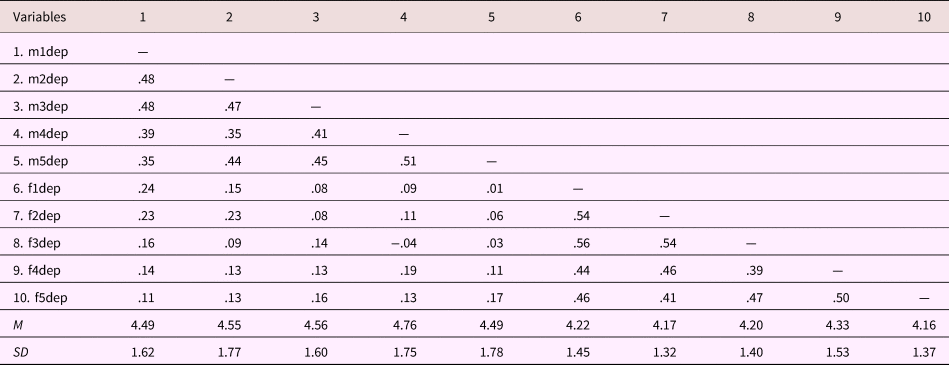
Table 1 provides descriptive information regarding mothers’ and fathers’ depressive symptoms. In all models, a stable trait latent construct (Kenny & Zautra, Reference Kenny, Zautra, Collins and Sayer2001) was created to capture the between-person differences for each reporters’ symptoms. In addition, the time-varying components for each reporter's symptoms were fixed according to a simplex pattern (e.g., youth's Wave 1 internalizing symptoms predicted their Wave 2 internalizing symptoms, but not the nonadjacent waves). At each time point, the time-varying variables for all reporters were correlated. In addition to including stability coefficients and cross-lagged influences on each reporter, the global trait factor for each reporter was correlated with the other two reporters’ global trait factor (e.g., mothers’ trait-like depressive symptoms were correlated with youth's trait-invariant internalizing symptoms and father's trait-like depressive symptoms). For Wave 5 youth's internalizing symptoms, both parents’ proximal effects (e.g., Wave 4) and distal effects (e.g., Wave 1) were allowed to predict changes in youth's time-varying internalizing symptoms. Changes in all models refer to time-varying variances that reflect both within-person variances as well as wave-specific variability. The notations for covariances are denoted as c and the unidirectional path estimates are denoted as b.
Correlations, M, and SD for mothers’ and fathers’ depressive symptoms

Note: FDEP = fathers’ depressive symptoms; MDEP = mothers’ depressive symptoms. Correlations ≥.099 are significant at the probability level of .05. Correlations ≥.130 are significant at the probability level of .01.
The baseline cross-lagged model (Model A) fit the data well, χ2 (46) = 67.851, p = .020, RMSEA = .035, 95% confidence interval (95% CI) [.014, .052], CFI = .991, TLI = .979, SRMR = .033. In Model B, however, the covariances between reporters for later waves were removed to be consistent with traditional cross-lagged panel designs, χ2 (58) = 87.556, p = .007, RMSEA = .036 [.019, .051], CFI = .987, TLI = .977, SRMR = .036. Model B did not differ significantly from Model A, Δχ2 (12) = 19.705, p = .073, suggesting that the later covariances did not contribute significant information to the model.
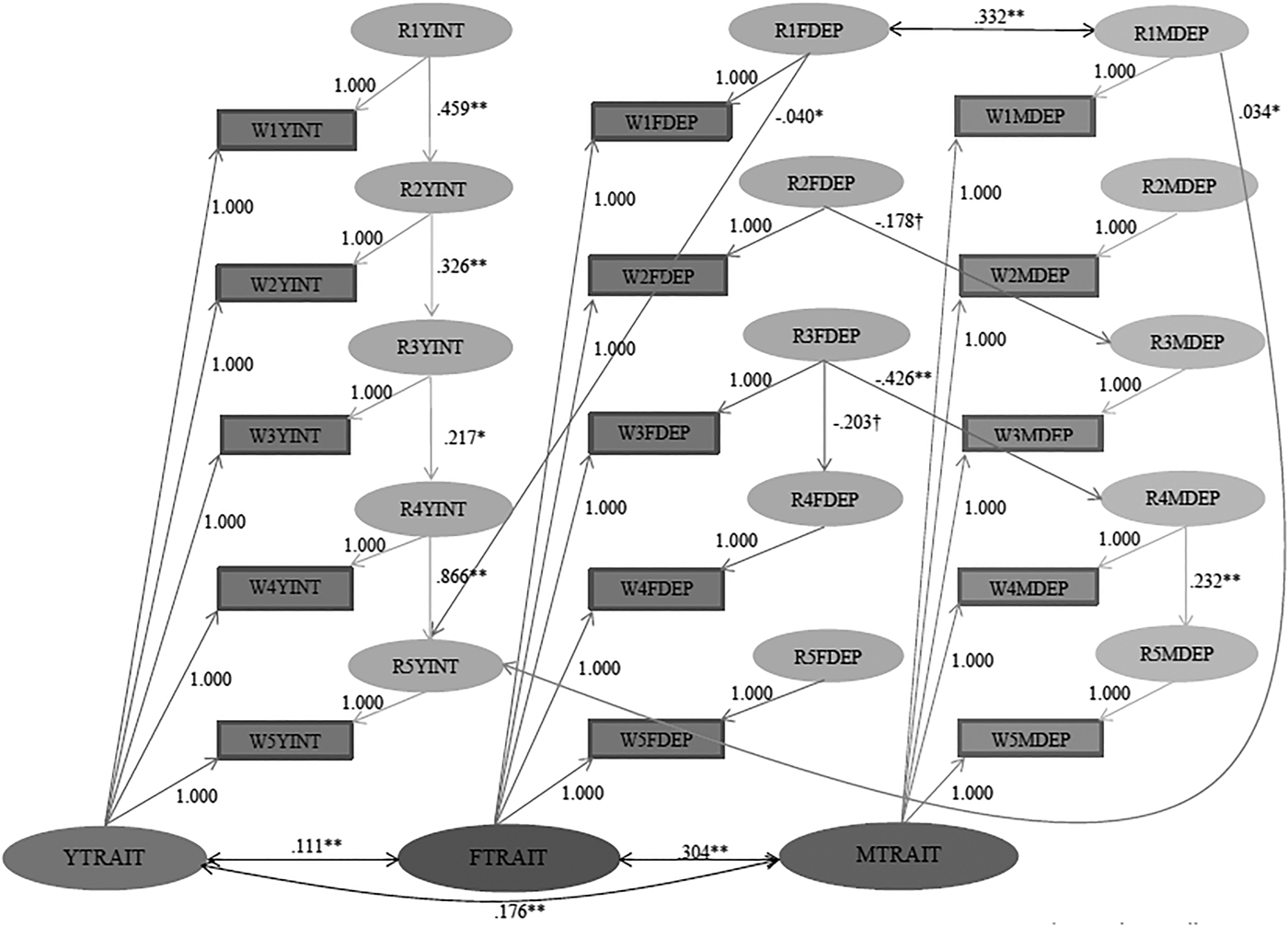
Model B revealed both trait-invariant and time-varying differences in youth's internalizing symptoms across time with the standardized coefficients for the global trait factor ranging from .674 to .741 (Figure 1). These trait-like differences in youth's internalizing symptoms appeared consistent across time; however, youth also showed significant time-varying changes in their internalizing symptoms after removing their trait-like differences. Across early and middle adolescence (i.e., Waves 1–3), youth's internalizing symptoms varied across time, b = .459 to b = .217, and this time-varying component of internalizing symptoms became very stable between late adolescence and young adulthood (i.e., Waves 4–5), b = .866.
Unstandardized coefficients for the trait and time-varying cross-lagged panel analysis for youth's internalizing symptoms. *p ≤ .05. **p ≤ .01.

For mothers’ depressive symptoms, only one time-varying coefficient was significant. Specifically, mothers’ time-varying depressive symptoms at Wave 4 were positively associated with their time-varying depressive symptoms at Wave 5, b = .232, standard error [SE] = .070, p < .001. These findings suggest that the variation in mothers’ depressive symptoms can be explained by between-person differences. A similar pattern was found for fathers’ depressive symptoms. Fathers’ time-varying depressive symptoms at Wave 3 were negatively associated with fathers’ time-varying depressive symptoms at Wave 4, b = –.203, SE = .109, p = .061. There were no other significant time-varying associations across waves, suggesting that most of the variation in fathers’ depressive symptoms was explained by stable between-person differences at the trait level.
Correlations between the global trait factor among the three reporters revealed that mothers’ and fathers’ trait-invariant differences in depressive symptoms were related to youth's trait-invariant internalizing symptoms across time. Specifically, youth's trait-invariant differences in internalizing symptoms were positively associated with mothers’ (c = .176, SE = .047, p < .001) and fathers’ (c = .111, SE = .041, p = .006) trait-invariant depressive symptoms. Similarly, mothers’ trait-invariant differences were positively associated with fathers’ trait-invariant differences in depressive symptoms (c = .304, SE = .078, p < .001).
At Wave 1, the time-varying covariance between mothers’ and fathers’ depressive symptoms was significant (c = .332, SE = .092, p < .001). In contrast, youth's time-varying internalizing symptoms did not correlate significantly with mothers’ (c = .049, SE = .056, p = .385) or fathers’ (c = .048, SE = .047, p = .380) time-varying depressive symptoms at Wave 1. The cross-lagged results revealed that mothers’ (b = .034, SE = .017, p = .046) and fathers’ (b = –.04, SE = .020, p = .042) time-varying depressive symptoms at Wave 1 predicted changes in youth's time-varying internalizing symptoms at Wave 5 (i.e., distal effects). However, mothers’ and fathers’ time-varying depressive symptoms at Wave 4 did not predict changes in youth's time-varying internalizing symptoms at Wave 5 (i.e., proximal effects). Furthermore, there were no significant associations between both parents’ depressive symptoms and youth's internalizing symptoms at earlier waves. Fathers’ time-varying depressive symptoms at Waves 2 and 3 predicted lower levels of mothers’ time-varying depressive symptoms at Wave 3 (b = –.178, SE = .095, p = .060) and Wave 4 (b = –.426, SE = .122, p < .001). Fathers’ depressive symptoms, however, did not predict changes in mothers’ depressive symptoms at other waves. Mothers’ depressive symptoms showed no effect on fathers’ depressive symptoms across time. Similarly, youth's time-varying internalizing symptoms did not predict changes in mothers’ and fathers’ time-varying depressive symptoms.
Moderation analyses
A series of multigroup analyses tested whether the previous trait and time-varying model (Model B) varied by family ethnicity, family structure, or child gender. For each moderator, an unconstrained model was compared with a model that equated the parameter estimates across groups. Findings from the multigroup analyses revealed that the unconstrained models differed significantly from the fully equated models for family ethnicity, Δχ2 (44) = 80.922, p < .001, and child gender, Δχ2 (44) = 67.777, p = .012, but not family structure, Δχ2 (44) = 48.697, p = .290. A series of multigroup analyses were conducted for family ethnicity and child gender to compare the unconstrained model with constrained versions of the model (e.g., trait-invariant differences, time-varying differences, mother effects on child, father effects on child, child effects on each parent). Sets of effects were tested, rather than individual paths, to avoid capitalizing on chance (i.e., type 1 error), although analyzing sets of effects may also obscure significant path coefficients (i.e., type 2 error). Significant moderation findings are reported below.
Family ethnicity
A χ2 difference test examining the trait-invariant differences between European and Mexican American families was significant: Δχ2 (3) = 11.143, p = .011. Among European American families, youth's trait-invariant internalizing symptoms were significantly correlated with mothers’ (c = .244, SE = .063, p < .001) and fathers’ (c = .238, SE = .065, p < .001) trait-invariant depressive symptoms, and mothers’ trait-invariant depressive symptoms were significantly correlated with fathers’ trait-invariant depressive symptoms (c = .298, SE = .099, p < .001). In contrast, although mothers’ and fathers’ trait-invariant depressive symptoms were significantly correlated in Mexican American families (c = .250, SE = .119, p = .035), youth's trait-invariant internalizing symptoms were not associated significantly with mothers’ (c = .116, SE = .070, p = .095) or fathers’ (c = –.019, SE = .050, p = .704) trait-invariant depressive symptoms. Other multigroup analyses did not differ significantly across European and Mexican American families.
Child gender
A significant χ2 difference test indicated that the time-varying effects in youth's internalizing symptoms differed for males and females, Δχ2 (4) = 10.580, p = .032. Females evidenced greater stability in their internalizing symptoms than males. The time-varying coefficients for females were significant from Wave 1 to Wave 2, b = .285, SE = .102, p = .005, and from Wave 4 to Wave 5, b = .825, SE = .040, p < .001, but not from Waves 2–4. In contrast, the time-varying coefficients for males were significant across all waves (b = .359, SE = .119, p < .001 to b = .914, SE = .042, p < .001). The standardized coefficients for the global trait factor of internalizing symptoms were consistent with the time-varying coefficients. Specifically, the standardized coefficients for the global trait factor revealed that less of the variation in internalizing symptoms was explained by trait-invariant differences among males, with coefficients ranging from .452 to .507, than among females, with coefficients ranging from .711 to .846.
A second χ2 difference test for gender was significant, Δχ2 (5) = 11.618, p = .040, revealing that the influence of mothers’ depressive symptoms on youth's internalizing symptoms differed between males and females across time. An examination of the unstandardized path coefficients across waves indicated that mothers’ depressive symptoms at Wave 4 predicted higher levels of youth's internalizing symptoms at Wave 5 for females, b = .063, SE = .024, p = .008, but not for males, b = –.002, SE = .016, p = .916.
Externalizing symptoms
Cross-lagged panel analyses evaluated the effects of mothers’ and fathers’ depressive symptoms on youth's externalizing symptoms, as well as youth's reciprocal influences on mothers’ and fathers’ depressive symptoms. Similar to the model for youth's internalizing symptoms, mothers’ and fathers’ depressive symptoms at Waves 1 and 4 were allowed to predict changes in youth's externalizing symptoms at Wave 5. In addition to the stability coefficients and cross-lagged influences across all three reporters, this baseline trait and time-varying cross-lagged model included within-wave covariances between all three reporters’ time-varying symptoms. Model A fit the data well, χ2 (44) = 64.060, p = .026, RMSEA = .034 [.012, .051], CFI = .990, TLI = .975, SRMR = .035; however, a subsequent model (Model B) with only the within-wave covariances of the time-varying components for all three reporters at Wave 1 also fit the data well, χ2 (56) = 80.945, p = .016, RMSEA = .034 [.015, .049], CFI = .987, TLI = .976, SRMR = .038, and did not differ significantly from Model A, Δχ2 (12) = 16.885, p = .154, which suggests that these covariances did not contribute significant information to the model.
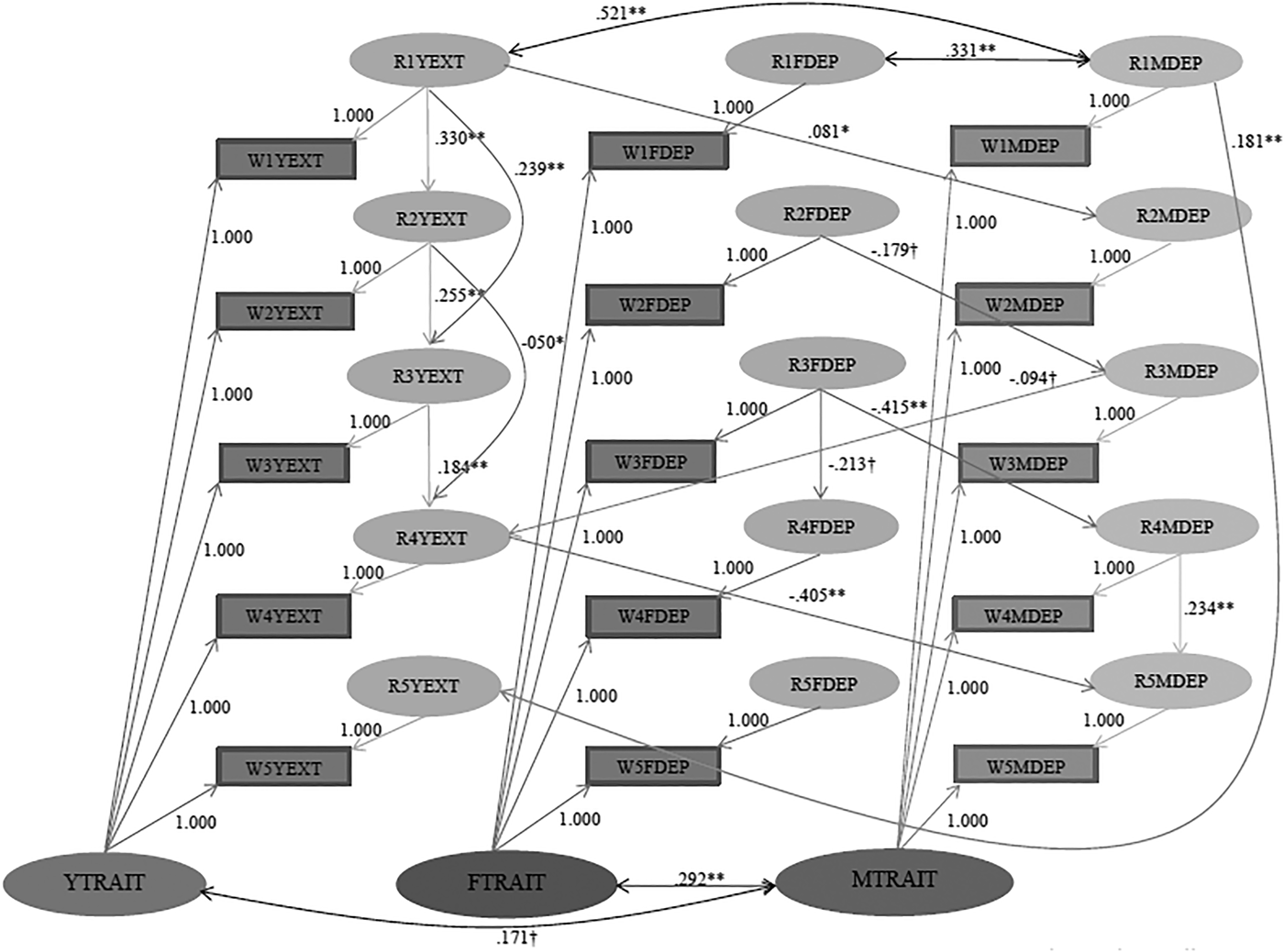
Findings from Model B revealed both trait-invariant and time-varying differences in youth's externalizing symptoms across time with standardized coefficients on this global trait factor ranging from .500 to .927 (Figure 2). From Waves 1 through 4, youth's time-varying externalizing symptoms were significantly correlated with each subsequent wave, with the results showing a declining trend in externalizing symptoms across time, b = .330, SE = .047, p < .001 to b = .189, SE = .052, p = .001. Youth's externalizing symptoms did not follow a simplex pattern (e.g., higher correlations between variables closer in time intervals), suggesting that some effects from earlier waves did not carry through to the next wave in sequential order (Table 2). As a result, there were significant nonadjacent paths between Waves 1 and 3 (b = .239, SE = .030, p < .001), and between waves 2 and wave 4 (b = –.050, SE = .024, p = .037), although the latter association was negative. The time-varying association between Waves 4 and 5 was not significant, b = .005, SE = .210, p = .980, which suggests that youth's externalizing symptoms showed considerable variation from early to middle adolescence, but not from late adolescence and young adulthood. Indeed, the standardized coefficients of the global trait factor mirrored the findings of the time-varying coefficients, which showed an increase in the trait-like variation of youth's externalizing symptoms from Wave 1 (β = .500, SE = .024, p < .001) to Wave 5 (β = .927, SE = .035, p < .001).
Unstandardized coefficients for the trait and time-varying cross-lagged panel analysis for youth's externalizing symptoms. *p ≤ .05. **p ≤.01.

Correlations for the latent constructs of youth's externalizing symptoms across waves

Findings for mothers’ and fathers’ trait-invariant and time-varying depressive symptoms were consistent with the youth internalizing model with most of the variation in mothers’ and fathers’ depressive symptoms being explained by between-person differences. An examination of the correlations between the global trait factor for all three reporters revealed that youth's trait-invariant externalizing symptoms were marginally associated with mothers’ depressive symptoms (c = .171, SE = .102, p = .093), but were not related to fathers’ depressive symptoms (c = .132, SE = .089, p = .137). Mothers’ and fathers’ trait-invariant depressive symptoms were significantly associated (c = .292, SE = .077, p < .001).
In the total sample, mothers’ time-varying depressive symptoms at Wave 1 predicted higher rates of youth's externalizing symptoms at Wave 5 (b = .181, SE = .053, p = .001), but mothers’ time-varying depressive symptoms at Wave 3 predicted lower rates of youth's externalizing symptoms at Wave 4 (b = –.094, SE = .055, p = .089). There were no other parent effects on youth externalizing symptoms across time. Consistent with the youth's internalizing model for the total sample, fathers’ time-varying depressive symptoms at Waves 2 and 3 were associated with lower levels of mothers’ time-varying depressive symptoms at Waves 3 and 4. In addition, mothers’ time-varying depressive symptoms at Wave 1 were correlated with fathers’ time-varying depressive symptoms (c = .331, SE = .092, p < .001) and youth's time-varying externalizing symptoms (c = .521, SE = .203, p = .010) at the same time point, but youth's time-varying externalizing symptoms at Wave 1 were not correlated with father time-varying depressive symptoms (c = .102, SE = .172, p = .556). Youth's time-varying externalizing symptoms at Wave 1 predicted higher levels of mothers’ depressive symptoms at Wave 2 (b = .081, SE = .034, p = .016), whereas youth's time-varying externalizing symptoms at Wave 4 predicted lower levels of mothers’ depressive symptoms at Wave 5 (b = –.405, SE = .116, p = .001).
Moderation analyses
A series of multigroup analyses were conducted to determine whether the previous trait and time-varying cross-lagged model (Model B) varied by family ethnicity, family structure, and child gender. For each moderation analysis, an unconstrained model was compared with a model that equated the parameter estimates across groups. Findings from the multigroup analyses revealed that the unconstrained models differed significantly from the fully equated models for family ethnicity, Δχ2 (46) = 71.498, p = .009, and child gender, Δχ2 (46) = 63.835, p = .041, but not family structure, Δχ2 (46) = 34.035, p = .904. Several multigroup analyses were conducted for family ethnicity and child gender to compare an unconstrained model with various constrained versions of the model (e.g., trait-invariant differences, time-varying differences, mother effects on child, father effects on child, child effects on each parent). Significant moderation findings are reported in the following section.
Family ethnicity
A χ2 difference test for the time-varying covariances at Wave 1 among all three reporters was significant, Δχ2 (3) = 10.126, p = .017. Although the association between mothers’ and fathers’ time-varying depressive symptoms at Wave 1 was pronounced in both European (b = .227, SE = .126, p = .072) and Mexican (b = .444, SE = .142, p = .002) American families, the relation between fathers’ depressive symptoms and youth's externalizing symptoms differed by family ethnicity. Specifically, fathers’ depressive symptoms were significantly associated with youth's externalizing symptoms in European American families at Wave 1 (c = .541, SE = .251, p = .031), whereas fathers’ depressive symptoms were not associated significantly with youth's externalizing symptoms in Mexican American families (c = –.404, SE = .255, p = .114) at the same time point. In Mexican American families, mothers’ time-varying depressive symptoms were marginally associated with youth's externalizing symptoms at Wave 1 (c = .589, SE = .318, p = .064), but this relation was not significant in European American families (c = .425, SE = .265, p = .108).
Child gender
The χ2 difference test investigating the effects of youth's time-varying externalizing symptoms on mothers’ time-varying depressive symptoms, Δχ2 (4) = 8.226, p = .082, and of fathers’ time-varying depressive symptoms on mothers’ time-varying depressive symptoms, Δχ2 (4) = 8.006, p = .091, were marginally significant; therefore, these analyses were not probed further for moderation effects.
Discussion
This investigation evaluated the unique contributions of mothers’ and fathers’ depressive symptoms to youth's internalizing and externalizing symptoms from early adolescence to young adulthood, as well as the reciprocal effects of youth's symptomatology on each parent's depressive symptoms. This is one of the first longitudinal studies to examine the effects of parents’ psychopathology on youth adjustment while taking into account the influence of the coparent's psychopathology. Moreover, whereas prior studies have typically used cross-sectional approaches to study young, European American children in clinical samples, this study evaluated associations between parents’ depressive symptoms and youth's symptomatology from early adolescence to young adulthood in a community sample of European American and Mexican American families. Overall, the findings showed that both mothers’ and fathers’ between- and within-person differences in depressive symptoms across time were related to youth's internalizing and externalizing symptoms from early adolescence to young adulthood, but reciprocal effects from youth's symptomatology to parents’ depressive symptoms were modest. These associations varied significantly across groups defined by family ethnicity and child gender, but not by family structure.
Fathers’ and mothers’ depressive symptoms
Fathers’ and mothers’ depressive symptoms evidenced predominantly trait-invariant (i.e., between-person) differences, which indicates that mothers’ and fathers’ depressive symptoms remained stable over time and had comparable effects on youth's symptomatology across early adolescence and young adulthood. Mothers’ and fathers’ between-person differences in depressive symptoms across time and their individual differences in depressive symptoms at the initial wave of assessment were positively correlated with each other and did not significantly differ across racial/ethnic, family structure, or gender groups. Previous research has suggested similar patterns, such that, if one partner has a history of depression, there is an increased likelihood that the other partner will experience similar rates of depression (e.g., Brennan et al., Reference Brennan, Hammen, Katz and Le Brocque2002). These patterns likely reflect assortative mating patterns wherein partners both seek out individuals who are genetically similar to them and/or have similar personal characteristics, such that, as time unfolds, fathers and mothers become increasingly psychologically similar in the context of a coconstructed environment (Watson et al., Reference Watson, Klohnen, Casillas, Nus Simms, Haig and Berry2004).
Youth's internalizing symptoms
Unlike mothers’ and fathers’ depressive symptoms, youth's internalizing symptoms evidenced both between- and within-person differences from early adolescence to young adulthood. The between-person differences in youth's internalizing symptoms (i.e., the differences in internalizing scores between two people) remained consistent across time, however, whereas the within-person differences in youth's internalizing symptoms (i.e., the differences in an individual's internalizing scores across time after the trait portion has been removed) became increasingly stable over time. This finding is consistent with recent work examining time-invariant between-person and time-varying within-person differences in children's depressive symptoms, which suggests that between-person differences in children's depressive symptoms are congruent across time, informants, and settings (Cole et al., Reference Cole, Martin, Jacquez, Tram, Zelkowitz, Nick and Rights2017). The increasing stability of individual differences in youth's internalizing symptoms from late adolescence to young adulthood is also consistent with previous research showing that youth's internalizing symptoms, especially depression, increase from early to mid-adolescence, but remain stable after mid-adolescence and into adulthood (Ge, Natsuaki, & Conger, Reference Ge, Natsuaki and Conger2006). As in prior studies (Ge, Lorenz, Conger, Elder, & Simons, Reference Ge, Lorenz, Conger, Elder and Simons1994; Ge et al., Reference Ge, Natsuaki and Conger2006; Kessler, Reference Kessler2003), however, girls experienced more stability than boys in their internalizing symptoms by mid adolescence and evidenced increasing rates of internalizing symptoms across early adolescence.
Between-person differences in youth's internalizing symptoms were associated with between-person differences in mothers’ and fathers’ depressive symptoms across time. Specifically, mothers and fathers who experienced higher levels of depressive symptoms were more likely to have children with elevated rates of anxiety and depressive symptoms from early adolescence to young adulthood. These findings are consistent with previous empirical evidence suggesting that both mothers’ and fathers’ depressive symptoms contribute to youth's internalizing symptoms (Cummings et al., Reference Cummings, Cheung, Koss and Davies2014; Elgar et al., Reference Elgar, Mills, McGrath, Waschbusch and Brownridge2007; Hammen et al., Reference Hammen, Brennan and Keenan-Miller2008).
Although the associations of mothers’ and fathers’ depressive symptoms with youth's internalizing symptoms were consistent across intact and stepfather families and across families with daughters and sons, these effects varied by family ethnicity. European American youth's experiences of anxiety and depressive symptoms were linked to both their mothers’ and fathers’ depressive symptoms, but neither set of relations attained significance among Mexican American youth. This finding contradicts prior studies suggesting that relations between parental psychopathology and child symptomatology are stronger in non-European American families because of the relatively greater interdependence among family members (Wilson & Durbin, Reference Wilson and Durbin2010). In contrast to prior assertions, the current findings may reflect a buffering effect of close and supportive connections in Mexican American families, such that they mitigate the influence of parents’ depressive symptomatology on children.
Mirroring the obtained patterns of between-person differences, individual differences in mothers’ and fathers’ depressive symptoms predicted changes in youth's internalizing symptoms. Specifically, mothers’ and fathers’ depressive symptoms in early adolescence (i.e., distal effects) evidenced a stronger influence on youth's later internalizing symptoms than parents’ depressive symptoms in late adolescence (i.e., proximal effects). These findings are consistent with prior theoretical frameworks that conceptualize development as cumulative, orderly, and hierarchically integrated, such that early experiences in the family environment tend to have special significance or meaning for youth development (Cummings & Cicchetti, Reference Cummings, Cicchetti, Greenberg, Cicchetti and Cummings1990; Duggal, Carlson, Sroufe, & Egeland, Reference Duggal, Carlson, Sroufe and Egeland2001; Sroufe, Reference Sroufe, Cicchetti and Beeghly1990). In this view, distal parental depressive symptoms may lead to youth's symptomatology in young adulthood because parents’ experiences of depressive symptoms during youth's earlier development influence their responsiveness and psychological availability to their children's developmental needs, which in turn affects their children's emergent representational, regulatory, and relational structures (Cummings & Cicchetti, Reference Cummings, Cicchetti, Greenberg, Cicchetti and Cummings1990; Duggal et al., Reference Duggal, Carlson, Sroufe and Egeland2001). Alternatively, the relatively modest effect of proximal parental depressive symptoms on youth's symptomatology may reflect the normative decline in parental influence across adolescence and into young adulthood as youth's relationships beyond the family with platonic and romantic peers takes on increasing salience (Furman & Buhrmester, Reference Furman and Buhrmester1992; Larson, Richards, Moneta, Holmbeck, & Duckett, Reference Larson, Richards, Moneta, Holmbeck and Duckett1996).
The influence of mothers’ and fathers’ depressive symptoms on youth's internalizing symptoms differed such that elevated rates of mothers’ depressive symptoms in early adolescence were associated with higher levels of youth's internalizing symptoms in young adulthood, whereas elevated rates of fathers’ depressive symptoms in early adolescence were associated with lower levels of youth's internalizing symptoms in young adulthood. The obtained findings are consistent with prior studies showing that mothers’ depressive symptoms in early adolescence predicted children's anxiety and depressive symptoms in young adulthood (Reeb et al., Reference Reeb, Wu, Martin, Gelardi, Chan and Conger2015), as well as with other studies suggesting that changes in mothers’ depressive symptoms were associated with higher rates of emotional problems in children during adolescence (Cummings et al., Reference Cummings, Cheung, Koss and Davies2014; Elgar et al., Reference Elgar, Mills, McGrath, Waschbusch and Brownridge2007). Of interesting, higher levels of fathers’ depressive symptoms in early adolescence were associated with less vulnerability to internalizing symptoms for youth in young adulthood. Given this counterintuitive finding, we encourage efforts to replicate this pattern in advance of offering tenuous interpretations, particularly as the large number of analyses in the current study may have inflated the risk of type 1 errors.
Although mothers’ depressive symptoms in early adolescence were positively associated with youth's internalizing symptoms for the total sample, changes in mothers’ depressive symptoms during late adolescence emerged as a stronger influence on girls’ than on boys’ internalizing symptomatology during young adulthood. These findings are consistent with prior evidence that mothers’ depressive symptoms influence both boys’ and girls’ internalizing symptoms (Connell & Goodman, Reference Connell and Goodman2002), but they further suggest that girls may be especially vulnerable to mothers’ depressive symptoms during young adulthood. This pattern may reflect a shift in the relational dynamics between mothers and their children such that mothers may be more willing to share their emotional challenges with their older daughters and may depend on them for emotional support to a greater extent than their older sons. Alternately, some scholars have argued that daughters may become overinvolved with their mothers’ depression, which increases the immediate transmission of mothers’ depressive symptoms to their daughters relative to their sons (Duggal et al., Reference Duggal, Carlson, Sroufe and Egeland2001). Finally, changes in youth's internalizing symptoms did not affect parents’ depressive symptoms. This pattern could suggest that youth's internalizing symptoms create fewer disruptions in the family system, perhaps because they are more likely to go unnoticed.
Youth's externalizing symptoms
Youth's externalizing symptoms evidenced both between- and within-person differences from adolescence to young adulthood. The trait-like variation in youth's externalizing symptoms increased from adolescence to young adulthood and the time-varying effects decreased across time. The obtained findings mirror those of prior studies, which have shown that children's externalizing problems increase from early to middle adolescence (Galambos, Barker, & Almeida, Reference Galambos, Barker and Almeida2003), and become increasingly stable across adolescence (Kim, Conger, Elder, & Lorenz, Reference Kim, Conger, Elder and Lorenz2003).
Youth's between-person differences in externalizing symptoms were associated with mothers’ between-person depressive symptoms, but not with fathers’ between-person depressive symptoms.; thus, mothers who had higher levels of depressive symptoms were more likely to have children who engaged in delinquent, intrusive, and rule-breaking behaviors from early adolescence through young adulthood. Although these findings support prior studies showing that depressed mothers tend to have children with more problem behaviors (Elgar et al., Reference Elgar, Mills, McGrath, Waschbusch and Brownridge2007; Natsuaki et al., Reference Natsuaki, Shaw, Neiderhiser, Ganiban, Harold, Reiss and Leve2014), the current results are inconsistent with previous studies showing that fathers’ depressive symptoms are more important than mothers’ depressive symptoms for understanding children's externalizing symptoms (Connell & Goodman, Reference Connell and Goodman2002; Kane & Garber, Reference Kane and Garber2004; Low & Stocker, Reference Low and Stocker2005). Given that prior studies have typically examined mothers’ and fathers’ depressive symptoms in separate models and have not disentangled between-person from the within-person effects, the association between fathers’ depressive symptoms and youth's externalizing symptoms in the current study may have been attenuated by the concomitant consideration of mothers’ symptomatology, as well as the separation of these two variance types in this study.
Similar to the influence of parent's between-person differences in depressive symptoms on youth's externalizing symptoms, within-person differences in mothers’, but not fathers’, depressive symptoms predicted changes in youth's externalizing symptoms. Interestingly, whereas mothers’ elevated depressive symptoms during early adolescence (i.e., distal effects) predicted higher levels of youth's externalizing symptoms during young adulthood, mothers’ elevated depressive symptoms in middle adolescence (i.e., proximal effects) predicted lower levels of youth's externalizing symptoms during late adolescence. Although the distal effect found for mothers’ depressive symptoms is consistent with prior research (Cummings et al., Reference Cummings, Cheung, Koss and Davies2014; Elgar et al., Reference Elgar, Mills, McGrath, Waschbusch and Brownridge2007), the proximal negative effect of mothers’ depressive symptoms on youth's externalizing problems is inconsistent with the research literature and warrants further replication in the field before it should be interpreted.
The current findings also highlight the importance of investigating child effects on parents’ psychological functioning and suggest that children's behavior in adolescence and young adulthood may feed back to influence parents’ mental health in divergent ways. Youth's externalizing symptoms predicted higher levels of mothers’ depressive symptoms during early adolescence, whereas youth's externalizing symptoms in late adolescence predicted lower levels of mothers’ depressive symptoms during young adulthood. These data suggest that youth's externalizing problems during early adolescence were associated with elevated depressive symptoms in mothers, but that these same problems were associated with lower maternal depressive symptoms in late adolescence. It may be that mothers are more likely to attribute their children's problem behaviors during early adolescence to their own shortcomings as parents, whereas higher levels of youth's externalizing behaviors during late adolescence might be perceived as more age-appropriate or normative.
Strengths, limitations, and future directions
This investigation drew on a multiwave, multi-informant longitudinal study of a large and diverse sample of two-parent families. Notable strengths of this study included the examination of between- and within-person effects, transactional effects among multiple family members, proximal and distal influences, and the ability to evaluate directional hypotheses and developmental timing. Several limitations both qualify the interpretation of the findings and reveal promising directions for future research, however.
First, given the complexity of the models and moderate sample size, it was not possible to test synergistic effects between the independent and contextual variables in this study. Although some researchers have argued that the effects of parental depression on youth adjustment may be additive (Reeb et al., Reference Reeb, Conger and Wu2010, Reference Reeb, Wu, Martin, Gelardi, Chan and Conger2015) rather than interactive, previous studies have found interactive effects between mothers’ and fathers’ depressive symptoms on youth adjustment (Brennan et al., Reference Brennan, Hammen, Katz and Le Brocque2002). Furthermore, it is important that higher level interactions among family ethnicity, family structure, and child gender could lead to differential developmental outcomes. Likewise, we encourage future researchers to consider alternative analytic models, such as dynamic growth curve models (McArdle & Nesselroade, Reference McArdle, Nesselroade, Schinka and Velicer2003).
Second, moderation analyses were tested in sets (e.g., all mother effects on youth's symptomatology across time) to mitigate type 1 error; however, this analytic approach could have masked significant effects for individual paths. In addition, the complexity of the models as well as the sample size may not have been sufficient to detect small effects. Future research should use larger, nationally representative datasets to determine if the effects found in this study are consistent across different samples. Future research should also determine whether the distal effect of fathers’ depressive symptoms on youth's internalizing symptoms differs between sons and daughters.
Third, we were not able to disentangle the confound of family structure and genetic influences on youth's symptomatology. Indeed, a recent study examining the interplay between genetics and early environmental influences on youth's internalizing symptoms from late childhood to adolescence found that genetic predisposition was the sole predictor of the stable latent trait (i.e., time-invariant) portion of youth's internalizing symptoms across adolescence (Musci et al., Reference Musci, Masyn, Benke, Maher, Uhl and Ialongo2016). Although a fully unconstrained model by family structure and models with only fathers showed a direct association between fathers’ depressive symptoms and youth's internalizing symptoms, this study did not provide strong support for paternal genetic transmission as family structure was not found to moderate the obtained pathways.
Finally, the factor score estimates for youth's internalizing and externalizing symptoms were computed using a novel approach to data harmonization and this process may not have been fully corrective. For example, the associations between Waves 3 and 4 were lower (and in some instances not significant), and this was coincident with the interwave transition in measurement tools. That said, it is important to note that the time-varying associations between these two waves were quite large considering this was the longest time interval in the study. Although the findings were consistent with prior research on youth's internalizing (Cole et al., Reference Cole, Martin, Jacquez, Tram, Zelkowitz, Nick and Rights2017; Ge et al., Reference Ge, Natsuaki and Conger2006) and externalizing (Galambos et al., Reference Galambos, Barker and Almeida2003; Kim et al., Reference Kim, Conger, Elder and Lorenz2003) symptoms, future research should verify these trait and time-varying differences in youth's symptomatology in studies with closer assessment intervals. It is also important to note that although we were able to establish weak invariance with youth's measures of internalizing and externalizing symptoms across time, we were unable to acquire strong invariance which is fundamental in assessing change across time; therefore, the time-varying effects could be attributed to both real change as well as measurement error and should be interpreted with caution.
Implications and conclusions
The current study addressed several gaps in the existing literature on the effects of parent's depressive symptoms on youth's adjustment. Overall, the findings revealed dynamic transactions across family members and revealed opportune times and targets for intervention and prevention efforts aimed at mitigating the deleterious effects of parental psychopathology on adolescent and young adult adjustment. In particular, these data suggest that intervention and policy efforts to reduce the negative effect of parental psychopathology on children should include the entire family system. The findings from this study also highlight the need to include children in intervention efforts as youth's externalizing symptoms influenced parents’ depressive symptoms.
One of the most interesting findings in this study was the moderating effect of family ethnicity on the association between parental depressive symptoms and youth's symptomatology, with European American youth appearing more susceptible to their parents’ depressive symptoms than their Mexican American peers. To maximize the effectiveness of prevention and intervention programs, it might be beneficial for researchers and clinicians to understand what features of the Mexican American family environment seem to prevent the transmission of negative parental depression effects on youth adjustment. Intervention efforts also need to consider developmental timing during the implementation of these programs.
Finally, given the unique examination of trait and time-varying effects in this study, some of the findings were inconsistent with previous empirical evidence. In particular, most of the findings that were consistent with previous literature were at the trait level (i.e., between-person differences), suggesting that findings in the existing literature on longitudinal and transactional effects are driven in large part by differences at the trait level and less so by time-varying effects. This investigation suggests that researchers need to be careful about the conclusions they draw from traditional cross-lagged models and should adhere to recent calls in the field (Berry & Willoughby, Reference Berry and Willoughby2017; Hamaker et al., Reference Hamaker, Kuiper and Grasman2015) that advocate for the separation of between- and within-person differences in psychological constructs across time.
Author ORCIDs
Fanita A. Tyrell 0000-0001-6419-6485.