Introduction
This article examines a 60-year period of curriculum development and reform with the purpose of tracing the inclusion of popular music and musicians in Australian classroom music education. The Australian context is well able to contribute to the global discussion that is under way in popular music education. Here curricular acknowledgement of the so-called non-literate musician at the senior secondary level (equivalent to UK late Key Stage 4–Stage 5) dates back to the late 1970s (Board of Senior School Studies, 1977). Over this time, syllabus documents facilitating practical learning and generic music ‘elements’ or ‘concepts’ knowledge frameworks have been deemed adequate in meeting the needs of those with ‘informal learning’ backgrounds (Board of Studies, 2009c, p. 6). Despite such inattention to curriculum innovation surrounding popular musicianship at the senior secondary level, the number of schools encouraging informal learning and non-formal pedagogies continues to grow, particularly at the junior secondary or middle-school levels (Hallam, Creech & Mc Queen, Reference HALLAM, CREECH and Mc QUEEN2017; Jeanneret, Reference JEANNERET2010; Jeanneret, Stevens-Ballenger & Mc Lellan, Reference JEANNERET, STEVENS-BALLENGER and Mc LELLAN2014). Beyond school, tertiary degrees in popular and contemporary music have been established for several decades both in Australia and internationally (Bjornberg, Reference BJORNBERG1993; Hannan, Reference HANNAN2005; Karlsen, Reference KARLSEN2010; Powell, Krikun & Pignato, Reference POWELL, KRIKUN and PIGNATO2015). Clearly, it is time for a focused re-examination of curriculum and practice at the senior secondary level for the ‘informal learner’. Yet to do so requires a close look at the past in order to contextualise the present, for every field of practice ‘consists of a set of objective historical relations between positions anchored in certain forms of power’ (Bourdieu & Wacquant, Reference BOURDIEU and WACQUANT1992, p. 16). As will be seen, these ‘forms of power’ manifest in both curriculum documents and accounts of classroom learning according to the perceived value of music literacy skills, with obvious implications for students who learn and perform music by ear.
School music curriculum has tended to evolve in response to changes occurring beyond the walls of the classroom: as a consequence of music industries subject to cultural, social, technological and market trends, but, equally, in response to shifting educational ideologies influencing the field of education more broadly. Frequently, the two are entwined. Once curriculum reform has taken place, however, the impact upon classroom practice is less easy to trace due to the flexibility in which syllabus documents are interpreted by practitioners. An analysis of reform trends and their implications for present practice require, therefore, a theoretical lens capable of looking beyond context-specific situations, in order to unveil the underlying mechanisms perpetuating the current state of play in classrooms today. For this reason, Legitimation Code Theory (or LCT) from the sociology of education was employed, useful in the theorisation of knowledge practices evident in a range of data sources, from the metalanguage of curriculum through individual teaching and learning interactions (Maton, Reference MATON2014).
Empirically, research was conducted in the state of New South Wales (NSW) – the geographic context most immediate to me as a teacher-researcher – with this paper reporting the initial findings of historic investigation foreground to case study research conducted in my own classroom (Carroll, Reference CARROLL2017). School syllabus documents for music were acquired by contacting the NSW Education Standards Authority (NESA), the curriculum and assessment authority responsible for school education in NSW, the State Library of NSW and rare books at Fisher Library, the University of Sydney. Matriculation statistics from the same period 1955–2018 were available online at the NESA website (http://www.boardofstudies.nsw.edu.au). The period in question represents the same time period in which popular music rose to cultural dominance in middle-class Australia, and simultaneously, reform initiatives would take place within education leading to the eventual inclusion of this music in classrooms, and with it, increasing numbers of students enculturated in popular music-making experiences gained largely outside formal education.
Theoretical framework: Legitimation Code Theory (LCT)
LCT is being used in an increasingly diverse array of fields, with its use in music education having already provided a valuable analytical and explanatory tool (Lamont & Maton, Reference LAMONT and MATON2008, Reference LAMONT, MATON and Wright2010; Martin, Reference MARTIN, Maton, Hood and Shay2016). As a practical, multidimensional toolkit, LCT extends and integrates Bourdieu’s field theory and Bernstein’s code theory (Maton, Reference MATON2014). It recognises that each field (of which classroom music education is one) is relatively distinct, yet connected to others through an underlying set of principles. The game that ensues is therefore one of ‘competing claims to legitimacy’, and its practices are known as ‘languages of legitimation’ (Maton, Reference MATON2014, p. 17). Although LCT comprises five dimensions, only the Specialisation dimension features here. Specialisation is useful in differentiating how knowledge practices relate to knowers’ positionality within fields in terms of their legitimate claim to both status and resources. Both knowledge and knowing are represented conceptually as epistemic relations (or ER), tying educational practices or beliefs to objects of study; and social relations (or SR), tying practices or beliefs to actors of different kinds (Maton, Reference MATON2014, p. 29). Importantly these are not static concepts, but rather can be conceptualised on a continuum of strengths and weaknesses (ER+, –) and (SR+, –), respectively.
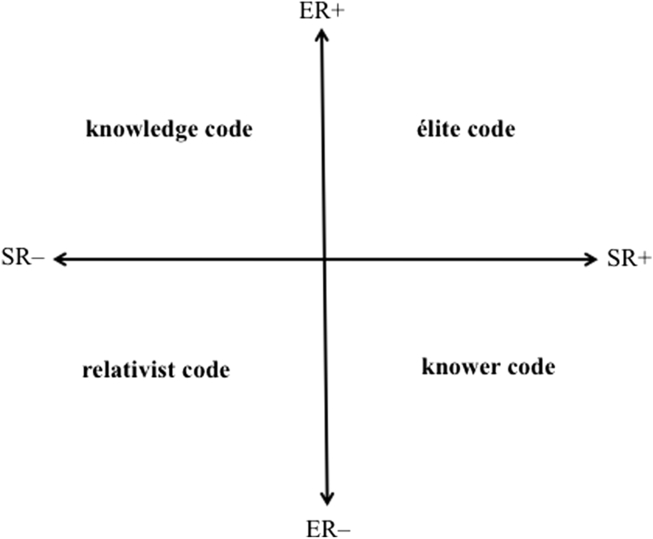
The key concepts of epistemic relations and social relations, therefore, generate four specialisation codes: a knowledge code (ER+, SR–) when claims to legitimacy depend more or less on an actor’s position to an object of study (or possessing the right kind of musical knowledge or skills); a knower code (ER–, SR+) when individual and collective claims to legitimacy are based instead on possessing a particular disposition or quality necessary for inclusion in a social group or in this case classroom music practice (being the right kind of student musician); an élite code (ER+, SR+) where the terms for legitimacy are based not only on possessing specialised knowledge but also on being the right kind of student knower; and a relativist code (ER–, SR–), where legitimacy is based neither on possessing specialised knowledge nor on acquiring a particular disposition or set of knower attributes (Maton, Reference MATON2014, p. 29). Represented diagrammatically using a Cartesian plane, the four codes can be depicted as follows in Figure 1:
Specialisation codes (Maton, Reference MATON2014, p. 30).

An examination of syllabus documents and associated literature reveals a series of code clashes surrounding the meeting of literate and non-literate music learning traditions in classrooms, now mediated by separate curricular pathways of study, with no attempt to reconcile the gap between these pathways over time. For clarity, the analysis is structured in three parts. Part 1 begins with the post–World War II era of the 1950s and the development of the original senior secondary curriculum which paid homage to both university and conservatory tertiary study in Western art music (WAM). Part 2 deals with the period of curriculum reform of the 1960s and 1970s. These reforms first impacted the junior secondary level; however, shifts to both rationale and content instigated a chain of events that lead to the inclusion of popular music and, eventually, provision at the senior secondary level for the so-called ‘illiterate’ student musician. Part 3 deals with the present era (from the 1980s onwards) and the maintenance of separately streamed senior music courses. The first stream is an adaptation of the original WAM–focused senior music course outlined in Part 1 now known as Music 2, and the second is the newer aforementioned Music 1 course, which caters for general music study, and the inclusion of the ‘informal’ learner typically possessing a background in popular music. Beginning with an analysis of the 1950s post-war period, the Specialisation dimension of LCT is used to show how each of the eras has resulted in the emergence of distinct codes impacting both curriculum design and classroom practice today.
PART 1: The post–World War II era and the study of WAM
The 1950s represents the beginning of a period of intense historic and cultural change, but one difficult initially to detect in school music classrooms (Pitts, Reference PITTS2000; Rainbow, Reference RAINBOW2006). Outside institutional education it was the era of rock ‘n’ roll, the rise of youth culture as a market force and growing political and social liberalisation in Australia (Arrow, Reference ARROW2009). Inside music classrooms, however, none of these forces were evident in curriculum, nor in practice. An examination of available school syllabus documents dating from the 1950s reveals a music curriculum centred upon the established canon of WAM knowledge and skills (Secondary School Board, 1956). Both ‘non-examination’ (general music) and additional ‘examination’ courses were offered to ‘any secondary school students with musical interest and aptitude’ including those intending to pursue tertiary study (ibid., p.1). This syllabus was developed to reflect the established British university curriculum upon which Australian music scholarship was modelled (Comte, Reference COMTE1988, p. 104). This required instruction in harmony and counterpoint, fugue and canon writing, formal score analysis, music history and related skills in composition (Rainbow, Reference RAINBOW2006). As a direct precursor to this path, school music in NSW followed a clear and detailed sequence of graded learning, in order that students develop the requisite skills for success at the tertiary level. Foundational to study was the development of audiation skills,Footnote 1 graded instruction in harmony and part-writing (or basic counterpoint), melodic and rhythmic transcription, and the terminology and analytical techniques needed to discuss detailed lists of musical scores prescribed at each level of study. From these canonised works students were expected to recognise, discuss and reproduce memorised score quotations in written examinations throughout secondary school (Secondary School Board, 1956, 1957).
The 1950s school syllabus represented a hierarchy of knowledge and associated skills, structured and sequenced to imitate the rigour of a science. Although providing a degree of self-expression in composition, the curriculum at this time best reflected what Maton (Reference MATON2014) describes as a knowledge code (strong epistemic relations or ER+), emphasising ‘more or less consensual, relatively formal and explicit principles and procedures’ (p. 32). The course downplayed the more practical aspects of music learning, opting for prescribed and graded exercises in class singing and imitative composition, with vocal performance the assumed choice for sight reading tests (Secondary School Board, 1956, p. 4). Instrumental performance and private tuition were not stipulated as necessary requirements for study at this time.
The design of this early curriculum sought to strengthen the relatively weak position of school music as a peripheral discipline, by drawing upon the discrete canon of knowledge and skills highly valued at the tertiary level. The syllabus stated: ‘Music has been regarded as a language of sounds, the vocabulary of which may be learned through a step by step study of its use in musical literature, hand in hand with creative and re-creative self-expression’ (Secondary School Board, 1956, p. 2). Music education as synonymous with music ‘literacy’ reflected norms in British secondary school education established in the inter-war era and possibly earlier (Goodman & Jacobs, Reference GOODMAN and JACOBS2008). However, the syllabus implemented in schools was not the only acknowledged pathway to matriculation and entry into tertiary music study in NSW at this time.
Early syllabus documents and the research literature reveal that there were at least two additional pathways into tertiary music study, the first through accreditations provided by the Australian Music Examinations Board (AMEB), a nationally recognised examining body still in existence, and the second, through the NSW Conservatorium of Music, which conducted its own tertiary entrance exams (Comte, Reference COMTE1988, pp. 110–111; Secondary School Board, 1957, p. 4). Unlike the syllabus typically employed in school classrooms, the AMEB curriculum focused on the progressive development of solo performance skills in the WAM tradition accompanied secondarily by the study of music theory. The graded examinations also imitated vertical progression, with sequenced technical work and progressive repertoire lists provided for each instrument or voice type. However, the focus of study was different, with assessment directed towards the demonstration of stylistic awareness, technical mastery and personal expression in performance examinations – musicianship traits best acquired with the assistance of private tuition (Australian Music Examinations Board, 1956).
In contrast to the more explicit academic knowledge and skills emphasised by the school board (stronger ER), the AMEB system aimed to assist in the development of an ideal musician displaying the correct musical disposition in performance, a quality in Maton’s terms described as a cultivated knower code (stronger SR) (Reference MATON2014, p. 32). The refinement of performance skills served not only to provide entry into tertiary study, but, more importantly, developed the qualities necessary for success in the real world of solo and orchestral music, not just in Australia, but potentially abroad (Finnegan, Reference FINNEGAN1989). Training in classical musicianship had since the 19th century commonly been undertaken in music conservatories, to which the AMEB system of accreditation was immutably tied. The role of the conservatory – in contrast to the university – maintained a more practical and rigorous course in instrumental and vocal performance, in addition to theoretical and historical study and instruction in composition (Mc Phail, Reference Mc PHAIL2012; Rainbow, Reference RAINBOW2006).
Whether attempting to gain some of the control which the AMEB maintained over matriculating music candidates or in recognition that many students participated in both school and AMEB systems of accreditation, revisions were made during the 1960s and 1970s to the junior secondary curriculum to include more options for the study and examination of instrumental music (Secondary School Board, 1962, 1986). The senior syllabus was also revised over this time period to encourage students to specialise in performance, composition or musicology. By 1983, students undertaking 3 Units of Music in performance (the most rigorous level with the highest candidature) were required to display many of the skills and qualities previously outlined by the AMEB system. This included a final solo recital of up to eight contrasting works for the NSW Higher School Certificate (HSC) – the revised examination system for high school matriculation (Board of Senior School Studies, 1983b). Supporting these observations Comte (Reference COMTE1988) notes that ‘the final year of secondary schooling is, in many areas of Australia, tied somewhat immutably to an external examination system’ (p. 109). Senior music had attempted a dual purpose, to acknowledge two different but interrelated forms of power and status. The first maintained the core knowledge content outlined by the earlier 1950s school curriculum (ER+), and for performance (traditionally the highest number of candidates), the musical attributes acquired through concurrent progression through the AMEB or equivalent system of private instrumental learning (SR+).
The combination of these outcomes, and the many years of private tuition (and associated financial cost) required achieving them, maintained a narrow and somewhat exclusive selection process for senior secondary music study, and, the world of classical music performance beyond school. The result reflected an élite code, in that the revised senior course by the 1980s paid homage to the knowledge and cultivated knower attributes of both the school and AMEB systems concurrently (ER+ and SR+). This required schools to produce students eligible for tertiary study who could be regarded as musicians already skilled in both the practice and knowledge of WAM. As Carruthers (Reference CARRUTHERS2005) states:
Entrance to university music programs is especially selective. Incoming geography students are not expected to be geographers, nor are first-year botany students expected to be botanists, but entering music students are expected to be musicians. They must have received extensive musical training, especially (for whatever reason) in performance, and have achieved high standards. At universities with open admission policies in other areas, admission to music is by audition only. Students are accepted or rejected on the basis of prior learning, which puts tremendous responsibility on pre-university private and public music programs. (p. 50)
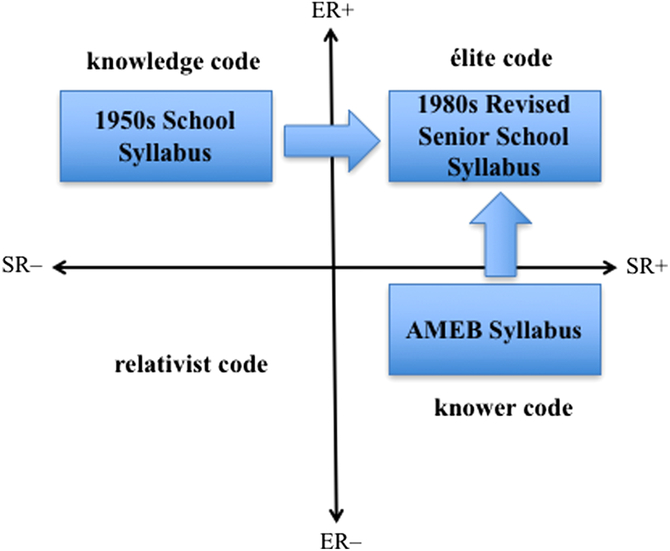
To summarise these developments, three interrelated specialisation codes impacting senior secondary music students had emerged. The first was a knowledge code, maintained by the focus of the original school curriculum, and the second was a cultivated knower code, maintained by the AMEB and equivalent external pathways. Notwithstanding variations in coding for students electing to specialise in performance, composition and musicology, revisions to the senior music course offered in schools by the early 1980s reflected a third élite code, which required students to display a subtle combination of both knowledge and knower attributes (SR+ and ER+) to qualify for entry into tertiary music study. This progression in curriculum development is traced heuristically in Figure 2.
The origins of an élite code (ER+, SR+) for NSW senior secondary school music.
Although these requirements and skills were difficult to cultivate, two factors put additional pressure on the preparation of senior secondary (HSC) students and hence the maintenance of the élite code after the 1980s. The first included curriculum reforms initiated earlier during the 1960s and 1970s at the junior secondary level. These reforms introduced new content and competencies and major shifts in the rationale for classroom learning. The second was societal. Over the same era, a dramatic rise occurred in the number of students choosing to complete high school study. This rise was exponential. In 1955, 7903 students matriculated from high school in NSW. The number in 1985 was 37 529, with 75 700 matriculating in 2018 (http://www.boardofstudies.nsw.edu.au/bos_stats/). Eventually, the combination of both junior school reform and the rise in candidature would require change at the senior level. However, in order to understand the nature of this change, reforms made to junior secondary music require address, as these lead to the introduction of popular music and eventually musicians in classrooms due to the emergence of a new legitimation code.
PART 2: Junior secondary reform and the introduction of popular music
Despite the pressure placed upon schools to maintain a rigorous course of study at the senior level, the rationale for school music at the lower or junior secondary level began to change during the 1960s and 1970s.Footnote 2 For both mandatory music classes (typically ages 11–13) and optional or elective music classes (typically ages 14–15), ‘student-centred’, ‘discovery’ and ‘creative learning’ approaches began to be implemented at a grassroots level in classrooms, facilitating practical music-making, student composition and the inclusion of Australian content (Beston, Reference BESTON2005).Footnote 3 The aim was for students to become performers, composers, conductors, listeners and critics in their own right, rather than the passive receptors of WAM knowledge and skills (Jeanneret et al., Reference JEANNERET, Mc PHERSON, DUNBAR-HALL and FORREST2003).
Jeanneret et al. (Reference JEANNERET, Mc PHERSON, DUNBAR-HALL and FORREST2003), propose that the reforms in NSW followed similar developments abroad. The comprehensive musicianship movement in Australia was paralleled in the USA by developments set out in the Manhattanville Music Curriculum Program (MMCP) (Mark, Reference MARK1986), with teachers encouraged to integrate learning in music theory, history and performance (Choksky et al., Reference CHOKSKY, ABRAMSON, GILLESPIE, WOODS, Choksky, Abramson, Gillespie and Woods2001; Heavner, Reference HEAVNER2005). The creativity movement in Australia with its focus on student composition followed similar movements in Britain, and the Contemporary Music Project (CMP) in the USA (Burke, Reference BURKE2014).
The belief that classroom music learning had been out of touch with authentic, situated real-world musical practices was fundamental to these developments. Pedagogically, these movements were constructivist in orientation – the dominant educational ideology of the era (Cleaver & Ballantyne, Reference CLEAVER and BALLANTYNE2013; Fox, Reference FOX2001). Constructivist classrooms sought to facilitate musical engagement, opportunities for social interaction, connections between new and prior learning, authentic assessment and the valuing of student ideas and opinions (Blair & Wiggins, Reference BLAIR, WIGGINS, Ballantyne and Bartleet2010, pp. 23–24). This resulted in a shift of pedagogic agenda towards the student knower, and away from the acquisition of a prescribed body of musical knowledge as per pre-reform.
However ideal, many teachers faced problems enacting these models (Burke, Reference BURKE2014), with the rigidities of timetabling and assessment often imposing a degree of separation, and prioritisation of one learning activity over another (Jeanneret, Reference JEANNERET1993). The construction of musical knowledge also posed a problem, as knowledge outcomes were not articulated clearly nor mapped out in sequence by curriculum writers at the time (Secondary School Board, 1981, 1986). By the early 1980s the mandatory junior secondary syllabus reflected a climate of epistemic relativism (or epistemic relations ER–) stating: ‘Rather than being told what sound is, pupils should be encouraged to discover for themselves the range of sounds available to them, together with the unique qualities of these sounds’ (Secondary School Board, 1981, p. 12). In keeping, notation requirements were imprecise and stipulated only in relation to creative activity: ‘Creative activities are ideally suited to develop an awareness of the function of notation, as a means of recording what is done’ (ibid., p. 17). Instead of the linear or hierarchic sequence articulated in the earlier postwar syllabus, knowledge acquisition was intended to occur in a broader ‘spiral’ as proposed by Bruner (Reference BRUNER1963), with student learning following a cyclic passage towards individual musical refinement (Jeanneret & Mc Pherson, Reference JEANNERET and Mc PHERSON2005; Mark, Reference MARK1986).
However well intentioned, doubts began to be felt concerning the extent to which these initiatives truly resonated with students and hence met their intended aim. Swanwick (Reference SWANWICK1999), an earlier proponent of the British creative music movement, later claimed the pedagogies had in reality served to widen the gap between students’ school and everyday musical experiences. Retrospectively, he writes:
Metrical rhythms and tonal pitch relationships were discarded, and attention was switched to levels of loudness, texture and tone color. But in the evening after these distinctive school experiences, the students went home and played The Beatles and The Rolling Stones, or perhaps they taught themselves to play the music that really mattered to them, where metric rhythms and tonal tensions were the norm. (p. 129)
In Australia, the era was marked by drastic political and social change, the introduction of television, a financial boom and the rise of youth culture and with it, popular music as the dominant voice of a new generation (Arrow, Reference ARROW2009; Fiske, Reference FISKE2010). Classrooms attempted to keep up. By the 1980s a range of new topics appeared for elective music students in the junior secondary course alongside those for WAM. These included ‘Popular music’, ‘Music for Theatre’, ‘Jazz’ and ‘Music of a Culture’ providing the opportunity for students to encounter a variety of musics, and with them, the potential for new musical knowledge and skills (Secondary School Board, 1986). This curriculum (typically the prerequisite for senior study) outlined no mandatory topics or set works, but rather allowed teachers to organise content according to the perceived needs of their students.
By the 1970s and 1980s, the reforms made to facilitate practical music-making at the junior secondary level coincided with a range of approaches for which popular music proved a valuable and compatible teaching tool (Swanwick, Reference SWANWICK1968; Vulliamy & Lee, Reference VULLIAMY and LEE1976). However, the pedagogies employed to teach it worked within norms of classroom practice established for the study of WAM. Dunbar-Hall and Wemyss note that in Australia ‘the repetitive nature of much popular music was an added bonus, … as ostinato based work (such as performance of drum kit rhythms, bass guitar patterns, lead guitar riffs, and chord progressions) could form the basis of much simple classroom work’ (Reference DUNBAR-HALL and WEMYSS2000, p. 24). Further, simple lead sheets could facilitate the acquisition of notation skills and provide a way to enhance comprehensive musicianship pedagogies, through listening to recordings, performing simple arrangements and improvising or composing over these (ibid.). The influential Orff-Schulwerk approach, originally developed in the pre-war years, was useful in reinforcing many of these trends. Although intended for WAM and folk music traditions, Orff pedagogies fostered creative play upon repetitive musical figures, the use of modal or pentatonic tonality and flexible performing media – techniques all compatible with popular music (Dunbar-Hall & Wemyss, Reference DUNBAR-HALL and WEMYSS2000; Vulliamy & Lee, Reference VULLIAMY and LEE1976, p. 75). Practically, popular music proved easier to adapt, whereas classical music, due to its length, scope and complexity, proved more challenging for classroom instrumentation (Dunbar-Hall & Wemyss, Reference DUNBAR-HALL and WEMYSS2000, p. 24).
So, the introduction of popular music content worked to reinforce progressive trends within music education at the time. These reforms challenged the formal social dynamics of the classroom and the centrality of WAM through the introduction of alternative skills required to realise more personal goals – in other words, a shift to emphasise the social over the more epistemic aspects of the discipline. Knowledge was not abandoned but had become a secondary concern. But in providing more options for study including popular music, curriculum writers neglected to problematise and redefine how multiple ‘real-world’ notions of the music ‘work’ or music ‘text’ might align with different kinds of learning strategies in the classroom (Board of Senior School Studies, 1983a, p. 6; Secondary School Board, 1986, p. iii). This was a significant oversight and remains so, and revealed the extent to which popular music served an existing agenda, rather than propose a new one potentially in line with students’ informal learning experiences. As this problem remains, it is unpacked in some detail hence.
Recording versus score: Opposing views of the music ‘work’ or ‘text’
As popular music entered the school classroom due to these reforms, opposing definitions of the music at the centre of learning signalled the potential for tension. For popular music and other aural learning traditions, the musical ‘text’ is defined primarily by the ‘sounds themselves’ (Moore, Reference MOORE2007, p. 1), in either live or recorded form (Green, Reference GREEN2002; Turino, Reference TURINO2008; Vulliamy & Shepherd, Reference VULLIAMY and SHEPHERD1983).Footnote 4 To this end, lyrics, sound manipulation, amplification techniques, studio production effects and today music video together constitute the music work or ‘text’ being studied (Frith, Reference FRITH, Leppart and McClary1987; Tobias, Reference TOBIAS2013; Turino, Reference TURINO2008; Webb, Reference WEBB2007). This is not to say that musicians participating in aural or vernacular learning traditions do not use various kinds of notation such as lyric sheets, chord charts and tablature; however, these remain pedagogic rather than performance aids (Moore, Reference MOORE2007, pp. 32–33). This is distinct from educational norms established for WAM, where the notated score remains a central authority.
When popular music entered the school curriculum, the unmediated tension created by these opposing definitions of music text was not acknowledged in curriculum. Ultimately the construction or transmission of knowledge was tied to two different objects of study: the recording or the score. For WAM, the use of notation provides a way of condensing and expressing musical meaning, and is a relatively unproblematic way to represent sound – albeit one that prioritises pitch and rhythmic information. Notation provides the basis for WAM musicology, music theory and all formal systems of analysis. By emphasising the importance of notation, teachers could maintain pathways of access to these higher-level forms of musical knowledge. Yet in doing so, other forms of knowledge more compatible with popular music were potentially overlooked. For popular music and popular musicians, the music text is more complex. ‘Sound’ (in both live and recorded form) represents a much richer yet more problematic foundation for the construction of knowledge. In contrast to staff notation, sound recordings (now including video recordings) provide a more troublesome teaching tool, as meaning (or rather ‘meanings’) are tied to multiple referents presenting an intricate web of potential readings, including – but not limited to – social, cultural, racial and gendered interpretations (Middleton, Reference MIDDLETON1993; Moore, Reference MOORE2007, pp. 154–187).
Therefore, the construction and assessment of knowledge in classrooms in relation to live or recorded music lacked consistency, clarity and authority. As Maton states: ‘When arguing for knowledge it is easy to valorise the kinds of knowledge most easily seen: explicit, abstract, condensed, hierarchical forms that visibly announce themselves’ (Reference MATON2014, p. 14). Despite the usefulness of popular music in the classroom, it thus served existing pedagogic agendas initiating easy summary or straightforward formalisation (Green, Reference GREEN2002). Accordingly, pedagogy based on staff notation remained central to classroom learning especially at higher levels of study even after popular music entered the curriculum. Staff notation provided the means for some teachers to maintain a fairly narrow yet teacher-centred mode of knowledge construction and transmission that was relatively clear, quick and seemingly unproblematic to maintain (Waller, Reference WALLER2010, p. 27). Yet at the same time, the expanded range of topics now on offer in the curriculum at the junior secondary level in NSW required more. It required a complete re-examination of knowledge frameworks for school music, which then sparked the next major reform initiative, the incorporation of ‘concepts’ or music ‘elements’ frameworks through which school music knowledge has been articulated ever since. The framework remains the sole mode for representing knowledge in curriculum documents, and all that would be offered to student popular musicians soon to be acknowledged in curricular rationale at the senior secondary level in NSW.
The concepts or elements approach to music knowledge
Without critical awareness of the enduring tension between score and recording in classroom discourse, knowledge frameworks capable of addressing a broader range of musics were included in NSW school curricula from the 1970s onwards (Jeanneret et al., Reference JEANNERET, Mc PHERSON, DUNBAR-HALL and FORREST2003), and concurrently abroad (Mark, Reference MARK1986). The language-based frameworks commonly known as music concepts or elements reflected an international trend to systematically organise music terminology into separate yet interconnected categories such as pitch, duration, texture, timbre and structure (Rose & Countryman, Reference ROSE and COUNTRYMAN2013). These categories were believed to be capable of transcending the need to revert to the teaching of specific formal structures and theoretical concepts developed for the study of WAM.
The new frameworks provided an opportunity for knowledge to be constructed in the classroom to address music features common to the different music styles and topics listed in the syllabus. It was this potential that gave the framework pride of place, as the narrower (yet clearer) hierarchic sequence of knowledge in the pre-reform curriculum was tied immutably to the WAM tradition alone. It was intended that teachers should use music notation to accompany classroom pedagogy using the new schema, and as discussed, this meant that in most cases the centrality of the score as authority was maintained. But the introduction of skills in reading and writing notation remained conditional upon teachers’ choices of topics, the demands of chosen repertoire and the personal needs of students in recording compositions (Secondary School Board, 1986).
As with the earlier pre-reform syllabus, learning was still expected to occur in sequence and then ‘aural experience be symbolised through some form of notation’ (Secondary School Board, 1986, p. iii). However, without clear expectations or skill outcomes for each stage of learning and the removal of official examinations at the junior secondary level, the design of teaching programmes from school to school proved a challenge for many teachers whose learning was solely defined by the previous élite code passage (Jeanneret, Reference JEANNERET1993). Moreover, as the framework was intended for use in conjunction with systems of music notation, a disparity prevailed between a range terminology, symbols and their potential meanings, with the recording assuming only a secondary authority in teaching and learning interactions.
In summary, the reforms instigated at the junior secondary levels during the 1960s and 1970s created a chain of events that would eventually affect the need for change at the senior secondary level. Fortuitously, the reforms improved the social dimension of music learning, as teachers could frame content around material deemed more culturally relevant to their students (SR+). This included the introduction of practical ‘real-world’ learning models where popular music served as a compatible teaching tool to student-centred learning. However, despite the inclusion of popular music as a valuable pedagogic tool, the development of pedagogies specific to popular music and alternative knowledge and skills pertinent to popular musicians did not factor critically in discussion nor in curriculum content or design.
In addition, the topic-based or modular approach to curriculum using the concepts or elements frameworks created a marked shift in practice that worked against the systematic construction of knowledge – the very thing the reforms were intended to facilitate. Maton describes this as generating ‘segmented’ knowledge (ER–) (Maton, Reference MATON2009). In opposition to ‘cumulative knowledge’ where ‘new knowledge builds and integrates past knowledge’ (p. 43), learning in topics or modules tends towards fragmentation and segmentation, with new knowledge acquired alongside old knowledge over time without drawing connections between them. In opposition to the established canon of hierarchic knowledge for WAM (ER+), knowledge and skills for jazz, popular and non-Western music topics each involved discrete and interchangeable repertoire, and a more diverse range of skills.
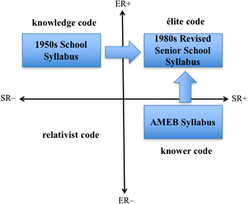
This created a problem. As dependent on a teacher’s choice of topics undertaken at the junior secondary level and the choice of knowledge and skills imparted in association with chosen repertoire, schools could no longer guarantee that students were adequately prepared for the challenges and rigour of the senior music curriculum. The result of the reformed curricula for junior secondary students had created a new path of learning in parallel with the first established for WAM. This can be described as a more inclusive knower code that addressed students’ immediate needs and tastes (SR+) but downplayed relations to hierarchic knowledge (ER–). The other was the much narrower and specialised élite code (SR+, ER+), providing access to the senior curriculum and to tertiary study beyond. This code split is represented diagrammatically in Figure 3, with a faint arrow depicting more limited preparation for senior school study.
Specialisation codes for NSW school music post-reform.

The reformed curricula forged a gap between the knowledge practices displayed in different music classrooms. However, in keeping with the broader scope afforded by the new modular yet segmented approach, and more specifically, the inclusion of popular music content within the curriculum, the ‘popularity’ of school music gradually began to grow (Dunbar-Hall & Wemyss, Reference DUNBAR-HALL and WEMYSS2000; Wemyss, Reference WEMYSS and Rodriguez2004). Eventually this would result in the addition of a second curriculum to cater to demand at the senior secondary level, a course of study that remains in place in NSW to this day.
PART 3: Bifurcation and streaming in NSW senior secondary music
Mirroring the general growth in numbers in the senior school, the candidature for senior music began to slowly rise during the 1970s. Strategically though, matriculation in both school and AMEB courses had remained small at only 2%–3% of the state cohort until the then Board of Senior School Studies (BoSSS) introduced a second senior music syllabus, Music 2 Unit A in 1978 (Board of Senior School Studies, 1977; Wemyss, Reference WEMYSS and Rodriguez2004). The new syllabus (since revised Music Course 1 and then Music 1) stated in rationale that ‘the present structure of Music courses in the senior school pre-supposes a firm foundation of musical literacy and does not allow for a later development of interest in or aptitude for music’ (Board of Senior School Studies, 1977, p. 1). Clearly on the grounds of inclusiveness, the emergence of a new kind of senior school student with skills developed other than in the narrower élite code set had prompted the addition. However, the kind of knowledge required of the ‘illiterate’ musician appears ambiguous.
Analysis of revised syllabus documents for the year 1983 maintains these legitimation codes. In rationale, the newer 2 Unit Music Course 1 syllabus offered ‘a broadly-based multi-stranded course of study in music, in which the individual needs, abilities and interests of each student are paramount’ (Board of Senior School Studies, 1983a, p. 1). Mirroring many of the reform trends noted previously at the junior level, this syllabus reflected a knower code. The facilitation of ‘individual needs’, ‘abilities’ and musical ‘interests’ is emphasised (SR+), but no pre-requisite knowledge is required (ER–), allowing a greater portion of class time to be spent engaging in practical content and individualised programmes of study.
For the 2 and 3 Unit (Related) course (since revised 2 and 3 Unit (Common), and then Music 2 and Music Extension) however, a very different rationale emphasises the ‘need to continue to develop foundational skills of musical literacy based on traditional Western music’ (Board of Senior School Studies, 1983b, p. 1). Here a very different set of criteria are required maintaining the previous élite code. Some flexibility is provided through options in performance, composition or musicology, with ‘creativity’ encouraged particularly in composition (SR+). Yet this student requires the ‘development’ not the ‘acquisition’ of music knowledge – again defined as ‘music literacy’ – gained through prior and ongoing study and music-making aligned with the WAM tradition (ER+).
Notwithstanding minor revisions to the titles, topic areas and assessment procedures for the courses over the 1990s, the central differences and contrasting codes of legitimation for each have remained (Board of Studies, 1993a, 1993b). Today, the structure outlined for each of the course streams contains similar wording – masking the gap between the codes. For example, both streams stipulate that students will study ‘the concepts of music [or acquire knowledge], through the learning experiences of performing, composing, musicology and aural [through knowers’ experiences], within the context of a range of styles, periods and genres [in segments]’ (Board of Studies, 2009c; 2009d, p. 8). These ‘segments’ or topic areas are not equivalent however, framed variously under ‘style’, ‘period’ ‘genre’ and other categories that vary considerably between the courses, continuing the code disjunction – or rather, code chasm – between the two.
The syllabi for each senior secondary stream continue to address the critical issue of prior knowledge, music interests as well as preparation for subsequent tertiary study as the primary justification for the separate streams. For the Music 1 course the term ‘informal’ rather than ‘non-literate’ is used to describe the learning backgrounds of those deemed suitable for enrolment; however, the term is used to imply a deficit rather than a divergent set of musical skills, and one for which Green’s research (Reference GREEN2002, Reference GREEN2008) and many others have made an established case. The present Music 1 rationale states:
Students in Music 1 range from those with beginner instrumental and/or vocal skills to those with highly developed performance skills in a variety of musical styles including contemporary/popular music. Many of the students have highly developed aural skills that have been nurtured through performance by imitation, and skills in improvisation have often been developed through the same process. (Board of Studies, 2009c, p. 8)
Note here that the ‘informal learner’ is acknowledged to have ‘highly developed aural skills’ developed in conjunction with skills in performance and improvisation (SR+), yet at the same time these abilities are placed alongside those of ‘beginner level’ musicianship (ER–). There is also no explicit mention of opportunity for extension for the ‘informal learner’, nor the opportunity to hone their skills through specific curricular structures or assessment procedures tailored to address their needs. More importantly, tertiary preparation is not mentioned, despite degrees and diplomas in popular music being offered in a range of NSW institutions from the 1980s onwards.
In contrast, the current rationale for Music 2 states, ‘Music 2 builds on the Years 7–10 mandatory and elective courses and focuses on the study of WAM. It assumes students have a formal background in music, have developed music literacy skills and have some knowledge and understanding of musical styles’ (Board of Studies, 2009d, p. 7). Importantly, access to the Music Extension course (an additional unit allowing sole study in performance, composition or musicology) is only offered to Music 2 students who have ‘advanced music knowledge and skills’ and ‘high level[s] of music literacy (Board of Studies, 2009d, p. 5). The current bifurcated senior curriculum is therefore represented as follows in Figure 4:
Bifurcated curricular structure for NSW senior secondary music 1979 to present.

In an attempt to bridge the gap between the streamed courses in the senior school, the junior elective syllabus now mandates the inclusion of WAM with clearer outcomes stipulated for music literacy (Board of Studies, 2003). Yet problematically, the precise nature of knowledge and skills taught and potentially acquired through these and other topic areas continues to remain subject to the choice of teachers (and the perceived needs and interests of students) working within the segmented topic-based curriculum – constituting therefore no guarantee of preparation for the demands of senior study.
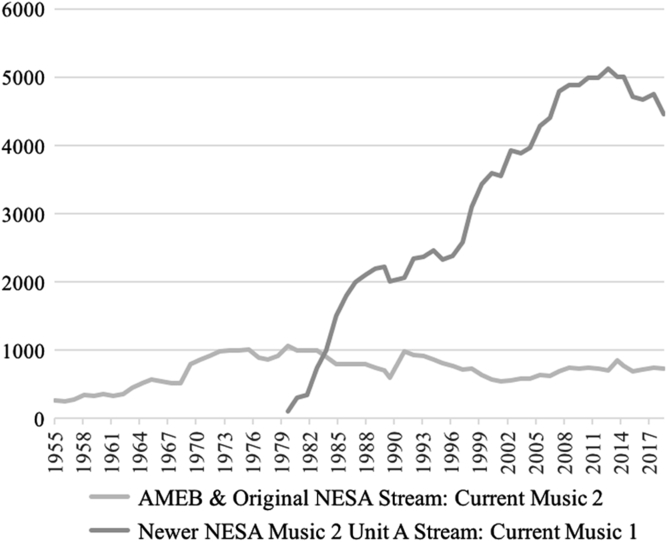
More importantly, a loophole exists. Students who have participated in the elective music course at the junior secondary level are permitted to enter either the Music 1 or the Music 2 course at the senior level. This presents a dilemma for teachers as many components assessed in the Music 2 course still pay homage to the old knowledge code established pre-reform, requiring many years to acquire. These include sight singing, melodic dictation from recordings (or transcription using staff notation), score reading and the discussion of seen and unseen WAM scores in written examinations requiring memorised score quotations from studied works.Footnote 6 Therefore, whether on grounds of inadequate preparation or music interests, the Music 1 course currently contains the vast majority of HSC candidates, with an average of 86% of students choosing, or being offered, this course of study.Footnote 7 Despite the hegemony of WAM maintained by the structure of the streamed courses, a different kind of force can be seen to shape the future of senior secondary music in NSW, as is reflected by the sharp rise in Music 1 candidates depicted in Figure 5 since the course was first examined in 1979.
Matriculation statistics for NSW senior secondary music 1955–2018Footnote 5 .

Concluding Discussion
The article has unveiled the underlying codes of legitimation underpinning curriculum design and practice for senior secondary students in NSW. In summary, the orientation of an élite code (ER+, SR+) for Music 2 has served to insulate and elevate traditional disciplinary knowledge and skills for WAM, with numbers remaining small but fairly stable for this course over the past 30 years. Against this, a knower code (ER–, SR+) for Music 1 has provided access to general music instruction inclusive of the ‘informal learner’, with numeric growth for this course mirroring the sharp rise in students staying on to complete high school since the late 1970s. There has been no attempt to reconcile the curricular gap created by these codes over time, with ‘music literacy’ retained as the defining attribute of having received a music education, with other forms of knowledge arguably more relevant to popular musicianship at the secondary and tertiary levels yet to enter discussion (Dunbar-Hall, Reference DUNBAR-HALL1991, Reference DUNBAR-HALL1999; Frith & Goodwin, Reference FRITH and GOODWIN1990; McClary & Walser, Reference Mc CLARY, WALSER, Frith and Goodwin1988; Middleton, Reference MIDDLETON1993).
The bifurcated curriculum aligned to preserve the existing code distinctions presents numerous problems for teachers, and for students with skills established in aural-based learning traditions aligned with popular musics. On a surface level, the skills and academic capabilities of students with informal learning backgrounds are not specified, nor have pedagogies and assessment practices been developed for these students at this curricular level. For example, despite the communal and collaborative nature of popular music-making, students are assessed and examined individually in all course components, with compositions requiring scores for marking purposes rather than recordings alone. The syllabi also mask the knowledge expectations between the courses through the unilateral use of music ‘concepts’, albeit fleshed out both with and without the use of notation in syllabus documents and written examinations (Board of Studies, 2009c, 2009d).Footnote 8 Further, Figure 5 reveals an interesting late development, with enrolment numbers for Music 1 dropping consistently over the past 4 years. Although reasons for this remain unclear, the trend warrants investigation with further implications for a re-thinking of both curriculum and practice for Music 1.
Mirroring the sharp rise in the number of Music 1 candidates, the number of tertiary institutions specialising in popular music performance and production has risen sharply since 1980, with pre-service teacher training courses and now schools employing teachers with backgrounds specialising in popular music. Poignantly, as the popularity of school music has grown to accommodate popular music and musicians in classrooms – not just in NSW, but further afield – there remains a pressing need for research to reconcile their informal music learning and knowledge practices with the formal domain of the music classroom. This need is ever present. With the growth and worldwide success of informal and popular music pedagogies particularly at the junior secondary level, it is perhaps time to embrace a broader conception of music learning beyond the enduring literate/illiterate binary, in order to build classroom discourse to more holistically address the needs of 21st-century musicianship.