Introduction
Ageism constitutes ‘a set of oppressive social relations’ (Laws Reference Laws1995: 112) whereby age is used as an organising principle of society as those who are not old gain power over the old, who, in turn, face increasing social exclusion (Calasanti and Slevin Reference Calasanti and Slevin2001). The term ageism was originally coined in 1969 by Robert Butler, who subsequently defined the concept as ‘the systematic stereotyping and discrimination against older adults because they are old’ (Butler Reference Butler1975: 12). Building on the work of Butler (Reference Butler1975), Bytheway and Johnson have argued that:
Ageism generates and reinforces a fear and denigration of the ageing process, and stereotyping presumptions regarding competence and the need for protection. In particular, ageism legitimates the use of chronological age to mark out classes of people who are systematically denied resources and opportunities that others enjoy, and who suffer the consequences of such denigration, ranging from well-meaning patronage to unambiguous vilification. (Reference Bytheway and Johnson1990: 37)
There is a wealth of research examining ageism, with the bulk of the studies focused on workplace discrimination, ageist health-care practices and policies, elder abuse and the internalisation of age-based prejudice. With respect to workplace discrimination, it has been well-documented that ageism negatively affects older workers’ recruitment, job security, job retention, training and promotion (Berger Reference Berger2006, 2009; Chiu et al. Reference Chiu, Chan, Snape and Redman2001; Duncan and Loretto Reference Duncan and Loretto2004; Henkens Reference Henkens2005; Hirsch, MacPherson and Hardy Reference Hirsch, Macpherson and Hardy2000; Loretto and White Reference Loretto and White2006; Pompper Reference Pompper and Pompper2014; Posthuma and Campion Reference Posthuma and Campion2009; Roscigno et al. Reference Roscigno, Mong, Byron and Tester2007; Taylor and Urwin Reference Taylor and Urwin2001). Employers are often reluctant to hire and retain older workers who are assumed to be less flexible, creative, competent, skilled, productive, ambitious, and adaptable to workplace changes than younger workers (Chiu et al. Reference Chiu, Chan, Snape and Redman2001; Cuddy and Fiske Reference Cuddy, Fiske and Nelson2002; Gullette Reference Gullette2004; Henkens Reference Henkens2005; Posthuma and Campion Reference Butler2009). Older employees frequently experience hostile work environments, job displacement, longer unemployment times, downward mobility upon re-employment, and involuntary early retirement (Berger Reference Berger2009; Henkens Reference Henkens2005; Hirsch, MacPherson and Hardy Reference Hirsch, Macpherson and Hardy2000; Loretto and White Reference Loretto and White2006; Pompper Reference Pompper and Pompper2014; Roscigno et al. Reference Roscigno, Mong, Byron and Tester2007). Moreover, gendered ageism results in older female employees being subject to the ‘double jeopardy’ of age and gender (Itzin and Phillipson Reference Itzin, Phillipson, Itzin and Phillipson1995: 84), as they tend to be perceived as less competent than both younger women and older men (Duncan and Loretto Reference Duncan and Loretto2004; Roscigno et al. Reference Roscigno, Mong, Byron and Tester2007; Walker et al. Reference Walker, Grant, Meadows and Cook2007). Older female workers often face age discrimination at younger ages, barriers to training and promotion, and more negative attitudes associated with their appearance and sexuality as compared to their male counterparts (Duncan and Loretto Reference Duncan and Loretto2004; Granlesse and Sayer Reference Granlesse and Sayer2006; Handy and Davy Reference Handy and Davy2007; Walker et al. Reference Walker, Grant, Meadows and Cook2007).
Considerable evidence suggests that age discrimination impacts older adults’ access to health care and interactions with health-care providers (Adams et al. Reference Adams, McIlvain, Lacy, Magsi, Crabtree, Yenny and Sitorius2002; Kagan Reference Kagan2008; Robb, Chen and Haley Reference Robb, Chen and Haley2002). Older patients are less likely to receive adequate diagnoses and treatment when compared to younger patients with similar health conditions (Adams et al. Reference Adams, McIlvain, Lacy, Magsi, Crabtree, Yenny and Sitorius2002; Adelman, Greene and Charon Reference Adelman, Greene and Charon1991; Bowling Reference Bowling1999; Burroughs et al. Reference Burroughs, Lovell, Morley, Baldwin, Burns and Chew-Graham2006; Ganz et al. Reference Ganz, Lamas, Orav, Goldman, Gutierrez and Mangione1999; Ivey, Wieling and Harris Reference Ivey, Wieling and Harris2000; Kagan Reference Kagan2008; Pasupathi and Lockenhoff Reference Pasupathi, Lockenhoff and Nelson2002; Redelmeier, Tan and Booth Reference Redelmeier, Tan and Booth1998; Robb, Chen and Haley Reference Robb, Chen and Haley2002). Numerous studies have also found that health-care providers often express persistently negative attitudes towards older adults as well as a reluctance to treat older patients, especially those aged 85+ and individuals residing in long-term care facilities (Adams et al. Reference Adams, McIlvain, Lacy, Magsi, Crabtree, Yenny and Sitorius2002; Dobbs et al. Reference Dobbs, Eckert, Rubinstein, Keimig, Clark, Frankowski and Zimmerman2008; Gallagher, Bennett and Halford Reference Gallagher, Bennett and Halford2006; Gunderson et al. Reference Gunderson, Tomkowiak, Menachemi and Brooks2005; Higgins et al. Reference Higgins, Van Der Riet, Slater and Peek2007; Kearney et al. Reference Kearney, Miller, Paul and Smith2000; Pasupathi and Lockenhoff Reference Pasupathi, Lockenhoff and Nelson2002; Robb, Chen and Haley Reference Robb, Chen and Haley2002).
Additionally, a growing body of research has explored how ageism may culminate in elder abuse and neglect (Brozowski and Hall Reference Brozowski and Hall2010; Gutman and Spencer Reference Gutman and Spencer2010). Brozowski and Hall have argued that elder abuse is ‘a symptom of deeply entrenched ageism within a highly individualised risk-oriented culture’ (2010: 1184). While the prevalence of elder abuse is frequently under-reported due to its stigmatised and invisible nature, survey data suggest that approximately one in ten adults over the age of 60 experience neglect, financial exploitation, or emotional, physical or sexual abuse at the hands of a care-giver, family member or intimate partner (Acierno et al. Reference Acierno, Hernandez, Amstadter, Resnick, Steve, Muzzy and Kilpatrick2010). Older adults who are female, Aboriginal, socially isolated, poor, cognitively impaired, mentally ill, and/or residing in assisted living and long-term care facilities have been found to be particularly vulnerable to abuse and mistreatment (Brozowski and Hall Reference Gutman and Spencer2010; Burgess and Phillips Reference Burgess and Phillips2006; Cooper, Selwood and Livingston Reference Cooper, Selwood and Livinston2008; Dobbs et al. Reference Dobbs, Eckert, Rubinstein, Keimig, Clark, Frankowski and Zimmerman2008; Joshi and Flaherty Reference Joshi and Flahery2005; Stevens et al. Reference Stevens, Biggs, Dixon, Tinker and Manthorpe2013).
Finally, the research suggests that ageism is often deeply internalised as individuals accept stereotypes that depict later life as a time of poor health, cognitive impairment, dependence, lack of productivity and social disengagement (Cuddy, Norton and Fiske Reference Cuddy, Norton and Fiske2005; Minichiello, Browne and Kendig Reference Minichiello, Browne and Kendig2000; Nelson Reference Nelson2002; Nussbaum et al. Reference Nussbaum, Pitts, Huber, Raup Krieger and Ohs2005; Palmore Reference Palmore1999). Ageist stereotypes are gendered and particularly demeaning of older women who are assumed to lose their physical attractiveness and sexual desirability progressively. In contrast, older men may continue to be thought of as distinguished and sexy, especially when they are affluent and powerful (Arber and Ginn Reference Arber and Ginn1991; Calasanti and Slevin Reference Calasanti and Slevin2001; Sontag Reference Sontag and Pearsall1997). A man's relative immunity to ageism is linked to his ability to approximate and maintain hegemonic masculinity, the dominant expression of masculine behaviour and ideals to which all other masculinities and femininities are subordinated (Connell Reference Connell1995; Connell and Messerschmidt Reference Connell and Messerschmidt2005). Those older men who successfully perform hegemonic masculinity may fail to see ageism in themselves or experience exclusion as a result of their social privilege (Kimmel Reference Kimmel, Brod and Kaufman1994). Kimmel argues that ‘the very processes that confer privilege to one group and not another group are often invisible to those upon whom that privilege is conferred … [such that] only men have the luxury to pretend that gender does not matter’ (Reference Kimmel1997: 186). Indeed, as individuals embrace ageist cultural values and assumptions, ‘those who are advantaged by this system view their position as “natural” and beyond dispute’ (Calasanti Reference Calasanti2007: 336).
At the same time, internalised assumptions about later life may lead individuals to distance themselves from those they deem old by virtue of their approximation, if not capitulation, to ageist stereotypes (Hurd Reference Hurd1999; Minichiello, Browne and Kendig Reference Minichiello, Browne and Kendig2000; Slevin Reference Slevin, Calasanti and Slevin2006). For instance, the older adults interviewed in the studies conducted by Hurd (Reference Hurd1999) and Minichiello, Browne and Kendig (Reference Minichiello, Browne and Kendig2000) positioned themselves as active, busy, positive and purposeful, and thus in opposition to those considered old by virtue of their social isolation, disengagement, frailty and loss of physical attractiveness. Another means of distancing the self from oldness is the differentiation between one's chronological and felt ages, as older adults frequently suggest that they feel younger than their actual ages or that their appearances and physical abilities belie their youthful identities (Choi, DiNitto and Kim Reference Choi, DiNitto and Kim2014; Furstenberg Reference Furstenberg1989; Minichiello, Browne and Kendig Reference Minichiello, Browne and Kendig2000; Weiss and Lang Reference Weiss and Lang2012). Several theorists contend that the internalisation of ageist stereotypes is deeply problematic (Calasanti Reference Calasanti2005; Coupland Reference Coupland2009; Laws Reference Laws1995) because, as Calasanti argues, ‘we ultimately oppress ourselves: Either we try to avoid the ageing process or we lose self-esteem because of the selves we feel we are becoming’ (2005: 8). In order words, avoiding age-based discrimination eventually becomes impossible as ‘ageism is the one oppression that we will all face’ (Calasanti and Slevin Reference Calasanti and Slevin2001: 193).
With the exception of the work of Minichiello, Browne and Kendig (Reference Minichiello, Browne and Kendig2000), the research examining the internalisation of ageism has primarily been concerned with older women such that older men's experiences have largely been ignored. Thus, the purpose of this study was to explore how older Canadian men encountered and responded to age-based discrimination in the context of their everyday lives. In particular, we wanted to know whether or not older men had experienced and internalised ageist prejudice. Our research was guided by the following questions: (a) How do older men define, perceive and experience ageism, if at all?; and (b) To what extent are older men's daily lives shaped and constrained by age-based discrimination? In this way, we were endeavouring to uncover how and why older men's experiences with and responses to ageism were unique from those of older women.
Methods
Design
Ethical approval for the study was received from the University of British Columbia Behavioural Research Ethics Board. Twenty-nine participants residing in the greater Vancouver area were recruited through advertisements in local newspapers and posters in public facilities. To be included in the study, participants needed to be 65+ and self-identify as male. In addition to covering any travel expenses they incurred, we offered each participant a $25 gift card from a merchant of their choice as compensation for their time, although seven participants declined the honorarium.
Each participant was interviewed by the first author, second author or another trained graduate student, for an average of 2.5 hours (and a total of 73 interview hours). While 23 participants were interviewed once, seven participants preferred to divide the interview hours across two meetings. Fifteen participants were interviewed in their own homes, ten were interviewed at the university, one was interviewed by Skype and three were interviewed in public locations. Although participants were encouraged to speak freely and our interviews were semi-structured, we used a topic guide to ensure that there was consistency across all the interviews. The men were asked to describe how ageing had influenced or altered their sense of identity, appearances, physical function, health, sexuality, sense of masculinity and interactions with others, if at all. Additionally, the men were questioned about whether or not they had been treated differently by others as a result of their ages, their perceptions of ageist stereotypes, and what ageing and oldness meant to them in the context of their everyday lives.
Sample
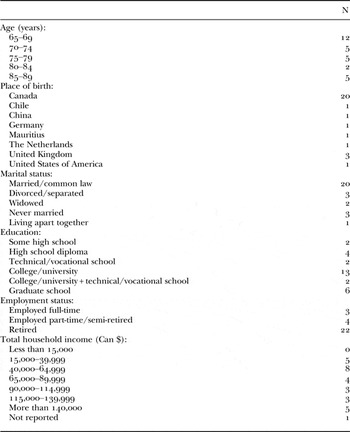
The participants ranged in age from 65 to 89 years, with an average age of 74 years. While 28 of the men identified as heterosexual, one man identified as homosexual. As noted in Table 1, the participants varied in terms of their ages, places of birth, marital statuses, levels of education, employment statuses and household incomes, although the majority were Canadian born, married, well-educated, retired and of middle or upper class. While 15 men rated their health as excellent, 11 perceived their health to be good and three indicated that they were in poor health. All of the men were living independently in the community.
Demographic information and descriptive characteristics

Note: N = 29.
Data analysis
All interviews were digitally recorded and transcribed verbatim by trained research assistants. Each of the original interviewers subsequently reviewed her respective transcripts to ensure the accuracy of the transcription relative to the digital recording. Following transcription, both authors read and reread the transcripts, independently making note of emerging themes, of which ageism was a broad category. From there, all of the transcripts were coded line-by-line with the aid of NVivo 8 software by a trained research assistant who identified all of the text that made reference to ageism. The first and second authors then completed a thematic analysis (Patton Reference Patton2002) of the ageism data together, drawing on the extant literature and theorising. This collaborative process resulted in the generation of three sub-themes, namely ‘perceptions of ageism as a distant social problem’, ‘others’ experiences of ageism’ and ‘internalised ageism’. The participants were provided with a summary report outlining the key themes identified across the set of interviews and invited to provide feedback (although none of them opted to do so).
Findings
In the sections that follow, we summarise the three major themes from our thematic analysis, drawing upon representative quotations expressed by our participants, who have each been assigned a pseudonym.
‘Ageism? Never heard of the term’: age-based discrimination as a distant social problem
Similar to the participants interviewed by Minichiello, Browne and Kendig (Reference Minichiello, Browne and Kendig2000), 13 of our 29 participants voiced confusion with or a lack of awareness of the term ageism such that our requests for information about their personal experiences of age-based discrimination were initially often met with puzzled silences, shrugs of shoulders or requests for a definition of the concept. It was not uncommon for the participants to make comments similar to those of 85-year-old Henry who stated: ‘Ageism? Never heard of the term.’ Some of the men were also surprised by the definition of ageism as discrimination against older adults because they had tended to equate the word with ageing more generally. For example, upon hearing the definition, Patrick, aged 69, responded, ‘Oh, is that what ageism is? I would have taken ageism to be somebody growing older.’
Despite their frequent lack of familiarity with the term, 20 participants suggested that age-based discrimination was a widespread social problem, albeit something they themselves had not personally experienced. Irrespective of their ages, employment status, sexual orientation and social class, the men made comments similar to those of 65-year-old Michael who declared, ‘Well, I know it exists … but I haven't experienced it personally.’ In describing ageism as a distant social problem, the men used language such as ‘them’, ‘they’ and ‘those older people’ to distinguish themselves from the victims of age-based discrimination. Peter, a 65-year-old put it this way: ‘There's certainly devaluation of older people in this society … I mean as you get older, people see them as more disposable’ (emphasis added). Ramon, aged 66, had this to say:
I think [ageism] is quite prevalent … because people just don't want to relate to old people. They think of them as being ill and complaining. They don't have time … This society is in such a hurry, okay, it's all so selfish. They got no time for anybody else. (emphasis added)
When asked why they thought they had been able to avoid age-based discrimination, the men appealed to their own inherent youthfulness as they argued that they were ‘not old’. For example, 67-year-old Calvin asserted:
I can't recall being treated differently because of my age because really, I don't consider myself an elderly person or an old man. And I don't think most people probably perceive me as that way. I feel like I'm somebody who is in their forties or fifties at the most … I would describe myself as middle aged … because I feel young at heart and my spirit. I laugh a lot, I joke a lot, I can enjoy life, [I have] so many interests, [I'm] physically active. I feel young.
Indeed, the men often used expressions such as ‘young at heart’, ‘quite young’, ‘middle-aged’, ‘younger than my numerical age’, ‘very young’ and ‘not old’ to describe themselves. In this way, the men suggested that youthfulness and oldness had more to do with one's mind-set than one's chronological age, as articulated by 68-year-old Wayne:
I may look old but I'm not old … Old fashioned [is] a state of mind … I hate to say this, I see some guys at my age or even younger that have said, ‘Oh I'm older, that's it. Life is over’ … You just see them sort of trudging around [and] I say ‘C'mon! … Buy yourself a nice Tommy Bahamas shirt … and a pair of red shoes! Just go out feeling good!’ Some people age well … and that's a mind-set.
The men further asserted that their lack of oldness was evident in their active lifestyles and physical abilities, as articulated by 80-year-old Hugh who stated:
To me to be old is you can't do something that you want to do. I've never encountered that. You know, I've always been able to do whatever I want to do … So if I want to bike a long distance, or something, do a bit of shopping, throw it in my backpack, which I do a lot, you know, I can do it. If I felt I was old, I would say, ‘Gee, I'm too old to do that’ [but] I don't restrict myself.
By retaining youthful spirts and engaging in active lifestyles, the men concluded that they could avoid being seen and treated as old, as expressed by 85-year-old Marshall:
I think if you act old mentally or physically you'll be treated old and looked at as being old. But in our circumstances, because we can just carry on life as normal every day, people aren't looking at us like we're old.
In this way, the men suggested that they had personally avoided ageism by retaining a youthful attitude towards life and remaining socially active and engaged.
‘I hear stories about ageism’: others’ experiences of ageism
Even as the men largely distanced themselves from oldness and the effects of age-based discrimination, they also frequently identified particular groups of older adults who they perceived to be especially vulnerable. Eighteen men stated that older women were far more likely to experience ageism and social exclusion than older men. These participants suggested that an older woman's social position was precarious, if not predominantly negative, because, as Wayne put it: ‘It's harder for older women. Society just doesn't accept older women as much as they do older men.’ The men maintained that the underlying reason for older women's marginalisation stemmed from cultural associations between youthfulness, feminine beauty and women's social value. Walter, aged 69, stated: ‘Women are much more bombarded by the public view or this notion that a youthful appearance is the essential element of femininity.’ The men contrasted women's negative experiences with the ability of some men to continue to be thought of as distinguished and attractive. For example, Barry, aged 81, maintained: ‘I think a guy who looks after himself looks distinguished when he's old. A woman, if she's not careful, when she gets old, she looks old.’
The second group that 15 men (two of whom were still employed) identified as being particularly vulnerable to ageism was older individuals already in the workforce or those trying to obtain new employment. Peter, who was retired, had this to say:
Ageism is quite prevalent especially for job opportunities. Once you reach your fifties and sixties, forget it … I think 40 is about the cut-off. After that, people aren't going to hire you. And then also at the job people are going to push you out.
The men further contended that older female workers were especially susceptible to work-based discrimination, as articulated by 75-year-old Harold who worked part-time: ‘In the workplace women are pressured all the time to look younger or else they think they're going to be let go.’ The men also suggested that women of all ages but especially older women were ‘not given the same level of opportunity’ (Barry, who was retired) in the workplace and were rarely promoted to positions of authority. Notably, seven men (of whom six were retired and one was employed) indicated that they themselves had experienced age-based discrimination in the workplace. As well as finding it difficult to obtain new employment or feeling pressured to retire, these men felt that their talents and creativity had been overlooked and devalued in the latter years of their careers. Morris, who was 70 years old and retired, stated:
There was perhaps a sense, before I retired, that I'd been there too long and I wasn't able to see new things. And it's funny because that was probably the furthest thing from the truth because I was very creative in doing things and bringing in new ideas and constantly sort of evaluating what we were doing and such. But it was just the perception that if you're 55 years old you're not as good as a 28-year-old.
That said, three men felt that age-related prejudice operated in positive ways in the workplace and resulted in older workers being regarded as invaluable sources of wisdom and experience. Keith, aged 75, who was retired, had this to say:
In the workplace, as you got older, you were the senior guy. So very definitely there was a certain amount of deference given to you simply because you had experience and perhaps more knowledge or at least a different approach to the knowledge that had been shared around the table. If I had a staff meeting, I was sort of the last voice in the room … because I was the oldest guy in the room.
For these men, all of whom had higher educations and had been employed in senior management positions with concomitantly higher incomes, ageing served to augment the power and authority they held in the workplace rather than undermining their perceived social value.
Finally, nine men contended that frail older adults, typically women residing in institutions, were especially vulnerable to age-based discrimination. For example, Patrick described incidents of ageism at the hands of family members and health-care providers:
I hear stories about ageism when I go to my mom's place at the nursing home … about people who are on their own and their families don't visit or they come and argue over the will or take advantage of them … Also when somebody at the nursing home says how cute my mother is, I find it derogatory and demeaning because they're saying the reason she's cute is she's old and does things that four-year-olds do, which isn't complimentary.
Alan, aged 78, relayed concerns about elder abuse: ‘You hear about elderly people in care homes being hurt or not being well cared for, and families having [to] get security cameras in there to make sure that their old frail mother isn't being … bruised or beaten up.’ Similarly, Hugh recounted how his elderly aunt had initially been denied health-care treatment because of her age:
My aunt developed anaemia. Therefore she needed a blood transfusion and I took her to see the doctor at the hospital. The doctor called me aside and said, ‘You know, your aunt is 94 and we're awful busy and we're short of blood.’ And I said, ‘Are you trying to tell me because of her age she shouldn't get a blood transfusion?’ I took out my blood donor card and I said, ‘I've donated 110 pints of blood. Please give her some of that.’ You know, so definitely she was being treated differently [because of her age].
In this way, our participants often decried the ageism experienced by frail, institutionalised, older others and described incidents where they had advocated for the rights and needs of their vulnerable loved ones.
‘Most of the stereotypes are pretty real actually’: internalised ageism
Irrespective of their advocacy efforts and concern for the victims of ageism, the men had often internalised many ageist stereotypes regarding later life. In addition to privileging youthfulness over oldness, the men frequently endorsed stereotypes as statements of fact. Thus, 23 men suggested that older adults were invariably grumpy, as they echoed Morris’ sentiments:
I think most of the stereotypes are pretty real actually. For example, the grumpy old man … It's very hard for me to go into a restaurant and have yelling, screaming kids there and so I get grumpier … I think you do get grumpy. You can be less tolerant and then that causes grumpiness.
While some of the men equated irritability with declining tolerance, others viewed it as an increasing ability of older adults to be candid with their opinions. Including himself in the description through his use of the term ‘we’, 69-year-old Nicholas asserted, ‘We're more and more grumpy … and there's nothing wrong with it. We like what we like and we're not afraid to tell anybody about it anymore.’ Still others explained grouchiness in relation the assumption that later life was unavoidably a time of declining physical health and abilities, a stereotype they actively avoided. Using language that differentiated themselves from the old and the frail, 20 men made comments similar to Peter who stated: ‘Most of the old got something wrong with them. You know they take a ton of pills or something's wrong. I bet you there's not one in 100 who makes it through to age 90 without any major health problems.’ Consequently, these men attributed older adults’ cantankerousness to pain and suffering, as articulated by 66-year-old William: ‘The ones you find who are grumpy, I think they've most probably got aches and pains and they're having a bad day. You know, they're short on their medications or they need new meds or whatever.’
In addition to grumpiness and declining health, most of the men asserted that older adults lacked or progressively lost specific skills, although they were divided in their assessments of their own driving abilities and technological savviness. For example, 20 men maintained that older adults were poor drivers, as expressed by Henry who stated: ‘I don't think I'm a bad driver but certainly there are some that their reflexes aren't good, their eyesight's not good. So yeah, certainly ageing has an effect on your driving ability. I don't think there's any doubt about that.’ Additionally, 14 men indicated that older adults, including themselves, struggled to learn how to use new technologies. For example, Keith contended:
I'm the first to admit that technology has blown right by me … Myself and my peer group are not that adept … The rate of change in technology is blowing us all away. I mean we're just figuring out what our grandkids take for granted and by the time we've got it figured out, there's a whole new thing to have to learn. So technology is leaving us behind.
Finally, irrespective of their ages, employment status, sexual orientation and social class, 26 men expressed internalised gendered ageism as they described older women as less attractive and less sexually desirable than their younger counterparts. Henry stated: ‘Age does have an effect on attractiveness. You know a 20- or 25-year-old woman is certainly not the same as an 85-year-old woman. I mean, they lose a lot of their attractiveness when they get older.’ As a result, the men who were currently in relationships often discussed how their wives found changes to their appearance to be distressing even as they emphasised the importance of youthfulness to feminine beauty. For example, Ramon, who had been in a common-law relationship for 26 years to a woman 15 years his junior asserted:
My wife is more concerned about her appearance than I am about mine … She's only 52 and she complains that she's getting old … I guess because women like to look young, stay young … Even though my wife could be older than me, I would never expect her to look older. Because who would want to be married to an older woman? … At my age, as long as I age with grace, I can show my age. But a woman should never look older.
A few of the men who were currently single and looking for new partners made comments similar to Harold who asserted: ‘I have to be honest. Women my age do not appeal to me. They're too old. I mean for a platonic relationship, it's fine. But if it's sexual interest no way! I like women in their twenties.’ In this way, not only did the men acknowledge the social pressure on older women to remain youthful in appearance (as noted in the second findings section), but they themselves also expressed a preference for younger women.
Discussion and conclusions
In this paper we have examined how older Canadian men defined, perceived, and internalised ageism in the context of their everyday lives. Similar to the extensive research on age-based discrimination (see e.g. Adams et al. Reference Adams, McIlvain, Lacy, Magsi, Crabtree, Yenny and Sitorius2002; Berger Reference Berger2009; Brozowski and Hall Reference Brozowski and Hall2010; Henkens Reference Henkens2005; Hirsch, MacPherson and Hardy Reference Hirsch, Macpherson and Hardy2000; Kagan Reference Kagan2008; Loretto and White Reference Loretto and White2006; Pompper Reference Pompper and Pompper2014; Robb, Chen and Haley Reference Robb, Chen and Haley2002; Roscigno et al. Reference Roscigno, Mong, Byron and Tester2007), the majority of the older men we interviewed considered ageism to be an issue that was primarily experienced by women, older workers and frail elders living in long-term care facilities. In this way, the men experienced age-based discrimination as a distant social problem that affected vulnerable others rather than something that permeated and constrained their own daily lives. Similar to previous research (Hurd Reference Hurd1999; Minichiello, Browne and Kendig Reference Minichiello, Browne and Kendig2000; Slevin Reference Slevin, Calasanti and Slevin2006), the men explained their relative immunity to ageism in terms of their youthful mind-sets and active lifestyles, and thus as a result of their personal choices and abilities. The men failed to recognise age-based prejudice in their own deeply internalised ageist and sexist understandings of the social world around them as they largely embraced stereotypes concerning later life and older women as statements of fact.
The men's perception of ageism as a distant rather than proximal issue warrants further comment. Rather than arising from personal choices and behaviours, the men's relative immunity to ageism was a product of their privileged social position. Indeed, the men were protected from explicit ageism because of their gender, social class, retirement status, good health and ability to conform to hegemonic masculinity ideals (Connell Reference Connell1995; Connell and Messerschmidt Reference Connell and Messerschmidt2005) despite their advancing ages. While some of the men were aware of their advantaged social position relative to women (e.g. in the case of employed older female workers) and dependent elderly (e.g. residents in long-term care facilities), they failed to understand how their internalised ageism rendered them complicit in the oppression of others. In particular, by viewing older women as less sexually desirable, the men both accepted and reinforced idealised standards of feminine beauty defined in terms of youthfulness. At the same time, the men were contributing to the future social exclusion of themselves as their own health and physical abilities eventually declined and they joined the ranks of the vulnerable, dependent others.
Our study is limited by its small, convenience sample as well as by the relatively homogeneous nature of our participants. Although they were diverse with respect to age, income and education, the majority of the men were of middle and upper class. Likewise, only one participant identified as homosexual. While this man's experiences of ageism were in line with those of his heterosexual counterparts, further research is needed to explore the influence of sexual orientation on older men's perceptions of age-based discrimination. The fact the interviews were conducted by women may have inhibited some of our male participants from fully disclosing their sense of vulnerability related to ageing and ageism, although none of the men we spoke to conveyed any such sense of discomfort. Further research needs to examine how frail older men perceive, experience and internalise age-based discrimination. It would also be interesting to investigate whether or not older men engage in specific types of body work and health practices so as to maintain their perceived youthfulness. Finally, more research is needed to understand how internalised ageism is manifested in the attitudes and behaviours of individuals of all ages.
In conclusion, our findings highlight the taken-for-granted nature of ageism in the everyday world where agedness is abhorred and youth is increasingly valourised. As such, the men that we spoke with were a product of their social environment as they emulated and reproduced the deeply entrenched gendered ageism that underscores cultural attitudes about growing older. Indeed, in contemporary society, to age successfully individuals must continually strive to distance themselves from oldness despite the ultimate impossibility of this goal. Moreover, the insidious and harmful nature of ageist stereotypes go largely unopposed and unseen as they are unquestioningly accepted and assumed to be factual. In addition to ending structural inequalities and discriminatory policies and practices, the eradication of ageism will require challenging the myriad of ways that age-based prejudice is invisible in our everyday interactions and assumptions about old age.
Acknowledgements
This research was supported by a Social Sciences and Humanities Research Council of Canada Insight Grant that was awarded to the first author. The authors wish to thank all of the individuals who took part in the study and shared with us their time, personal stories and important insights. We would also like to thank Erica Bennett, Rachel Courtice and Chris Liu for their invaluable assistance in the completion of this research.