In 2007, Tarana Burke created the #MeToo movement after sitting across from a 13-year-old girl who shared her story of sexual assault. Fast-forward 10 years: Burke’s movement attracted national attention when Alyssa Milano tweeted the hashtag #MeToo to bring awareness to the prevalence of sexual assault and harassment and to give voice to the victims. From the entertainment and media industries to government, the #MeToo movement has exposed sexual impropriety and institutions that enabled this type of behavior, resulting in the resignation of six members of Congress and a push for legislative remedies (e.g., the METOO bill by Representative Jackie Speier). Consequently, members of Congress have embraced the #MeToo hashtag in solidarity with victims to promote change and greater gender equity. However, we lack a complete understanding of which members are talking about #MeToo and why they choose to embrace and promote the movement (or why they opt to remain silent).
This article examines the factors that influence whether members of Congress tweet about the #MeToo movement. Whereas social-identity theory suggests that congresswomen would be more likely to tweet about #MeToo, congressional research argues that increased polarization has resulted in congresswomen bucking gender stereotypes and embracing more partisan behavior than might otherwise be expected (Pearson and Dancey Reference Pearson and Dancey2011). Thus, we would expect partisanship to be a greater influence on legislators’ decisions to tweet about the #MeToo movement. We examined the influence of partisanship, gender, and ideology using an original dataset of Congress members’ tweets since October 2017 when the #MeToo movement gained prominence on Twitter. Combining Twitter data with individual-member indicators (e.g., gender, partisanship, leadership, and seniority), we estimated a logistic-regression model to test our key predictions about the role of gender and partisanship on Congress members’ Twitter behavior involving #MeToo.
MEMBERS OF CONGRESS RESPONDING TO WOMEN’S ISSUES
The representation of women in Congress has increased notably in recent decades; however, women remain underrepresented—occupying fewer than 25% of the seats. The underrepresentation of women in elective office seriously challenges our notions of democratic representation and the legitimacy of our institutions as a means of popular control. Research on women in politics emphasizes the important role of gender in the priorities and issue positions of women both in the electorate and in office. The different policy priorities of men and women in the electorate have been well documented (Box-Steffensmeier, DeBoef, and Lin Reference Box-Steffensmeier, DeBoef and Lin2004). Women typically hold more liberal viewpoints on social welfare, criminal justice, and foreign policy (Shapiro and Mahajan Reference Shapiro and Mahajan1986). Women also are more likely to advocate for government funding of health care and education, and they are more likely to be in favor of other programs that help the elderly, sick, and children (Page and Shapiro Reference Page and Shapiro1992).
When women run for office, they may be helped by campaigning more heavily on these topics with female voters. However, at the same time, others might view the candidates as being able to discuss only those issues and not be suitable for political office when we need representatives to address a broader range of issues. Research in this area has shown that women gain a significant advantage at the polls when they emphasize these issues with female voters (Huddy and Terkildsen Reference Huddy and Terkildsen1993); however, female candidates also are harmed by emphasizing these traditional “women’s issues” (Larson Reference Larson2001; Witt, Paget, and Matthews Reference Witt, Paget and Matthews1994).
Research that examines women’s issues and campaigning has shown that women tend to emphasize these issues when they provide them with an advantage over their competitor; this happens in both traditional media (i.e., radio, print, and television) and online campaigning (Ditonto and Andersen Reference Ditonto and Andersen2018; Evans and Clark Reference Evans and Clark2016; Fridkin and Kenney Reference Fridkin and Kenney2009). Not only do female candidates spend more time discussing these topics during campaigns; they also tend to focus on these areas when they are in office (Clark and Caro Reference Clark and Caro2013; Shogan Reference Shogan2002; Walsh Reference Walsh and Rosenthal2002). For instance, Gerrity, Osborn, and Mendez (Reference Gerrity, Osborn and Mendez2007) found that women who replace men in the same district focus on women’s issues more often. In Congress, both Republican and Democratic women tend to sponsor and co-sponsor legislation that addresses women’s issues more often than men in their respective party (Swers Reference Swers2002).
Although the background of women may shape their legislative actions, we also know that legislative decision making does not occur in a vacuum. The institutional rules and political environment likely shape the behavior of members, including congresswomen. Thus, whereas gender stereotypes suggest that women work together communally and engage in “consensus-building” (Alexander and Andersen Reference Alexander and Andersen1993), research by Bauer, Yong, and Krupnikov (Reference Bauer, Yong and Krupnikov2017) demonstrated that women legislators are not consistently facing a backlash for failing to conform to the gender stereotypes of setting aside differences and compromising. They found that the degree of backlash that legislators receive for failing to compromise is conditional on partisanship (i.e., which can “insulate” legislators from the criticism) and issue topic (i.e., women can face backlash on issues not considered “female-owned”). Moreover, when voters express a preference for bipartisanship or compromise, they want the other side to adopt their own position (Harbridge, Malhotra, and Harrison Reference Harbridge, Malhotra and Harrison2014). This suggests that in the current polarized political environment, there may be greater incentives for women legislators to act as partisans, first and foremost, and that they may have additional insulation from criticism on issues traditionally thought to be women’s issues (e.g., sexual harassment and assault). Because research has shown that women’s issues are entrenched in the partisan divide (Swers Reference Swers2016), we therefore might expect that legislators’ partisanship shapes their attention to women’s issues, including sexual harassment and the #MeToo movement.
SEXUAL HARASSMENT AND THE #METOO MOVEMENT
One women’s issue that has received considerable attention since 2017 is sexual harassment and assault. In the fall of 2017, the hashtag #MeToo went viral. In early October, Ashley Judd accused Harvey Weinstein of sexual assault in a story reported in the New York Times. Approximately 10 days later, Alyssa Milano tweeted, “If you’ve been sexually harassed or assaulted, write ‘me too’ as a reply to this tweet.” That is the moment when #MeToo became a movement. Sexual harassment and assault in the entertainment industry, sports, and government were brought to light. Accusations against Roy Moore, a Republican candidate for the US Senate from Alabama, emerged in early November. Matt Lauer, the “Today Show” cohost, was fired after allegations surfaced about his sexual misconduct. On December 6, Time Magazine even named “Silence Breakers” as its 2017 “Person of the Year,” paying homage to the women who had come out publicly about these incidents. More recently, allegations of sexual assault and violence engulfed the confirmation hearings surrounding US Supreme Court Justice Brett Kavanaugh.
After #MeToo became a movement, many politicians tweeted about it and shared their own personal stories of sexual harassment. We lack an understanding, however, of which members of Congress were more likely to support this movement and those who were more likely to stay silent. Some scholarship, however, suggests that women will be more likely to discuss #MeToo on Twitter because they have been more likely to discuss women’s issues in general. Evans and Clark (Reference Evans and Clark2016), for instance, showed that women—regardless of their party identification—were more likely to tweet about women’s issues during the 2012 election and that the broader definition included discussing rape and domestic violence.
However, there are reasons to think that the #MeToo movement might be discussed equally by both men and women in Congress. First, like many current political issues, it is possible that partisanship has more influence over what representatives discuss on Twitter than gender. Conversely, given the gendered aspect to this particular policy issue—specifically, the fact that women tend to be the victims of harassment and men the perpetrators—we might expect this to be one area in which women will join in solidarity instead of reacting in a partisan manner. Social identity theory, first conceived by Tajfel (Reference Tajfel1974), suggests that women will react to these events together because an individual’s self-concept is derived from her social-group membership (in this case, gender). Women should encourage one another to discuss these cases of sexual harassment in much the same way that the theory suggests group members should prioritize in-group objectives (Hogg and Terry Reference Hogg and Terry2001).
Second, research demonstrates that gender has a significant impact on not only whether people believe sexual harassment has happened but also what the outcomes of such cases should be (DeSouza and Solberg Reference DeSouza and Solberg2004; Weber, Bauer, and Martinez Reference Weber, Bauer and Martinez2012). Women are more likely to seek harsher punishments for those who have been accused of sexual harassment and assault, especially if those women work in more male-dominated fields (Weber, Bauer, and Martinez Reference Weber, Bauer and Martinez2012). This indicates that women in Congress, who have chosen careers that are more historically male dominated, also may have stronger opinions about the #MeToo movement and discuss it more often on social media.
This indicates that women in Congress, who have chosen careers that are more historically male dominated, also may have stronger opinions about the #MeToo movement and discuss it more often on social media.
DATA AND METHODS
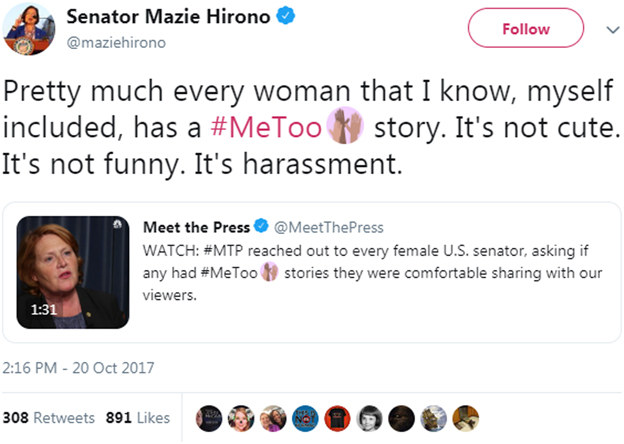
To examine congressional attention to the #MeToo movement, we compiled an original dataset of all tweets sent by members of the US House and the US Senate from October 2017 to June 2018, which represents the period when the #MeToo movement went viral.Footnote 1 We then coded the tweets for whether they used the #MeToo hashtag.Footnote 2 About 11% of legislators (i.e., 60 representatives and senators combined) tweeted about the #MeToo movement. Figure 1 is an example of a tweet by Senator Mazie Hirono dated October 20, 2017.
#MeToo Tweet Example

Congress members tweeting about #MeToo represent both parties and cross the ideological spectrum. Among the Democratic women in the US Senate are senators Claire McCaskill, Mazie Hirono, and Heidi Heitkamp. Male senators and representatives also tweet about #MeToo, including moderate Republican Representative John Carter and liberal Democratic Representative Ted Lieu.
A table included in the online appendix shows the general breakdown of legislators’ tweeting about #MeToo across different groups: 41 representatives compared to 19 senators; 53 Democrats and seven Republicans, including 35 female and 25 male legislators. These raw numbers suggest that the #MeToo movement among members of Congress may be driven most by partisanship; although more women than men are tweeting about #MeToo, it does not seem like an overwhelmingly female phenomenon.
There is a broad array of legislators tweeting about the #MeToo movement; however, examining how gender, partisanship, and ideology shape their activity requires systematic analysis of how these factors relate to their tweets. Accordingly, we merged data on legislators’ background and ideological position with our Twitter dataset. Specifically, we included indicators for members’ gender, partisan affiliation, ideology (using DW-NOMINATE scores), and number of terms served. We compiled data for both the US House and the US Senate; therefore, we estimated separate models for each chamber. The dependent variable of each model was whether the member tweeted about #MeToo.Footnote 3 Because it is a dichotomous variable, we estimated logistic-regression models.
RESULTS
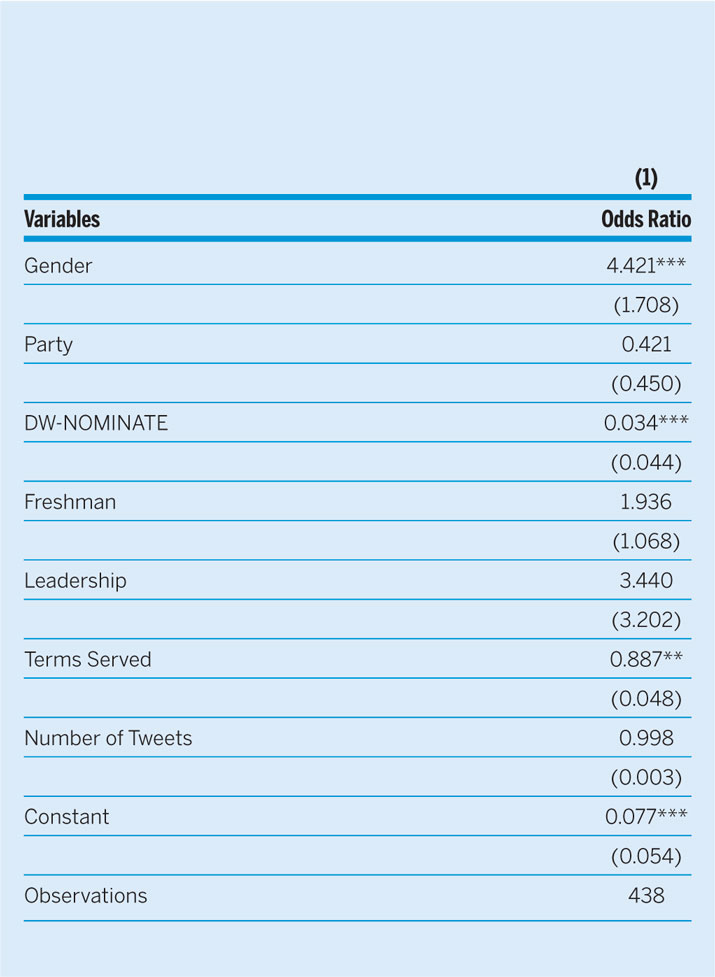
The results of our model are in table 1. For ease of interpretation, the table presents the odds ratios. An odds ratio of 1 represents even odds of tweeting or not tweeting about #MeToo (i.e., a coin flip). Odds ratios greater than 1 represent increased odds; odds ratios less than 1 represent decreased odds of tweeting about #MeToo. Consistent with our expectations, we find a significant effect of gender on the odds of representatives tweeting about #MeToo. Among US House members, women had about 4.5 times the odds of tweeting with the hashtag #MeToo compared to men. This had the greatest effect of any of the variables included in our analysis. Female representatives appear to be leading the charge to make issues of sexual harassment and assault visible to the broader public. Their actions are consistent with the long-standing literature that suggests congresswomen are more likely to espouse a “female legislative agenda.”
US House Members’ Attention to #MeToo on Twitter

Notes: Standard errors in parentheses. ***p<0.01, **p<0.05, *p<0.1.
In addition to gender, however, we must consider the role of partisanship in Congress members’ decisions to tweet about #MeToo, given the important role of party in individual perceptions of issues as well as the role of parties in congressional policy making (Cox and McCubbins Reference Cox and McCubbins1993). We do not find a statistically significant relationship between party affiliation and whether a representative tweets about #MeToo. This may seem surprising; however, if in fact gender plays such a major role in whether a Congress member tweets about #MeToo, then we are likely to see a bipartisan effort to get #MeToo into public discourse by women from both Democratic and Republican parties. Thus, this effort could cut across party lines.
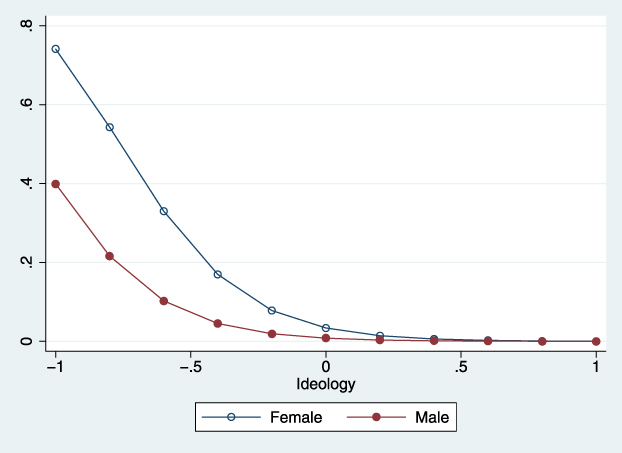
Although partisanship failed to significantly influence tweeting about #MeToo, it also is important to investigate the role of ideology. Prior scholarship demonstrates that many women’s issues, particularly those involving sexual harassment and assault, are listed on the agenda of liberal members, whereas conservative members generally do not prioritize these issues. Among US House members, we find a highly statistically significant relationship between ideology and the likelihood of legislators tweeting about #MeToo. To further assess the magnitude of the effects of ideology, we examined the predicted probabilities that a legislator will tweet about #MeToo across the ideological spectrum for male and female representatives. The results are presented in figure 2. We find that the probability of tweeting about #MeToo is greatest among the most liberal representatives. For the most progressive female representatives, there is an approximate 75% probability that they will tweet about #MeToo. For the most progressive male representatives, their probability of tweeting about #MeToo is about 45%. Moving across the ideological spectrum, the probabilities decline both for men and women. Among liberal members, at each point on the ideological spectrum, female representatives are more likely to tweet about #MeToo; however, men and women converge around zero and there are no significant gender differences as they become more conservative. Indeed, the probability of tweeting about #MeToo is minor moving beyond zero on the ideological scale (i.e., less than 5%).
Probability of a Representative Tweeting about #MeToo by Gender and Ideology

The indicator for whether a legislator was a freshman is an insignificant predictor of whether that representative tweeted about #MeToo. Legislators’ institutional position also failed to explain tweeting about #MeToo. There was no significant difference between leaders and rank-and-file representatives. Finally, the terms-served variable was statistically significant: more-senior representatives had lower odds of tweeting about #MeToo compared to their junior counterparts.
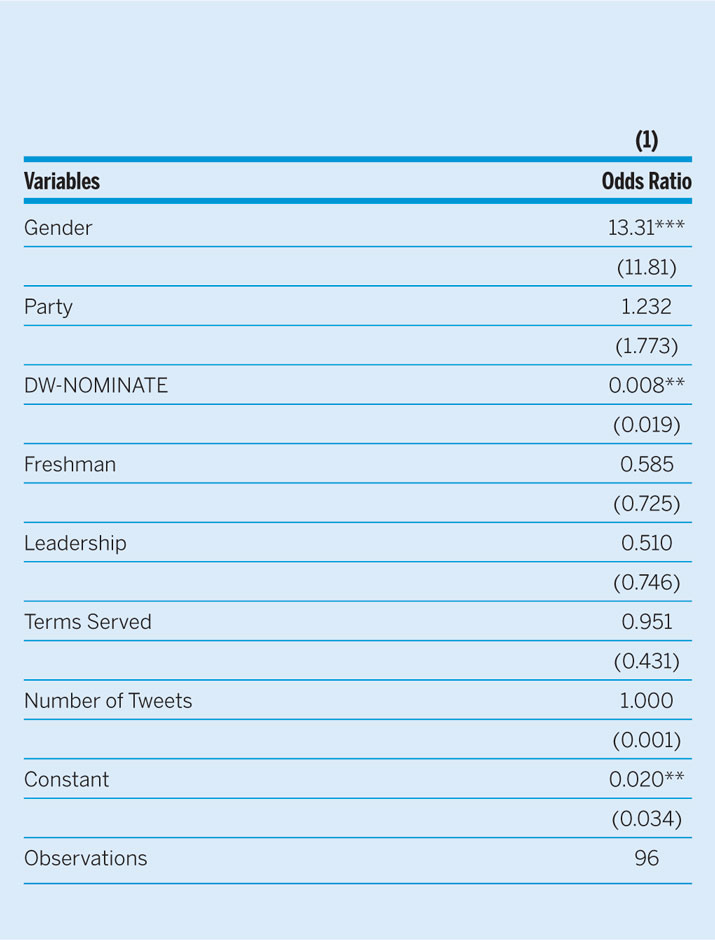
Turning to our model of the US Senate, we find a strong effect of gender on tweeting about #MeToo. As shown in table 2, female senators had about 13 times the odds of tweeting about #MeToo compared to male senators.A legislator’s gender had the greatest effect of any variable in explaining whether they decide to tweet about #MeToo. This result is consistent with our findings from the US House. Female legislators are most active in drawing attention to the #MeToo movement on Twitter.
Turning to our model of the US Senate, we find a strong effect of gender on tweeting about #MeToo. As shown in table 2, female senators had about 13 times the odds of tweeting about #MeToo compared to male senators.
US Senators’ Attention to #MeToo on Twitter
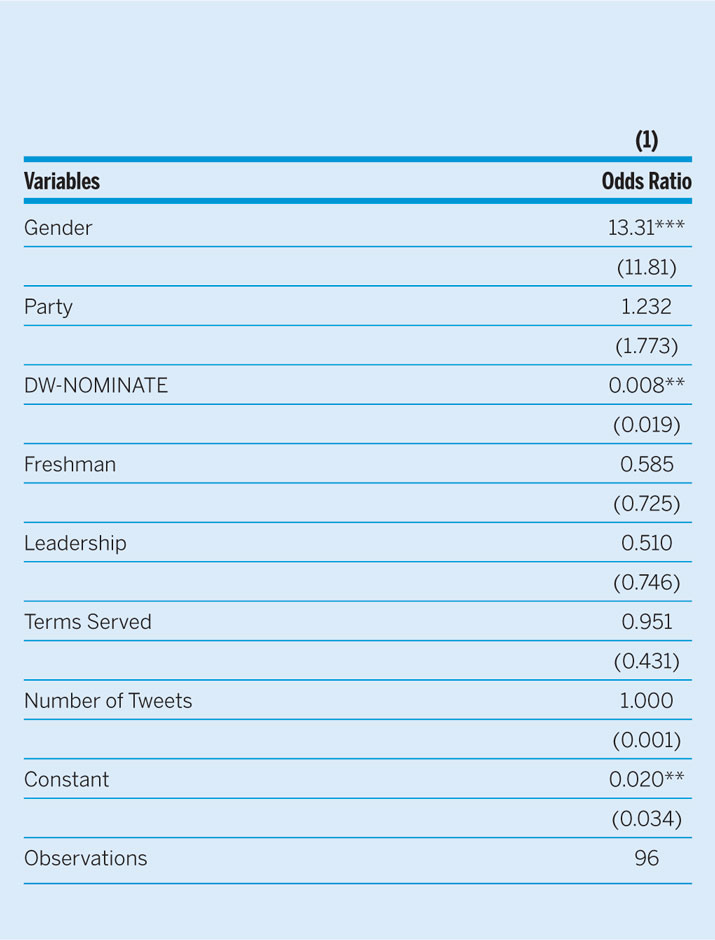
Notes: Standard errors in parentheses. ***p<0.01, **p<0.05, *p<0.1.
We next discuss the effect of partisan affiliation. Given the different policy priorities of the parties, we might expect that Democratic senators would be more likely to tweet about #MeToo compared to their Republican counterparts. Our analysis shows that partisan affiliation does not play a significant role in whether a senator tweets about #MeToo. This also is consistent with our findings for the US House.
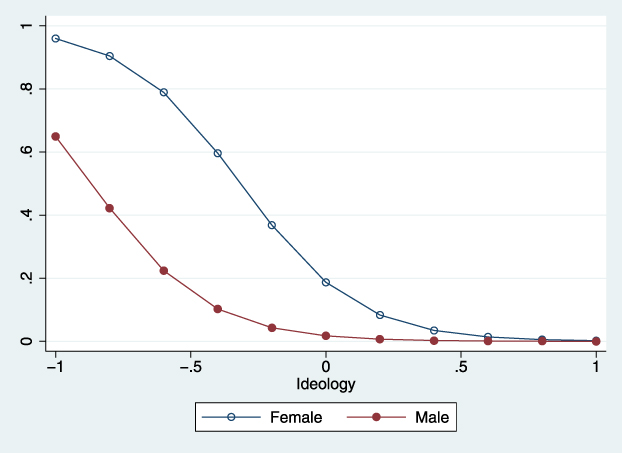
We find that conservative senators have much lower odds of tweeting about #MeToo compared to liberal senators. To fully explore the magnitude of these effects, figure 3 presents the predicted probabilities of tweeting about #MeToo across the ideological spectrum for male and female senators. Among the most liberal senators, there is a high predicted probability that they will tweet about the #MeToo movement. This is especially true for female senators; the most liberal (i.e., -1 on the DW-NOMINATE scale) had more than 95% probability of tweeting about #MeToo. The most liberal (i.e., -1 on DW-NOMINATE) male senators had an approximate 70% predicted probability of tweeting about #MeToo. Female senators are generally more likely to tweet about #MeToo across the ideological scale; however, at around 0.2 on the DW-NOMINATE scale, the gender differences are negligible. Among the most conservative senators, regardless of gender, it is unlikely (i.e., less than 5%) that they will tweet about the #MeToo movement.
Probability of a Senator Tweeting about #MeToo by Gender and Ideology

The institutional position of senators (measured by the leadership variable) did not appear to yield a significant effect on their decision to tweet about #MeToo. Likewise, there were no significant differences between freshman and non-freshman members. Finally, the number of terms served by senators failed to explain whether they tweeted about #MeToo. This represents a departure from our findings in the US House, where we found that seniority was negatively associated with the likelihood of tweeting about #MeToo.
CONCLUSION
After a few congressmen were outed for sexual harassment that stemmed from the #MeToo movement, both the US House and the US Senate took up #MeToo legislation aimed at overhauling the sexual-harassment complaint process on the Hill. The House passed a bill in February 2018 and the Senate passed a bill in May 2018. A conference committee did not meet to take up the bill before the end of the congressional session, which means that the process would start all over again in the 116th Congress.
To spur the US Senate into action in March 2018, all of the 22 female senators signed a letter urging their leadership to take up a bill to review the complaint process. Given this united front regarding sexual harassment, this article asks whether gender was a predictor of support for the movement on Twitter or whether partisanship was a better predictor. Our results demonstrate that gender is the strongest predictor of whether members of Congress are tweeting about the #MeToo movement, which is consistent for members of the US House and the US Senate.Footnote 4 Within Congress, women are the leaders magnifying this movement on social media to draw attention to victims of sexual assault and harassment and even sharing their own experiences. There also is a strong ideological element in which we find that the more liberal members are significantly more likely to tweet about #MeToo. It is interesting, however, that partisan affiliation was not a significant predictor of whether a politician tweeted about the #MeToo movement.
Although some members of Congress have sought to bring attention to issues surrounding sexual assault and harassment by embracing the #MeToo hashtag, the reach is still limited. In large part, the movement has not been embraced by more conservative members of Congress and, therefore, this threatens to cast the movement as simply a liberal one. To the extent that the movement can be propelled by members from both parties and across the ideological spectrum, Congress members may send a signal to their constituents about the importance of issues concerning sexual harassment and assault. The passage of the #MeToo bills signals that there appears to be common ground on which Democrats and Republicans can build. However, throughout the Senate confirmation hearings of Brett Kavanaugh, the issue of sexual-assault allegations and #MeToo came to the forefront, and partisan divisions seemed to override ideology and gender. Future work should extend this analysis of Congress members’ tweeting activity concerning #MeToo to examine how the effects of partisanship may have emerged over time and what this means for the effect of gender on Twitter activity surrounding #MeToo. This suggests that there may be major challenges in advancing legislative proposals aimed at addressing issues related to #MeToo as the parties become more entrenched in their beliefs.
SUPPLEMENTARY MATERIAL
To view supplementary material for this article, please visit https://doi.org/10.1017/S1049096519001124