Prior research has established that children with congenital heart disease (CHD) are at a higher risk for psychological challenges, Reference Marino, Lipkin and Newburger1 with previous studies suggesting that up to 41% of children with CHD exhibit behavioural and/or emotional problems. Reference Latal, Helfricht, Fischer, Bauersfeld and Landolt2 In particular, children with CHD are at a greater risk for experiencing problems related to internalising (e.g., depression, anxiety, withdrawal) and externalising (e.g., behaviour problems, inattention) symptoms, when compared to normative data or another type of control group such as siblings or healthy, same-aged peers. Reference Marino, Lipkin and Newburger1–Reference Karsdorp, Everaerd, Kindt and Mulder7 Earliest signs of psychological difficulties have been seen in infants with CHD as young as 3 months old, who were noted to be more irritable, difficult to soothe and negative in mood when compared to healthy infants. Reference Torowitz, Irving, Hanlon, Sumpter and Medoff-Cooper8 These problems with emotional and behavioural regulation are common during early childhood for children with CHD, Reference Clancy, Jordan, de Weerth and Muscara9 and often continue as children age, with one study suggesting that 65% of 10–19 year olds with CHD have met criteria for a psychiatric diagnosis in their lifetime, compared to 22% of a referent population. Reference DeMaso, Calderon and Taylor10
There has been growing interest in examining the development of psychological concerns in children with CHD, especially young children. While low-severity emotional and behavioural dysregulation and impairments in socialisation have been reported, Reference Re, Dean, Mullaert, Guedeney and Menahem11–Reference Tahirović, Begić, Tahirović and Varni13 limited research has examined risk factors that contribute to the development of behavioural and emotional problems at an early age in the CHD population. Reference Clancy, Jordan, de Weerth and Muscara9 To address this gap in the literature, this study aimed to identify predictors of behavioural and emotional problems in 2-year olds with CHD. The identification of such risk factors, particularly if they are modifiable, could help to inform early intervention services that may prevent later emotional and behavioural distress in this population. The study was exploratory in nature, with no a priori hypotheses regarding which risk factors may predict outcomes, given the paucity of research on behavioural and emotional functioning in this young age group. However, demographic and treatment variables, such as race, parental education level, history of prematurity, cardiopulmonary bypass (CPB) time and surgical complexity were explored as potential risk factors, given that these factors have been shown to be related to developmental outcomes in very young children. Reference Mussatto, Hoffmann and Hoffman14–Reference Favilla, Faerber and Hampton16
Materials and methods
Patient population
Children with CHD were referred to the Herma Heart Institute (HHI) Developmental Follow-up Clinic at Children’s Wisconsin (CW) for evaluation if they were classified as high risk for developmental disorder or disability by current American Heart Association (AHA)/American Academy of Pediatrics (AAP) guidelines. Reference Marino, Lipkin and Newburger1 These children were evaluated by a multi-disciplinary team (developmental paediatrician, advanced practice nurse, occupational therapist, physical therapist, speech therapist). Although evaluations were recommended to occur approximately every 6 months between 6 months and 3 years of age, some children did not complete all of the recommended visits.
Children evaluated between 24 and 36 months of age were eligible for this study if they had the Child Behavior Checklist (CBCL) Reference Achenbach and Ruffle17 completed by a parent or guardian, as well as a prior neurodevelopmental evaluation at 12 ± 3 months of age using the Bayley Scales of Infant Development–III (BSID-III). Reference Bayley18 Informed consent was provided by parents to include their child’s data into a databank approved by the Institutional Review Board at CW. No children were excluded from the study due to coexisting medical or genetic conditions. Because tests were administered in English, children who did not speak English were not included in the study.
Measures
At the 12 ± 3 month assessment, children were administered the BSID-III. Reference Bayley18 This measure of development assesses cognitive, language and motor skills and provides composite scores for these three domains (mean = 100, SD = 15). In addition, subscale scores for expressive and receptive language, and fine and gross motor skills can be calculated (mean = 10, SD = 3). Higher scores indicate better skills. BSID-III scores have been shown to correlate with later preschool IQ scores, and have sensitivity and specificity to discriminate clinical cases from normal cases. Reference Bayley18 For purposes of this study, the cognitive, language and motor composite scores were used in statistical analyses.
When children were between 24 and 36 months of age, their parents or guardians completed the CBCL. Reference Achenbach and Ruffle17 The CBCL is a standardised measure of emotional/behavioural problems, and it provides composite T scores for internalising, externalising and total problems. This measure has strong psychometric properties with test–retest reliability of 0.85, and criterion-related validity being established by all items discriminating significantly (p < 0.01) between children who were referred versus those that were not referred to a mental health clinic for behavioural problems. Patient scores were compared to test norms and classified as normal (T ≤ 64), borderline (T = 65–69) and abnormal (T ≥ 70). Higher scores indicate more problems. For the purposes of this study, borderline and abnormal scores were both categorised as “abnormal.”
At the 12-month clinic visit, parents completed a demographic form which provided information regarding parental education and occupation and family constellation. Information was also collected about any intervention services (speech therapy, physical therapy, occupational therapy) that the child was currently receiving or had received in the past. Information regarding medical variables and treatment characteristics were gathered via chart review.
Statistical analysis
Median and interquartile range (IQR) were used to summarise continuous or ordinal data and frequencies (%) were used for categorical data. A Mann–Whitney test was used to examine the relationship between a continuous variable and outcomes (internalising, externalising and total problems; normal versus abnormal). A Chi-square or a Fisher’s exact test was used to examine the relationship between categorical variables. Multi-variable analyses were conducted using a classification tree model to examine important associations with outcomes. The advantages of a tree approach include: it is able to identify thresholds; unlike a typical general linear model, it allows for interaction between many interrelated covariates and for the form of the covariates to be investigated and the resulting decision tree is transparent. A tree approach was selected as we were interested in identifying threshold scores, and we expected that there would be interactions between variables that would not be detected using logistic regression. The tree was optimised by Gini with 10-fold cross validation, and the split criteria were 10 for parent node and 5 minimal for terminal node. The considered variables included: sex, race, whether the child was first born in the family, parental education level, maternal age, gestational age at birth, history of prenatal diagnosis, history of premature birth, history of transplant, history of extracorporeal membrane oxygenation (ECMO), CPB, age at first open-heart procedure, Society of Thoracic Surgeons (STS) risk of mortality score and BSID-III scores at 12 ± 3 months of age. Missing data were handled using listwise deletion method for univariable analysis, which assumes that data are missing completely at random. In multi-variable tree analysis, CART handles missing data in the database by substituting “surrogate splitters”. An unadjusted two-sided p-value of <0.05 was considered as significant. All statistical analyses were performed using SAS version 9.4 (SAS Institute, Cary, North Carolina) and Salford CART 8.0. Reference Steinberg and Colla19
Results
From 2007 to 2018, 317 children with cardiac diagnoses were seen in the HHI Developmental Follow-up Clinic for 24–36-month-old preschool developmental testing. Of these 317 children, 144 had both BSID-III completed at 12 ± 3 months, as well as a CBCL completed by parent/guardian between 24 and 36 months of age and met the criteria to be included in this study.
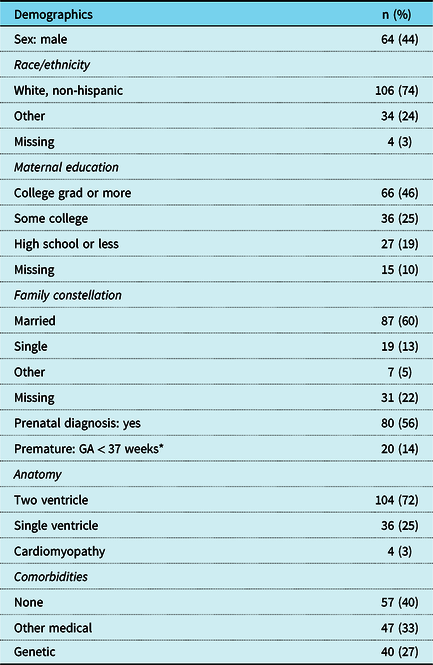
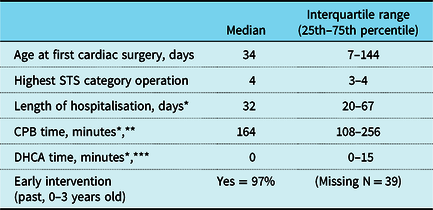
Demographical characteristics of the sample are presented in Table 1. Median gestational age of the patients was 39 weeks (IQR = 37–39). Age of mothers and fathers at the time of patient’s birth was 31 years (IQR = 27–35) and 32 years (IQR = 28–37), respectively. Thirty-seven percent (n = 54) of patients were first-born children in the family. Treatment characteristics are presented in Table 2. Seventeen percent (n = 24) of patients had their first open-heart procedure at less than 7 days of age, 44% (n = 63) had their first open-heart procedure at less than 30 days of age, 5% (n = 7) had a history of ECMO and 2% (n = 3) had received a heart transplant.
Sample demographics n = 144

* GA, gestational age.
Subject and treatment characteristics

CPB, cardiopulmonary bypass; DHCA, deep hypothermic circulatory arrest.
* Cumulative to the time of 1 year neurodevelopmental assessment.
** Sixteen subjects never had open heart surgery.
*** Ninety-three subjects had DHCA.
On the BSID-III, the majority of the patients fell within the normal range for cognitive (x = 116, 81%), language (x = 101, 71%) and motor (x = 75, 52%) scores. 19% of the patients fell within the abnormal range for cognitive, 29% for language and 48% for motor scores. On the CBCL, the majority of the patients fell within the normal range for total problems (x = 124, 86%), internalising problems (x = 120, 83%) and externalising problems (x = 129, 90%). 14% of the patients fell within the abnormal range for total problems, 17% for internalising problems and 10% for externalising problems. For reference, in a normal population, 85% of scores would be expected to fall within the normal range and 15% would be expected to fall within the abnormal range.
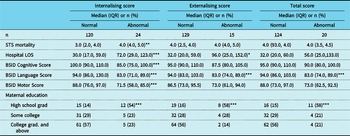
Statistically significant relationships between demographic/treatment variables, BSID-III scores at age 12 ± 3 months and CBCL scores at age 24–36 months are presented in Table 3. In univariate analyses, abnormal internalising scores were associated with higher STS risk of mortality score (p = 0.006), longer length of hospitalisation (p = 0.002), lower maternal education (p < 0.001) and lower scores on all BSID-III composite scores: cognitive (p = 0.001), language (p < 0.001) and motor (p < 0.001). Abnormal externalising scores were associated with longer length of hospitalisation (p = 0.032), lower maternal education (p < 0.001) and lower BSID-III language scores (p = 0.005). Finally, abnormal total problems scores were associated with lower maternal education (high school graduate and below) (p < 0.0001), lower paternal education (p = 0.002), race (non-White) (p = 0.005), presence of other medical or genetic conditions (p = 0.030) and lower BSID-III language scores (p = 0.003).
Univariate analyses

* For p < 0.05.
** For p < 0.01.
*** p ≤ 0.005.
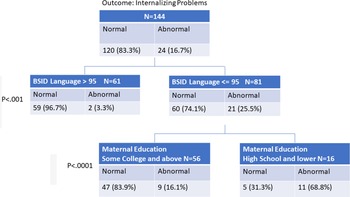
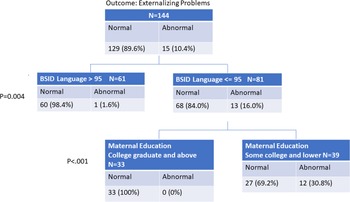
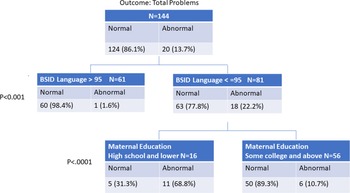
Results of the multi-variable tree analyses are presented in Figures 1, 2, and 3. Lower BSID-III language scores, with a cutoff score of ≤95, at age 12 ± 3 months were an important predictor of abnormal CBCL internalising (p < 0.001), externalising (p = 0.004) and total scores (p < 0.001) at age 24–36 months. Maternal education level was also an important predictor of abnormal CBCL scores; children with mothers who had a high school diploma or less education were more likely to exhibit internalising (p < 0.0001) and total problems (p < 0.0001) at age 24–36 months compared to children whose mothers had some college education or more. Children with mothers who had some college education or less were more likely to exhibit externalising problems at age 24–36 months (p < 0.001) compared to children whose mothers had a college degree or beyond. The following variables were no longer significant in multi-variable analyses: STS risk of mortality score, hospital length of stay, minority race or presence of other medical or genetic conditions.
Multi-variable tree analysis for predictors of internalising problems at age 24–36 months. BSID-III, Bayley Scales of Infant and Toddler Development, Third Edition.

Multi-variable tree analysis for predictors of externalizing problems at age 24–36 months. BSID-III, Bayley Scales of Infant and Toddler Development, Third Edition.

Multi-variable tree analysis for predictors of total problems at age 24–36 months. BSID-III, Bayley Scales of Infant and Toddler Development, Third Edition.

Discussion
Results of this study suggest that lower language abilities and lower maternal education predict increased internalising, externalising and total problems in toddlers with CHD. This is consistent with previous studies in the general paediatric population that have found that delays in language vocabulary as early as 18 months of age were associated with higher rates of internalising and externalising problems, Reference Henrichs, Rescorla and Donkersloot20 and children with higher language ability were reported to have less inattentive–hyperactive problems. Reference Petersen, Bates and DʼOnofrio21 Parental education level has also been previously shown to be related to child mental health problems, with children whose parents had at least a college degree exhibiting fewer externalising and ADHD symptoms. Reference Nuru-Jeter, Sarsour, Jutte and Boyce22 Finally, higher parental education level has been shown to be associated with better developmental skills in children. Reference Patra, Greene, Patel and Meier23 Thus, parental education level, which tends to be correlated with family socioeconomic status, may serve as a significant protective factor for children in their overall psychosocial development. This points to the importance of interventions that target the family system, not just the child, and the need to address social determinants of health.
It is interesting to note that the tree analysis identified that a cutoff score of ≤95 on the BSID-III should be considered “low”; however, BSID-III norms (mean = 100, SD = 15) define a score of <85 as low. Several previous studies have suggested that the BSID-III may overestimate abilities, as patients score higher on the BSID-III compared to previous versions of the test. Reference Acton, Biggs and Creighton24–Reference Goldstone, Baiocchi and Wypij26 A study of 2 year olds looked at the BSID-III composite scores in preterm versus term children and found that the term children had a language mean score of 108.2 (SD 14.8), almost 10 points above the standardised mean of 100. Reference Acton, Biggs and Creighton24 This suggests that if a score of <85 is used to indicate a delay, children with actual deficits may be missed. Therefore, the cutoff score of ≤95 that was suggested by the tree analysis in this study may be more sensitive in identifying which children may be more at risk. Alternatively, it is possible that because the language expectations are so low for BSID-III testing near age 12 months, low language scores may actually be reflecting a more global developmental delay versus a language delay, and thus the relationship may be between global developmental delay (not language) and the development of later psychosocial concerns. This would have important implications for interventions, which could address more global developmental skills in addition to targeting speech and language.
The current study fills an important gap in the literature as it identifies risk factors that contribute to the development of behavioural and emotional problems in very young children with CHD. Few studies have reported psychosocial outcomes of children with CHD as young as 2 years with a standardised tool such as the CBCL, and thus, there is limited information about the rates of behavioural and emotional concerns in children with CHD at this age. Results indicate that the rates of behaviour problems in this young sample of children with CHD did not differ significantly from population norms; thus interventions that target this subset of children at higher risk for problems may be warranted. More research is needed on psychosocial outcomes in young children with CHD. Reference Clancy, Jordan, de Weerth and Muscara9
Limitations of this study include that findings are based on a single centre, and thus results may not generalise to all children with CHD. In addition, a healthy control group was not included, and comparisons were made based on test normative values. The CBCL is a parent report measure, and therefore scores of child emotional and behavioural problems may be subjective since they are not based on direct observation. Future studies should include measures that do not rely exclusively on parent report. Reference Dahlawi, Milnes and Swallow27
Other variables that were significant in univariate analysis, but not multi-variable analysis, such as longer length of hospitalisation, presence of other medical or genetic conditions, and minority race have previously been identified as risk factors for developmental delays. Reference Mussatto, Hoffmann and Hoffman14–Reference Favilla, Faerber and Hampton16 However, their relationship to behavioural and emotional problems in very young children is less well established. It is possible that these factors may have been significant had the CBCL been administered when children were older, when behavioural and emotional problems are more apparent. In addition, with a larger sample size, these variables might be significant in a multi-variable analysis. However, in this study, language abilities and maternal education have clearly been identified as more important predictors of early behavioural and emotional problems.
Conclusions
Children with CHD who have early language delays and mothers with less education are at risk for developing behavioural and emotional problems over time. Serial, longitudinal follow-up is needed in this population to evaluate for internalising and externalising problems as children age. If problems can be identified earlier in these children, interventions can be implemented sooner, resulting in better outcomes for these children.
Acknowledgements
The authors would like to acknowledge Ann Chin, RN, for her role as a nurse clinician and lead for patient recruitment. We thank the children and parents who attended developmental follow-up clinic and were willing to participate in this research.
Financial support
This publication was supported in part by the National Center for Research Resources and the National Center for Advancing Translational Sciences, National Institutes of Health, through Grant Number 8UL1TR000055. Its contents are solely the responsibility of the authors and do not necessarily represent the official views of the NIH.
Conflicts of interest
The authors have no conflicts of interest relevant to this article to disclose.
Ethical standards
The authors assert that all procedures contributing to this work comply with the ethical standards of the relevant national guidelines on human experimentation (United States Policy for the Protection of Human Subjects) and with the Helsinki Declaration of 1975, as revised in 2008, and has been approved by the Institutional Review Board at Children’s Wisconsin. Parents provided written informed consent to have their child’s de-identified data be included in this study.