


1. INTRODUCTION
Generation of nuclear fusion from the reaction of protons (hydrogen) and boron-11 isotope (HB11) is interesting because no neutrons are generated primarily, and the resulting radioactivity per produced energy is less than from burning coal (Weaver et al., Reference Weaver, Zimmerman and Wood1973). Compared with the next available exothermic fusion reaction of deuterium and tritium (DT) for energy production (Moses et al., Reference Moses, Miller and Kauffman2006; Moses, Reference Moses2008), however, the reaction of HB11 is about 100,000 times more difficult (Stening et al., Reference Stening, Khoda-Bakhsh, Pieruschka, Kasotakis, Kuhn, Miley, Hora, Miley and Hora1992; Scheffel et al., Reference Scheffel, Stening, Hora, Höpfl, Martinez-Val, Eliezer, Kasotakis, Piera and Sarris1997; Eliezer et al., Reference Eliezer, Murakami and Martinez-Val2007; Hora et al., Reference Hora, Miley, Ghoranneviss, Malekynia and Azizi2009, Reference Hora, Miley, Ghoranneviss, Malekynia, Azizi and He2010) if ignition by thermokinetic compression to extremely high densities has to be used.
If instead of the thermokinetic compression and ignition scheme, a basically alternative ignition scheme is used with the nonlinear forces of laser interaction by converting the optical energy without heating into kinetic energy of the irradiated plasma (Hora et al., Reference Hora, Badziak, Read, Li, Liang, Liu, Sheng, Zhang, Osman, Miley, Zhang, He, Peng, Glowacz, Jablonski, Wolowski, Skladanowski, Jungwirth, Rohlena and Ullschmied2007), the HB11 fusion is only about 10 times more difficult than for DT (Azizi et al., Reference Azizi, Hora, Miley, Malekynia, Ghoranneviss and He2009; Hora et al., Reference Hora, Miley, Ghoranneviss, Malekynia and Azizi2009, Reference Hora, Miley, Ghoranneviss, Malekynia, Azizi and He2010). These calculations are based on hydrodynamic computations going back to Chu (Reference Chu1972) and Bobin (Reference Bobin, Schwarz and Hora1974) following the results of Hora et al. (Reference Hora, Badziak, Boody, Höpfl, Jungwirth, Kralikova, Kraska, Laska, Parys, Perina, Pfeifer and Rohlena2002), Hora and Miley (Reference Hora, Miley, Hora and Miley2005), and Hora (Reference Hora2007, Reference Hora2009), where the validity of hydrodynamics at the plasma with extreme inhomogeneities and particle interpenetration is still under research (Li, Reference Li2010).
In view of these not finalized questions, the alternative case of thermokinetic ignition of HB11 may be still of interest in view of the following reported drastic improvements in nuclear fusion gains due to recent results (Nevins & Swain, Reference Nevins and Swain2000) with details about the astrophysical S-function (Li et al., Reference Li, Liu, Chen, Wei and Hora2004) of the resonance at 145 keV for the fusion cross-sections of HB11. Unexpected changes of fusion gain computations for volume ignition (Hora & Ray, Reference Hora and Ray1978) may improve the conditions for HB11 by more than two orders of magnitude. To avoid the radioactive T (with 12.3 years half-life) and the undesired radioactivity generated by the neutrons, we strongly put attention to the H-11B fusion reaction:

The aim of this study is an investigation of the resonance at cross-section leading to an effect of the energy gain of H-11B fusion reaction at volume ignition by spherical compression to high densities. Nevins and Swain (Reference Nevins and Swain2000) provided analytic approximations to the fusion rate coefficients for the H-11B reaction by considering resonance in the astrophysical S-function. In this paper, for the first time, we are including this resonance for the fusion cross-section into our computer code and calculate the fusion gain for various initial conditions.
2. THERMOKINETIC VERSUS ELECTRODYNAMIC IGNITION
The difference between thermokinetic and electrodynamic ignition of fusion plasmas by lasers can be seen from the values of acceleration to be reached. The largest laser on earth, the National Ignition Fusion (NIF) laser, produced pulses in the range of a few ns duration and a few MJ of energy. This can be used to accelerate the plasma for all kinds of studies where High Energy Density Laboratory Astrophysics (HEDLA) is an example to offer plasma accelerations (Park et al., Reference Park and Remington2010)

These are typical thermokinetic accelerations for producing velocities of the D plasma of a few 107 cm/s due to the gradients of gas pressures given by nKT with the density n of the plasma particles, and the temperature (T) to which the laser is heating the plasma in the force density f, which reads simplified in one dimension

where the first term on the right-hand side of Eq. (1b) is the thermokinetic one and the second term occurring due to the electric field (E) and the magnetic field (H) of the laser is called nonlinear force (f NL). In one dimension, this force is formally identical with the ponderomotive force or the electrostriction in electrostatics, but the general Lorentz- and gauge-invariant final expressions is much more detailed (see Eqs. (8.87) and (8.88) in Hora (Reference Hora1991)). As soon as the quiver energy of the electrons in the laser field is higher than that of thermal motion, the f NL dominates. The f NL is modified by the dielectric properties of the plasma. For a more general geometry, see Eq. (1b) and Hora et al. (Reference Hora, Badziak, Read, Li, Liang, Liu, Sheng, Zhang, Osman, Miley, Zhang, He, Peng, Glowacz, Jablonski, Wolowski, Skladanowski, Jungwirth, Rohlena and Ullschmied2007).
Plane geometry accelerations with the dominating f NL were measured by Doppler effects (Sauerbrey, Reference Sauerbrey1996) with laser pulses of 0.5 ps duration and energies in the range of Joules to be

the comparable plasma velocities are about 100,000 times higher than at thermokinetic acceleration (1a). It should be noticed that the measurement of Sauerbrey (Reference Sauerbrey1996) has a rather large error bar (Sauerbrey, 2010, private communication) on the order of a factor of two. For the comparison of the experimental result (1c) with the theory (Hora et al., Reference Hora, Badziak, Read, Li, Liang, Liu, Sheng, Zhang, Osman, Miley, Zhang, He, Peng, Glowacz, Jablonski, Wolowski, Skladanowski, Jungwirth, Rohlena and Ullschmied2007), it has to be taken into account that the dynamically changing dielectric swelling of the energy density in the plasma had to be taken from several other similar experiments, with an average value between two and three, with a similar error bar as the experiment. Apart from this rather complex detail, it is evident that the difference between the thermokinetic acceleration with delay times of thermalization, and equi-partition is significantly larger than ps (Sadighi-Bonabi et al., Reference Sadighi-Bonabi, Yazdani, Cang and Hora2010) than the instantly acting general dielectric modified f NL of the laser radiation on the electrons for acceleration of space charge quasi-neutral plasma blocks. This is the reason for the 100,000 times difference of the accelerations (1a) and (1c).
The essential property of the experiments of Sauerbrey (Reference Sauerbrey1996) was that the laser pulses had to be clean. This means that any prepulse had to be eliminated by a factor of 108 compared with the ps main pulse up to times of a few ps before the incidence of the main pulse. Only under these conditions the plane geometry acceleration (1c) was possible, otherwise the prepulse had produced a plasma plume before the target where relativistic self-focusing squeezed the laser pulse to less than wave length diameter resulting in such extremely high intensities that very highly ionized ions were emitted with energies much above MeV up to GeV.
The accelerations (1c) were exactly predicted from computations with f NL (Hora et al., Reference Hora, Castillo, Clark, Kane, Lawrence, Miller, Nicholson-Florence, Movak, Ray, Shepanski and Tsivinsky1979; Hora 1991, see Section 10.5). The clean pulse interaction of intense ps laser pulses was measured by other authors and the resulting highly directed space charge neutral plasma blocks (Hora et al., Reference Hora, Badziak, Boody, Höpfl, Jungwirth, Kralikova, Kraska, Laska, Parys, Perina, Pfeifer and Rohlena2002) arrived at ion current densities above 1011 A/cm2 (Hora et al., Reference Hora, Badziak, Read, Li, Liang, Liu, Sheng, Zhang, Osman, Miley, Zhang, He, Peng, Glowacz, Jablonski, Wolowski, Skladanowski, Jungwirth, Rohlena and Ullschmied2007). Using the plasma blocks for side-on ignition of uncompressed solid state density DT (Chu, Reference Chu1972), the nearly available laser pulses of ps duration and 10 PW power should ignite the fusion by a fusion flame process (Hora, Reference Hora2009). The ignition of HB11 should then be about 10 times more difficult (Hora et al., Reference Hora, Miley, Ghoranneviss, Malekynia and Azizi2009, Reference Hora, Miley, Ghoranneviss, Malekynia, Azizi and He2010).
This laser ignition for fusion is based on the very highly efficient direct conversion of optical energy into kinetic energy of plasma by the nonlinear forces and is therefore basically different from the thermokinetic ignition processes at compression of DT to 1000 times solid density, or 100,000 times for HB11. In view of the not finally clarified properties of the f NL driven block ignition, the following reported relaxations of the conditions for the alternative thermokinetic ignition of HB11 are of interest.
3. FUSION RATE COEFFICIENT
In this section, the selective resonant tunneling model (Li et al., Reference Li, Tian, Mei and Li2000, Reference Li, Liu, Chen, Wei and Hora2004) is used to calculate the H-11B fusion rate coefficient before volume ignition, and gain calculations are described by the results of which are presented in the following sections.
Fusion reactions between two nuclei can be divided into two independent steps (spatially for heavy nuclei): the penetration of the Coulomb barrier (formation of the compound nucleus) and the fusion reaction (decay of the compound nucleus). For light nuclei, Li et al. (Reference Li, Tian, Mei and Li2000; Reference Li, Liu, Chen, Wei and Hora2004) proposed the selective resonant tunneling model to estimate fusion cross-sections of DT fusion reactions. In this model, the two steps of fusion reaction are not independent. Consequently, we do not observe any neutron emission in the H-11B fusion reaction. Although H-11B fusion reactions have a charge number of five for boron-11, its fusion cross-section is much greater than that of DD fusion at similar energy due to the resonant tunneling (Li et al., Reference Li, Tian, Mei and Li2000).
Here the selective resonance theory (Li et al., Reference Li, Tian, Mei and Li2000, Reference Li, Liu, Chen, Wei and Hora2004) is extended to the H-11B fusion reaction case. When a proton is injected into a boron-11 nucleus, their relative motion can be described by the solution of the Schrödinger equation using a complex potential including damping by the imaginary part. The nuclear interaction can be introduced by a phase shift δ ° in the wave function. The reaction cross-section related to this phase shift is (Li, Reference Li2010)

Here k is the wave number for the relative motion outside the nuclear potential well. Taking into account the reduced mass (μ), it can be written as  . The subscript “°” denotes that only the s-partial wave is considered. Since the nuclear potential well (U r + iU i) is complex, the phase shift
 is also a complex number. We are introducing the phase shift
 as

Usually, we obtain cot( ) directly from the continuity of the logarithmic derivative of the wave function

Here C = 0.577216 is an Euler's constant, a is the radius of the nuclear potential well,  is the length of Coulomb unit,
 is the complex wave number inside the nuclear potential well, and 1/θ2 is the Gamow penetration factor
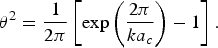
h(ka c) is related to the logarithmic derivative of the Γ function and to calculate this function, we can use the following formula (Landau & Lifshitz, Reference Landau and Lifshitz1987)

One can obtain a useful identity to show the effect of selective resonance on the cross-section. We write this identity as (Li et al., Reference Li, Liu, Chen, Wei and Hora2004)

Then, the fusion cross-section can be written as:

It must be emphasized that W r and W i are related to the real and imaginary parts of the nuclear potential well, respectively. The detailed evaluation of this potential well property for the HB11 has not yet been performed. Instead, the procedures for using the cross-section in the following numerical evaluations were essentially based on the measurements of Nevins and Swain (Reference Nevins and Swain2000) for the resonance maximum at 148 keV with a minor adjustment based on the result of Li et al. (Reference Li, Liu, Chen, Wei and Hora2004) for DT. The DT case is shown in Eq. (7) that the cross-sections of the resonance needed only the physical understandable two values of the maximum and the width of the resonance curve. In this DT case, the very precise experimental cross-sections were agreeing better with the computations than any of the numerical fitting attempts with a number of adjusting parameters. One example for a fitting with the parameters is that of Clark et al. (Reference Clark, Hora, Ray and Titterton1978). Using this experience, the measurements of Nevins and Swain (Reference Nevins and Swain2000) were compared with the analytical values where few minor deviations were experienced. This semi-empirical procedure avoided an explicit evaluation of the W r and W i values.
The fusion rate coefficient (averaged reactivity) is related to the fusion cross-section through the integral

When both ion species have thermal distributions, this integral can be reduced to

where we have allowed for possible differences in the temperature of the two ion species by defining

Substituting σ in Eq. (7) into Eq. (9), we calculate the fusion rate coefficient <σv> as shown in Figure 1. One may note how the fusion rates improved since the very early initial calculations (Miley et al., Reference Miley, Towner and Ivich1974; Bosch & Hale, Reference Bosch and Hale1992).
Temperature dependence of the fusion rate coefficient, ft〈σv〉, for H-11B fusion reaction.

Nevins and Swain (Reference Nevins and Swain2000) obtained the analytical approximations to the astrophysical S-function for the H-11B fusion reaction. Figure 2 shows variations of S(E) for E < 1000 keV as a function of E with details of the resonance at E = 148 keV. There is a second resonance at ≈ 520 keV. The peak in the H-11B fusion cross-section is shifted upward to ≈ 590 keV due to the strong energy dependence of the Gamow factor (see Fig. 4 in Nevins et al. (2000)).
Astrophysical S-function of H-11B fusion reaction varies as a function of energy in keV (Nevins et al., 2000).

The fusion rate coefficients for H-11B fusion reactions according to Nevins and Swain (Reference Nevins and Swain2000), Davidson et al. (Reference Davidson, Berg, Lowry, Dwarakanath, Sierk and Batay-Csorba1979), and our calculation from the selective resonance model (Li et al., Reference Li, Liu, Chen, Wei and Hora2004) is shown in Figure 1. At higher temperatures the contribution from the 148 keV resonances can be neglected in the following computations. In this paper, we employed these rate coefficients to calculate energy gain in H-11B fusion reaction, with the volume ignition model (Hora & Ray, Reference Hora and Ray1978) as it was confirmed by the Wheeler modes (Kirkpatrick & Wheeler, Reference Kirkpatrick and Wheeler1981).
4. VOLUME IGNITION AND GAIN CALCULATIONS
In the direct drive approach to inertial confinement fusion, the driver beams or laser light are incident directly at the very small spherical pellets. The laser energy is absorbed by electrons in the target's outer corona. With short wavelength lasers (Hosseini et al., Reference Hosseini-Motlagh, Mohamadi and Shamsi2008), absorption can exceed 80%. The hydrodynamic transfer of laser energy into an ideal compression profile (i.e., the self-similarity model for volume ignition (Hora, Reference Hora1991, Section 5)) is possible only if the initially deposited laser energy into the spherical plasma corona is transferred into the compressed plasma. This occurs when the hot corona plasma ablates and the momentum of it causes compressing recoil to the interior. So, dense and compressed plasma is generated in the interior of the target. The central core in this high density and high temperature region (Eliezer & Hora, Reference Eliezer, Hora, Velarde, Martinez-Val and Ronen1993) can undergo ignition.
The simplified fusion reactions gain (core gain) is defined by the ratio of nuclear fusion reaction energy (E f) to the input energy (E o),

where the energy per H-11B fusion reaction is εHB = 8.664 MeV. n i is the ion density and A = 4 is the binary reactions of the type H-11B, or A = 2 for cases like DD reactions.
Following Stenning et al. (1992), the algorithm was considered including the direct temperature changing of the elements, the adiabatic cooling, the alpha particles reheat, and the temperature change due to Bremsstrahlung losses and partial re-absorption. To include the re-absorption of the Bremsstrahlung, the classical collision frequency was used as in the initial case for DT (Hora & Ray, Reference Hora and Ray1978).
The problem of reheat is involved with the very complex question, what penetration depth for the MeV alpha particles in the high density plasma is to be taken. We have calculated it on the basis of the alternative to the well known Bethe-Bloch binary collision model. Instead, the collective model of Gabor (Reference Gabor1933, Reference Gabor1952) has to be used for the stopping power of alpha particles for collisions with the whole collective of the electrons in the Debye sphere (collective effect) at the high plasma densities in contrast to the binary collisions with electrons following from the Bethe-Bloch theory, see Hora (Reference Hora2009) and Malekynia et al. (Reference Malekynia, Hora, Azizi, Kouhi, Ghoranneviss, Miley and He2010). As before (Scheffel et al., Reference Scheffel, Stening, Hora, Höpfl, Martinez-Val, Eliezer, Kasotakis, Piera and Sarris1997), the absorption of an alpha particle by the plasma itself is

where Rα denotes the range of alpha particle according to the collective effect, and R is the radius of the spherical plasma. Considering this probability, we calculate the deposition energy of alpha particles.
We base the computation of gain on the model of spherical plasma with initial temperature T o, radius R o and ion density n ioexpanding symmetrically in vacuum. This self-similarity model has also been used by Hora and Ray (Reference Hora and Ray1978). We use their calculation and take for H-11B the improved cross-sections into account.
We assume that a laser supplies energy E o all of which is absorbed by a plasma sphere of initial radius R o so that

Where n io is the initial ion density,  is the average ionic charge, and T o is initial energy of ion after the laser heating expressed.
The numerical results were obtained above; debate and conservation of energy and momentum are discussed in the next section.
5. RESULTS UNDER USUAL CONDITIONS
For a generation of energy in reactor plasma with H-11B fusion reaction, 105 times the solid state density and 30% efficiency of the drivers are necessary known form of the preceding computations (Scheffel et al., Reference Scheffel, Stening, Hora, Höpfl, Martinez-Val, Eliezer, Kasotakis, Piera and Sarris1997). This shows that HB11 fusion with compression and thermal ignition is about 100,000 times more difficult than the compression ignition of DT, because 100 times higher compression is needed, 100 times high laser energy (100 MJ instead of about 1 MJ), and the gain is 10 times less than for DT. Before going to a drastic change of these conditions in the next section, we evaluate how the resonance changes the usual conditions.
Here, we calculate fusion gain from Eq. (11) for H-11B at 105 times the solid state initial compressed densities and various initial volumes as parameter as shown in Figure 3. We note that the strongest gain increase due to resonance absorption occurs in the few MJ input energy range. The results of computation of maximum fusion gain are summarized in Table 1. As can be seen from this figure and Table 1, the fusion gain increased and the needed driver energy decreased due to resonance at fusion cross-section.
Dependence of the fusion gain on the input energy of the H-11B reactions for 105 times the solid state density and initial pellet volumes in the range 10−8–10−2 cm3.

Fusion gain (with resonance) and driver energy reduction and gain increase for different initial conditions of pellet compressions and volumes for H-11B fuel

The maximum gain that we can obtain for H-11B fuel is approximately 100, which needs initial laser energy close to 1100 GJ, which is not interesting for power stations. Comparison of our results with that of Scheffel at al. (1997) shows that the fusion gain increased about two times due to the resonance effect. Also, Comparison of our H-11B results with the 3He3He (Khoda-Bakhsh et al., Reference Khoda-Bakhsh, Soltanian and Aminat-Talab2007) shows that for a driver energy five times less than for 3He3He, we can obtain fusion gains two times higher than for 3He3He. Decreasing driver energy for maximum gain and increasing gain are varying irregularly for different initial volumes and initial densities. Most effect of resonance at cross-section, as can be seen occur in the lower energies, see the following section.
Taking the maximum gain for every volume, one gets the optimum gain curves for each initial density as shown in Figure 4. The results of computation of maximum fusion gain are summarized in Table 1. As can be seen from this figure and Table 1, the fusion gain increased and the needed driver energy decreased due to resonance at fusion cross-section. The optimum gains get higher when increasing the densities up to 2 × 10⁵ times the solid state density (Scheffel et al., Reference Scheffel, Stening, Hora, Höpfl, Martinez-Val, Eliezer, Kasotakis, Piera and Sarris1997), but at still higher densities, the optimum fusion gains drop down as it was explained be a retrograde fusion process. As can be seen from Figure 4 due to the resonance, all optimum fusion gain curves are shifted upward.
Optimum gains for the H-11B fusion for initial volumes 10−7 to 10−3 cm3 and various initial densities.

For demonstrating the strong effect of resonance at fusion cross-sections, we have printed out the details of the time dependence of the plasma temperature at the volume ignition process of one of the numerous calculated cases as shown in Figure 5. In this figure, we see these cases for an initial volume 10−5 cm3 and an initial density 105 times the solid state, and the cases for initial energies 1.6 and 2 GJ for both with (solid curves) and without (dashed curves) resonance. The differences between the two cases are evident from Table 2. As can be seen, 1.6 GJ energy for both cases shows that the reheat is nearly keeping a constant plasma temperature despite the adiabatic cooling of expansion. The initial 2 GJ energy shows the ignition and self-burning, raising the plasma temperature above 360 keV (with resonance), and 290 keV (without resonance) after some picoseconds similar to the very detailed results by Martinez-Val et al. (Reference Martinez-Val, Eliezer and Piera1994).
Dependence of the temperature in keV of a H-11B pellet on time for an initial compression of 105 times of the solid state density and initial volume 10−5 cm3 at various initial energy.

Associated data for dashed and solid line curves of Figure 5

The result of Figure 5 shows in details how the selection of initial parameters very sensibly defines the ignition conditions. In this paper, we have included the resonance at fusion cross-section, so we find above 22% increasing fusion gain in 10−5 cm3 initial volume and 105 times solid state density (see Table 2) under these usual conditions and as before (Hora & Ray, Reference Hora and Ray1978; Scheffel et al., Reference Scheffel, Stening, Hora, Höpfl, Martinez-Val, Eliezer, Kasotakis, Piera and Sarris1997) the very steep increase of the gain (G) at the threshold energy E o for ignition. The very high values of ∂G/∂E o are very important for the considerations in the following section.
6. IMPROVEMENT OF SPHERICAL COMPRESSION HB11 FUSION BY A FACTOR OF 100
As mentioned when discussing Figure 4 in the preceding section, a remarkable change of the fusion gains occurred in the range of energies around 10 MJ input energy E o when the inclusion of the resonance led to an anomalous increase of the gain. Another anomaly is the appearing of second maxima in the plots. For volume V o before compression of 2.5 × 10⁻⁹ cm3, the maximum gain with resonance is 6.207 times higher than without resonance. This is significantly different with the much lower increase of the gains at very high E o as reported in the preceding section. In order to understand the details, we arrived at the results in Figure 6 for an input energy E o of only 2 MJ. The gain G for an initial volume V o of 2.5 × 10⁻⁹ cm3 shows the generation of a second maximum, which may indicate that the analytical process is related to a retrograde behavior as known for other conditions of the H-11B fusion (Scheffel et al., Reference Scheffel, Stening, Hora, Höpfl, Martinez-Val, Eliezer, Kasotakis, Piera and Sarris1997), due to the fact that ∂G/∂E o has extremely high values close to a pole of the functions involved. One question may be whether there are dissipation processes as it is well known from the resonance absorption. In collisionless plasmas, the effective dielectric constant has a pole of minus infinity (White & Chen, Reference White and Chen1974), while any very little dissipation by absorption makes the pole jumping from minus infinity to a very high positive value (Hora, Reference Hora1991, 271). In the case of the here treated nuclear fusion gains, the topic is completely different to absorption processes and electric fields in plasmas, but the mathematically similarity of the cases may be interesting to be considered.
Evaluation for volume ignition spherical compression fusion gains G for HB11fuel depending on the maximum compression density n o in multiples of the solid state density n s at an input energy E o of 2 MJ at varying volume V o in the fusion plasma without and with the resonance of the cross-section at 148 keV impact energy (Nevins et al., 2000) and with inclusion of the theory of Li et al. (Reference Li, Tian, Mei and Li2000, Reference Li, Liu, Chen, Wei and Hora2004) with a Schrödinger potential having an imaginary part.

Figures 7 to 11 shows the effect of the anomalously strong difference of the fusion gain maxima between the cases with and without the resonance of the fusion cross-section. Figures 12a and 12b are summarizing these results as a first step for further considerations.
Same as Figure 6 with parameter volume V o between 10−10 cm3 in steps 1.0, 1.1, 1.2. 1.3….1.9 to 10−9 cm3 for input energy E o = 1 MJ.

Same as Figure 7 with volume V o as parameter for input energy E o = 2 MJ.

Same as Figure 7 with volume V o as parameter for input energy E o = 5 MJ.

Same as Figure 7 with volume V o as parameter for input energy E o = 10 MJ.

Same as Figure 7 with volume V o as parameter for input energy E o = 15 MJ,

(a) Summarizing the maximum gains G from Figures 7 to 11 depending on the volume V o with the input energy E o as parameter. (b) Summarizing the maximum gains G from Figures 7 to 11 depending on the compression density n o with the input energy E o as parameter.

What is most significant is that the gains G are reaching values of 10 and above 20 for input energies of only 1 MJ and a little above. This is not only surprising but can reduce the before mentioned argument that the HB11 fusion is 100,000 times more difficult than DT fusion if spherical compression and thermokinetic ignition is used as done in the NIF experiment (Moses et al., Reference Moses, Miller and Kauffman2006; Moses, Reference Moses2008; Glenzer et al., Reference Glenzer, Macgowan, Michel, Meezan, Suter, Dixit, Kline, Kyrala, Bradley, Callahan, Dewald, Divol, Dzenitis, Edwards, Hamza, Haynam, Hinkel, Kalanda, Kilkenny, Landen, Lindl, Lepape, Moody, Nikroo Parham, Schneider, Town, Wegner, Widmann, Whitman, Young, Van Wontherghem, Atherton and Moses2010). In the before mentioned conditions with the factor 100,000 (Scheffel et al., Reference Scheffel, Stening, Hora, Höpfl, Martinez-Val, Eliezer, Kasotakis, Piera and Sarris1997; Hora et al., Reference Hora, Miley, Ghoranneviss, Malekynia, Azizi and He2010), these impossible conditions can be seen from the following. The input energies E o were of 100 MJ and above the energies of MJ for DT, the compression had to be 100 times higher at more than 100,000 times the solid density and the gains were 10 times lower. If one — for the here derived similar fusion gain up to 20 — could reduce the factor for E o by the value 100, the difficulty to the thermokinetic compression ignition of DT is then reduced to a factor less than 1000.
For the possible interest in the HB11 fusion — if not the side-on ignition described in the second section of this paper would arrive at a solution (Hora et al., Reference Hora, Miley, Ghoranneviss, Malekynia, Azizi and He2010) — the problem of the compression to densities of 105 times the solid state for HB11 still remains for the spherical compression and thermokinetik ignition. The problem compression to 100,000 times solid state density of the fusion fuel is well-known also for the ignition of DD or D-3He. One new approach to produce such high densities in the solid state are given by the measurements with clusters of deuterium for a Bose-Einstein condensation as inverted Rydberg states in crystal defects at the surface of iron oxide due to catalytic mechanisms (Holmlid et al., Reference Holmlid, Hora, Miley and Yang2009; Badiei et al., Reference Badiei, Andersson and Holmlid2010; Yang et al., Reference Yang, Miley, Flippo and Hora2011). Such clusters have been measured from the superconducting state of deuterons with more than 100 times solid state density in Schottky-crystal defects (Lipson et al., Reference Lipson, Heuser, Castano, Miley, Lyakov and Mitin2005), while measurements with laser irradiation of only 1010 W/cm2 intensity resulting in 630 eV deuteron emission and generation of fusion reactions result in densities within the clusters of more than 1029 deuterons per cm3 (Badiei et al., Reference Badiei, Andersson and Holmlid2010).
7. CONCLUSIONS
Inclusion of the recent evaluations of the fusion reaction cross-sections for the H-B11 reaction at the resonance maximum of 148 keV energy (Nevin and Swain, 2000; Li et al., Reference Li, Liu, Chen, Wei and Hora2004) resulted in a relaxation of the difficulties for thermal-compression inertial fusion by a factor of 100. On top, the result shows that the input energies for laser fusion are in the rather comfortable range around few megajoules. Without this factor 100 of improvement, the inertial confinement fusion of H-B11 was completely impossible by using spherical compression and thermal ignition. The still necessary compression in the range of 100,000 times the solid state is still a problem but the recent result of generation of inverted Rydberg states of clusters in crystal defects (Holmlid et al., Reference Holmlid, Hora, Miley and Yang2009; Badiei et al., Reference Badiei, Andersson and Holmlid2010; Yang et al., Reference Yang, Miley, Flippo and Hora2011) may open an avenue to consider these possibilities (Miley et al., Reference Miley, Yang, Hora, Flippo, Gaillard, Offermann and Gautier2010).
It should be underlined that this fusion process with spherical compression and thermokinetic ignition may be an alternative only to the completely different ignition of solid density or low compression proton-boron-11 by side-on interaction using laser driving of nonlinear-force accelerated plasma blocks (Hora et al., Reference Hora, Miley, Ghoranneviss, Malekynia, Azizi and He2010) discussed in Section 2
ACKNOWLEDGMENTS
Communication with the Coordinating Editor, Dr. habil. Claudia-Veronika Meister led to very valuable improvements of the manuscript for which the authors are most grateful. This work was partially supported by the International Atomic Energy Agency (IAEA) Coordinated Research Project CRP No. 13508 at the Islamic Azad University. Attention by Dr. Guenter Mank is highly acknowledged with special thanks.



