Introduction
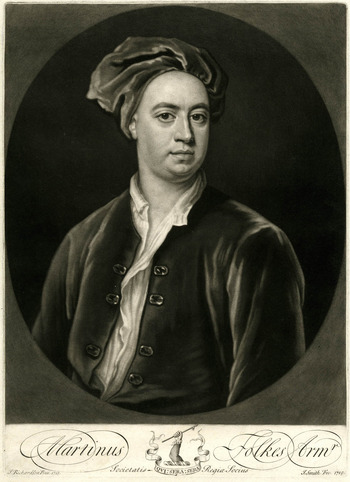
Qui sera sera, ‘Who or What will be, will be’ is the opening phrase that Martin Folkes (1690–1754) chose as his personal motto and inscribed in his travel diaries of his Grand Tour from 24 March 1733, returning to London on 3 September 1735.Footnote 1 Folkes was Newton's protégé, an English antiquary, mathematician, numismatist and astronomer who, in addition to becoming simultaneously president of the Royal Society and of the Society of Antiquaries, was a member of the Spalding Gentlemen's Society and the Académie royale des sciences (Figure 1). Folkes became a friend of Voltaire, a participant in French salon culture and a correspondent of one of its doyennes, Madame Geoffrin.Footnote 2 Folkes was a governor of Coram's Foundling Hospital, a patron of Hogarth and the first member of the gentry to marry a London actress, one Lucretia Bradshaw; antiquary William Stukeley related that Folkes's mother Dorothy Hovell ‘grieved at it so much that she threw her self out of a window and broke her arm’.Footnote 3 Then again, Lucretia's debut play in the London Theatre was entitled The Royal Mischief, and Dorothy was perhaps justifiably concerned with the family's reputation, as her older sister Etheldreda had married William Wake, who later became Archbishop of Canterbury. Folkes was also deputy master of the Premier Grand Masonic Lodge of England and active in the short-lived Egyptian Society. He was possibly the best-connected and most versatile natural philosopher and antiquary of his age, an epitome of Enlightenment sociability, yet he is today a surprisingly neglected figure. His was an intellectually vibrant world in which the long shadow of Newton – Folkes's patron and hero – has tended to obscure those who followed him.
The mezzotint copy by John Smith of Folkes's portrait by Jonathan Richardson the Elder. Folkes's personal motto is inscribed on the bottom. British Museum, image: 1902,1011.4540AN121298001, Creative Commons BY-NC-SA 4.0 license.

Folkes recorded the Italian leg of his peregrination from Padua to Rome in his journal.Footnote 4 His travel diary, like Folkes himself, is little known in the historical literature, and, when it is assessed, it is to provide examples of historical topography or more general commentary of the import of the Grand Tour, or analysed with regard to Folkes's interests in coins and medals.Footnote 5
According to Stukeley, Folkes went on his journey because he was ‘baffled’ by his losing the election for the Royal Society presidency to Sir Hans Sloane. And, indeed, Folkes's ‘vocal supporter and right-hand man, James Jurin … lost also his hard-won Secretaryship’, handing over the society's papers to his successor, William Rutty, on 7 December 1727.Footnote 6 Stukeley's opinion was, however, partisan. He was hostile to Folkes's irreligion, claiming that Folkes was ‘an errant infidel’ who ‘profess[ed] himself a godfather to all monkeys’.Footnote 7 Folkes certainly entertained materialist philosophies before and after his tour of Italy; the Mancunian poet John Byrom recorded their conversation when at Folkes's house on Queen's Square for dinner on 26 February 1725/6, to see his ‘books and rarities’. They talked with the surgeon William Cheseldon and the watchmaker George Graham about Mrs Folkes's very comical pet monkey: they ‘disputed whether he had reason or no’, concluding that ‘he was a man without reason’.Footnote 8
Folkes entertained other puzzles from nature that gnawed at assumptions of God-given human exceptionalism. In later correspondence with microscopist Henry Baker, Folkes's discussions centred around whether a parasitic twin could be ensouled.Footnote 9 Their discussion was a result of Folkes's second tour of France in May 1739, where he met Madame Geoffrin, hostess of an illustrious Parisian salon, and where he was exposed to Abraham Trembley's work on the regeneration of hydra or polyps. As Ratcliff has eruditely shown, work on polyps challenged the Aristotelian Chain of Being, which had dominated understanding of the natural world and raised questions of vitalism, materialism and deism.Footnote 10 For instance, did the polyp have a soul, and could that soul be split into two? Was the ability of the polyp to regenerate support for preformation, the idea that all living things pre-existed as invisible germs? Folkes and Baker asked similar questions about parasitic twins.
Stukeley's ire was also probably raised because, when younger, he had been exposed to heterodox notions from Folkes, who was then his close friend. Like Folkes, Stukeley was an active Freemason when it was newly fashionable after the appointment of the Duke of Montagu as grand master in 1721. Stukeley became a Mason of the Salutation Tavern that year; by 1729, Stukeley admitted to Samuel Dale that he was ‘in a manner voyd of religion’.Footnote 11 Stukeley's redemption and subsequent taking of holy orders as a priest in the Church of England in 1729 may have made him uncomfortable about his previous indiscretions.Footnote 12
More practically, Folkes's Grand Tour came five years after his loss of the Royal Society election; in the interim, he had been appointed vice president by Sloane on 8 February 1733, so, contrary to Stukeley's assertion, there must have been another reason for his journey. Charles Weld in his 1848 History of the Royal Society claimed that the journey was so that Folkes could ‘improve himself in classical antiquity’.Footnote 13 Indeed, Charles Lennox, the 2nd Duke of Richmond (1701–1750), provided Folkes with a number of rather blustery letters of introduction, one to Alessandro Albani, the leading collector of antiquities in Rome, whom Lennox described as ‘a very odd Curr, Ignorant enough, & proud as Hell’; Nevertheless, Lennox added he had ‘the finest library, one of them, in Europe, & without exception one of the very best collection of bustos, in the World. You must flatter him upon his learning’.Footnote 14 Lennox also wrote a letter of introduction for Folkes to Teresa Grillo Pamphili (d. 1763), the Genoese poet who led an important literary salon (the Arcadia) in Rome. He referred to her rather uncharitably as the ‘Ugliest Bitch, in the World, Damn'd proud also, & stark staring mad, butt a Develish deal of Witt, some knowledge, & altogether Une Maitresse ferme, sans un brin de religion [a resolute woman without a touch of religion]’.Footnote 15
In a more serious vein, James Jurin wrote a letter for Folkes to Giovanni Poleni, the Italian natural philosopher and expert in architecture and classical antiquity (who had also been engaged in the vis viva dispute with Samuel Clarke and other Newtonians). Jurin stressed that
Folkes was an excellent gentleman of high achievement in every kind of literature, especially physics and mathematics; whom Newton valued so highly that, nor content to consider him worthy of his own close friendship, he voluntarily chose him to carry out the duties of Vice-President at the formal meetings of the Society in his own absence.Footnote 16
Folkes subsequently met Poleni in Venice on 18 July 1733, on which occasion he discussed meteorology and the state of learning in England.Footnote 17
Intellectual and aesthetic development was thus part of the reason for Folkes's tour, just as before him it had been for natural philosopher George Berkeley, who, in his case, cultivated a taste for Greek Doric architecture. In 1713, Berkeley wrote to Sir John Percival stating that he was interested in the ‘agreeable effects’ of such buildings on his eyes, an interesting remark given that Berkeley had recently published his New Theory of Vision (1709), a subjectivist theory of perception.Footnote 18
Like Berkeley, Folkes melded aesthetic and natural-philosophical concerns, his tour one of scientific peregrination, or ‘science on the move’, that was prevalent from 1650 to 1750.Footnote 19 The origins of the scientific peregrination were in the ‘peregrinatio academia of early modern aspiring scholars’; another predecessor was the peregrinatio medica, as medicine was the subject for which foreign travel was most valuable.Footnote 20 Medical students brought back new techniques, knowledge and materia medica to their homeland; in the 1670s, Thomas Bartholin, when recalling his own peregrinatio medica, noted, ‘Today there are many travellers; indeed, it seems as if the whole of Europe is on the move’.Footnote 21 Young medical students would travel abroad not only to earn professional credentials, but also to attain accomplishments, becoming gentlemen of quality and adding polish to their English education. But by the time of Folkes's journey, I would argue, scientific tours apart from the reasons of politesse and medical pedagogy had long developed as a separate enterprise. Previous works such as botanist John Ray's later published travelogue of his journey on the Continent (editions in 1693 and 1738) reinforced the image of ‘diligent natural philosophers, engaged in the pursuit of activities conducive to the public [and scientific] good’.Footnote 22 In 1698, physician and naturalist Martin Lister (1639–1712) wrote a guidebook of his Journey to Paris, intending it specifically to appeal to fellow natural philosophers.Footnote 23 Lister directed the reader to his interests in natural history using his mature judgement and own eyes, offering ‘clean Matter of Fact, and some short notes of an unprejudiced Observer’.Footnote 24
Although not a doctor or a naturalist like Lister or Ray, Folkes had similar sentiments reflecting his specialism in mathematics and his interest in architectural measurement; his journey was designed to answer particular questions of natural philosophy. His diary reflected ‘antiquarian science’, a form of peregrination in which he used metrology to understand not only the aesthetics but also the engineering principles of antique buildings and artefacts, as well as their context and place in the Italian landscape. Although Folkes followed in the tradition of past natural philosophers such as John Greaves, the Savilian Professor of Astronomy who desired to standardize and synchronize the weights and measures of all ancient and modern nations, we will see in the first part of the paper that Folkes also wished to verify Greaves's measurements of the Roman foot as an expression of his status as a Freemason and in response to interests promoted within the Society of Antiquaries.Footnote 25 Using Folkes's diary, his account book of his journey in the Norwich archives and accompanying correspondence with other natural philosophers such as Francesco Algarotti (1712–1764), Anders Celsius (1701–1744) and Abbé Antonio Schinella Conti (1667–1749), we will then determine to what extent this journey established Folkes's reputation as an international broker of Newtonianism, particularly in optics. We will then analyse Folkes's subsequent application of his mentor Newton's natural philosophy to geodesy, the ultimate form of metrology. Finally, we will determine to what extent Folkes was successful in demonstrating the overall primacy of English scientific instrumentation to Italian virtuosi. His journey was an expression of the motto scrawled in his diary, symbolic of who and what he would become.
Folkes, his diary, Freemasonry and metrology
In her discussion of early eighteenth-century arguments between materialists and anti-materialists, and of the formal foundation of modern Freemasonry with the establishment of the Grand Lodge in London in 1717, Margaret Jacob has suggested that ‘tolerant-minded Newtonians … invented a new form of ritual to worship the Grand Architect of the Universe’; Jacobs argued, in short, that Freemasonry was an innovation sprung ‘from Newtonian inspiration’.Footnote 26 Garry Trompf agreed, writing, ‘The more one ponders Newton's axial principles … and then one relates this covert, Talmudically-inspired unorthodoxy to his fascination for the mysterious proportions of the Solomonic temple, the more one can sense the milieu of early Freemasonry.’Footnote 27 Folkes was not only a ‘prestigious figure in the scientific and antiquarian communities’ in Britain and the Continent, but also a visible ambassador of Freemasonry's ideals of free thought and sociability, and of Newtonian scientific principles. It was rumoured, after Folkes returned from Italy, that he was the author of the scurrilous Relation Apologique (1738) for Freemasonry which applied Newtonian principles to government and communicated Masonry as a primarily scientific institution.Footnote 28
Folkes was a follower of speculative Freemasonry, a non-sectarian group of freethinkers to which many fellows of the Society of Antiquaries and the Royal Society belonged; forty-five percent of the fellows of the Royal Society were Masons in the 1720s.Footnote 29 Between 1719 and 1742, he proposed eleven fellow Masons of the Bedford Head and Maid's Head Lodge in Norfolk (which he founded) as fellows of the Royal Society.Footnote 30 Folkes's friend and patron, Charles Lennox, was grand master of the Bedford Head Lodge (installed in 1724/5), and a fellow of the Royal Society. Folkes also provided Lennox with antiquarian documents about Freemasonry; Lennox wrote to Folkes in 1725 apologizing for missing the Masonic feast day of St John's, ‘guilty of such an omission that nobody less than the Deputy Grand Master of Masonry can make up for me’. He then proceeded, ‘I thanke you for the Old Record you sent me, it is really very curious, & a certain proof at least, of our antiquity, to the unbelievers’.Footnote 31
Although the precise line that divided deism, natural religion and the revealed religion of the orthodox Christian was subtle in this period, Folkes's travel diary to Italy confirmed his freethinking beliefs. He noted that he considered Catholicism and Protestantism ‘as only a tool of the state to keep the vulgar in awe’, noting that Venetian intellectuals were ‘fond of any sort of freethinking book, and with what eagerness they speak on the subject and enquire after the ways of thinking of a nation more used to liberty of thought than themselves’.Footnote 32 That said, Folkes did go on to find them wanting in the knowledge of religion:
The bible is in no ways known and I have met with stupendous instances of mistakes about the things contained in it … and it has been with the greatest surprise several have heard me speak of the measure of learning of all sorts that very antient … book contains.Footnote 33
Martin Folkes considered the Bible an authoritative historical source (one of many), and even helped Thomas Pellet edit a manuscript of Newton's Biblical Chronology of Ancient Kingdoms, ‘a truncated version of Newton's more radical manuscript’, as historian James Force has called it.Footnote 34 Newton used data about the precession of the equinoxes to formulate his new chronology, and Folkes's astronomical expertise was useful in this regard. Folkes, however, unlike Newton, did not identify with the use of astronomical data to vindicate religious truths, admitting to his friend John Byrom that he was ‘a heretic about the book of Daniel’.Footnote 35 Nor was Folkes a believer in natural theology, also admitting to Byrom that he thought William Derham's Astro –Theology, a corollary to the Boyle Lectures that used natural history and teleology to promote and prove a natural theology, ‘a silly book’.Footnote 36 It seemed an appropriate comment for someone with such a resolutely non-teleological personal motto.
As a Freemason, Folkes was, however, interested in using biblical evidence in other ways. He wished to clarify the scripturally ambiguous dimensions of the sacred cubit of the Hebrews used to build Solomon's Temple, and to assess the dimensions of the Roman foot.Footnote 37 Folkes took as his motto in the album amicorum (friendship book) for the Egyptian Society ‘omnia in mensura et numero et pondere diposuisti’, or ‘thou has ordered all things in measure and number and weight (Wisdom, 11:21)’. Folkes's interests reflected the current intellectual milieu, as Masonry emphasized a mathematical deity that, in Elliot and Daniels's phrase, ‘accorded well with the Newtonian conception of the universe, with a grand mathematician or architect at the centre’.Footnote 38 Newton had previously written a dissertation upon the sacred cubit which would be republished in 1737, along with the works of John Greaves by antiquary Thomas Birch, who wrote the History of the Royal Society (1757). Moreover, as Haycock noted, in 1723, Bernard Lamy published his Apparatus Biblicus with engravings of the Tabernacle and Temple, and in 1726 William Whiston advertised ‘a small, but curious Course of Lectures’ on astronomical subjects which also included ‘Sacred Architecture past’, as well as ‘Sacred Architecture Future’.Footnote 39 Freemasonry was taking off in London at this time, with prominent Newtonians playing an active role.
Therefore it is not surprising that one of Folkes's first tasks when he arrived in Venice was to measure the height of the Campanile by its shadow, concluding that it was 140 feet high. He then measured again to confirm his conclusions; to do this, Folkes figured out the conversion factor between Venetian palms and English feet. He then proceeded to measure the Rialto bridge in Venice to confirm his determination and comparison of past standards of measurement. Folkes noted on 8 July 1733 that, ‘writers not agreeing perfectly with one another’ about the Rialto's dimensions, he decided to measure it himself using ‘packthread’ and a plumb bob; he made a sketch in his diary of the bridge recording his observations.Footnote 40 He carefully compared his own measures of the Rialto to those of it taken by Francesco Sansovino, the son of Jacopo Sansovino (1486–1570). Jacopo was the proto or chief architect of Venice who was responsible for the rebuilding of the Fabbriche Nuove di Rialto complex (seat of the magistrates in charge of customs and duty).Footnote 41 Disturbed that his measurements of the bridge were different from Sansovino's, he wrote,
I would readily think may be partly owing to defect in my own measure, partly perhaps an inaccuracy in the building the bridg[e] itself to the intended model, and perhaps again in the not having to perfect these proportions between the English and Venetian foot.Footnote 42
After making some enquiries after the original standard of the Venetian measures, which he found to be fruitless, he ‘took some measures of St Geminiano's Church in order to have made something out by them’. However, upon comparing the measures he had taken, Folkes found the church ‘was not built by the Venetian foot but by the Roman Architectonick palm whose length comes out very exactly by it’.Footnote 43
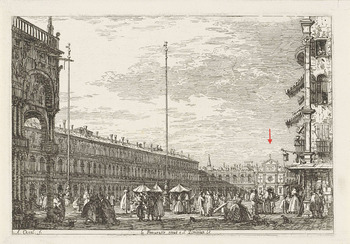
It was a perceptive comment. St Geminiano was in the Piazza San Marco, part of the complete remodelling of the piazza and surrounding buildings by Sansovino in Renaissance Venice in the classical style; as historian Fiona Kisby has noted, the ‘effect was to superimpose an evocation of ancient Rome on the existing Byzantine elements’.Footnote 44 St Geminiano, directly across the piazza from San Marco, was a focal point of the architectural complex designed by Jacopo Sansovino in Vitruvian proportion to evoke the ancient Roman forum (Figure 2). Hence Folkes suspected and proved that Sansovino used Roman measurements to create his building, particularly as Vitruvius in his third book of De Architectura gave a thorough description of the Roman foot or pes and palms (one-quarter of the foot).Footnote 45 In this manner, principles of measure and geometry would ensure harmony and aesthetic appeal in the building's design. In other words, Folkes was investigating architectural metrology to provide what we would term archaeological information about architects and builders of Renaissance Venice, and, as we will see, ancient Rome.
Piazza San Marco, etching by Canaletto, 1710–1758, Rijksmuseum, Amsterdam, public domain, object number RP-P-OB-35.577. St Geminiano, indicated by the arrow, was the focal point of the piazza which evoked the Roman past.

Queries about ancient metrology began in 1573 with the publication of De Mensuris et ponderibus Romanis et Graecis by Lucas Paetus. That publication spawned an active debate about the exact length of the pes. Dissatisfied with inconsistencies in textual evidence, John Greaves, professor of astronomy at Oxford, visited Rome in 1639, to ‘examine as many ancient measures, and monuments, in Italy, and other parts, as it was possible’, and to compare these ‘with as many Standards, and Originals, as I procure the sight of’.Footnote 46 He thus measured brass measuring rods in Roman ruins, and the foot measures on the tomb of Titus Statilius Aper and the statue of Cossutius. Greaves then noted with some pleasure that these foot measures exactly corresponded with the distance between the milestones on the Appian Way.Footnote 47 He then made comparisons between the Roman foot and the iron standard of the English foot in the London Guildhall and published his findings on Discourse on the Romane foot and denarius in 1647, concluding that the Cossutian foot was the ‘true’ Roman pes. Greaves also claimed that he thought he could find a relationship between the pes and the sacred cubit, something which Newton also noted in his own treatise on the cubit.
Folkes followed the same methodology as Greaves in his own travels. In 1736, Folkes identified the Root Canonical Greek foot as 1.0057142 times the English measure, and the Roman pes as 0.966 of the English foot, noting them as being engraved on a standards stone tablet at the Roman Capitol that might have been the actual record of the pes monetalis. His paper about the stone was subsequently published in the Philosophical Transactions of the Royal Society; Folkes recorded ‘setting the point of my Compasses’ in the lines in the stone that represented the measures, and also noted his ‘chief Attention was given to the Roman foot, as of greater Consequence than the other measures’.Footnote 48
In making his conclusion, Folkes considered previous measurements made by Fabretti, but recorded in his diary that he also measured the height of the Trajan Pillar ‘using an exact two-foot rule brought from London’. Folkes was particularly interested in the column because the height of its shaft from the plinth of the base to the abacus of the column was said to measure exactly one hundred Roman feet, a columna centenaria.Footnote 49 The column was thus ideal to determine the dimensions of the Roman foot.Footnote 50 Now, of course, studies of metrology and measurement surveys of ancient buildings constitute some of the most important work in archaeology.Footnote 51 He found the column, ‘from the Ground to the Top of the Cimatium of the Capitol’, to be ‘115 feet 10 inches 5/8’; this height, divided by 120, gave nearly 966 for the quotient, thus confirming that the Roman foot was 0.966 of an English foot and used frequently in Roman architecture. Ironically, Folkes's exactitude of measurement has not been borne out in modern studies as there appear to be some slight variations in the Roman pes. Historians Soren and Soren attribute these variations to ‘the Augustan decree to standardise Roman metrology … most easily implemented by the transport of replicas of the pes monetalis at Rome to the colonies’.Footnote 52
During his tour, Folkes also discussed his work on Trajan's Column in more depth with the Venetian Francesco Algarotti. Folkes was interested in measuring the figures on the column to assess and compare the Roman artist's use of visual perspective as opposed to the use of perspective in modern artistic practice.Footnote 53 Their conversation comparing ancient and modern techniques was an extension of the literary quarrel of the ‘ancients and moderns’ that raged amongst French and English intellectuals in the seventeenth and early eighteenth centures. Intellectuals who sided with the ‘ancients’ argued that antique literature offered the sole models for literary excellence; the ‘moderns’, on the other hand, challenged the supposed supremacy of the classical writers. This scholarly debate was extended to assessing technological and aesthetic achievement.Footnote 54 Folkes was particularly interested in discussing with Algarotti to what extent measurement could answer questions about the relative merits of ancient technology and artistic production.
Algarotti had associated himself with ‘radical conversazioni and early masonic lodges’ at some point during his tours of Padua and the Veneto, and subsequently in Florence and Rome of the early 1730s, where he met Folkes.Footnote 55 Algarotti was best known for his popularization of Newton's precepts in his Il Newtonianismo per le dame, but he also wrote a number of letters and essays on aesthetics, including one in which he analysed the helical frieze on Trajan's Column. In a letter to Jean Paolucci, Algarotti recalled that he speculated with Folkes as to whether the bas relief on Trajan’s Column gave them any reason to presume that the ancients did not have any knowledge of the ‘proportions of perspective’.Footnote 56 Folkes noted in an article he later published about the column that
it has been said by some, that the bas-reliefs on the shaft of this pillar increase in size upwards, in order to appear of the same size below; but this is not true; and I had an opportunity of satisfying myself from the plaister-cast of the whole pillar, kept at the French academy of painting and sculpture in Rome, where … I measured several of the fairest figures.Footnote 57
It appeared from Folkes's observations of the column that the Roman artists who carved frieze on the column did not use traditional perspectival techniques in their portrayal of the Dacian Wars.
Algarotti also recalled discussing with Folkes the arguments of Charles Perrault, who rose in the French Academy to champion modern authors in the quarrel between the ancients and moderns. Folkes and Algarotti noted that Perrault was of the opinion that while the ancients excelled in sculpture (a genre that in Perrault's eyes demanded little ‘reflection’ and abstract thought), bas-reliefs and painting required a deeper understanding of perspective and spatial relations which the ancients did not have. Perrault thought his opinion was supported by the ‘casts of the Trajan Column’ he saw in Paris, which to him were naive in their understanding of perspective space.Footnote 58 However, Folkes and Algarotti were sceptical about Perrault's claim, Algarotti writing that ‘the defects which are believed to been seen in the ancient bas-reliefs, and especially in the Trajan Column, prove nothing against the knowledge of the ancients in regard to perspective’. Rather, Algarotti and Folkes realized the artists who carved the column used fewer emblematic forms to represent the events of the war rather than hundreds of individual participants; perspectival tricks could not assist the artist in highlighting ‘certain figures, groups, or parts of the composition’. Indeed, the composition in the frieze is characterized by diagonals so that the ‘figure of the emperor is emphasized along with the direction of gazes and actions of the figures surrounding him’.Footnote 59 To make the figures and iconography intelligible to a spectator who was at a great distance, the composition required a multiperspectival approach and simple converging and diverging orthogonals were not appropriate. Trajan's Column was in fact designed so that viewers could comprehend the story of the Dacian Wars from bottom to top standing in one place rather than circling the column twenty-three times as the carved spiral frieze does. A viewer could see key events of the war from two main vantage points.Footnote 60 Folkes and Algarotti thus concluded that far from being naive, the designer of the column's frieze was more like a great captain employing a stratagem of sophistication.
Folkes, Venice and Newtonianism
Folkes's conversation with Algarotti reflected his pervasive interest in optics, optical illusion and perception, topics which came to the fore when he was in Venice. Although the Venetians were aware of the theories of Newtonian optics, in the 1730s there was a degree of scepticism among natural philosophers there about the validity of the refrangibility of light in the visible spectrum. As a result, when he was in the Veneto, Folkes cultivated fellow mathematicians and astronomers to gain adherents of the Newtonian research programme in the Royal Society.
Before he left for his journey and during his time on the Council of the Royal Society, Folkes was exposed to a constant stream of accounts ‘of the present state of Learning and Experimental Philosophy in Italy’, from the English Jacobite Thomas Dereham, the Royal Society's contact in Florence. Dereham was the translator into Italian of Astro-Theology, a five-volume set of the Philosophical Transactions of the Royal Society (published by Felice Mosca between 1729 and 1734), as well as a work by Newtonian physician George Cheyne.Footnote 61 Dereham relied on luminaries such as Eustachio Manfredi, the chair of mathematics in Bologna, discoverer of a comet and asteroid, and observer of the transit of Mercury, for natural-philosophical news to pass on to the Royal Society; Manfredi was a correspondent of Algarotti and also passed along news of Venetian natural philosophy.Footnote 62
Venice, in particular, was also a favourite haunt of Newtonian mathematicians and their intellectual circles, and Folkes went there to convince their virtuosi of the truth of Newton's work in optics. Twenty years previously Newtonians had fought a campaign against Italian supporters of Leibniz in the calculus dispute. In Padua and Venice, after 1710, Jakob Hermann and Nicolas Bernoulli were ‘promoters of a fierce campaign against Newton's methods of fluxions in the calculus’.Footnote 63 Hermann had taught differential and integral calculus using Leibniz's method at Padua from 1707 to 1713. However, Newton had friends as well, and hoped to diminish the prestige of Leibniz through the offices of Abbé Antonio Schinella Conti, who was born and educated in the Veneto but spent several years abroad before returning to Venice in 1726. Conti was in London between 1715 and 1718 to become part of Newton's intellectual circle, where he met Folkes. In his travel diary of 1733 Folkes noted, ‘I had known the Abbé very well in England above 16 years ago, I had a very agreeable conversation with him as he is a Gentleman of great knowledg and politeness, and indeed the most knowing man of all the Italians of his side the country’.Footnote 64 Conti would also serve as a go-between for Leibniz and Newton in the calculus affair, and, through Conti's offices, Newton thought he could lessen Leibniz's prestige in Italy, which had grown during the calculus dispute.Footnote 65
Folkes had also been tutored by Abraham De Moivre (1667–1754), his correspondence showing that he and Edward Montagu dined with their former teacher on de Moivre's eightieth birthday in 1747.Footnote 66 De Moivre would subsequently be an intermediary in a mathematical dispute between Newton and Bernoulli, so Folkes was intimately au fait with the history of the Newton Wars.
Before his journey, Folkes had attended a series of Royal Society meetings in which the society responded to the refutation of Newton's optical work by Giovanni Rizzetti (1675–1751), a Paduan nobleman who belonged to the circle of the mathematician Jacopo Riccati (1676–1754) of Castlefranco Veneto. The Royal Society journal book for 27 June 1728 reported that the society received Rizzetti's De Luminis Affectionibus Specimen Physico Mathematicum; the tract was referred ‘to Dr Desaguliers which he promised to make an extract of’.Footnote 67 In De Luminis, Rizzetti discussed refrangibility, the degree to which light refracts passing from one medium into another, or, as Newton wrote, a ‘predisposition, which every particular Ray hath to suffer a particular degree of Refraction’.Footnote 68 In particular, Rizzetti claimed he could not replicate the experiments in Book 1 of the Opticks, in which Newton used a candle to illuminate a two-coloured card with black silk threads wrapped around it, thus supposedly demonstrating the principle of chromatic aberration.Footnote 69
Newton had placed a glass lens at a distance of six feet from the card, and used it to project the light coming from the illuminated card onto a piece of white paper which was at the same distance from the lens on the other side. He moved the piece of white paper back and forth, taking note where and when the red and blue parts of the image were most distinct. The black threads indicated distinctness of the image (when the lines created by the thread were sharpest). Newton found it ‘impossible to focus the image of black silk-thread lines upon a blue background at the same distance as when the same lines are placed against a red background; the distance between the two positions of sharp focus was as much as one and half inches’.Footnote 70 In other words, to get a distinct red image, the paper had to be held 1.5 inches further away than to obtain a distinct blue image. Newton thus concluded that the blue light was refracted more by the lens than the red, and was more refrangible.Footnote 71
Red and blue light were not strictly homogeneous, and so not all the blue light was more refrangible than all the red light, something Newton admitted. However, he indicated that this experiment demonstrated a general effect: ‘But these Rays, in proportion to the whole Light, are but few, and serve to diminish the Event of the Experiment, but are not able to destroy it’.Footnote 72 Newton thus described an ideal experiment.
The inability to create these ideal conditions was the point upon which Rizzetti had seized. The popular lecturer John Theophilus Desaguliers (1683–1744) refuted Rizzetti's claims in a series of optical experiments performed at the Royal Society in 1728 in response to Rizzetti's De Luminis Affectionibus. In his article published in Philosophical Transactions, Desaguliers noted that ‘we hear indeed in a letter from Sir Thomas Dereham to Sir Hans Sloane, President of the Royal Society, that now Signior Rizzetti alledges, that he was deceived in his experiments by reason of the badness of his prisms which he had from Venice’.Footnote 73 In other words, Rizzetti claimed he did not have ideal experimental conditions due to the quality of his prisms.
As Simon Schaffer has shown in his essay ‘Glass works’, the quality of the prisms was important; Francesco Algarotti's attempts in Bologna in 1726 to replicate the experimentum crucis were described by Rizzetti as failures since he could not isolate a single red ray of light; Algarotti eventually realized that his prisms were defective, and he had success at replicating the experimentum crucis when he tried again with some top-quality English prisms.Footnote 74 Schaffer shows us how and why acceptance or denial of the specific experimental apparatus became a flashpoint in disputes over knowledge and method; we see the beginnings of the establishment of standards for professional instrumentation, or what has been termed the sociology of calibration.
Schaffer did not analyse as much the debate over Newton's Opticks in Italy, which continued long after Desaguliers's 1728 demonstrations in the Royal Society.Footnote 75 Long after Isaac Newton's fame was recognized, Venetian natural philosophers had an attitude of ‘critical acceptance, if not open aversion’, towards Newtonianism.Footnote 76 Part of the reason for Folkes's travels in Venice was so that he could serve in Desaguliers's stead as a Newtonian demonstrator, and the quality of Folkes's prisms was still the focus of inquiry for Venetian intellectuals. It seemed particularly important that Folkes prove the truth of Newtonian optics in the city whose glass had been the ‘standard against which other glass was to be compared’.Footnote 77 Folkes's status as a protégé of Newton and a vice president of the Royal Society (his office conferred by Sloane six weeks before his travels), and his fluency in Italian and French, were also helpful assets.
On 9 July 1733, Folkes received a letter from Abbé Conti, who began, ‘I beg you to bring these Italian manners to an end and to treat me as a friend, that is the first favour I am asking you’.Footnote 78 Conti related that his colleague, Giovan Bernardo Pisenti (d. 1742), having heard of the success of past demonstrations of Newtonian optics, requested ‘to see demonstrated geometrically the order of the colours of the image’.Footnote 79 Pisenti was a Somasco cleric educated by the Jesuits who also studied with Eustachio Manfredi in Bologna, and he himself served as a personal tutor to Girolamo Ascanio Giustiniani; Folkes's diary shows that he spent much of his time in Venice at the Giustiniani Palace with Girolamo's family, so it is likely that he met Pisenti there.Footnote 80 Pisenti was also the translator of George Berkeley's An Essay towards a New Theory of Vision (1709) into Italian, and dedicated his translation to Berkeley's friend Sir John Percival, with whom he was also acquainted.Footnote 81 In scholar Antonella Barzazi's opinion, the initiative to publish Berkeley's work was probably born in the wake of the Newtonian optics controversy aroused in the Venetian world by the attacks of Rizzetti; Berkeley refuted an account of distance vision of Malebranche and Descartes which required tacit geometrical calculations, that we perceive space by lines and angles.
Malebranche and Descartes argued that distance was judged by the geometry of angles between the eyes and the perceived object, or via the angles of light rays that fall upon the eye.Footnote 82 One thus judges distances by the optic axes of the eyes which form an angle at the object; whether that angle is great or small, we judge if the object is far or near. Berkeley rejected those accounts and was quite negative about using Euclidean geometry of the visual world as the sole basis for visual perception. Berkeley argued against the classical scholars of optics by claiming that space is perceived by experience. As Berkeley later stated in his Philosophical Commentaries, ‘The common Errour of the Opticians, that we judge of Distance by Angles strengthens men in their prejudice that they see things without and distant from their mind’.Footnote 83 In Berkeley's view, the visual perception of distance was explained by the association of ideas of both sight and touch, and this associative approach challenged appeals to geometric calculation that profess to explain completely monocular vision and the moon illusion, ‘anomalies that had plagued the geometric account’.Footnote 84
Visual perception of distance was also of great interest to Folkes. We recall his conversations with Algarotti about the friezes on Trajan's Column. Folkes also gave advice to Robert Smith FRS, Plumian Professor of Astronomy at Cambridge University, in his A Compleat System of Opticks in Four Books (1738). Cantor has judged that the work was the most ‘famous book dealing with the subject’ after Newton's own Opticks (1704).Footnote 85 Smith acknowledged Folkes for his ‘curious remarks’ on fallacies in vision, applying optics to explain phenomena such as ‘the sun's apparent distance, on the apparent figure of the sky, on the apparent curvity of the sides of long walks and ploughed lands, and the changes of curvity by the observer's motion’.Footnote 86
Folkes had also spoken to Algarotti about Molyneux's problem in some depth.Footnote 87 The Irish natural philosopher William Molyneux (1656–1698) had asked John Locke whether, if a blind person could suddenly see, he or she would be able to recognize by sight an object's shape they previously only knew by touch. Presented with a globe and a cube, could such a person determine which was which just by looking? An affirmative answer meant that one believed in a rationalist and innate conception of space common to touch and sight. A negative answer indicated an empiricist view, that this was a relationship that we learn only through experience. Locke responded in his Essay Concerning Human Understanding that the formerly blind person would not be able to say with certainty ‘which was the globe, which the cube … though he could unerringly name them by his touch’; the connection between the senses was learned.Footnote 88 Berkeley also offered a negative response, that a perception of distance was an ‘act of judgment grounded on experience’.Footnote 89
However, well before Diderot's famous essay Letter on the Blind (1749), Folkes spoke to Algarotti about Molyneux's problem in reference to the case of Nicholas Saunderson (1682–1739), the blind Lucasian Professor at Cambridge and fervent Newtonian who lost his sight at twelve months from smallpox and who could purportedly judge the size of a room and his distance from the wall by sound. Saunderson made Newton's Opticks the basis of several lectures that he made at Cambridge, including some on the theory of vision.Footnote 90 Folkes was a close colleague of Saunderson and commissioned a painting of him. Saunderson affirmed he could have distinguished the objects with his sight restored, namely because he innately understood the mathematical definition of a sphere and cube and could identify them from the number of vertices they would present to him, as well as the shape of their cast shadows. This was an argument drawn out of Saunderson's Elements of Algebra, in which he proved that the cube could be divided into six equal pyramids having their vertices at the centre of the cube and the six faces as their bases; ‘this is used for an elegant proof that a pyramid is one-third of a prism having the same base and height’.Footnote 91 Folkes, as a Newtonian mathematician, believed there was an innate geometrical quality to vision and was a very supportive subscriber to Saunderson's Elements of Algebra, putting money in for eight books, ‘4 Royal and 4 common paper’.Footnote 92
In order to create a demonstration to counter directly Rizzetti's disavowal of Newtonian optics and tacitly Berkeley's caution about using optics as the sole means of explaining vision, Conti wrote to Folkes for advice. Conti indicated to Folkes that he made a figure ‘to show visibly the different relative refrangibility’, showing ‘the different perpendiculars with which are made the angles of the refraction of the exiting rays; these angles are as small as the others that are made with the internal perpendicular are large’.Footnote 93 He then indicated to Folkes,
You would do me a favour if you told me whether you imagine that [refrangibility] in the same way. The obscurity of Mr Newton's book consists in failing to give the Theory of the refractions of the rays exiting a prism, that is what he had to start with in order to remove any doubt.Footnote 94
Conti was right. Newton had only conjectured in the Opticks about these issues rather sparsely; for instance, although Newton analogized about the behaviour of light and matter, he really did not even assert the materiality of light. As Geoffrey Cantor has shown, later popularizers of Newton, such as Desaguliers, Smith and later Willem Jacob ’s Gravesande (1688–1742), interpreted Newton's Opticks as if, in Cantor's phrase, it were ‘an appendix to the Principia’, in which forces ‘were employed to explain all those phenomena in which light deviated from its natural rectilinear path’.Footnote 95 In this form of projectile optics, light was postulated to travel in a straight line with finite velocity, and refraction was explained by the influence of attractive forces. One could say, for instance, that refractive dispersion was due to a particulate model of light, the rays or bodies being of different sizes, the violet-making rays the smallest and the red-making ones the largest and heaviest.Footnote 96
Conti then went on to mention the work of Paris lawyer and Anglophile Nicolas Gauger, who in 1727 produced a long account defending Newtonian optics. In July 1727, Gauger had written Conti a twenty-page letter which was publicly printed, addressing the danger of Rizzetti's attacks on the Newtonian system, with particular mention of the two-colour-card experiment.Footnote 97 But five years later, Conti lamented to Folkes that ‘although Mr Gauger has given it quite amply … I don't know if his book is still being printed’. He went on, ‘It is certain that if the ray was not divided into several threads, so they made different angles, you would see the image differently from how we see it … I am waiting for your decisions on this’.Footnote 98 But such pedagogically clear, if sometimes superficial, explanations by Newtonian pedagogues had not reached or convinced all Venetian ears; hence Conti's plea to Folkes for a proper diagram and clarification of refrangibility.
Shortly after this exchange, on 5 August 1733, Folkes met Rizzetti himself, recording that Father Giovanni Crivelli ‘calld on me with Sigr. Rizzetti author of a book which he gave me of the nature of light and colours against Sir Isaac Newton’.Footnote 99 Crivelli had written Elementi de fisica in 1731, a textbook which was a reinterpretation of recent discoveries in natural philosophy within an Aristotelian framework. Historian Vincenzo Ferrone considered Crivelli's work as reflecting the attitude of a large segment of Venetian society towards Newton's works.Footnote 100 While the first volume offered the most complete, if dispassionate, explanation of Newtonian gravity that has appeared in Italy (for example, he rejects Newton's concept of a vacuum in space), the explanation of the Opticks is equally neutral. Crivelli presented both Newtonian optics and the objections of Rizzetti in a manner that subtlely neutralized them, doing the same thing in his coverage of astronomy, noncommittally describing Copernican, Tychonic and Ptolemaic hypotheses with little comment.Footnote 101 Although one receives the impression from reading his manual that there was wide-ranging knowledge of Newtonian theory in the Veneto, one also receives the impression that there was a rejection of any sort of Newtonian orthodoxy.Footnote 102 In this light, Crivelli's visit with the antagonistic Rizzetti in tow may be interpreted as a challenge to the Newtonian Folkes.
After Rizzetti's visit and a short period of illness (Folkes and his wife contracted a kind of heat rash termed scotture), Folkes met Conti on 23 July. The latter had just come to town and upon hearing about Rizzetti's visit to Folkes proposed that he and Folkes act and publicly ‘make some of Sir I[saac] Newton's experiments on fryday next’. Folkes subsequently indicated in his travel diary on Friday 27 August 1733:
I was of the Palace Justinian in the morning, to have made some of Sir Isaac Newtons optical Experiments but the Sun not stirring I could no more than get things in order for another day. The apparatus belonged to Abbe Conti who was here and he had brought some very good prisms from England.Footnote 103
Clearly on the hunt for apparatus, Folkes had three days earlier indicated, ‘I was also at another person who is a practical Mathematician to see some instruments but nothing was particular what he had best were some English things’.Footnote 104
On 28 August 1733, Folkes recorded triumphantly, ‘I was again at the Guistinian Palace and made most of the Experiments of the first book of Opticks with very good success and to the satisfaction of all that were here which were … men of the first people of Venice’.Footnote 105 Folkes was rewarded by Giustiniani with a present of ‘spanish Chocolate’.Footnote 106 On 2 and 7 September, Folkes then indicated,
I was again to prepare some of the Experiments of the Opticks at Sr. Guistinianis, our Experiments there have made a good deal of noise and many of the chief Nobility are very desirous to see some of them which I have promised to repeat on Saturd tuesday next though it is but in a gross manner I can make them want of a convenient apparatus. They are very satisfactory and carry demonstration to all that are capable of comprehending them … I made the Experiment I had intended at the Justinian Palace. I have now shewn all that are considerable in the book of opticks in the first book, and though my apparatus was none of the best I was sufficiently satisfyd with them and am told it is what was never done with any success here before, there were several of the Chief nobility and some others here present. and every one that has any sense seems thoroughly satisfyd as far as he understands. though I was a little surprised at some mistakes Crivelli fell into and [he] was pretty obstinate … a great while which showed me he is not so perfect master of the philosophy as I thought before.Footnote 107
Considering Crivelli's neutral stance in presenting Newton's optics in his Elementi, his obstinate behaviour during the demonstration was not surprising. Rizzetti also continued his anti-Newtonian campaign until the 1740s, with diminishing success.
Nonetheless, Folkes's performance had the required effect. When he left Venice, Folkes noted that his experimental success showed that he had ‘conversd with many of them [the Venetians] in a manner no English man almost has done before me’.Footnote 108 In a letter from the physician Pietro Michelotti to John Machin, secretary of the Royal Society, Michelotti indeed indicated that Folkes had spent several days staying with him in Venice, indicating close familiarity.Footnote 109 Several of the Newtonian adherents in Venice that Folkes indicated in his diary that he met in Venice, including Ludovico Riva (1698–1746), professor of astronomy at Padua, were subsequently put forward for election in the Royal Society and became fellows.Footnote 110 Although Folkes worried about his apparatus, his use of Conti's ‘very good’ English prisms and his expertise in his demonstrations vindicated, or so he was told, Newtonian optics in the Veneto.
Folkes continued his Newtonian campaign when he travelled to Florence, but he still worried about the quality of his equipment. In a letter of c.1734 to Sir Philip Stanhope (who was on his own Grand Tour at the time) Folkes wrote,
The morning promising very finely Dr Cocchi has just sent to me to desire if I could to try to make some to Sr Isaacs Prismatic Experiments at his house; at which both he and my self should esteem your Lordships company a great honour … I can make them but in a bungling sort of a manner by reason the tackle is very indifferent …Footnote 111
Folkes's son, also named Martin, was sent to take Earl Stanhope to the house of Antonio Cocchi, a well-known physician and defender of Newton whom Folkes met in 1723, where the experiments were performed.Footnote 112 It does not seem that Folkes's comments about his equipment were the result of a false modesty, as the presentation of the optical experiments was important due to the importance of the participants in the audience. Folkes invited ‘Mr Rhodes’, secretary to Charles Fane, the British minister in Tuscany, and ‘Mr Mann’ or Sir Horace Mann, 1st Baronet (1706–1786), the long-standing British resident in Florence. (Folkes and Mann had been at Clare College, Cambridge, together, where they initially met.)Footnote 113
The presentation was much less public, probably because outside the safety of the Venetian Republic, the Inquisition was active and dangerous; it placed Locke's Essay on Human Understanding on the Index in 1734. Algarotti's Il Newtonianismo per le dame had also been condemned as Masonic, and the Inquisition denounced Newtonian Antonio Conti, whom Folkes had met in Venice. Open acceptance of Newtonian gravitation was impeded because the Catholic Church still banned belief in the Earth's motion, and the refutation of Newtonian colour theory in itself was an implicit opposition to a moving Earth.Footnote 114 Although we do not know the specific outcome, we do know that upon Folkes's return, when he informed Cocchi of his intention to visit Italy again, Cocchi replied that he was ‘overjoy'd’ at Folkes's decisions. Conti offered to make domestic arrangements for Folkes during his planned visit, and reminded him to bring a telescope and microscope from England. Conti added, ‘I should very proud if you would habilitate my Terrace with Some of your Astronomical Observations … and other Phisical experiments will be very much admired here’.Footnote 115 Folkes in his correspondence in subsequent years also successfully cultivated Stanhope as a fellow mathematician working on problems of series and probability, so his demonstration was probably convincing.Footnote 116 When Folkes was in Venice, he was questioned by several virtuosi, such as Cristino Martinelli, about the probability problems and the odds of winning the Pope's Lottery, so he was known for his expertise in this area.Footnote 117 In Venice and Florence, Folkes thus successfully demonstrated Newtonian optics, cultivated fellow natural philosophers, and fashioned himself as a ambassador of Newtonianism.
Folkes, Venice and Celsius
Not only did Folkes demonstrate the primacy of Newtonian optics as well as awareness of standards of professional equipment during his journey, but he also had another encounter that would contribute to the primacy of Newtonianism and English instruments. On 18 September 1734, while he was in Venice, Folkes recorded in his diary a meeting with
2 Swedish Gentlemen. Mr Schelsius Profr. of Astronomy at Upsal, and a young Gentleman who travels at the Kings expense to study Architecture. they [Celsius and his companion] are very well bred understanding men and make a handsome figure. Mr Schelsius presented me with a book he has published on the Aurora borealis.Footnote 118
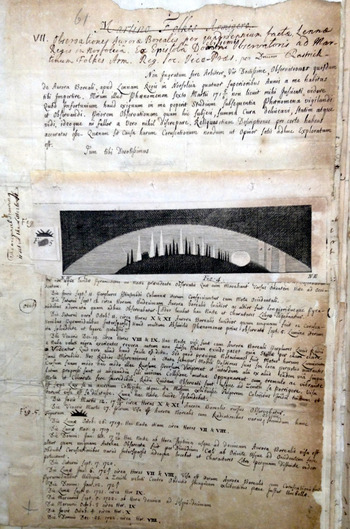
‘Schelsius’ was, of course, Anders Celsius, his work on the aurora borealis the Nova Methodus distantiam solis a terra determinandi (New Method for Determining the Distance from the Earth to the Sun), which was first read to the Royal Society on 8 April 1736, and printed in Philosophical Transactions. Celsius was also one of the first to suggest a connection between aurorae and changes in the Earth's magnetic fields, and he would also make observations of sightings in England.Footnote 119 Folkes would have been very interested to talk to Celsius as Folkes himself made some of the earliest sightings of aurorae from King's Lynn, Norfolk, not too far from his country seat, Hillington Hall. The early part of the century saw the end of the Maunder minimum, and London, Plymouth and King's Lynn were ideally situated to observe aurorae (Figure 3).Footnote 120
Aurora borealis observed by William Rastrick, one of Folkes's neighbours in Norfolk. Letter from Rastrick to Folkes, 20 March 1726/7, EL/R1/61. © The Royal Society.

Folkes then noted the next day,
I had invited the 2 Swedish Gentlemen, and I passd the day with them, they gave me several curious accounts both of their own country and their observations in Germany, they also gave me the measure and weights of their own country in which they have been both been very curious, and I am so well satisfied of their acquaintance that tis a satisfaction they are going the same way and will be of service to me observing the same things as my self.
More importantly, Folkes indeed would be involved with the scientific work of Celsius, assisting him with his geodesic expedition with Maupertuis to measure the shape of the Earth. The argument over the Earth's shape involved predictive calculations by Newton, and thus its outcome was crucial to the primacy of Newtonianism. When Celsius came to London to procure scientific instrumention for the expedition, was he introduced by Folkes not only to key members of the Royal Society, but also to fellows of the Society of Antiquaries, as Folkes promoted close ties between the two organizations, which had common interests in metrology.
When he met Folkes, Celsius had just been to Paris on a grand tour of European observatories and had met Algarotti in Italy.Footnote 121 And when they arrived in Paris together at the end of the summer of 1734, Algarotti introduced Celsius to Maupertuis and his colleagues. Here the idea for the Lapland expedition to measure the true shape of the Earth was born and given a royal warrant five months later to find and provision a ship to take the travellers to Stockholm.Footnote 122 The expedition would help settle a dispute that Maupertuis had with French cartographer Jacques Cassini over whether the Earth was prolate (longer along its axis from north to south), or oblate (broader along its diameter at the equator). Cassini believed that the Earth was prolate. Maupertuis in his expedition, and Newton with predictive calculation, proved it was oblate. The expedition to Lapland, lasting from July 1736 to March 1737, measured an arc of the meridian from Tornea to Kittis. The scientific party consisted of Maupertuis, Clairaut, Camus, Le Monnier, the Abbé Outhier and of course Celsius, who would measure the meridian arc near the North Pole. Another expedition organized by the French to South America (1735–43) near the equator to measure the meridian arc would eventually demonstrate that Newton was correct about the Earth's shape.
The travellers would use a fixed-length pendulum clock, a theodolite and a zenith sector that could the measure the shape of the Earth in tropical, temperate and Arctic latitudes. The first method depended on the comparison of the periods of pendulum clocks at different latitudes, eliminating the temperature-dependent variable (clocks went a second a day slower for every two divisions of temperature rise on the thermometer).Footnote 123 Newton in his Principia noted that astronomers found that pendulum clocks moved slower near the equator, thus supporting his prediction that their increase in weight from the equator to the poles was as the square of the sine of the latitude.Footnote 124 Other than comparing the period of pendulum clocks, one could use a theodolite and surveyors’ rods to measure out a large distance (sixty to seventy miles) and, using a zenith sector, measure the degree of arc that distance covered, a more direct means of measuring the Earth's surface.
As Celsius was on his way to London, Maupertuis asked him to obtain several instruments made by George Graham.Footnote 125 Maupertuis desired a model of Graham's portable zenith sector, for observing the transits of fixed stars that allowed for the calculations of latitude; it was this sector with which in 1728 James Bradley had also discovered the aberration of starlight measuring Gamma Draconis. Gamma Draconis has a high northerly position of 51.5 degrees north of the celestial equator, which takes it through the zenith, as seen from London. The atmosphere of the Earth causes refraction of light, which makes stars appear higher than they really are, but using a star that passes directly overhead like Draconis solves such problems. Draconis was thus used to measure stellar parallax. However, in his work with Samuel Molyneux, Bradley detected a small apparent motion of Draconis not due to parallax (the annual timetable for Draco's parallax was different), but instead due to what is termed stellar aberration resulting from the finite speed of light and the orbital motion of the Earth.Footnote 126
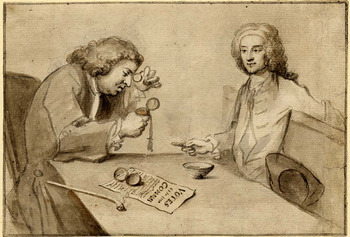
Maupertuis and Folkes had become friends in 1728 during the Frenchman's own Grand Tour. Folkes was a chief patron of Graham, having nominated him to the fellowship of the Royal Society on 8 December 1720.Footnote 127 Folkes also appended to his ‘memoranda’ a list of prices for Graham's watches, often securing them as gifts for his scientific correspondents. Folkes and Graham were close friends, recorded in John Byrom's diary as often socializing in various coffeehouses or taverns such as the Sun after Royal Society meetings (Figure 4).Footnote 128 When Celsius was in London in 1735, he observed a lunar eclipse from Graham's house using some of Bradley's new telescopes.
William Hogarth's sketch of Folkes examining a watch, c.1720s, Button's Coffeehouse, British Museum, image 1861.0413.508, Creative Commons BY-NC-SA 4.0 license.

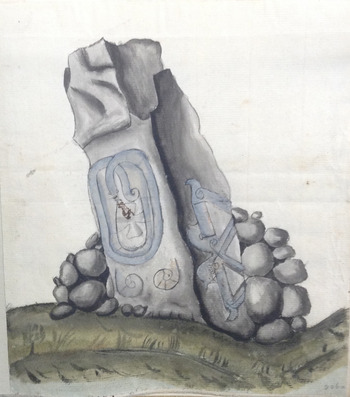
Celsius was also invited to attend meetings at both the Royal Society (where he discussed aurora borealis he had seen in Sweden), and to meetings of the Society of Antiquaries, showing his deep connections between the two organizations. For instance, on 13 November 1735 Celsius presented at Antiquaries ‘a draught of two kinds of Runic Characters, namely the Vulgar and Helsingic together with some remarks on them’, found on the Malsta stone in Rogsta, Hälsingland, Sweden (Figure 5).Footnote 129 This paper on runes was published by the Philosophical Transactions of the Royal Society in 1737 with an attempt to date the stone by examining the genealogy of the family it described and applying the rationale used to date events in Newton's biblical Chronology of Ancient Kingdoms.Footnote 130 In Folkes's presence, Celsius attended the Society of Antiquaries again on 9 March 1735/6 and on 18 March 1735/6, where Celsius ‘delivered an account of an ancient Alabaster vase found in Sweden … at the Antiquarian College of Stockholm … which was read’; Celsius also presented the Society of Antiquaries ‘with a wooden print of the said vase’.Footnote 131 As Celsius received his instruments, Folkes's friends received an antiquarian gift, part of a time-honoured exchange characteristic of the Republic of Letters. The ties between the Royal Society, the Antiquaries and Newtonianism were strengthened.
Sketch of Celsius's discovery of runes on the Malsta stone in Rogsta, Hälsingland, Sweden, which was engraved and published in the Philosophical Transactions, CLP/16/51, © The Royal Society

Folkes also gave advice to Celsius while he was on expedition. In December 1736, Celsius wrote to Folkes stating that he was ‘one thousand times grateful for the courtesies you did for me during my stay in London’. He continued, ‘We have observed the difference of latitude between Torne and Pello with Mr Graham's instrument. The observations were made in September in Pello, having not found any suitable star other than the Dragon. We then observed it in October here in Torne’.Footnote 132
In other words, Graham's sector measured the angle at which a particular star, in this case Draco or the Dragon, near the zenith passed the meridian (the star's altitude). The expedition moved then to another mountaintop at Pello and repeated the same measurement. The difference between the star's altitudes was due to the party's having travelled south. As Sorrenson stated, they then had to ‘establish the distance between the two mountains by surveying a series of triangles and measuring several of the baselines with wooden poles’.Footnote 133 Once they had the distance between the two points and the difference in angles, they ‘calculated that the length of one degree of arc near the polar circle was longer than at Paris’, and concluded that the Earth was oblate, vindicating Newton. However, there was one problem. As Celsius continued,
since this star [Draco] is close to the ecliptic pole, the declination changed in the meantime.[ Footnote 134 ] That is why I beg you, Sir, to send me the rule according to which one calculates the change of declination from one month to the next. We don't have here in memory what Mr Bradley gave about this in the Philosophical Transactions. And I would like to know as well if Mr Bradley has established anything yet about the irregularities that he found in the stars located around … the equinoxes, since our star of the Dragon is very close to that location.Footnote 135
As mentioned, Bradley's observations of the motion of Draco led to his discovery of stellar aberration. As Celsius was using Draco as a reference point for his triangulation measurement, he was concerned that this aberration would affect his measurements. Folkes's reply to Celsius's query is not extant, but we know that Bradley's calculations regarding stellar aberration were communicated. Maupertuis, in his publications about the exhibition, incorporated Bradley's data about declination, and used Bradley's precision in measuring stellar positions as an example of new standards of astronomical practice only possible with the best instruments. Maupertuis stated, ‘Mr Bradley very kindly shared with me his latest discoveries on the motions of the stars, and communicated to me the necessary correction to the arcs we observed’. As Terrall has shown, this precision of English instruments was used as a weapon against Cassini's claims for a prolate Earth. When Maupertuis's book finally did appear about the shape of the Earth (Le figure de terre) in 1738, he wrote to Folkes,
It is my turn now to thank you after the obliging[ Footnote 136 ] letter that you did me the honour of writing me. The most flattering reward I could get from a work[ Footnote 137 ] that has faced many difficulties and risks[ Footnote 138 ] is to see it has the approval of an excellent judge such as you. Such approval makes me well strong against the injustice of those who were not pleased by our measures, and their conspiracy. It is true that it is something singular and that it will be difficult to understand that the Astronomer [Cassini][ Footnote 139 ] who has the highest reputation in France was mistaken 5 different times in the measures he undertook and that he has always found that the Earth is elongated in 1701, 1713, 1714, 1733, and 1734. It seems that if there had been chance only, it should have led him better. But I am nevertheless convinced that the Earth is flattened.Footnote 140
He then continued, ‘It has been very sweet to me, Sir, to find myself still in the honour of your memory after such a long time … I [send my book] to you as one of the first scholars in Europe’.Footnote 141
Folkes's interest in stellar parallax, aberration and the modification of the constellations over time was demonstrated by a model he had made of the globe which he demonstrated to the Society of Antiquaries on 7 July 1736 when he returned to England. It was a plaster of Paris copy of the Farnese Globe, the oldest surviving depiction of this set of Western constellations; Folkes recorded in his travel diary, ‘Diam of the Farnesian Globe. 2f. 5 inch. 1/10 English Measure’, likely indicating that he saw and measured in it Rome.Footnote 142 The globe puts the celestial figures against a grid of circles comprising the celestial equator, the colures, the ecliptic, the tropics and the Arctic and Antarctic Circles. This allows for the constellations to be positioned accurately. It was noted at the Antiquaries meeting that ‘the colure of this globe passes by those parts of the asterism by which it is said to have past in the days of Hipparchus but the intersection of the Equator and Eccliptic is not at the Colure’. This was a reference to the 26,000-year precession or axial wobble on the Earth which Newton discovered shifts the positions of the celestial circles over time, so that the observed positions on the Farnese Atlas can be traced to a particular date in celestial time. ‘The declination of the Arctic and Antarctic Circles will correspond to a particular latitude for the observer whose observations were adopted by the sculptor … a detailed analysis of the globe will reveal the latitude and epoch for the observations incorporated in the globe’.Footnote 143 The Society of Antiquaries’ entry in their Minute Book about Folkes's presentation about the globe noted that its age could be determined to be during the time of the Antonine emperors.
Geodesy also continued to be a preoccupation of Folkes when he eventually realized his goal of being appointed president of the Royal Society, and then of the Society of Antiquaries, nearly a decade after his initial Italian visit. Folkes became one of the strongest supporters in the Royal Society of John Harrison and his longitude clock, convinced of Harrison's ‘strong impulses of a natural and uncommon genius’.Footnote 144 And in 1745 Folkes intervened when Antonio de Ulloa, who went on the Peruvian expedition to measure the meridian arc near the equator, was captured by the English as he sailed home when the expedition was completed. Spain and Britain were at the time at war. Ulloa's calculations were confiscated and he languished in prison in Portsmouth, until he was granted leave to travel to London at the request of the Royal Society. Folkes mediated, and on 8 May 1746 he used his knowledge of Spanish to summarize the details of Ulloa's expedition in thirty-three pages of manuscript which he presented to the society later that month.Footnote 145 Folkes reproduced Ulloa's triangulation and its results, which confirmed Newton's predictions of the shape of the Earth. Folkes noted that the ‘proportion resulting of the Axis of the Earth’ from the Maupertuis expedition ‘to its Equatorial Diameter’ of Ulloa's measurements ‘will be nearly 223 to 222 surprizingly near to that given from calculation only, by the great Sir Isaac Newton, of 229 to 230, in the last edition of his Principia’.Footnote 146 Rather ironically, Folkes noted that ‘Dr Bradley's aberration of the fixed stars from the successive propagation of light is not brought into the account’.
Folkes also recorded their barometric observations made in the Andes, as well as the heights of the mountains, and included Ulloa's ethnographic information about the Peruvians and descriptions of the flora and fauna, including the deadly coral snake. Folkes noted that he did not want the material to be made public, as Ulloa intended to publish a book about his exploits when he returned to Spain (accomplished in 1748 with twelve subsequent editions in French, English, Dutch and German); Folkes noted that he was unwilling to publicize Ulloa's findings because of the pleasure the public would ‘without doubt receive’ from Ulloa's book.Footnote 147 Apart from the evident esteem Ulloa and Folkes developed for each other, vindication of Newtonianism was all the more powerful from an outside entity. Ulloa was made an FRS, his papers were returned to him by order of the Lords Commissioners of the Admiralty, and it was arranged that he would get passage to Portugal, which was a neutral in the war, so he could get back to Spain.
Conclusion
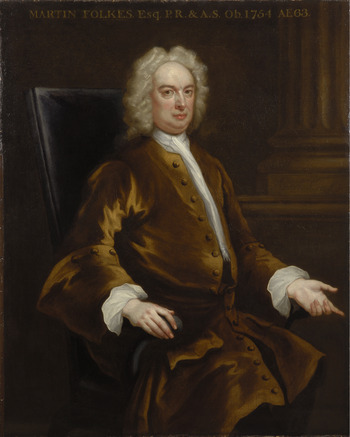
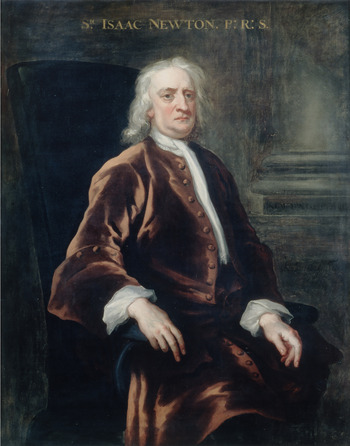
Whether speaking in defence of Newtonian optics, or in support of Maupertuis's flattened Earth, Folkes's travel diary reveals that he made a case for the primacy and precision of English instruments and measurement in natural philosophy. This precision of measurement would also extend to antiquarian questions in which conversion factors were sought between the English and Roman feet to comprehend Roman architectural engineering. The diary also represented the manifestation of Folkes as an international broker of Newtonianism, something reflected in the portraiture he commissioned of himself before and after his tour. The portrait by Jonathan Richardson painted in 1718 has no indication of Folkes's association with Newton, or even of his interests in astronomy, lacking the typical props of books or scientific instruments. Richardson instead painted this portrait to commemorate his and Folkes's friendship, not as an official image. However, the 1739 portrait of Folkes commissioned from John Vanderbank very much shows him in the image of Newton, strikingly similar in iconography to Vanderbank portraits of the latter (Figure 6).Footnote 148 Here we see Folkes's self-fashioning as the heir apparent to the Royal Society presidency, something he achieved in 1741 after Sloane's death. Folkes's journey to Italy was an expression of the motto scrawled on his travel diary, symbolic of who and what he would become, a natural philosopher who would manifest several elements of the Newtonian programme during his tenure as president of the Royal Society.
Portrait of Martin Folkes by John Vanderbank, 1739, in private collection. My thanks to Christopher Foley FSA of Lane Fine Art for permissions to use this image.

Three-quarter-length portrait of Sir Isaac Newton, aged eighty-three years, by John Vanderbank, 1725–1726, which Folkes clearly emulated for his own image. © The Royal Society.

Folkes's diary thus demonstrates, importantly, that the impression among some historians that the eighteenth-century Royal Society was moribund has been mistaken. Sorrenson has noted that this unedifying impression stemmed from the belief that the Royal Society failed to match the standard that Newton had set in the Principia; it also stemmed from negative opinions voiced by the society's critics, such as John Hill and from the popularity of Babbage's Reflection on the Decline of Science in England (1830).Footnote 149 It seems, however, that the Royal Society in the eighteenth century manifested considerable strengths in technological innovation, setting new standards in experimental precision.
And as Folkes's journal shows, during his journey to Italy, and shortly after he returned, he was in the very centre of an intellectual network, brokering and furthering these aims. His diary also represented, as Feingold reminds us, the ‘confabulatory life’ of the scholar, the diffusion of scientific knowledge through informal discussion with colleagues.Footnote 150 Henry Guerlac has commented that ‘as historians of ideas we are happiest when we can navigate from the firm ground of one document to the next, and we are prone to forget how great a part travel, gossip and word-of-mouth have played in the diffusion of scientific knowledge, indeed of knowledge of all sorts’.Footnote 151 In this manner, the journal of Folkes's scientific peregrination demonstrates to us the parameters of Georgian antiquarian science and Newtonianism.