Introduction
Description of the Upper Mississippian coleoids Hematites, Paleoconus, and Bactritimimus by Flower and Gordon (Reference Flower and Gordon1959) marked the beginning of recognition of coleoid cephalopods in the Paleozoic. Gradually, over the past 60+ years since their report, a modest number of coleoids have been recognized from North American upper Paleozoic strata. For the taxa that have been described, see the classification in Doguzhaeva et al. (Reference Doguzhaeva, Mapes and Mutvei2010) and subsequent reports by Mutvei et al. (Reference Mutvei, Mapes and Doguzhaeva2012) and Doguzhaeva and Mapes (Reference Doguzhaeva and Mapes2015).
The Pennsylvanian age flattened and partial phragmocone specimens from Nebraska and Iowa, described herein, lack a well-defined rostrum like the coleoid specimens described by Flower and Gordon in 1959. However, these specimens can be confidently assigned to the Coleoidea because they preserve perfectly shaped, flask-like organs filled with ink, and ink in the Cephalopoda is only known in the Coleoidea. The preservation of coleoid ink as well as the factors that controlled the three-dimensional preservation of ink in the ink sac within the extremely compressed phragmocones, and body chambers were reported by Doguzhaeva et al. (Reference Doguzhaeva, Mapes, Mutvei and Pabian2002b). The ink ultrastructure of one of the Stark coleoids fossils was examined under scanning electron microscope (Doguzhaeva et al., Reference Doguzhaeva, Mapes and Mutvei2004, fig.1) and compared with that of modern squids and Jurassic squid-like coleoids (Doguzhaeva et al., Reference Doguzhaeva, Mapes and Mutvei2004). Because of the rarity of the Stark specimens and similarities seen on other ink-bearing taxa, additional destructive ink testing was not attempted. At this time, only one other taxon from the Nebraska and Iowa coleoid collection from the Stark Shale has been described and named Flowerites bellevuensis by Mapes et al. (Reference Mapes, Doguzhaeva, Mutvei and Pabian2010a). However, that generic name proved to be preoccupied and the new generic designation Flowericonus was proposed to replace the preoccupied name (Doguzhaeva and Mapes, in press). Mapes et al. (Reference Mapes, Doguzhaeva, Mutvei and Pabian2010a) proposed several scenarios to explain the morphology of Flowericonus. However, that taxon remains a problematic specimen in that the three-dimensional ink sac appears to be placed under the septa in the bullet-shaped phragmocone, which is somewhat similar to that seen in the mature conchs of the nautiloid order Ascocerida. Since this morphology has not been reported in any coleoid from any age, interpretation of the conch of Flowericonus remains debatable at this time.
In spite of the fact that Paleozoic coleoid cephalopods are extremely rare all over the world, the Carboniferous coleoids discovered from the central part of USA in the past 40 years demonstrate their remarkable diversity. Analysis of the Upper Paleozoic coleoids from this region indicates that an evolutionary radiation took place in the coleoid cephalopod lineage during the upper Paleozoic (Doguzhaeva et al., Reference Doguzhaeva, Mapes and Mutvei2010). This evolutionary radiation hypothesis is based on a mosaic combination of the “old” (typical for the externally shelled cephalopods as seen in the orthoceratid and bactritoid cephalopods) and “new” (typical for the internally shelled cephalopods as new morphologic features not previously seen in the cephalopod lineage) morphological traits, the parallel appearance and variations of new morphological features, and relatively rapid changes in basic shell morphology.
The Pennsylvanian genus Donovaniconus Doguzhaeva, Mapes, and Mutvei, Reference Doguzhaeva, Mapes and Mutvei2002a from Oklahoma exemplifies the mosaic combination of “old” and “new” traits in which a body chamber is an ancestral (bactritoid) trait, a pro-ostracum-like structure is a novelty, and an ink sac is a coleoid trait (Doguzhaeva et al., Reference Doguzhaeva, Mapes and Mutvei2003). The Pennsylvanian genus Mutveiconites Doguzhaeva, Reference Doguzhaeva2002 from Texas combines an ancestral (bactritoid) trait that is a long body chamber and a coleoid trait that is a rostrum (Doguzhaeva et al., Reference Doguzhaeva, Mapes and Dunca2006). The Mississippian genus Hematites Flower and Gordon, Reference Flower and Gordon1959 from Arkansas and Gordoniconus Mapes, Weller, and Doguzhaeva, Reference Mapes, Weller and Doguzhaeva2010b from Montana, as well as the Pennsylvanian age Shimanskya Doguzhaeva, Mapes, and Mutvei, Reference Doguzhaeva, Mapes and Mutvei1999 from Texas and Oklahoma, Donovaniconus, Mutveiconites Doguzhaeva, Reference Doguzhaeva2002, and Saundersites Doguzhaeva, Mapes, and Mutvei, Reference Doguzhaeva, Mapes and Mutvei2007 from Illinois reveal the appearance of a novelty at different evolutionary stages together with a retention of ancestral traits for a long period after the appearance of a novelty in another form (Doguzhaeva et al., Reference Doguzhaeva, Mapes and Mutvei1999, Reference Doguzhaeva, Mapes and Mutvei2002a, Reference Doguzhaeva, Mapes and Dunca2006, Reference Doguzhaeva, Mapes and Mutvei2010). For example, the evolutionary loss of the body chamber occurred in Hematites, while the retention of the body chamber was maintained in younger genera like Donovaniconus. The Late Mississippian Hematites and Gordoniconus and the Pennsylvanian Mutveiconites and Donovaniconus demonstrate the parallel development of a new morphological trait, namely, a rostrum, that is a long well mineralized well-shaped structure in Hematites, a long spine-shaped weakly mineralized structure in Gordoniconus, a short loosely mineralized cap-like structure in Mutveiconites, and a sheath-like weakly mineralized structure in Donovaniconus. The Pennsylvanian age Shimanskya shows the ultrastructural coleoid novelty that is a shell wall formed by two loosely mineralized distinctly separated prismatic layers. A similar shell wall is secreted in the modern Spirula-Sepia branch of coleoids, but it is unknown in externally shelled cephalopods that have a shell wall formed by a nacreous layer located between two prismatic layers. The nacreous layer in the shell wall was retained in the Pennsylvanian coleoid Donovaniconus (Doguzhaeva et al., Reference Doguzhaeva, Mapes and Mutvei2003). Donovaniconus shows another ultrastructural coleoid novelty in having lamello-fibrillar nacre in its septum. This ultrastructure is also known from septa in modern Spirula Lamarck, Reference Lamarck1799 (Mutvei, Reference Mutvei1964), the Cretaceous coleoid Naefia Wetzel, Reference Wetzel1930 (Doguzhaeva, Reference Doguzhaeva1996), and late Eocene cuttlefish Belosaepia Voltz, Reference Voltz1830 and Mississaepia Doguzhaeva, Weaver, and Ciampaglio, Reference Doguzhaeva, Weaver and Ciampaglio2014 (Doguzhaeva et al., Reference Doguzhaeva, Weaver and Ciampaglio2014).
Two additional evolutionary innovations in coleoid morphology also deserve mention. One is the complete loss of an internal shell or internal support structure. This innovation was reported in Pohlsepia mazonensis Kluessendorf and Doyle, Reference Kluessendorf and Doyle2000 from Desmoinesian (=Moscovian) age sediments of the Mazon Creek Lagerstätte by Kluessendorf and Doyle (Reference Kluessendorf and Doyle2000). The second is replacement of the calcareous internal shell with an internal organic (chitin?) skeletal support structure. This innovation is seen in Glochinomorpha Gordon, Reference Gordon1971 from the lower Permian of Utah (see Doguzhaeva and Mapes, Reference Doguzhaeva and Mapes2015 for a complete discussion). To date, no transitional coleoid forms from a bactritoid-like ancestor have been recovered and described. We suspect, given the extreme shell change in chemical composition in Glochinomorpha and the complete loss of an internal shell in Pohlsepia, that such an evolutionary change must require significant time to occur and that this must have been at least as early as the Middle or Early Devonian.
As can be seen above, a number of different Carboniferous coleoids with different new and old morphological combinations have been reported from North America in the past 20 years. These discoveries point to an evolutionary radiation in the upper Paleozoic (i.e., the upper part of the Mississippian into the Permian), as reported by Doguzhaeva et al. (Reference Doguzhaeva, Mapes and Mutvei2010). This variety of morphological combinations has increased the difficulty in determining the ancestor-descendant relationships in early coleoid taxa with those known in the Mesozoic and Cenozoic where coleoids are much better represented in the fossil record. Additionally, the earliest origins of the coleoid lineage still remain to be discovered in the lower part of the Lower Mississippian or the Devonian. By describing the Nebraska and Iowa coleoids from the Stark Shale, additional insights into upper Paleozoic coleoid morphologic features are added to the features that have been previously reported. This additional information provides greater insight into coleoid diversity and into the coleoid evolutionary radiation.
Material, geological setting, and generalized depositional environment
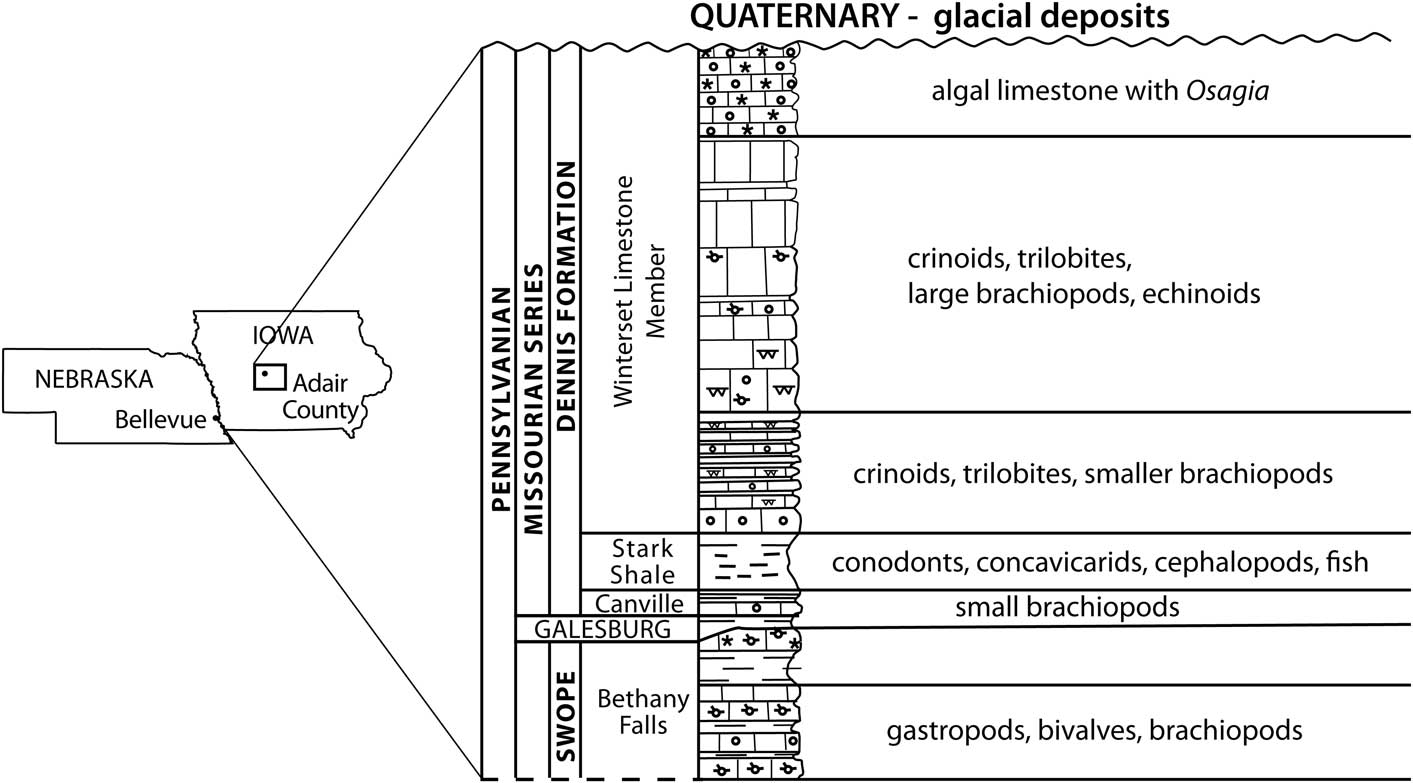
The examined specimens were collected from quarries in Pennsylvanian (Missourian=Kasimovian) limestone in southeast Nebraska near Bellevue, Nebraska and southwest central Iowa at the Howe Quarry in Adair County (Pope et al., Reference Pope, Witzke, Anderson, Ludvigson, Bunker and Greeney2002) (Fig. 1). In that region, the Winterset Limestone, which overlies the Stark Shale, and the underlying Canville Limestone are mined and the thin (~1 m thick) Stark Shale, which is considered waste rock, is removed as irregularly shaped blocks and piled in abandoned parts of the quarries. After weathering, these shale blocks can be split along bedding planes.
Generalized map of Nebraska and Iowa showing the approximate locations of the quarries and the general stratigraphic section showing the position of the Stark Shale that yielded the coleoid specimens. Several different quarries in the vicinity of Bellevue, Nebraska are noted as producing coleoids, but it is not known which quarry yielded which specimen. Of the coleoids from the Pennsylvanian age coleoid collection from Nebraska and Iowa, only a single specimen has been recovered from Adair County, Iowa.

The Stark Shale in this region is rich in phosphate, which occurs as discrete spheroidal concretions and as thin plates between the bedding planes. The Stark Shale is currently interpreted as having been deposited in an offshore, outer shelf environment in relatively deep water with the bottom of the water column at the water sediment interface being anoxic (Heckel, Reference Heckel1977). Such shales in the Carboniferous are typically conodont-rich (Heckel and Baesemann, Reference Heckel and Baesemann1975), and several conodonts are seen on the bedding planes of the coleoid-bearing shale specimens. In addition to the coleoids listed above, other recovered fauna from the Stark Shale at the coleoid-bearing localities include iniopterygians (Zangerl and Case, Reference Zangerl and Case1973), articulated sharks and other fish tentatively assigned to the platysomoids and paleoniscoids, rare, small-sized, tightly umbilicate ammonoids (tentatively identified as Neodimorphoceras [Schmidt, Reference Schmidt1925], Schistoceras Hyatt, Reference Hyatt1884 , Gonioloboceras Hyatt, Reference Hyatt1900), and arthropods including concavidcarids, tyrannophonitids, eocarids, and eurypterids (Schram, Reference Schram1984; R. Pabian personal communication, 2009).
The preservation of shell material from the Stark Shale is distinctive in that all the aragonite of the coleoids (and other cephalopods) has been replaced by phosphate. This replacement has altered the ultrastructure of the shell and septa, and as such, the replacement has placed limits on utilization of an important morphological tool in the recognition of coleoids. It is not absolutely certain that the amount of shell material preserved in these specimens is representative of the original shell. There are visual differences in the appearance of the shell that differ from place to place in the same specimen and from specimen to specimen. With this in mind, there is no way to determine how much, if any, shell has been lost from these Stark coleoid specimens during the phosphatization process. It appears that if shell material was originally present, at a minimum it left an impression in the shale. These impressions were used in the systematic identifications and descriptions, but the degree of shell replacement was not used as an important systematic morphologic feature.
Repositories and institutional abbreviations
The quarries near and in Bellevue that yielded the specimens are the “Old Public Works Quarry” (PWA)—Starkites compressus n. gen. n. sp. (UNSM 16562A, B); the La Platte Quarry—Nebraskaconus whitei n. gen. n. sp. (UNSM 8161); and the 36th Street Quarry—Pabianiconus starkensis n. gen. n. sp. (UNSM 16568A). The eight clusters of crushed and fragmented specimens (UNSM 16563–16566, UNSM 16569–16572) are from the “Old Public Works Quarry” (PWA) at Bellevue, Nebraska. The single coleoid specimen from Iowa, which is identified as Donovaniconus sp. (SUI 62497), is from the Howe Quarry in Adair County.
The studied specimens are deposited at the University of Nebraska State Museum (UNSM prefix), Lincoln, Nebraska and the University of Iowa Museum and fossil repository (SUI prefix), Iowa City, Iowa.
Systematic paleontology
Subclass Coleoidea Bather, Reference Bather1888
Discussion
As presently defined, none of the presently established Paleozoic coleoid orders will accommodate the new coleoid taxa from the Stark Shale. Therefore, the new fossil coleoids described herein are not assigned to established Paleozoic coleoid orders at this time because an extensive review and possible revision of the diagnostic features of the described coleoid orders from the Paleozoic is necessary.
Genus Nebraskaconus new genus
Type species
Nebraskaconus whitei new genus new species.
Diagnosis
As for the type species.
Etymology
After the state of Nebraska where the holotype was collected.
Occurrence
Specimen UNSM 8161A and B, part and counterpart, respectively, was collected by Mr. W.D. “Ted” White at the LaPlatte Quarry near Belleveu, Nebraska from the Stark Shale (Pennsylvanian, Missourian). No additional information is available.
Discussion
Nebraskaconus whitei n. gen. n. sp. is similar to Starkites compressus n. gen. n. sp., but differs from the latter in having a mineralized body chamber (as does Pabianiconus starkensis n. gen. n. sp.). Donovaniconus differs in having a long, parallel-sided body chamber and longitudinal lirae as ornament on the body chamber.
Nebraskaconus whitei new species
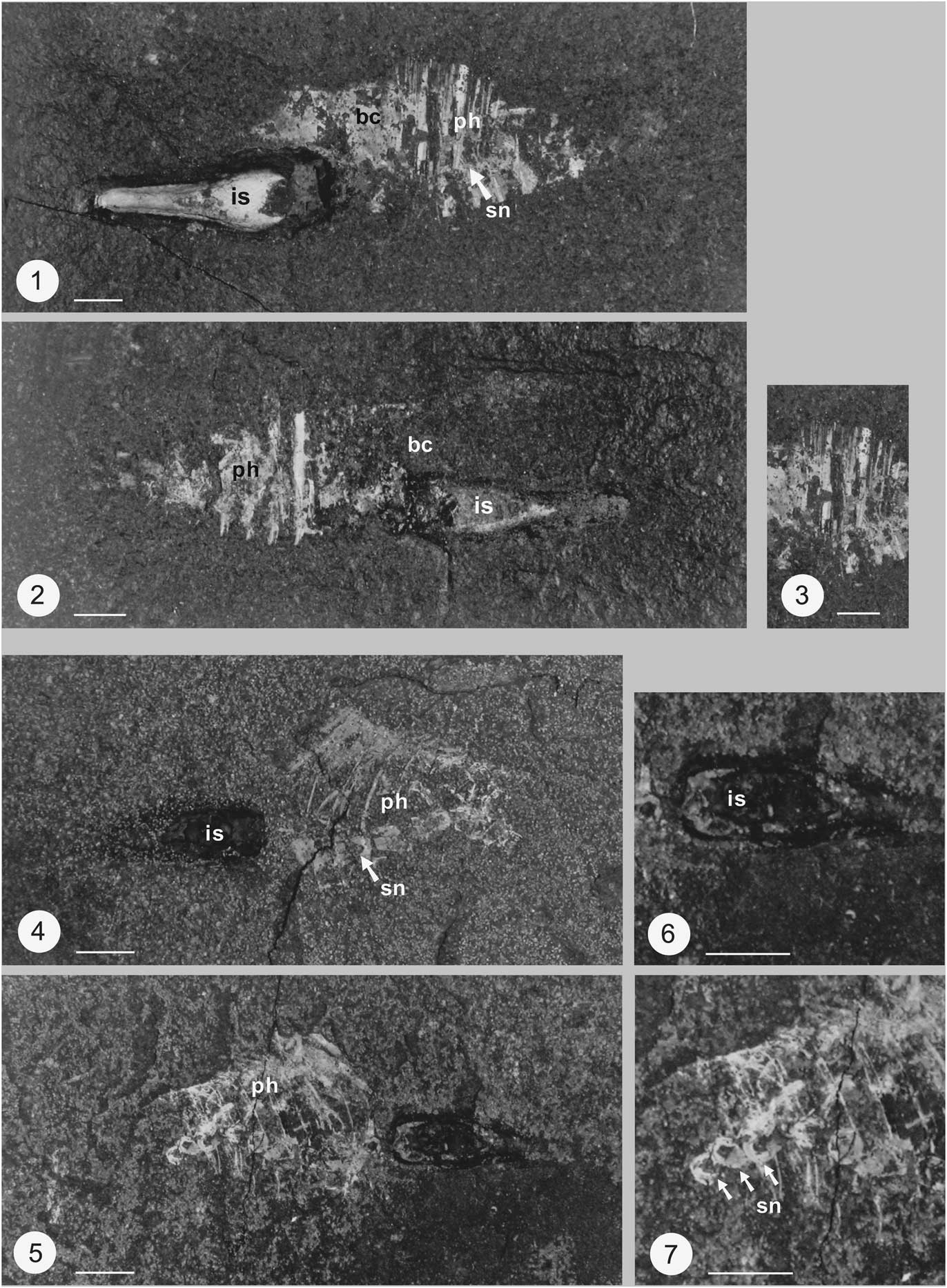
Nebraskaconus whitei n. gen. n. sp. (1, 2) Part and counterpart, respectively, of holotype UNSM 8161 showing a three-dimensional ink sac (is) filled with ink, part of the body chamber (bc), and a crushed breviconic phragmocone (ph); (3), fine lirae between the septa of the phragmocone suggesting the conch had a “wrinkle layer”, which if true, then the test of the conch and the sheath-like rostrum must have been very thin. (4–7) Starkites compressus n. gen. n. sp. (4, 5) Part and counterpart, respectively, of holotype UNSM 16562A showing the three-dimensional ink-filled sac (is), the breviconic phragmocone (ph), and aligned circular septal necks (sn). Note there is no trace of a body chamber; (6) enlargement of the ink-filled sac in position in front of the terminal septum without any trace of a body chamber; (7) enlargement of the cyrtochoanitic septal necks (sn) as donut-shaped structures. Scale bars are 5 mm.

Types
Holotype (UNSM 1918).
Diagnosis
Short, breviconic phragmocone with ink sac extending beyond the end of the mineralized part of the body chamber, septa closely spaced, mural part of septum about half the cameral length, apical end of ink sac located near, but not at, the terminal septum.
Description
Shell length ~67 mm; crushed breviconic phragmocone 36.1 mm long and 17.4 mm wide at terminal septum; phragmocone apicad from terminal septum has partly mineralized shell wall and septa for ~17.5 mm, apicad of septa for 18.6 mm, only faint shell traces to the presumed conch apex; estimated phragmocone and body chamber apical angle ~10°; body chamber length from terminal septum to orad tip of ink sac is 30.9 mm; approximately eight closely spaced septa are present with mural part of septum extending approximately half a camera length; orad end of phragmocone and posterior part of dorsum of body chamber preserve numerous fine, transverse wrinkles between the septa, which sometimes are impressions on shale matrix; on presumed ventral phragmocone surface are eight hollow ovals that probably are septal foramen with thin siphuncular deposits on the septal surfaces; ink sac is 27.7 mm long and 8.4 mm wide at widest point, with rounded apical end ~7.0 mm orad of terminal septum on presumed venter, ink sac base is flatly oval for ~12.1 mm and then narrows in 15.6 mm to a flat, blunt point.
Etymology
After Mr. W.D. “Ted” White, who collected the holotype.
Occurrence
Same as the genus.
Discussion
Based on the length of the body chamber from the terminal septum (30.9 mm), the body of the animal was at least 30 mm long. There is no sign of arm hooks orad of the aperture or on the shale surface, and it is possible that the animal did not have hooks on the arms. The meaning of the “wrinkles” located at the base of the body chamber and near the terminal septum of the phragmocone is unclear at this time; however, as a speculation, these “wrinkles” could be the remnants of the “wrinkle layer” seen in bactritoid-like coleoids (Mutvei et al., Reference Mutvei, Mapes and Doguzhaeva2012). The orientation of the specimen when it came to rest on the sea floor is uncertain; however, the position of the siphuncular elements in the crushed phragmocone, which are typically on the presumed ventral side of coleoids, supports an interpretation that the animal was on its side when it came to rest. The ink sac is the only trace of the soft body of the animal, and there is no evidence that there was a pro-ostracum or pro-ostracum-like structure or rostrum on the phragmocone.
Genus Starkites new genus
Type species
Starkites compressus new genus new species.
Diagnosis
As for the type species.
Etymology
Named after the Stark Shale that yielded the holotype.
Occurrence
From the Stark Shale (Pennsylvanian, Missourian=Kasimovian) at the Old Public Works (WPA) Quarry near Bellevue, Nebraska. No other information is available.
Discussion
All other coleoid taxa from the Stark Shale retain traces of a body chamber. Because this taxon lacks this condition, it is unique. The ink sac being adjacent to the terminal septum is seen in both Starkites n. gen. and Pabianiconus n. gen., however, the later genus has a well-mineralized body chamber.
Evidence that the body of the animal was present when the specimen came to rest on the sea floor bottom can be deduced because of the presence of a complete ink sac that is filled with ink, which is in front of the last septum of the phragmocone. That position is the logical place where an ink sac would be expected. It also seems reasonable that if the body had a shell that formed a body chamber, which had been removed by diagenetic processes, the mineralized phragmocone also would have been removed. Thus, the conclusion that can be made is that there was never a mineralized shell for the main body of the animal and only the internal phragmocone was mineralized.
Starkites compressus new species
Diagnosis
Mineralized breviconic phragmocone with closely spaced septa. Body chamber, rostrum, and pro-ostracum absent. Apical angle of the phragmocone ~10°, ink sac abuts the terminal septum.
Description
Crushed breviconic phragmocone 21.0 mm long and 16.1 mm wide at terminal aperture; phragmocone 6.9 mm wide with incomplete apex and with approximately nine closely spaced septa with nine hollow ovals that represent the siphuncle foramen with cyrtochoanitic septal necks with thin siphuncular deposits around the septal necks that aided in their preservation; numerous wrinkles between the septa on orad phragmocone end on presumed dorsum may represent a “wrinkle layer”; ink sac 19.9 mm long and 5.0 mm wide at its rounded apical end, which is adjacent to terminal septum on the presumed ventral side of the animal, is nearly cylindrical for ~8.0 mm and then narrows in a length of 11.9 mm to a blunt point that is buried in the shale; body chamber, pro-ostracum, and rostrum are absent.
Etymology
Named after the shape of the shell after diagenetic crushing.
Occurrence
From the Stark Shale at the LaPlatte Quarry south of Bellevue, Nebraska. No other information is available.
Discussion
The single specimen of Starkites compressus n. gen. n. sp. is unique in the Stark Shale coleoids with its combination of the ink sac and lack of a mineralized body chamber. The large apical angle of the phragmocone of ~10º may be a partial product of shell crushing; however, that the shell is a brevicone is supported by the close septal spacing. The position of the siphuncular elements on the presumed ventral side supports a lateral crushing orientation for the specimen. The ink sac is the only trace of the soft body of the animal. Without the presence of the undisputed and undistorted ink sac, this specimen would be viewed as a rather ordinary, poorly preserved and unidentifiable othoceratid nautiloid or prehaps a parabactritoid. However the discovery and validation of the ink sac filled with ink implies the soft body was present when the animal came to rest of the ocean floor.
This specimen represents a rather important stage of coleoid evolution in the upper Carboniferous in proving that the coleoids had evolved in having an internal mineralized phragmocone without a mineralized body chamber to contain the soft body tissues and without a well-developed rostrum as is seen in the Upper Mississippian coleoid Hematites, which also lacks a body chamber (Doguzhaeva et al., Reference Doguzhaeva, Mapes and Mutvei2002a). This condition was thought to have evolved in the Mesozoic, and so this Pennsylvanian age specimen is important in documenting that this condition began much earlier in geological time in several different lineages.
Genus Pabianiconus new genus
Type species
Pabianiconus starkensis new genus new species.
Diagnosis
As for the type species.
Types
Holotype (UNSM 16568A).
Etymology
After Roger Pabian in recognition of his numerous contributions to the understanding of invertebrate fossils from the upper Paleozoic of Nebraska and surrounding regions.
Occurrence
From the Stark Shale (Pennsylvanian, Missourian=Kasimovian) at the 36th Street Quarry in Bellevue, Nebraska. No other information is available.
Discussion
Pabianiconus n. gen. is only somewhat comparable with Donovaniconus in that both have a mineralized body chamber; however, the body chamber of Donovaniconus is long and parallel-sided and the body chamber of Pabianiconus n. gen. is relatively short and flared with a relatively high angle (~20º) from the terminal septum to the aperture. Pabianiconus n. gen. has no ornament on the exterior of the shell wall and no evidence that a rostrum or a pro-ostracum-like structure was present; whereas, Donovaniconus has longitudinal ridges as ornament and curved growth lines on the dorsum, indicating that a short, broad pro-ostracum-like structure was present. Additionally, the body chamber length in Donovaniconus is longer and the length of the ink sac compared to the length of the body chamber length is shorter. Pabianiconus n. gen., with its flared body chamber, differs from Starkites n. gen., which lacks a body chamber.
Pabianiconus starkensis new species
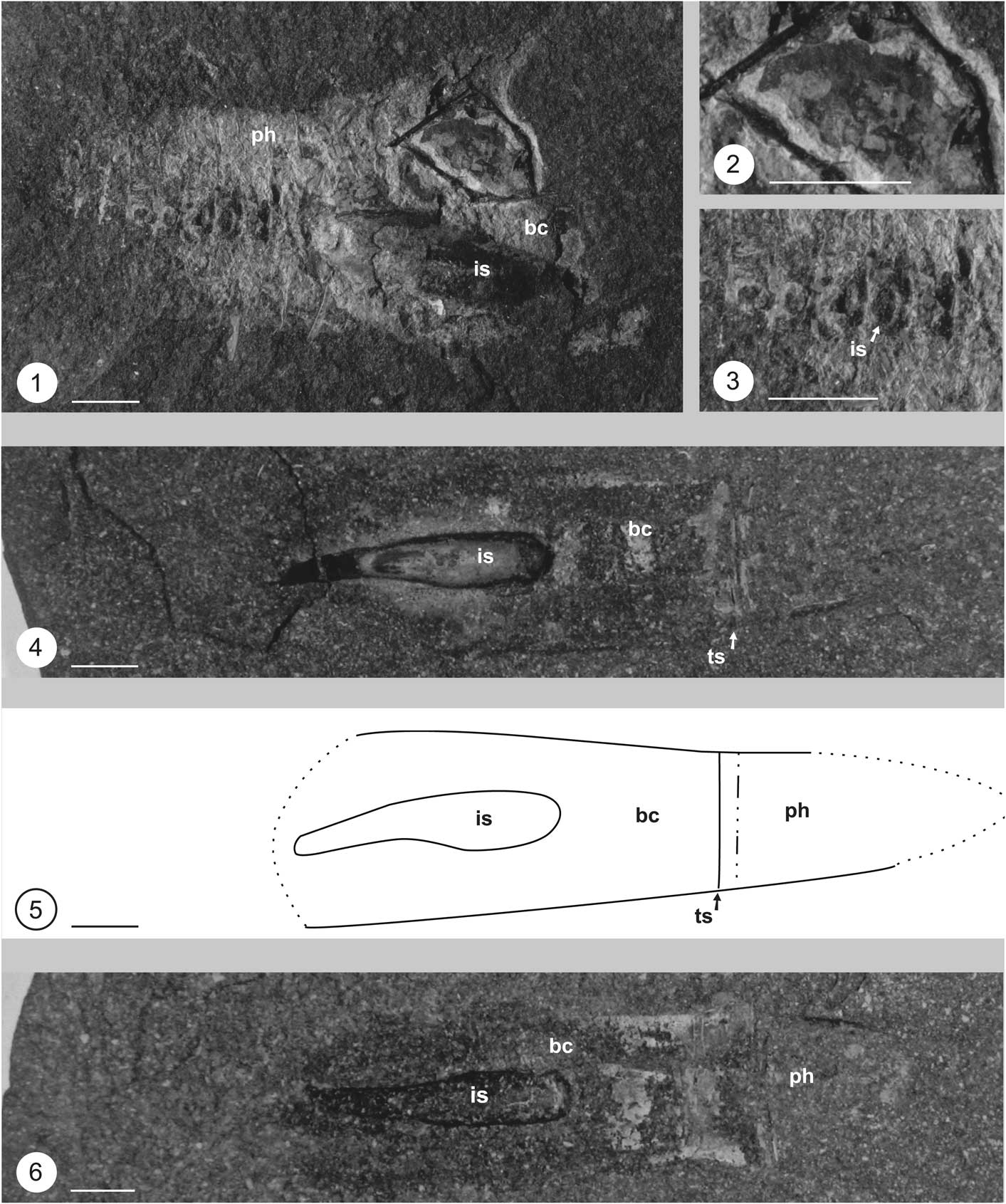
(1–3) Pabianoconus starkensis n. gen. and n. sp. (1) Overall view of holotype UNSM 16568A showing body chamber with external shell containing an ink-filled sac (is) in the body chamber (bc) and the partly complete breviconic phragomocone (ph) with aligned circular septal necks; (2) enlargement of a striated brown layer on the surface of the shell that is interpreted as the remains of the mantle tissue; (3) enlargement of the septal necks (is) that form a ring probably because of deposits around the cyrtochonanitic septal necks. Donovaniconus sp. (4, 5) Specimen UMSN 62497A (part) and diagram of the specimen, respectively; (4) overall view showing the impression of the animal’s relatively long, parallel-sided body chamber (bc) with a three-dimensional, ink-filled sac (is), and a partly complete phragmocone with remains of several closely spaced septa including the terminal septum (ts); (5) diagram of the faint body chamber impression and the partly complete breviconic phragmocone, the latter of which has the upper (dorsal?) edge preserved as a faint impression, and on the lower (ventral?) side as a thin strip of shell material; the earliest part of the shell is not preserved; (6) specimen UMSN 62497B (counterpart) showing the impression of the parallel-sided body chamber (bc) with an ink-filled sac (is) impression and a partly complete phragmocone (ph); the apical end of the ink-filled sac has a greater diameter than the restricted orad end; also note that the ink sac is placed about midway in the body chamber. Scale bars are 5 mm.

Types
Holotype (UNSM 16568A, B).
Diagnosis
Rostrum absent, incomplete and crushed phragmocone 21.3 mm long with an apical angle of ~10º, body chamber 23.3 mm long with an apical angle of ~20º; septa -closely spaced, mural part of septa about one-third of camera length; ink sac about three-fourths of body chamber length and located immediately orad of terminal septum; multilayered shell wall of body chamber surrounds entire body mass.
Description
Around the exterior of the specimen there is an oval stain in the black shale suggesting that the animal tissues during bacterial degradation produced a micro chemical environment that aided the preservation of the specimen. The oval is 52 x 45 mm and probably encompasses the entirety of the fossil specimen, including any soft tissues that were present. If this was the case, then the specimen lacked arm hooks because none was observed on the bedding plane that contains the specimen.
The conch of Pabianiconus starkensis n. sp. is crushed laterally, based on the assumption that the siphuncle, which is presumed to have been ventral and marginal, is now positioned in the center of the crushed phragmocone. Thus, after death, the animal came to rest on the anoxic sea floor on its side. The only remnants of the siphuncle are nine circular rings, which are the foramens of the septal necks and are relatively well preserved because they had thin siphuncular deposits around the apical and adapical septal neck surfaces that allowed them to better survive the crushing and diagenetic alteration of the specimen. In the body chamber, which is ~27.5 mm long and 25.2 mm wide, there is an ink-filled, cylindrical organ with a flattened narrow duct on the orad end that extends to near the edge of the body chamber. The ink sac is 23 mm long and 5 mm in maximum width. In places the ink sac is covered by the shell wall of the body chamber on the upper and lower surfaces, indicating the body chamber was mineralized around its complete circumference. The posterior end of the ink sac is immediately adjacent to the terminal septum of the phragmocone. Patches of striated brown material are present in the body chamber and on the shell covering the ink sac; this material is interpreted to be muscular mantle tissue. The phragmocone is represented by the septal necks, which were described previously, and nine fragmentary septa with their mural edges extending approximately one-third the length of the camerae. The terminal septum is slightly displaced because of the crushing of the specimen.
Etymology
After the Stark Shale that yielded the holotype.
Occurrence
Same as the genus.
Discussion
One unusual aspect of this holotype is the presence of preserved mantle tissue in the body chamber. Similar material has been observed in other coleoids from the Paleozoic and Mesozoic (Kear et al., Reference Kear, Briggs and Donovan1995; Doguzhaeva and Mutvei, Reference Doguzhaeva and Mutvei2003; Doguzhaeva et al., Reference Doguzhaeva, Mapes and Mutvei2007), and all of these taxa are presumed to have been good swimmers. This same conclusion can also be applied to this Stark specimen. Additionally, the presence of fossil ink in the shape of the original organ is unusual. This ink is comparable to the ink of both fossil and modern coleoids (Doguzhaeva et al., Reference Doguzhaeva, Mapes and Mutvei2004).
Genus Donovaniconus Doguzhaeva, Mapes, and Mutvei, Reference Doguzhaeva, Mapes and Mutvei2003
Type species
Donovaniconus oklahomensis Doguzhaeva, Mapes, and Mutvei, Reference Doguzhaeva, Mapes and Mutvei2003.
Type locality
Wewoka Formation (Pennsylvanian, Desmoinesian=Moscovian) at the Deep Fork River Bridge east of Okmulgee, Oklahoma (see Mapes, Reference Mapes1979, locality P-6, p. 9,10).
Description
Laterally crushed, weakly mineralized body chamber 37.9 mm long with essentially parallel sides, partly complete breviconic phragmocone 14.3 mm long, overall specimen length 51.8 mm; estimated phragmocone apical angle ~25°; body chamber aperture width 14.1 mm, width at terminal septum 11.0 mm, because the body chamber expands slightly just orad of terminal septum 13.0 mm wide; three closely spaced septa are preserved, mural part of each septum extends about one-half cameral length; mineralization of the conch very weak with thickest shell traces at posterior end of body chamber and around the three septa; shell is a thin bluish (phosphate replaced aragonite), semitransparent covering at orad end of body chamber and on ink sac upper surface; ink sac has cylindrical shape with rounded base that tapers to a flat, blunt point on orad end, cylindrical part ~8 mm long and then for 5 mm gradually tapers to narrowly tapered duct ~8.0 mm long, ink sac total length is 21.0 mm and is approximately two-thirds of body chamber length; apical end of ink sac is 14.0 mm orad of terminal septum, which places the ink sac in forward two-thirds of body chamber; on body chamber surface there are branching grooves that probably represent the original pathways of the blood supply for muscles that controlled expulsion of ink from the ink sac. On impressed shale surface that was in contact with thinly mineralized body chamber, there are fine, longitudinal lirae indicating that body chamber external surface was ornamented.
Occurrence
Specimen SUI 62497 (part and counterpart) was collected by J.P. Pope at the Howe Quarry, Adair County, Iowa (NW1/4 sec. 1, T.76 N., R.30 W.) from the Stark Shale (Pennsylvanian, Missourian=Kasimovian). See Pope et al. (Reference Pope, Witzke, Anderson, Ludvigson, Bunker and Greeney2002) for additional information of the geology of the region and of the quarry.
Discussion
The specimen of Donovaniconus is unique in the Stark Shale coleoid collection with its relatively long, parallel-sided body chamber and breviconic phragmocone with closely spaced septa. However, the eight fragmented coleoid specimens described, but not named, herein (see Figure 3.1–3.6) may represent this or a closely related genus based on the long pieces of body chamber and the septal spacing observed on phragmocone segments.
Unnamed coleoids
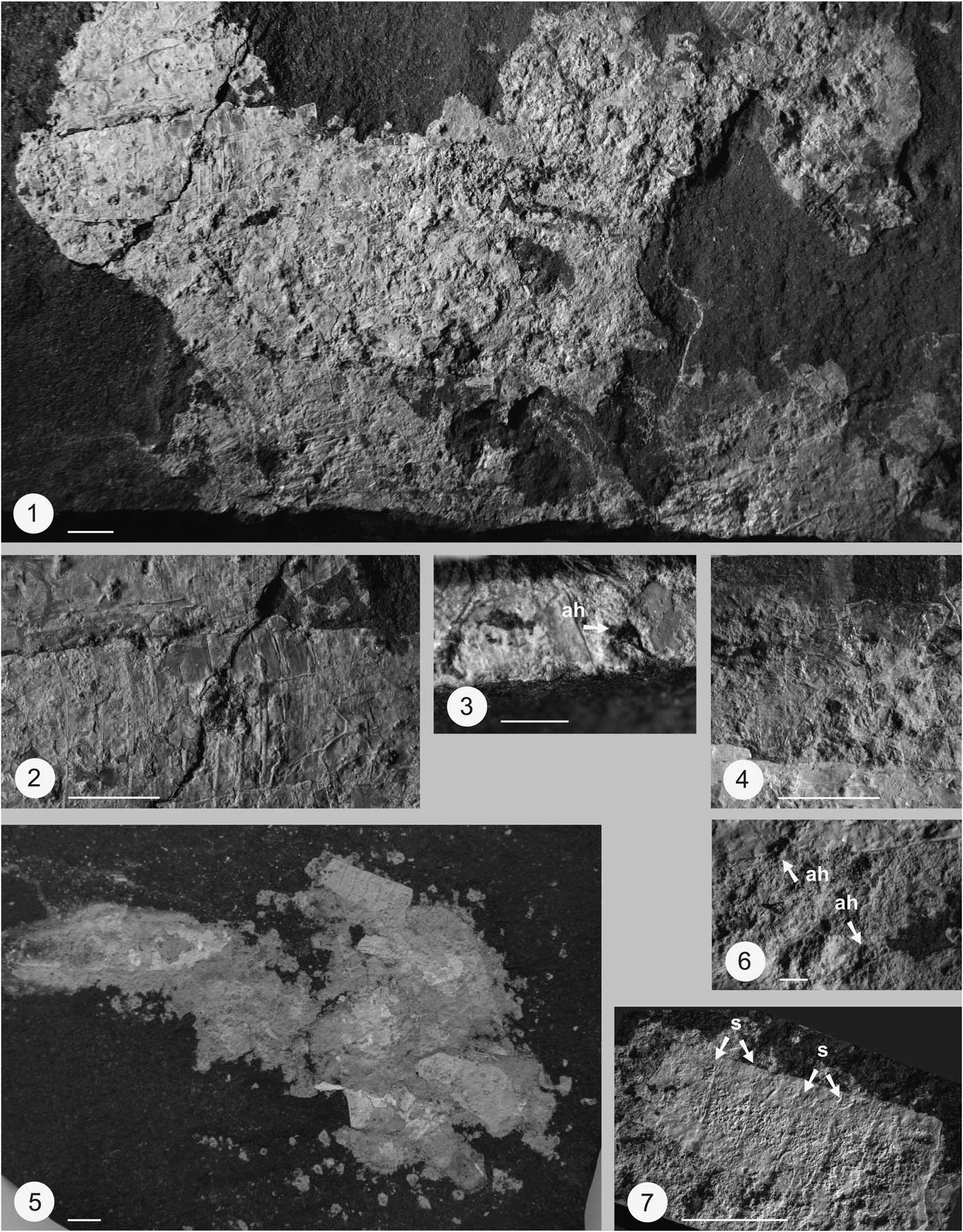
(1–4) Unidentified coleoid specimen UMSN 16569B. (1) Overall view of the disarticulated and fragmented pieces of the phragmocone and body chamber on a single bedding plane in the shale; (2) enlargement of a section of the phragmocone showing the septal spacing and the size of the mural part of the septal attachment to the inner shell wall; (3) enlargement of a partly complete arm hook (ah) surrounded by macerated debris and fragmented shell pieces; (4) impression of a phragmocone segment (lower) and macerated debris (upper); (5–7) Unidentified coleoid specimen UMSN 16566A; (5) shell debris with unidentified finely macerated material preserved as an irregular blob on a single bedding plane; (6) enlargement showing two arm hooks (ah) in macerated debris; (7) enlargement of a segment of the phragmocone showing septal spacing (s). Scale bar is 3 mm in Figure 4.3 and 1 mm in Figure 4.6; the remaining scales are 5 mm.

Description
Eight debris cluster specimens (UNSM 16563, 16564-6 pieces, 16565, 1656A, B, 16569A, B, 16570, 16571, 16572) are included in the Stark coleoid collection. All of the specimens are similar in preservation with replacement of the aragonitic shell by phosphate and the degree of fragmentation of the cephalopod conchs. The shell replacement ranges from good to poor, with some shell fragments being well preserved with two layers of shell and other segments being preserved as “ghosts” with only a thin film on the shale surface. The shell debris is confined to a single bedding plane on shale slabs, as are the named coleoids described elsewhere in this report. Some specimens differ slightly in being shell dedris without significant other material in the cluster and other specimens having unidentifiable, finely macerated debris mixed with the shell fragments. The debris clusters are irregular in size ranging from 55 mm to 115 mm in maximum length. Only one specimen (UNSM 16564) appeared to have ink fragments dispersed among the shell debris. Four specimens (UNSM 16565–16567 and 16571) have scattered arm hooks associated with the debris clusters; all the hooks are moderately to poorly preserved and are <1 mm in length. The siphuncle is present on four specimens (UNSM 16562, 16564, 16566, and 16570) and is preserved by relatively thick circular structures that contain the cyrtochoanitic septal necks. The thickness of the structures compared to the relative thinness of the shell probably represents cameral deposits around the septal necks, which allowed greater preservation potential. The circular structures range in diameter from 1.8 to 3.1 mm; the large range in diameter is probably the result of variations in the orientation of the structures and amount of septal deposits around the septal necks. All of the clusters have pieces of phragmocone, and septal spacing ranges from 0.6 to 3.3 mm; most have a septal spacing of 1.5 to 2.5 mm. All of the specimens appear to have some shell fragments that were a part of the body chamber. The longest body chamber segment is on specimen UNSM 16570 with a length of 55 mm.
Specimen UNSM 16569 (Fig. 3.1–3.6) was selected as being typical of the debris clusters. The fossilized material forms an irregular-shaped blob that was partly controlled by how it was originally deposited and how the bedding planes split during the collecting process. All of the shell debris, which was probably somewhat three-dimensional despite being broken into fragments when deposited on the sea floor, has numerous fractures and deformation due to flattening produced by lithostatic compaction. Some shell pieces show ‘wrinkling” and folding of the shell fragments suggesting that there were significant amounts of organic material in the shell ultrastructure. Only two poorly preserved arm hooks are present in the cluster, and they are scattered in the unidentifiable, finely macerated debris associated with the phragmocone and body chamber pieces. Septal spacing on phragmocone segments ranges from 1.2 to 2.3 mm.
Occurrence
All of the coleoid debris clusters were recovered by splitting blocks of Stark Shale (Pennsylvanian, Missourian=Kasimovian) at the Old Public Works (WPA) Quarry near Bellevue, Nebraska. No other information is available. The degree of completeness of the clusters was controlled by the shape of the shale block in the waste pile in the quarry and in the “luck of the split” when processing any particular shale block.
Discussion
These clusters are considered to be coleoids based on the combined presence of ink, arm hooks, septal spacing, and similarity in preservation. Based on the presence of the finely macerated material and the breakage associated with the coloeid shells, these clusters are interpreted as ejectoid masses or as coprolites from predators. It is unlikely that this shell breakage occurred after the coleoid was deposited on the sea floor because the sea floor is thought to have been anoxic based on the lack of benthic fauna and the presence of bedded and nodular phosphate in the shale. Based on described taxa from the Carboniferous, these coleoids are most closely related to Donovaniconus from the Wewoka Formation (Pennsylvanian, Desmoinesian=Moscovian) in Oklahoma (Doguzhaeva et al., Reference Doguzhaeva, Mapes and Mutvei2003) or to a closely related taxon.
Acknowledgments
All of the specimens described herein were collected by W.D. White, J.P. Pope, and R. Pabian from limestone quarries in the vicinity of Omaha, Nebraska and across the border to the east in west central Iowa. We thank them for their tireless efforts in developing these irreplaceable Stark collections. Additionally, RHM is very grateful to K. Tanabe and his students for helpful discussions of these specimens and fossil ink, and to K. Sasaki, all at the University of Tokyo, Tokyo, Japan for aiding in obtaining the modern coleoids and their ink. Some of the figure photographs were produced by J. Sattler, and P. Sattler used her skills to assemble the figures. We are very grateful for their assistance and skills.