





1. Introduction
Stellar rotation plays a fundamental role in shaping the internal structure and evolution of stars. It impacts the redistribution of angular momentum as well as the mixing of chemical elements, thereby influencing stellar lifetimes, evolutionary paths, nucleosynthesis, and observable surface properties (Maeder Reference Maeder2009; Aerts Reference Aerts2021).
Thanks to helio- and asteroseismology, we have direct constraints on the internal rotation profiles of different types of stars. For the Sun, helioseismic inversion revealed a nearly uniform rotation in the radiative zone until
 $0.25R_{\odot}$
(García et al. Reference García, Turck-Chièze, Jiménez-Reyes, Ballot, Pallé, Eff-Darwich, Mathur and Provost2007). Observations with Kepler of a sample of main sequence stars with masses below
 $\sim$
1.5M
 $_{\odot}$
provide strong indications that the rotation rates of their surface and their interior are generally similar (within a factor of
 $\sim 2$
; Benomar et al. Reference Benomar, Takata, Shibahashi, Ceillier and García2015, Reference Benomar, Bazot, Nielsen, Gizon, Sekii, Takata, Hotta, Hanasoge, Sreenivasan and Christensen-Dalsgaard2018; Nielsen et al. Reference Nielsen, Schunker, Gizon and Ball2015). The core of more massive main sequence
 $\gamma$
-Doradus stars appears to be slowly rotating (Van Reeth et al. Reference Van Reeth, Tkachenko and Aerts2016; Ouazzani et al. Reference Ouazzani, Marques, Goupil, Christophe, Antoci, Salmon and Ballot2019; Li et al. Reference Li, Van Reeth, Bedding, Murphy, Antoci, Ouazzani and Barbara2020). For subgiant and red giant stars, asteroseismic analyses show that their cores rotate only a few times faster than their envelopes (e.g. Beck et al. Reference Beck, Montalban, Kallinger, De Ridder, Aerts, García, Hekker, Dupret, Mosser, Eggenberger, Stello, Elsworth, Frandsen, Carrier, Hillen, Gruberbauer, Christensen-Dalsgaard, Miglio, Valentini, Bedding, Kjeldsen, Girouard, Hall and Ibrahim2012; Mosser et al. Reference Mosser, Goupil, Belkacem, Marques, Beck, Bloemen, De Ridder, Barban, Deheuvels and Elsworth2012; Deheuvels et al. Reference Deheuvels, Doğan, Goupil, Appourchaux, Benomar, Bruntt, Campante, Casagrande, Ceillier and Davies2014; Aerts et al. Reference Aerts, Mathis and Rogers2019). However, current one-dimensional stellar evolution codes, which account for rotationally induced hydrodynamical instabilities (including shear turbulence) and large-scale meridional circulation, fail to reproduce these seismic constraints. In such models, the internal angular velocity remains much faster than the observed ones, by up to two orders of magnitude in the case of red giants (e.g. Turck-Chièze et al. Reference Turck-Chièze, Palacios, Marques and Nghiem2010; Eggenberger, P. et al. 2012; Marques, J. P. et al. 2013; Cantiello et al. Reference Cantiello, Mankovich, Bildsten, Christensen-Dalsgaard and Paxton2014). This discrepancy strongly suggests that additional mechanisms for angular momentum transport must be at work in stably stratified regions of stars (Mathis Reference Mathis2013; Zahn, J.-P. 2013).
Among the proposed candidates for angular momentum transport are internal gravity waves (IGWs), which are excited at the interface between convective and radiative zones by the Reynolds stresses of convective motions and coherent plumes (Schatzman Reference Schatzman1993; Zahn et al. Reference Zahn, Talon and Matias1997; Kumar and Quataert Reference Kumar and Quataert1997; Pinçon et al. Reference Pinçon, Belkacem and Goupil2016). IGWs have been shown to efficiently extract angular momentum from stellar cores and may allow for the explanation of the nearly rigid rotation observed in solar-like stars (Talon and Charbonnel Reference Talon and Charbonnel2005; Charbonnel et al. Reference Charbonnel, Decressin, Amard, Palacios and Talon2013), in sub-giants (Pinçon et al. Reference Pinçon, Belkacem, Goupil and Marques2017), and in the radiative envelope of early-type stars (Lee and Saio Reference Lee and Saio1993; Rogers Reference Rogers2015; Fuller Reference Fuller2017; Neiner et al. Reference Neiner, Lee, Mathis, Saio, Lovekin and Augustson2020).
In this work, we focus on the impact of rotation on the damping of IGWs, extending their classical treatment to the gravito-inertial regime, where the Coriolis acceleration modifies both wave propagation and their dissipation. We present recent developments implemented in the stellar evolution code STAREVOL (Amard et al. Reference Amard, Palacios, Charbonnel, Gallet, Georgy, Lagarde and Siess2019), which incorporates rotation in the wave damping formalism, and we discuss their consequences for the redistribution of angular momentum during the pre-main-sequence and main sequence of a 1
 $M_{\odot}$
star.
2. Internal Gravity Waves and Angular Momentum Transport
The efficiency of angular momentum transport by IGWs depends on three key processes: wave excitation, propagation, and dissipation. They are excited at the boundaries of convective zones by Reynolds stresses and the penetration of convective plumes, and they propagate within stably stratified radiative regions. They are dissipated through three main processes: linear thermal diffusion, interaction with critical layers, and non-linear breaking (Zahn et al. Reference Zahn, Talon and Matias1997; Alvan et al. Reference Alvan, Mathis and Decressin2013; Mathis Reference Mathis2025). As IGWs damp radiatively or through corotation resonances, they deposit positive or negative angular momentum locally, depending on their prograde or retrograde nature, respectively. Previous studies have shown that IGWs can efficiently redistribute angular momentum and reproduce the nearly uniform rotation in solar-type stars (Talon and Charbonnel Reference Talon and Charbonnel2005; Charbonnel et al. Reference Charbonnel, Decressin, Amard, Palacios and Talon2013). In the classical (non-rotating) formalism adopted then, the local damping rate depends on thermal diffusivity, turbulent viscosity, and the local Doppler-shifted frequency. However, it is important to also account for the fact that rotation modifies both the amplitude and frequency spectrum, as well as the damping factor.
Analytical prescriptions implemented in 1D stellar evolution codes often neglect these rotational effects, relying on expressions derived for pure gravity waves. When rotation is included, it is typically under the traditional approximation of rotation (TAR, e.g. Eckart Reference Eckart1960; Berthomieu et al. Reference Berthomieu, Gonczi, Graff, Provost and Rocca1978), which assumes that stratification dominates over the Coriolis acceleration (
 $2\Omega \ll N$
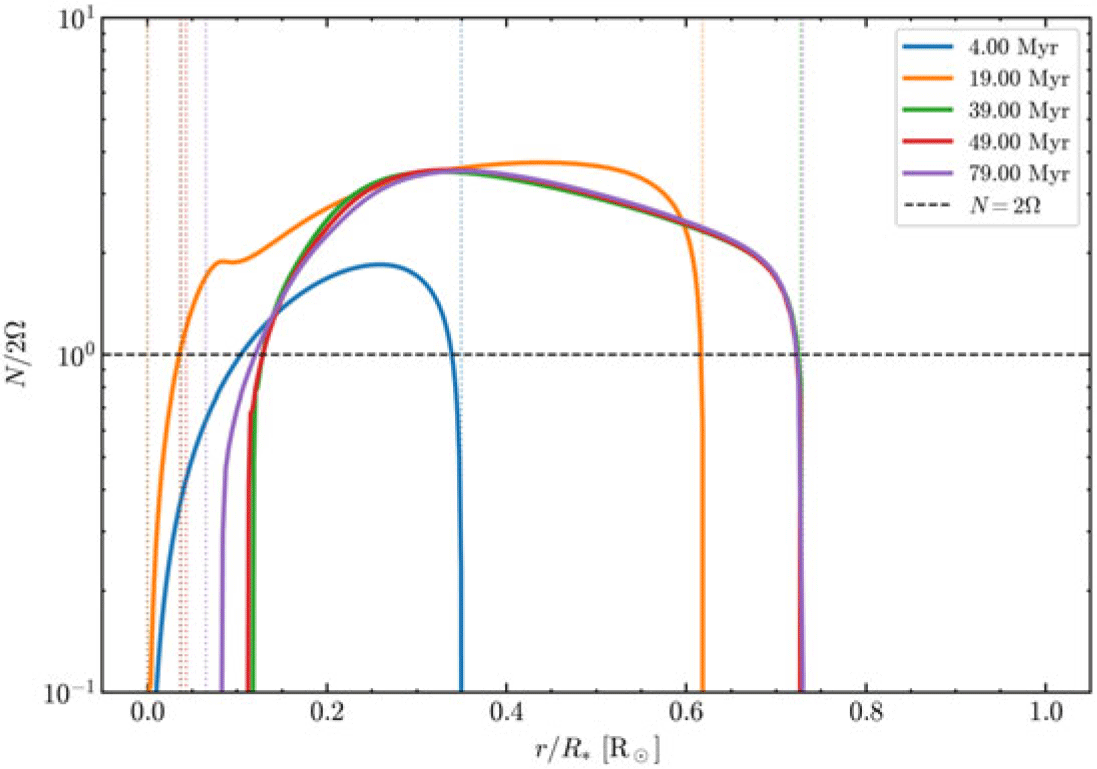
) in the vertical direction and neglects the horizontal component of the rotation vector (Pantillon et al. Reference Pantillon, Talon and Charbonnel2007; Mathis et al. Reference Mathis, Talon, Pantillon and Zahn2008; Mathis, S. 2009). However, this assumption is not always valid. For example, in the radiative zones of pre-main-sequence (PMS) stars, the Brunt-Väisälä frequency N and the Coriolis acceleration
 $2\Omega$
are often of the same order of magnitude, as illustrated in Fig. 1. In this regime, the Coriolis acceleration cannot be neglected anymore, and a full treatment of gravito-inertial waves (GIWs) is required.
Ratio of N/
 $2\Omega$
as a function of the normalized radius of a
 $1M_{\odot}$
star at different ages during the pre-main sequence. The vertical lines indicate the boundaries of the radiative zone at each age.

Figure 1 Long description
A line graph showing the ratio of N/2Ω as a function of the normalized radius of a 1 solar mass star at different ages during the pre-main sequence. The horizontal axis represents the normalized radius (r/R☉) ranging from 0.0 to 1.0. The vertical axis represents the ratio of N/2Ω on a logarithmic scale ranging from 10^-1 to 10^1. The graph includes five data lines representing different ages: 4.00 Myr (blue), 19.00 Myr (orange), 39.00 Myr (green), 49.00 Myr (red), and 79.00 Myr (purple). A dashed black line indicates the N=2Ω threshold. Vertical lines mark the boundaries of the radiative zone at each age. The blue line starts at a lower ratio and increases sharply, peaking around 0.2 normalized radius before declining. The orange, green, red, and purple lines follow a similar trend but start at higher ratios and peak at different positions along the normalized radius.
3. Analytical Formalism for Gravito-Inertial Waves
We implemented in STAREVOL a new analytical formalism for an equatorial-plane model developed by André et al. (2018), which is also intensively used in numerical simulations to study the transport of angular momentum by IGWs in rotating stars (e.g. Rogers et al. Reference Rogers, MacGregor and Glatzmaier2008, Reference Rogers, Lin, McElwaine and Lau2013; Rogers Reference Rogers2015; Varghese et al. Reference Varghese, Ratnasingam, Vanon, Edelmann, Mathis and Rogers2024). This formalism allows us to consistently include the effects of the Coriolis acceleration on the damping of internal gravity waves, thereby extending the classical prescription of IGWs into the gravito-inertial regime.
In the current version of our implementation, only the damping term is modified to include the effects of rotation. The excitation remains described by the standard non-rotating prescription (Talon and Charbonnel Reference Talon and Charbonnel2005), where waves are generated by convective Reynolds stresses – which would be modified by rotation (Mathis et al. Reference Mathis, Neiner and Tran Minh2014; Augustson et al. Reference Augustson, Mathis and Astoul2020). The damping factor
 $\tau$
therefore now explicitly depends on rotation, leading to a revised dissipation factor. This development constitutes the first step toward a fully consistent treatment of GIWs in a stellar evolution code. Future work will extend this formalism to the excitation process, incorporating the rotational dependence of the excited spectrum.
3.1. Gravito-Inertial Wave Damping
The deposition of angular momentum within the radiative layers occurs at the depth where individual monochromatic waves are dissipated by thermal diffusivity and viscosity or where they encounter a corotation resonance (Goldreich 1990; Schatzman Reference Schatzman1993; Zahn et al. Reference Zahn, Talon and Matias1997). Taking into account the Coriolis acceleration, the expression for the damping factor is:
 \begin{equation} \tau(r, \sigma, \ell) = [\ell(\ell+1)]^{3/2}\int_{r_c}^r \!\! \left( \frac{K_T + \nu_v}{N} \right)\! \left( \frac{N}\sigma \right)^2\! \left( \frac{N^2 + {{\alpha 2 \Omega \zeta}}}{\sigma^2} \right)\! \left( \frac{N^2}{N^2 + {\alpha 2 \Omega \zeta }- \sigma^2} \right)^{1/2}\! \frac{dr'}{r^3} \end{equation}
where
 $K_T$
and
 $\nu_v$
are the thermal diffusivity and vertical turbulent viscosity, N is the Brunt-Väisälä frequency,
 $\sigma$
is the local Doppler-shifted frequency, and
 $\Omega$
is the local angular velocity. The terms specific to the rotating case are highlighted in green. They are defined as:
 \begin{equation} \bar{\zeta} = 2\bar{\Omega} + r \frac{d\bar{\Omega}}{dr}\end{equation}
representing the latitudinal component of the mean flow vorticity, and
 \begin{equation} \alpha = 1 - \frac{m^2}{h^2}\end{equation}
which accounts for the azimuthal and latitudinal dependence of the wave. The local Doppler-shifted frequency is given by
 \begin{equation} \sigma(r) = \omega_0 + m[\Omega(r) - \Omega_{\mathrm{cz}}],\end{equation}
where
 $\omega_0$
is the wave frequency in the corotating frame of the convective envelope, which rotates with the angular velocity
 $\Omega_{\mathrm{cz}}$
.
The transport of angular momentum is followed in the equatorial plane under the combined action of IGWs modified by rotation, vertical shear induced turbulence, and meridional flows as in Talon and Charbonnel (Reference Talon and Charbonnel2005); Charbonnel et al. (Reference Charbonnel, Decressin, Amard, Palacios and Talon2013) and Mathis et al. (Reference Mathis, Decressin, Eggenberger and Charbonnel2013).
4. Application to a solar-like star
We tested the new GIW damping formalism in a
 $1M_{\odot}$
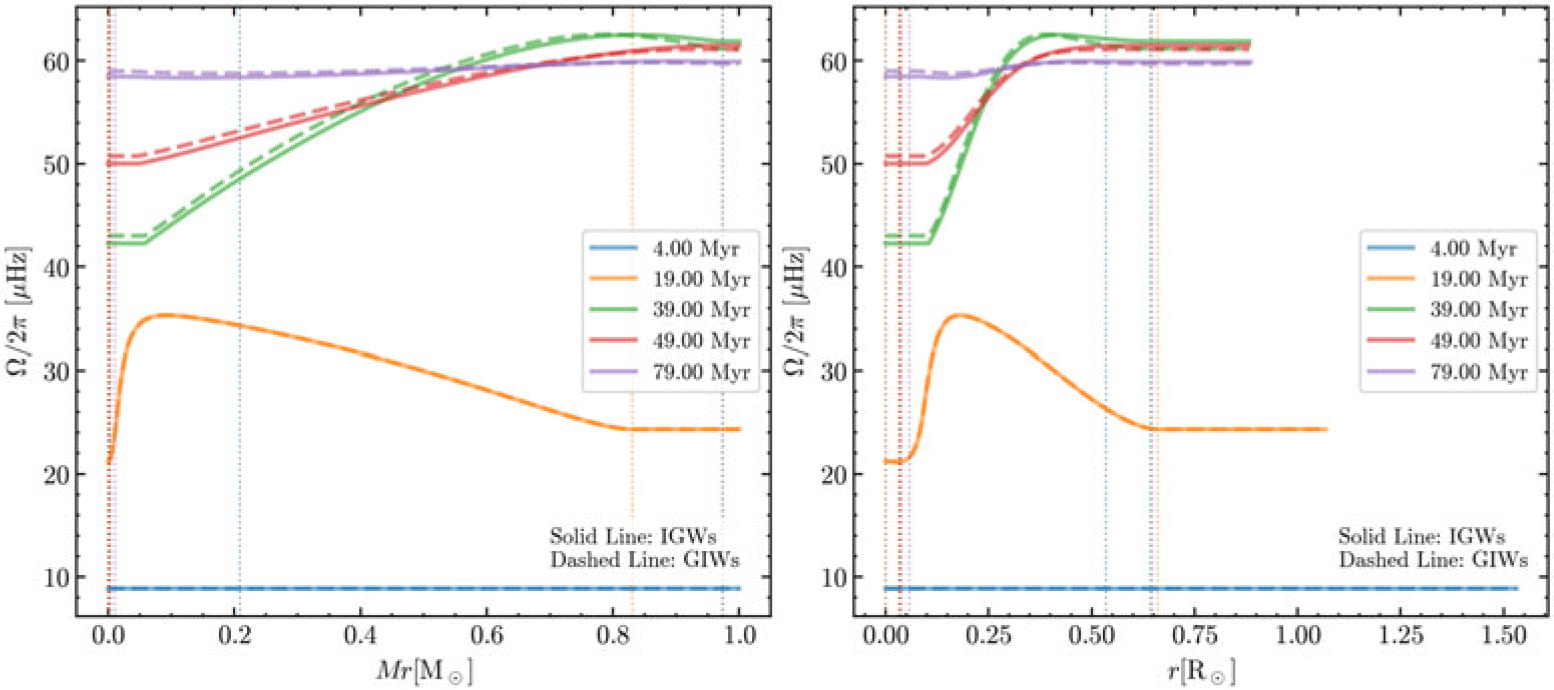
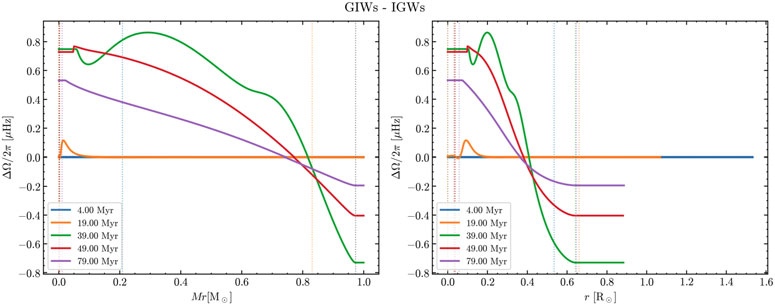
PMS and main-sequence (MS) model of a fast-rotating star (fast rotating case in Amard et al. Reference Amard, Palacios, Charbonnel, Gallet and Bouvier2016). Fig. 2 compares the internal rotation profiles obtained with the classical (non-rotating) IGW damping and with the Coriolis-modified GIW damping given in Eq.1. In both cases, the transport by waves redistributes angular momentum and efficiently mitigates the spin-up of the stellar core during contraction. However, when rotation is included in the damping term, the transport becomes slightly less efficient: the dashed lines in Fig. 2 show marginally higher rotation rates in the stellar core compared to the non-rotating IGW case. We quantify this effect in Fig. 3, where we compute the difference between the two formalisms as a function of radius and mass coordinate.
Evolution of the internal rotation profile of a
 $1M_{\odot}$
PMS star as a function of mass (right) and radius (left). Solid lines correspond to models including IGWs damping without rotation, while dashed lines show results when the Coriolis term is included in the damping prescription.

Difference between the rotational profiles obtained with IGWs and GIWs damping at various ages. Positive values indicate regions where the GIW case rotates faster than the IGW case.

These results confirm that GIWs play an important role in the angular momentum evolution of young stars. The inclusion of rotation modifies the spatial distribution of wave dissipation, shifting the damping region closer to the excitation zone near the convective-radiative interface, as observed in the traditional case (Pantillon et al. Reference Pantillon, Talon and Charbonnel2007). This indicates that rotation affects not only the overall efficiency of angular momentum transport but also the depth at which waves deposit their momentum within the radiative interior.
5. Discussion and Conclusions
Including rotation in the damping formalism provides a more complete and physically consistent description of the transport of angular momentum in stellar interiors by internal waves. The new prescription accounts for the influence of the Coriolis acceleration on wave dissipation, allowing us to better describe the transition from pure internal gravity waves (IGWs) to gravito-inertial waves (GIWs).
In our test case of a PMS and MS
 $1M_{\odot}$
model, we find that while both formalisms lead to a redistribution of angular momentum that mitigates and can even prevent the spin-up of the stellar core, the inclusion of rotation tends to very slightly reduce the overall efficiency of this transport. The Coriolis acceleration modifies the local wave frequencies and, therefore, the damping geometry, leading to stronger dissipation closer to the convective–radiative interface.
The present implementation of a Coriolis-modified damping formalism in STAREVOL constitutes the first step toward a fully consistent treatment of GIWs in stellar evolution models. Next, we will focus on extending the formalism to the wave excitation mechanism, following, for example, the work by Neiner et al. (Reference Neiner, Lee, Mathis, Saio, Lovekin and Augustson2020) and Bessila et al. (Reference Bessila, Deckx van Ruys, Buriasco, Mathis, Bugnet, García and Mathur2025). This will allow a comprehensive assessment of how rotation affects both the generation and the dissipation of waves, and ultimately, their contribution to angular momentum redistribution in stars of different masses and rotation rates.
Acknowledgements
LRG, LA, and CC acknowledge support by the Swiss National Science Foundation (Projects 200020-192039, 200021-212160 and 200021L-231331 PI CC). LA and CC also acknowledge support from the French Agence Nationale de la Recherche (ANR-24-CE93-0009-01) “PRIMA - PRobing the origIns of the Milky WAy’s oldest stars”. S.M. acknowledges support from the European Research Council (ERC) under the Horizon Europe programme (Synergy Grant agreement 101071505: 4D-STAR), from the CNES SOHO-GOLF and PLATO grants at CEA-DAp, and from PNPS (CNRS/INSU). While partially funded by the European Union, the views and opinions expressed are, however, those of the author only and do not necessarily reflect those of the European Union or the European Research Council. Neither the European Union nor the granting authority can be held responsible for them.
 2Ω
 1M⊙
 1M⊙

 Open access

