INTRODUCTION
More than 1.5 million Americans live in nursing homes, and 43% of individuals who reach the age of 65—slightly under half of us—will move into a nursing home at some point in our lives. To live in a nursing home also, quite likely, means to die there. The mortality rate for nursing home residents is approximately 25% per year, and one of every four chronic-disease deaths in this country now occurs in a nursing home bed (Teno, Reference Teno2004). Despite this, we know relatively little about dying experiences in long-term-care settings. Innovations dedicated to advancing palliative care generally have not targeted the nursing home community, and reports of suboptimal end-of-life care in these settings abound (Teno et al., Reference Teno, Weitzen and Wetle2001; Reynolds et al., Reference Reynolds, Henderson, Schulman and Hanson2002; Mitchell et al., Reference Mitchell, Kiely and Hamel2004; Oliver et al., Reference Oliver, Porock and Zweig2005).
Our study investigated two palliative care domains: (1) the ability of dying individuals and their loved ones to have some say over the kind of medical treatments received near the end of life, routinely called advance care planning, and (2) management of pain. Although there is no gold standard as to what constitutes excellence in end-of-life care, involving seriously ill individuals and their family members in discussions about care options and adequately controlling pain are accepted widely as important components of high-quality palliative care (Singer et al., Reference Singer, Martin and Kelner1999; Steinhauser et al., Reference Steinhauser, Christakis and Clipp2000). We examine the extent to which these indicators of care vary based on residents' race and age.
In the general population, we know that disparities in end-of-life care exist. Caucasians have much higher rates of advance care planning, for example, than do racial minorities (Hopp, Reference Hopp2000; Hopp & Duffy, 2000; Phipps et al., Reference Phipps, True and Harris2003), and minorities reportedly often receive inferior pain management (Crawley et al., Reference Crawley, Payne and Bolden2000; Anderson et al., Reference Anderson, Mendoza and Valero2000). Few studies, however, examine whether these differences remain once individuals enter institutional settings. There is evidence that racial differences in advance care planning continue into nursing home settings (Kiely et al., Reference Kiely, Mitchell, Marlow, Murphy and Morris2001; Degenholtz et al., Reference Degenholtz, Arnold, Meisel and Lave2002). Studies exploring the correlation between end-of-life care planning and other demographic characteristics (e.g., age, sex) of nursing home residents have found conflicting results (Lurie et al., Reference Lurie, Pheley and Miles1992; Terry & Zweig, Reference Terry and Zweig1994; Mark et al., Reference Mark, Bahr and Duthie1995), and some research suggests that the rate at which nursing home residents' pain is detected and treated varies by residents' demographic characteristics, with older residents and racial minorities particularly at risk for undertreatment of pain (Engle et al., Reference Engle, Fox-Hill and Graney1998; Won et al., Reference Won, Lapane and Gambassi1999).
For this article, we analyzed data collected as part of a nursing-home-based quality improvement project. We first describe our sample nursing home population. We then detail the levels of advance care planning and pain management documented in residents' charts and stratify these data by race and age subgroups, examining the extent to which the facilities addressed the palliative care needs of all residents, irrespective of race or age.
METHODS
Study Design
The data reported in this article are part of a larger effort to design, implement, and evaluate a nursing-home-based palliative care quality improvement project, described elsewhere (Hanson et al., Reference Hanson, Reynolds and Henderson2005). We conducted explicit chart reviews in 12 nursing homes in central North Carolina from 2001 to 2004. We purposefully selected nursing homes to represent the organizational heterogeneity of long-term-care organizations in the state. Therefore, nursing homes in this study include both for-profit (n = 4) and not-for-profit organizations, locally owned and chain-owned (n = 5) facilities, hospital-affiliated institutions (n = 4), and free-standing facilities as well as health care centers within continuing care retirement communities (n = 4). Facilities in our sample varied in size, ranging from 80 to 250 beds; all were located in small urban or suburban communities. Because collaboration with local hospices was a criterion of the larger study, all participating facilities had contracts with a community hospice organization, as do 76% of nursing homes nationally (Miller & Mor, Reference Miller and Mor2004).
Approval for the study was granted by the University of North Carolina School of Medicine's Institutional Review Board.
Data Collection
At the outset of the larger study, investigators developed a structured chart abstraction instrument, and pairs of investigators piloted chart abstraction on 15 charts in each of two different facilities. The pilot demonstrated good feasibility and high interrater reliability (kappa ≥ .80 all items). Research assistants abstracted data on resident demographics, health status, and palliative care quality indicators from a 40% random sample of charts. Because we collected data in each nursing home on several occasions for the larger study, individual residents' charts could have been sampled at more than one point in time. To create the database for this study, if we reviewed a resident's chart more than once, we used data only from the first review. Our final data set includes information abstracted from the charts of 1133 unique nursing home residents.
Measures
We collected data on each resident's basic demographic characteristics, including age, race, sex, and primary chronic disease diagnoses. Per Centers for Medicare & Medicaid Services (CMS) requirements, every nursing home receiving federal funds must complete a standardized assessment form, the Minimum Data Set (MDS), for every resident upon admission, and then quarterly or whenever there is a major change in health status. Using residents' most recent MDS, we noted whether or not nurses completing the MDS reported that a resident experienced pain in the past 7 days, and, if so, whether that pain was mild, moderate, or severe. To further examine pain management practices, we looked at physicians' orders, nurses' notes, each resident's most recent “Care Plan,” and daily medication reports to document what medications and nonpharmacological treatments had been administered to relieve pain.
To measure advance care planning, we looked in the “physicians' notes,” “MD orders,”and “advance directives” sections of each chart to collect information on four topics: whether or not a resident in the nursing home had (1) a do not resuscitate order, (2) a living will, (3) a health care proxy or health care power of attorney, or (4) whether or not there was chart documentation of any kind of in-depth discussion between residents/families and health care providers about end-of-life care issues. Examples of items we counted in this latter category included conversations about food and drink choices when swallowing was becoming problematic, discussions about spiritual concerns as death approached, or dialogues about incorporating comfort measures into the goals of care.
With the exception of age, all variables in our data set are nominal or ordinal. We recoded age into a three-way categorical variable, comprised of the youngest residents (those from 22 through 79 years of age, with an average of 69), a middle range (for residents between 80 and 87 years of age, with an average of 84), and the oldest residents (those 88+ years of age, with an average of 92). Groupings were of relatively equal sizes. These age cutpoints generated useful treatment goal distinctions, with the younger nursing home residents most likely to be on a rehabilitation track, the oldest residents most likely to remain long-term inhabitants of their respective nursing homes, and the middle group to represent a mix of both.
Our data collection instrument included three racial categories: Caucasians, African-Americans, and others. By the end of data collection we had only five individuals in the “other” category (three Latinos and two Native Americans)—too few to conduct meaningful analyses; therefore we created racial categories of “whites” and “minorities” and included African-Americans, Latinos, and Native Americans in the latter group.
Analysis
To characterize our sample nursing home population, we generated univariate descriptive statistics. We then stratified the data by race and age and used standard statistical tests to determine whether differences in advance care planning and pain management existed by residents' demographic characteristics, using chi-squared (χ2). P values given are for asymptotic two-sided tests. For two-by-two tables, we used the Yates' Correction for Continuity in presenting the p values, as this compensates for the overestimate of the chi-squared value when each variable has only two values (Pallant, Reference Pallant2001). We used the software package SPSS 11.5 for analysis.
RESULTS
Resident Characteristics
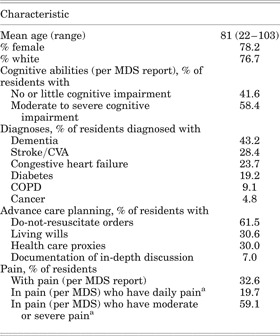
Residents in our sample were typical of the U.S. nursing home population: older, mostly female, predominately white, with a wide range of chronic, progressive diseases of uncertain prognosis. The average and median age in our sample was 81 and 83, respectively, with a range from 22 to 103. Almost 80% of residents were female, and over 75% of residents were white. A more detailed presentation of resident characteristics is provided in Table 1.
Resident characteristics (N = 1133)

a The denominator used to calculate these percentages includes only residents documented on the MDS as having pain.
Differences by Race
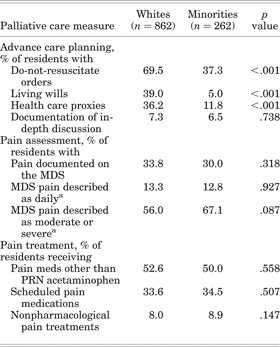
Stratifying our variables by race (Table 2), we found that whites were almost twice as likely as minority nursing home residents to have DNR orders. Furthermore, whites were almost eight times more likely than minorities to have living wills and three times more likely to have named a health care proxy. Chart-documented discussions of in-depth conversations about end-of-life care wishes were similar, and low, for both racial groups. In our sample, nursing staff who completed the MDS rated the presence and frequency of pain similarly across racial groups but described minority residents as having a greater intensity of pain: 56% of whites and 67% of minorities with pain experienced moderate to severe (as opposed to mild) pain, although this difference was not statistically significant (p = .087). We found no differences by race in either medication-based or nonpharmacological treatments for pain.
Palliative care measures by race

a aThe denominator used to calculated these percentages includes only residents documented on the MDS as having pain
Differences by Age
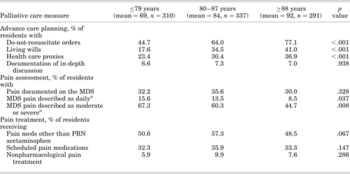
In an analysis stratified by age (Table 3), we see that traditional measures of advance care planning—DNR orders, living wills, and health care proxies—are positively and highly correlated with age, although in-depth conversations about residents' and families' end-of-life care wishes remained low no matter what a resident's age. Nurses' reports of the presence of pain did not vary by age cohort, but, when they detected pain, they were much more likely to describe younger residents' pain as moderate to severe while classifying the oldest residents' pain as mild; they were also more likely to recognize younger residents as having daily pain. Our analysis also showed that just less than half of the oldest residents received anything other than PRN acetaminophen to treat their pain, whereas 57% of their slightly younger cohort received stronger and/or regularly scheduled pain medications. This distinction approached significance (p = .067).
Palliative care measures by age

a aThe denominator used to calculated these percentages includes only residents documented on the MDS as having pain.
DISCUSSION
Improving end-of-life care in nursing homes has the potential to affect a significant percentage of the U.S. population, given the large number of deaths occurring in these settings and the many individuals who are touched by each of these deaths, such as family members, staff, and fellow residents. This study adds to our rather rudimentary knowledge base about end-of-life care in long-term-care settings. In addition, it contributes to the growing literature on disparities in health care.
Resident Characteristics
The residents in our study, as in most nursing homes, present an interesting case for end-of-life care. Less than 5% of the residents in the nursing homes in which we worked have cancer, the disease most commonly associated with excellence in palliative care. The vast majority will die of advanced chronic illnesses, such as heart failure, lung disease, or neurological diseases such as stroke or Alzheimer's dementia. The course of these illnesses is less predictable than the final stages of terminal cancer, and there is greater uncertainty about the timing of death. This uncertainty, as well as the prevalence of cognitive impairment, creates unique challenges in advance care planning and in pain assessment and treatment.
Advance Care Planning
Our study confirms earlier research highlighting racial differences in rates of advance care planning, with minority populations much less likely than whites to have all types of written advance directives. This tendency, which has been most well documented in acute-care hospitals, continues into nursing home settings (O'Brien et al., Reference O'Brien, Grisso and Maislin1995). To the extent that advance care planning enhances autonomy and improves the quality of care at the end of life, African-Americans and other racial minorities residing in nursing homes are relatively disadvantaged, compared to their white fellow residents.
We note in our sample, however, that the racial difference in advance care planning is less pronounced with health care proxies than it is for living wills (an eightfold white/minority difference for living wills vs. a threefold white/minority difference for health care proxies). Given a cultural history of denial of basic health and medical care, we do not finding it surprising that many African-American individuals would be reluctant to sign documents that could be interpreted as renouncing their access to health care, as many people may view a living will. A health care proxy, however, is a document that intrinsically invites a conversation (by specifying a spokesperson). We speculate that such an approach may potentially be more palatable to individuals concerned about being unfairly denied medical care. Bolstering this argument, we note that white nursing home residents seem to have similar comfort levels in signing living wills and health care proxies (with whites having just under a 40% completion rate for both types of advance directives). In contrast, over twice as many minority residents produced health care proxies (12%) as opposed to living wills (5%). In addition, although in-depth discussions about end-of-life care wishes were low for all residents, this report may be the only published finding of an advance care planning approach that does not demonstrate a large racial differential. These data suggest to us that, although there is still a long way to go in achieving better advance care planning for members of all racial groups, focusing on health care proxies and in-depth discussions may be one way to begin to ameliorate racial disparities in this area. This finding is in keeping with the most current research and thinking on the importance and influence of cultural issues in end-of-life care (Berger, Reference Berger1998; Hern et al., Reference Hern Jr., Koenig and Moore1998; Morrison et al., Reference Morrison, Zayas and Mulvihill1998; Kagawa Singer & Blackhall, Reference Kagawa Singer and Blackhall2001).
Our study also demonstrates a glaring differential in advance care planning by age, with advance directives much more common for older residents than for younger residents. Nursing homes in our sample do seem to recognize the importance of completing advance directives for older residents, who are statistically more likely to die. Many younger individuals who are unhealthy enough to be living in a nursing home, however, are at risk of death at an early age. Even if younger individuals spend time in a nursing home for rehabilitation or recovery from a non-life-threatening illness, they too could benefit from advance care planning, as the timing of death is always uncertain. The relatively low rates of advance directives for younger residents represent missed opportunities for nursing home staff to talk with residents of all ages about these issues.
Furthermore, although nursing homes may be responding to the very high mortality rates in their facilities by devoting attention to obtaining advance directive documents from their oldest residents, this unfortunately does not translate into more sophisticated forms of end-of-life care planning (Happ et al., Reference Happ, Capezuti and Strumpf2002). In our sample, discussions between nursing home staff and residents/families that focused on quality of life or desired care when death may be near occurred for only about 1 out of every 15 residents, irrespective of residents' demographic characteristics.
Pain Management
In our study, nurses completing the MDS identified 33% of residents as experiencing pain. We know from in-depth and varied studies of pain in nursing homes that somewhere between 50% to 80% of nursing home residents have pain (Ferrell, Reference Ferrell1995; Stein, Reference Stein2001; Allcock et al., Reference Allcock, McGarry and Elkan2002). In our sample of nursing homes, then, pain is likely underidentified. This is not surprising, given that underidentification of pain is an endemic problem in long-term-care facilities (Ferrell, Reference Ferrell and Rubenstein1993; Kovach et al., Reference Kovach, Weissman and Griffie1999; Baier et al., Reference Baier, Gifford and Patry2004). We were somewhat surprised, however, to discover that identification of pain was not correlated with residents' race. There is a growing body of research from acute care and hospital settings suggesting that racial minorities receive inferior pain management, but we did not see such a disparity in our study.
The only clearly significant difference we observed in pain management was a trend toward rating the pain of older residents as milder and less frequent than the pain of younger residents. Given that numerous painful conditions, such as osteoarthritis, osteoporosis, and neuropathies, are more common with age, this finding is perhaps counterintuitive. It may indicate ageist thinking on the part of nursing home staff, if elder individuals are believed to experience less pain than younger individuals or if pain is regarded as an untreatable or acceptable phenomenon of the aging experience. In addition, signs of pain can become more difficult to recognize as communication abilities decline with age. These and other possibilities, as well as potential remedies, could be explored in further studies.
Limitations
It is important to consider the limitations of this research. Our analysis makes no claims of causation; rather, it highlights only correlations. Given the relatively weak inferences that can be made from observational studies, this work may best be viewed as a springboard for further research. We did not have data to control for additional demographic characteristics, which potentially could have modified the relationships we observed. Furthermore, our data come from 12 nursing homes, all located in one Southeastern state. These facilities may share regional characteristics that limit generalizability. Finally, we conducted all our analyses at the resident level, with no controls for organizational factors. With only a dozen long-term care facilities in our sample, we did not have the power to conduct such multilevel analyses. We attempted to minimize these limitations by sampling facilities representing a broad range of the nursing home spectrum. Our study included facilities with different ownership structures, sizes, practice patterns, and institutional affiliations.
SUMMARY
In summary, we found that, as in acute-care settings and among the general populace, Caucasian nursing home residents were much more likely than minority residents to have formal advance directives. This type of advance care planning was also more common among older as compared to younger residents. Despite the fact that nursing homes have extremely high death rates, advance care planning in these settings is still focused on obtaining DNR orders and other documents specifying limits on care. In-depth documented discussions of goals of medical care and treatment orders were rare regardless of the age or race of residents. Redefining advance care planning to center on values and goals of care and to include discussions about enhancing quality of life, rather than on placing limits on medical treatments, may lessen racial disparities in end-of-life care.
We also found that resident age but not resident race was associated with pain management practices in nursing home settings, with nurses considering younger residents' pain to be more intense and frequent than older residents' pain. If nursing homes are doing a better job than other health care institutions of eliminating racial disparities in pain management, further studies of how they are accomplishing this are warranted. Nursing home staff, however, should recognize that residents of any age can experience pain, and they should be particularly vigilant to ensure that they are not overlooking signs of pain among their oldest residents.
ACKNOWLEDGMENTS
We thank Robert F. DeVellis, Brenda M. DeVellis, Laura A. Linnan, and Matthew P. Tiedemann for reviewing and commenting on drafts of this article. The Duke Endowment funded the intervention study through which the data for this article were collected. Kimberly Reynolds's time was supported in part by an AHRQ/NRSA predoctoral fellowship, administered through the Cecil G. Sheps Center for Health Services Research, University of North Carolina at Chapel Hill, and a Veterans Affairs postdoctoral fellowship, administered through the Health Services Research and Development Service, VA Medical Center, Durham, North Carolina.