Introduction
Approximately 1.2 million persons in Oakland County, Michigan (USA) reside less than 50 miles from the Fermi Nuclear Power Plant, Unit 2. The proximity of Michigan to the Great Lakes makes it susceptible to extreme weather events, including lake-effect storms (rain or snow) and tornadoes.Reference Steiger, Hamilton, Keeler and Orville 1 On October 6, 2010, two bands of thunderstorms and tornadoes caused damage to the Fermi Nuclear Power Plant, forcing an automatic shutdown. Although no radiation release was reported, the resulting power outage affected approximately 30,000 persons. As a result of the continued use of nuclear power in the United States,Reference Fitzgerald, Wollner, Adalja, Morhard, Cicero and Inglesby 2 efforts are in place to ensure that this power source is as safe as possible. However, the possibility remains that a nuclear power plant radiation emergency can still occur. 3 A radiation emergency is said to occur when radioactive material or radiation is released into the environment, whether intentionally (as in a terrorist event) or unintentionally (as in a nuclear power plant “accident”). This release can give rise to a hazardous condition wherein people and the environment can become contaminated with radioactive material or exposed to high doses of radiation. In addition to nuclear power plants, other possible sources of radiation emergencies include nuclear material transportation spills, explosive radiological dispersal devices (so-called “dirty bombs”), or detection of elevated radiation levels from an unknown source in air, food, or water. Taken together, these are all reason enough for developing comprehensive radiation emergency preparedness plans.
In Michigan, local health departments are responsible for disseminating public health information to the general public during a radiation emergency. 4 Emergency preparedness has not been assessed previously among residents in Oakland County. In support of updating emergency preparedness plans, including radiation emergency response plans, Oakland County Health Division (OCHD) requested the assistance of the Centers for Disease Control and Prevention (CDC) and the Michigan Department of Community Health (MDCH) to conduct a household preparedness assessment by using a Community Assessment for Public Health Emergency Response (CASPER) survey. 5
Ionizing radiation from a radiation emergency can create extreme fear among the public, compared with other health threats (eg, carbon dioxide, mercury, and pesticides) or other radiation sources (eg, radiographs in medical settings or radon in household settings).Reference Fitzgerald, Wollner, Adalja, Morhard, Cicero and Inglesby 2 , Reference Slovic 6 Thus, the absence of guidance based on sound scientific principles or the inability to predict the public's reaction during a radiation emergency, fear and low baseline knowledge about radiation can lead to worse outcomes. For instance, the lack of thorough guidance from officials during the Fukushima Daiichi nuclear disaster power plant disaster caused thousands of residents of Namie, Japan to evacuate north into the radioactive plume, believing the winter winds would have been blowing south and carrying away any radioactive emissions. 7
CASPER is a set of tools and methods designed by the CDC to collect reliable and accurate population-based public health information rapidly. 5 The CASPER methodology uses a 2-stage cluster sampling process originally developed by the World Health Organization to assess vaccination coverage rates, eliminating the need to enumerate all eligible persons among the population before selection.Reference Henderson and Sundaresan 8 , Reference Malilay, Flanders and Brogan 9 The 2-stage sampling design uses a probability proportionate to population size to select 30 clusters, or census blocks, in the first stage and a random selection of seven households in the second stage. These CASPERs have been used successfully in disaster and nondisaster settings; 10 – Reference Horney, Davis, Davis and Fleischauer 14 however, they are perceived to be most beneficial in nondisaster settings (eg, community health assessments) with clearly defined goals and objectives.Reference Horney, Davis, Davis and Fleischauer 14 In addition, the CASPER methodology has not been used previously to assess radiation emergency preparedness.
A CASPER survey was conducted to assess residents’ general needs and emergency preparedness plans, as well as their potential reaction to county officials’ instructions. Additionally, residents’ most trusted source of information and their main medium for obtaining information during a radiation emergency was determined. Field testing the CASPER methodology as a tool for radiation emergency preparedness planning was a secondary objective.
Methods and Materials
Assessment Area
Oakland County is located in southeast Michigan and borders the city of Detroit and also borders Macomb, Lapeer, Genesee, Livingston, and Washtenaw Counties (Figure 1, online only). The 2010 US Census recorded a population of 1,202,363 persons. Oakland County comprises 62 cities, villages, and townships, 15 all of which were included in the sampling frame for the CASPER survey.
Sampling Methodology
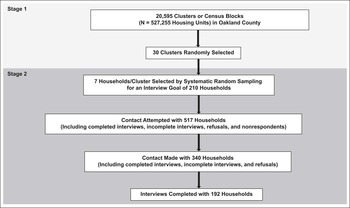
The CASPER methodology described in the CASPER Toolkit (Version 2.0, CDC, Atlanta, Georgia USA) was used and all households in Oakland County, comprising 527,255 housing units recorded by the 2010 US Census, were included in defining the sampling frame. 5 , 15 For the first stage of sampling, 30 census blocks, or clusters, were selected with a probability proportional to the number of housing units within the clusters by using the geographic information systems CASPER tool. Street-level and Google Earth (Google Incorporated, Mountain View, California USA) maps of each of the 30 clusters were generated to aid interview teams in locating the clusters. For the second stage of sampling, interview teams used systematic random sampling to select seven housing units/cluster. Systematic random sampling involved dividing the total number of households within a cluster by seven to provide n and then selecting every n th house within the cluster. Three attempts were made to conduct interviews at each selected household, after which a household was replaced by randomly selecting a housing unit within the same cluster not selected for interviewing previously. Households in which respondents declined interviews were also replaced in the same manner described (Figure 2).
A 2-Stage Cluster Sampling Design and the Household Participation Rate of the Oakland County, Michigan USA CASPER-2012. Census Block and Housing Unit Data. Source: United States Census Bureau.

Survey Implementation
The CASPER survey was conducted during September 10-12, 2012. Seventeen teams of two persons on Day 1, a total of 15 teams of two persons on Day 2, and one team of two persons on Day 3 were involved. Teams were comprised primarily of state and local public health staff, with CASPER training provided by staff from CDC's National Center for Environmental Health/Agency for Toxic Substances and Disease Registry. All interview teams underwent a 3-hour training session that focused on the overall purpose of the CASPER survey, household selection, interview techniques, administering questionnaires, safety, and logistics. The total survey collection time was approximately 11 hours.
A 2-page data collection instrument was developed collaboratively by OCHD, MDCH, and CDC. The questionnaire assessed household residents’ health care needs, emergency preparedness plans and supplies, and, in relation to a radiation emergency, anticipated response to emergency instructions from officials, most trusted information source, and main source for obtaining information during a radiation emergency. For each question, responses were collected as “Yes,” “No,” “Don't know,” or “Refused.” Team members also collected precise reasons for respondents answering “No” to radiation emergency-related questions. Before asking interviewees questions specifically related to radiation emergencies, a script was read to every interviewee, as follows:
Now, we are going to ask about how you might protect yourself and your family if there was a release of radioactive material that could affect your community. For example, what if there was a release from a nuclear power plant in Michigan USA similar to what happened in Japan last year following the earthquake and tsunami, or a substantial release of radioactive material because of a nearby transportation accident?
Before initiation of data collection, Oakland County advertised the survey through different media outlets, including the radio and Facebook (Facebook Inc., Menlo Park, California USA), and police were alerted to the presence of survey teams in communities. Interviews were conducted during 3 pm-8 pm Eastern Daylight Time. An attempt was made to conduct seven interviews/cluster, with a goal of 210 total interviews. An eligible respondent had to be aged ⩾ 18 years and residing in a household selected for interviewing. All eligible respondents approached were given an information sheet with contact telephone numbers for OCHD, educational material from OCHD regarding emergency preparedness, an OCHD bag in which to store emergency supplies, and additional OCHD information regarding West Nile virus and influenza vaccinations. Interviewers were also required to complete confidential referral forms whenever they encountered urgent physical or mental health needs in any household. This study was approved by the MDCH institutional review board for the protection of human research subjects.
Analysis
Data analyses were conducted using Epi Info Version 7.0.8.3 software (CDC, Atlanta, Georgia USA). A weighted cluster analysis was performed. The analysis incorporated the total number of housing units in the sampling frame, the number of housing units where interviews were conducted within each cluster, and the number of clusters selected to represent the estimated percentage and projected number of households. Specific calculations of outcomes were generated as follows: unweighted and weighted frequencies, unweighted and weighted percentages, estimated number of households, and the 95% confidence intervals of weighted percentages.
Results
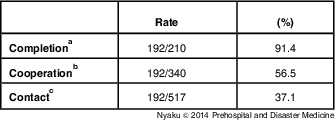
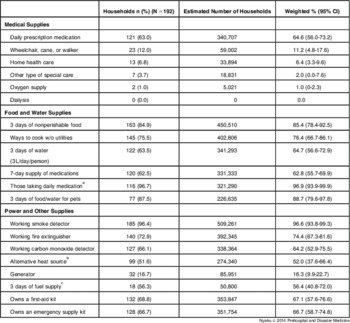
Interview teams completed 192 (91.4%) of the targeted 210 interviews. Contact was attempted with 517 households, and contact was made with 340 households (Table 1). The household respondent was asked, “Do you or any member of your household need X,” where X referred to a specific medical need. Approximately two-thirds of respondents (64.6%) reported that one or more persons in the household required daily prescription medication. Among 11.2% of households, one or more persons living there required a wheelchair, cane, or walker; 6.4% of respondents reported that one or more persons living there required home health care; and no respondent reported needing dialysis. Approximately 85% of respondents reported having a 3-day supply of nonperishable food (eg, protein bars or nuts) and 76.4% reported to have a way to cook food if they had no utilities (eg, gas or charcoal grill). Approximately two-thirds (64.7%) of respondents reported that they had a 3-day supply of drinking water (3 L/person/day). Among households with one or more persons taking prescribed medication, 62.8% of respondents reported having a 7-day supply of medications. Among households where one or more persons take daily medication, 96.9% of respondents had a 7-day supply. Approximately 88% of households with a pet reported that they had a 3-day food and water supply for their pets.
Questionnaire Response Rates for the Oakland County, Michigan USA CASPER-2012

aPercentage of surveys completed in relation to the goal of 210.
bPercentage of households where contact was made, including completed interviews, incomplete interviews, and refusals.
cPercentage of households where contact was attempted, including completed interviews, incomplete interviews, refusals, and nonrespondents.
In response to questions about emergency preparedness, 96.6% of respondents reported having a working smoke detector and 74.4% a working fire extinguisher; 64.2% of respondents reported having a working carbon monoxide detector and 52% an alternative heat source (eg, kerosene heater or a fireplace). Only 16.3% of respondents reported having a generator, and of these, approximately half (56.4%) reported having a 3-day supply of fuel. Approximately two-thirds of respondents (67.1%) reported that they had prepared a first-aid kit with medical supplies kept in a designated place. Two-thirds of respondents (66.7%) reported that they had prepared an emergency kit with supplies (eg, flashlights, radio, and extra batteries) kept in a designated place (Table 2).
Household Emergency Supplies for Oakland County, Michigan USA, CASPER-2012

Abbreviation: CI, confidence interval.
aOf residents taking daily medication (n = 120).
bAlternative heat source, which includes a kerosene heater or a fireplace.
cOf households with a generator (n = 32).
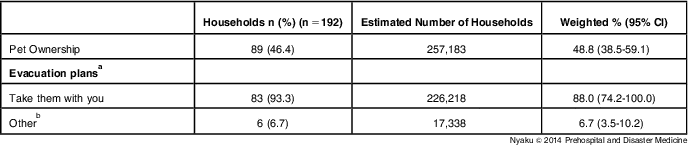
Eighty-eight percent of respondents with pets reported that they would take their pets with them during any emergency evacuation, including a radiation emergency. Plans for households not evacuating with their pets include finding a safe place to leave their pet, leaving their pet behind with food and water, and not evacuating because of their pet (Table 3).
Household Pet Ownership and Evacuation Plans for the Oakland County, Michigan USA, CASPER-2012

Abbreviation: CI, confidence interval.
aOf residents who own a pet (n = 89).
bOther evacuation plans, as follows: find a safe place to leave pet (3); leave behind food and water for pet (2); and will not evacuate because of pet (1).
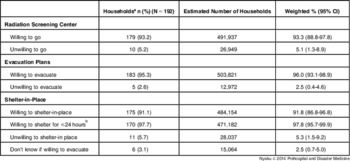
In response to the question, “If radioactive material was released and officials told you and your household to go to a radiation screening center, would you go there?” 93.3% of respondents reported that they were willing to go. Reasons indicated by those unwilling to go to a radiation screening center were: “I want to go to my own physician,” “I would just leave,” “I do not want to leave,” “I will go to the police station,” and “I don't like medical health care.” In response to the question, “If radioactive material was released and officials told you and your household to evacuate, would your household do so?” 96% of respondents reported that they were willing to evacuate. Reasons for unwillingness to evacuate were lack of transportation and inconvenience or expense. In response to the question, “If radioactive material was released and officials told your household to shelter-in-place, that is, to remain in a safe location, would your household remain in place?” 91.8% of respondents were willing to shelter-in-place. However, of the households willing to shelter-in-place, 97.8% of respondents reported they were willing to shelter-in-place for ⩽ 24 hours. Reasons provided from those unwilling to shelter-in-place were to reunite with family, to leave the area as quickly as possible, and a lack of trust in public health officials (Table 4).
Respondents’ Willingness to Follow Instructions from Oakland County, Michigan USA Officials During a Radiation Emergency, CASPER-2012

Abbreviation: CI, confidence interval.
aHouseholds providing a nonresponse to a specific question are not included in the total count.
bOf residents willing to shelter (n = 175).
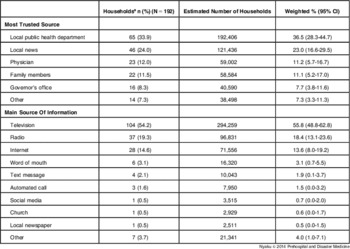
In response to the question, “If radioactive material was released, who would you and members of your household most likely trust for reliable information?” 36.5% of respondents indicated the local public health department, 23% local news, 11.2% physicians, and 11.1% family members. In response to the question, “If radioactive material was released in your community, what would be the main source of information for your household to keep up-to-date on the event?” approximately half of respondents (55.8%) indicated television broadcasts, 18.4% indicated radio programs, and 13.6% the Internet (Table 5).
Trusted and Main Source of Information for Radiation Emergency for the Oakland County, Michigan USA, CASPER-2012

Abbreviation: CI, confidence interval.
aHouseholds providing a nonresponse to a specific question are not included in the total count.
Discussion
Using CASPER to assess household emergency preparedness, including radiation emergency preparedness, provides an objective quantification of residents’ needs and supplies rather than relying on anecdotal evidence of preparedness. The valid statistical sampling design of CASPER methodology enables estimation of the total number of households in Oakland County by sampling a subset of households representative of the entire county. Population estimates obtained by sound statistical methods are essential because they provide a basis for prioritizing responses and resource distribution during a disaster setting.
An accepted method used in assessing an individual household's level of emergency preparedness is to examine the amount of emergency supplies on hand, although an exclusive determination cannot be made regarding whether these supplies were purposefully obtained for emergency purposes.Reference Levac, Toal-Sullivan and O'Sullivan 16 , Reference Paek, Hilyard, Freimuth, Barge and Mindlin 17 However, the availability of these supplies represents an enhanced state of preparedness, compared with those households without supplies. The US Department of Homeland Security recommends that ⩾ 80% of households should maintain disaster supplies, including food, water, medicine, and a first-aid kit as part of preparedness plans. 18 On the basis of these recommendations, the results relating to household possession of emergency supplies indicate that Oakland County residents might not be adequately prepared for a disaster, including a radiation emergency, especially in a setting requiring persons to shelter-in-place. However, Oakland County respondents indicated that they would follow instructions from county officials during a radiation emergency. A lack of awareness or understanding of the importance of emergency preparedness might contribute to the inadequate preparation of residents in Oakland County, similar to findings from a 2010 survey that assessed general emergency preparedness among residents living near nuclear power plants in Michigan.Reference Zwolinski, Stanbury and Manente 19 Also, because a radiation emergency substantially heightens public fear, compared with other types of emergencies not involving radiation, residents might be inclined to follow instructions from an entity perceived to be knowledgeable in handling such an emergency.
Availability of basic necessities, including food, water, and medications, are critical to improved outcomes after a disaster.Reference Levac, Toal-Sullivan and O'Sullivan 16 The findings indicate that residents in Oakland County lack adequate supplies of these basic necessities for themselves or their pets, compared with official pre-incident recommendations. Equally lacking are other emergency supplies, including an alternative heat source, 3-day fuel supply for households with generators, a working fire extinguisher, and a first-aid kit. Respondents in Oakland County reported having residents needing wheelchairs, canes, walkers, home health care, and supplemental oxygen; however, prior research indicates that vulnerable persons are least likely to care for themselves during a disaster.Reference Levac, Toal-Sullivan and O'Sullivan 16 To aid in preparedness, residents of Oakland County should be encouraged to maintain emergency supplies and equipment. The Federal Emergency Management Agency, as part of its Ready Campaign, recommends that each household have a disaster supply kit with nonperishable food, water (1 gallon/person/day), and other supplies (eg, flashlight and extra batteries, first-aid kit, whistle to signal for help, and battery-powered or hand-crank radio) to last ⩾72 hours after a disaster, because help from local officials or relief workers might be delayed substantially. 20
The main information media reported by the majority of respondents during a radiation emergency (television, radio, and Internet) usually require electricity. Electrical outages or interruptions after disasters frequently occur and can render use of these sources of information sharing useless; 21 thus, preparedness plans in Oakland County should involve public address systems, use of bullhorns by fire and police personnel, or door-to-door notifications.Reference Kennedy, Richards, Chicarelli, Ernst, Harrell and Stites 22 In addition, a combination of the trusted sources indicated by respondents should be used for disseminating information.
A substantial number of respondents indicated their willingness to follow instruction from county officials, specifically regarding going to a radiation screening center, evacuation, or sheltering-in-place during a radiation emergency. In addition, a majority of respondents with pets indicated that they would take their pets with them during an evacuation. Emergency preparedness plans should address reasons provided for an unwillingness to follow instructions. A comprehensive educational campaign that incorporates actionable steps (eg, practicing a family preparedness plan that considers the person's social environments) will more likely produce the desired behavioral change, compared with education focusing on awareness alone.Reference Ablah, Konda and Kelley 23 Also, logistics of accommodating a substantial number of persons and pets might present a challenge to Oakland County during a radiation emergency requiring evacuation; thus, emergency preparedness plans should incorporate this scenario.
The CASPER completion rates of ⩾ 80% indicate an acceptable number to represent the sampling frame. 7 A completion rate of 91.4% was obtained during the survey. Rapid collection of data during a disaster setting might be challenging because of the chaotic environment.Reference Morton and Levy 24 This CASPER assessed emergency preparedness, including for a radiation emergency, in a nondisaster setting with clearly defined objectives; hence, data were collected smoothly and rapidly. Oakland County's previous radiation emergency preparedness plans did not include household-level preparedness; thus, data collected from this CASPER should improve the county's preparedness plans. However, preparedness is dynamic and requires revisions and modifications with the ever-changing social context;Reference Perry and Lindell 25 therefore, Oakland County should consider periodically assessing community preparedness and updating its emergency preparedness plans accordingly. In addition, this CASPER did not assess residents’ awareness of the potential for a radiation disaster in Oakland County, what they will specifically do during a disaster, or their familiarity with the potential harms of radiation. Thus, these questions could be incorporated into future CASPERs or surveys.
Limitations
The findings from the CASPER survey are subject to certain limitations. First, because all persons aged ⩾ 18 years living in a household were eligible to respond to the surveys, the actual survey respondent might not have been the head of the household, and thus, unaware of all preparedness measures being taken by others in the home. Second, data regarding levels or measures of emergency preparedness were self-reported, not verified, and reflect reports at a single time; thus, these might have been over or underestimated. Third, the survey was conducted from 3 pm-8 pm; therefore, households with eligible respondents working or unavailable during this time had limited representation, possibly resulting in selection bias. Finally, responses to a survey questionnaire might not correlate with actual behavior during an emergency.
Conclusions
The use of CASPER methodology was successful in addressing the objectives of this study. The data presented indicates that Oakland County households are not adequately prepared for a disaster. Thus, fewer households maintained essential disaster supplies (including food, water, medicine, and a first-aid kit) compared to the minimum recommended household threshold levels. However, the majority of Oakland County households are willing to follow instructions from county officials during a radiation emergency. This is the first time CASPER has been used to assess residents’ radiation emergency preparedness. The data collected are useful and highlight both the usefulness and feasibility of using CASPER to assist with radiation emergency preparedness planning. Future CASPERs, incorporating a radiation emergency assessment component, should be considered as a means of assessing the reliability of the current findings.
Acknowledgment
The findings and conclusions in this report are those of the author(s) and do not necessarily represent the views of the Centers for Disease Control and Prevention (CDC).