In October 2012, the College Board published a new curriculum framework for its Advanced Placement course and exam in United States History, to take effect in the academic year 2014–2015. Nearly half a million students take the AP U.S. History exam each May, so any changes to this course have an outsized effect on history education in the United States.Footnote 1 In the past year, the curriculum framework has become an object of considerable political controversy and misinformation. As a historian of the Gilded Age who has worked on this project and in the field of history education for a number of years, I am grateful to JGAPE for the opportunity to discuss the changes to the AP U.S. History course and what they say about current understandings of the Gilded Age and Progressive Era more generally.Footnote 2 I hope to explain why the College Board undertook the redesign effort and what its implications are for scholars and teachers of the late nineteenth and early twentieth centuries.
****
Any serious effort to understand Advanced Placement history courses needs to consider what most experts describe as serious and long-standing problems with broader history education in the United States. Frederick Hess and Chester Finn recently pointed out that the percentage of high school students deemed “proficient” in U.S. history by the National Assessment of Educational Progress has been among the lowest of all subjects tested for decades.Footnote 3 Moreover, in the words of educational researcher Bruce VanSledright, in many studies on history teaching, “students consistently tell researchers that history is their least liked school subject and that they would avoid it if they could.”Footnote 4 Although attempts to revise history courses to engage students and better prepare them for success in the subject have been debated since the late nineteenth century, the pattern of low interest and proficiency in the discipline has remained stubbornly unchanged.Footnote 5
The Advanced Placement courses in U.S., World, and European History, in which students receive college credit or placement in exchange for a qualifying score on an end-of-year AP Exam, have long been held out as the best exemplars of history education in a high school setting. Yet here, too, dissatisfaction with the instruction and outcomes of AP history courses has been steadily increasing. Scholars of history teaching and learning such as Sam Wineburg found that while some AP history classrooms featured rigorous and engaging debates among students, others primarily emphasized shallow coverage of a multitude of poorly explored topics.Footnote 6 The College Board's own surveys of AP teachers found that compared with other subjects, AP U.S. History teachers felt especially discouraged from pursuing topics in depth or using innovative methods to explore the content of the course. These criticisms have dovetailed with broader scholarly appraisals of the Advanced Placement Program as a whole. According to educational researchers, a number of AP courses suffered from the same problem that AP U.S. History did: they bred a shallow instructional focus at the expense of rigorous in-depth inquiry or the development of appropriate thinking skills within their discipline.Footnote 7
In AP U.S. History, teachers often complained that the thinness of their instruction stemmed from their lack of knowledge of what might appear on the end-of-year AP U.S. History Exam. The AP Course Description, with its outline of twenty-eight general topics “that might appear in a college freshman survey course,” each with an accompanying short list of possible subtopics, provided only vague hints of what qualified college-level understandings of the subject looked like. The Course Description contained twelve suggested themes, such as “reform,” “American diversity,” or “religion,” that might be used by teachers in organizing the whole course. Neither the topic outline nor the themes dictated or constrained in any way the content that would actually appear on the AP Exam. A weighting distribution for three time periods (Pre-Columbian to 1890, 1789 to 1914, and 1915 to the present) and four categories of historical analysis (political, social/cultural, diplomatic, and economic) were the only hard-and-fast rules governing the content of the exam. To better understand its expectations, AP teachers relied heavily on inferences from past exams released to the public, with free-response questions released annually and full exams (with multiple-choice questions) released approximately every five years.
Without any effective guidance on what subjects might appear on the exam, many teachers felt pressured to ensure that students recalled every individual, date, and event found in a college-level textbook. The result was often a breakneck race through the textbook in order to prepare students for the exam in early May—if, indeed, teachers could get anywhere near the end of the twentieth century in their coverage by that point. Many AP teachers, especially veteran teachers, adapted their instruction to be able to teach a challenging and enriching history course, but often felt that they did so in spite of, not because of, the demands of the AP Exam. Among the activities often left by the wayside were deep reading in classic primary sources of American history; explorations into diverse historical interpretations to encourage critical thinking; and research into emerging subfields such as cultural, women's, or environmental history.
The lack of exposure to thinking skills and current trends in historical research threatened one of the core ideas behind the Advanced Placement Program: that high school students benefit from a rigorous AP course because it exposes them to the expectations they will have to meet in college. As AP history instruction began increasingly to diverge from the college history survey, elite colleges began to tighten their policies for accepting AP credit.Footnote 8 Private schools also began to move away from offering AP courses in order to create their own richer courses that they believed would be closer to the kinds of courses offered in college.Footnote 9
The College Board thus began an ambitious plan to “redesign” all Advanced Placement courses to emphasize the development of college-level skills and the key concepts or understandings of various subjects. For United States, World, and European History, scholars in these disciplines would articulate a set of common “historical thinking skills” that students should master in the corresponding AP history courses. To take advantage of research advances in understanding how students learn history, experts would design both curriculum and assessment pieces of these courses in tandem, so that the concepts assessed on the exam would be readily apparent to teachers and students alike.Footnote 10 For AP U.S. History, the College Board turned in 2006–2007 to a commission of history professors and prize-winning teachers that described the high-level themes, periods, and chronological scope of the course.
Next, an AP U.S. History Curriculum Development and Assessment Committee, also composed of college and high school history faculty, worked on laying out a clear set of college-level learning objectives and understandings for the course. The learning objectives were crafted at the thematic level, to present the course's goals as inquiries into long-term historical developments. This committee also wrote the major understandings or “key concepts” in an outline for each period. These key concepts are presented as statements, not open-ended inquiries, to give guidance to AP teachers who need to know what college professors expect students to know at the end of the introductory survey course in U.S. History.
The skills, learning objectives, and key concept outline together provide the curriculum framework for AP U.S. History. In fall 2010, a representative sample of college history department chairs and professors studied the curriculum framework and affirmed that it did, in fact, represent the expectations of college-level survey courses in American history. (I will discuss the statements in the framework for the Gilded Age and Progressive Era in the section below.)
Although the curriculum framework was intended to provide guidance to teachers, the College Board does not create actual curricula, with teaching materials and lesson plans that all AP teachers and students would have to follow. First, an exhaustive account of all relevant details of American history would have amounted to nothing less than a rigid and prescriptive textbook-like treatment. This would have broken with the tradition in Advanced Placement of allowing teachers to be responsible for the content of the course. Second, the need for AP U.S. History to be taught in a myriad of different states, districts, and schools meant that the framework would not succeed if the College Board's expectations conflicted with the standards set by these entities for required historical content. Third, a highly directive AP U.S. History curriculum would not have reflected the diverse ways that college instructors actually provided instructional depth in their survey courses.
Accordingly, the curriculum framework sought to give teachers and policymakers the greatest possible flexibility in choosing the historical phenomena that students would study in depth in the AP U.S. History course. It minimized mention of specific individuals, small-scale events such as battles and elections, and other details of American history. The intention was that state history standards, district curriculum planners, and experienced individual AP teachers would actually flesh out the particular primary sources and historical evidence that students encounter. A few teacher-selected examples were included in the framework, after focus groups of teachers found some of the statements in the framework too general, but these were set off from the main text in gray boxes, and clearly labeled as optional.
In order for this approach to succeed, the AP Exam would have to change to support it. To address this, a new exam design was developed by the committee and the College Board, in collaboration with the AP Exam's traditional administrators, Educational Testing Service. In the new exam design, the questions would allow students to write as much as possible about the details discussed by their teachers in instruction. Students with a persuasive, well-supported understanding of significant historical events would be rewarded with higher scores on written questions. The multiple-choice section of the exam would primarily ask students about their ability to reason with and about historical evidence, such as the foundational documents of American history, or works of historical scholarship. Students would need a strong command of the historical context to interpret such sources, but they would also need to reason with different sources in a historically rigorous way in order to answer the questions accurately.
After successful piloting of the new exam with students and validation by college professors, the AP U.S. History curriculum framework was published in October 2012. The College Board then began to undertake professional development efforts in preparation for the course to debut for most students in fall of 2014. The administration of the first exam to incorporate this new design and assess the redesigned course will come in May 2015.
***
Readers of JGAPE will naturally be most interested in seeing how this process has changed the AP U.S. History course and exam's treatment of the Gilded Age and Progressive Era. What are the differences between the “old” AP U.S. History course (contained in a Course Description last published in 2010) and the redesigned course outlined in the 2014 AP U.S. History Course and Exam Description? How did the writers of the course framework decide how and what to include for these periods? How does the framework reflect current research in the field, particularly changes in scholarship that might have occurred in the last thirty years? And what would these mean for a rigorous course in American history taking place in the high school setting?
Space will not permit a reprinting of all of the relevant sections of the Course and Exam Description, which is available online.Footnote 11 However, readers of that document would first note that the historical thinking skills that will be assessed on the exam—which the old Course Description left entirely undefined—are front and center in the new document. These skills include historical habits of mind (such as awareness of context, causation, comparison, and periodization) and argumentative or analytical skills (such as use of evidence, argumentation, and synthesis).
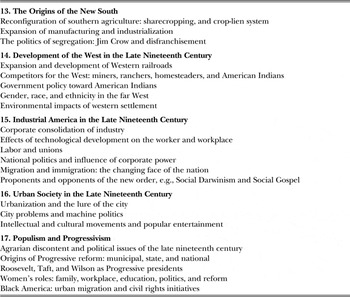
In terms of historical content, Table 1 shows the outline of coverage of the Gilded Age and Progressive Eras in the “old,” pre-redesign Course Description. Most of the developments of this period are presented in rough chronological order. Readers will note the outline's emphasis on listing a set of general processes, such as industrialization, Western development, the rise of big business, and urbanization. No attempt is made to relate these processes to one another, to explain why they arose, or to describe their long-term significance. The Course Description also has virtually no historical figures, dates, or concrete events (such as elections or specific legislation).
The 2010 AP Course Description's Topic Outline for the Gilded Age and Progressive Era

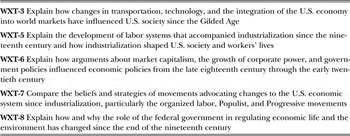
In contrast, the redesigned Course and Exam Description provides an account of required content for the Gilded Age and Progressive Era in two places. First, several of the course-long learning objectives, specifying what students should know and be able to do at the end of the AP U.S. History course, touch on these periods (Table 2). These objectives are organized thematically (around one of the seven themes: Identity; Peopling; Work, Exchange, and Technology; Politics and Power; Environment and Geography: Physical and Human; and Ideas, Beliefs, and Culture) and are intended to provide a set of long-term “takeaways” whose significance spans several periods of U.S. history. These learning objectives form the core understandings of U.S. history that the questions on the AP exam should assess. The learning objectives provided here are only the ones for the theme of Work, Exchange, and Technology; other objectives relevant to the Gilded Age and the Progressive Era accompany the other themes.
Learning Objectives in the AP Course and Exam Description for the Theme of Work, Exchange, and Technology (WXT) That Affect the Gilded Age or Progressive Era

In addition to the learning objectives, the Course and Exam Description provides a “concept outline” that organizes the content of AP U.S. History into nine historical periods. One crucial decision made by the authors of the curriculum framework was to have periods 5 (1844–1877) and 6 (1865–1898), and periods 6 and 7 (1890–1945), overlap in time. This recognizes the conventional distinction between the Civil War era, the Gilded Age, and the Progressive Era, as each period traditionally has a distinct narrative arc and set of understandings: period 6 is much more heavily focused on industrialization, its effects, and its discontents, while period 5 addresses Reconstruction in detail and period 7 discusses government reform and the rise of the United States as a world power. Yet the overlap between these three periods also acknowledges the substantial continuities between them. Indeed, the Course and Exam Description explicitly encourages teachers to question its own periodization, using the juncture between these periods to “challenge students to reflect on how the choice of different beginning and ending dates and the labels for specific ‘time periods’ (such as the Progressive Era) can alter the historical narrative and give a higher value to one group over another” (p. 6). The Course and Exam Description's text also refers to the “Gilded Age” itself in quotation marks.Footnote 12
The major understandings of each period are presented in outline form as a set of “key concept” statements describing significant historical developments. Table 3 presents some of these key concept statements for one section of period 6. Unlike the old Course Description's “laundry list” of disconnected facts, the outline statements attempt to explain the relationships between disparate historical events. These events are “fair game” for assessment: AP Exam questions can ask students directly about their details. However, as discussed earlier, these statements assume that teachers will provide concrete examples to make these general concepts come alive in the classroom.
One Section of the AP U.S. History Course and Exam Description for Period 6 (1865–1898)

A detailed comparison between the “old” AP U.S. History and the redesigned course framework for the Gilded Age finds many similarities. Industrialization and its social effects, such as urbanization and the rise of big business, play a dominant role in both documents. Other common topics include gender, race, and ethnicity; the rise of labor unions and agrarian protest; growing migration and immigration; and the rise of the “New South” as well as Jim Crow and segregation. Both documents connect social problems to the rise of urban machines. The redesigned Course and Exam Description, however, is much more direct in connecting these social problems to other changes in the period, such as labor strife, reform efforts, and different opinions of laissez-faire economic policy. Some new and potentially unfamiliar topics, such as the western land reform movement las Gorras Blancas, are presented in the Course and Exam Description in gray boxes as examples of optional content that teachers may or may not want to explore with their students. But at first glance, most of the topics present in the Course Description also appear in the redesigned course.
When the Course and Exam Description's key concept outline comes to the Progressive Era, it connects the efforts of Progressive activists to reform government and economic institutions to similar efforts during the New Deal. Since many mainstream textbooks take as many as eight to ten different chapters to cover the period 1890–1945, placing the myriad events of these years into a single unit may be the single most significant content change to most AP teachers’ instruction caused by the redesign. The key concept statements on period 7 knit the period together by having a main focus on the rise of the United States as a world power, from overseas expansion in the late nineteenth century to the point in 1945 when the United States becomes “the most powerful nation on earth.”
Although the old course's outline did contain some references to Progressive Era presidents, the key concept outline in the Course and Exam Description provides a much more specific explanation of the developments of the Progressive Era. One statement from the Course and Exam Description, linking Progressive era reformers with New Deal policymakers who collectively “responded to economic upheavals, laissez-faire capitalism, and the Great Depression by transforming the U.S. into a limited welfare state,” has been interpreted in some quarters as a form of cheerleading for liberalism. However, the architects of the framework undoubtedly intended for these and similar statements to provide coherence to the period by stressing continuities between nineteenth- and twentieth-century social reform efforts, in line with the efforts of recent historians.Footnote 13 Even hostile commentators might concede that the rise to power of liberal ideas in the twentieth century is a major “takeaway” of these years that deserves prominence in any college-level history survey course.
Both professors and teachers of U.S. history will recognize that although scholars have validated these statements, they are far from any sort of last word on how to understand these periods. The key concepts are both debatable and even elliptical in a good number of places; they simply cannot amount to the entirety of instruction in the course. They lack reference to specific evidence or interpretations that would make them come alive to students. These must be provided by AP teachers, who are encouraged—indeed, mandated—to choose the salient details, primary sources, and historical scholarship to meet the needs of their students.
One such need might be finding relevant and engaging source materials that give concrete, local illustration to the broad patterns of history. A student of industrialization in Paterson, New Jersey, for example, could benefit from a field trip to learn about the growth of the silk manufacturing there, while a student in Pittsburgh could concentrate on the development of the local steel industry. A teacher on the West Coast could have students research the process of immigration to Angel Island, as opposed to only focusing on the Ellis Island experience of immigrants from Europe.
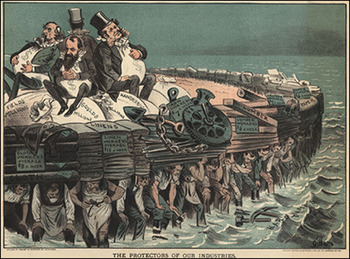
In order for this approach to succeed, the AP Exam cannot ask students to simply parrot back the key concepts found in the Course and Exam Description; instead, students must weigh the historical evidence and decide what it means for their understanding of the period. For example, Figure 1 presents a practice AP Exam question about an 1883 Puck cartoon. This source typifies the contemporary hostility expressed in middle-class magazines of the Gilded Age toward contemporary “captains of industry” such as Cyrus Field, Jay Gould, and Cornelius Vanderbilt. Students must recognize the perspective of the cartoonist, but to receive full credit, students must also provide and explain evidence that would both support and refute the cartoonist.
Practice Short Answer Question on the Gilded Age in the Course and Exam Description. Using the 1883 image above, answer a, b, and c. a) Briefly explain the point of view about the economy expressed by the artist. b) Briefly explain ONE development in the period 1865 to 1910 that could be used to support the point of view expressed by the artist. c) Briefly explain ONE development in the period 1865 to 1910 that could be used to challenge the point of view expressed by the artist.

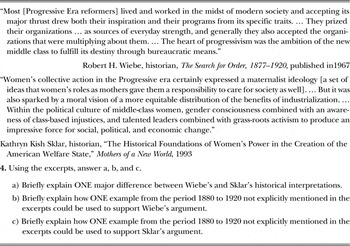
Other AP Exam questions ask students to compare and contrast passages on the same topic by different historians, or to use historians’ viewpoints to make sense of a collection of contradictory primary sources. For example, in Table 4, the Short Answer Question asks students to analyze divergent interpretations of the motives of Progressive Era reformers from historians Robert H. Wiebe and Kathryn Kish Sklar and, critically, to explain pieces of historical evidence that could be used to support either perspective.
Practice Short Answer Question on the Progressive Era in the Course and Exam Description

By asking students to understand historians’ reasoning and also to explain how that reasoning is supported with evidence, students can become familiar not only with historical thinking but with the idea that different interpretations of history must be grounded in specific historical facts, persons, and events.
The AP Exam also continues to prominently feature a Document-Based Question (DBQ), which asks students to address an interpretive issue in history by analyzing a set of primary source documents. The DBQ released with the practice exam in summer 2014 asked students to “Compare and contrast views of United States overseas expansion in the late 19th and early 20th centuries. Evaluate how understandings of national identity at the time shaped these views.” The documents included with this task included an article for the Washington, DC, newspaper Colored American, supporting African American military service in the Spanish-American War; statements on imperialism by Theodore Roosevelt, William Graham Sumner, and Jane Addams; and a 1904 satirical cartoon from the magazine Puck of the American eagle outstretched over the globe. Questions like these allow students to demonstrate their ability to understand a source in its historical context but also ask them to evaluate its viewpoint in light of other perspectives on the period. They also assess students’ ability to use the course's historical thinking skills in relation to particular individuals, events, and documents.
****
The AP U.S. History program described here, while now organized to help teachers better understand its goals, in fact, does not represent a dramatic departure from the content parameters of the old course, particularly in reference to the Gilded Age and Progressive Era periods of American history. To be sure, there have been some substantive changes for AP teachers and students. The redesigned exam will now ask students to do more to justify their understanding of specific events by using historical evidence of their own choosing. Students will learn about these types of evidence through the content provided by AP teachers or by state, district, or school mandates on curricula. The goal is for the course to become less of a race through all possible topics of American history and more of an experience of learning about the past in depth. These changes came about due to the wishes of AP teachers, professors, and history educators that the College Board find ways to make the course more engaging and rigorous while still holding students responsible for command of a wealth of factual knowledge in American history. Although significant, none of these developments amount to a fundamental reorientation of the content of the AP U.S. History course, or a move away from the Advanced Placement Program's historic mission of connecting high school students to college-level understandings. They do represent an attempt to encourage teachers and students to have a richer and more engaging experience with the AP history course.
Nevertheless, the redesigned course has occasioned considerable recent controversy. As someone who has been closely involved in the development and launch of this effort, I won't attempt to provide a complete answer as to why this might be so. Many historians and educators would probably agree that American history education is inherently contentious, with debates occurring at frequent intervals in the twentieth century, most recently in the ill-fated attempt to create National History Standards in the 1990s.Footnote 14 A tension that has appeared often in such controversies is the divide between historians’ understandings of American history and popular beliefs about the subject. Readers of JGAPE, who are the experts in the field, can look at the course and exam description in conjunction with the released practice exam and draw their own conclusions as to whether or not AP U.S. History accurately represents the consensus of beliefs among professional historians about the discipline.
A more interesting question might be whether the changes to the course and exam will have a lasting impact on AP teachers and students. As of this writing, the evidence to answer this question is largely anecdotal, but early accounts have portrayed AP teachers using the framework to improve their instructional practices. Colorado Public Radio, for example, interviewed AP teachers who felt the redesign allowed students to “truly think like a historian,” looking at different historical perspectives and analyzing different sides of an argument.Footnote 15 Similarly, a blogger for the National Endowment for the Humanities explained how the redesign would ask him to focus more on primary sources and on how students “understand … the craft of history and how it relates to past/future events.”Footnote 16 These accounts show that AP teachers, while continuing to provide a rigorous experience to their students, are taking advantage of the redesign's flexibility, working with students to develop their ability to think deeply and write critically about history. In doing so, they are fulfilling the intentions and hopes of the many history educators who have worked on this effort over the last ten years.