Introduction
It is widely reported that some cognitive abilities show a mean decline with age. However, there is variability in the magnitude and rate of decline among older individuals. Here, we test the suggestion that people's differences in serum lipids and statin medication might contribute to differences in cognitive functions in older age.
Serum lipoprotein levels have been identified as a potential modifiable risk factor for cognitive impairment (Kivipelto and Solomon, Reference Kivipelto and Solomon2006). Numerous studies suggest that high midlife serum total cholesterol (TC) levels are associated with greater late-life cognitive impairment (Whitmer et al., Reference Whitmer, Sidney, Selby, Johnston and Yaffe2005; Solomon et al., Reference Solomon2007; Anstey et al., Reference Anstey, Lipnicki and Low2008; Beydoun et al., Reference Beydoun2010; Reynolds et al., Reference Reynolds, Gatz, Prince, Berg and Pedersen2010). An increased risk of cardiovascular pathologies with a higher midlife TC (Simons et al., Reference Simons, Simons, Friedlander and McCallum2001; Berry et al., Reference Berry2008) may, in part, explain the later risk of cognitive impairment. However, the association between late-life TC levels and cognitive function remains unclear. With age, there is typically a drop in cholesterol (Abbott et al., Reference Abbott1997) and high-density lipoprotein cholesterol (HDL-C) levels (Formiga et al., Reference Formiga2012), as cholesterol synthesis and absorption decrease (Tilvis et al., Reference Tilvis, Valvanne, Strandberg and Miettinen2011). A 2009 review (van Vliet et al., Reference van Vliet, van de Water, de Craen and Westendorp2009) of cross-sectional and longitudinal studies concluded that there is either no association in healthy older people (Li et al., Reference Li2005; Reitz et al., Reference Reitz, Luchsinger, Tang, Manly and Mayeux2005) or a decreased risk of cognitive impairment with high late-life TC levels (e.g. Mielke et al., Reference Mielke2005; see also Piguet et al., Reference Piguet2003; Karlamangla et al., Reference Karlamangla, Singer, Reuben and Seeman2004; Panza et al., Reference Panza2009). Moreover, findings suggest the relation between high TC levels and cardiovascular risk in late-life (over age 70 years) is weak, at best (Simons et al., Reference Simons, Simons, Friedlander and McCallum2001; van Vliet et al., Reference van Vliet, van de Water, de Craen and Westendorp2009). The decreased risk might specifically apply to certain cognitive domains, e.g. attention and word fluency tasks (Elias et al., Reference Elias, Elias, D’Agostino, Sullivan and Wolf2005). In contrast to these findings, TC correlated negatively with brain gray matter volume in a sample of men and women in their late 70s, supporting the role of elevated serum cholesterol in brain shrinkage and age-related neurodegeneration (Whalley et al., Reference Whalley2003).
High-density lipoprotein cholesterol offers some protection against cardiovascular disease (CVD) in both midlife and late-life (de Freitas et al., Reference de Freitas2011) but there is no conclusive evidence that “protection” from HDL-C extends to cognitive function at either life stage. Cross-sectional studies were more likely to show an association between high HDL-C and better cognitive performance in old age (Atzmon et al., Reference Atzmon2002; Reitz et al., Reference Reitz2010; van Exel et al., Reference van Exel2002). In general, the results of longitudinal investigations have been unable to support the high HDL-C-better cognitive function association in those over the age of 65 years (Henderson et al., Reference Henderson, Guthrie and Dennerstein2003; Reitz et al., Reference Reitz, Luchsinger, Tang, Manly and Mayeux2005, Reitz et al., Reference Reitz2008). However, many of the reported studies have been restricted to brief tests of global cognition (Atzmon et al., Reference Atzmon2002; Yaffe et al., Reference Yaffe, Barrett-Connor, Lin and Grady2002; Solomon et al., Reference Solomon2009; Formiga et al., Reference Formiga2012).
Statins are the first-line treatment option for hypercholesterolemia; by reducing serum cholesterol levels, statins lower the risk of angina, heart attack, and stroke. Whether or not statins can improve cognitive function in older age is unclear. Statins were reported to have beneficial effects on cognitive outcomes in several clinical trials (Parale et al., Reference Parale, Baheti, Kulkarni and Panchal2006; Carlsson et al., Reference Carlsson2008), but no association in others (Trompet et al., Reference Trompet2010), even though statin treatment successfully reduced the risk of cardiovascular disease in the same sample (Shepherd et al., Reference Shepherd2002). Population-based studies suggest a potential role for statins in preventing cognitive decline (Yaffe et al., Reference Yaffe, Barrett-Connor, Lin and Grady2002; Starr et al., Reference Starr2004; Bernick et al., Reference Bernick2005; Solomon et al., Reference Solomon2009).
Other possible confounding factors in the lipid-cognition association should be considered. Given that childhood cognitive ability is the most important determinant of adult cognitive ability (accounting for around half the variance; Deary et al., Reference Deary, Whalley, Lemmon, Crawford and Starr2000) and a predictor of a healthy diet and lifestyle in adulthood (Batty and Deary, Reference Batty and Deary2004; Batty et al., Reference Batty, Deary, Schoon and Gale2007), and morbidity and mortality rates (Deary et al., Reference Deary, Weiss and Batty2010; Kilgour et al., Reference Kilgour, Starr and Whalley2010), the direction of causation is a prime concern. Cross-sectional relationships may reflect the observed association between a higher “trait” IQ and healthy behaviors in adulthood which are conducive to a “desirable” lipid profile, low CVD risk, and other favorable health outcomes. There is much evidence to suggest that it is unsaturated fatty acids, typical of a Mediterranean-type diet that have some benefit on serum lipid profiles (Siri-Tarino et al., Reference Siri-Tarino, Sun, Hu and Krauss2010) and cognition (Coscina et al., Reference Coscina, Yehuda, Dixon, Kish and Leprohon-Greenwood1986; Whalley et al., Reference Whalley, Fox, Whale, Starr and Deary2004) in comparison to a low-fat or high-saturated-fat diet. Therefore, early-life cognitive ability and, by association, socioeconomic status (SES; Sacker et al., Reference Sacker, Schoon and Bartley2002; Hagger-Johnson et al., Reference Hagger-Johnson, Mõttus, Craig, Starr and Deary2012), may be important confounders of the cholesterol-cognition relationship in later-life.
The present study attempts to address gaps in the knowledge of the cholesterol-statins-cognition associations by examining generally healthy, older people without dementia from Lothian Birth Cohort 1936 (LBC1936) Study and their functioning over several major aging-relevant cognitive domains. They are unusual in being an older-age cohort for whom there are valid cognitive ability test scores from age 11 years. Our goals were to determine: (1) the nature of the associations between serum cholesterol measures and cognitive function at age 70 years; (2) the amount of variance in cognitive performance explained by cholesterol levels once we have accounted for the contribution of prior cognitive ability measured in childhood (age 11 years); (3) whether additional statistical control for potential covariates further attenuate the lipids-cognition associations; (4) the relationship between statin use and life-long cognitive ability (at ages 11 and 70 years).
Methods
Study sample
The Lothian Birth Cohort 1936 (LBC1936) comprises 1,091 men and women, almost all of whom were resident in Edinburgh and the surrounding Lothian region at about age 70 years. Early life (mean age 11 years) intelligence test scores are available for most in this sample, because they are surviving participants of the Scottish Mental Survey of 1947 (SMS1947; Deary et al., Reference Deary, Whalley and Starr2009). On June 4th 1947, about 95% of school children born in 1936 and attending Scottish schools (n = 70,805), took a version of the Moray House Test (MHT) No.12 (Scottish Council for Research in Education – SCRE, 1933; 1949). The MHT is a group-administered test of general intelligence. This test was concurrently validated against the Terman-Merill revision of the Binet scales with a correlation of about 0.8 (SCRE, 1949). Scottish Council for Research in Education recorded and archived these scores and made them available to the LBC1936 Study. Participants in Edinburgh and the surrounding areas were traced in later life and invited to take part in a longitudinal study of cognitive aging, hereafter referred to as the LBC1936 Study. Full recruitment and testing procedures are reported in a free-access protocol paper (Deary et al., Reference Deary2007). In brief, the assessment involved detailed cognitive, medical, and other testing, and self-completed questionnaires, and took place between 2004 and 2007 when participants were aged about 70 years.
Of the 1,091 participants in the study, 37 had missing cholesterol data. Of the remaining participants, 11 scored less than 24 on the Mini-Mental State Examination; this cut-off is often used to indicate possible dementia. These participants were excluded from the analyses. The sample n for the current study is 1,043 (50.1% men).
Ethics permission for the Lothian Birth Cohort 1936 (LBC1936) study protocol was obtained from the Multi-Centre Research Ethics Committee for Scotland (MREC/01/0/56) and from Lothian Research Ethics Committee for Scotland (LREC/2003/2/29). The research was carried out in compliance with the Helsinki Declaration. All participants gave their written, informed consent.
Measurement of cholesterol
Serum cholesterol was measured as part of a blood analysis profile. Non-fasting blood was drawn on the day of cognitive assessment and analyzed within 24 h in serum stored at 4 °C using an enzymatic Quinoneimine dye method measuring at 500 nm, at the Western General Hospital, Edinburgh. Lipids are expressed in mmol/L. The main analyses were conducted using cholesterol measures as continuous variables. For illustrative purposes only, each lipid measure was also classified into three clinically relevant categories, in accordance with the National Cholesterol Education Program (Adult Treatment Panel III, 2001). Total cholesterol (TC) groups were: <5.2 mmol/L (low), 5.2 to 6.2 mmol/L (intermediate), >6.2 mmol/L (high). The range of TC in the current sample was 2.7 to 10.8 mmol/L (mean = 5.5, SD = 1.2). High-density lipoprotein cholesterol groups were: <1.3 mmol/L (low), 1.3 to 1.5 mmol/L (intermediate), >1.5 mmol/L (high). The range of HDL-C in the current sample was 0.53 to 3.82 mmol/L (mean = 1.5, SD = 0.44). Triglycerides groups were: <1.7 mmol/L (low), 1.7 to 2.2 mmol/L (intermediate), >2.2 mmol/L (high). The range of triglycerides for the current sample was 0.47 to 16.32 mmol/L (mean = 1.6, SD = 0.91). The ratio of TC to HDL cholesterol (chol:HDL-C) provides a stronger prediction of coronary heart disease (CHD) risk (Ingelsson et al., Reference Ingelsson2007) and CHD mortality (Prospective Studies Collaboration, 2007) because these components are related to risk in opposite directions. A lower ratio is clinically more desirable in terms of CHD risk. Chol:HDL-C ratio groups were: <3.5mmol/L (low); 3.5 to 5.1mmol/L (intermediate); >5.1mmol/L (high) (range 0.38 to 9.50, mean = 3.76, SD = 1.07). Low-density lipoprotein (LDL) cholesterol measurement was not available in this sample. For the purposes of this study, cholesterol classification groups are hereafter referred to as low, intermediate, and high.
Cognitive functions
The cognitive test battery was chosen to provide a comprehensive assessment of cognitive function. Full details of the cognitive tests have been provided elsewhere (Deary et al., Reference Deary2007). Participants took six subtests from the Wechsler Adult Intelligence Scale-IIIUK (WAIS-III; Wechsler, Reference Wechsler1998a), namely: Letter–Number Sequencing; Matrix Reasoning; Block Design; Digit Symbol; Digit Span Backwards; Symbol Search. Participants took subtests from the Wechsler Memory Scale-IIIUK (WMS-III; Wechsler, Reference Wechsler1998b), namely: Logical Memory; Spatial Span; Verbal Paired Associates. Participants also completed a simple and choice reaction time task (Cox et al., Reference Cox, Huppert and Whichelow1993; Deary et al., Reference Deary, Der and Ford2001) and a computer-based visual processing speed task known as Inspection Time (Deary et al., Reference Deary2004).
From these tests, composite cognitive function scores were formed to represent three cognitive domains (general cognitive ability, processing speed, and memory). The previous extraction of these scores, using principal components analysis, has been described in detail elsewhere (Luciano et al., Reference Luciano2009; Corley et al., Reference Corley, Gow, Starr and Deary2010). A general cognitive ability factor (often referred to as g), was derived from scores on the WAIS-III subtests: Letter–Number Sequencing; Matrix Reasoning; Block Design; Digit Symbol; Digit Span Backwards; Symbol Search. A processing speed factor was derived from scores on a set of mental processing speed measures, namely: Symbol Search; Digit Symbol; Simple and Choice Reaction Time mean; Inspection Time. A memory factor was derived from scores on a set of memory measures, namely: Logical Memory I (immediate) and II (delayed) recall; Spatial Span Forwards and Spatial Span Backwards; Verbal Paired Associates I (immediate) recall and II (delayed) recall; Letter–Number Sequencing; Digit Span Backwards.
Participants re-sat the MHT at age 70 years. Moray House Test scores at ages 11 and 70 years were corrected for age in days at time of testing and converted into IQ-type scores for the sample (M = 100, SD = 15).
Verbal ability was assessed using the National Adult Reading Test (NART; Nelson and Willison, Reference Nelson and Willison1991) which is widely used to estimate prior cognitive ability; it requires the pronunciation of a list of 50 irregular words. The Mini-Mental State Examination (MMSE), a standardized brief screening measure for cognitive pathology (Folstein et al., Reference Folstein, Folstein and McHugh1975), was used as a brief screening test for dementia. Scores range from 0 to 30, with a score of less than 24 often used to indicate possible dementia.
Covariates
Participants provided general demographic information including age, years of full-time education, and social class. Adult occupational social class was derived from each participant's highest reported occupation (for women, their spouses occupation was used if higher than their own) and classified into one of six categories ranging from I (professional occupations) to V (unskilled occupations), with III divided into IIIN (non-manual) and IIIM (manual) using the UK Registrar General's Classification of Occupations, 1980 (Office of Population Censuses and Surveys, 1980). For analyses, occupational social classes IV and V were combined due to the small number of participants (n = 4) in class V. The number of years of full-time education, self-reported history of hypertension, stroke, CVD, high cholesterol, and stain use were recorded (“yes/no”) by an interviewer at the time of assessment. Dietary intake and alcohol use were recorded using the Scottish Collaborative Group Food Frequency Questionnaire (SCG-FFQ) version 7.0 (Jia et al., Reference Jia, Craig, Aucott, Milne and McNeill2008). Alcohol use was expressed as units of alcohol consumed in a typical week. Dietary intake of saturated fats (grams per day), polyunsaturated fatty acids (PUFAs, grams per day), and cholesterol (milligrams per day) were calculated based on responses to the 168-item FFQ. Level of physical activity was obtained from a self-report questionnaire. This measure was coded as follows: 1 – “household chores;” 2 – “walking etc. 1–2 times a week;” 3 – “walking etc. several times a week;” 4 – “exercise 1–2 times a week;” 5 – “exercise several times a week;” 6 – “keep-fit/heavy exercise/sport several times a week.” Height and weight were measured as part of a physical examination. Body mass index (BMI) was calculated as weight (kg) divided by height squared (in square meters). Adiposity is an important influence in adult lipid profiles; BMI is often used as a proxy measure of adiposity and, in adults, BMI is positively related to TC and negatively related to HDL-C (Folsom et al., Reference Folsom1994).
Statistical analysis
Analyses were performed using IBM SPSS, version 19 (IBM, NY, USA). Demographic and health differences between clinically relevant cholesterol categories were demonstrated using analysis of variance (ANOVA) and χ 2 tests, as appropriate. We used linear regression to examine the relationship between each lipid measure's three-level grouping (for TC, HDL-C, triglycerides, and chol:HDL-C) and cognitive outcomes (general (g) cognitive ability, processing speed, memory, and verbal ability (NART) and age 70 MHT-IQ) and between statin use and cognitive function in youth and old age. Additional logistic regression models were used to examine the relationship between age 11 IQ (divided into quartiles) and statin use. We report odds ratios and 95% CI.
In the main analyses, multiple linear regression models were used to test the association between the continuous distributions of lipid measures with each cognitive performance measure. Three models were fit to the data. Model 1 included exact age at testing (in days) and sex. In model 2, age 11 IQ was added. In model 3, we further included occupational social class, statin use and history of CVD. All effects are reported using standardized regression coefficients, also known as “betas.” These coefficients are calculated from standardized data and reflect the impact on the outcome variable of a change of one standard deviation in the predictor variables. p-values are reported. The 0.05 level of significance was used for all data analyses.
Results
Participant characteristics
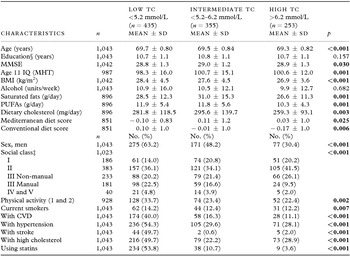
In Table 1, demographic and covariate data are displayed by TC group, based on TC clinical categories. The mean TC values (M ± SD) for each TC group were: (1) 4.4 ± 0.53; (2) 5.7 ± 0.32; (3) 7.0 ± 0.64. There were notable differences in several characteristics in relation to TC levels. Higher TC levels were associated with being younger, being female, being in a more “professional” social class, having a lower BMI, smoking less, having a sedentary lifestyle, and having a lower prevalence of CVD, hypertension, stroke and high cholesterol, and with less reported statin use. All of these are factors associated with a healthy lifestyle. In terms of dietary intake, a higher TC level was associated with a lower score on the conventional dietary pattern (which loads highly on saturated fats and convenience foods), lower saturated fats and a lower dietary cholesterol intake. In contrast, a higher TC level was associated (rather counter-intuitively) with lower dietary PUFAs, which are generally considered to have a beneficial effect on health and HDL cholesterol while reducing LDL cholesterol. The intermediate group had the highest MMSE and age 11 IQ score, in addition to the highest intake of saturated fats, dietary cholesterol, and the highest Mediterranean diet score (which loads highly on vegetables, fish, beans, and pulses). There was no significant difference in education level or alcohol consumption between the three groups.
Characteristics of participants according to serum total cholesterol (TC) group at age 70 years

TC = total cholesterol; MMSE = Mini-Mental State Examination; MHT = Moray House Test; BMI = body mass index; PUFAs = polyunsaturated fatty acids; CVD = cardiovascular disease; SD = standard deviation.
§Education was coded as number of years in full-time education.
‡Occupational social class was measured on a scale of I to V in which I represented executive/professional occupations and V represented unskilled labor.
Physical activity was measured on a scale from 1 to 6 in which 1 represented the least physical activity. Results for groups 1 and 2 combined (representing the most sedentary groups) versus groups 3 to 6 are presented.
p-values are from ANOVA for continuous variables and χ 2 tests for categorical variables. Probabilities for significant effects are given in boldface; *p < 0.05, **p < 0.01, ***p < 0.001.
Post hoc tests using the Bonferroni correction revealed that the statistical differences in age, social class, BMI, physical activity level, and prevalence of disease (as above) existed between the low TC group versus the other two groups (corrected p < 0.05; data not shown). For these variables there were no statistical differences between the intermediate- and high-TC groups. In the low-TC group, there was a markedly increased prevalence of CVD (40%), stroke (50%), and hypertension (54%) compared with the highest TC group (11%, 2%, and 28% respectively). Lower age 11 IQ and more pack years of smoking were found in the low-TC group compared to the high-TC group only (p = 0.001) and MMSE score differed between the low and intermediate groups only (p = 0.029). There were statistical differences in gender between all TC groups (p < 0.001). Dietary intake of saturated fats and cholesterol differed between the intermediate and high groups only and PUFAs differed between intermediate and high, and also between low- and high-TC groups.
Associations between childhood IQ, age 70 IQ, and other cognitive function at age 70 years
The Pearson correlation between MHT-derived IQ at age 11 years and IQ at age 70 years was 0.69 (p < 0.001). Age 11 IQ was also strongly correlated with all other cognitive outcomes; general cognitive ability (r = 0.61, p < 0.001); speed (r = 0.46, p < 0.001); memory (r = 0.54, p < 0.001); NART (r = 0.69, p < 0.001).
Associations between serum cholesterol groups and cognitive function at age 70 years
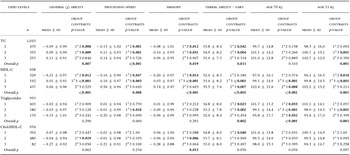
Table 2 presents the results of unadjusted linear regression analyses with serum cholesterol groups as the (categorical) predictor variables and cognitive outcomes as the dependent variables. Higher TC predicted better performance on tests of general cognitive (g) ability, processing speed, memory, and verbal ability, but not age 70 IQ. Post hoc multiple comparison tests revealed that the significant differences were between groups 1*2 and 1*3 and not between 2*3.
Cognitive function scores at age 70 years in relation to clinical categories (low, intermediate, and high) of TC, HDL-C, triglycerides, and Chol:HDL-C ratio

TC = total cholesterol; HDL-C = high-density lipoprotein cholesterol; Chol:HDL-C = cholesterol:HDL cholesterol ratio; NART = National Adult Reading Test; SD = standard deviation.
Lipid levels: 1 – low; 2 – intermediate; 3 – high.
p-values are from ANOVA. Probabilities for significant effects are given in boldface.
Significance at the p < 0.05 level.
Higher HDL-C predicted better cognitive scores on all cognitive domains measured, including age 70 IQ. For the three composite cognitive factors (g, speed, memory), post hoc tests revealed that the significant differences were between groups 1*2 and 1*3 and not between 2*3, as found for TC. However, for verbal ability and age 70 IQ, the significant differences were between groups 1*3 and 2*3 but not 1*2. Those in the high HDL-C group had a higher average age 70 IQ by 4.5 points, than those in the “low” HDL-C group.
Higher triglycerides predicted worse performance on tests of age 70 IQ (for all group contrasts) and verbal ability (groups 1*2, 1*3) but not for the composite cognitive factors. Although non-significant, a negative trend of lower cognitive scores for g, speed, and memory with higher triglycerides was observed. Compared with a high triglycerides group, a low (clinically more desirable) level of triglycerides was associated with a higher average age 70 IQ by 5.9 points and a higher verbal ability.
A significant inverse association was found between chol:HDL-C ratio groups and memory scores such that those with a lower (more desirable) ratio was associated with better scores, but this difference was significant only between groups 1*3. This inverse trend was apparent with the other cognitive scores but these differences were not statistically significant.
Significant associations were found between childhood IQ and three of the four cholesterol measures (TC, HDL-C, triglycerides, overall p = 0.001). Childhood IQ was significantly associated with TC (groups 1*3) and HDL-C (1*2, 1*3) in a positive direction, and with triglycerides (1*3) in a negative direction. Differences in childhood IQ points between the low- and high-cholesterol groups were as follows: TC 4.4 IQ points; HDL-C 6.1 IQ points; triglycerides 5.5 points.
Associations between childhood IQ and covariates
Age 11 IQ was significantly and negatively associated with occupational social class (standardized β = − 0.393, p < 0.001), such that individuals with a higher age 11 IQ were more likely to belong to a more professional social class (classes 1 and 2), and with CVD history (β = −0.077, p < 0.015), such that individuals with a higher age 11 IQ were less likely to have a history of CVD.
Associations between statin use and cognitive function at ages 11 and 70 years
First, we examined whether there was an association between age 11 IQ (as a predictor) and statin medication use in later life. Table 3 shows a significantly higher prevalence of statin use in adulthood in those who had a lower age 11 IQ score (standardized β = −0.077, p = 0.015). Using a logistic regression model (data not presented) where the predictor variable was age 11 IQ (divided into quartiles) and the outcome variable was statin use, we found that compared to those in the highest age 11 IQ quartile (fourth quartile; reference group) those in the lowest age 11 IQ quartile had 1.6 times higher odds (95% CI = 1.05–2.32), and those in the second quartile had 1.4 times higher odds (95% CI = 0.94–2.03), and those in the third quartile had 1.2 times higher odds (95% CI = 0.79–1.78) of taking statin drugs in later life.
Associations between statin use and cognitive outcomes before and after adjustment for age 11 IQ

TC = total cholesterol; SD = standard deviation.
Verbal ability – National Adult Reading Test score.
aAge 70 IQ is age-adjusted (age is not included in these models).
p-values are from linear regression analyses. Probabilities for significant effects are given in boldface.
Significance at the p < 0.05 level.
†Effects adjusted for age 11 IQ.
§Effects adjusted for age 11 IQ and TC (total cholesterol) levels.
Second, we examined whether there was an association between statin use (as a predictor) and cognitive function assessed at age 70 years. We found that statin use predicted poorer performance on the same test of IQ repeated almost 60 years later (p = 0.024). The difference in terms of IQ points is small, but the relationship is significant and linear. Statin use was associated with significantly lower cognitive performance across all other cognitive domains tested, compared with non-statin use. In order to account for the effect of lifelong cognitive ability on these associations we included age 11 IQ as a covariate. Associations remained, though with marked attenuation of the effect sizes, for g, processing speed and verbal ability, but not memory or age 70 IQ. However, when TC was added to this model to adjust for blood cholesterol levels, there were no longer any significant relationships between statin use and cognition.
Adjusted associations between serum cholesterol measures (as continuous vari-ables) and cognitive function at age 70 years
Table 4 shows the results of multiple linear regression models used to examine the association between cholesterol measures (as continuous variables) and cognitive outcomes at age 70 years, before and after covariate inclusion. In the basic age- and sex-adjusted model (model 1), a higher TC level is associated with better cognitive performance on all cognitive domains: g (R 2 = 0.067, p = 0.002); speed (R 2 = 0.048, p = 0.002); NART (R 2 = 0.032, p = 0.030); age 70 IQ (R 2 = 0.007, p = 0.029) with the exception of memory, and a higher HDL-C level, with better performance on all cognitive outcomes g (R 2 = 0.043, p < 0.001); speed (R 2 = 0.028, p = 0.027); memory (R 2 = 0.048, p = 0.001); NART (R 2 = 0.023, p < 0.001); age 70 IQ (R 2 = 0.022, p < 0.001). When age 11 IQ is included (model 2), significance is lost for all associations except for TC and processing speed (with marked attenuation; R 2 = 0.234, p = 0.033) and for all HDL-C associations. In the basic age- and sex-adjusted model (model 1), lower triglyceride levels are associated with better general cognitive ability (R 2 = 0.033, p = 0.016), memory (R 2 = 0.041, p = 0.032), verbal ability (R 2 = 0.019, p = 0.002), and age 70 IQ (R 2 = 0.027, p < 0.001) and a lower chol:HDL-C ratio with better memory (R 2 = 0.041, p = 0.034), verbal ability (R 2 = 0.015, p = 0.020), and age 70 IQ (R 2 = 0.010, p = 0.009). When age 11 IQ is included (model 2), significance is lost for all associations except for triglycerides and age 70 IQ (with marked attenuation; R 2 = 0.497, p = 0.048). In the final model, which is adjusted for age 11 IQ, occupational social class, statin use, and history of CVD, significance is lost for all cholesterol-cognitive function associations at age 70 years.
Adjusted effects† of serum cholesterol measures on cognitive function scores at age 70 years

TC = total cholesterol; HDL-C = high-density lipoprotein cholesterol; Chol:HDL-C = cholesterol:HDL cholesterol ratio.
Model 1: adjusted for sex and age (exact age in days at testing).
Model 2: as model 1 and additionally adjusted for age 11 IQ.
Model 3: as model 2 and additionally adjusted for occupational social class, statin use, and history of cardiovascular disease.
Verbal ability – National Adult Reading Test score.
aAge 70 IQ is age-adjusted (age is not included in these models).
†Effect represented as a β (standardized regression coefficient). *p < 0.05, **p < 0.01, ***p < 0.001.
In addition, we ran the same models with social class of origin (based on father's social class) instead of adult social class, in order examine the potential influence of childhood social circumstances. There were no meaningful differences in results and therefore the data are not shown.
Discussion
In this study, of generally well-functioning older people, we found small but significant associations between serum cholesterol and cognitive functions at age 70 years, almost all of which disappeared after accounting for differences in childhood IQ. Overall, performance on a range of cognitive domains including general (g) cognitive ability, processing speed, memory, verbal ability, and IQ at first appeared to be better in those with higher levels of TC and HDL cholesterol and lower levels of triglycerides. However, the key novel finding here was these relationships between cholesterol measures and cognition were markedly attenuated and mostly no longer significant after including IQ test scores recorded almost 60 years previously. In the final multivariate model, which also included occupational social class, statin use, and CVD history, there was no longer any association between serum cholesterol and cognition. A lower IQ in childhood was related to a higher prevalence of statin use in adulthood. Statin users showed poorer cognitive abilities in old-age independently of earlier ability, but this effect disappeared once we adjusted for serum TC levels. The results suggest that the associations between serum cholesterol, statin use, and cognitive function are confounded by the lifelong stable trait of intelligence. Without early-life measures of intelligence, researchers might attribute a possible causal effect of lipid profiles on successful cognitive aging.
The previous literature on the relationship between serum cholesterol and cognitive outcomes in later-life is equivocal, probably in part due to age-effects. Some reports suggest that the impact of lipids on cognitive trajectories is most prominent in mid-old age. But, over the age of 65 years, serum lipids have little predictive value in terms of cognitive outcomes (Mielke et al., Reference Mielke2008; Van Vliet et al., Reference van Vliet, van de Water, de Craen and Westendorp2009; Reynolds et al., Reference Reynolds, Gatz, Prince, Berg and Pedersen2010; Formiga et al., Reference Formiga2011; Reference Formiga2012; Van Vliet, Reference van Vliet2012). Our finding of poorer performance in those with lower TC is consistent with previous studies demonstrating similar results (e.g. Karlamangla et al., Reference Karlamangla, Singer, Reuben and Seeman2004; van den Kommer et al., Reference van den Kommer2009). However, in terms of cardiovascular risk, “low” cholesterol levels are considered to be “desirable.” Given that assessment occurred later in life in the present sample, the finding of increased prevalence of disease (including high cholesterol) and statin use (about 50%) in those with the lowest TC levels, probably reflects the beneficial effect of cholesterol reduction with statin treatment over a period of time. Elevated cholesterol levels at this stage in life may not be a good indicator of cognitive function or predictor of subsequent cognitive decline. In the current sample of 70-year-olds, lipid measures were clearly associated with a range of cognitive outcomes including processing speed, verbal ability, and general (g) cognitive ability, but this effect often went away after including childhood intelligence. One of the key findings here is that childhood intelligence accounts for much of the initially reported association between TC, HDL-C, triglycerides, and cognitive abilities. The LBC1936 Study is useful in having intelligence data from youth as it is rarely available. Without it the results could have been interpreted as suggesting a possible role for higher cholesterol levels in successful cognitive aging.
Why would there be a life-long relationship between intelligence and serum lipid profiles? Intelligence and health are inextricably linked across the life course. The relationship between lifestyle factors and cognitive abilities is well-documented (Hertzog et al., Reference Hertzog, Kramer, Wilson and Lindenberger2009; Lee et al., Reference Lee2010). Crucially, intelligence from childhood is associated with health behaviors including diet, physical exercise, smoking, and alcohol consumption, and, pathways linking childhood IQ and lifestyle involve reciprocal interactions. Gottfredson (Reference Gottfredson2004) suggested that IQ may be the single most important factor in the adoption of such health behaviors in adulthood. This may, in part, explain the well-documented relationship between low childhood IQ and high morbidity rates (Calvin et al., Reference Calvin2011) resulting in increased medication use in later life including statins (Starr et al., Reference Starr2004). The higher prevalence of statin use in those with lower intelligence scores from childhood in the current sample attests to this.
Although genetic predisposition and metabolic function largely determine an individual's serum lipid profile, lifestyle-related factors may influence serum cholesterol. For example, low nutritional intake, weight loss, and poor overall health, are features more likely to be present in those with a low IQ and SES given the intelligence and SES gradients in health. Dietary (macronutrient) intake is known to affect lipid levels (Cook, Reference Cook2005), and the brain, which is the most cholesterol-rich organ in the body, is vulnerable to such diet-induced changes in serum lipid levels (Muldoon et al., Reference Muldoon, Ryan, Matthews and Manuck1997; Thorsson et al., Reference Thorsson2013). In addition to dietary intake, research suggests that physical activity (Bronwell et al., Reference Brownell, Bachorik and Averle1982; Ellison et al., Reference Ellison2004), moderate alcohol consumption, and non-smoking (Whitehead et al., Reference Whitehead, Robinson and Allaway1996; Ellison et al., Reference Ellison2004) are related to increases in HDL cholesterol. An increased BMI (Ellison et al., Reference Ellison2004) and fat mass decreases HDL cholesterol (Schubert et al., Reference Schubert2006).
In the present study, the relationship between some health-related behaviors such as dietary saturated fat and dietary cholesterol intake, adherence to a “healthy” Mediterranean-style dietary pattern, and alcohol consumption with TC levels was not clear-cut and at times, counter-intuitive. The TC-diet findings may be suggestive of behavioral change in those with or at high-risk of CVD. Dietary advice usually accompanies a diagnosis of high cholesterol by a medical practitioner; dietary intervention is increasingly recognized as a necessary strategy against various metabolic disorders. Advice regarding dietary fat quality, in particular, the inclusion of foods rich in PUFAs (including oily fish), at the expense of foods high in saturated fats and dietary cholesterol, has been shown to have cardioprotective effects by improving serum lipid profiles (Sacks, Reference Sacks1994).
In a summary of the largest primary and secondary dietary prevention studies, Law et al., (Reference Law, Wald and Thompson1994) estimated that for a 10% reduction in serum cholesterol (0.6 mmol L), the risk of non-fatal myocardial infarction was reduced by 9% in the first two years of follow-up, 14% from years two to five, and by 37% with more than five years of follow-up. In the current sample, the low-TC group had the highest prevalence not only of CVD but stroke, hypertension, statin use, and high BMI, and therefore the most likely group to have made dietary modifications as part of a health management program to reduce weight and improve overall health. However, TC represents many sub-components including HDL, LDL, and very-LDL cholesterol, and therefore the effect of a dietary change on TC may differ depending on which specific cholesterol components were altered (Willett, Reference Willett2012). Furthermore, we suggest that these behavioral modifications are relatively recent otherwise we would have expected TC levels to be affected by a low cholesterol diet; a finding not borne out of our results. This possibly reflects relatively recent interest in potential adverse effects of high dietary cholesterol on older adults among GPs and other medical practitioners. However, those with the highest TC had a lower BMI, more physically active lifestyles and were less likely to be current smokers. Such evidence may support the theory that the relationship between childhood IQ, serum lipid profiles, and necessity of lipid-lowering medication, is mediated by lifestyle factors and the possibility of reverse causation, that is, higher lifetime trait levels of IQ predict lipid profiles in adulthood (via lifestyle), rather than lipid profiles predicting IQ/cognitive ability. Alternatively, any relationship between serum cholesterol and intelligence may originate in childhood when the developing brain is more susceptible to environmental influences such as nutrient supply.
The results do not support an effect (beneficial or detrimental) of statins on cognition. Although initial analyses revealed some differences favoring non-statin users in terms of better cognitive function, adjusted analyses suggested that participants taking statins did not differ from their counterparts in terms of neuropsychological test performance. Our results are in line with another observational study (Benito-León et al., Reference Benito-León, Louis, Vega and Bermejo-Pareja2010) and several clinical trials (Trompet et al., Reference Trompet2010; see Xiong et al., Reference Xiong, Benson and Doraiswamy2005) reporting no cognitive effects of statin treatment in the elderly, but not with the many observational studies reporting beneficial effects (Rockwood et al., Reference Rockwood2002; Yaffe et al., Reference Yaffe, Barrett-Connor, Lin and Grady2002; Bernick et al., Reference Bernick2005; Solomon et al., Reference Solomon2009). On the whole, longitudinal studies with long follow-up periods have failed to confirm these results (see Van Vliet et al., Reference van Vliet, van de Water, de Craen and Westendorp2009) and a recent systematic review of randomized controlled trials, cohort case-control, and cross-sectional studies evaluating cognition in patients receiving statins concluded that statins have a neutral effect. However, the lack of cognitive benefit in old age does not obviate that use of statins in middle age might be beneficial for cognitive function later in life.
Those who survive to old age with high cholesterol may be physically more robust and less susceptible to the adverse effects of a high midlife TC on cardiovascular pathologies. Alternatively lower TC levels in elderly people may be a proxy for poorer general health status and/or malnutrition (Brescianini et al., Reference Brescianini2003). There is some suggestion that TC may be a potential marker of physical frailty (Schalk et al., Reference Schalk, Visser, Deeg and Bouter2004, Tilvis et al., Reference Tilvis, Valvanne, Strandberg and Miettinen2011). In the current study, a low TC level, compared to both intermediate and high levels was associated with an increased prevalence of a range of diseases. Approximately half of those in the lowest TC group had a history of stroke, hypertension, and lipid-lowering medication use, and 40% had CVD thus supporting the latter suggestion. Higher cholesterol levels in the elderly are inversely associated with the onset and outcome of certain diseases (Onder et al., Reference Onder2003), better health outcomes after stroke (Dyker et al., Reference Dyker, Weir and Lees1997) and surgery (Delgado-Rodriguez et al., Reference Delgado-Rodríguez2002). Total cholesterol is an independent predictor of all-cause mortality in middle-age but in those over the age of 65 years, high cholesterol levels provide a mortality advantage over lower levels (Weverling-Rijnsburger et al., Reference Weverling-Rijnsburger1997; Schatz et al., Reference Schatz2001). We suggest that higher total serum cholesterol levels reflect better health status in late-life and are therefore likely to associate with better physical health markers but there is no evidence that lipid profiles contribute independently to cognitive aging, successful or otherwise.
Study strengths and limitations
This is, to our knowledge, the first study to examine the relationship between serum cholesterol and cognition that also includes a validated measure of early-life IQ. In terms of cognitive ability, it was useful to have measures at two distant points across the life course. Knowledge of cognitive ability before the influences of aging and illnesses is necessary in order to elucidate possible causal directions because lower childhood IQ is in itself related to a greater risk of disease and a higher mortality (Whalley and Deary, Reference Whalley and Deary2001, Calvin et al., Reference Calvin2011). Other large cohorts might look, in the future, at prior cognitive ability measurements at multiple time-points. Given the stability of intelligence (Deary et al., Reference Deary, Whalley, Lemmon, Crawford and Starr2000), results may not differ significantly. The large sample size and availability of comprehensive cognitive, health, and demographic data were important for statistical power and to determine whether cholesterol contributes to the variance in cognitive scores explained by “extrinsic” factors, given that approximately half the variance in IQ scores in old age is explained by childhood IQ (Deary et al., Reference Deary, Whalley, Lemmon, Crawford and Starr2000). We examined multiple cholesterol measures. Participants were from a narrow age range, thereby minimizing the confounding effect of chronological age differences.
The cross-sectional design of this study – albeit with a much earlier measure of cognitive ability – is a limitation as it is possible that current lipid levels may reflect recent changes in response to poor physical health, i.e. underlying disease or weight loss with age, in addition to widespread statin use, rather than lipid history. However, future longitudinal analyses on the LBC1936 within old age (using baseline age 70 data) are planned, with cognitive, lipid, and dietary data collection prospectively over several waves of follow-up spanning ten years. There is a possibility that individuals with high midlife serum cholesterol succumb to its adverse biological effects and die before they reach the age 70 years. An older, and relatively healthy cohort such as the present sample, may represent a select group with lower cholesterol, on average, than the general population of the same age. Whereas it is not possible to determine the pattern of lipid levels before older age in this sample, this does not affect our conclusion that there is little direct relationship between lipids and cognitive function in later-life. Pattern of TC change may be more relevant to late-life cognition than TC levels at given time points. We had no measure of LDL cholesterol, although we utilized the cholesterol:HDL cholesterol ratio as a proxy measure. Blood samples in this study were measured in the non-fasting state which might influence the concentrations of cholesterol. However, a growing body of evidence suggests that fasting is not necessary prior to a lipid test in most scenarios as it does not greatly alter the levels of lipid parameters (Gaziano, Reference Gaziano2012). Non-fasting lipid profiles change minimally in response to food intake in the general population (Langsted et al., Reference Langsted, Freiberg and Nordestgaard2008). The authors are confident that the use of a non-fasting blood sample is more than sufficient to examine population variations in cholesterol parameters in a relatively healthy, community dwelling sample such as the LBC1936.
We used a self-report dietary assessment instrument (FFQ) which may be subject to misreporting of food intakes. However, the (self-selected) LBC1936 consists of relatively healthy, high-functioning men and women, and the empirical outcome of any non-systematic (low-level) misreporting is likely to be, at most, a small amount of noise in the data. Moreover, the SCG-FFQ used in the present study, shows good repeatability (dietary intake in later life is reasonably stable in the short term) and validity in community-dwelling older populations compared with four-day diet diaries (Jia et al., Reference Jia, Craig, Aucott, Milne and McNeill2008; McNeill et al., Reference McNeill, Winter and Jia2009).
Finally, these simple indices of cholesterol are fairly “coarse” measures. We have not taken into account individual fatty acids. There is evidence that unsaturated fatty acids have a major benefit on cognition (Whalley et al., Reference Whalley, Fox, Whale, Starr and Deary2004). Future examination of such dietary factors (including individual fatty acids) on TC sub-components, i.e. individual lipid indices such as HDL, LDL, and very-LDL, and cognition, may be warranted.
Conclusions
In this community-based sample of older men and women, higher cholesterol (TC and HDL-C) and lower triglycerides levels were not associated with better cognition once the confounding effects of childhood IQ were taken into account. We conclude that serum lipid profiles do not independently contribute to cognitive aging, successful or otherwise, in this cohort. Further studies are required to determine the longitudinal relationships between changes in lipid levels and changes in cognitive function and decline in the same samples and to determine the pathways linking early-life cognitive ability with serum cholesterol in later life.
Conflict of interest
None.
Description of authors’ roles
J. Corley was involved in data collection, performed the statistical analyses, and led the writing of the paper. J. Corley and I. J. Deary discussed the statistical analyses. I. J. Deary and J. M. Starr contributed to study design, study management, interpretation of analyses, and drafting of the manuscript.
Acknowledgments
The LBC1936 data were collected using a Research Into Ageing program grant; this research continues as part of the Age UK-funded Disconnected Mind project. We thank the Scottish Council for Research in Education for allowing access to the SMS1947. We thank the LBC1936 Study participants. J. M. Starr and I. J. Deary are members of The University of Edinburgh Centre for Cognitive Ageing and Cognitive Epidemiology, part of the cross council Lifelong Health and Wellbeing Initiative (MR/K026992/1). Funding from the Biotechnology and Biological Sciences Research Council (BBSRC), Engineering and Physical Sciences Research Council (EPSRC), Economic and Social Research Council (ESRC), and Medical Research Council (MRC) is gratefully acknowledged.