INTRODUCTION
A large number of flatfish species have been reported for the Portuguese coast (e.g. Nielsen, Reference Nielsen, Whitehead, Bauchot, Hureau, Nielsen and Tortonese1986a, Reference Nielsen, Whitehead, Bauchot, Hureau, Nielsen and Tortoneseb, Reference Nielsen, Whitehead, Bauchot, Hureau, Nielsen and Tortonesec, Reference Nielsen, Whitehead, Bauchot, Hureau, Nielsen and Tortonesed; Quéro et al., Reference Quéro, Desoutter, Lagardère, Whitehead, Bauchot, Hureau, Nielsen and Tortonese1986a, Reference Quéro, Desoutter, Lagardère, Whitehead, Bauchot, Hureau, Nielsen and Tortoneseb; Cabral, Reference Cabral2000a) and though many of them have a high commercial interest, few studies have been conducted on Pleuronectiformes biology in Portuguese waters (e.g. Dinis, Reference Dinis1986; Andrade, Reference Andrade1990; Cabral, Reference Cabral1998, Reference Cabral2000a, Reference Cabralb; Cabral & Reference Cabral and CostaCosta, 1999; Cabral et al., Reference Cabral, Lopes and Loeper2002).
The sand sole, Solea lascaris (Risso, 1810) is a Soleidae with a wide geographical distribution, from the southern North Sea to the Gulf of Guinea and the Mediterranean, inhabiting sandy and muddy bottoms at depths of 5 to 350 m (Quéro et al., Reference Quéro, Desoutter, Lagardère, Whitehead, Bauchot, Hureau, Nielsen and Tortonese1986a).
Despite its broad distribution, most studies on S. lascaris biology were conducted along the west coast of Brittany (France) and the Portuguese coast and have considered essentially its growth and reproduction (e.g. Deniel, Reference Deniel1981; Dinis, Reference Dinis1986; Deniel et al., Reference Deniel, Le Blanc and Rodriguez1989; Andrade, Reference Andrade1990). The diet of S. lascaris was previously studied along the west Brittany (France) and Algerian coasts (Marinaro Bouabid, 1983; Rodriguez, Reference Rodriguez1996).
The studies conducted along the Portuguese coast, reported that S. lascaris spawns from January to June, southerly populations having an earlier spawning season (Dinis, Reference Dinis1986; Andrade, Reference Andrade1990; Gomes, Reference Gomes2002). A similar latitudinal gradient has been reported for growth parameters with specimens of the central coastal area showing a lower growth coefficient than those collected in Algarve (Andrade, Reference Andrade1990). Dinis (Reference Dinis1986) determined longevity of 11 years and a maximum total length of 355 mm. Cabral et al. (Reference Cabral, Lopes and Loeper2002) mention that juvenile sand sole fed on small Crustacea and Bivalvia.
Solea lascaris is a species with a growing commercial interest. In Portugal, its landings have quadrupled in the last decade (from about 28 tonnes in 1990 to 116 tonnes landed in 2000), coming to represent 6.4% of the landed flatfish. Still less common than other commercially important sole species such as Solea solea (Linnaeus, 1758) and Solea senegalensis Kaup, 1858, with which S. lascaris are fished, it reaches high values in auction giving it a great economic importance (DGPA, unpublished data).
As a commercially important species, increasingly exploited and poorly known, the study of S. lascaris ecology has become of particular importance for fisheries management purposes. Thus, the aim of the present work was to study the feeding ecology, growth and sexual cycle of S. lascaris along the Portuguese coast.
MATERIALS AND METHODS
Sampling surveys and samples processing
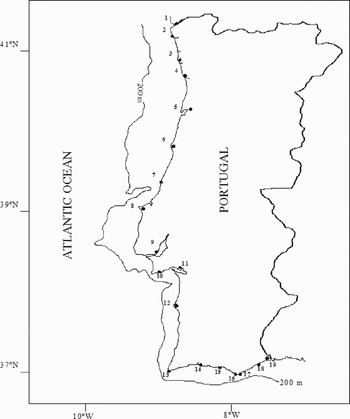
A total of 665 individuals were collected seasonally (autumn, winter, spring and summer), between October 2002 and July 2003, from commercial fishing vessels operating with gill nets and bottom trawls along the Portuguese coast (Figure 1).
Map of mainland Portugal landing ports (1, Caminha; 2, Viana do Castelo; 3, Póvoa do Varzim; 4, Leixões; 5, Aveiro; 6, Figueira da Foz; 7, Nazaré; 8, Peniche; 9, Lisboa; 10, Sesimbra; 11, Setúbal; 12, Sines; 13, Sagres; 14, Portimão; 15, Quarteira; 16, Faro; 17, Olhão; 18, Tavira; 19, Vila Real de Santo António).
All fish were measured (total length to nearest 1 mm) and weighed (total and eviscerated wet weight with 0.01 g precision). Stomachs and gonads were removed and frozen (−20°C) for further analysis. Then, the stomach contents were removed for identification and gonads were weighed. Each prey item was identified to the lowest taxonomic level possible, counted and weighed (wet weight to 0.001 g). Sagittae otoliths were removed, cleaned and kept dry for later age determination.
Feeding ecology
The relative importance of each item was evaluated by calculating the numerical composition (Cn%), frequency of occurrence (F%) and biomass (Cw%) (Hyslop, Reference Hyslop1980). Differences in diet composition by sampling season and fish length (two length-classes: <250 mm and >250 mm total length) were evaluated by correspondence analysis (CA) that was performed using CANOCO software (ter Braack Smilauer, Reference ter Braak and Smilauer1998).
Age and growth
Age was evaluated using otoliths. For each specimen, two counts of otolith annuli were made under a dissecting microscope. Whenever the two readings of the same otolith resulted in different age estimates the data were not considered for further analysis.
Estimates of theoretical growth in length were obtained by fitting length-at-age data to the von Bertalanffy (vB) growth equation:

where Lt is the total length at age t, L∞ is the asymptotic length, k is the growth coefficient and t0 is the theoretical age at zero length. The growth parameters of this model were estimated iteratively using the least squares method in STATISTICA software. This analysis was performed separately for females and males.
Sexual cycle
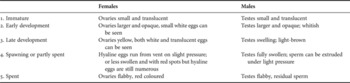
Gonads were observed macroscopically and a maturation stage was assigned to each individual, according to a five-stage scale (Table 1). For each season the proportion of fish in stages 2 to 5 was determined.
Sexual maturity stages of Solea lascaris (adapted from Andrade, Reference Andrade1990, and Cabral, Reference Cabral1998).

In order to evaluate gonadal development during the annual sexual cycle and to determine the spawning season, the gonadosomatic index (GSI) was calculated per sex for each season. The GSI was expressed as the percentage of the weight of gonads in relation to eviscerated weight of fish.
RESULTS
Feeding ecology
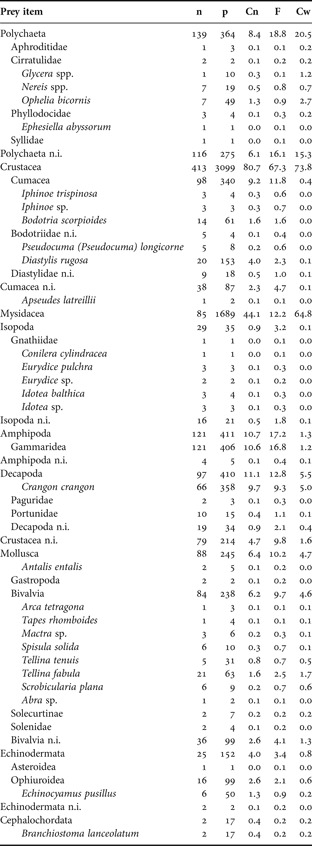
The diet spectrum of Solea lascaris was broad, consisting of a variety of Polychaeta, Crustacea, Mollusca, Echinodermata and Cephalochordata (Table 2). Crustacea was found to be the most important prey group according to all three indices (Cn = 80.7%; F = 67.3%; Cw = 73.8%). Amongst Crustacea, Mysidacea were the most important prey in both numbers and weight (values of Cn = 44.1% and Cw = 64.8%), while on occurrence alone Amphipoda was the most important group (F = 17.2%). Polychaeta also held a considerable importance in the S. lascaris diet: when considering occurrence in stomach contents (F = 18.8%) Polychaeta were more important than any subgroup of Crustacea and also scored a high value on the basis of weight (Cw = 20.5%).
Numerical composition (Cn), frequency of occurrence (F) and biomass composition (Cw) indices values of prey found in stomachs of Solea lascaris on the Portuguese coast (n, number of stomachs in which prey occurs; p, number of individuals of a specific prey).

n.i., not identified.
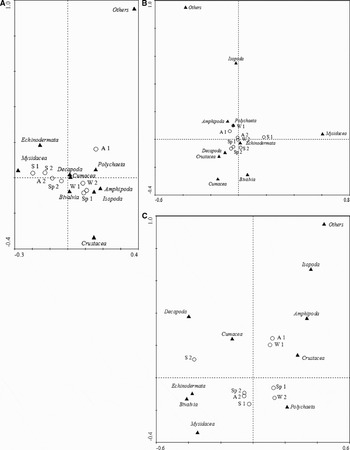
The first two axes of all three CA that were performed explained a high percentage of the total observed variation in diet according to each of the three indices (85.9%, 90.6% and 88.7% for Cn, F and Cw data based analyses, respectively) (Figure 2).
Ordination diagrams of the correspondence analyses performed to numerical composition (A), frequency of occurrence (B) and biomass composition (C) of prey found in stomachs of Solea lascaris (1, length-class 1; 2, length-class 2; W, winter; Sp, spring; S, summer; A, autumn).

Three groups can be identified based on the Cn ordination diagram: one group encompasses the samples relative to autumn diet of the length-class 1, that was strongly associated with Polychaeta; winter and spring diets of the length-class 1 and winter diet of the length-class 2 formed a second group associated to Amphipoda, Bivalvia and Isopoda; the third group consisted of the spring diet of length-class 1, the summer diet of length-classes 1 and 2, and the autumn diet of length-class 2, which was associated with Cumacea, Decapoda, Echinodermata and Mysidacea.
In the ordination diagram obtained for frequency of occurrence data can be seen one group relative to winter diet of length-class 1, autumn diet of length-classes 1 and 2, and summer diet of length-class 1, associated with Amphipoda and Polychaeta. The diet of individuals of length-class 1 in spring and of length-class 2 in winter, spring and summer were associated with Crustacea, Decapoda and Echinodermata.
When the Cw was considered in the ordination analysis, Polychaeta was strongly related to spring and winter diets of length-classes 2 and 1, respectively. Winter and autumn diets of length-class 1 were associated with Crustacea, Amphipoda and Isopoda; the summer diet of length-class 2 were associated with Cumacea and Decapoda; Echinodermata, Bivalvia and Mysidacea were associated with spring and autumn diets of length-class 2 and summer diet of length-class 1.
Overall, Amphipoda and Echinodermata were the most important element of the winter and summer diets, respectively, according to all three indices. Considering Cn and F, Decapoda were particularly important in spring. The Amphipoda were the major item of the autumn diet according to F and Cw. Winter and autumn diets were very similar according to F and Cw, and spring and summer diets were very similar according to F. Amphipoda were the most important prey item of length-class 1, according to all three indices. Length-class 2 fed mainly on Decapoda and Echinodermata, according to all three indices.
Age and growth
A total of 296 females and 113 males were analysed for age determination. The total length of fish analysed varied from 61 mm to 340 mm, for females, and from 61 mm to 310 mm, for males. The oldest fish was 6 years.
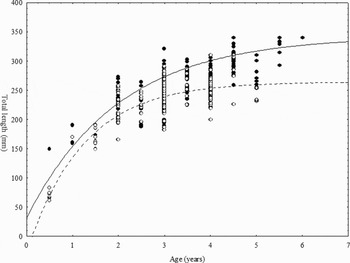
The von Bertalanffy growth equation parameters differed between sexes (Figure 3). The asymptotic length (L∞) obtained for females was higher compared to the one obtained for males (342.3 mm and 264.5 mm, respectively), while the growth coefficient (k) estimated for females (k = 0.50) was lower than that determined for males (k = 0.82). The t0 estimates were −0.87 and 0.13 for females and males, respectively.
von Bertalanffy growth curves fitted to length-at-age data of Solea lascaris (females. black circles and solid lines; males, empty circles and dashed lines).

Sexual cycle
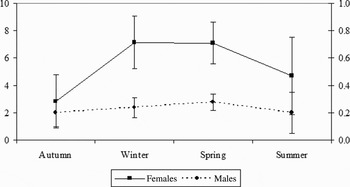
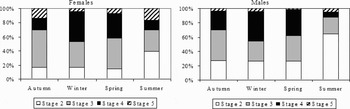
Percentage of individuals according to maturity stages was in agreement with GSI seasonal changes (Figures 4 & 5). The highest values of the GSI were obtained in winter and spring, the seasons when the highest percentage of individuals in spawning were recorded. The lowest GSI values (2.8% of eviscerated weight for females, 0.2% of eviscerated weight for males) were recorded in autumn, but a large proportion of partly spent females and spawning males indicated spawning was still taking place.
Gonadosomatic index mean values season, determined for each sex (standard deviation is represented).

Percentage of individuals in each maturation stage according to season, for females and males (maturation stages as in Table 2).

DISCUSSION
The diet composition determined for Solea lascaris along the Portuguese coast was similar to that described by Rodriguez (Reference Rodriguez1996) for the west coast of Brittany. In both studies, it was found that S. lascaris feeds on a wide range of prey belonging to several taxa, the most important groups being Mysidacea, Polychaeta and Amphipoda. The S. lascaris diet reported by Cabral et al. (Reference Cabral, Lopes and Loeper2002) and Marinaro & Bouabid (Reference Marinaro and Bouabid1983) is somewhat different: the prey-range is much smaller and Polychaeta are not an important prey. However, Cabral et al. (Reference Cabral, Lopes and Loeper2002) studied the diet of juveniles and Marinaro & Bouabid (Reference Marinaro and Bouabid1983) had a small sample size (24 full stomachs), which could bias the estimation of prey importance.
The diet of S. lascaris is similar to that of S. solea and S. senegalensis differing mostly on Mollusca importance (e.g. Molinero & Flos, Reference Molinero and Flos1991; Garcia-Franquesa et al., Reference Garcia-Franquesa, Molinero, Valero and Flos1996; Cabral, Reference Cabral2000b; Darnaude et al., Reference Darnaude, Harmelin-Vivien and Salen-Picard2001) that seem to be a preferential prey for the former species but not for S. lascaris. Overall, S. lascaris can be considered an opportunistic and generalist feeder, a status that has been recognized for several species of Soleidae (e.g. Cabral, Reference Cabral2000b; Darnaude et al., Reference Darnaude, Harmelin-Vivien and Salen-Picard2001).
The differences found in the diet of S. lascaris in regards to season and length size were in agreement with Rodriguez (Reference Rodriguez1996). These seasonal variations were a consequence of changes in space- and time-variation of benthic fauna composition, shifts due to life-history patterns of prey and feeding activity of the predator (Wootton, Reference Wootton and Wootton1998). The diet variation according to fish length is consistent with the optimum foraging theory (Gerking, Reference Gerking1994), which states that larger predators tend to consume larger prey in order to maximize the energetic gain relative to capture effort.
The growth pattern found for S. lascaris in this study is quite different from what was previously described (e.g. Deniel, Reference Deniel1981; Dinis, Reference Dinis1986; Andrade, Reference Andrade1990). The observed longevities of 6 years for females and 5 years for males are lower than those found by Dinis (Reference Dinis1986) (11 years, both for females and males), but similar to those reported by Andrade (Reference Andrade1990) (7 and 6 years, respectively for females and males).
The observed pattern in the sexual cycle through the year is in accordance with expectations, and is similar to those reported by Dinis (Reference Dinis1986), Andrade (Reference Andrade1990) and Gomes (Reference Gomes2002) for the Portuguese coast: S. lascaris has a winter–summer spawning season and a latitudinal gradient that can be noticed. For the Douarnenez Bay (France), Deniel (Reference Deniel1981) found a spawning season from May to September. Deniel (Reference Deniel1981) reported a similar gradient for the S. solea spawning season.
The observed duration of the spawning period was longer than has been reported (7/8 months in this study against 5 months—Deniel, Reference Deniel1981; Dinis, Reference Dinis1986; Andrade, Reference Andrade1990; Gomes, Reference Gomes2002). These authors have noted that there is an asynchrony in the spawning of older and younger females, the second group spawns later, which could explain this long duration. This trend was not completely evident in this study (data not shown), and the long duration of the spawning season is due perhaps to serial spawning temporally spaced and/or to year fluctuations (e.g. Koutsikopoulos et al., Reference Koutsikopoulos, Dorel and Desaunay1995).
Other Soleidae species have a winter–summer spawning season, namely S. senegalensis and Dicologlossa cuneata (Moreau, 1881) (Dinis, Reference Dinis1986): as S. lascaris these are sub-tropical species that attain maturity during the increasing daylight period.
Many aspects of S. lascaris biology remain to be studied, namely those regarding larvae and juvenile stages. These have been generally considered as very important life cycle phases, critical for individual survival, and so knowledge of these is of extreme importance, both for fisheries and aquaculture purposes.
ACKNOWLEDGEMENTS
This study was partially financed by the Fundação para a Ciência e a Tecnologia (FCT), through the grant awarded to C.M. Teixeira (Grant SFRH/BD/19319/2004).
This study was also co-funded by the European Union through the FEDER—Fisheries Programme (MARE).