Introduction
Seeds of most temperate- and arctic-zone species of Fabaceae have an impermeable seed coat and thus physical dormancy (PY); they are ‘hardseeded’ (Baskin and Baskin, Reference Baskin and Baskin1998). Thus, seeds with this class of dormancy do not imbibe water even under favourable environmental conditions. PY may play a role in determining the time and place of seed germination in the field and thus in helping to ensure long-term seed survival, especially for wild species growing in harsh environments (Tran and Cavanagh, Reference Tran, Cavanagh and Murray1984; Hu et al., Reference Hu, Wu and Wang2009). After the seed coat of most hardseeded species of Fabaceae becomes permeable, they can germinate over a wide range of temperatures.
However, seeds of some species with water-impermeable seed coats will not germinate, or germinate only under a very limited temperature range, even when the seed coat is made permeable. Seeds of such species also have physiological dormancy (PD) and, thus, combinational dormancy (PY+PD) (Baskin and Baskin, Reference Baskin and Baskin2004). Van Assche and Vandelook (Reference Van Assche and Vandelook2010) showed that PD of the embryo is quite common in herbaceous winter annual species of Fabaceae in temperate climates. The combination of a hard seed coat and a dormant embryo is interpreted as a double safety mechanism to prevent early germination after out-of-season rains in arid regions and in Mediterranean climates (Kigel, Reference Kigel, Kigel and Galili1995; Norman et al., Reference Norman, Cocks, Smith and Nutt1998). In these and other moisture-limited ecosystems, combinational dormancy may ensure that seeds germinate in the wet cool season, thus increasing seedling establishment success (Baskin and Baskin, Reference Baskin and Baskin1998; Van Assche and Vandelook, Reference Van Assche and Vandelook2010). However, it is not known how this kind of seed dormancy regulates germination in time and space in subalpine/alpine areas.
In high-elevation ecosystems, where temperature is a critical driver for plant regeneration, some legume species fail to reproduce by seeds due to temperature limitation (Wang et al., Reference Wang, Nan, Nie, Zhang and Zhang2005; Nie, Reference Nie2011; Hu et al., Reference Hu, Wang and Wang2012). Legume species growing in relatively cool ecosystems may have evolved special adaptive strategies for local environments. For example, seeds in alpine environments have relatively lower germination temperatures (base temperature) compared to those in other ecosystems (Trudgill et al., Reference Trudgill, Squire and Thompson2000; Wang et al., Reference Wang, Liu, Liu and Bu2011; Hu et al., Reference Hu, Wang and Wang2012). Baskin and Baskin (Reference Baskin and Baskin1998) reported that >70% of arctic–alpine species have dormant seeds, mainly PD and to a much lesser extent PY. Some early comprehensive studies also included information on seed germination and dormancy in alpine species (Amen, Reference Amen1966; Körner, Reference Körner2003). However, detailed information on seed dormancy in high-elevation legumes and its adaptative significance is still lacking.
The genus Vicia is of considerable economic importance in the Qinghai-Tibet subalpine/alpine ecosystem. Two annuals, V. sativa and V. angustifolia, have been successfully domesticated and extensively cultivated in the area as the most important sources of crude protein for livestock (Wang et al., Reference Wang, Nan, Nie, Zhang and Zhang2005; Nie, Reference Nie2011; Hu et al., Reference Hu, Wang and Wang2012). The other two species, V. amoena and V. unijuga, are perennials commonly found on the Qinghai-Tibetan Plateau, and they are also valuable forage plants in the area. However, in the high-elevation rangelands it is still not known how these species germinate and maintain populations year by year. Thus, we investigated: (1) the expression of seed dormancy under different temperature and moisture conditions; and (2) the role of plant growth regulators in seed dormancy regulation.
The hydrotime model has proven to be useful for understanding the physiological mechanism of dormancy and has been suggested as a tool to describe relative dormancy levels in seeds (Alvarado and Bradford, Reference Alvarado and Bradford2002). Here, we use the hydrotime model to characterize changes in response to water potential during alleviation of physiological dormancy.
Materials and methods
Species and seed collection
Although the four Vicia species are widely distributed in temperate regions, they are commonly found in high-elevation rangelands on the Qinghai-Tibet Plateau, Gansu Province, China. The Vicia species flower from June to July and seeds can mature before frost in Qinghai-Tibet rangelands. They are an important source of crude protein for livestock in this high-elevation rangeland.
Seeds of the four Vicia species were collected in the Qinghai-Tibet rangelands (Xiahe County, 102°30′E, 35°16′ N, 3000 m above sea level) in late August, 2010 and 2011. Pods were collected as soon as they were ripe and when seeds had started to disperse naturally from some of them. Pods dried in laboratory conditions (20°C, 35% relative humidity) for 1 or 2 d opened naturally, and then seeds were manually separated from the pods. Fresh seeds were used within 1 week after harvest. To test the effect of storage on seed germination, the other samples were placed in paper bags, and stored for 1 year under room conditions (16–22°C, 20–45% relative humidity). The 1000-seed mass for V. angustifolia, V. sativa, V. amoena and V. unijuga was 20.5, 68.5, 20.3 and 10.3 g, respectively. All seed lots in this study exhibited high quality and germinated to 99 or 100% under optimal conditions after physical dormancy release.
Seed coat impermeability
Impermeability of the seed coat to water was tested on fresh and 1-year-stored seeds of the four species. Seeds were placed on two sheets of filter paper (Hangzhou Shuangquan, Hangzhou, Zhejiang, China) moistened with 10 ml distilled water in 12-cm-diameter Petri dishes and incubated in darkness at 20°C for 14 d. The number of imbibed and unimbibed seeds in each dish was monitored daily. When a seed imbibed, there was a visible change in its size/volume, thus imbibed and unimbibed seeds could easily be distinguished from each other. For each species, four replicates of 50 seeds each were used.
Effect of scarification on germination rate of fresh and stored seeds at different temperatures
Fresh and 1-year-stored seeds were scarified by cutting a small hole in the seed coat on the concave side of the seed with a surgical knife. Four replicates of 50 seeds each were placed in 12-cm-diameter Petri dishes on moist filter paper and incubated at 5, 10, 15 and 20°C in the dark. A preliminary experiment showed that light did not affect seed germination. Germinated seeds were counted daily until germination was complete or for a maximum period of 28 d. A seed was regarded as germinated when the radical protruded from the seed coat. From the cumulative germination curve, we derived T 50, the number of days to attain 50% germination of the total seed population. Germination rate was expressed as 1/T 50.
Hydrotime model and estimated parameters of fresh and stored seeds after scarification
The hydrotime model (Gummerson, Reference Gummerson1986; Bradford, Reference Bradford1990) can be defined as:
 $$probit( g ) = [ \Psi - ( \theta _{ H }/ tg ) - \Psi _{ b }(50)]/ \sigma _{ \Psi b } $$
where θH is the hydrotime constant, Ψ the water potential of the germination testing medium and Ψb(g) the base or threshold water potential for a specific germination fraction g. The normal distribution of Ψb(g) values among seeds in the population is characterized by its median [Ψb(50)] and standard deviation (σΨb), which can be derived using repeated probit analysis in which θHis varied until the best fit is attained (Ellis et al., Reference Ellis, Covell, Roberts and Summerfield1986; Bradford, Reference Bradford1990; Bradford, Reference Bradford, Kigel and Galili1995; Cheng and Bradford, Reference Cheng and Bradford1999):
 $$probit( g ) = [ \Psi - ( \theta _{ H }/ tg ) - \Psi _{ b }(50)]/ \sigma _{ \Psi b } $$
To characterize the germination response of V. sativa to temperature and water potential (Ψ), fresh and 1-year-stored seeds were tested for germination at different water potentials at 10, 15 and 20°C. Different water potentials were obtained with polyethylene glycol (PEG) 6000. The solutions were prepared according to Michel and Kaufmann (Reference Michel and Kaufmann1973) to give water potentials of 0.0, − 0.2, − 0.4, − 0.6, − 0.8, − 1.0, − 1.2, − 1.4 and − 1.6 MPa. PEG-6000 solutions were renewed every 48 h to ensure relatively constant Ψ. For each treatment, four replicates of 50 seeds were placed in Petri dishes on two layers of filter paper moistened with 10 ml of solution. Germinated seeds were counted daily for a maximum period of 28 d.
Effect of plant growth regulators on germination
To determine the role of plant growth regulators in controlling seed dormancy, the effects of gibberellic acid (GA3, Sigma, China), fluridone (FLU, Sigma), an inhibitor of abscisic acid (ABA) biosynthesis, abscisic acid (Sigma) and paclobutrazol (PAC, Sigma), an inhibitor of GA biosynthesis, were tested. For this study, scarified fresh or 1-year-stored seeds of V. angustifolia were incubated in a range of concentrations of the different compounds. For FLU and GA treatments, seeds were incubated at 20°C in the dark and for ABA and PAC treatments at 10°C in the dark. FLU and GA3 were dissolved in 2 ml of ethanol prior to dilution in water. A preliminary experiment showed that a low concentration of ethanol did not affect seed germination in the studied species. For each treatment, four replicates of 50 seeds were used. Seed germination was monitored daily for 14 d.
Germination and dormancy release in the field
The purpose of this part of the study was to determine the role of dormancy in regulating germination in the field after the seeds are dispersed. Fifteen nylon bags of 100 seeds each of V. angustifolia and V. unijuga were placed on the soil surface in Xiahe County (102°30′E, 35°16′N, 3000 m above sea level) after they were harvested on 5 October 2011. Five bags of each species were taken to the laboratory in December, February and April. All seeds from each nylon bag for each species were poured into separate Petri dishes with two layers of filter paper moistened with 10 ml of distilled water. The dishes were placed in an incubator at 20°C in the dark. The number of dead, germinated, imbibed ungerminated and hard (unimbibed) seeds was counted after 14 d.
Statistical analysis
The effects of storage, incubation temperature and their interaction with T 50 were analysed for each species at a P< 0.05 significance level using a two-way ANOVA (SPSS version 15.0, SPSS Inc., Chicago, Illinois, USA). Duncan's multiple range test was used to compare means of germination percentage and germination rate between treatments. The data were arcsine transformed before they were analysed.
For estimation of hydrotime model parameters, data were converted to germination percentage based on viable seeds. Germination times of stored and fresh seeds were analysed by repeated probit regressions based on the hydrotime model (Bradford, Reference Bradford1990) to estimate water relation parameters.
Results
Seed coat impermeability
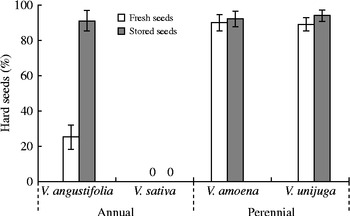
Storage, species and their interaction all had a significant effect on seed coat impermeability (Fig. 1). There were large differences among species in percentage of impermeable seeds. No (V. sativa) or a low portion of fresh seeds were impermeable in the two annual species, V. sativa and V. angustifolia, whereas >90% of the seeds were impermeable in the two perennial species, V. amoena and V. unijuga. One year of storage increased the percentage of impermeable seeds from 25 to 90 in V. angustifolia. However, storage had no effect on seed coat impermeability in the other three species.
Seed coat impermeability of fresh seeds of four Vicia species and of seeds stored dry in the laboratory for 1 year, after 14 d of incubation at 20°C.

Effect of scarification on germination percentage and germination rate of fresh and stored seeds at different temperatures
Except for V. sativa, temperature, but not storage, showed a significant effect on final seed germination (Table 1). High temperature (20°C) significantly decreased fresh seed germination of V. angustifolia but showed no effect on stored seeds. In contrast, low (5°C) but not high temperature significantly reduced fresh and stored seed germination of the two perennial species, V. amoena and V. unijuga.
Germination percentage (mean ± SE) of fresh and 1-year-old scarified seeds of four Vicia species incubated at four temperatures for 28 d

Different letters within each row indicate significant difference at the 0.05 level with Duncan's multiple range test.
Storage, temperature and their interaction all had significant effects on germination rate (Table 2). One year of storage significantly increased germination rate of the tested species, but this effect was less obvious at low temperatures (5 and 10°C). Compared to stored seeds, fresh seeds remained swollen for a longer period of time at 20°C, and germination was delayed, with a T 50 of up to 27 d in V. angustifolia, indicating the presence of dormant embryos. Also, there was a large difference in germination rate among the species, which was higher at 5°C and lower at 20°C in fresh seeds of the two annuals than in the two perennials. For stored seeds, germination rate at 20°C did not differ between annuals and perennials, but at 5°C it was lower in the two perennials. Also, the effect of storage on germination rate was smaller for the two perennials than for the two annuals.
Germination rate (T 50, mean ± SE) of fresh and 1-year-old scarified seeds of four Vicia species incubated at different temperatures. Germination rate is expressed as time in days to 50% germination. For individual species, the interactive effect of storage (S) and incubation temperature (T) was analysed using a two-way ANOVA

Different letters within each row indicate significant difference at the 0.05 level with Duncan's multiple range test.
Hydrotime model and estimated parameters of fresh and stored seeds after scarification
The hydrotime model described germination dynamics in response to water availability very well for both stored and fresh seeds of V. sativa (Table 3). A large difference was found between stored and fresh seeds at each temperature. Stored seeds attained a higher hydrotime constant (θH) and a lower median base water potential [Ψb(50)] than fresh seeds (Table 3). Also, temperature had a significant effect on θH and Ψb(50). The lowest Ψb(50) was at 15°C in both stored and fresh seeds, and lower or higher temperatures shifted the Ψb(50) to a more positive value. Temperature had a greater effect on Ψb(50) in fresh than in stored seeds.
Characterization of the germination responses of Vicia sativa seed lots to water potential at 10, 15 and 20°C by parameters of the hydrotime model. θH, hydrotime constant; Ψb(50), median base water potential; δΨb, standard deviation in base water potential; R 2, coefficient of determination of regression

Effect of plant growth regulators on germination
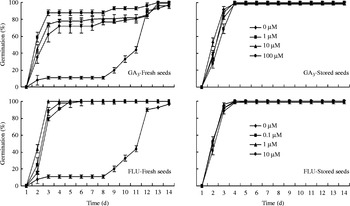
Neither FLU nor GA3 affected the germination rate of stored seed. However, both of them significantly increased fresh seed germination rate at 20°C (Fig. 2). A concentration of 0.1 μM FLU or 1 μM GA3 was sufficient to eliminate the difference in germination rate between stored and fresh seeds. As GA3 concentration increased, its promotional effect on fresh seed germination decreased. In contrast, as FLU concentration increased, its promotional effect on fresh seed germination increased and then decreased.
Germination percentages (mean ± SE) of scarified fresh and stored seeds of V. angustifolia in distilled water (0 μM) and in three concentrations each of gibberellic acid (GA3) and fluridone (FLU). Cumulative germination percentage was determined at 20°C in the dark for 14 d.

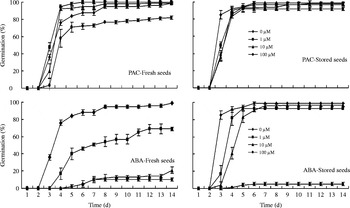
ABA decreased both seed germination percentage and rate in a dose dependent manner (Fig. 3). ABA had a greater effect on reducing germination percentage and rate in fresh than in stored seeds. In contrast to ABA, PAC reduced germination rate but had no effect on germination percentage of stored seeds, and it reduced fresh seed germination only at the highest concentration (100 μM).
Germination percentages (mean ± SE) of scarified fresh and stored seeds of V. angustifolia in distilled water (0 μM) and in three concentrations each of abscisic acid (ABA) and paclobutrazol (PAC). Cumulative germination percentage was determined at 10°C in the dark for 14 d.

Germination and dormancy release in the field
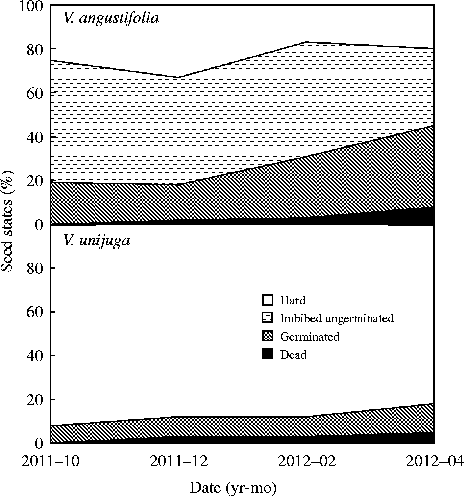
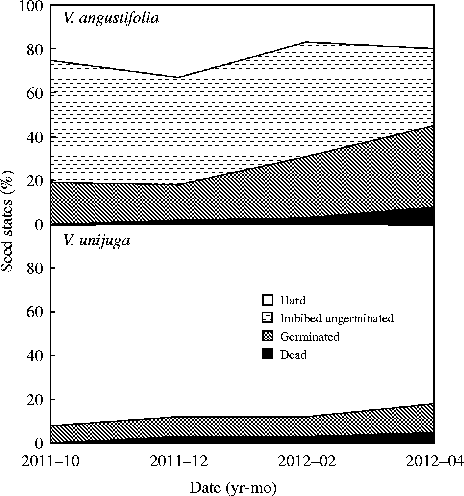
The pattern of dormancy and germination for V. angustifolia and V. unijuga differed in the field (Fig. 4). As time in the field increased, the percentage of hard seeds and of imbibed non-germinated seeds of V. angustifolia decreased, and the percentage of germinated seeds increased. Thus, after 6 months in the field hard seeds had decreased from 25 to 17%, germinated seeds had increased from 19 to 37% and imbibed non-germinated seeds had decreased from 56 to 35%. In contrast to seeds of V. angustifolia, most of those of V. unijuga remained water impermeable even after 6 months in the field, and all seeds germinated at 20°C after they were scarified.
Changes in seed states of V. angustifolia and V. unijuga while on the soil surface in the field from October 2011 to April 2012. The four seed states were determined by incubating field-stored seeds at 20°C in the dark for 14 d.
Discussion
Impermeability of seed coat and physiological dormancy
Except for V. sativa, the Vicia species have, to a greater or lesser degree, physical dormancy since at least a portion of the seeds did not imbibe water during incubation. PY is more intense in the two perennial species than in the two annual species; more than 90% of both fresh and stored seeds of the two perennials were impermeable to water. This impermeability may prevent germination in autumn following dispersal and thus help conserve seeds in the soil seed bank. Further, a short-term burial experiment also showed that most seeds of V. unijuga remained impermeable to water during burial (Fig. 4). This observation is consistent with the results of Nie (Reference Nie2011), who found that seeds of V. unijuga remained hard in the field for >3 years. Seeds of the annual species V. sativa were not impermeable, and only 25% of the fresh seeds of the annual V. angustifolia had PY, which increased to 90% after 1 year of storage. This increase in percentage of PY shows that storage under dry conditions makes seeds become impermeable to water. This suggests that seeds of V. angustifolia had not dried to a low enough moisture content at the time they were collected to have become water-impermeable, whereas during the storage period seeds did dry to a low enough moisture content to become impermeable (Qu et al., Reference Qu, Baskin and Baskin2010). When we harvested the seeds of V. angustifolia and then placed them on the soil surface at the collection site, they did not become impermeable even after exposure to field conditions for 6 months. Although short field exposure time may contribute to the low physical dormancy, these results at least imply that local field conditions do not favour hard seed formation in V. sativa and V. angustifolia after dispersal, in which case PY is not the main mechanism preventing seed germination of these two annual species in the field. However, all seeds remained intact after 6 months of burial, suggesting that other mechanisms are involved in seed germination inhibition in the field after dispersal.
Previous researchers have reported that in addition to PY, PD is very common in herbaceous Fabaceae species (Thomson, Reference Thomson1965; Kigel, Reference Kigel, Kigel and Galili1995; Van Assche and Vandelook, Reference Van Assche and Vandelook2010). Consistent with the reports of PD in seeds of other herbaceous Fabaceae species, scarified seeds of our four study species that had been stored for 1 year germinated faster than fresh seeds. Thus, we conclude that the embryos of all four Vicia species have some degree of PD but that PD in the annual species is a little deeper than that of the perennial species (Table 2). Expression of PD was evident at the relatively high temperatures of 15 and 20°C but not at lower temperatures. This relative dormancy at higher temperature is typical of winter annuals and has been interpreted as a mechanism to prevent seed germination under high summer temperatures (Van Assche and Vandelook, Reference Van Assche and Vandelook2010). However, this is not the case in the present study because seeds start to disperse in late August to early September, when the average temperature in the local area has decreased to around 10°C (Nie, Reference Nie2011), which is not high enough to prevent fresh seeds of V. angustifolia from germinating in the field. However, our field experiment showed that fresh seeds of this species remained intact in the field for 6 months, implying that factors other than temperature were involved in breaking dormancy.
Characterization of germination response to temperature and water potential
During alleviation of dormancy, Ψb(g) shifts to lower values, and consequently germination percentage, uniformity and rate increase (Bradford, Reference Bradford, Kigel and Galili1995). Consistent with this pattern, the hydrotime model revealed that stored V. sativa seeds had a significantly lower Ψb(50) than fresh seeds. A higher Ψb(50) implies that germination of fresh seeds will be greatly reduced or prevented when water availability is limited, which may partly explain why seeds did not germinate in the field although temperatures were appropriate for germination. Further, a significant interaction effect between temperature and water potential on Ψb(50) distribution was observed. Ψb(50) at the optimal germination temperature seems to be affected little by storage, but it greatly decreased at suboptimal or supraoptimal temperature. This suggests that the presence of PD in Vicia species prevents germination after seed dispersal. Thus, fatal germination is avoided not only by shifting Ψb(50) to a more positive value, but more importantly by its interaction with temperature. Further, during a period of 6 months on the soil surface, the percentage of imbibed non-germinated seeds of V. angustifolia decreased from 56 to 35%, implying that PD was alleviated during this time and that germination occurs in early spring.
ABA and GA3 dependency
It is well documented that ABA and GAs play an important role in the biochemical control of seed germination and dormancy (Finch-Savage and Leubner-Metzger, Reference Finch-Savage and Leubner-Metzger2006). Consistent with the results of Bolingue et al. (Reference Bolingue, Ly Vu, Leprince and Buitink2010) on Medicago truncatula, ABA synthesis during imbibition appears to play a key role in maintaining seed dormancy in V. angustifolia, since its inhibition by fluridone resulted in a comparable germination rate (speed) of fresh and 1-year stored seeds. Moreover, exogenous ABA decreased germination percentages and speed in both fresh and stored seeds in a dose-dependent manner. Compared to stored seeds, fresh seeds are more sensitive to ABA, which shows that storage decreases embryo sensitivity to ABA and thus releases PD. GA3 also increased germination speed and final germination percentage in fresh seeds, pointing to the role of GA3 in regulation of seed dormancy. However, it is worth noting that as GA3 concentration increased, its promotional effect on fresh seed germination decreased. da Silva et al. (Reference da Silva, Toorop, Nijsse, Bewley and Hilhorst2005) reported that reduction of coffee seed germination by a low concentration (1 μM) of GA4+7 is caused by factors released from the endosperm during or after its weakening, causing cell death in the embryo and leading to inhibition of radical protrusion. However, this does not seem to be the case in our study because even 100 μM GA3 reduced germination rate only and did not reduce final germination percentage. Surprisingly, inhibition of GA3 biosynthesis showed no effect on stored seeds. This may be due to the low PAC concentration used because PAC did reduce germination rate of either fresh or stored seeds in a dose-dependent manner. Further, it significantly reduced the germination percentage of fresh seeds at the highest concentration (100 μM). Thus, a significant effect on stored seed germination may be expected when a high PAC concentration is applied.
Conclusions
In conclusion, the intensity of dormancy differs among the four Vicia species we studied from the Tibetan Plateau. For the two perennial species, physical dormancy is important for germination regulation, but for the two annual species physiological dormancy may be more important than physical dormancy for germination timing. Physiological dormancy plays a key role in preventing seed germination in winter by shifting Ψb(50) to a more positive value. Embryo sensitivity to ABA is important in regulating seed dormancy in the Vicia species.
Acknowledgements
This study was supported by the Natural Science Foundation for the Youth of China (31001030) and the Fundamental Research Funds for the Central Universities (lzujbky-2012-99).