Aortic stenosis is the abnormal narrowing of the aortic valve. The main cause for aortic stenosis (AS) is the calcification of the aortic valve; this is prevalent in elderly populations. In the United States, 2–7 percent of people over the age of 65 have severe aortic stenosis (Reference Ramaraj and Sorrell1). Osnabrugge et al. reported in a recent meta-analysis, using seven published prevalence studies from high-income countries, that aortic stenosis prevalence among >75 years old is 12.4 percent with 3.4 percent are severe cases (Reference Osnabrugge, Mylotte and Head2). Of the severe cases, 75.6 percent are symptomatic (Reference Osnabrugge, Mylotte and Head2). There are approximately 189,836 aortic stenosis (AS) prevalence in Europe and 102,558 in North America (Reference Osnabrugge, Mylotte and Head2). Survival of AS is 2–3 years without intervention. Two-year and 3-year mortality had been reported as 50 percent and 75 percent, respectively (Reference Carabello and Paulus3).
For severe symptomatic AS, treatment involves medical management (with or without balloon valvuloplasty) or aortic valve replacement. Aortic valve replacement (AVR) can be achieved with either surgical aortic valve replacement (SAVR) or minimally invasive, transcatheter aortic valve implantation (TAVI). TAVI is an established therapy of replacing aortic valves being first used in 2002 (Reference Cribier, Eltchaninoff and Bash4). This method of valve replacement allows implantation without the need for sternectomy and cardiopulmonary bypass, resulting in faster recovery time for patients than SAVR (Reference Abramowitz, Banai and Katz5). The U.S. Food and Drug Administration (FDA) and the European Union have both approved TAVI for high-risk and inoperable patients. There are two common approaches to TAVI: transfemoral (TF) and transapical (TA), and a third developing approach is transaortic (TAo). However, with TAVI, short-term adverse events including strokes and bleeding are commonly observed (Reference Adams, Popma and Reardon6;Reference Smith, Leon and Mack7).
Although a less invasive procedure than SAVR, TAVI could produce different cost scenarios due to different prosthesis costs (Reference Cao, Ang and Indraratna8), reduced length of hospital stay, and avoidance of stays in intensive care units (Reference Watt, Mealing and Eaton9). Therefore, governments need to consider funding and reimbursement of TAVI for patients who are otherwise inoperable and/or with excessively high risk of operative death. Governments base decisions on health technology assessment (HTA) to inform the clinical effectiveness, safety, and value for money from reimbursing a new intervention. There is conditional reimbursement for TAVI in Austria, Canada, and Spain, whereas, Germany and Switzerland fully reimburse the cost of treatment of severe AS with TAVI (10). However, there is no information available from Germany, Austria, Spain, and Switzerland on how the reimbursement decisions were made (10).
Currently, there are several randomized controlled trials for TAVI compared with SAVR or medical management (Reference Adams, Popma and Reardon6;Reference Smith, Leon and Mack11) which HTAs have had to rely heavily upon. The available HTAs from Belgium (10), Canada (Reference Sehatzadeh, Doble and Xie12), and the United Kingdom (Reference Orlando, Pennant and Rooney13) have based their reimbursement decisions on evidence provided by the Placement of Aortic Transcatheter Valve (PARTNER) trial data published in 2010 and 2011 (Reference Smith, Leon and Mack11;Reference Leon, Smith and Mack14;Reference Mack, Leon and Smith15). All three HTAs recommended TAVI for inoperable patients based on their respective analysis. Given the differences between jurisdictions in the decisions to reimburse TAVI, it is important to examine the processes and evidence that was considered in reimbursing TAVI. Therefore, the aim of the present study is to review the HTAs that relied on cost-effectiveness analysis to assess the reimbursement of TAVI.
METHODS
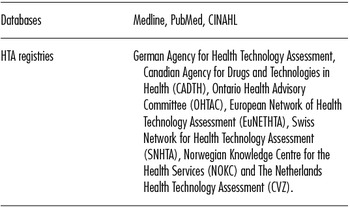
A comprehensive search of the published literature was carried out to identify HTAs conducted for TAVIs using the databases and registries described in Table 1. The search was restricted from 2000 to October 2015 and included all languages. The literature review was conducted on October 25th 2015.
Databases and HTA Registries Searched in the Systematic Literature Review

HTA, health technology assessment.
Using the keywords given below all databases was searched using the same strategy: 1. “HTA” or “Health Technology Assessment”, 2. “TAVI” or “Transcatheter Aortic Valve implantation”, 3. “TAVR” or “Transcatheter Aortic Valve Replacement”.
The search terms 2 and 3 were combined using the Boolean term “OR” (#2 OR #3). The results were combined with search term 1 with the Boolean term “AND” to achieve the final search results. Using references from the search results and HTA databases, country specific HTA institutions were searched to identify any further study. References of the selected HTAs were also pursued to identify HTAs not picked up by the above keywords.
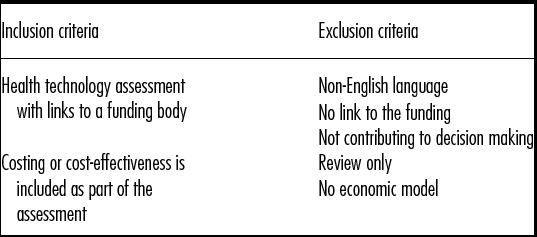
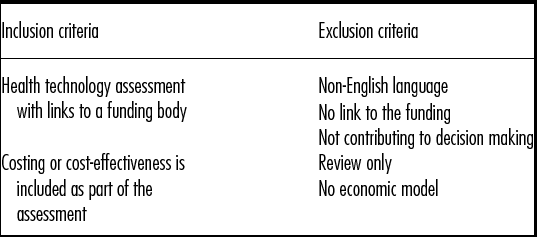
The review was carried out using the Preferred Reporting System for Systematic Reviews and Meta-Analysis (PRISMA) which allows systematic selection of papers according to a prespecified exclusion and inclusion criteria (Table 2) (Reference Liberati, Altman and Tetzlaff16). The selected papers were assessed based on the Consolidated Health Economic Evaluation Reporting Standards (CHEERS) checklist (Reference Husereau, Drummond and Petrou17). This checklist was used mainly to assess the quality of the model inputs including probabilities, time horizon, discount rate, outcome measurement, cost, and choice of model. The checklist was also used to evaluate how the models accounted for uncertainty. The focus of this review is in evaluating the model parameters used to determine the cost-effectiveness of TAVI in the available HTAs. The quality and validity of the evidence generated to produce model parameters and the way they were used are also critiqued.
Inclusion and Exclusion Criteria
RESULTS
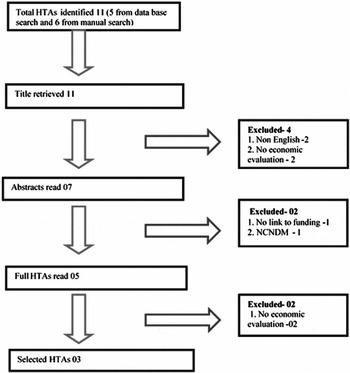
After excluding duplicates, a total of eleven papers reporting on HTAs of TAVI (five reports from the database search and six from the manual search) were identified (Figure 1) (Reference Watt, Mealing and Eaton9;10;Reference Sehatzadeh, Doble and Xie12;Reference Orlando, Pennant and Rooney13;Reference Velzenberger, Galmiche, Denis and Machecourt18–Reference Messori, Trippoli and Biancari24). On reading the titles, four were excluded: two non-English (Reference Velzenberger, Galmiche, Denis and Machecourt18;Reference Varela-Lema, Queiro-Verdes and Baz-Alonso19), two without cost-effectiveness analysis (Reference McGregor20;Reference Messori, Trippoli and Biancari24). After reading the abstracts, a further two reports were excluded as there were no links to funding and did not appear to be undertaken on behalf of an HTA agency (Reference Watt, Mealing and Eaton9;Reference Fairbairn, Meads and Hulme22). Reading of the remaining five papers excluded a further two reports (21;Reference Walters, Sinhal and Baron23) as they did not include an economic costing analysis. The European Union Network of Health Technology Assessment (EUnetHTA) identified reports from each of the following countries Austria, Italy, France, Belgium (included in this review), Netherlands, Scotland, and Croatia (25). The Scottish report was a review, and all other HTAs were not available in English. An HTA from Canada was excluded as it contributed to decision making in only a single health institution (Reference McGregor20). The review also identified a recent report from Australia (26). An application requesting listing of TAVI in Australia has been made (26). However, the application is still under review by the Medical Services Advisory Committee. As the report is not publicly available yet, we did not include it in our review. Therefore, three HTAs were selected for the review: Canada (Reference Sehatzadeh, Doble and Xie12), Belgium (10), and the United Kingdom (Reference Orlando, Pennant and Rooney13).
Study selection for the review. NCNDM, not contributing to national decision making.

The Canadian HTA was published by the Ontario Health Technology Advisory Committee in 2012 (Reference Sehatzadeh, Doble and Xie12). The HTA from Belgium was published by The Belgian Health Care Knowledge Centre (KCE) in 2011 (10), and the UK HTA was published by the National Institute for Health Research in 2013 (Reference Orlando, Pennant and Rooney13). All three were for their respective national decision-making institutions. The results below are presented with respect to the CHEERS checklist.
Population
All three HTAs used the PARTNER trial data in their cost-effectiveness analysis. The PARTNER trial was a randomized controlled trial with two cohorts: Cohort A consisted of patients at high risk for SAVR, and compared TAVI with SAVR (Reference Smith, Leon and Mack11); and Cohort B were inoperable patients comparing TAVI with medical management (Reference Leon, Smith and Mack14). Cohort A and B consisted of 699 and 358 patients, respectively. The average age was 84 and 83 years, and the proportion of males was 57 percent and 46 percent, in Cohort A and B, respectively (10). The PARTNER trial was conducted in 25 centers in the United States, Canada, and Germany between 2007 and 2009.
The target population for the Canadian HTA was severe symptomatic patients either at high risk for surgery or inoperable. The key model input parameters were derived from the PARTNER trial and mortality was derived from a sample of the Canadian population in 2007. The models for the Canadian HTA used 84 and 83 years as the starting age to match the PARTNER Cohort A and B.
The Belgian HTA also used the PARTNER trial data to estimate the cost-effectiveness of TAVI (Reference Smith, Leon and Mack11;Reference Leon, Smith and Mack14). No systematic review was conducted to find any other available TAVI clinical trials. However, at that point in time, it is accepted that no other trial data were available. The HTA considered the demographics and clinical subgroups of the PARTNER trial participants as representative of the Belgian population.
The UK report included a systematic review carried out from 2007 to November 2010 (Reference Orlando, Pennant and Rooney13). However, the UK report only reported data from the PARTNER trial studies. The report did not describe the characteristics or the patient populations of the other studies identified in the systematic review. In addition, the review did not identify published data on the cost-effectiveness of TAVI. The cost-effectiveness analysis presented in the UK report relied on the survival curves of the PARTNER trial, supplemented with unpublished data and conference presentations.
Study Perspective
The Canadian HTA considered a third party Canadian payer's perspective to develop the economic model. The Belgian report considered the heathcare payer perspective, including the government as well as patient co-payments (10). The UK HTA considered a National Health Services (NHS) perspective as most of the patients that require the treatment are over retirement age.
Comparators
The three HTAs considered two patient populations: high-risk patients and inoperable patients. A separate cost-effectiveness analysis was performed for each patient population in all three HTAs: TAVI versus SAVR in high-risk patients and TAVI versus medical treatment in inoperable patients. The PARTNER trial studies reported clinical outcomes of TAVI by means of the transfemoral route for Cohort A and B and by means of transapical route for Cohort A. The Canadian HTA referred to the sub-groups TF and TA TAVI against SAVR and TF TAVI against standard medical treatment. The Belgian report only referred to the sub-groups TF and TA TAVI against SAVR. The UK report did not consider any subgroup.
Time Horizon and Discount Rates
The Canadian HTA used a 20-year time horizon for their models. The Belgian report used different time horizons for the two patient populations. The Belgian report applied a life-time horizon if the intervention had an impact on mortality after 1 year for inoperable patients (10). For high-risk patients, the time horizon was restricted to 1-year period as the authors determined there were no significant survival differences after 1 year. In a sensitivity analysis, a time horizon of 3 years was also considered. In the Belgian analysis, the survival data were extrapolated beyond the trial follow-up until all patients died. The UK report considered a 25-year time horizon as a life-time model (Reference Orlando, Pennant and Rooney13). In addition, alternative analysis was carried out using 2-year time horizon in the sensitivity analysis.
The Canadian HTA discounted costs at 5 percent annually. The Belgian report used discount rate of 3 percent for future cost and 1.5 percent for future benefits for the base case for the inoperable patients (10). The authors argued discount rates are not useful for high-risk patients as the time horizon was only 1 year. The UK study discounted all costs and health outcomes at 3.5 percent (Reference Orlando, Pennant and Rooney13).
Reporting of Outcomes
The three HTAs mainly used the PARTNER trial data for survival and adverse event outcomes, including pacemaker insertions (Reference Smith, Leon and Mack11;Reference Leon, Smith and Mack14). The Canadian report conducted a comprehensive literature review and identified only the PARTNER trial publications. The Belgian HTA included only the PARTNER results for its analysis (10). It did not describe any attempt to identify or review other literature (Reference Smith, Leon and Mack11;Reference Leon, Smith and Mack14). The UK report undertook a comprehensive literature search in 2010 but did not update it for 2013 when they published their report (Reference Orlando, Pennant and Rooney13). In addition, the UK report did not describe the data they extracted from other literature.
The three HTAs used quality-adjusted life-years (QALYs) as the outcome measure and used utility to determine the QALYs. In the Canadian HTA, utility weights associated with New York Heart Association (NYHA) functional class estimated by Gohler et al. (Reference Gohler, Geisler and Manne27) were used and mapped to the NYHA functional class status at 1 year from the PARTNER trial. Due to the absence of long-term TAVI probabilities, 1 year NYHA functional class estimates were carried forward from year 2 to 20. In the Belgian HTA, utility data were only available for inoperable patients and these were applied to high-risk patients. This might not be reasonable as utility scores could be different between patient groups and across health states.
Moreover, in the high-risk group, for the first month postsurgery, SAVR patients were arbitrarily given a utility value 0.1 lower than TAVI patients. For inoperable patients, PARTNER study sponsors provided utility estimates which indicated TAVI patients had higher utility scores than standard therapy (10). However, there was no information on how the utility estimates were calculated or the methods used. In the UK study, utilities were attached to the two types of survival considering them as health states: hospital-free survival and other survival. The utilities were estimated applying an indirect method on the PARTNER trial data and Maliwa et al. data (Reference Maliwa, van der Heijden and Bots28). Maliwa et al. published EQ-5D utility scores for NYHA classes of patients after 30 years of mechanical aortic valve replacement. The estimation of utility values included a two stage process involving estimation of weighted averages and solving a couple of simultaneous linear equations.
Reporting of Costs for TAVI
The Canadian HTA used Canadian cost data in the model. These data were mainly derived from the Canadian costing literature and the Ontario Case Costing Initiative administrative database. They calculated the cost for the valve at CAN$37,606. Also included were costs for procedural and pharmaceutical complications as well as costs for re-hospitalizations and long-term care in a facility. They did not report SAVR and medical management costs but mentioned the source for these costs.
The Belgian report estimated the cost of TAVI for their analysis (10) and described data sources and details of cost groups. The cost for the valve was reported for TF and TA in both Edwards and CoreValve brands. The range of cost for the valve was from €15,160 to €32,732. However, in their analysis they used €18,000 as the device cost. They also used local Belgian cost data for their economic analysis. The total costs for TAVI used were from €40,057 (TF) to €49,799 (TA). The model assumed follow-up costs for healthcare resource used (€43.2 per month) and drugs (€20.5 per month). No additional information was provided. Finally, the Belgian report provided average SAVR cost as €23,772. There was no cost information on medically managed patients.
The UK study gave detailed cost breakdowns and presented them in 2010 British pounds but did not describe the methods used for identifying or collecting cost data (Reference Orlando, Pennant and Rooney13). They reported TAVI procedure costs including adverse events, as £25,078. The SAVR costs were reported as £19,193. None of the three reports included adjustments to approximate opportunity costs.
Model Assumptions and Model Parameters
The Canadian model considered high-risk and inoperable patients with severe aortic valve stenosis. The Canadian model compared TF TAVI with standard treatment in inoperable patients. Transition probabilities were estimated from the PARTNER trial data. The model assumed no survival difference between TAVI and standard treatment in inoperable patients after 2 years. The outcome was expressed in cost per QALY gained. The Canadian HTA used two model structures to inform its decision. It is comprised of a decision tree for a short-term 30-day postoperative period and a Markov process for the long-term period (day 31 to 20 years). The structure of the decision tree and the Markov model were presented in the HTA report. The models were constructed using Microsoft Excel and TreeAge Pro software. The cycle length for this model was not provided. A secondary analysis was also conducted comparing TF or TA TAVI with SAVR in high-risk patients which used similar survival assumptions.
The patients of the Belgian model reflected the characteristics of North American trial patients based PARTNER trial data (Reference Smith, Leon and Mack11;Reference Leon, Smith and Mack14). It was fitted for only TAVI-eligible patients and considered two scenarios parallel to the PARTNER trial design: high-risk patients who receive SAVR, and inoperable patients who receive medical management (Reference Smith, Leon and Mack11;Reference Leon, Smith and Mack14). Both TF and TA TAVI were compared with SAVR in high-risk patients separately. However, combined TAVI was considered in inoperable patients. The model used mortality and other survival events as health states. All transition probabilities in the model were estimated from the PARTNER trial data (Reference Smith, Leon and Mack11;Reference Leon, Smith and Mack14). In the case of TAVI and inoperable patients, survival data from the PARTNER trial were extrapolated to a life time horizon using what appeared to be a constant probability of death applied to remaining survivors. For high-risk patients, the model was run for 1 year only as the data considered showed no survival difference after 1 year. That model simulated a hypothetical cohort of 1,000 TAVI-eligible Belgian patients. The model used the intention-to-treat results for the primary data analysis. The model also considered repeat hospitalizations as per PARTNER trial data (10).
The utilities from EQ-5D health states were used for health outcomes. However, it is unclear how these utilities were determined. Their model included outcomes in life years gained and QALYs. The Belgian report developed a Markov model, with monthly cycles, using Microsoft Excel.
The UK report presented two scenarios: a scenario where TAVI is available, and a scenario where TAVI is not available. Where TAVI is available, patients who were not suitable for surgery could receive TAVI or medical management while patients who were suitable for surgery could receive TAVI or SAVR. The primary outcome of the model was overall survival. Overall survival was extrapolated based on the PARTNER trial data for all scenarios also using constant probabilities of death for each group. The model also considered hospital-free survival. Monthly costs were determined by time spent in these health states. The outcomes were expressed in cost per QALY gained. The UK HTA also developed a Markov model with monthly cycles using TreeAge Pro software (Reference Orlando, Pennant and Rooney13). Markov models were justified through the ability to represent the clinical situations. The model assumed a policy would be in place to determine patient referral pathways to AS management. This report did not consider sub group analysis of TF and TA.
Cost-Effectiveness of TAVI
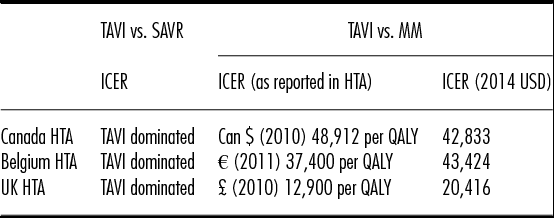
Compared with SAVR in high-risk patients, TAVI was consistently found to be more costly and less effective than SAVR in all three countries as reported in Table 3. In other words, TAVI was dominated by SAVR. The Canadian HTA also reported that both TF and TA TAVI were dominated by SAVR in high-risk patients. The Canadian HTA conducted sensitivity analyses and reported that cost, long-term mortality, and utility increment significantly influenced the model. The Belgian HTA considered reimbursement for high-risk patients inappropriate, as TAVI did not provide greater health benefits than SAVR but was more costly (10). Nevertheless, the Belgian HTA report presented an incremental cost-effectiveness ratio (ICER) greater than €750,000 per QALY for TAVI, taking into account the nonsignificant difference in 30-day and 1-year mortality. The Belgian HTA further reported an ICER of 546,384/QALY in TF TAVI versus SAVR and 1,810,667/QALY in TA TAVI versus SAVR. Finally, the UK HTA reported that TAVI was more costly and less effective than SAVR for high-risk patients.
Comparison of ICERs for the Three HTAs of TAVI
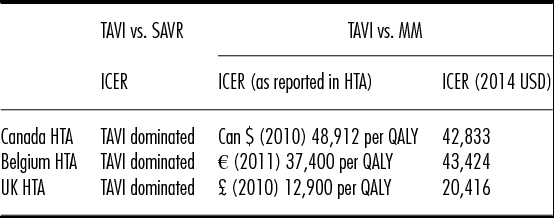
ICER, Incremental cost-effectiveness ratio; TAVI, transcatheter aortic valve implantation; MM, medical management; SAVR, surgical valve replacement; HTA, health technology assessment; QALY, Quality adjusted life years; Can, Canadian.
On the other hand, TAVI was consistently found to be cost-effective compared with medical management. The Canadian HTA reported an ICER of $48,912 per QALY and $33,141 per life-year gained when comparing TAVI with standard medical treatment for inoperable patients (Table 3). The Belgian HTA reported an ICER of €37,400 per QALY and mentioned that the ICER was very sensitive to the duration of the model (10). When the model was limited to 3 years, the ICER increased to approximately €70,000 per QALY. Finally, the UK HTA reported an ICER of £12,900 per QALY. Using a probabilistic sensitivity analysis, the UK report found for over 99 percent of the simulations, the ICER was below £20,000 per QALY in inoperable patients (Reference Orlando, Pennant and Rooney13). Table 3 shows the three ICERs in 2014 United States dollars (29). The UK report recorded the best value for money in using TAVI in inoperable patients.
DISCUSSION
This review identified three HTAs assessing the cost-effectiveness of TAVI for the first generation SAPIEN valve. All three HTAs relied heavily on the PARTNER trial data and recommended TAVI for inoperable patients who would otherwise be managed medically, but not for high-risk patients who could undergo surgical aortic valve replacement.
The recommended use of TAVI for inoperable patients is in line with recently published cost-effectiveness studies (Reference Watt, Mealing and Eaton9;Reference Eaton, Mealing and Thompson30;Reference Simons, Cipriano and Shah31). When the three HTAs were undertaken, there were no studies published on the cost-effectiveness of TAVI. In recent years, several cost-effectiveness analyses have been published using the PARTNER trial data, and these studies have demonstrated that TAVI is associated with higher costs (Reference Watt, Mealing and Eaton9;Reference Eaton, Mealing and Thompson30;Reference Simons, Cipriano and Shah31). Simons et al. have shown that TAVI improved life expectancy and is thus an effective alternative to medical management (Reference Simons, Cipriano and Shah31). Therefore, assumptions of equal survival benefits, as used in the Canadian HTA, underestimate the benefit of TAVI and overestimate the ICER (Reference Reynolds, Thompson and Duhay32). Other studies have shown that TAVI is cost-effective compared with medical management (Reference Watt, Mealing and Eaton9;Reference Eaton, Mealing and Thompson30).
Unlike the three HTAs, recent published cost-effectiveness studies have shown that TAVI resulted in better outcomes and lower costs compared with SAVR for high-risk patients. Studies have criticized some of the model parameters in the economic model of the HTAs. For instance, Reynolds et al. (Reference Reynolds, Thompson and Duhay32) noted that the cost of the SAPIEN valve reported in the Canadian HTA ($37,606) was not appropriate. The authors argued that applying the current price of $24,000 would reduce the reported ICER from the Canadian HTA by a similar magnitude and TAVI would be well below the suggested value-for-money acceptability threshold (Reference Reynolds, Thompson and Duhay32).
Recently published cost-effectiveness studies have also shown that TF TAVI is good value for money in high-risk patients who are otherwise amenable to SAVR (Reference Reynolds, Magnuson and Lei33). Reynolds et al. (Reference Reynolds, Magnuson and Lei33) showed although 12-month costs and QALYs were similar to the UK HTA report, important differences were observed when results were stratified by access site, transfemoral or transapical. Transfemoral TAVI was dominant to SAVR. Reynolds et al. (Reference Reynolds, Magnuson and Lei33) concluded that TAVI was economically attractive for transfemoral access using PARTNER trial data. This was further supported by Fairbairn et al. (Reference Fairbairn, Meads and Hulme22) in 2013 who used a cost utility analysis and determined TAVI is cost effective compared with SAVR for high-risk patients. At the £20,000 NICE willingness to pay threshold, TAVI had a 64.6 percent likelihood of being cost effective (Reference Fairbairn, Meads and Hulme22).
Evidence from recent clinical trials has shown that TA and TAo TAVI seem to be associated with favorable outcomes (Reference Walters, Sinhal and Baron23;Reference Lardizabal, O'Neill and Desai34;Reference Seco, Martinez and Bannon35), unlike the results of the PARTNER trial (Reference Pighi, Serdoz and Kilic36;Reference Bourantas, Farooq and Onuma37). Since the PARTNER trial, conducted in 2007–09 and published in 2010, this new evidence needs to be considered in future HTA decisions (Reference Walters, Sinhal and Baron23;Reference Lardizabal, O'Neill and Desai34;Reference Seco, Martinez and Bannon35). TAVI technology has also improved alongside the experience of the clinicians making them more effective. Data from contemporary clinical trials have also contributed to show substantial evidence of the effectiveness of TAVI (Reference Walters, Sinhal and Baron23;Reference Lardizabal, O'Neill and Desai34;Reference Seco, Martinez and Bannon35). It is recommended to conduct future cost-effectiveness analysis using this new evidence to ascertain the value for money in using TA TAVI. Therefore, for future HTA, these cost-effectiveness results would be useful as well as undertaking analysis with respect to access site.
Consideration of AS patient referral pathways is another important factor for CEA models. The decision analytic model for the management of symptomatic AS should include clinical decision probabilities regarding patient referral. In the Belgian and Canadian context, the protocol of the PARTNER study was considered valid for the Belgian and Canadian patients (10). The Belgian and Canadian HTAs assumed the Society of Thoracic Surgeons (STS) score and clinical determination by at least two heart surgeons would suffice to make a decision on high-risk and inoperable patients (10).
On the other hand, the UK report describes the complexities of choosing the appropriate intervention for AS patients, including clinical group decisions and back and forth referral between different specialties for optimum management and decision on TAVI use (Reference Orlando, Pennant and Rooney13). However, the UK HTA stops short of including those probabilities into the model. The Belgian study reveals it depends on the clinical “feeling” to determine high-risk and inoperable patients (10). Better clinical guidelines and a heart team approach, as described in the UK HTA, would provide evidence based patient referral pathways. This would also improve CEA models as it would limit the number of assumptions required as well as reduce uncertainty regarding the patient population.
The CHEERS checklist recommends a description of the health outcomes used to measure the benefits in a cost-effectiveness analysis and their relevance for the type of analysis performed (Reference Husereau, Drummond and Petrou17). There is no indication from the three HTAs that health states described by AS patients were considered using a preference based measure to determine the utility of a given AS health state. However, utility and QALYs were used in the analysis of the three HTAs (10;Reference Orlando, Pennant and Rooney13). The Canadian HTA used a combination of utility values for NYHA functional class to estimate utility weights. However, carrying forward of NYHA class information from year 2 to 20 poses a serious overestimation of quality of life.
The Belgian and the UK HTAs used the EQ-5D instrument. However, the estimation of utility weights was not made from their patients but estimated from other literature. The reports also did not mention what utility value sets were used or which preference elicitation method was used. The Belgian study used the PARTNER study that provided utility for some health states; however, it is unclear how those were calculated. The estimation of utility weights in the UK report by NYHA class was seriously unstable as the authors themselves pointed out (Reference Orlando, Pennant and Rooney13). In addition, there was no inclusion of utility weights for adverse outcomes (e.g., stroke). The results of a cost-effectiveness analysis where measurement of health outcomes were compromised can significantly affect the ICER.
Finally, the UK HTA used survival curves to calculate the survival of AS patients after different treatment methods. They used 2-year data to extrapolate long-term survival curves which produced further unstable results. Moreover, the survival for SAVR patients was based on low- and moderate-risk AS patients who were taken from an unrelated study. That increased the overall survival of low-risk SAVR patients to 51 years which questions the external validity of the model (where the mean age of the baseline population from the trial was over 80 years).
CONCLUSION
The information on the cost-effectiveness of the first generation SAPIEN TAVI has been updated since the available HTAs were published. The published HTAs had only considered the PARTNER trial data in their analysis. Some model inputs were estimated using unrelated data which has distorted the model outputs. Importantly, the models did not have good utility inputs to measure the utility increment for each treatment option. In some cases, the utility values were arbitrary and incorrectly estimated. We believe a future model should include patient referral decisions to improve TAVI reimbursement decision making. Additionally, a clear and validated methodology should be adopted in estimating utility for clinically and treatment relevant health states. Finally, we recommend using ISPOR good practice guidelines and CHEERS guidelines in building cost-effectiveness models for HTA decisions on TAVI reimbursements.
CONFLICTS OF INTEREST
J.B., M.C.M. and P.A.S. report receiving funds from Edwards Lifesciences, outside the submitted work; S.K. has nothing to disclose.