Introduction
Injuries caused by marine creatures are considered quite rare; however, there have been an increasing number of reports over the last few decades. Such incidents are a well-recognised mechanism of aquatic injury in the Indo-Pacific ocean areas, but more recently, cases have been reported off the coasts of the Americas and Europe, as well as the Mediterranean basin.
In this article, we describe the first reported case of a traumatic tympanic membrane perforation due to impalement by a needlefish beak.
Case report
An 11-year-old boy presented with a two-month history of left-sided otorrhoea and deafness. These symptoms had persisted since being struck on the ear by a needlefish whilst swimming in the sea in Oman on holiday. There was no history of otalgia, vertigo or tinnitus. There had been no previous ear surgery or family history of ear disease. Initial examination of the left ear revealed a subtotal perforation with oedematous middle-ear mucosa. The ear was cleaned and the patient started treatment with ciprofloxacin drops. A subsequent review showed that the tympanic membrane was still perforated, and the patient was therefore scheduled for myringoplasty.
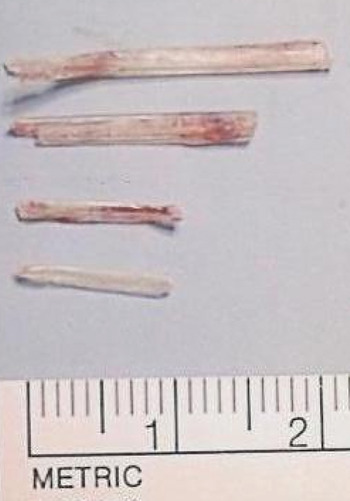
During surgery under general anaesthesia, four pieces of bone were detected in the middle ear (Figure 1). In order to retrieve these, a tympano-meatal flap was raised. The bone pieces ranged from 2.5 to 5 cm in length. It was noted that one of the longer pieces was partially inserted into the eustachian tube. The specimens were sent for histopathological analysis. The tympano-meatal flap was replaced and the ear was left to heal spontaneously now that the foreign body had been removed. Histological analysis of the foreign bodies revealed dead bone with surrounding active inflammation. It is suspected that these were from the beak of the needlefish that had struck the patient previously.
The four bones removed from the middle ear during the first surgical procedure.

A further out-patient review indicated that the perforation had not healed, and the patient was scheduled for a myringoplasty under general anaesthetic. Intra-operative findings showed a scarred ossicular chain with limited movement. The tympanic membrane was repaired with a temporalis fascia underlay graft, via an endaural approach.
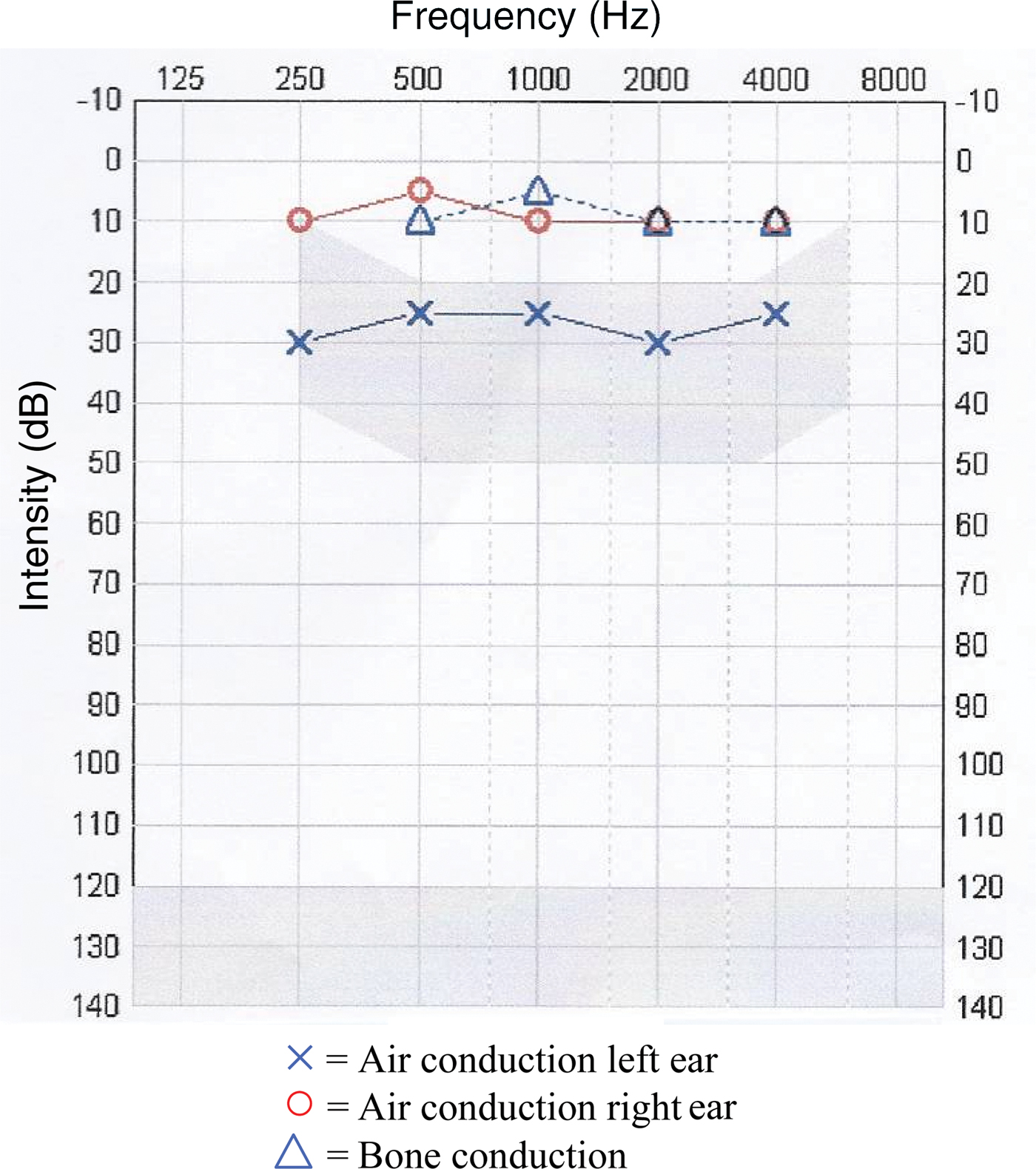
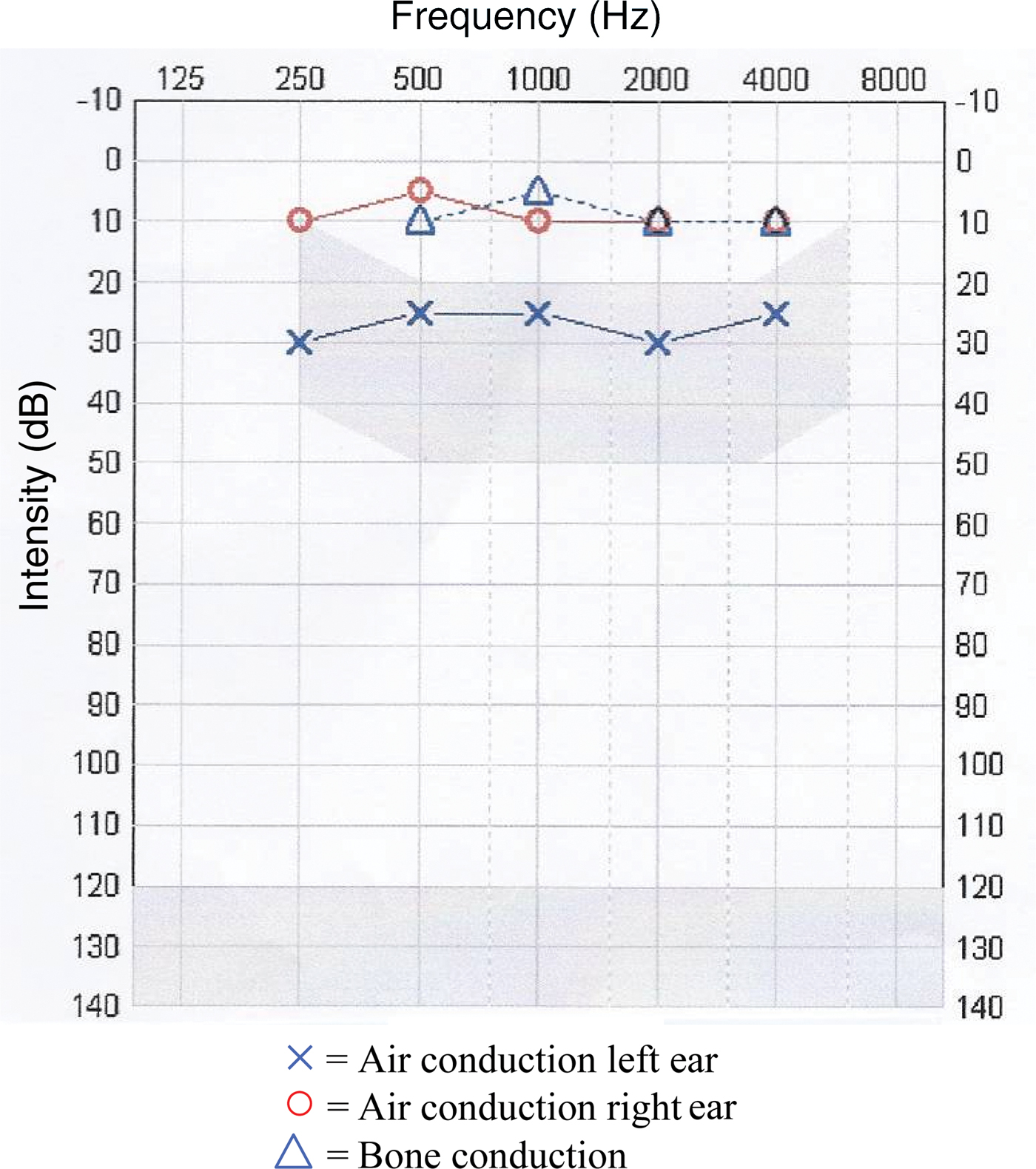
Following surgery, the patient had a persistent pin-hole perforation of the left tympanic membrane, but the otorrhoea had completely resolved. Pure tone audiometry demonstrated a mild conductive hearing loss (Figure 2), presumably due to scar tissue surrounding the ossicular chain. The patient was happy with his hearing level and was discharged from the out-patient clinic.
Post-operative audiogram demonstrating mild conductive hearing loss in the left ear.
Discussion
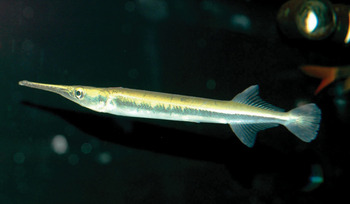
The needlefish is a species of fish that belongs to the Beloniform order. They are commonly found in the tropical and subtropical regions of all oceans.1 Needlefish are carnivorous surface predators that have a long, slender body typically measuring between 0.5 to 1.5 m in length. They have a long, narrow ‘beak’ that consists of rigid jaws with sharp, putrid teeth (Figure 3).
A needlefish (family Belonidae).

These fish often congregate in large schools. Injury typically occurs by impalement of the needlefish beak when the fish leaps out of the water at extremely high speed.
Needlefish, like all ray-finned beloniforms, are capable of making short jumps out of the water at up to 61 km/hour. Since needlefish swim near the surface, they often leap over the decks of low boats rather than going around. This jumping activity is greatly exacerbated by artificial light at night; in areas across the Pacific Ocean, night fisherman and divers have been ‘attacked’ by schools of suddenly excited needlefish diving across the water towards the light source at high speed. Their sharp beak is capable of inflicting a deep puncture wound, often breaking off inside the victim in the process.
• Needlefish injuries are rare but have been known to be fatal
• This is the first reported case of tympanic membrane perforation by a needlefish
• The perforation was repaired by myringoplasty, with satisfactory results
• The middle ear should be carefully examined if a foreign body is possible
For many traditional Pacific Islander communities, who primarily fish on reefs from low boats, needlefish represent an even greater risk of injury than sharks.2 In addition, swimmers and divers have also been seriously injured by needlefish in Japan, New Zealand and the Red Sea. To date, there have been two reported deaths caused by needlefish. The first occurred in 1977, when a 10-year-old Hawaiian boy was night fishing with his father at Hanamaulu Bay, Kaua'i. The boy was killed when a 3–4 ft long needlefish jumped from the water and pierced his orbit and brain, resulting in a carotid-cavernous fistula.Reference McCabe, Hammon, Halstead and Newton3 The second was a 16-year-old Vietnamese boy, stabbed through the heart by the 15 cm spike of a needlefish in 2007, while night diving for sea cucumbers near Halong Bay.4
Conclusion
To our knowledge, this is the first reported case in the world literature of a traumatic tympanic membrane perforation secondary to direct trauma from a needlefish beak. It is recommended that careful examination of the middle-ear space should always be carried out prior to and during myringoplasty if there is a possibility of a foreign body.