Estimation of the number of leucocytes (‘somatic cell counts’, SCC) in milk remains the best method for confirmation of the inflammatory response of female goats with mastitis. Moreover, bulk milk total bacterial counts (TBC) are used to assess the bacteriological quality of raw milk. It is generally considered that there is a relation between SCC and TBC and that their values may vary depending upon the same factors (Koop et al., Reference Koop, Nielen and van Werven2009). For the raw milk of goats, the currently prevailing EU legislation does not enforce a legal threshold for SCC. For TBC, the threshold is set at 1 500 000 colony-forming units (cfu) ml−1 for milk to undergo thermal processing and at 500 000 cfu ml−1 for milk for direct consumption (European Union, 2004).
Dairy goat farming is an important sector of the agricultural industry in Greece, with an annual total milk production exceeding 450 000 l and accounting for over 25% of all goat milk produced in the European Union (Popescu, Reference Popescu2013); Greece is the largest producer of goat milk in Europe. This milk is used mainly for cheese production, among which ‘feta’ cheese. Nevertheless, despite the importance of goat milk for the agricultural sector in Greece, no systematic investigations in the bulk-tank milk of goats in Greece have been reported. Nationwide investigations of bulk-tank milk are of value, because the relevant situation can be monitored and evaluated with regard to the quality of the produced milk.
The present study refers to an extensive countrywide investigation performed in 119 dairy goat herds throughout Greece (Supplementary material 1). Objectives of the study were (a) to investigate SCC and TBC in the raw bulk-tank milk of goat herds in Greece, (b) to study factors potentially influencing increased SCC and TBC in the bulk-tank milk of goats and (c) to evaluate possible associations of SCC and TBC with milk content.
Materials and methods
Initially, veterinarians active in small ruminant health management around Greece, were contacted by telephone and asked if they wished to collaborate in the investigation (Lianou et al., Reference Lianou, Chatziprodromidou, Vasileiou, Michael, Mavrogianni, Politis, Kordalis, Billinis, Giannakopoulos, Papadopoulos, Giannenas, Ioannidi, Katsafadou, Gougoulis, Lacasta, Caroprese and Fthenakis2020). A total of 48 veterinarians were contacted and of these, 47 (97.9%) agreed to collaborate. Herds were selected by the collaborating veterinarians on convenience basis (willingness of farmers to accept a visit by University personnel for an interview and sample collection). Each of these veterinarians had a stable, although not contractual, association with the respective farm, among those selected for visit, and were responsible for their decisions and actions in relation to the health and welfare of the animals therein, in full accord with the relevant veterinary conduct codes (Federation of Veterinarians of Europe, 2009; Hellenic Veterinary Association, 2011). The principal investigators (DTL and GCF) accompanied by other investigators (CKM, NGCV, APP, NGK, KSI, DAG, DCO) visited the respective herds for sample collection.
The target population of the study was the goat herds in Greece. During 2019, a total of 13 019 herds in the country had produced and delivered milk (Hellenic Agricultural Organisation – Demeter, 2020). Within all these herds, the sampling frame was the herds to which veterinarians had access and also ones in which farmers were happy to receive a visit. A total of 119 herds were visited. Hence, these referred to 0.91% of the total herds in Greece.
At the start of each visit, an interview of the farmer was performed using a detailed questionnaire (Lianou et al., Reference Lianou, Chatziprodromidou, Vasileiou, Michael, Mavrogianni, Politis, Kordalis, Billinis, Giannakopoulos, Papadopoulos, Giannenas, Ioannidi, Katsafadou, Gougoulis, Lacasta, Caroprese and Fthenakis2020) to record management practices and health issues in the herd. On each visit, four 20 ml samples were collected from the bulk-tank milk using aseptic sampling techniques. Twenty-five goats were selected at random and evaluated for body condition scoring. In order to ensure uniformity of measurements and adherence to published standards, scoring (0–5, including half scores) was always carried out by a certified European Veterinary Specialist in Small Ruminant Health Management.
The milk samples were stored at 0.0−4.0°C using ice packs in portable refrigerators. Transportation of samples to the laboratory was made by the investigators and by car; samples collected from herds in the islands were also transported as ice-packed accompanying luggage by airplane (Crete, Lesvos and Rhodes) or by boat (Cephalonia).
Two of the four milk samples collected from each bulk-tank were used for somatic cell counting and milk composition measurement and the remaining two were used for the bacteriological examinations. Two sub-samples were created and processed from each of the four samples, so that each separate test was performed four times (each one in different sub-samples). Initially, somatic cell counting (Lactoscan SCC; Milkotronic Ltd, Nova Zagora, Bulgaria) and milk composition measurement (Lactoscan Farm Eco; Milkotronic Ltd) were performed on each of the four relevant sub-samples, which was completed within 4 h of collection.
Bacteriological examinations started within 24 h after collection of samples. TBC in the milk samples was performed on each of the four relevant sub-samples. The procedures detailed by Laird et al. (Reference Laird, Gambrel-Lenarz, Scher, Graham, Reddy, Wehr and Frank2004) were followed. Milk samples (10 μl) from each of the four relevant sub-samples were also cultured on staphylococcus selective medium (Mannitol salt agar; BioPrepare Microbiology, Athens, Greece); all plates were incubated aerobically at 37°C for 48 h and if there was no growth the plates were re-incubated for another 24 h. After completion of sample aliquot withdrawal for microbiological examination, the temperature of the respective samples was measured and in no case was found to exceed 3.8°C. Bacterial isolation and initial identification were performed using standard methods (Barrow and Feltham, Reference Barrow and Feltham1993; Euzeby, Reference Euzeby1997). Detection of at least three confirmed staphylococcal colonies on at least one agar plate of the four plates cultured with each bulk-tank milk sub-sample from each herd, was considered to indicate presence of the organism. The staphylococcal isolates were identified to species level using Matrix-Assisted Laser Desorption/Ionization Time-of-Flight Mass Spectrometry (VITEK MS; BioMerieux, Marcy-l’-Étoile, France).
All staphylococcal isolates were processed for evaluation of in vitro biofilm formation. This was tested by a combination of (a) culture appearance on Congo Red agar plates and (b) results of microplate adhesion test, as detailed by Vasileiou et al. (Reference Vasileiou, Chatzopoulos, Gougoulis, Sarrou, Katsafadou, Spyrou, Mavrogianni, Petinaki and Fthenakis2018) for staphylococcal isolates recovered from milk.
All the data were analysed as described in detail in Supplementary material 2. Variables evaluated for potential association with somatic cell counts (n = 52) or total bacterial counts (n = 57) are listed in Supplementary material 3.
Results
Somatic cell counts and bacteriological findings
The geometric mean SCC in the bulk-tank milk of the 119 herds visited throughout Greece and sampled was 0.838 × 10⁶ (95% CI: 0.759 × 10⁶–0.933 × 10⁶) cells ml−1. In 77 herds (64.7%), SCC over 0.75 × 10⁶ cells ml−1 were recorded (Supplementary material 4). The geometric mean TBC in the bulk-tank milk of the 119 herds was 581 × 103 (95% CI: 447 × 103–741 × 103) cfu ml−1. In 29 herds (24.4%), TBC over 1500 × 103 cfu ml−1 were recorded. In 21 herds (17.7%), SCC over 0.75 × 10⁶ cells ml−1 and TBC over 1500 × 103 cfu ml−1 were recorded simultaneously.
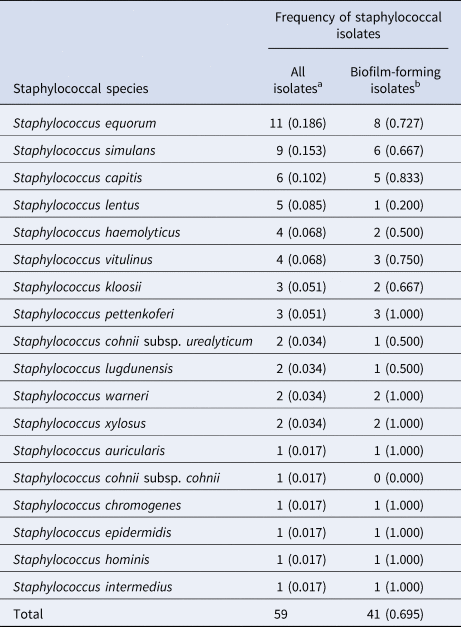
Staphylococci were isolated from 75 bulk-tank milk samples (63.0%). Staphylococcus aureus was isolated from 21 samples (17.7%) and coagulase-negative Staphylococci (cnS) from 54 samples (45.4%), resulting in total to 59 cnS isolates. Among the cnS isolates, Staphylococcus equorum was most often identified; other frequently identified species were Staphylococcus simulans and Staphylococcus capitis. A total of 17 (81.0%) S. aureus and 41 (69.5%) cnS isolates were biofilm-forming. The frequency of the various coagulase-negative staphylococcal isolates identified is shown in Table 1.
Frequency of coagulase-negative staphylococcal species recovered from bulk-tank milk of 119 goat herds in Greece

a In brackets, frequency of isolation of each species;
b In brackets, proportion of biofilm-forming isolates among that species.
The correlation of SCC with TBC in the bulk-tank milk was moderate (r = 0.294, P = 0.001) (Fig. 1). There was also an association between increased SCC (>0.75 × 10⁶ cells ml−1) in bulk-tank milk and the isolation of S. aureus or biofilm-forming S. aureus (P < 0.01), but not with the isolation of cnS (P > 0.05 in all cases), from that. No such associations were seen with TBC in bulk-tank milk (P > 0.05 in all cases) (Supplementary material 5).
Somatic cell counts and total bacterial counts in the bulk-tank milk of 119 goat herds in Greece. Dotted line: tendency line.

There were also significant differences in SCC between herds, in accordance with staphylococcal isolation from therein (P < 0.05 for all staphylococcal isolates and biofilm-forming isolates analysed separately). In contrast, no such difference was seen in the TBC (P > 0.05 in all cases).
Variables associated with increased somatic cell counts
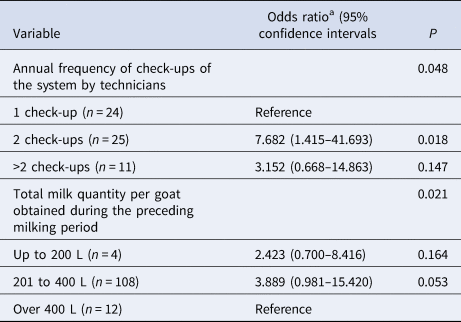
For 3 of the 53 factors evaluated, the analysis indicated significant variations in SCC between their categories (Supplementary material 6); for the other 50 no such variations were evident (Supplementary material 7). For 2 of these 53 variables, a significant association with increased SCC (>0.75 × 10⁶ cells ml−1) in bulk-tank milk was evident during the univariable analysis (Supplementary material 8). Among the variables included in the multivariable analysis (Supplementary material 9), the following two emerged as significant factors for increased SCC in the herds: total milk quantity per goat obtained during the preceding milking period (P < 0.05) and annual frequency of check-ups of the system by technician (P < 0.05: Table 2).
Results of multivariable analysis for increased somatic cell counts (>0.75 × 10⁶ cells ml−1) in the bulk-tank milk of 119 goat herds in Greece (mixed effects logistic regression)

a Odds ratios calculated against the lowest frequency of increased SCC.
Variables associated with increased total bacterial counts
For 2 of the 58 factors evaluated, the analysis indicated significant variations in TBC between their categories (Supplementary material 6); for the other 56 no such differences were evident (Supplementary material 7).
For one of these 58 variables, a significant association with increased TBC (>1500 × 103 cfu ml−1) in bulk-tank milk was evident during the univariable analysis (Supplementary material 8). Among the variables included in the multivariable analysis (Supplementary material 9), none emerged as a significant factor for increased TBC in the herds (P > 0.05).
Associations with body condition scores
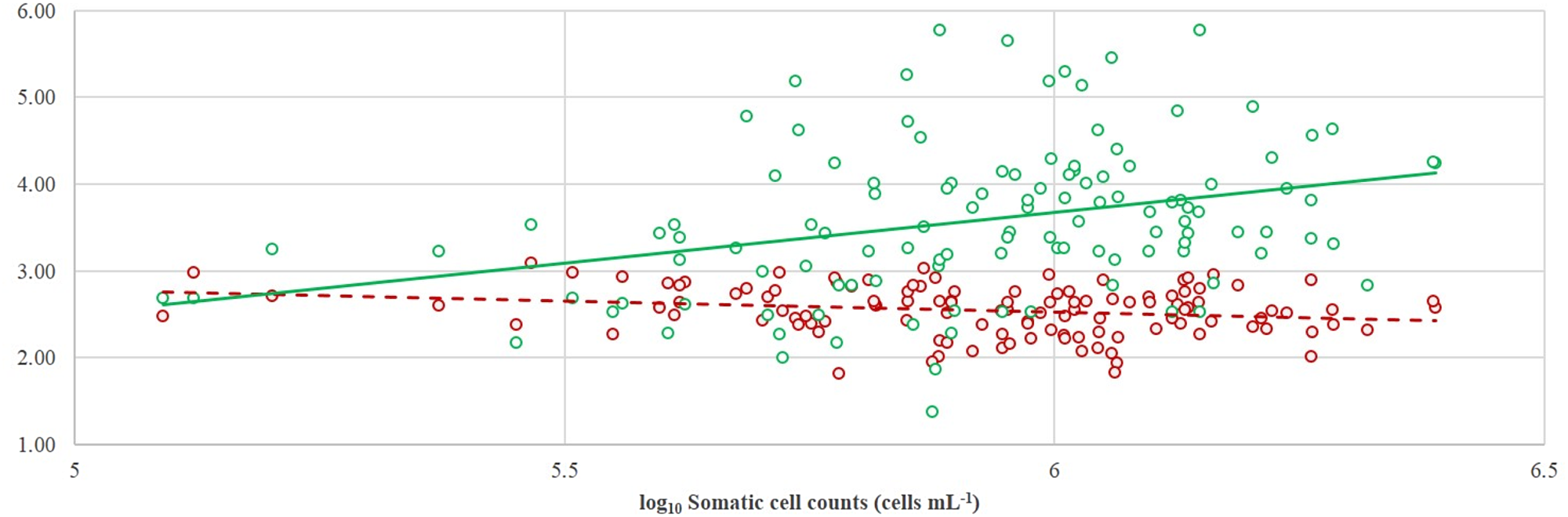
There was a moderate correlation of mean body condition scores with SCC (r = −0.225; P < 0.01), as well as of the sem body condition scores with SCC (r = 0.328; P < 0.001) (Fig. 2).
Somatic cell counts in the bulk-tank milk and body condition scores in 119 goat herds in Greece. Green dots: SCC with standard error of the mean body condition scores, straight green line: tendency line; red dots: SCC with mean body condition scores, dashed red line: tendency line.

Associations with milk composition
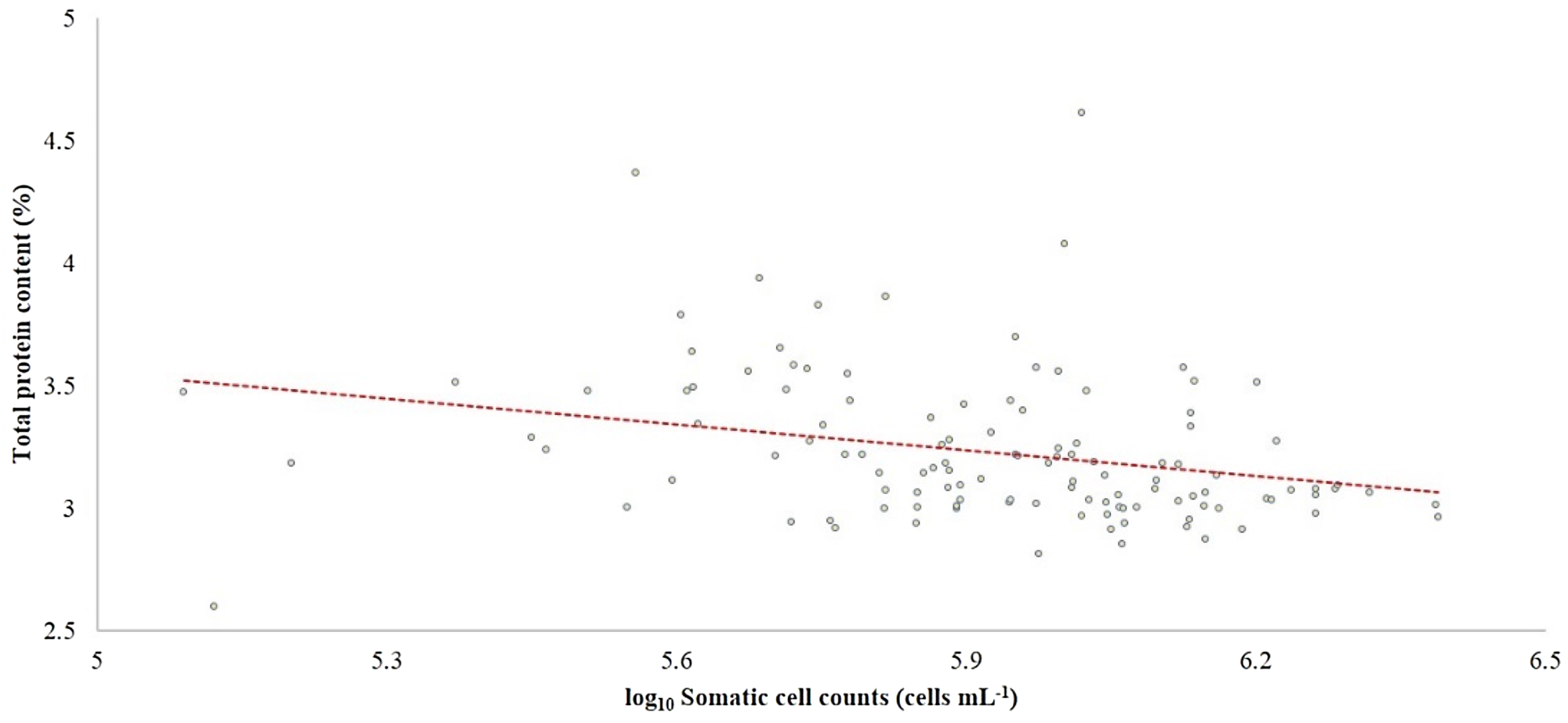
There was a negative moderate correlation of SCC with total protein content (r = −0.280; P = 0.001) and a moderate correlation of SCC with added water content (r = 0.153; P < 0.05) in the bulk-tank milk (Fig. 3). No such correlation was seen for fat content (r = 0.091; P > 0.05). Also, no correlations were seen between TBC and content of bulk tank milk (|r|<0.145; P > 0.05 in all cases).
Somatic cell counts and total protein content in the bulk-tank milk of 119 goat herds in Greece. Dashed line: tendency line.

Compared to herds with SCC <0.75 × 10⁶ cells ml−1, mean total protein content in the bulk-tank milk in herds with SCC >0.75 × 10⁶ cells ml−1 was 5.1% lower (3.34% vs. 3.17%) (P < 0.01). Then, in herds with SCC >1.5 × 10⁶ cells ml−1, it was 7.8% lower (3.08%) (P < 0.01).
Discussion
The paper describes an extensive field investigation in the bulk-tank milk of goat herds, one of largest ever on worldwide basis. Goat herds in all regions of Greece were included into the study, and in that way conditions prevailing throughout the country had been taken into account and factors of regional importance weighted less. Application of consistent methodologies, as well as performance of all tasks always by the same investigator has contributed to minimise possible bias.
Somatic cell counts in bulk-tank milk and factors potentially affecting somatic cell counts in bulk-tank milk
In works that appraised the relevant situation during the 1990s in the country, SCC over 1.0 × 10⁶ cells ml−1 in the bulk-tank milk from goats were reported (Anyfantakis, Reference Anyfantakis2004, Papadopoulos, Reference Papadopoulos2009), values that are higher than the ones found in the current study. Although it can be difficult to directly compare studies performed by differing methodological approaches, there is still merit in analysing them, as they indicate the changes that have taken place within the last 20 to 30 years. This reduction in SCC reflects the changes that have occurred in the Greek goat industry during that period and the achievements in improving management of the herds, benefiting from the general scientific progress in the field and the social changes in the country. For example, improved training of veterinarians active in the discipline, has led to increased implementation of udder health management practices in the farms.
It is interesting to note that in similar studies in other countries with prominent dairy goat farming sectors, varying SCC values were reported. In a study in north Italy, the mean SCC in herds was found to be 0.724 × 10⁶ cells ml−1 (Sandrucci et al., Reference Sandrucci, Bava, Tamburini, Gislon and Zucali2019), whilst in a study in Israel, the mean SCC in herds was found to be 2.080 × 10⁶ cells ml−1 (Leitner et al., Reference Leitner, Lavon, Matzrafi, Benun, Bezman and Merin2016).
The present study has assessed the possible effects of a wide range of factors on SCC. This was achieved with two types of analysis: the first to identify factors that may lead to higher SCC and the second to identify factors that may lead to SCC over 0.75 × 10⁶ cells ml−1. Although the current EU legislation does not mention a legal threshold for SCC in the milk of goats, the threshold of 0.75 × 10⁶ cells ml−1 was considered and applied herein, for two reasons: first, the relevant USA legislation (US Department of Health and Human Services, 2017), indicating that in goat bulk-tank milk the value of 0.75 × 10⁶ cells ml−1 is the upper threshold allowed, and second, the use of this value by some Greek dairy factories to qualitatively classify milk produced in goat herds and regulate prices paid to farmers. Nevertheless, the bulk-milk threshold should be differentiated to the somatic cell counts in the milk of individual goats, in which other values apply, for example Albenzio et al. (Reference Albenzio, Santillo, Caroprese, Schena, Russo and Sevi2011) have indicated that an impairment of mammary gland of individual animals can be observed in values as low as 0.3 × 10⁶ cells ml−1.
Certainly, the most important and significant factor associated with high SCC is mastitis (Haenlein, Reference Haenlein2002; Moroni et al., Reference Moroni, Pisoni, Ruffo and Boettcher2005; Koop et al., Reference Koop, De Vliegher, De Visscher, Supré, Haesebrouck, Nielen and van Werven2012). Somatic cell counts reflect mastitis presence in a herd, therefore factors predisposing to mastitis would also have influence to high SCC as well. For example, provision of feed during milking can lead in higher SCC: if animals would be fed when in the milking parlour, they may thereafter lie down, which can bring the open teat orifice in contact with the soil, that way facilitating entrance of mastitis-causing pathogens, which abound in farms. Further, factors related to the milking parlour (e.g., type of flow line) can also affect udder health by creating conditions that can facilitate bacterial entrance into the teat, that way causing mastitis, which is then reflected in high SCC, whilst inappropriate function of the milking system is a prime factor leading to mastitis (Besier et al., Reference Besier, Lind and Bruckmaier2016; Romero et al., Reference Romero, Peris, Fthenakis and Diaz2020). Therefore, we postulate that the finding of the association of many (≥2 annually) visits by a technician for milking system does not indicate causation, but, rather, reflects increased problems in the milking system, which need technical attendance and repair, because potentially they cause problems in the milking procedures.
The total milk quantity per goat obtained during the preceding milking period (<400 L) was also identified in the multivariable analysis as a factor associated with increased SCC in the bulk-tank milk in goat herds. In general, subclinical mastitis has been associated with a reduction of milk yield of the affected animals (e.g., cows: Martins et al. Reference Martins, Barcelos, Cue, Anderson, dos Santos and Goncalves2020; ewes: Saratsis et al. Reference Saratsis, Alexopoulos, Tzora and Fthenakis1999). However, in goats, Koop et al. (Reference Koop, van Werven, Schuiling and Nielen2010) have reported that milk yield losses caused by subclinical mammary infections were limited and SCC could not estimate the magnitude of these losses. In view of that, we propose that the reduced milk production per goat and the associated increased SCC in the bulk-tank milk both indirectly reflect incorrect management in the respective herds, which shows up that way, i.e., as production losses and increased mammary infections.
In goats, factors unassociated with the inflammatory response of the mammary gland can result in a significant variation of somatic cell counts even in the absence of an infection. Martinez (Reference Martinez2000) has reported that somatic cell counts as high as 2 × 10⁶ cells ml−1 can result from such factors (often termed ‘physiological variation’). Indeed, at individual animal level, non-infection related factors (e.g., breed, stage of lactation) can account for up to 48% SCC variance (Gonzalo et al., Reference Gonzalo, Ariznabarreta, Carriedo and San Primitivo2002). The above can also be relevant within the context of the present results, as, at animal level, changes in milk quantity may be associated with ‘physiological’ (i.e., non infection-related) changes in somatic cell counts (Jimenez-Granado et al., Reference Jimenez-Granado, Sanchez-Rodriguez, Arce and Rodriguez-Estevez2014). These changes may also be expected to influence the bulk-tank somatic cell counts in herds.
A moderate negative correlation of SCC with mean body condition scores of goats in the herds was also found, a result that at first may not seem indicative of any causation. Nevertheless, one should take into account that, in small ruminants, the primary factor influencing body condition score is nutrition (Kenyon et al., Reference Kenyon, Maloney and Blache2014). Suboptimal nutrition, which is reflected in a low body condition score, can be responsible for compromising goat immunity through various pathways: reduced formation of immunoglobulins, inefficient cellular response, lack of micronutrients necessary for the integrity of epithelia (e.g., zinc) or immune processes (e.g., selenium) (Caroprese et al., Reference Caroprese, Giannenas and Fthenakis2015), all these playing a role in the efficient defence of animals against mastitis pathogens. Moreover, a moderate positive correlation emerged with the standard error of the mean of body condition score. A small sem would reflect a reduced variability of body condition scores in the animals of the herd, which can indicate a better plane of nutrition and in general a better management in the herd, which can thus be reflected in low SCC.
In other relevant studies, various factors were also reported to be influencing SCC in the bulk-tank milk. For example, in the study of Sandrucci et al. (Reference Sandrucci, Bava, Tamburini, Gislon and Zucali2019), stage of the lactation period and milk production were reported to influence SCC. These findings reflect the multifaceted and multifactorial nature of mastitis and the importance of the many predisposing factors, many of which also have complex interactions between them.
Total bacterial counts in bulk-tank milk and factors potentially affecting total bacterial counts in bulk-tank milk
There was a difference in the staphylococcal species identified in this study to the species generally confirmed as aetiological agents of subclinical mastitis. The present results indicate S. equorum, S. simulans and S. capitis, as the main species identified, whilst, in general, S. simulans, S. xylosus, S. caprae and S. epidermidis, are the cnS species usually recovered from cases of subclinical mastitis (Contreras et al., Reference Contreras, Luengo, Sanchez and Corrales2003; Koop et al., Reference Koop, De Vliegher, De Visscher, Supré, Haesebrouck, Nielen and van Werven2012; Gosselin et al., Reference Gosselin, Dufour, Adkins and Middleton2019). This study also recovered species that have not been considered as mastitis pathogens, e.g., S. lugdunensis or S. vitulinus. The above indicate that many of the staphylococci in the bulk-tank milk were not of goat origin, but originated from other sources in the herd environment, possibly staff (S. haemolyticus) or other animal species (S. intermedius). This also indicates the possibility of contamination of the milk with bacteria of human origin, which then can act as potential human pathogens (e.g., with production of enterotoxins or transfer of antibiotic resistance genes). Albenzio et al. (Reference Albenzio, Taibi, Caroprese, De Rosa, Muscio and Sevi2003) reported that the hands of milkers were the main sources of milk contamination with bacteria of non-animal source. Although in most cases pasteurisation of milk would kill such bacteria, one should also take into account the cases of cheese production made of unpasteurised milk, mainly in small-scale local cheese types.
Among the staphylococcal isolates recovered, 72.5% were identified as biofilm-forming, which indicates the high proportion of such strains even among non-goat sources. Increased adhesion properties can lead to colonisation of the milk system (teatcups, milklines, etc.), thus providing increased risk for intramammary infection of goats at the parlour, leading to staphylococcal mastitis (Lira et al., Reference Lira, Givisiez, de Sousa, Magnani, de Souza, Spricigo, Gebreyes and Bruno de Oliveira2016; Vasileiou et al., Reference Vasileiou, Chatzopoulos, Gougoulis, Sarrou, Katsafadou, Spyrou, Mavrogianni, Petinaki and Fthenakis2018).
The difference in the sources of bacteria in milk is reflected in the difference of factors that can influence TBC to the respective factors for SCC in the bulk-tank milk. For example, the lower bacterial counts in milk produced in rotary parlours might be associated with the reduced milking time spent by farm staff in such parlours, which can allow more time and energy to undertake thorough post-milking cleaning procedures in the parlour.
The current results indicate that in most cases raw milk from goat herds complied with the standards required in the legislation. The value of 1500 × 103 cfu ml−1 is, in the current EU legislation, the acceptable upper limit of bacterial counts in raw milk from goats (European Union, 2004). The findings indicate a significant reduction in total bacterial counts to those reported by Anyfantakis (Reference Anyfantakis2004) and Papadopoulos (Reference Papadopoulos2009), who indicated that TBC >5000 × 103 cfu ml−1 prevailed in raw milk from goat farms in Greece during the 1990s. Again, the same reasons as for SCC would have contributed to this reduction. Sevi et al. (Reference Sevi, Albenzio, Taibi, Dantone, Massa and Annicchiarico1999) have suggested that the threshold of 0.7 × 10⁶ cells ml−1 for bulk-tank milk from ewes, allows for low microbial burdens in the milk and the present findings are in line with that proposal.
There are differences between the current results and those of Koop et al. (Reference Koop, Nielen and van Werven2009). In the current study SCC were found to be, in general, lower to those reported by Koop et al. (Reference Koop, Nielen and van Werven2009), whilst TBC were found to be higher. Moreover and with regard to the factors potentially affecting TBC, there was also difference between the two studies in the variables considered to be of significance for high TBC in goat herds. The above further indicate that there is no complete association between SCC and TBC.
Associations with milk content
The present study found that in cases of SCC over 0.75 × 10⁶ cells ml−1, the protein content in the bulk-tank milk was reduced. This directly associates increased SCC in raw milk with reduced cheese production from such milk, given that protein content of milk is a primary determinant of cheese yield. In a similar approach, Sevi et al. (Reference Sevi, Albenzio, Taibi, Dantone, Massa and Annicchiarico1999) have indicated that, for sheep milk, in cases of high SCC the renneting ability of milk would decrease.
In conclusion, the results of an extensive countrywide investigation into somatic cell counts of bulk-tank milk in 119 herds throughout Greece indicate that with regard to somatic cell counts (geometric mean: 0.838 × 10⁶ cells ml−1) and total bacterial counts (geometric mean: 581 × 103 cfu ml−1), the milk can be considered to comply with the standards required in the legislation, although in 65% and 24% of herds, respectively, SCC over 0.75 × 10⁶ cells ml−1 and TBC over 1500 × 103 cfu ml−1 were found. In total, 19 different Staphylococcus species were identified in the samples, recovered from 63% of the herds. Some of these species are not confirmed mammary pathogens, thus indicating their potential origin from other sources in the environment of the herds. The findings indicate that incorrect management in the herds may lead to high SCC in the bulk-tank milk. A moderate inverse correlation between SCC and protein content in milk was also seen.
Supplementary material
The supplementary material for this article can be found at https://doi.org/10.1017/S0022029921000674.
Ackowledgements
The help received from E. Albanaki, M. Ali, E. Angelidou, C. Arsenopoulos, E. Charalambidis, M. Choutea, T. Chovolos, P. Dagkas, A. Daousi, V. Delistamatis, G. Dimou, I. Farmakis, E. Fotiadi, C. Gogos, A. Hantzara, T. Kanavos, T. Karatzinos, T. Kazakos, A. Koukoufikas, I. Lakafosi, G. Loufardaki, C. Mathiopoulos, G. Mousourakis, P. Ntais, S. Pakos, C. Pantopoulos, I. Papadakis, A. Papathanasiou, A. Papoutsi, C. Peleki, N. Petis, A. Pechlivanidis, P. Skourfounta, S.A. Spanos, M.C. Statira, P. Toulatos, and S. Tsakalidis is greatly appreciated; these veterinarians contributed significantly by selecting farms and arranging the visits and the interviews, and also providing details about the herds. Partial funding for this project was received by the Research Committee of the University of Thessaly and by Laboratorios Hipra S.A. (the funding bodies did not have any influence in the design of the study, in collection, analysis and interpretation of data and in writing the manuscript). Their contribution is gratefully acknowledged.