School counselling, as a pervasive element of a range of educational activities, should be conceptualised as a comprehensive program that focuses on the academic, social and personal, and career development of all students (Hines et al., Reference Hines, Moore, Mayes, Harris, Vega, Robinson, Gray and Jackson2020; Mason, Reference Mason2010; Rodriguez, Watson & Gerlach, Reference Rodriguez, Watson and Gerlach2018, Strear, van Velsor, DeCino, & Peters, Reference Strear, Van Velsor, DeCino and Peters2018). The purpose of counselling is to support students in satisfying developmental needs and achieving personal potential (Corey, Reference Corey2011; Nelson-Jones, Reference Nelson-Jones2007); that is, to develop strategies that will lead to change while coping with specific and/or problematic life circumstances (Adams, Reference Adams2015). The aim is to raise students’ awareness about opportunities for overcoming certain obstacles and barriers in their personal functioning, using different behaviours and independently influencing those aspects of everyday problems that they have not tried or succeeded in changing so far. This means that counselling can be seen as both an educational mean and a form of learning (Hechler, Reference Hechler2012). The success of counselling is largely determined by the choice of an adequate approach, wherein the advantages of applying indirect (person-centred) counselling, brief (solution-oriented) counselling, and transactional-analytical counselling are especially emphasised (Bor, Ebner-Landy, Gill, & Brace, Reference Bor, Ebner-Landy, Gill and Brace2002; Brasher, Reference Brasher2009; Chan, Reference Chan2000; Corey, Reference Corey2011; Njuel & Džefri, Reference Njuel and Džefri2002; Murphy, Reference Murphy2008; Selekman, Reference Selekman1997; Sklare, Reference Sklare2005; Sobhy & Cavallaro, Reference Sobhy and Cavallaro2010; Stjuart & Džoins, Reference Stjuart and Džoins2011; Vernon & Kottman, Reference Vernon and Kottman2009).
In addition to choosing an appropriate counselling approach, it is important to take into account psychosocial and contextual aspects, students’ value system and emotional connections, their perception of a particular problem or difficulty, as well as the life cycle stages (of both individual and family). Also, in order to keep students motivated and maximally engaged in the counselling process, it is necessary to create contextual conditions that will ensure the school’s openness to their developmental needs (Bor et al., Reference Bor, Ebner-Landy, Gill and Brace2002; Zuković, Reference Zuković2017). This requires that all participants in school life are actively involved in supporting students’ development (Hines et al., Reference Hines, Moore, Mayes, Harris, Vega, Robinson, Gray and Jackson2020; Kourkoutas & Giovazolias, Reference Kourkoutas and Giovazolias2015). All of the above implies the need for acknowledging the content-methodical specifics of counselling in elementary/primary school. It is necessary to constantly reflect on those conditions in this environment that can contribute to the effects of counselling being visible at the individual and wider level.
Content-Methodical Aspects and Prerequisites of Effective Counselling with Students
Content-methodical aspects of counselling work with students are conditioned by students’ social, emotional and cognitive development, as well as by the variety of difficulties that children and young people face at different ages. It is important to emphasise that counselling involves not only the students who have learning and behavioural problems, but also those who have any dilemmas or concerns about how to direct and fulfill specific desires and needs. Accordingly, it is possible to distinguish the following areas of counselling: (1) The personal development of the student (psychophysical development and the problems it carries) and the student’s life perspectives (among others, self-image); (2) Social environment issues (school social environment, peers, family); (3) Academic achievement and career development (Resman, Reference Resman2000, p. 132).
A preferred method is the nondirective method, which enables students to be active participants in counselling. It includes giving an individual as many chances as possible to reveal, conclude and take action, while the counsellor’s role is to provide expert guidance and support that will enable students to gain insight and make decisions independently (Corey, Reference Corey2011; Zuković, Reference Zuković2017). On the other hand, despite the criticisms of the directive method, experience in working with students shows that this approach is sometimes necessary and effective. This especially applies when working with young students, to whom clear requirements and directives often represent a useful way of learning and developing mechanisms of self-control and social adjustment (Hechler, Reference Hechler2012; Lines, Reference Lines2006). It is important to take into account the choice of organisational form of counselling — individual, group or class-level counselling (Bor et al., Reference Bor, Ebner-Landy, Gill and Brace2002; Vernon & Kottman, Reference Vernon and Kottman2009), which should be made in accordance with the characteristics of the student’s personality, type and depth of the problem, specificity of the school environment itself, and so on (Hines et al., Reference Hines, Moore, Mayes, Harris, Vega, Robinson, Gray and Jackson2020; Zuković, Reference Zuković2017).
A key prerequisite for effective counselling with students is to avoid technocratic solutions and ready-made advice, but instead to guide students to self-identify and change dysfunctional behaviours. This way the counsellor is seeking out students’ strengths and resources that can help in overcoming the problem situation (Bor et al., Reference Bor, Ebner-Landy, Gill and Brace2002). In other words, ‘not against mistakes, but in favor of that what is missing’ (Moor, 1974, as cited in Hechler, Reference Hechler2012, p. 86).
Essentially, school counselling should be the function of primary (developmental) prevention (Goodman-Scott, Betters-Bubon, & Donohue, Reference Goodman-Scott, Betters-Bubon and Donohue2015; McAtamney & Morgan, Reference McAtamney and Morgan2009; Hawkins, van Horn, & Arthur, Reference Hawkins, van Horn and Arthur2004). This requires not only implementing various activities at school level, but also preventive action that involves activities in other significant developmental environments (Farrington & Welsh, Reference Farrington and Welsh2014; Nelson-Jones, Reference Nelson-Jones2007), with the aim of organising an effective system for early recognition and detection of risky behaviours (Murray & Farrington, Reference Murray and Farrington2010; Sprague & Walker, Reference Sprague and Walker2000). However, it is often necessary to conduct secondary and tertiary prevention, that is, to work with the students who are at risk of experiencing or already facing particular problems and difficulties (Domitrovich et al., Reference Domitrovich, Bradshaw, Greenberg, Embry, Poduska and Ialongo2010; Goodman-Scott et al., Reference Goodman-Scott, Betters-Bubon and Donohue2015; Lane, Capizzi, Fisher, & Ennis, Reference Lane, Capizzi, Fisher and Ennis2012; Wasserman et al., Reference Wasserman, Keenan, Tremblay, Coie, Herrenkohl, Loeber and Petechuk2003). These types of prevention include highly individualised and intensive support, which requires the teamwork of a number of specialised professionals and collaboration with all the relevant people from the student’s surroundings.
Whether it is preventive or corrective counselling, it is necessary to use various counselling interventions — supportive, catalytic, cathartic, informative, prescriptive, confrontational (Hechler, Reference Hechler2012). The point is to strengthen the protective factors, that is, mechanisms of adaptation and resilience (Domitrovich et al., Reference Domitrovich, Bradshaw, Greenberg, Embry, Poduska and Ialongo2010; Fergus & Zimmerman, Reference Fergus and Zimmerman2005; Olsson, Bond, Burns, Vella-Brodrick, & Sawyer, Reference Olsson, Bond, Burns, Vella-Brodrick and Sawyer2003; Werner, Reference Werner, Shonkoff and Meisels2000). This can help develop the student’s capacity to overcome difficulties and challenges, to make decisions, and to constructively apply gained knowledge in new situations (Baruth & Robinson, Reference Baruth and Robinson1987). The final effects of counselling should be visible at the individual level (e.g., developed communication and social skills, successful problem solving, ability to control behaviour and emotions, developed interests), and also at the institutional (school) level (e.g., having sense of belonging to the school, improvement in school success, respect for diversity, development of group cohesion; Fergus & Zimmerman, Reference Fergus and Zimmerman2005; Herrenkohl et al., Reference Herrenkohl, Hill, Chung, Guo, Abbott and Hawkins2003; Olsson et al., Reference Olsson, Bond, Burns, Vella-Brodrick and Sawyer2003; Vanderbilt-Adriance & Shaw, Reference Vanderbilt-Adriance and Shaw2008).
The Practice of School-Based Counselling in Serbia
All schools in Serbia employ school counsellors. They are most often a pedagogue and/or psychologist; however, they can also be a social worker or speech therapist. The number of school counsellors at each school is determined by the number of students and classes, while the school principal is the one who makes the decision about which professional profile will be employed (Popov & Spasenovic, Reference Popov and Spasenović2018). The general guidelines of school counsellors’ roles in school are defined by legal regulations (Zakon o osnovama sistema obrazovanja i vaspitanja, 2017), and the key areas of their work are defined by an official rulebook (Pravilnik o programu svih oblika rada stručnih saradnika, 2012). This rulebook prescribes nine areas of work, and the planned activities and tasks within these areas vary to a greater or lesser extent depending on the professional profile of the school counsellor. However, the greatest correspondence in the tasks and job description is between pedagogues and psychologists.
In general, the goal of the professional activity of school counsellors is aimed at providing optimal conditions for student learning and development, as well as for the successful functioning of the school as a whole (Popov & Spasenović, Reference Popov and Spasenović2018; Zuković & Slijepčević, Reference Zuković and Slijepčević2019). This means that school counsellors’ scope of work is very broad and includes their participation in almost all areas of the school. In that sense, the role of school counsellors requires highly developed professional competencies and the ability to fulfill various functions in a school. There are essentially three key functions — advisory and consultative, analytical, and developmental (Popov & Spasenović, Reference Popov and Spasenović2018) — or three broader dimensions of roles — collaborative, research, and advisory-consulting (Hebib, Reference Hebib2014).
Although the activity of school counsellors is always, directly or indirectly, aimed at supporting student development, the fact is that working with students is not the sole nor dominant activity of a school counsellor. In that sense, according to the law (Zakon o osnovama sistema obrazovanja i vaspitanja, 2017), the tasks of a school counsellor include, among other things: monitoring, encouraging and supporting the overall development of the students; providing expert support to teachers and principal; monitoring and evaluating educational work and proposing measures for increasing its quality; and cooperation with parents, employees in the institution and the local community. Therefore, through effective collaborative relationships and various activities, it is expected that the school counsellor will provide assistance and support to: (1) students (e.g., in overcoming difficulties and problems in learning, behaving and achieving social relationships, in developing their potentials, in the field of professional guidance); (2) teachers (e.g., in the planning, realisation and evaluation of teaching activities, working with students, innovating and increasing the quality of teaching, professional development); (3) parents (e.g., in the realisation of the educational function of the family, dealing with the expected and unexpected developmental problems of children; Popov & Spasenović, Reference Popov and Spasenović2018).
Counselling is therefore an important part of a school counsellor’s professional activities in working with students, where the choice of approaches, methods and techniques of counselling depend on the situational-content aspect of counselling; for example, developmental counselling, preventive and intervention counselling, career guidance and counselling (Zuković, Reference Zuković2017). However, the fact is that the legislation does not provide a well-defined program or guidelines for school counselling. Thus, for example, in the only official document that defines the areas of work of a school pedagogue (Pravilnik o programu svih oblika rada stručnih saradnika, 2012), counselling with students is mentioned only in the context of some specific situations (new student at school, repetition of classes, change of orientation, and transition to part-time attendance). In addition, none of the official documents clearly define the necessary competences for counselling, which has been recognised by school educators as a major drawback and an obstacle to better quality counselling work (Zuković & Slijepčević, Reference Zuković and Slijepčević2019). Accordingly, an outline of this research was developed,Footnote 1 guided by the idea of examining the perspectives of pedagogues about the current situation in the practice of counselling students, as well as considering the possible directions for improving it.
Method
Research Objectives
The aim of the research was to examine the practical experiences of school counsellors in conducting counselling with students. Based on this, the following research questions were formed:
1. What are the most frequent reasons for conducting counselling with students and who usually initiates the process?
2. What types and forms of counselling are most commonly used during student counselling?
3. What problems and challenges do pedagogues face in conducting counselling with students?
Research Type and Instrument
The applied research concept can be defined as a pragmatist qualitative research that, through a phenomenological approach, contributes to the understanding of phenomena and processes in practice, as well as seeing the respondents’ perspectives on their own practice through self-reflection (Eatough & Smith, Reference Eatough, Smith, Willing and Stainton-Rogers2008; Savin-Baden & Howell Major, Reference Savin-Baden and Howell Major2013). This includes the appreciation of the socio-cultural context and structural conditions that determine personal experiences (Braun & Clarke, Reference Braun and Clarke2006).
For the purpose of data collection, a semistructured interview technique was used in which questions were prepared in advance, but in a form that allows the respondent to express his or her opinions or experiences more freely. For the purpose of the research, an Interview Conducting Protocol was constructed that served as a guide for collecting data on the topic of the study. Starting from the set of research questions, the protocol included the following open-ended questions: What are the most frequent reasons for conducting counselling with students? Who usually initiates the process of counselling? What type of counselling do you use the most and why? What form of counselling do you use the most and why? What are the biggest challenges and difficulties you face in counselling students?
Research Sample
The research involved 81 school counsellors from elementary schools in Serbia (from the territory of Autonomous Province of Vojvodina), of whom 47 were from urban and suburban schools, and 34 from schools in rural areas. This was a convenient sample that included counsellors employed in elementary schools with whom the Faculty of Philosophy, University of Novi Sad has a contract for student internship. The interview protocol was created by the authors of this paper and the interview itself was conducted by the final year students of Pedagogy, who were assistant researchers. Prior to the start of the research, students were prepared for this role by receiving comprehensive guidelines regarding the professional approach to research and conducting the interview (e.g., methodological and ethical principles of conducting research in the school context, specifics of the application of the interview method, the course of the interview, a proper way of asking questions and encouraging the respondents to give the most comprehensive answers, a proper way of taking notes).
Procedure and Course of Research
The data collection process lasted for three years (2015–2018) during student internships, which allowed the assistant researchers to get official permission for conducting the interviews and to incorporate these into previously planned activities of the school. The interviews were conducted in the offices of school counsellors, and prior to the interview, participants were informed about the purpose of the conversation, the ethical research standards related to the confidentiality, and the voluntary participation in the interview. Duration of the conversation was not limited because the research assistants were keeping written notes during the interview, so the length of it was dependent on the interviewee’s openness (approximate duration was 45 minutes on average). The data obtained were analysed using qualitative thematic analysis (Braun & Clarke, Reference Braun and Clarke2006), which included familiarising with the material, generating initial codes, setting a thematic framework (identifying topics and subtopics), topic review (data recoding and topic refinement), final defining and naming of topics, following which a report was drafted (final analysis and interpretation, supported by some of the original answers for the purpose of illustration, i.e., as a contribution to the description of the isolated topics). All notes were read by both authors, which was followed by mutual agreement on a chosen framework for thematic analysis, as well as synthesis and interpretation of the findings.
Trustworthiness of the Study
With the aim of ensuring trustworthiness, four criteria were followed: credibility, transferability, confirmability, and dependability (Shenton, Reference Shenton2004). In order to ensure the credibility of the research, the collection of the data was conducted until theoretical saturation was determined. However, future research should consider the implementation of triangulation as a data collection strategy. Regarding transferability of the study, the results, conclusions and recommendations presented here can serve as a good starting point for future research. Regarding confirmability of the research, in order to ensure that the findings are based on participants’ responses and not on any potential bias or personal motivations of the researchers, all the respondents had the opportunity to check the interview notes and add or correct certain parts, if deemed necessary. The dependability of the research is ensured by: the detailed description of the research design and the process of obtaining and processing the data; transparancy of research and interview questions; the recommendations for future research given in this article.
Research Results
Reasons for Conducting Counselling
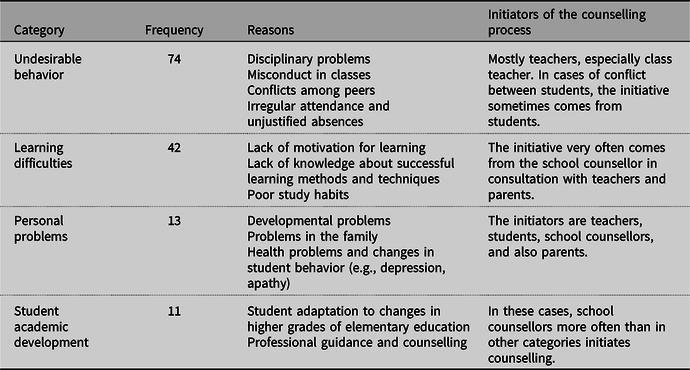
A wide variety of responses were received when we asked the participants about the reasons for conducting counselling and who usually initiates the process. Respondents emphasised that each student in the counselling process had specific individual problems, strengths and characteristics that made it impossible for any counselling conversation or counsellor’s approach to be regarded as a universal ‘recipe’. On the other hand, school counsellors have pointed out that in each development period of students (as well as the development cycle of the family) there are certain anticipated situations and difficulties that are often cause for counselling. In order to gain a clearer perception of the reasons for performing counselling with students and the most frequent initiators of this process, the responses were categorised, starting from the most common to the least frequent reasons (Table 1).
The reasons and initiators of counselling process

It is important to emphasise that some of the answers received regarding the question about the initiators of counselling process could not be precisely categorised. Specifically, the responses of one group of school counsellors surveyed (15 respondents) suggest the presence of many factors that determine who will initiate counselling and in what way (e.g., ‘All participants of life in schools are equally initiators’; ‘Who will initiate the beginning of counselling process depends on the problem/situation’; ‘I cannot tell who initiates this form of work the most, initially those are mostly teachers, parents or students, but when it comes to continuing the collaboration, because rarely the problem can be solved with only one session, I initiate the conversation personally’). In addition, some school counsellors (15 respondents) pointed out that initiating a counselling process in their schools usually comes from several levels, and that such types of initiative generally involve a high level of collaboration with class teachers and teachers in general.
Almost all interviewed school counsellors (74 respondents) stated that problematic student behaviour is one of the most common reason for conducting counselling, while initiative in these cases generally comes from teachers, especially class teachers (34 respondents). Also, more than half of the respondents (42) indicated that counselling usually revolves around dealing with learning difficulties students have, and that in these cases counselling often begins ‘at the end of a grading period’. Fewer school counsellors (13) mentioned students’ individual problems as a reason for counselling, while the least frequent reasons for counselling were related to students’ academic development (e.g., professional guidance and counselling, which only 7 respondents mentioned). School counsellors’ experiences about students’ initiative for engaging in the counselling process varied — some stated that students often turn to the pedagogue for help, while others claim that this type of initiative is rarely present and it generally occurs in cases of conflict with another student.
Application of Counselling with Students
In order to analyse the ways school counsellors perform counselling with students we discussed the types and forms of counselling they applied the most, and the factors that determined those choices. It was found that most of the participants were more likely to apply corrective counselling (42 respondents). Only a minority of school counsellors indicated that they practised preventive counselling more frequently (15 respondents) or both types in equal amounts (24 respondents). These respondents stated that they usually implement preventive counselling with the entire class through educational workshops and lectures on various topics; for example, peer violence prevention, teaching methods and learning techniques, and communication skills. Respondents who use preventive work to a lesser extent blame it on the fact that there are many situations in schools that require an emergency response (e.g., ‘We have a lot of situations that require immediate response, so there is little time for preventive action’), as well as work overload caused by a large number of students per school (e.g., ‘Although I think it is important to apply preventive action more often, due to a large number of students and the volume of pedagogues’ work, corrective action is more common’). Some participants in this research, however, had little faith in the positive effects of the preventive approach (e.g., ‘Corrective educational action is inevitable because prevention does not affect all students’).
The answers obtained show that the majority of school counsellors (56 respondents) use an individual form of counselling with students because, as they point out, ‘numerous problems students face require discretion and establishing relationship based on trust’. These are mainly the following problems: family issues (divorce, inadequate family relations, conflicts with parents, poverty and social deprivation); manifestation of various forms of antisocial behaviour; problems in students’ adaptation to school; difficulty in establishing adequate relationship with peers; the existence of social anxiety. A slightly smaller number of school counsellors (25 respondents) pointed out that they use a combination of group and individual work, emphasising that group counselling is more effective in situations when the problem exists on a class level (e.g., increased number of unjustified absences from classes, disciplinary problems in class, poor peer social relations, peer violence). Also, they use the group form of counselling in situations where a group of students has a similar problem (e.g., ‘Group counselling applies when larger number of students have a problem with learning, concentration and motivation’). Respondents pointed out that a number of factors determine the ways of conducting and the approaches used in counselling (e.g., ‘The choice of type and form of counselling depends on the issue being at hand, but also on conditions in school’), but that they generally perform corrective counselling through individual work with the student, while preventive action is usually carried out through group counselling.
Challenges and Difficulties in Counselling Students
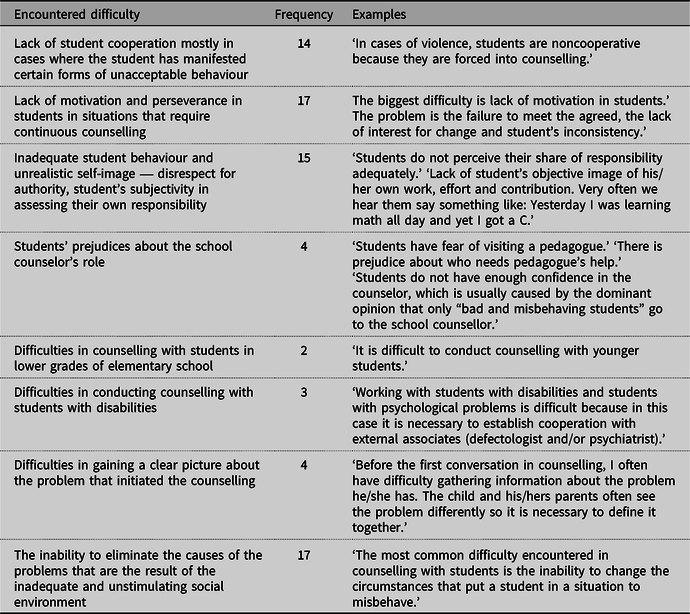
When asked about the challenges and difficulties they face in the process of student counselling, only five school counsellors stated that they generally have no problems in this area of their work and that if a problem arises, they solve it very quickly. The remaining respondents presented different problems that they face at different levels, which can possibly undermine the effectiveness of counselling to a greater or a lesser extent (Table 2).
The difficulties in students counselling

Discussion
Based on the results of the research, it seems that the practice of counselling students in the schools covered by our sample is predominantly focused on the individual model of counselling, concentrating on specific deficits. The most common reasons for initiating this process are learning disabilities and undesirable student behaviours, which is consistent with other research findings (Bryan, Moore-Thomas, Day-Vines, Holcomb-McCoy, & Mitchel, Reference Bryan, Moore-Thomas, Day-Vines, Holcomb-McCoy and Mitchell2009; Kourkoutas & Giovazolias, Reference Kourkoutas and Giovazolias2015) that showed that at-risk students were the most frequent counsellees. The finding showing that when it comes to learning disabilities counselling is often initiated at the end of a grading period, which may indicate a tendency to approach this problem only when analysis shows a low level of school achievement. Previous research (Gutvajn & Ševkušić, Reference Gutvajn and Ševkušić2013) recognises this as an inadequate approach in working with students in cases of underachievement in school. Although one of the important functions of the school counsellor is to assist students in making decisions about future occupation (Popov & Spasenović, Reference Popov and Spasenović2018), the results have shown that few provide career guidance counselling. Given the field of school pedagogues’ expertise, it is possible that the activity of direct professional guidance counselling is to a greater extent performed by psychologists, and that pedagogues are more focused on an educational approach in the development of students’ professional interests. Although school counsellors (school pedagogues and psychologists) are expected to act as a team, this approach can be a good way to avoid diffusion of their roles in the school (Astramovich, Hoskins, Gutierrez, & Bartlett, Reference Astramovich, Hoskins, Gutierrez and Bartlett2013).
Results show that the initiative for beginning the counselling process depends on the type of the problem, but that it is still predominantly coming from a teacher or school counsellor. Such practice should be reduced by encouraging students to take the initiative themselves. This is supported by the findings of some research (Nikšić, Reference Nikšić and Turk2017), which showed that the presence of intrinsic motivation influences positive counselling outcomes as it contributes to students’ openness and willingness to cooperate. Encouraging and motivating students to seek support from the counselling service should be particularly intensified in cases of students’ underachievement (Gutvajn & Ševkušić, Reference Gutvajn and Ševkušić2013). It is necessary to work on eliminating their resistance towards enrolling in support programs for learning and academic advancement. It is also important to point out the finding that teacher initiative regarding school counselling most often occurs in cases of student disciplinary problems and inappropriate behaviour in class. On the one hand, this situation can create resistance in students because they have the feeling of being pressured to talk, thus violating the principle of voluntariness in counselling. This principle requires that the decision to start the counselling process should be the student’s (Zuković, Reference Zuković2017). On the other hand, there is a danger that teachers initiate the process of counselling expecting school counsellor to adjudicate and take sides in a particular conflict. This certainly makes it difficult for school counsellors to adequately fulfill their role as a student advocate (McMahon, Mason, & Paisley, Reference McMahon, Mason and Paisley2009; Sink, Reference Sink2016).
The answers regarding the type of the counselling indicate that corrective counselling is used more frequently in schools compared to preventive counselling. Most respondents pointed out that the primary reason for lesser use of preventive counselling is the lack of time and work overload. This implies that certain problems are being addressed when they escalate, so school counselling becomes a process of ‘putting out fires’. Similar results have been obtained in some earlier studies (Goodman-Scott, Reference Goodman-Scott2015; Popović & Andjelković, Reference Popović, Anđelković and Turk2017; Scarborough & Culbreth, Reference Scarborough and Culbreth2008), which showed that school counsellors express dissatisfaction with not having time to do more counselling. In other words, they are often engaged in activities that are outside the scope of their professional roles and tasks (e.g., class scheduling, class substitutes, participating in committees, various on-call duties). On the other hand, lower representation of preventive counselling may be a consequence of an insufficient number of employed school counsellors with various professional orientations in schools in Serbia (Zuković & Slijepčević, Reference Zuković and Slijepčević2019). This certainly impacts the ability to provide adequate and purposeful student support from different aspects and through teamwork with experts.
When asked about the difficulties they face in the counselling process, most respondents focused on difficulties related to student behaviour during counselling (e.g., insufficient openness for cooperation, lack of motivation for change, and lack of ability to realistically perceive problems and self). Besides, some respondents pointed out the problem of adverse conditions or dysfunctional relationships in other settings in a student’s life, which school counsellors cannot influence through their professional performance. This finding implies the need for institutional networking and strengths-based partnerships that would provide a multilevel and multisystemic program of school counselling for supporting students in their development and advancement (Bryan & Henry, Reference Bryan and Henry2008; DeKruyf, Auger, & Trice-Black, Reference DeKruyf, Auger and Trice-Black2013; Hines et al., Reference Hines, Moore, Mayes, Harris, Vega, Robinson, Gray and Jackson2020; Kourkoutas & Giovazolias, Reference Kourkoutas and Giovazolias2015; Sink, Reference Sink2016).
Limitations and Implications for Further Research
Although the presented research results provide significant insight into the practice of counselling with students in the schools that were involved in this research, it is necessary to highlight certain methodological limitations and implications for further research. The key limitation of this research is connected to the method of sampling, because the convenience sample used does not allow the possibility to generalise the findings as a prevailing practice of school counselling in Serbia. In addition to the sample type, the structure of the sample can also be considered as a limitation, since the research covered only school counsellors employed in primary schools. Therefore, in order to obtain an idea of the common practice of counselling with students in schools in Serbia, it would be desirable to use a sample that would satisfy the criteria of representativeness in further research of this topic, that is, include a larger number of school counsellors from schools of all educational levels.
Regarding the data collection process, one of the limitations of this research could be that the interview was conducted by students. Although they had acquired the necessary methodological knowledge during their studies and were additionally prepared for the role of assistant researchers by the authors of this article, it is uncertain how successfully they executed this role. Other than that, there is a question of their ability to motivate and lead the respondents to provide as comprehensive answers as possible. Also, the use of a semistructured interview may have limited the possibility of obtaining a comprehensive overview of the examined phenomenon, and for future research on this topic it would be useful to apply triangulation (e.g., unstructured interviews and focus groups). Finally, in order to explore this phenomenon from the perspectives of different participants in the counselling process, it would be important to examine students’ opinions and attitudes about the current practice of school counselling, and about the possibilities for its improvement.
With all of the stated limitations in mind, the presented study may be a valid starting point and inspiration for some future research that could be related to the critical contemplation about the deficiencies in one’s own practice by school counsellors (i.e., counsellor as a reflective practitioner). Also, since this research has highlighted significant issues faced by school counsellors, it could provide a good basis for future research that would focus on the potential (from within the school, all the way to the level of educational policy) for overcoming the identified difficulties in counselling.
Conclusion
Based on the practical experiences of the surveyed school counsellors, the impression is that the practice of counselling with students is mainly focused on corrective action, that is, towards students who exhibit certain deficits in behaviour or learning. Although the unrepresentativeness of the sample does not make it possible to generalise the findings as a universal school counselling practice in Serbia, the findings potentially imply the presence of a counselling practice that does not sufficiently appreciate the importance of an integrative-systematic approach in student counselling (Bor et al., Reference Bor, Ebner-Landy, Gill and Brace2002). Also, the findings imply a lack of preventive action where counselling is a component of a whole school approach to mental health and wellbeing (Department of Education, 2016).
In line with the above, it is possible to make certain recommendations, which could, directly or indirectly, contribute to the advancement of student counselling practice. First, it is necessary to work towards removing institutional and noninstitutional barriers that interfere with the quality of counselling. This involves educating all school stakeholders about the potential of integrative system-oriented counselling and strong partnership between school, family and community (Bryan, Griffin, Kim, Griffin, & Young, Reference Bryan, Griffin, Kim, Griffin, Young, Sheldon and Turner-Vorbeck2019; Kourkoutas & Giovazolias, Reference Kourkoutas and Giovazolias2015). According to this approach, school counsellors should not focus only on working directly with students and implementing strategically targeted interventions. It requires of them to be school and community advocates, leaders of educational and system change, and creators of effective collaborative relationships (Hines et al., Reference Hines, Moore, Mayes, Harris, Vega, Robinson, Gray and Jackson2020; McMahon et al., Reference McMahon, Mason and Paisley2009; Sink, Reference Sink2016; Strear et al., Reference Strear, Van Velsor, DeCino and Peters2018). Also, it is necessary to appeal to government officials to recognise the importance of school counselling, to increase the number of counselling professionals employed in schools, and to provide systematic support for the professional development of school counsellors (e.g., through establishing supervision; DeKruyf et al., Reference DeKruyf, Auger and Trice-Black2013; Zuković & Slijepčević, Reference Zuković and Slijepčević2019). School counsellors can greatly contribute to this issue by advocating for their profession (McMahon et al., Reference McMahon, Mason and Paisley2009; Sink, Reference Sink2016) and through the results of evidence-based practice (Sakiz & Sariçali, Reference Sakiz and Sariçali2019; Zyromski, Dimmitt, Mariani, & Griffith, Reference Zyromski, Dimmitt, Mariani and Griffith2018). They need to show how important they are for the advancement and development of students and for the effectiveness of the practice of school as a whole. Finally, the key recommendation of this research relates to the need to transform the approach in school counselling from student-centred to a multilevel and systemic model (Bor et al., Reference Bor, Ebner-Landy, Gill and Brace2002; Hines et al., Reference Hines, Moore, Mayes, Harris, Vega, Robinson, Gray and Jackson2020; Kourkoutas & Giovazolias, Reference Kourkoutas and Giovazolias2015; Sink, Reference Sink2016; Zuković, Reference Zuković2017) that would provide a multitiered system of student support through collaborative partnerships with teachers and school staff, parents, as well as through interinstitutional networking.
Financial support
This paper was written within the project ‘Quality of educational system of Serbia in the European perspective’ (179010) SZ and ‘Digital media technology and socio-educational changes’ (47020) SS, financed by the Ministry of Education, Science and Technological Development of the Republic of Serbia.
Conflicts of interest
None.