Introduction
The international recognition of new states is loaded with political and legal controversies, and it lacks a rigorous normative framework. Although the material requirements of sovereign statehood have, in principle, reflected general agreement since the first half of the twentieth century, the practice of international recognition has often been ad hoc, sui generis, and highly political.Footnote 1 In particular, where legal sovereignty is contested, the politics of international recognition are controversial and can have far-reaching implications for peace and security. An underexplored question is whether and how the membership of states in regional and international organisations shapes foreign policies and practices of state recognition. While international recognition is an exclusive prerogative of sovereign states, international and regional organisations play a significant role in this process, which is a reflection of their evolving capacity as well as an evolution in the political dynamics of international recognition.
This article explores the EU’s engagement with the politics of international recognition, as a key example of the impact of regional organisations in this area. Depending on the case, this engagement has involved a collective position on recognition or non-recognition, or a decision to allow individual EU members to adopt independent national positions. Our overarching argument is that the EU’s practice of state recognition is based on a complex balance between internal and external considerations, which expose tensions between the EU’s constitutive principles and the geopolitical realities it faces. A number of themes provide the focus for analysis. First, the EU is stuck between a normative commitment to recognition based upon remedial secession – in cases where there is a strong humanitarian or democratic case for statehood – and a political environment in which this normative commitment may be contrary to its material interests. This is highlighted in cases in the former Soviet space, and to some extent Taiwan, where the EU has sought, with only limited success, to balance its normative commitments and its geopolitical, including economic, interests. At a time when cases of international recognition are increasingly partisan in the context of global geopolitical rivalries, the EU’s approach is particularly sensitive. This challenges the idea that Europe has an inherent capacity to draw upon its ‘normative power’ to influence international behaviour,Footnote 2 because this kind of authority rests upon a certain level of normative coherence as well as consistency of action.
Second, the EU’s approach to recognition also points to a tension between its commitment to promote human rights and engage with communities (especially in its neighbourhood and near abroad), and its commitment to international order based upon territorial integrity. While the EU’s normative values in principle place it on the side of the ‘people’, it is difficult to engage with breakaway regions such as South Ossetia, Crimea, and Abkhazia without generating controversy – or even exacerbating conflict – which in turn exposes an internal contradiction in the EU’s approach to such situations. Therefore, where there is a tension between the will of the people (for separation) and existing borders, the EU’s normative position can be problematised. A pragmatic policy of ‘engagement without recognition’ has provided a way to avoid some of the sensitivities, but we will argue that this has not addressed the tensions that exist.
Third, a further issue that makes the EU’s approach to recognition a pressing topic – both in terms of specific cases and its broader practice – concerns the international norms that are relevant to recognition. The international system is generally reluctant to grant statehood, especially in contested cases. However, there has arguably been a shift in international norms from the limited 1933 Montevideo Convention criteria for statehood, towards a greater emphasis upon human rights, democracy, minority rights, and thus a shift towards recognising remedial secession. The EU, as an organisation committed to liberal norms, is again contested since it must reconcile the importance of international order alongside its normative principles and it interests. Simultaneously, powerful states – such as the US, China, and Russia – often take opposing sides on recognition conflicts, resulting in a number of new states that enjoy only partial membership of international society. International recognition thus appears to be increasingly about politics rather than law; according to Cedric Ryngaert and Sven Sobrie the rules governing the process of state recognition are in ‘existential crisis’ due to their ‘uncertainty and incoherence’.Footnote 3 As the EU engages with the world more – in particular following the Lisbon Treaty and the creation of the European External Action Service – it is increasingly engaged with de facto or unrecognised states and claims for statehood. This further problematises the position of the EU since it exposes its decisions on recognition to greater international controversy.
Exploring a wide range of practices, we find that the EU’s collective stance on the recognition of new states has far-reaching implications for its internal cohesion and external impact. In general, this stance is not based on principled norms, but rather it reflects a less predetermined process that is shaped by multiple factors and interests, which are often in tension. Moreover, when a collective position has been adopted by the EU it has often been controversial – such as in the former Yugoslavia – or raised tensions with powerful third parties, such as Russia in connection with eastern Ukraine. While the EU’s pragmatic, case-by-case approach seems sensible it has not enabled the EU to avoid a number of tensions and inconsistencies that have problematised its relationship with important external partners, and potentially undermined the EU’s own normative credibility.
These debates raise a number of inter-linked questions, which will be considered in this article. How has the EU’s practice of state recognition evolved, what factors have shaped it, and what patterns have emerged from this practice? How significant are the recognition policies of supranational bodies such as the EU in steering the preferences and decisions of their members? What has determined when the EU has taken a collective position on the recognition of a new state entity, and when it has allowed EU members to make a unilateral decision on recognition? Can the EU approach international recognition in a manner that reconciles human rights concerns, remedial claims, and international stability in a coherent way?
This article contributes to the literature on state recognition by providing both a conceptual and empirical discussion of the role of regional organisations in shaping international recognition politics, a neglected but important topic. It gives particular attention to the challenges encountered by the EU as it engages with international recognition, focusing on specific practices. The next two sections explore the role of the EU in the evolving dynamics of international recognition, providing a framework for understanding how the EU forms its recognition policies. The following section analyses the different patterns of EU practice since the early 1990s, which are collective recognition, collective non-recognition, and the practice of allowing EU members to form their own position. In so doing, the discussion demonstrates how these practices generate the controversies introduced above, providing a substantive illustration of the tension between normative principles and geopolitical realities, made more acute in a transitional international order. Finally, the conclusion provides an analysis of the broader implications of the EU’s practices in this area. The research for this article draws upon interview data gathered in Brussels, in addition to official EU sources.
Regional organisations and state recognition
Decades of debate have not resolved deep divisions between scholars, practitioners, and lawyers on who has the right to recognise new states and under what circumstances new states gain diplomatic recognition.Footnote 4 This is because the recognition of states – a prerogative held only by other states – remains one of the most unregulated and decentralised aspects of international relations.Footnote 5 The most prominent debate is between those scholars who argue that recognition is a constitutive element and essential precondition of independent statehood,Footnote 6 and those scholars who see the emergence and existence of sovereign statehood independent of recognition by the other states.Footnote 7 In practice, although legal doctrine governs the conferment of statehood and the interactions of states, the process by which some entities become recognised as states and others do not is largely political. There is no regime that can objectively rule on the criteria for international recognition and less so enforce a duty to recognise new states.Footnote 8 As John Dugard maintains, ‘[r]ecognition is still characterized by political arbitrarines’, and states do not accept a duty to recognise new states.Footnote 9 Ryngaert and Sobrie thus argue that ‘the lack of a clear-cut normative framework gives way to uncertainty and incoherent policies’.Footnote 10
There were early attempts by several UN member states to delegate their right of recognition to UN bodies, in order to regulate and centralise the process. Hersch Lauterpacht argued that the collective coordination of state recognition would avoid controversial and unilateral interpretations of the principles and rules dictating the recognition of states and strengthen the global legal order.Footnote 11 According to this, collective recognition would resolve the issue of partial recognition and thus avoid state contestation, it would remove dilemmas among states where there are rival claims, and it would overcome the difficulty of forming a judgement on the availability of facts. More recently, Dugard has called for the formation of normative guidelines that would enable international organisations ‘to reach fair decisions on the statehood of seceding entities within a coherent legal framework’.Footnote 12 However, a centralised, regulated regime for deciding on recognition decisions has never found much support among states, and it is generally agreed that ‘it is the national practice which will be of primary importance when it comes to the mechanisms and procedures of recognition’.Footnote 13 In this context, the politics of diplomatic recognition predominantly involve legal, normative, and geopolitical considerations in granting or withholding recognition of new states.
Traditionally, diplomatic recognition of new states is granted by existing sovereign states, but with the rise of regional organisations and supranational bodies new practices of state recognition are emerging that provide new grounds for understanding the changing nature of state recognition.Footnote 14 Admission to international organisations, for example, represents one form of regulation. It is widely accepted that ‘admission to full UN membership is tantamount to collective de jure recognition’, which is ‘likely to facilitate the entry of the new state into other multilateral Organizations’.Footnote 15 Inverting this, the deliberate exclusion of a state from UN membership amounts to collective non-recognition. Yet, other scholars dissociate membership of international organisations with de jure and de facto recognition of states.Footnote 16
In turn, while a great deal is known about the rules, roles, and practices of the UN in the recognition of states,Footnote 17 less is known about the practice of state recognition by regional organisations, such as the EU.Footnote 18 Can regional organisations recognise states, and would this change the manner in which new states are admitted to international society? Barry Buzan and Ole Wæver demonstrate that a regional level of analysis provides a compelling focus for the interaction of subnational, national, regional, as well as global normative and political dynamics.Footnote 19 Regional organisations have the capacity to form collective intentions, and thus act as legal subjects in international relations.Footnote 20 Increasingly, regional organisations, as distinct entities in world politics, demonstrate not only the capacity to coordinate the actions of member states, including when and how to recognise states, but also make decisions that have legal and political consequences. This capacity helps to explain the constraining and enabling role of regional organisations in relation to their members’ foreign policy conduct. A regional perspective provides a differentiated understanding of state recognition by capturing region-specific dynamics, and it demonstrates the coexistence of geopolitical and normative agendas, and divergent foreign policy interests. The EU is a key test of this, since it has in the past two decades sought to consolidate a common position on external and security matters. Other regional organisations, such as the Organisation of American States (OAS), North Atlantic Treaty Organisation (NATO), and the African Union (AU) have also engaged on a case-by-case basis with the question of state recognition, largely by clarifying the discretionary character of recognition and shaping the decisions of their members on when to grant or withhold recognition.
The outcomes of state recognition processes can range from collective recognition and non-recognition to bilateral recognition. Collective recognition is the most effective method for entering international society as it reduces the burden of bilateral recognition as well as enhances the international legitimacy of new states.Footnote 21 Collective non-recognition is grounded on the conviction that ‘states are under an obligation not to recognize, through individual or collective acts, the purported statehood of an effective territorial entity created in violation of one or more fundamental norms of international law.’Footnote 22 Bilateral recognition signifies formal recognition of independence and sovereign statehood and it confers the legal personality necessary to share benefits and obligations of international law.Footnote 23
The EU has developed an elaborate practice of state recognition over the past two decades.Footnote 24 Membership in the EU by major powers such as the UK, Germany, and France has gradually given the EU the status of a collective power with global influence, underpinning the importance of this practice.Footnote 25 The fact that the EU has a structure in place for common decision-making on foreign matters signifies its capacity – and perhaps a duty – to respond collectively to claims for recognition by new states. Moreover, the diplomatic practice of the EU in the past two decades has demonstrated that regional organisations, as political assemblages of states, are establishing new practices of collective and individual recognition and non-recognition of states. Therefore, exploring the EU’s practice of state recognition not only helps to shine light on the role of regional organisations in gatekeeping or enabling the expansion of the political cartography of states, but also provides a contribution to debate on the evolution of the EU’s global role.
In turn, the EU’s practice of international recognition is interrelated with the idea of ‘normative power’ and Europe’s capacity to shape norms related to a range of policy areas.Footnote 26 If the EU’s constitutive principles generate legitimacy for its actions, in theory this should strengthen its role as a norm leader. According to this idea, these principles guide Europe’s interaction with external partners, and represent a standard of practice to aspire to for those who wish to do business with Europe. If Europe is inherently normative as a function of its constitutive principles, the key question is whether the EU has the ‘ability to shape conceptions of the “normal” in international relations’ in relation to recognition.Footnote 27 The ‘Normative Power Europe’ idea has been widely critiqued,Footnote 28 and international recognition practices present a further challenge. In particular, the authority of EU practices is conditioned by the coherence and consistency of its action – which is challenged by the geopolitical tensions that are at the heart of this policy area. In addition, the legitimacy of its decisions will be conditioned by the relationship between its actions and the principles upon which it – in theory – bases its action. From this perspective, even though EU practices of international recognition have been politically influential, these practices have implications for, and potentially problematise, its normative ‘power’.
Shaping the EU’s practices of international recognition
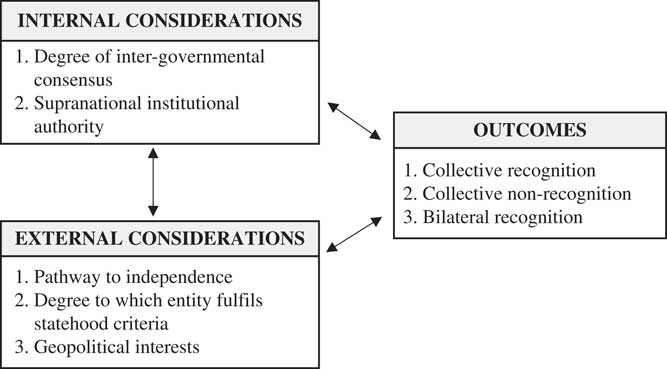
Conceptualising the EU’s role in state recognition requires integrating legal, normative, and political perspectives, as well as an exploration of the internal and external considerations shaping recognition practices (see Figure 1 below). To explore the EU’s state recognition responses it is necessary to provide a framework that accounts for normative divergence and convergence. Normative divergence refers to differences among the members of an organisation on various norms, policies, and responses towards specific challenges. In general, it is considered that normative divergence slows down or even prevents ‘effective policy co-ordination in response to situations of international crises’.Footnote 29 Normative divergence within the EU is driven primarily by different national interests among the member states, demonstrating that coordination and consensus has been uneven and prone to contingent and case-specific circumstances. Therefore, it can be expected that the normative structure of the EU’s state recognition practices would be flexible and more pragmatic than principled. In other words, despite a basic predisposition in favour of liberal norms, the EU’s response to secessionist cases is driven by multiple and diverse pressures; in some cases there can be policy solidarity while in other cases policy fragmentation.Footnote 30
Analytical framework for tracing the EU’s practice of state recognition.
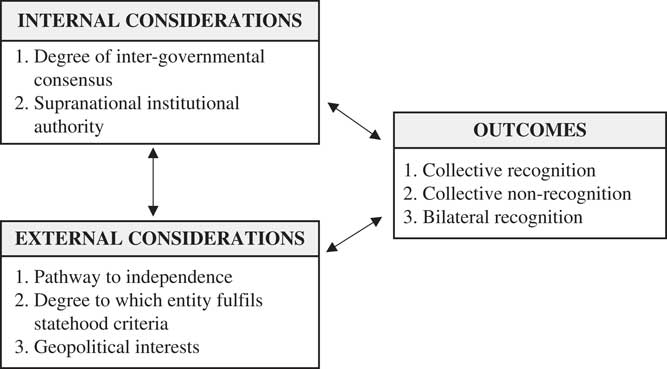
The Treaty of Lisbon envisioned an active international role for the EU, led by the High Representative for Foreign and Security Policy.Footnote 31 The strengthening of the legal basis for the EU’s common foreign and security policy has provided more scope to put forward common positions and guidelines on foreign policy, which provide a basis to assume that the EU as a whole can shape a state recognition policy. Although the EU has made progress in consolidating common foreign, security, and defence policies, the organisation does not have legal competency to recognise states as this remains a prerogative right of its members.Footnote 32 Therefore, the EU’s ability to form a collective stance on state recognition rests upon the extent to which its institutions and member states have managed to generate consensus on when to grant or withhold collective recognition of states, a process that is conditioned by national self-interests and trade-offs. In addition, policymaking in the EU is also shaped by strong member states that utilise the EU and the principle of solidarity to advance issues of national importance.Footnote 33 The EU’s recognition practices can therefore be shaped by individual members or clusters of states who galvanise support for specific regions and third countries.
The EU’s practice of state recognition is also shaped by external considerations. Whether a new state comes into existence through the consent of the ‘parent’ state and a legitimate referendum or through unilateral action, contrary to international law, plays an important role in the EU’s collective stance on state recognition. The EU’s decision to coordinate the recognition of new states thus depends on how much the pathway to independence enjoys international legitimacy and legality. The satisfaction of practical and normative criteria of statehood on the part of aspiring new states is also important, including a permanent population, territory, effective government, and the ability to enter in international relations. In addition to these traditional standards of statehood, respect for international law, non-interference in other states’ internal affairs, and a commitment to democracy, human rights, and the protection of minorities have also become increasingly but unevenly relevant.Footnote 34 Of course, the EU and its members also have geopolitical interests that play an important role in the conduct of foreign policy, which often weigh against and sometimes side-line normative considerations – a tendency that is amply demonstrated in the analysis below (Figure 1).
The EU’s practices of state recognition
In tracing the EU’s practices of state recognition, we look at all the cases since the early 1990s where the EU played a role in establishing collective recognition or non-recognition to newly (re-)established and contested states, and when it has left its members to undertake individual decisions. In exploring collective recognition we focus on the former Yugoslav and Soviet republics, Eritrea, East Timor, and South Sudan. In exploring the EU’s collective non-recognition policy, we focus on cases such as Taiwan, the Turkish Republic of Northern Cyprus (TRNC), Somaliland, Western Sahara, Nagorno Karabakh, Transnistria, Abkhazia, South Ossetia, Crimea, and Sevastopol. Finally, in examining the EU’s individual recognition and non-recognition policy, we explore the cases of Kosovo and Palestine. By looking at this broad range of cases, we disentangle the various rationales invoked to justify the EU’s position on state recognition in order to demonstrate continuity and change in the norms and practices governing its role in state recognition.
The methodology used involves looking closely at the empirical detail of the EU’s political dynamics and behaviour in relation to this topic. In IR scholarship there is a growing interest in exploring international practices, which not only helps to explain diplomatic dynamics and performances, but also helps trace and disentangle the emergence of discourses, policies, and norms in practice.Footnote 35 Exploring the EU’s approach to state recognition from the perspective of practice helps to make sense of the unevenness, gaps, and inconsistencies in the EU’s practice of state recognition. It helps to account for the role of embedded institutional routines, vested interests, and the tactics of various stakeholders who have an interest in recognition debates. Focusing on the EU’s practice of recognition also helps to account for structural constraints, the role of agency and practicality, and the impact of situational circumstances and external factors that contribute towards state recognition or non-recognition. The following sections explore three principal patterns of behaviour in the EU’s practice of international recognition: collective recognition, collective non-recognition, and a position of delegating decisions on recognition to EU members.
The EU’s practice of collective recognition
Since the end of the Cold War the EU has been faced with the challenge of responding to two distinct secession scenarios. First, in the context of the emergence of new states, following the peaceful or violent dissolution of federations. Second, in cases of consensual self-determination and proclamations of statehood, through democratic referenda and under UN mediation. One of the early major tests of European unity was the question of the recognition of new states emerging from the violent dissolution of Yugoslavia and the formation of new independent states in the former Soviet space in the early 1990s.Footnote 36 As Richard Caplan suggests, the consequences of this represented a shift away from recent state practice, where recognition had generally been in line with non-political criteria.Footnote 37 The European Community’s (EC) guidelines on the recognition of new states in Eastern Europe and in the Soviet Union therefore required not only the fulfilment of objective criteria of statehood, but also a commitment to international law, respect for sovereignty, and protection of minorities.
A mixture of internal and external factors, as well as legal and political considerations drove the EC’s collective recognition policy in the 1990s. Internally, the EC’s decision in favour of collective recognition of former Yugoslav and Soviet republics aimed at limiting unilateralism within the EC’s member states and demonstrating unity as an aspirational global power.Footnote 38 In the recognition of former Soviet republics, there was full consensus among member states to grant recognition to the entities that were republics within the USSR, since these were more likely to fulfil the functional criteria of statehood.Footnote 39 There was an overriding concern, reflected in the guidelines for recognition, that the former Soviet republics must respect the territorial integrity and sovereignty of other states and resolve their disputes peacefully. In the case of the former Yugoslav republics, the intergovernmental consensus was a response to Germany’s intention to recognise Slovenia and Croatia, and Greece’s decision not to recognise Macedonia. At that time, the EC’s supranational powers in the area of foreign and security policy were limited. Therefore, it seems that the presence of a strong advocate country, namely Germany, played a significant role in generating internal consensus within the EC to create a common position on state recognition. This demonstrates that collective recognition is not always truly consensual, as some states camouflage their own national interests within collective efforts and others merely follow the dominant states. By threatening to unilaterally recognise Croatia and Slovenia, Germany therefore forged a necessity among other European states to take a collective stance in order to avoid harming broader regional cooperation.
However, external considerations also played a role in how collective recognition was formulated and implemented, in particular in terms of the pathway to independence. Recognition was granted to the federal units that had republic status, thus excluding autonomous provinces. In the absence of international legal rules and written norms on state recognition, the EU’s case-by-case decisions on recognition, expressed in the form of guidelines, legal opinions, and joint communications, have gradually constituted a norm-making process.Footnote 40 This assumes that the EU is not addressing cases as entirely discrete, isolated decisions, but rather a cumulative process through which normative ‘baggage’ evolves and conditions decisions. Externally, the implications of this are that EU decisions and EU practice in international recognition has a conditioning effect on the behaviour of other international actors.
This process emerged with the EC’s response to the breakup of the former Yugoslavia. The EC’s Arbitration Commission for Yugoslavia (the Badinter Commission) issued consultative and non-binding opinions that clarified matters concerning statehood and succession in the context of the eventual dissolution of Yugoslavia, but also had wider application. The Badinter Commission confirmed that Yugoslavia was in the process of dissolution; that republic entities had the right to self-determination; and the existing administrative borders of the former Yugoslavia would serve as the new borders of the succeeding states. It also established that international recognition should be granted only after tangible guarantees were in place for minority protection, and international peace and security.Footnote 41 These legal opinions allowed the imposition of normative and legal considerations when granting collective recognition to former Yugoslav republics. Caplan suggests ‘norms were the very basis of the Community’s criteria for the recognition of new states’.Footnote 42 The new states in the former Yugoslav space were expected to demonstrate respect for human rights, especially the rights of national and ethnic groups; support for the UN in resolving outstanding issues in the region; and implement constitutional guarantees to ensure that new states have no territorial claims towards neighbours. What followed was the EU’s conditional normalisation of diplomatic relations with newly independent republics in exchange for their mutual recognition and full normalisation of relations among the states of the former Yugoslavia.
In terms of the recognition of the former Yugoslav republics, the EU has followed the international doctrine that borders should not be unilaterally changed, and this was in line with the Yugoslav constitution stipulation that ‘the republics’ boundaries cannot be altered without their consent’, thus supporting the uti possidentis juris principle.Footnote 43 This legal and constitutional threshold had serious ramification for Kosovo as an autonomous province within the former Yugoslavia, but also far-reaching consequences for entities in the former Soviet Union, namely Chechnya, Abkhazia, and South Ossetia. Nevertheless, the practice of collective recognition also served as a useful method for disciplining fledgling states through the imposition of normative and political conditions, tied to their recognition. The process through which the EC collectively recognised the new states of the disintegrating Yugoslavia was also driven by security and geopolitical interests. The policy aimed to de-escalate conflict and put pressure on the parties to accept a general settlement and ease their re-integration into international society following a postwar transition. With regard to former Soviet republics, the EU considered recognition as an important move for enlarging the EU and possibly NATO in eastern Europe, and the expansion of the region’s market economies.Footnote 44 However, the EU’s collective decision to recognise former Yugoslav republics had an unintended effect; rather than serving as an instrument of conflict management it arguably intensified violent conflicts in the region.
The former Yugoslavia cases illustrate an evolution and process of learning through European practices of state recognition. Initially, these practices were intended to de-escalate conflict and shape the domestic and regional circumstances for resolving emerging conflicts through imposing conditional terms for recognition. At the time this was controversial since it was widely seen to have contributed to the escalation of armed conflict across the region, as it reinforced the anxieties of minorities within Croatia and Bosnia and intensified inter-communal instability. At a later point, the collective recognition policy turned into an instrument for shaping the constitutional arrangements of the new independent states in relation to the protection of minorities, the peaceful resolution of outstanding disputes, and for establishing political guarantees against territorial claims towards neighbouring states. However, norm-making on state recognition through the issuance of policy guidelines and non-binding legal opinions – as seen in the Yugoslav case – has evolved into a broader range of less explicit practices. In other cases of collective recognition and non-recognition, joint policy positions of member states has formed the basis of implicit norm-making and norm-implementation. The EU has not been as clear and committed to developing explicit policies on state recognition, and in some ways the response to the Yugoslav and former USSR cases are exceptional.
Beyond the Yugoslav and USSR cases, the EU was able to develop an implicit and derivative common recognition policy, mainly in relation to those countries that obtained independence via a UN-mediated or consensual process, which thus demonstrated an acceptable and uncontested pathway to independence. This is particularly evident with the cases of Eritrea, East Timor, Montenegro, and South Sudan. In these uncontroversial cases, the EU issued joint statements on behalf of all member states, which opened the path for individual recognition by its members. The EU has followed globally accepted practices of state recognition where the consent of the host state and self-determination through international-supervised referenda have been at the heart of the claim for statehood. In the case of East Timor, during the 1990s, despite Portugal’s and Ireland’s strong lobbying efforts within the EU, a common affirmative position on independence was impossible largely due to the UK’s and Germany’s relations with Indonesia.Footnote 45 In the absence of internal consensus the EU followed the UN’s policy on East Timor that supported the transition to independence via a popular consultation in 1999. In 2001, following independence, the EU issued a statement expressing the EU’s commitment ‘to the success of the East Timorese transition to independence’.Footnote 46 Soon after, East Timor was admitted to the UN and did not require further bilateral recognitions.
In the case of Montenegro, the EU played a crucial role in mediating the path to independence and facilitating a referendum for dismemberment from the union with Serbia in 2006. The initial test of the EU’s foreign policy was its role in mediating the formation of the union of Serbia and Montenegro in 2002, which set the stage for eventual independence. The European Council pronounced that the pathway to independence was compatible with national and international law and ‘that it will fully respect the decision of the people of Montenegro’.Footnote 47 The EU’s direct involvement in mediating independence was driven by its strategic interest of stabilising the Western Balkans and for advancing the enlargement process in the region, as exemplified by the Stabilisation and Association Agreement with Montenegro in 2007.Footnote 48 The EU’s hands-on approach in facilitating Montenegro’s independence referendum was normatively based on the findings of the Badinter Commission where Montenegro had the same statehood entitlements as the other Yugoslav republics that became independent in the early 1990s.Footnote 49
Similarly, the EU granted collective recognition to South Sudan following the internationally mediated referendum for independence. A declaration issued on 9 July 2011 stated that ‘[o]n this historic day, the EU and its Member States welcome the Republic of South Sudan as a new independent state.’Footnote 50 Although there were no normative conditions attached to collective recognition, the EU’s High Representative encouraged the new government in Juba ‘to demonstrate its commitment to national reconciliation, democratic and transparent governance, and respect for human rights as the core of its vision for the future’.Footnote 51 Following the EU’s statement, individual EU members of the EU granted recognition to South Sudan in accordance with their own domestic procedures.Footnote 52 The EU’s collective recognition of South Sudan was driven by the desire for regional stability and represented a natural extension of the EU’s role as one of the witness signatories of the 2005 Comprehensive Peace Agreement, which ended the civil war and set the path for eventual independence. It is notable that the decision of other countries – such as Turkey and Indonesia – to recognise South Sudan followed from, and made reference to, the EU’s decision to do so, and also followed some of the normative language used by EU.Footnote 53 The AU also used similar normative language when admitting South Sudan as a new member state.Footnote 54
Across a range of cases the EU’s guidelines for state recognition have performed the function of conditioning and coordinating the foreign policy of its members as well as influencing the response of the wider international community. While the EU does not recognise states in a traditional sense, its collective statements serve as policy guidance and path-openers for bilateral recognition, given the EU’s global stature. The collective position of the EU as a significant group of states has also influenced the recognition decisions of other states, which position the EU as norm-builder in the broader context. For example, the EU’s practice of collective recognition shaped the response of the wider international community towards the former Yugoslav republics, thereby facilitating their passage to universal recognition evident in their admission to the UN and the establishment of bilateral relations broadly. While in the case of the former Yugoslavia, the practice of collective recognition was driven by geopolitical interests, the uncontroversial cases – such as Eritrea, East Timor, Montenegro, and South Sudan – helped to attune the EU’s practice of state recognition to wider UN practices. Yet across all the cases of collective recognition, it seems that satisfaction of core statehood criteria has not played a decisive role in shaping the EU’s policy of state recognition, which underscores the political nature of this process. Indeed, state fragility among the newly independent states provided space for the EU to intervene and assist in statebuilding and political reform.Footnote 55 As the Yugoslav and former Soviet cases suggest, the EU has tried to make recognition of states conditional upon their adherence to principles of international law, including protection for minorities and peaceful resolution of disputes between the seceding and former host states. However, while this adherence to the existing international order established the path for the EU’s response to other secessionist entities and contested states, the EU’s practice of state recognition is not predetermined by principles and norms, but shaped by situational circumstances and geopolitical dynamics.
The EU’s practice of collective non-recognition
The practice of collective non-recognition invokes an obligation among states within a specific community not to recognise the sovereignty of entities that claim statehood for a variety of possible reasons, but principally when their creation is in breach of fundamental norms of international law.Footnote 56 Over the years this doctrine has played a key role in maintaining a conservative expansion of international society. The EU’s practice of collective non-recognition has been pursued in three distinct situations, driven by external considerations which are generally faithful to legal doctrine but which also reflect political imperatives. Collective non-recognition has been observed when the entity concerned has proclaimed independence without the consent of the host state, when the secession and independence have taken place through aggressive and coercive methods, and when the EU’s and its members’ geopolitical interests would be threatened by the recognition of a new state. However, controversies have sometimes arisen as the EU has sought to balance its normative commitments with its geopolitical interests, particularly when the pursuit of a collective policy has put it at odds with powerful international partners.
One of the earliest examples where the EU took a collective non-recognition stance is Taiwan, a typical case where the EU has followed the geopolitical interests of its members and the UN’s position. The EU’s official position towards Taiwan is in line with the ‘One China’ policy: the EU recognises only the People’s Republic of China, and therefore it has no diplomatic or formal political relations with Taiwan. All policy documents explicitly state that ‘the EU does not recognize Taiwan as a sovereign state and has no diplomatic or formal relations with Taiwan’.Footnote 57 The EU’s common position on Taiwan is that it should resolve its differences with China through peaceful dialogue, avoiding any use or threat of force. Yet, the presence of advocate member states within the EU has played a role in the establishment of economic relations with Taiwan without diplomatic recognition. Some European states are closer to Taiwan, due to its commitment to democracy and human rights, and others – because of their extensive trade and investment exchanges with China – are more solidly opposed to any relationship with the Taiwanese authorities.Footnote 58 Nevertheless, most EU members have economic and trade offices in Taiwan, and EU members are major investors there. The European Economic and Trade Office in Taiwan is the EU’s representative office in Taipei, which focuses on non-controversial areas such as education, research, and technical programmes. This technical approach ensures functional cooperation with Taiwan without formal recognition, as well as demonstrating the possibility for political and economic interaction without antagonising the geopolitical interests of EU members. This modus vivendi is likely to continue as the practice has provided stability and predictability for both sides. Nevertheless, the denial of Taiwan’s statehood – understandable and sensible from a geopolitical perspective – does expose a tension between the EU’s liberal normative identity and some of its recognition practices.
The EU has also adopted a policy of collective non-recognition of the ‘Turkish Republic of Northern Cyprus’ (TRNC), since the entity declared independence in 1983. Turkey is currently the only state that recognises the TRNC, in defiance of claims of sovereignty over the territory by the Republic of Cyprus. UN Security Council Resolution 541 (1983) considered the creation of TRNC to be ‘legally invalid’. The EU’s position on the Cyprus problem is that a comprehensive settlement for a bi-communal, bi-zonal federation should be resolved through peaceful dialogue and in accordance with UN Security Council resolutions. The EU’s collective non-recognition policy of TRNC was primarily influenced by internal considerations, especially the vested interests of Greece and the UK. When Cyprus joined the EU in 2004, EU members recognised the Republic of Cyprus as the only subject of international law on the island. However, Protocol 10 of Cyprus’s Accession Treaty suspended EU legislation (acquis) in the areas where the Government of Cyprus does not exercise effective control, namely the TRNC-controlled areas. In 2007, the EU reiterated the collective non-recognition policy when it stated that ‘[t]he so-called “Turkish Republic of Northern Cyprus” is recognised neither by the European Union nor by any of its Member States.’Footnote 59 This non-recognition policy is also supported by external considerations, including the circumstances that led to proclaimed independence through Turkish intervention, the lack of support from the UN, and the threats to regional stability. However, despite not recognising the TRNC, the EU continues to provide aid to the Turkish Cypriot community to foster intercommunal reconciliation, help prepare for reunification, and bring the region closer to the EU. This balancing approach between internal and external considerations involves avoiding any recognition of TRNC, maintaining good relations with Turkey (at least until 2016), and satisfying EU members, especially Cyprus and Greece.
The EU has also adopted a policy of collective non-recognition of Nagorno Karabakh and Transnistria, two breakaway regions and ‘frozen conflicts’ in the Caucasus region. The EU’s position is that these breakaway territories belong to their Soviet-era states whose territorial integrity must be respected, thus independence contra international law must be prohibited. The EU openly reiterates ‘its support for the territorial integrity of Azerbaijan, and recalls that it does not recognise the independence of Nagorno Karabakh’.Footnote 60 It further emphasised ‘the need to establish a stable political agreement concerning Nagorno Karabakh, which should be acceptable to both Armenia and Azerbaijan’. Similarly, driven by internal considerations and the pressure from eastern European member states such as Romania, the EU favours ‘a comprehensive, peaceful settlement of the Transnistrian conflict based on the sovereignty and territorial integrity of the Republic of Moldova with a special status for Transnistria’.Footnote 61 As these conflicts do not pose immediate security threats, there is no apparent urgency for the EU to find a sustainable solution, while the policy of engagement without recognition fulfils EU’s basic political and security interests.Footnote 62
Somaliland is another self-proclaimed state that has not been recognised by the EU. Somaliland declared independence from Somalia in 1991 and since then it has managed to exist and develop resiliently without international recognition. In 2012, the EU High Representative declared that ‘[t]he EU, like the UN, considers Somaliland part of Somalia, in respect of the country’s territorial integrity’.Footnote 63 While in principle the EU does not recognise Somaliland because of its non-consensual secession, the policy of collective non-recognition is also motivated by geopolitical considerations, fearing that the alteration of borders could destabilise the entire Horn of Africa, a strategic route for European trade. However, while withholding diplomatic recognition, the EU and its member states have gradually recognised Somaliland’s trajectory towards democratic consolidation, domestic reconciliation, and stability. The EU’s policy towards Somaliland therefore amounts to engagement without recognition, which consists of providing aid and technical assistance to ensure that the territory does not become an exporter of insecurity.Footnote 64 The EU’s assistance focuses on improving economic development, agriculture, infrastructure, and governance. This notwithstanding, the EU considers that a ‘permanent solution to the status of Somaliland should be reached through negotiations between the authorities of Somaliland and the Federal Government of Somalia’.Footnote 65 Somaliland is another example of the EU’s practice of recognition that exposes a tension between its normative commitments – to democracy and self-determination – and its commitment to Westphalian principle of state sovereignty. The tension is all the more acute since Somaliland, for some years, achieved a greater degree of state consolidation and democracy than other states in the region.
The EU is also engaged in the case of Western Sahara, which has been occupied by the Kingdom of Morocco since 1975. Following decolonisation, the UN Security Council called for a referendum on self-determination for the region, which would open the path to independent statehood. However, Morocco and Mauritania occupied parts of Western Sahara that were later declared by the International Court of Justice to be an illegal occupation. To date, Western Sahara remains under Moroccan occupation. EU member states are divided on the recognition of Western Sahara, highlighting once again the salience of strong advocate states in shaping the recognition policy.Footnote 66 While Spain, a former colonial power over Western Sahara, appears to support the right of the Sahrawi people for self-determination, France tends to side more with Morocco for geopolitical and cultural reasons. Unable to generate a common affirmative position, the EU’s position so far has been that it ‘supports the UN Secretary-General’s efforts to achieve a just, lasting and mutually acceptable political solution, which will provide for the self-determination of the people of Western Sahara in the context of arrangements consistent with the principles and purposes of the Charter of the UN.’Footnote 67 Yet, as part of its efforts to secure its southern borders and deepen political influence in North Africa, the EU has signed an association agreement with Morocco, which entails enhanced political and economic relations.Footnote 68 This implies, because of its geopolitical needs, that the EU has come to gradually accept Morocco’s de facto control of Western Sahara, despite being in violation of UN resolutions, international law, and a ruling by the European Court of Justice. Again, this is a demonstration of the tension between the EU’s normative self-image and its material interests, exposed as a consequence of a more active external engagement.
While in the previous cases the EU’s recognition policy was implicit in its own practices, the first time the EU pursued an explicit position of collective non-recognition was in the cases of Abkhazia and South Ossetia, two breakaway regions of Georgia. This policy was a three-fold position, involving: explicitly and unanimously stating that no EU members would recognise the break-away territories; calling on other states not to recognise the independence proclamations; and condemning ‘Russia’s unilateral decision to recognise the independence of Abkhazia and South Ossetia’.Footnote 69 The extraordinary European Council meeting of 1 September 2008 outlined EU’s common position:
The European Council strongly condemns Russia’s unilateral decision to recognise the independence of Abkhazia and South Ossetia. That decision is unacceptable and the European Council calls on other States not to recognise this proclaimed independence and asks the Commission to examine the practical consequences to be drawn …Footnote 70
In the case of Georgia – embroiled in disputes with separatist movements and with Russia – the EU claims to be committed to ‘the principles of independence, sovereignty, territorial integrity and the inviolability of the internationally recognised borders’ of the country, and it has been active in pursuit of this stance.Footnote 71 In implementing a collective policy of non-recognition of Abkhazia and South Ossetia, the EU issued instructions in June 2011 to the EU’s delegations and the diplomatic networks of members to send a demarche to countries across the world. The purpose of this demarche was ‘to remind relevant EU partners about the importance that the EU attaches to the sovereignty and territorial integrity of Georgia’.Footnote 72 The demarche encouraged partner countries to maintain their policy of non-recognition, highlighting the detrimental effect of secession ‘to the stability and security of the region’, including ‘the ongoing international efforts to find a solution to the conflicts’.Footnote 73 Finally, the demarche threatened that ‘any recognition would hurt the core interests of the EU and would not be without consequences to the quality and depth of your relations with the EU’.Footnote 74 This goes far beyond passive non-recognition. Simultaneously, however, the EU has promoted a policy of engagement with Abkhazia and other Eurasian unrecognised breakaway regions, because of the risks of disengagement. The essence of this policy is to engage with the breakaway regions on political, economic, and cultural matters, while side-lining the question of international legal sovereignty and diplomatic recognition.Footnote 75 Although the EU has not recognised Abkhazia and South Ossetia, it has therefore provided financial support for economic development and civil society. The aim of this policy is primarily geo-strategic: to reduce Russia’s strategic leverage over these regions and have a stake in the de-escalation of tensions springing from international isolation.Footnote 76 However, any engagement by the EU, even when approached in a manner that is sensitive to local conflicts, has an impact upon regional politics and contributes to tensions between the EU and Russia.
The most recent example of the EU’s explicit and robust collective position of non-recognition is Crimea, formulated by the Council of the EU with the Commission and the High Representative for Foreign and Security Policy, and again driven by internal and external pressures. Following Russia’s intervention into Crimea and Sevastopol the President of the European Council and the President of the European Commission issued a joint statement on 18 March 2014, stating that ‘[t]he sovereignty, territorial integrity and independence of Ukraine must be respected. The European Union does neither recognise the illegal and illegitimate referendum in Crimea nor its outcome.’ The EU’s strong response came after Russia’s incursion into Crimea, which occurred after Ukraine expressed its intention to sign an Association Agreement with the EU. This made the EU directly implicated in the crisis, for which it needed to take strong political measures. The aggression against Ukraine represented a serious threat to the Euro-Atlantic community, and particularly alarmed the EU’s Nordic and Eastern members, who felt an acute threat to their security and territorial integrity. For this reason, these countries have been at the forefront of the EU’s policy of non-recognition of Crimea and Sevastopol. For example, in a joint statement, the Foreign Ministers of Sweden, Estonia, Lithuania, Latvia, Finland, and Denmark claimed that ‘the EU’s non-recognition policy of the annexation is the clearest and most effective manifestation of our support’, and that this policy ‘will remain in place as long as Russia’s illegal annexation continues’.Footnote 77
In parallel to internal considerations – including the physical threat to some EU countries – the formulation of the collective non-recognition policy was driven by the contested path to independence, the absence of state-like attributes, and the destabilising effects of the Crimean conflict. The EU’s stance was supported by UN General Assembly Resolution 68/262 (2014) which called upon ‘all States, international organizations and specialized agencies not to recognize any alteration of the status of the Autonomous Republic of Crimea and the city of Sevastopol on the basis of the above-mentioned referendum and to refrain from any action or dealing that might be interpreted as recognizing any such altered status.’Footnote 78 The goal of the EU’s common position on non-recognition was ‘to demonstrate that the EU does not accept the illegal annexation, using tangible measures in addition to regular political and diplomatic action’.Footnote 79 However, the policy went a step further by introducing sanctions against Russia and the Crimea region, including freezing assets and imposing visa bans, and condemning human rights abuses against ethnic Tatars in Crimea.Footnote 80 Interestingly, the EU’s policy of non-recognition of Crimea and Sevastopol not only obliges its members to adhere to the policy, but also requires compliance from candidate countries, including Albania, Macedonia, Montenegro, and Turkey, the potential candidate Bosnia and Herzegovina, and the members of the European Economic Area (EEA) and the European Free Trade Association (EFTA), such as Liechtenstein and Norway, as well as Ukraine and Georgia.
At an unprecedented scale, the Crimea case illustrates that the EU has taken a strong collective stance against the recognition of those states that tend to be pawns of a major adversary power, such as Russia. However, the EU has locked itself into a non-recognition policy that will shape EU-Russia relations for the foreseeable future, something that will become increasingly contentious as Russia gains stronger regional support and influence. Within the EU itself, the EU’s sanctions on Russia – as a part of this collective non-recognition policy – have harmed the economies of some member states and have increased energy insecurity, which in turn questions the viability of such a forthright stance against Russia.Footnote 81 Moreover, Russia’s response to sanctions – its campaign to propagate disinformation to weaken the EU’s institutional unity and encourage populist, fragmentary tendencies – has raised a serious challenge to the integrity of the EU.Footnote 82
Tracing the EU’s practice of collective non-recognition demonstrates that the EU has followed global orthodoxies for preserving the existing state-centric order, although this does not always correspond to the EU’s progressive agenda in other foreign policy areas, such as the promotion of gender equality, democracy, human security, and human rights. Yet the EU’s practice of state recognition is determined on a case-by-case basis, which gives some scope for pragmatism. On the one hand, when the EU and its member states do not have compelling vested interests in specific cases – such as Nagorno-Karabakh, Transnistria, Somaliland and Western Sahara – they tend to align their position with that of the UN, in the interests of international order and regional stability. On the other hand, when the EU’s geopolitical interests are affected, it has tended to develop a policy of engagement without recognition, and ensured that unrecognised states do not become pariah entities endangering regional stability. Political and diplomatic non-recognition are therefore combined with socioeconomic and technical cooperation. However, while the policy of non-recognition might be a viable solution – to balance the EU’s political interests and legal obligations – in the long run the persistence of contested territories can become a source of insecurity, injustice, and inequality, which run against the EU’s fundamental normative commitments. Collective non-recognition might be in the interests of regional organisations and wider stability; however, for unrecognised states this may also represent a hegemonic impasse that prevents their opportunity to gradually obtain recognition. Engagement without recognition is therefore rarely free from controversy.
The EU’s practice of bilateral recognition
As the EU’s policy of state recognition is determined on a case-by-case basis and depends upon the extent of internal consensus, in two significant cases – Kosovo and Palestine – EU members have pursued individual decisions and policies on recognition. Following Kosovo’s independence the EU Council conclusions on Kosovo (issued in February 2008) set out the EU’s collective stance on the question of independence and recognition.Footnote 83 In the absence of internal consensus, the European Council noted ‘Member States will decide, in accordance with national practice and international law, on their relations with Kosovo.’Footnote 84 This was the cornerstone statement of the EU’s policy of bilateral recognition of Kosovo’s independence. The European Council clearly did not contest the declaration of independence, nor consider it in breach of international law. While the EU reaffirmed its adherence to the principles of sovereignty and territorial integrity, it stated the circumstances that make Kosovo ‘a sui generis case which does not call into question these principles’,Footnote 85 highlighting two important factors: humanitarian intervention and the UN interim administration of Kosovo. So far, 23 out of 28 EU members have recognised the independence of Kosovo and have established full diplomatic relations.
Although the most influential EU member states – Germany, France, and the UK – seem to have pushed for a common position on Kosovo’s future status, the EU ultimately failed to offer Kosovo collective recognition due to internal resistance from five members, who for different domestic reasons were not ready to accept Kosovo’s independence. Spain is sensitive about the establishment of any precedent that may exacerbate separatist pressures in Catalonia, and Cyprus and Greece were directly preoccupied with the status of TRNC. Slovakia and Romania similarly feared encouragement to potential claims for expanding autonomy among their national minorities.
In addition to internal considerations – particularly the lack of consensus among its members – the EU’s pragmatic approach to Kosovo was also driven by external considerations. Kosovo’s remedial path to independence after the failure of UN-mediated talks, its satisfaction of core statehood criteria, and the need for regional peace and stability in the Western Balkans, were key to the broad support that it had for statehood.Footnote 86 Most importantly, the EU promised Kosovo, along with the rest of the region, the prospect of eventual membership in the EU upon satisfaction of various political and economic criteria.Footnote 87 Even in the absence of collective recognition of Kosovo, the EU therefore sent signals that imply recognition of Kosovo’s independence.Footnote 88 Acts of implied recognition can represent a broad range of acts, including exchanging diplomatic representatives, participation in international conferences, and participation in multilateral treaties.Footnote 89 Implied collective recognition arguably exists in the prospect of membership of the EU, which is not granted to non-state entities or any other contested territories. Kosovo signed the Stabilisation and Association Agreement (SAA) with the EU in 2015, which signifies political, economic, and legal engagement between the EU and states that seek membership. In June 2016, High Representative Mogherini clarified that ‘[t]he fact that some Member States do not recognise Kosovo as an independent state does not constitute an obstacle for Kosovo to implement the obligations that arise from the SAA, nor for the EU to continue to provide assistance to Kosovo as it has done until now.’Footnote 90 Within this framework, the five EU member states that continue to withhold recognition of Kosovo’s independence have adopted a pragmatic policy of engagement without recognition, which entails supporting Kosovo’s European integration and permitting the EU’s support for the country’s political and economic development.Footnote 91
More explicitly, the European Parliament, through numerous non-binding resolutions, has encouraged ‘those EU Member States which have not already done so to recognise the independence of Kosovo’.Footnote 92 This notwithstanding, the EU continued to insert a disclaimer in all official communication with Kosovo asserting that the designation of Kosovo is ‘without prejudice to positions on status, and is in line with UNSCR 1244/1999 and the ICJ Opinion on the Kosovo declaration of independence’.Footnote 93 The lack of a clear position on Kosovo’s independence raises questions about the EU’s internal unity, complicates the enlargement process, and risks undermining EU’s interests in the Western Balkans.Footnote 94 Moreover, the lack of a common position not only demonstrates the limits of regional organisations in shaping regional peace and stability, but also does little to contribute to the resolution of protracted disputes in the region. Nonetheless, in 2011 the EU agreed to facilitate a technical and political dialogue for the normalisation of relations between Kosovo and Serbia, which might eventually lead to mutual recognition in the process of joining the EU – an outcome thatv would make the EU a genuine regional peace-maker.
Another significant case of bilateral recognition by EU member states is Palestine, which has received different forms and degrees of political contact within the EU. Inside the EU there is wide consensus between all member states and the supranational structures on how to resolve the Israeli-Palestine conflict. Yet, the EU has reiterated ‘recognition of a state is not within the competences of the European Union. It is a competence, technically and politically a responsibility of member states.’Footnote 95 In line with this, Sweden was the first country to unilaterally extend diplomatic recognition to Palestine in 2014. While the EU does not have a common policy regarding the recognition of Palestine’s statehood, it has a common position on the Middle East Peace Process, which is ‘a just and comprehensive resolution of the Israeli-Palestinian conflict, based on the two state solution, with the state of Israel and an independent, democratic, contiguous, sovereign, and viable State of Palestine, living side by side in peace and security and mutual recognition.’Footnote 96
While there are several strong advocate states supporting Israeli and Palestinian interests, the nature of the path to independence is particularly important in any future recognition of Palestine. The EU as a collective entity has withheld collective recognition of Palestine in the hope that a mutually acceptable peace settlement would be reached between the Israel government and the Palestinian authorities. Initially, the EU member states supported the Palestinian right to self-determination, while constantly failing to have a unified position on the recognition of statehood.Footnote 97 In 2012 the EU Council expressed ‘its readiness to recognize a Palestinian State when appropriate’ and ‘its support and wish for Palestine to become a full member of the United Nations as part of a solution to the conflict’, which for the EU is ‘a two-state solution with the State of Israel and a sovereign, democratic, contiguous and viable State of Palestine, both living in agreed borders and enjoying peace and security’.Footnote 98 For Martins, ‘[a] broad European recognition of the state of Palestine would have important consequences’, such as ‘reinforce Palestine’s international aspirations and boost its participation in international institutions’, gain legal protection by accessing ‘international jurisdictions’, and ‘enhance the engagement of international institutions and other non-state actors in finding a solution to the conflict’.Footnote 99 However, geopolitical interests intermeshed with a special relationship between some EU members and Israel seemingly prevent the formation of consensus, and again illustrates how the EU’s approach to recognition is often contested both internally and externally.
In both the Kosovo and Palestine cases, there are grounds within international law for granting collective recognition and their full acceptance within the society of states. Yet, the EU’s policy on these two cases is a by-product of internal dynamics, and in the case of Palestine, an external environment conditioned by transatlantic relations and geopolitical calculations. The cases of Kosovo and Palestine, where the EU’s member states and supranational structures were unable to consolidate a common position, show that the EU’s diplomatic agency to shape the foreign policies of its members is limited in the face of acute, conflicting interests.
Conclusion
The EU, as a regional organisation, does not recognise states in the traditional sense, but it can generate common positions among its members that have a significant impact upon the foreign policy actions of these states and also steer global opinion – and sometimes practice – on particular cases. The EU’s capacity to formulate a position on state recognition is a product of agreement among members to decide when to grant the EU permission to speak on behalf of all members and when to retain that right individually to themselves. Common positions have reduced the diplomatic costs of individual states to deal with disputed cases, as well as an opportunity for certain states to promote their national interests within a more legitimate common position. Moreover, conditionality clauses have promoted the EU’s normative worldview related to the peaceful resolution of disputes, sovereignty, and human rights protection. This has enabled the EU and its members to reproduce the existing conservative order concerning state recognition in international politics, while also promoting a normative agenda and foreign policy interests related to EU enlargement, peacebuilding, security, trade, aid, and development. Punitive clauses attached to recognition reveal the EU’s diplomacy of soft coercion and the hybrid approach to the implementation of its foreign policy that ranges from diplomatic sanctions to more robust enforcement measures. These aspects speak of the emergence of a unique policy of state recognition that is fluid in nature and changes its features depending on the EU’s internal dynamics and the specificities of new states seeking diplomatic recognition. The performative function of EU common positions on state recognition not only discipline the conduct of its members but also influence the position of other states which are indirectly associated with the EU.
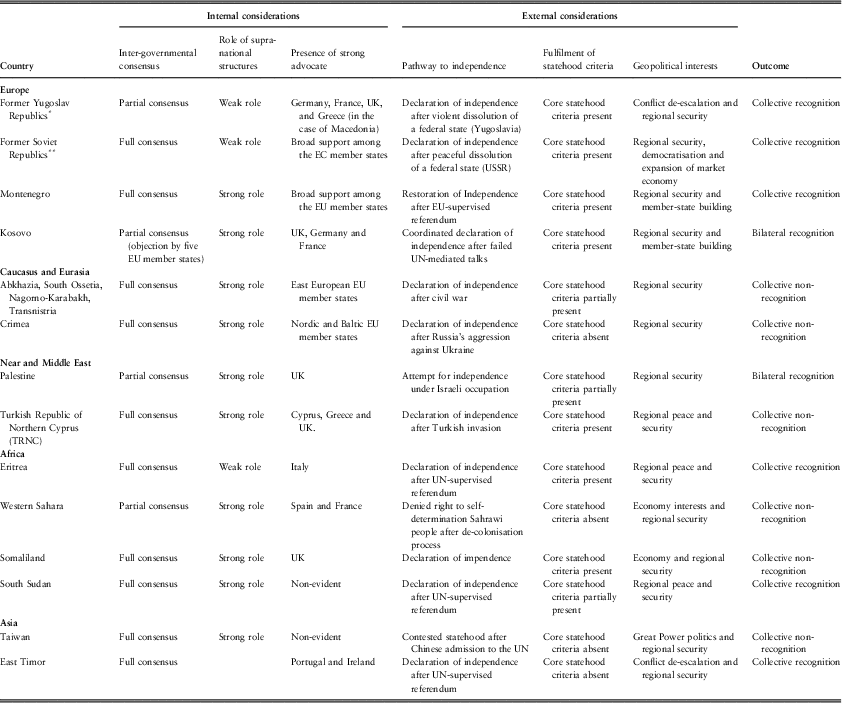
In this article, we have demonstrated that the EU’s practice of state recognition is driven by internal and external normative and geopolitical considerations applied inconsistently in light of the circumstances of each case. As summarised in Table 1, in relation to the 37 state-like entities seeking recognition since the early 1990s, the EU has been able to formulate and grant collective recognition to 26 states, it has withheld collective recognition from nine self-proclaimed states, and left it to its members to decide on a national policy in two specific cases. Cases which have received collective recognition by the EU have satisfied most, if not all, of the following conditions: full consensus among EU member states on whether to recognise the entity in question; close involvement by the European Commission and the High Representative for Foreign and Security Policy; the presence of strong advocate states within the EU; a declaration of independence following an internationally supervised referendum; fulfilment of core statehood criteria; and a strong fit with the geopolitical interests of the EU and its members. Although the EU’s supranational powers play a significant role in shaping the national and foreign policies of the member states, full consensus among members has been pivotal for the EU to formulate a common position on state recognition. The role of supranational structures, namely the European Commission and the High Representative for Foreign and Security Policy, was more evident in shaping the EU’s ‘engagement without recognition’ policy in the absence of full diplomatic recognition. The presence of strong advocate states within the EU played a far more significant role in restraining than in enabling a collective recognition policy. When full consensus was impossible, the response varied, encouraging either bilateral recognition, engagement without recognition, or collective non-recognition.
The EU’s internal and external considerations for state recognition.

Notes: * (Bosnia and Herzegovina, Croatia, Macedonia, Slovenia, Yugoslavia (Serbia and Montenegro); ** (Armenia, Azerbaijan, Belarus, Estonia, Georgia, Kazakhstan, Latvia, Lithuania, Kirgizstan, Moldova, Russia, Slovakia, Tajikistan, Turkmenistan, Kirgizstan, Ukraine, and Uzbekistan).
In terms of different pathways to independence, the EU has encountered state formation rooted in aggression, civil war, and foreign invasion, as demonstrated in the case of TRNC, Abkhazia, South Ossetia, and Crimea. Even though state weakness represents one of main security threats to the EU, the absence of some of the core statehood criteria – such as effective government – does not seem to have played a decisive role in shaping the EU’s state recognition policy, especially when independence was endorsed by the UN and the wider international community, evident in cases such as Eritrea, South Sudan, and East Timor. This might be explained by a spatial consideration. Geopolitical and security sensitivities have pushed the EU to develop a more assertive stance towards geographically proximate contested and unrecognised states, compared to those cases that are considered to be more distant. This said, the EU, constrained by the conservative international rules on territorial integrity and the sanctity of borders, has not extended diplomatic recognition to disputed territories away from its borders, such as in the case of Chechnya, Taiwan, Tibet, and several secessionist movements in Indonesia.
The EU has predominantly justified state recognition on legal and normative grounds. Yet geopolitical interests, especially concerns for regional stability, have been present across all cases in favour and against collective recognition. In the cases of Palestine, TRNC, and Taiwan – where the EU was not able to play a leading role due to internal and external constraints – it has followed the UN’s position and respected the hierarchical order of international organisations. In other cases, where the EU could not generate full internal consensus and its members had vested geopolitical interests, such as Kosovo and Western Sahara, the EU has not been entirely guided by norms of international law. While in the case of Western Sahara, the International Court of Justice has ruled in favour of an independence referendum and a right to self-determination, and in the case of Kosovo it has ruled that the declaration of independence did not breach international law.Footnote 100 Yet the EU has not formed collective recognition positions in either case.
Where the EU has differed from, and perhaps contributed to, doctrinal development has been in terms of the normative conditionality attached to the recognition process as well as with the ambiguous creativity in engaging with unrecognised states, as it attempts – with varying levels of success – to balance geopolitical interests and normative commitments. The EU therefore demonstrates that regional organisations can play an important role in shaping the norms of recognition, especially in defining the character of recognition, in clarifying the discretionary and political character of recognition, and in setting conditions on a case-by-case basis to shape the decisions of its members. The EU is thus a tentative norm-maker in the context of state recognition.
As the preceding discussion has demonstrated, the practices of international recognition and non-recognition have also played an important role in the evolution of the EU’s external engagement, and in strengthening the organisation’s credentials as a global actor. At an unprecedented scale, the EU, as a regional organisation, has been able to make an impact by extending or withholding recognition to new states – a significant change in the existing international order. Therefore, EU practices have made an important contribution to the evolving politics of international recognition, especially in demonstrating the existence of states in the grey area between recognition and non-recognition, and the challenges of engagement without recognition. Mainstream perspectives assume that recognition takes place in an anarchic international environment, highlighting the essential support of dominant powers in securing universal recognition.Footnote 101 Yet in the case of the EU, where decisions must be taken unanimously, even one small state can block the formation of a common position on recognition. In such circumstances, opportunities arise for some states to push forward a national agenda and camouflage it as the EU common position. However, the EU’s responses to international recognition challenges have exposed a number of fundamental problems. First, while collective responses to the formation of new states can be seen as opportunities to deepen the EU’s political integration and enhance its foreign policy, in practice the presence or absence of collective policy for recognition of new states poses challenges for EU institutions and its members. The EU’s differentiated approach to state recognition, determined on a case-by-case basis and by consensus, reveals weaknesses and inconsistencies, and also exposes internal tensions and limitations as an aspiring global actor.
Second, the EU’s practices of international recognition demonstrate a tension between the EU’s normative commitments and its commitment to an international order based upon Westphalian, statist principles of sovereignty and territorial integrity. The EU is, in principle, committed to self-determination, democracy, and human rights. In some cases it has denied recognition to viable entities that have a strong remedial case for recognition. It has pursued a policy of engagement without recognition and formed humanitarian and technical links with separatist regions that it does not recognise, with questionable results. As a first line of response, the EU has tried to adjust its policy of state recognition in line with international law and global consensus within the UN. However, in cases such as Kosovo where normative commitments, geopolitical interests, and the question of legality of independence are resolved, the EU was unable to generate an affirmative position on the recognition of new states. Thus, a common state recognition policy would strengthen the EU’s credentials as a global actor; yet such a move would come at the cost of deepening internal divisions among members.
Third, there is also a conflict between the EU’s practices of international recognition (and non-recognition) and its geopolitical interests. In the cases of frozen conflicts in the EU’s eastern and southern neighbourhood, the geopolitical interests of certain EU member states have prevented the EU from following a more consistent, rule-based policy. In other cases, the solidification of a common non-recognition policy – such as in the cases of Abkhazia, South Ossetia, and Crimea – has antagonised Russia and unintentionally contributed to the hardening of frozen conflicts. While the collective policy on state recognition or non-recognition has for most members reduced the burden of bilateral diplomacy regarding (non-)recognition, it has sometimes tied EU members to unwelcome commitments that can jeopardise their political and economic interests.
The EU’s response to state recognition has been profoundly impacted by the recurring problem of normative divergence among its member states on foreign policy matters. The lack of collective stance on state recognition as a result of normative divergences and insufficient policy coordination can potentially weaken the EU’s international standing and credibility and foreign policy actor. This also provides a further challenge to the idea of ‘Normative Power Europe’. The EU’s practices of recognition are unlikely to reify the existing norms, orthodoxies, and inconsistencies of state recognition. A more coherent recognition policy would provide clarity and credibility to the EU and expand its external influence, but it is highly questionable, based upon the experience of the last two decades, whether the geopolitical and normative tensions can be adequately reconciled. EU practice is therefore likely to continue to represent an imperfect case-by-case approach, guided both by principles and interests.
Acknowledgements
The authors would like to thank the University of Leeds and Dublin City University for support for this study as well as the journal editors and anonymous reviewers for their helpful comments. The opinions are the responsibility of the authors.