Introduction
Graves' disease is an autoimmune disorder with an unpredictable course. It was first described in 1835 when Robert Graves published a report documenting the association of hyperthyroidism with goitre and exophthalmos.Reference Graves1 In the US, the annual incidence of Graves' disease is 40 per 100 000, and it is 4–6 times more common in females.Reference Stålberg, Svensson, Hessman, Åkerström and Hellman2
Currently, three different treatment options are employed: antithyroid medication, definitive treatment with radioactive iodine ablation or thyroid surgery. Treatment preferences and options have varied over time, and also vary between hospitals and continents. For example, radioactive iodine is commonly recommended as the first-line treatment in the US;Reference Patwardhan, Moront, Rao, Rossi and Braverman3 in Europe, however, over two-thirds of endocrinologists use antithyroid drugs.Reference Glinoer, Hesch, Lagasse and Laurberg4 With the advent of radioactive iodine therapy in the 1970s, which demonstrates a single dose cure rate of 75 per cent, the use of surgery to treat Graves' disease has declined.Reference Metso, Jaatinen, Huhtala, Luukkaala, Oksala and Salmi5 In the UK, antithyroid medication is the current preferred option, followed by radioactive iodine therapy.Reference Glinoer, Hesch, Lagasse and Laurberg4, Reference Vaidya, Williams, Abraham and Pearce6 Thyroid surgery is typically only offered as a first-line treatment to: patients with Graves' ophthalmopathy, children, women wishing to start a family in the near future or suspected malignancy cases.Reference Stålberg, Svensson, Hessman, Åkerström and Hellman2, Reference Solomon, Glinoer, Lagasse and Wartofsky7 It is also offered after medical or radioactive iodine treatment failures,Reference Torring, Tallstedt, Wallin, Lundell, Ljunggren and Taube8 or in the presence of local compressive symptoms.
Surgical treatment traditionally involved subtotal thyroidectomy; it was rationalised that leaving a thyroid tissue remnant may prevent hypothyroidism and reduce the potential complications of recurrent laryngeal nerve damage and hypoparathyroidism. Unfortunately, subtotal thyroidectomy has an unpredictable outcome, and can lead to the recurrence of thyrotoxicosis or hypothyroidism.Reference Stålberg, Svensson, Hessman, Åkerström and Hellman2, Reference Palit, Miller and Miltenburg9, Reference Lowery and Kerin10 In addition, current evidence suggests that subtotal thyroid surgery fails to reduce complication rates.Reference Stålberg, Svensson, Hessman, Åkerström and Hellman2, Reference Barakate, Agarwal, Reeve, Barraclough, Robinson and Delbridge11 In contrast, there is sufficient level 1 evidence to indicate that total thyroidectomy is, in experienced hands, a safe and effective procedure which provides a definitive cure with a predictable result and few complications.Reference Stålberg, Svensson, Hessman, Åkerström and Hellman2, Reference Torring, Tallstedt, Wallin, Lundell, Ljunggren and Taube8 Furthermore, total thyroidectomy provides a definitive treatment for incidental thyroid cancers found in surgically resected specimens;Reference Palit, Miller and Miltenburg9, Reference Shapiro, Friedman, Perzik and Catz12, Reference Terzioğlu, Tezelman, Onaran and Tanakol13 this is particularly pertinent given the fact that the detected rate of thyroid cancer has risen by 240 per cent over the last 20 years.Reference Nix, Nicolaides and Coatesworth14
The purpose of the present study was to analyse the surgical management of Graves' disease by total thyroidectomy in the setting of a multidisciplinary thyroid clinic.
Materials and methods
All thyrotoxic patients were identified from a prospective thyroid database at the joint thyroid clinic held at Hull Royal Infirmary. Specifically, patients with thyrotoxicosis undergoing thyroid surgery as a definitive treatment option were prospectively entered into a dedicated thyroid surgery audit database; however, only those with a pathological diagnosis of Graves' disease were included in the study.
A thyroid surgeon and endocrinologist simultaneously discussed patient treatment options with all patients in the joint thyroid clinic. Patients were initially started on antithyroid medication to control their thyrotoxic status where possible. After consenting to undergo a total thyroidectomy, the patients scheduled for thyroid surgery were asked to take Lugol's iodine for 10 days prior to surgery. Pre-operative laryngoscopy was carried out on every patient to document vocal fold mobility.
All operations were performed or supervised by the senior author (RJE). The thyroid gland was removed through a 4–5 cm skin crease incision. Bipolar diathermy was utilised to achieve haemostasis. In addition, Ligaclips® were used in approximately 2 per cent of patients. During the operation, both recurrent laryngeal nerves and the superior parathyroid glands were positively identified. No active search for the inferior parathyroid glands was undertaken. Instead, the inferior pole of each thyroid lobe was examined to minimise the risk of inadvertent parathyroid removal. In addition, the thyrothymic ligament area was avoided to minimise the risk of parathyroid devascularisation. Following the insertion of a (14 French gauge) closed suction drain, the incision was closed in layers, with Vicryl to platysma and surgical clips to skin.
All surgical clips were removed by day two. Patients were routinely monitored for hypocalcaemia or voice change during the first 2 post-operative days and at a 6 week review.
Audit data were collected between 2001 and 2009. Case notes were independently reviewed for all patients in order to confirm data accuracy.
Results
Between 2001 and 2009, 206 patients underwent a total thyroidectomy for thyrotoxicosis with subsequent histological confirmation of Graves' disease. The average patient age was 42 years (range 17–75 years), with a male to female ratio of 1 to 3.5.
In addition to a histological diagnosis of Graves' disease, 3 patients also had a diagnosis of T1 papillary carcinoma (1.5 per cent), 3 patients had a follicular thyroid adenoma (1.5 per cent) and 1 patient had a diagnosis of Hashimoto's disease. The average weight of the thyroid gland was 37 g (range 9.5–184 g).
All patients were rendered hypothyroid, requiring lifelong thyroxine therapy. During the review period of up to seven years, no patient suffered a relapse of thyrotoxicosis.
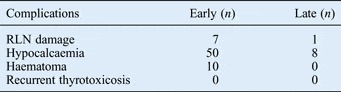
Transient hypocalcaemia was documented biochemically in 24 per cent of the patients. Permanent hypoparathyroidism requiring vitamin D supplementation beyond 6 months occurred in 3.9 per cent of the patients. Transient vocal fold paralysis occurred unilaterally in 3.4 per cent of patients, and permanent vocal fold palsy (lasting longer than 6 months) occurred in one patient (0.5 per cent) (Table I). The first 165 patients all underwent fibre-optic laryngoscopy at 3 months post-operation, which revealed no vocal fold palsies. In the subsequent 41 patients, fibre-optic laryngoscopy was only carried out if there was subjective or objective evidence of voice alteration.
Complications following total thyroidectomies*

* Procedures (total n = 206) performed to treat Graves' disease. RLN = recurrent laryngeal nerve
Post-operative haematoma developed in 4.9 per cent of the patients. In a further 89 patients who underwent a total thyroidectomy for pathology other than Graves' disease, the post-operative haematoma rate was 1.1 per cent. There were no documented wound infections in the 206 patients.
The reason for the treatment option chosen was clearly documented in 150 cases. Patient preference accounted for 72 per cent of the cases, with 21 per cent related to medical therapy failure, 3 per cent due to antithyroid drug reaction and 12.7 per cent due to associated Graves' thyroid eye disease.
Discussion
The management of patients with Graves' disease is controversial and continues to be debated. Total thyroidectomy appears to be an underutilised treatment option. It is recommended as a first-line treatment for: patients with Graves' ophthalmopathy, children, and females wishing to start a family.Reference Stålberg, Svensson, Hessman, Åkerström and Hellman2, Reference Solomon, Glinoer, Lagasse and Wartofsky7 It is also the treatment of choice when other treatments have failed to control the thyrotoxic patient.
Medical therapy with antithyroid medication typically involves regimes that last for 12–18 months.Reference Abraham, Avenell, Park, Watson and Bevan15 In the UK, antithyroid medication appears to be the preferred first-line therapy.Reference Vaidya, Williams, Abraham and Pearce6 Patients are reviewed in an endocrine clinic at regular intervals. A successful outcome is achieved in 73 per cent of cases at 30 months.Reference Patel, Abraham, Buscombe and Vanderpump16 Unfortunately, 40–60 per cent of patients experience a late relapse requiring further treatment for thyrotoxicosis,Reference Berglund, Christensen, Dymling and Hallengren17 and 10–20 per cent of patients become hypothyroid requiring thyroxine.Reference Tamai, Kasagi, Takaichi, Takamatsu, Komaki and Matsubayashi18 In addition, antithyroid medication is not without side effects, and there is a mortality risk due to agranulocytosis and suppression of the immune system.Reference Torring, Tallstedt, Wallin, Lundell, Ljunggren and Taube8, Reference Cooper, Goldminz, Levin, Ladenson, Daniels and Molitch19 Other rare major toxicities include hepatitis and vasculitis.
Radioiodine therapy is reported to be safe, with minimum morbidity.Reference Franklyn, Maisonneuve, Sheppard, Betteridge and Boyle20 This treatment has a 95 per cent cure rate at 24 months post therapy.Reference Patel, Abraham, Buscombe and Vanderpump16 However, there is a latency period of six weeks to six months before the patient is rendered euthyroid. In addition, 82 per cent of patients will become hypothyroid, requiring thyroxine therapy and long-term follow up.Reference Metso, Jaatinen, Huhtala, Luukkaala, Oksala and Salmi5 There are also reports of increased cardiovascular and cancer risks following radioiodine therapy.Reference Franklyn, Maisonneuve, Sheppard, Betteridge and Boyle21, Reference Metso, Jaatinen, Huhtala, Auvinen, Oksala and Salmi22
Recent publications have challenged the view that subtotal thyroid operations are associated with lower morbidity rates.Reference Barakate, Agarwal, Reeve, Barraclough, Robinson and Delbridge11, Reference Friguglietti, Lin and Kulcsar23, Reference Hussain and Hisham24 Data from a meta-analysis of 6703 patients who underwent subtotal thyroidectomy revealed persistent or recurrent hyperthyroidism in 7.9 per cent of patients, and hypothyroidism in 26 per cent of patients.Reference Palit, Miller and Miltenburg9 Re-exploration of the thyroid surgical bed in cases of thyrotoxicosis recurrence is associated with an increased incidence of recurrent laryngeal nerve palsy.Reference Harrison and Kinsman25
In contrast, total thyroidectomy provides an immediate and definitive cure for the thyrotoxic patient. Furthermore, there is increasing evidence that total thyroidectomy may have a beneficial effect on Graves' ophthalmopathy. Frilling et al. report 69 per cent improvement in Graves' ophthalmopathy following subtotal resection,Reference Frilling, Goretzki, Grussendorf, Erbslöh and Röher26 and Winsa et al. report a further benefit following total thyroid resection.Reference Winsa, Rastad, Akerström, Johansson, Westermark and Karlsson27 In addition, we have documented low complication rates in relation to permanent voice change (0.5 per cent) and permanent hypoparathyroidism (3.9 per cent). These figures compare favourably with the reported literature.Reference Stålberg, Svensson, Hessman, Åkerström and Hellman2, Reference Palit, Miller and Miltenburg9
• Treatment options for Graves' disease include antithyroid medication, radioiodine ablation and thyroid surgery
• Initial options offered to patients varies between institutions and countries
• Thyroid surgery is only initially offered to Graves' ophthalmopathy patients, children, some women and suspected malignancy cases
• In a multidisciplinary setting, total thyroidectomy is a safe and effective first-line treatment for Graves' disease
For Graves' disease treated by subtotal or total thyroidectomy, the British national thyroid and parathyroid database report in 2003 documented hypocalcaemia on patient discharge at 26.2 per cent, with hypocalcaemia at 3 months as 2.1 per cent.Reference Harrison and Kinsman25 Surprisingly, we report a haematoma rate of 6 per cent, which required further surgery. However, this is in line with the findings of smaller published studies on the surgical management of Graves' disease.Reference Grodski, Stalberg, Robinson and Delbridge28, Reference Gaujoux, Leenhardt, Tresallet, Rouxel, Hoang and Jublanc29 This result may reflect the highly vascular nature of this disease. In the senior author's experience (based upon an independent audit of 89 cases), the post-operative haematoma rate following total thyroidectomy for pathology other than Graves' was only 1.1 per cent. As a consequence, the senior author only routinely inserts a post-operative drain following thyroid surgery in patients suspected of Graves' disease. Total thyroidectomy has other merits in being able to definitively treat goitres, which may cause cosmetic, compressive or globus type symptoms.Reference Maung, Hayworth, Nix, Atkin and England30
The recent literature has demonstrated an increase in the incidence of thyroid cancer. Studies of surgical series for thyrotoxicosis have reported a cancer incidence of 1–9 per cent.Reference Terzioğlu, Tezelman, Onaran and Tanakol13, Reference Nix, Nicolaides and Coatesworth14, Reference Werga-Kjellman, Zedenius, Tallstedt, Traisk, Lundell and Wallin31, Reference Razack, Lore, Lippes, Schaefer and Rassael32 A meta-analysis of 1882 patients with Graves' disease reported a 4.5 per cent incidental carcinoma rate.Reference Palit, Miller and Miltenburg9 Total thyroidectomy is part of the recommended treatment for thyroid cancer.Reference Cooper, Doherty, Haugen, Kloos, Lee and Mandel33 In our series, only three incidental papillary thyroid cancers (1.5 per cent) and three follicular adenomas (1.5 per cent) were discovered.
This study indicates that total thyroidectomy is a safe procedure, with low recurrent laryngeal nerve palsy and hypoparathyroidism complication rates. It also documents an increased post-operative haemorrhage rate associated with Graves' pathology compared with other thyroid pathologies. In the context of Hull Royal Infirmary's multidisciplinary thyroid clinic, total thyroidectomy is offered as a first-line treatment for all patients with Graves' disease.
Acknowledgement
The authors would like to thank Ms Penny Barker for her assistance in case note recovery.