




No CrossRef data available.
Acoustic evidence for a push-chain shift in the Intermediate Period of New Zealand English
Published online by Cambridge University Press: 27 April 2006
Abstract
This study provides the results of an acoustic analysis of the short front vowels  in the speech of New Zealanders born between the 1890s and the 1930s. It will be shown that it is in this period in which the system of short front vowels undergoes a typological change, whereby a system of three short front vowels develops into one of two front vowels (
 ) and one central vowel (
 ). It will be further shown that these processes are interrelated and can justifiably be called a “chain-shift.” In addition, it will be demonstrated that centralization of
 postdates the raising of the other vowels, and that rates of centralization are dependent on consonantal environment.I would like to thank the DAAD (Deutscher Akademischer Austauschdienst) as well as the University of Canterbury for funding the research that is discussed here. I would also like to thank Dr. Jen Hay, Professor Lyle Campbell, Dr. Margaret Maclagan, Professor Peter Trudgill, and Professor Elizabeth Gordon for their support and their insightful comments on my work. I am also indebted to Elizabeth Gordon for allowing access to the ONZE (Origins of New Zealand English) data. The intermediate period archive data was collected by Rosemary Goodyear, Lesley Evans, and members of the ONZE team. The work done by members of the ONZE Project in preparing the data, making transcripts, and obtaining background information is also acknowledged.
Information
- Type
- Research Article
- Information
- Copyright
- © 2006 Cambridge University Press
In the following article, I will present the results of an acoustic analysis of the short front vowels1
In order to allow for a dialect-neutral terminology of etymological categories, I will adopt the method put forward by Wells (1982) and identify the short front vowels in terms of lexical sets, that is, using a cover term for each of the vowels. These are kit, dress, and trap (corresponding to the conventional IPA notation

and Traeger-Smith IH/EH/AE, respectively). For a discussion of the advantages of lexical sets over phonemic symbols see Batterham (1995).
Whereas previous studies of the SFVs in NZE (both acoustic and other) have predominantly focused on the speech of modern NZE speakers (cf. Maclagan, 1982), the extensive corpus of older speech recordings which are now part of the ONZE (Origins of New Zealand English) corpus based at the University of Canterbury allowed for a detailed analysis of the first and second generation speakers of New Zealand English (Gordon et al., 2004). With respect to the SFVs, the present study bridges the gap between the first and second generation of speakers and the modern ones.
The next section gives some background information on the SFV shift in NZE, and a brief outline of earlier work on this subject. The following two sections give information about the speaker sample and the methodology. Then I will present the overall patterns found in the analysis as well as argue for a push-chain scenario and elliptical distributions in transitional vowel systems. The next section is concerned with the results of a CART (classification and regression tree) analysis of a number of phonemic conditioning factors. The final section presents correlation tests to corroborate the hypotheses.
BACKGROUND
The basic mechanism of the NZE front vowel shift can be described as a process that converts a system with three short front vowels into one of two front vowels (dress and trap) and a central vowel (kit). Furthermore, the commonplace assumption is that the steps are interrelated and therefore form a so-called “chain-shift,” a quality change in a number of adjacent segments of the same type under the maintenance of the original set of phonemic distinctions. What is less clear, however, is whether all three steps of the shift are endemic and have occurred after the arrival of the first settlers in New Zealand or whether raising and fronting of dress/trap and centralization of kit was already present in the speech of those speakers. Earlier analyses have taken polar views, which means that they have adopted a viewpoint of either exclusive innovation in NZE (which is the view of Bauer, 1979, 1992) or exclusive conservatism vis-à-vis British English (Trudgill, 1986). Later analyses have arrived on the more reconciliatory conclusion that raised/fronted variants of dress and trap were already present in the speech of the earliest settlers, and that this process continued in New Zealand (as well as in the other Southern Hemisphere varieties) afterwards (Trudgill, Gordon, & Lewis, 1998). In addition, kit centralization has been analyzed as an endemic phenomenon (Gordon, Campbell, Hay, Maclagan, Sudbury, & Trudgill, 2004). There are relatively few examples of centralized kit in Gordon et al.'s (2004) study of the first and second generation of NZE speakers (1850–1900). Thus, it seems that the crucial period for KIT centralization was the subsequent Intermediate Period, which will be discussed here.
I will furthermore argue that there is compelling evidence that the centralization of KIT is the result of a push-chain relation between the SFVs, which has been a matter of considerable debate in earlier analyses. Whereas Trudgill et al. (1998) as well as Watson, Maclagan, and Harrington (2000) argued for a pull-chain scenario, Bauer (1979) as well as Gordon et al. (2004) favored a push-chain account of the SFV shift.
It should also be noted that the NZE short front vowel shift stands out as a true exception to the general principles of chain-shifting outlined by Labov (1994:138), who concedes that “this [the NZE short front vowel shift] clearly violates Principle III (since a short front vowel is moving to the back in a chain shift) and Principle II (since short front vowels are rising together).”
THE SPEAKERS
Thirty speakers from the Intermediate Archive were analyzed. This corpus consists of interviews of about 100 New Zealanders born between the 1890s and the early 1930s. The length of the interviews vary considerably, the shortest ones being about half an hour of running speech, whereas others last for up to two hours. The interviews were conducted by historians between 1991 and 1994 and cover a wide range of topics, from the interviewee's family background to childhood memories and local history. The sample was subsequently divided up according to age and gender. Speakers were grouped into three age groups: EARLY (born between 1895 and 1905, 4 males and 7 females), MEDIUM (born between 1910 and 1920, 5 males and 5 females), and LATE (born after 1925, 4 males and 5 females). This allows for a fairly high-resolution picture of subsequent stages of vowel movements within one generation.
METHOD
The data was analyzed using the PRAAT program for phonetic analysis (www.praat.org). For each token, frequency measurements of the first two formants (F1 and F2) were taken at the turning point of each vowel. If no such turning point could be identified, the measurement was taken at mid-point. Only stressed tokens were measured, and an overall number of 70–100 tokens were aimed at for each lexical set per speaker. For some speakers, it was not possible to obtain more than 40 tokens for some categories due to either too short a duration of the interview or articulatory modes (e.g., long stretches of whispery phonation in the speech of a number of older speakers).
Since individual vocal tract physiologies are known to hamper the between-speaker comparability of raw frequency values, the data was normalized using the algorithm proposed by Lobanov (1971), whereby a normalized formant frequency value is calculated on the basis of the formula presented next (for a discussion of this procedure vis-à-vis a number of other normalization strategies, see Disner, 1980):

where Fi is a given formant, Fi is the average of the formant Fi across all monophthongs, SDi the standard deviation of Fi about its mean for all monophthongs. In order to allow for comparability of the normalized values with other studies based on Hertz-scales, the normalized values were rescaled according to the procedure outlined in Disner (1980), that is, on the basis of an idealized schwa with formants at 500, 1500, and 2500 hertz and standard deviations of 150, 500, and 300 Hz for the first three formants, respectively.
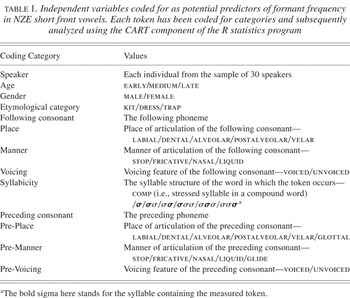
The tokens were then coded for the variables shown in Table 1. The data were subsequently fed into a CART (classification and regression tree) analysis program component of the R program for statistical analyses. Most of the results presented in the next section are based on that analysis.
Independent variables coded for as potential predictors of formant frequency in NZE short front vowels. Each token has been coded for categories and subsequently analyzed using the CART component of the R statistics program

OVERALL PATTERNS
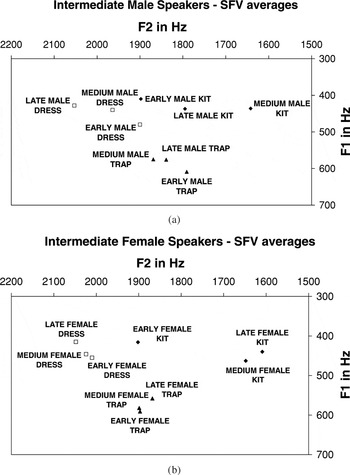
As Figures 1a, b show, the global pattern of change within the intermediate sample is fairly consistent. The younger speakers have higher realizations of dress and trap as well as a more central realization of kit, which matches the overall developments in the SFV system of NZE over the last 150 years. For comparison, Figures 1c, 1d, 1e, and 1f show SFV averages for the Mobile Unit (MU) speakers analyzed in Gordon et al. (2004). Figures 1e, f show modern speakers (cf. Maclagan, 1982). The data on which Figures 1c, 1d, 1e, and 1f are based were kindly made available to me by Margaret Maclagan. The only discontinuity is in the behavior of the kit vowel in the speech of the LATE MALES,2
The six subsamples will be spelled out in upper-case characters in this study.
Henceforth, the term “distance” will be used in an empirical (i.e., mathematical) sense as an expression of Euclidean distance between two points in linear two-dimensional space, such as a vowel plot in hertz.

F1/F2 averages of kit, dress, and trap for all groups of Intermediate speakers (Figures 1a, b), pre-Intermediate speakers (1c, d), and modern speakers (1e, f) (cf. Gordon et al., 2004; Maclagan, 1982). Note that the data plotted in Figures 1e, f are non-normalised. High F1 values correspond to openness. Similarly, the F2 axis corresponds to the front-back dimension, where higher F2 values correspond to more fronted articulation. (continues)

Figure 1. (continues)

Figure 1. (continued)
Figure 2 plots the position of the three SFVs and their respective contextual variants. Only those categories that occurred at least five times within any subgroup are plotted. Impressionistically, three characteristics stand out. First, there is substantial categorial overlap between a number of contextual variants in the lexical sets of kit and dress in the speech of the EARLY and MEDIUM MALES as well as the EARLY FEMALES. Second, there is an obvious stretch in the categories of kit in the F2 dimension in the speech of the EARLY MALES. Third, there is no categorial overlap between the lexical sets of dress and trap for any group of speakers in the sample.

Mean frequency values of the first two formants of the lexical sets of kit, dress, and trap as well as their contextual variants. Each of the six groups of Intermediate speakers is plotted. The contextural variants are given in IPA, where . (continues)

Figure 2. (continues)

Figure 2. (continued)
Evidence for a push-chain scenario
Table 2 sums up the Euclidean distances between the mean values of the SFVs for all six groups of speakers.The numbers indicated in Table 2 suggest a fairly clear picture. The most significant increase in terms of Euclidean distance between kit and dress occurs between the EARLY and the MEDIUM age groups for both genders, whereas DRESS and TRAP are dragged apart only later, that is, between the MEDIUM and the LATE stage. This behavior would suggest a pull-chain scenario, if it weren't for the following point: In the speech of the early speakers, the distance between kit and dress is extremely small, and there is substantial overlap of various allophones of both lexical sets (cf. Figure 2). Thus, it is hard to see how such a system could be viewed as an initial state in the vowel shift. In addition, a pull-chain scenario would probably assume that the second step in the shift was the movement of dress to a higher position, followed by trap. However, this seems unlikely, given the consistent increase of the distance between dress and trap over time in the sample. Under the pull-chain assumption, you would probably expect an initial increase, followed by a decrease of distance between the two lexical sets. We would also expect to find speakers with centralized kit, but not-yet raised dress under this scenario. As will be shown later, this is not the case, whereas the reverse possibility holds. It is therefore more likely that the system of the early speakers is a transitional one in which dress has already been raised sufficiently to trigger a reactive centralization of kit. With respect to dress and trap, it seems reasonable to extrapolate an earlier stage where the two lexical sets were closer to each other.
Euclidean distances between the mean values of the lexical sets of kit, dress and trap in the speech of the six groups of Intermediate speakers

The “Split System” in the EARLY MALE sample
It is obvious from looking at the plots in Figure 2 that the EARLY MALE group of Intermediate speakers stands out with respect to both the overall means of dress and kit as well as the structural set-up of the contextual variants. They are the only group that has allophones of kit as the most fronted tokens, but they also have centralized variants, which leads to a striking stretch in the F2 dimension for kit. It seems clear that the kit items that occupy the front part of the overall distribution are those that are followed by a velar consonant. What is less clear, however, is whether the front categories represent variants that have not yet undergone centralization, or whether this early group of speakers shows a strategy of both fronting and raising prevelar variants of kit and simultaneously centralizing others.
4It should also be noted that there is a striking mismatch in terms of conditioning factors in the arrangement of the contextual variants of kit in that group. Whereas the front categories share the same place of articulation (velar), the centralized ones are predominantly followed by fricatives (i.e., manner of articulation). The implications of this observation will be discussed later.

). This impression is supported by the data given in Bernard (1970), which states mean formant frequency values of 365 Hz for F1 and 2220 Hz for F2 for modern AusE kit, which is in the vicinity of the EARLY MALE realization of pre-velar tokens of kit. Secondly, a similar system is described by Lass (1987) and Wells (1982) for modern South African English, although the conditioning factors differ (Lass reports as the main conditioning factors for kit fronting/raising: kit in initial position, after /h/, and next to velars/palato-alveolars).
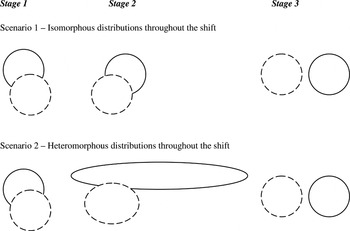
However, it is less clear how an elliptical distribution such as that of the EARLY MALES should shift at all, rather than merge. It has been recognized that a given vowel (i.e., as an etymological category) does not necessarily behave as a coherent category in a vowel shift. (See M. Gordon 2001, 2002 for a summary, as well as Labov 1994, 2001 for ample evidence of transitional allophonization of vowels which undergo a shift.) Rather, different contextual variants can shift at different rates, or even in different directions. This seems to have happened at the early stages of kit centralization in NZE, however, the modern resolved system has restored a uniform etymological category of kit.
Discussion
We have seen that it was in the Intermediate Period where the shift in the short front vowels came to its completion, resulting in the modern set-up with two front vowels and a central vowel. In addition, it could be demonstrated that there was a stage where the SFV system had the peculiar distributional property of an unusually elliptical5
I originally employed the term “skinny distribution” in the description of the kit vowel space for these speakers, upon which one of the reviewers justly remarked that this might be too metaphorical a term for what is essentially a statement about vowel space geometry. I have therefore resorted to the expression “unusually elliptical,” which means that the deviation around a mean in one dimension (here F2) vastly exceeds that in another dimension (here F1), and more so than is the case in some reference distribution. With the data at hand, it seems clear that the ratio of F2/F1 is unusually large in the case of the EARLY MALE distribution of kit compared to the other SFV distributions in the present sample.

Two possible scenarios for the NZE front vowel shift in the top two heights. The upper circle (or ellipse) represents an idealized distribution of kit vowels (solid line), the lower one that of dress (dashed line).
Apart from the general implication of this finding as a demonstration of the existence of highly elliptical vowel distributions in general (as opposed to, e.g., an assumption of mutually implied degree of innovativeness within a given subgroup of the speech community that undergoes the shift), this might also link the history of the short front vowel shift in NZE to that of AusE, which behaved similarly with respect to dress and trap, but raised and fronted kit rather than centralizing it. That is, it can be hypothesized that at an earlier stage, both varieties had at their disposal a range of kit variants spanning the entire range between (roughly)

, but generalized different means only later. This hypothesis seems to be confirmed by ongoing research on the Intermediate Period in AusE (P. Trudgill & E. Gordon, personal communication).
In addition, we have seen that it is through the study of such smaller units that apparent temporal discontinuities can be accounted for as a resolution of formerly overlapping lexical sets rather than the absolute position of a given lexical set (cf. kit in the MEDIUM and LATE MALE groups).
Another point that I would like to raise in relation to the short front vowel shift in NZE is of a more terminological nature and relates to the notions of “kit centralization” or “centralized kit.” Heretofore, this term has been used in a rather loose fashion in order to explain both the process as well as the outcome of a historical process. Given the nature of the short front vowel system of NZE in the early Intermediate Period, those terms acquire a certain amount of denotational ambiguity, in that it is not clear whether what is referred to in any given instance of usage of these terms is a centralized kit mean of the overall lexical set or the existence of centralized variants in the speech of any subgroup in the speech community (an age or gender cohort, a social class, an individual). That is, the kit vowel in the speech of a given subgroup or an individual can be both noncentralized (in that it has a mean position in the vicinity of dress, cf. Fig. 2a) and centralized (with the simultaneous existence of central allophones) at the same time, which implies that some conceptual clarification is probably advisable in future studies on this topic.
On a more sociolinguistic note, two things have to be pointed out regarding the role of the female speakers in the sample. First of all, they tend to clearly be spearheading the chain-shift in most of its various dimensions. That is, any given female group has more progressive mean values (more centralized for KIT, more raised for dress/trap) than their corresponding male counterparts of the same age cohort (cf. Fig. 1). This confirms the tenet of the leading role of women in nonstigmatized sound change, that is, sound change “from below” (Labov, 2001). On the other hand, my analysis should have made clear the limited usefulness of overall mean values of lexical categories in an unstable system. For example, both the MALE and the FEMALE speakers of the EARLY group have rather similar mean values for KIT, but differ considerably in the arrangement of the contextual categories (cf. Fig. 2).
Whereas the EARLY MALES have a system where kit can be either the most fronted element as well as the most central one of the SFVs, this does not hold true for the EARLY FEMALES, who are much more consistent and do not show the same degree of allophonization. For these two groups of speakers then, it is the MALES who have both the most conservative as well as the most innovative realizations of kit, which brings about a cancelling out around a mean that is close to that of the females.
FACTOR ANALYSIS
Coarticulation
Apart from pointing out the distributional properties of the SFV during the shift, we have mentioned in passing that these distributions do not represent random clusterings of kit/dress/trap tokens, but tend to have internal structure depending on the phonemic environment they occur in. I will briefly review the effects of adjacent phonemes on vowels, before moving on to whether these expected patterns show up in the sample. With respect to place of articulation, Stevens and House (1963:125) have found that: “In the environment of front vowels, for example, ‘velar’ consonants (being palatal variants in English) have a high F2-locus (above 200 cps) whereas the F2-loci for postdental and labial consonants are below the F2 values for the vowels.”
We would therefore expect a distribution where pre- and postvelars occur towards the front end of a distribution, whereas vowels in the other environments are more central. With regard to F1 effects, they found both a displacement of vowel frequencies towards those of the adjacent consonants (which is always a downward shift) and a shift towards a neutral value (i.e., that of schwa, in the vicinity of 500 Hz) if the articulatory target of the vowel is far from that of the surrounding consonants.
As for manner of articulation, Stevens and House (1963:126) state that: “One feature of the data […] is the tendency for F2-values for vowels in the environments of fricative consonants to be lower for front vowels and higher for back vowels relative to corresponding values for stop consonantal environments. This difference is most evident in the vowels

.” In addition, Wright (1986) has found a shrinking of the overall perceptual vowel space for vowels in nasal environments. For a more comprehensive survey of the relationship of vowel targets and phonemic context, see chapter 4 of Harrington and Cassidy (1999).
CART (classification and regression tree)
As a second step in the analysis, all tokens were coded for the categories outlined in Table 1, and subsequently subjected to a CART (classification and regression tree) analysis. This method is appropriate for continuous dependent variables such as vowel formant frequencies. As described by Mendoza-Denton, Hay, and Jannedy (2003:128–129):
The construction of classification trees is essentially a type of variable selection. […] Classification trees are an attractive method of data exploration because they can handle interactions between variables automatically. They also have the advantage of being completely non-parametric. No assumptions are made about the underlying distribution of the data. These features make them less powerful for detecting patterns in the data, but fairly reliable in terms of the patterns found. Classification trees do assume that the effect being modelled is organised into discrete factors. An analogous class of models, regression trees, deals with continuous data. […] A classification tree begins with the data to be analysed and then attempts to split it into two groups […]. Ideal splits minimise variation within categories and maximise variation across categories.
For the mathematical foundations of CART, see Breiman, Friedman, Olshen, and Stone (1984). The important thing with respect to the following exposition of internal factors involved in the NZE SFV shift are that divisions that CART finds are always binary at any node down the hierarchy of the overall set of divisions found in the data set, and that interacting categories are readily identified as successively branching nodes.
This section discusses the outcome of that analysis for a number of internal factors, that is, the variables PRE-PLACE, PRE-MANNER, PLACE, MANNER (cf. Table 1; the analysis of the other factors mentioned in Table 1 is not completed). The complete trees were built, and it is these coding categories that show up consistently in all speaker groups.
The importance of the prealveolar environment
In terms of the coding categories PRE-PLACE, PRE-MANNER, and MANNER, the patterning of the SFV vowel tokens followed the predictions we would make on the basis of the studies mentioned earlier in the subsection on coarticulation. That is, all three lexical sets showed a set-up where vowels in velar environments show high F2 values in all groups and across all three lexical sets. Vowels following nonvelars and/or preceding nonvelars except alveolars tended to have F2-values below the mean for their respective lexical set. As far as manner of articulation is concerned, fricative and stop environments behave as expected, that is, vowels in fricative environments show consistently lower-than-average F2-values, whereas those in stop environments show higher ones. Contrary to the results reported by Wright (1986), vowels in nasal environments consistently showed higher formant frequency values in all lexical sets, which might probably be best explained by an articulatory expansion of the prenasal vowel space in order to offset the loss of perceptual distinctness between lexical sets in these environments.
More importantly, however, was a striking mismatch between the three lexical sets with regard to prealveolar vowels. Whereas prealveolars are “well-behaved” in the lexical sets of kit and trap (with the exception of the LATE FEMALE group, where prealveolars have a higher F2 value in trap), that is, they are consistently realized with a significantly lower second formant than the mean, exactly the opposite holds true in the lexical set of dress. For all groups of speakers, prealveolar allophones of dress fall into the class of front allophones. In addition, they also tend to be the closest class in all three lexical sets, with 4 out of 6 groups showing low F1 values in kit, and 4 out of 5 in dress. In trap, low F1 values are categorical6
I use the term “categorical” here in reference to the mean formant frequency value in relation to the mean of the whole lexical set in all speaker groups, that is, if a given coding category has lower values across all groups of speakers, that category has “categorically lower Fx values.” This does not exclude the possibility of there being tokens with aberrant values.
CORRELATIONS BETWEEN VOWELS FOR INDIVIDUAL SPEAKERS
Having identified the primary conditioning factors governing the SFV shift in Intermediate NZE, I will now turn to the question of how both the movements of the three lexical sets as well as their phonemic subsets relate to each other. If the chain-shift hypothesis is correct, we would expect a positive correspondence between F1-values of dress and trap as well as between F1-values for dress and F2-values for kit. In addition, we can test the hypothesis that the shift came about as a push-chain, which led to the transitional stage where the lexical sets of dress and kit were close to each other. If this is true, we would expect to find speakers with high dress, and uncentralized kit. We can furthermore corroborate the claim that prealveolars are “special,” in that they seem to be carrying the overall shift and should therefore show the tightest correspondences in the dimensions mentioned earlier.
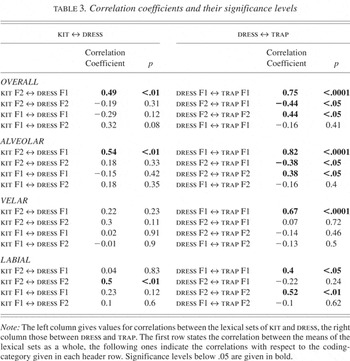
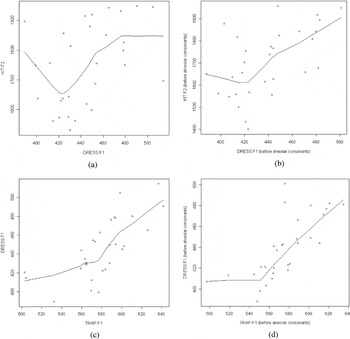
Table 3 sums up the Spearman's correlation coefficients for both the lexical sets as a whole as well as for the coding-category PLACE. The coding-categories DENTAL and POST-ALVEOLAR (i.e., vowels before dentals and postalveolars) did not show up in the speech of every speaker and are not listed separately. Figure 4 plots mean formant frequency values of each individual speaker in those dimensions where correlations are expected to hold, that is, the F2 value of kit versus F1 of dress (Fig. 4a and 4b, where (a) shows the mean values for the overall sets as a whole and (b) for prealveolars) and the F1 of dress against the F1 for trap (Fig. 4c and 4d).
Correlation coefficients and their significance levels


Individual mean values in those dimensions that are assumed to be interrelated [i.e., F2 for kit vs. F1 for dress in Figures 4a (all environments) and 4b (prealveolars), as well as F1 for dress vs. F1 for trap in 4c (all), and 4d (prealveolar)]. Each point represents mean values for a single speaker. The line represents a nonparametric scatterplot smoother fit through the data (Cleveland, 1979).
Two conclusions can be drawn from the correspondence test results indicated in Table 3. First, there is a solid positive correlation between the first formant frequency value of dress and the F2 of kit. That is, the lower the F1 of dress, the lower the F2 of kit tends to be. Translated into articulatory terms, the height of dress correlates with the centralization of kit. Along similar lines, it is clear that there is a height correlation between the lexical sets of dress and trap, whereby a low F1 value for dress corresponds to a low F1 for trap.
Secondly, it should be noted that the correlations are tighter if we look exclusively at prealveolar vowels. As far as the relationship between kit and dress is concerned, it can be said that it is the prealveolars that carry the shift, whereas the expected correlation between the F1 of dress and the F2 of kit fails to reach significance for prevelars and prelabials. The same holds true for the relationship between dress and trap, although there is a (weaker, but still highly significant) correlation in the other categories as well. We can then conclude that the developments in the SFV system in NZE have justifiably been analyzed as a chain-shift, where the movement of one vowel triggers a subsequent displacement of the next one on its way (through articulatory space). In addition, we have identified a class of allophones that carries the shift (the prealveolars), and have therefore adduced additional evidence regarding the importance of looking at phonemic environments in studies of vowel change. Furthermore, the plots in Figure 4 provide evidence for the push-chain hypothesis. Recall from Table 1 and Figure 2 that the EARLY speakers have a set-up wherein the means of kit and dress are fairly close to each other, which was hypothesized to be indicative of a stage where dress had raised, but kit was still a front vowel. In terms of correspondences, we would then expect there to be individual speakers who have a low mean F1 in dress (i.e., a high dress vowel), as well as a relatively high F2 in kit. This is exactly what we find in Figures 4a and 4b, in which the upper left corner is populated, whereas the lower right one is not. We can therefore conclude that it is a push-shift, and that it is sequential, that is, the elliptical distribution does not come about by grouping together speakers of different degrees of innovativeness, but represents a true transitional stage exemplified in the speech of one and the same speaker.
CONCLUSION
In this article I have presented the results of an acoustic analysis of the short front vowels in Intermediate New Zealand English. Group means were given for each lexical set as a whole as well as for a number of allophonic categories. It was shown that the Intermediate Period saw a change in the typology of the short front vowels, whereby an earlier system of three front vowels changes into a set-up with two front vowels, dress and trap, and a central vowel, kit. Furthermore, it could be observed that the behavior of the kit vowel is less straightforward than the movement of the overall means over time suggest. Rather, different allophonic categories shift at different rates, and centralization is never into empty territory sensu stricto, since a more centralized mean in a later group of speakers is occupied by one or more innovative allophones in the speech of an earlier group. In addition, there is one group of speakers (the EARLY MALES) that shows a most pronounced stretch in the F2 dimension of the kit vowel, which suggests the possibility of a temporary system with both fronted as well as centralized allophones of kit.
The results of a CART analysis indicate that it is mainly the prealveolar environment that carries the structure-changing properties of the shift, in that prealveolars are ahead of their lexical set as a whole in both raising and centralization. Other environmental factors (manner and place of articulation of the preceding consonant, as well as manner of articulation of the following one) pattern similarly in all three lexical sets, which is in keeping with general assumptions regarding contextual effects, that is, that they influence similar vowels in the same way.
A number of correspondence test results were discussed. It could be shown that the historical process that converted a system of three short front vowels into one of two front vowels and a central vowel is indeed a chain-shift, and that the centralization of kit clearly occurred last. I would therefore assume the following chronology:
- Raising of trap (pre-Intermediate7
)
Suggesting an earlier (i.e., pre-Intermediate) period of trap-raising is based on the analyses in Gordon et al. (2004), as well as on the discrepancy of the relationship between dress and trap vis-à-vis dress and kit in the Intermediate Period. Whereas there is substantial overlap between a number of allophones of dress and kit in the speech of earlier Intermediate speakers, no such overlap can be observed between dress and trap. In addition, the distance between trap and dress increases over the Intermediate Period. But there still is trap-raising in the Intermediate Period, so that an alternative hypothesis would be to assume that this process would be rather different from that of dress-raising/kit-centralization, in that it would be strictly mechanical and rather unmotivated, which does not sound too appealing from an Occamian point of view. In addition, Trudgill (2004) argued strongly in favor of trap-raising in 19th century England.
- Raising/Fronting of dress; incipient centralization of kit as well as temporary raising of kit (early Intermediate, “split”)
- Further raising of dress and trap
- Full centralization of kit; resolution of the kit/dress overlap (MEDIUM and LATE FEMALES, LATE MALES).
- Additional raising of dress/ trap (late Intermediate).
Having established the major pathways of the short front vowel shift in Intermediate New Zealand English, future work will take into account a larger number of internal factors (such as syllable structure, minimal pair effects, vowel length) as well as social ones. In addition, more can be said about the significance of elliptical distributions in vowel shifts and the exceptional status of the NZE shift with regard to the theoretical framework of Labov (1994). Both points are part of my ongoing research on these topics and will be explored further.
References
REFERENCES
Batterham, Margaret.
(1995).
Some front vowel variables in New Zealand English.
Doctoral dissertation,
La Trobe University, Melbourne.
Bauer, Laurie.
(1979).
The second great vowel shift.
Journal of the International Phonetic Association
9(2):57–66.Google Scholar
Bauer, Laurie.
(1986).
Notes on New Zealand English phonetics and phonology.
English World-Wide
7:225–258.Google Scholar
Bauer, Laurie.
(1992).
The second great vowel shift revisited.
English World-Wide
13(2):253–268.Google Scholar
Bernard, John R.
(1970).
Toward the acoustic specification of Australian English.
Zeitschrift fuer Phonetik und Kommunikationswissenschaft
23:113–128.Google Scholar
Breiman, Leo,
Friedman, J.,
Olshen, R., &
Stone, C.
(1984).
Classification and regression trees.
New York:
Chapman & Hall.
Cleveland, William S.
(1979).
Robust locally weighted regression and smoothing
scatterplots.
Journal of the American Statistical Association
74:829–836.Google Scholar
Disner, Sandra F.
(1980).
Evaluation of vowel normalisation procedures.
Journal of the Acoustical Society of America
67:253–261.Google Scholar
Gordon, Elizabeth,
Campbell, L.,
Hay, J.,
Maclagan, M.,
Sudbury, A., &
Trudgill, P.
(2004).
New Zealand English: Its origin and evolution.
Cambridge:
Cambridge University Press.
Gordon, Matthew J.
(2001).
Small-town values, big city vowels: A study of the Northern Cities
Shift in Michigan.
Durham:
Duke University Press.
Gordon, Matthew J.
(2002).
Investigating chain shift and mergers. In
J. K. Chambers et al.
(eds.),
The handbook of language variation and change.
Oxford:
Blackwell.
Harrington, Jonathan, &
Cassidy, Steve.
(1999).
Techniques in speech acoustics.
Boston:
Kluwer.
Labov, William.
(1994).
Principles of linguistic change. vol I: Internal factors.
Oxford:
Blackwell.
Labov, William.
(2001).
Principles of linguistic change. vol 2: Social factors.
Oxford:
Blackwell.
Lass, Roger.
(1987).
The shape of English: Structure and history.
London:
Dent.
Lobanov, B.
(1971).
Classification of Russian vowels spoken by different
speakers.
Journal of the Acoustical Society of America
49:606–608.Google Scholar
Maclagan, Margaret.
(1982).
An acoustic study of New Zealand English vowels.
The New Zealand Speech Therapists' Journal
12:34–42.Google Scholar
Mendoza-Denton, Norma,
Hay, J., &
Jannedy, S.
(2003).
Probabilistic sociolinguistics: Beyond variable rules. In
R. Bod,
J. Hay, &
S. Jannedy (eds.),
Probabilistic linguistics.
Cambridge, MA:
MIT Press.
Stevens, Kenneth, &
House, A.
(1963).
Perturbation of vowel articulations by consonantal context: An
acoustical study.
Journal of Speech and Hearing Research
6:111–128.Google Scholar
Trudgill, Peter.
(1986).
Dialects in contact.
Oxford:
Blackwell.
Trudgill, Peter.
(2004).
New-dialect formation: The inevitability of colonial
Englishes.
New York:
Oxford University Press.
Trudgill, Peter,
Gordon, E., &
Lewis, G.
(1998).
New dialect formation and southern hemisphere English: The New
Zealand short front vowels.
Journal of Sociolinguistics
2:35–51.Google Scholar
Watson, Catherine,
Maclagan, M., &
Harrington, J.
(2000).
Acoustic evidence for vowel change in New Zealand English.
Language Variation and Change
12:51–68.Google Scholar
Wells, John C.
(1982).
Accents of English.
Cambridge:
Cambridge University Press.
Wright, J. T.
(1986).
The behaviour of nasalised vowels in the perceptual vowel
space.
In
J. J. Ohala &
J. J. Jaeger (eds.),
Experimental phonology.
New York:
Academic Press.
Independent variables coded for as potential predictors of formant frequency in NZE short front vowels. Each token has been coded for categories and subsequently analyzed using the CART component of the R statistics program
F1/F2 averages of kit, dress, and trap for all groups of Intermediate speakers (Figures 1a, b), pre-Intermediate speakers (1c, d), and modern speakers (1e, f) (cf. Gordon et al., 2004; Maclagan, 1982). Note that the data plotted in Figures 1e, f are non-normalised. High F1 values correspond to openness. Similarly, the F2 axis corresponds to the front-back dimension, where higher F2 values correspond to more fronted articulation. (continues)
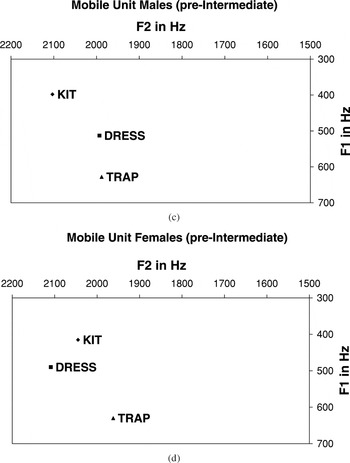
Figure 1. (continues)
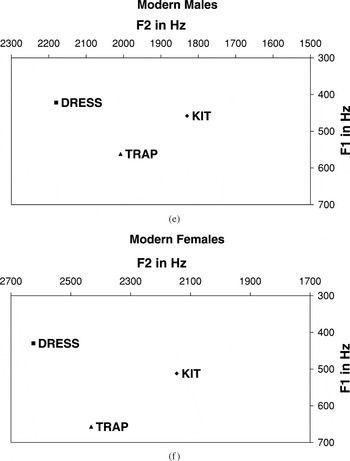
Figure 1. (continued)
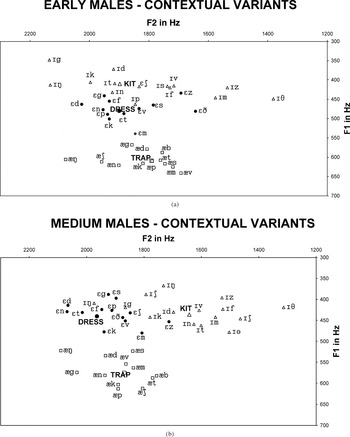
Mean frequency values of the first two formants of the lexical sets of kit, dress, and trap as well as their contextual variants. Each of the six groups of Intermediate speakers is plotted. The contextural variants are given in IPA, where . (continues)
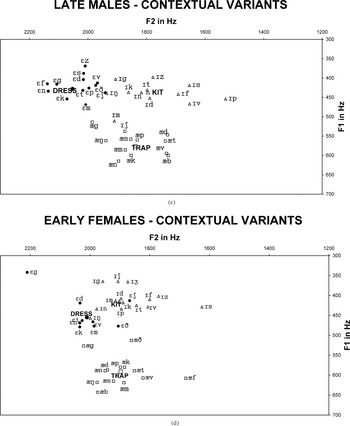
Figure 2. (continues)
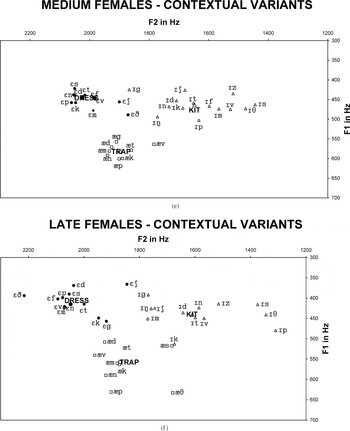
Figure 2. (continued)
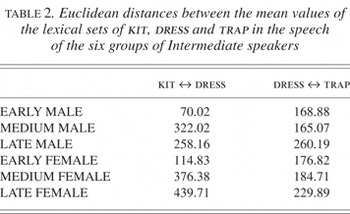
Euclidean distances between the mean values of the lexical sets of kit, dress and trap in the speech of the six groups of Intermediate speakers
Two possible scenarios for the NZE front vowel shift in the top two heights. The upper circle (or ellipse) represents an idealized distribution of kit vowels (solid line), the lower one that of dress (dashed line).
Correlation coefficients and their significance levels
Individual mean values in those dimensions that are assumed to be interrelated [i.e., F2 for kit vs. F1 for dress in Figures 4a (all environments) and 4b (prealveolars), as well as F1 for dress vs. F1 for trap in 4c (all), and 4d (prealveolar)]. Each point represents mean values for a single speaker. The line represents a nonparametric scatterplot smoother fit through the data (Cleveland, 1979).
 You have
Access
- 24
- Cited by