Introduction
The elderly population has proven to be very vulnerable in times of a disaster.Reference Bhalla, Burgess, Frey and Hardy 1 - Reference Powell, Plouffe and Gorr 4 Many have chronic medical problems for which they depend on medications, and often times, medical equipment. Natural or manmade disasters causing even a prolonged loss of electricity can have serious consequences on the ability of the aging population to remain in their home and care for themselves.
A coordinated effort for disaster preparation in the elderly population is paramount.Reference Aldrich and Benson 5 This study assessed the potential needs and individual awareness of community-residing elderly patients in the face of a local disaster. Information was gathered by voluntary survey participation of community-residing patients who receive care at the study institution. The primary objective was to determine the percentage of older adults who have a disaster plan and what that plan contains. The secondary objectives were to determine the percentage of older adults who would require additional resources if they were to be evacuated, to list those resources, and to ascertain what method would be most acceptable to the participants to receive disaster preparedness education.
Methods
Study Design
The survey was given to 100 community-dwelling patients aged 65 years or older and emergency department (ED) visitors also aged 65 years or older. If the patient or visitor could not read the survey, then it was read to them by the study personnel (study investigators or trained research assistants (RAs)). A convenience sample was collected when the RA was available. The RA used the hospital ED tracking board to search for patients at least 65 years of age. The RA then approached the treating attending physician to inquire if the patient was well enough to participate in a survey. The treating attending was not informed of the nature of the survey. Hours were typically 8:00 am to 5:00 pm, Monday through Friday, two days per week on average, from January through July 2013. The days of the week varied. Patients were eligible to participate in the study even if they did not have any visitors at their bedside. The Summa Health System (Akron, Ohio USA) Institutional Review Board approved this study. Participation in the study was voluntary and consent was obtained for all subjects.
Survey (Appendix A)
Demographic information was collected by the survey (Appendix A; available online only). The presence of a disaster plan and the type of plan were assessed. The use of medical equipment, and if it required electricity, was assessed. The use of oxygen, transportation, and the ability to stay in one’s home without a caregiver were assessed. The need for help with activities of daily living (ADLs; ie, dressing, eating, ambulating, toileting, and taking care of personal hygiene) and with instrumental activities of daily living (IADLs; ie, shopping, housekeeping, accounting, food preparation/medications, telephone use, and transportation) were obtained. Questions assessing the best way to educate this population on disaster preparedness were included. Since this was the first study of this type to assess the needs of older adults for disaster preparedness, the questions specific to disaster preparedness have not been validated previously. The questions about ADLs and IADLs have been validated previously for ED use.Reference Chan 6 , Reference Hustey, Mion, Connor, Emmerman, Campbell and Palmer 7 The survey was provided in English only.
Study Setting and Population
The ED was an adult facility that evaluated approximately 77,000 patients per year, 20% of which were over the age of 65 years. It is an urban, Level 1 Trauma Center with a community-based, university-affiliated, Emergency Medicine residency program. The local population is 51.6% female, 80.3% white, 14.7% black or African American, and 5.9% speak a language other than English at home.Reference Wilber, Blanda and Gerson 8 The median household income is US $49,669 and the per capita income is US $27,818.Reference Wilber, Blanda and Gerson 8 About 16% of the population is 65 years of age and older (15.8%), and 15.4% of residents live below the poverty level. Most (90.3%) of the residents over 18 are high school graduates, and 29.6% of adults have a Bachelors degree or higher.Reference Wilber, Blanda and Gerson 8 A previously published study from the investigational institution showed a high school graduation rate of 84% for patients 65 years of age and older. 9
The study excluded subjects who could not understand the survey questions in English, subjects that were too ill to participate as judged by their attending physician, and subjects who were permanent residents of extended care facilities. The RA attempted to enroll every eligible patient who was present during their scheduled time. Study subjects were not enrolled if they were not in their room when the RA approached them for participation.
Data Analysis
Data were entered into a Microsoft Excel file (Microsoft Corporation; Redmond, Washington USA) and the analysis was performed with Stata IC (version 11.0; StataCorp LP; College Station, Texas USA). Results are reported using proportions with 95% confidence intervals (CIs).
Results
Data were collected from 13 visitors and 87 patients. Three respondents did not answer all of the questions, but the questions that they did answer were included in the analysis. The mean age was 76 years (range 65-94 years) and 54% were female. Thirty-one responded that they had a disaster plan in place (31/100; CI, 22.4-41.4%). Of those 31, 94% (29/31; CI, 78.6-99.2%) had food and water as part of their plan, 62% of those (19/29; CI, 42.2-78.2%) had a supply of medication, and 35% of the original 31 (12/31; CI, 21.8-57.8%) had an evacuation plan.
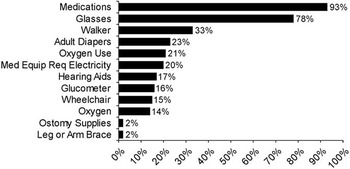
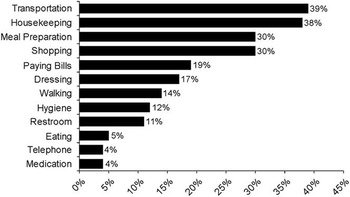
Most of the respondents would require medications (93/100; CI, 86.1-97.1%) and medical supplies (87/100; CI, 78.8-92.9%; Figure 1) if evacuated. Many of the respondents also required help with one or more of their ADLs or IADLs (Figure 2). Most of the respondents said that they, or someone else in their household, could drive (82%; 81/99; CI, 72.8-88.9%), but only 35% said that they were completely independent (35/99; CI, 26.0-45.6%). Eleven percent of the respondents said that they could not be left alone for any period of time (11/99; CI, 5.7-19.0%) and eight percent (8/99; CI, 3.6-15.3%) could not be left alone for more than 24 hours. Most of the respondents said that they kept a list of daily medications (80%; 79/99; CI, 70.5-87.2%), but only 41.4% (41/99; CI, 31.6-51.8%) had a list of medical problems, 55.6% (55/99; CI, 45.2-65.5%) had a list of their doctors, and 63.6% (63/99; CI, 53.3-73.1%) had a list of their emergency contacts.
Medical Equipment Required if Evacuated. (Respondents were asked which of the following items they would need to take with them or have provided to them if they were to evacuated to a shelter. Results shown are the percentage of respondents that indicated they would need each type of equipment).

Percent of Respondents that Require Help with ADLs or IADLs. (Respondents were asked if they required help with any of the items listed below at any time in the previous month. Results shown are the percentage of respondents that indicated they required assistance with each task). Abbreviations: ADLs, activities of daily living; IADLs, instrumental activities of daily living.

Only 42% (41/97; CI, 32.3-52.7%) were interested in learning more about disaster preparation. Television ads or printed booklets were the delivery method of choice. Only nine percent were interested in learning more via the Internet (9/99; CI, 4.0-17.0%).
Discussion
When planning for a community disaster response, one must take into account the needs of older adults. Shelters must be designed to accommodate their unique needs. This study shows that the majority of respondents would need some equipment or medication, and at least one-third would need some kind of assistance to care for themselves. The need for assistance for community members with medical conditions is not unique to older patients. Among community-residing Americans aged 57-85 years old, 81% use at least one prescription medication and 30% use at least five prescription medications.Reference Bhalla, Ruhlin, Frey and Wilber 10 As many as 10% of all sheltered persons in a recent domestic disaster needed at least one form of durable medical equipment.Reference Qato, Alexander, Conti, Johnson, Schumm and Lindau 11 , Reference McGuire, Ford and Okoro 12 Examples of possible durable medical equipment include wheelchairs, walkers, oxygen tanks, and glucometers. Many older adults are dependent on caregivers for daily assistance, such as family members, nurse aids, or other medical staff. Some older adults suffer from mental illness or other neurodegenerative disorders that increase their need for assistance in managing their ADLs (dressing, eating, ambulating, toileting, and taking care of personal hygiene) and their IADLs (shopping, housekeeping, accounting, food preparation/medications, telephone use, and transportation). For these reasons, a disaster causing even a loss of electricity or road closure can have serious consequences on the ability of the aging population to remain in their home and care for themselves. All of the above have lead to increased disparity in mortality among the aging population in previous national disasters.Reference Bhalla, Burgess, Frey and Hardy 1
The need for oxygen and other medical equipment that requires electricity may mean that some older adults might seek out the ED for their daily needs rather than a shelter. They may not be able to even make it to a shelter before suffering from their lack of support. Some seniors also rely on delivery services for their equipment and medications, which might be disrupted during a disaster. Diabetes is common among older adults and insulin requires refrigeration, and thus, electricity. Although this study did not inquire about specific dietary needs of the study participants, many might require cardiac or diabetic diets, which may be difficult to accommodate in a shelter or evacuation.Reference Jenkins, McCarthy, Kelen, Sauer and Kirsch 13 Many of the respondents did not have ready access to a list of medical problems or doctors. Although more health care systems are using electronic medical records, lack of access may still keep providers from finding patients’ medication or medical problem lists during a disaster. Although many of the respondents did have a list of medications, many did not have a list of their doctor’s names or their own emergency contacts. Many people now rely on their smart phones to carry that information; however, during a disaster, they may be misplaced or need to be charged.
Many of the respondents would need assistance with ADLs or IADLs if evacuated. A potential solution would be to train lay volunteers to be “geriatric aids” during a disaster. A course could be developed to help volunteers understand the unique needs of older or chronically ill individuals and teach basic techniques to aid with ambulation, toileting, dressing, eating, keeping up with personal hygiene, communication, and taking medication.
Unfortunately, the majority of the respondents were not interested in learning more about disaster preparedness. It is an important public health initiative to have the population practice some level of preparedness. For many age groups, the Internet might be a good way to communicate, but not in this study population of older adults.
Limitations
This study was limited to a single institution and a convenience sample of ED patients and visitors. Although the authors believe that this patient population’s vulnerability is not unique, communities must do their own evaluation of their constituents’ needs for disaster preparedness. The demographics of the study catchment area are similar to those of the United States, with the same percent below the poverty level and slightly higher percentage of residents being 65 years and older (15.8% versus 14.1% in United States). The percentage of white residents was slightly higher (80.3% versus 77.7% in the United States), and the percentage of high school graduates was slightly higher (90.3% versus 86.0% in the United States).Reference Arrieta, Foreman, Crook and Icenogle 14 Another limitation was that this survey was given primarily to patients and may over-estimate the needs of a healthier older adult population. Visitors were included in attempt to not have an entirely ill study set, though they only made up 13% of the respondents.
Conclusion
These data can be used to focus future research and community preparation in a coordinated fashion with local and national public health organizations. Only a minority of the older adults in the study population had a disaster plan in place (31/100; CI, 22.4-41.4%). Most of the respondents would require medications (93/100; CI, 86.1-97.1%) and medical supplies (87/100; CI, 78.8-92.9%) if evacuated. More than half of the respondents were not interested in learning more about disaster preparedness (56/97; CI, 47.2-67.7%).
Supplementary Material
To view supplementary material for this article, please visit http://dx.doi.org/10.1017/S1049023X15005075