

Introduction
The effect of climate and location on health has been of interest since Hippocrates wrote about it in the third to fourth centuries bc (Lloyd Reference Lloyd, Chadwick and Mann1983: 148–169). While there are obvious health risks associated with living in cold environments (such as frostbite and hypothermia), a cold climate and high latitude have other effects on health. In particular, in the nineteenth century tuberculosis was noted to be less common at higher altitudes and at high northern latitudes (Williams Reference Williams1876) and (wealthy) invalids would convalesce in colder and/or mountainous areas. Dr E.A. Wilson, the surgeon on both of Scott's expeditions, convalesced in Norway and Switzerland after he developed tuberculosis. There are also interesting physiological questions as to the effects of cold on the human organism; the effects of 24-hour light and 24-hour darkness; how humans are able to adapt to life both in the tropics and in the polar regions and maintain the same core body temperature; and, extending beyond human biology, why some animals hibernate.
Dr A.L. McLean of the Australasian expedition (1911–1914) wrote ‘the healthiness of the explorer's life was proverbial – should one not be in a position to study physiology, immunity and psychology under unique circumstances?’ (McLean Reference McLean1919: 6). More recent polar expeditions have been used to address some of these questions but there was no mention of physiology or medicine in the 1901 Antarctic Manual which detailed the research to be done on R.F. Scott's Discovery expedition (1901–1904) (G. Murray Reference Murray1901), nor in the Royal Society meeting to discuss the advantages of an expedition (J. Murray and others Reference Murray, Hooker, Neumayer, Markham, Geikie and Thompson1898), nor in the instructions for J.-B. Charcot's Pourquoi Pas? expedition (1908–1910) (Institut de France, Académie des Sciences 1907).
G.E. Fogg, in his history of Antarctic science, says of the expeditions of the heroic age: ‘Systematic recording of such things as men's weights, measurements, pulse rates and blood counts was done on some expeditions but there was little that could be dignified by the name of medical research’ (Fogg Reference Fogg2005: 275). The aim of this article is to describe the human biological data that was collected on these expeditions.
Methods
This is part of a larger study into medicine during the heroic age of Antarctic exploration during which I have tried to read everything written in English and French relating to this subject and have had relevant parts of German documents translated. As part of this, I have read the official books of the expeditions, the medical reports published about the expeditions, many books about the expeditions, the published diaries of many of the expedition members and the unpublished diaries of some of the doctors.
Expeditions and medical reports
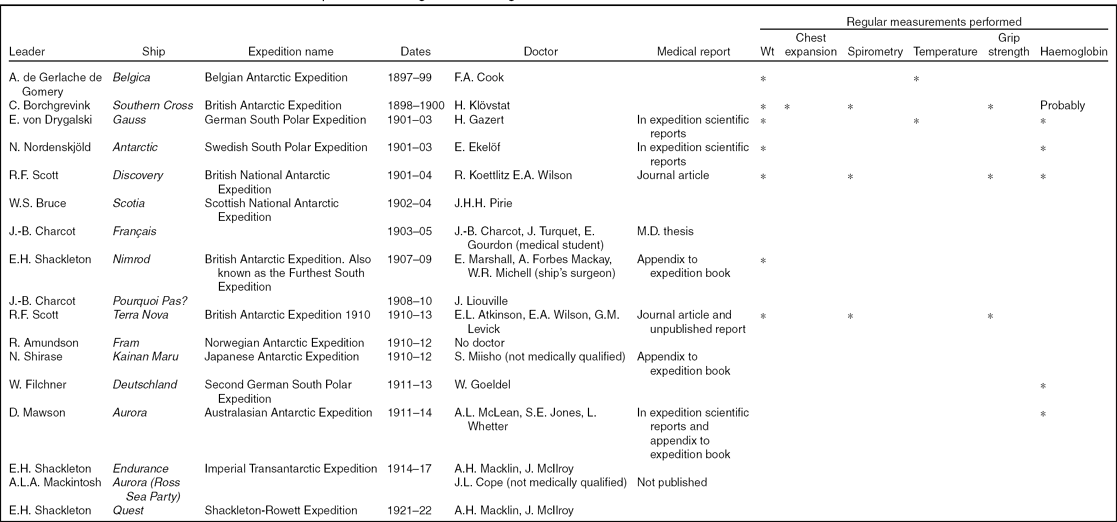
This article defines the heroic age of Antarctic exploration as between 1897 (the first expedition to winter in the Antarctic) to 1922 (the death of E.H. Shackleton). During this time there were 18 expeditions (excluding relief expeditions and whaling expeditions). These are listed in Table 1 together with the doctors on the expeditions, the medical reports and descriptions of measurements recorded as having been taken.
Medical tests carried out on Antarctic expeditions during the heroic age

Full medical reports were published in the scientific results of the first German expedition (Gazert Reference Gazert1927), the Australasian expedition (McLean Reference McLean1919) and the Swedish expedition (Ekelöf Reference Ekelöf1905). Dr E. Ekelöf also wrote a report in English on the medical aspects of the Swedish expedition (Ekelöf Reference Ekelöf1904). On the Français expedition, J.-B. Charcot, the leader, was medically qualified as was J. Turquet, the biologist. However, the medical report was written by a medical student, E. Gourdon, who was the geologist to the expedition. This was submitted as a doctoral thesis (Gourdon Reference Gourdon1913). Dr E.A. Wilson said that he expected Dr R. Koettlitz to write a medical report as part of the scientific results of Scott's Discovery expedition (E.A. Wilson Reference Wilson1905) but this did not happen, probably because Koettlitz became disillusioned with the expedition and left for South Africa shortly after it returned to England (A.A. Jones Reference Jones2011; Guly in press a).
On the Belgian expedition Dr F.A. Cook made regular measurements of weight, pulse rate and body temperature (De Gerlache de Gomery Reference De Gerlache de Gomery1998: 128) and it was obviously expected that he would write a medical report as part of volume 10 of the scientific reports of the expedition (Anonymous Reference Koehler1902) but this was never published.
On Shackleton's Nimrod expedition, Dr E. Marshall's medical notes were left behind at Cape Royds (Marshall Reference Marshall1950) but he wrote a brief report as an appendix to Shackleton's book of the expedition (Marshall Reference Marshall and Shackleton1909). Similarly, S. Miisho, a pharmacologist who acted as medical officer to the Japanese expedition, wrote an appendix to the expedition book (Miisho Reference Miisho, Dagnell and Shibata2012). Dr S.E. Jones and Dr A.L. McLean wrote an appendix to Mawson's book of the Australasian expedition (Jones and McLean Reference Jones, McLean and Mawson1915).
E.A. Wilson (Reference Wilson1905) and E. Atkinson (Reference Atkinson1915) wrote papers on the medical aspects of the Discovery and Terra Nova expeditions respectively and, in addition, Atkinson listed the medical equipment taken in the expedition's scientific reports (Atkinson Reference Atkinson and Lyons1924) and wrote a brief unpublished report (Atkinson Reference Atkinson1913). J.L. Cope, the biologist on Shackleton's Ross Sea party, also wrote a medical report which has not been published (Cope Reference Cope1917).
In his thesis based on the Français expedition, Gourdon (Reference Gourdon1913) says that as ‘my colleague Dr Liouville has made medical observations on the second expedition (1908–1910) so here I have confined my comments to observations on the first expedition, that of 1903–05’. Scientific American has a very brief report of a lecture given by Liouville to the Zoological Society of France (Anon. 1912a), but although the bulletin of the society records that he gave this lecture (Anon. 1912b), the author has found no transcript of the lecture or anything else written by Liouville on the medical aspects of this expedition.
No medical report was written after Shackleton's Endurance or Quest expeditions but Dr A.H. Macklin wrote about medical aspects of polar exploration in general (Macklin Reference Macklin1921, Reference Macklin and Wild1923). I am not aware of any medical report from the Scottish expedition (1902–1904), Amundsen's Norwegian expedition (1910–1912), or the second German expedition, under Wilhelm Filchner, (1911–1913).
Anthropometric measure
On most expeditions, body weights were regularly measured. However this was probably health screening rather than research as Dr H. Gazert said that in scurvy and beri-beri, the presence of oedema caused the weight to increase and this might be the first sign of the disease (Gazert Reference Gazert1927).
On R.F. Scott's two expeditions the doctors measured the body weight; chest expansion; circumference of the waist, biceps, forearm and calf; lung capacity (using spirometry); grip strength in both hands; and (occasionally) haemoglobin levels, red cell count and white cell count. Table 1 shows the expeditions that are known to have collected routine data on weight, haemoglobin levels and other physiological aspects. (Other expeditions may have collected this data but it is not recorded.)
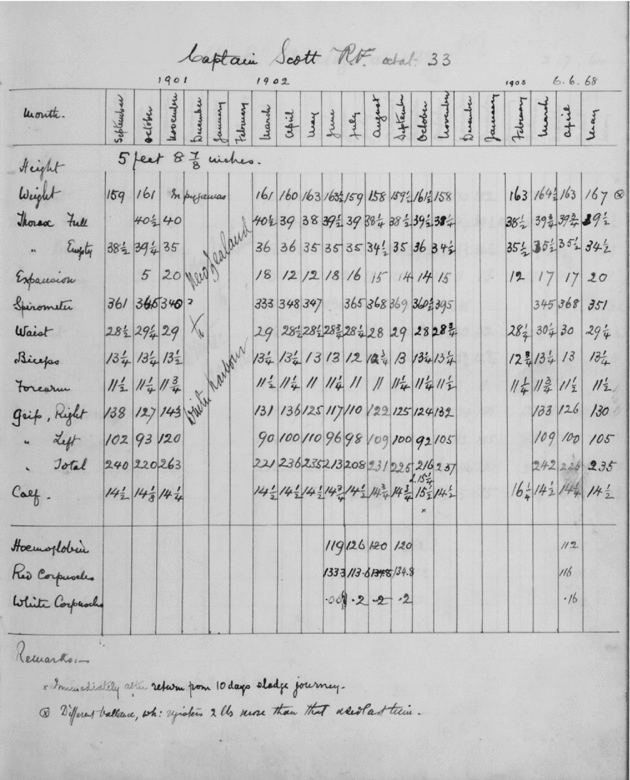
Dr R. Koettlitz's results are in the Natural History Museum in London (Koettlitz Reference Koettlitz1904) with a table for each expedition member. This is a fair copy, obviously written up towards the end of the expedition. As an example of this information, Fig. 1 shows a page on Scott himself. The same information was collected on the Terra Nova expedition as described by G. Taylor, whose book gives a table of the results for 24 April 1911 (Taylor Reference Taylor1916: 225).
Physiological information on R.F. Scott on the Discovery expedition (Koettlitz Reference Koettlitz1904). Copyright the Natural History Museum, London and reproduced with permission.
There is no indication as to what spirometer was used. The units are not stated but would have been in cubic inches. I would cast doubt on the accuracy of these figures: Scott's vital capacity of 361 (5.9 litres) in September 1901 is very high. The reading of 294.5 (4.8 litres) in April 1911 would be a more realistic measurement.
Similarly there is no indication as to what dynamometer was used to measure grip strength. The units for this would have been pounds and the lowest recorded grip strength of Scott's right hand as shown in Fig. 1 (110 lb or 50 kg) is, unsurprisingly, above the mean of 47 kg for a male of his age (Massy-Westropp and others Reference Massy-Westropp, Gill, Taylor, Bohannon and Hill2011).
Weights and lung capacities of members of the Southern Cross expedition are given in an appendix to Borchgrevink's book describing the expedition (Borchgrevink Reference Borchgrevink1980: 317). The value of measuring weight is shown in two examples of weight gain indicating illness, in N. Hanson on the Southern Cross expedition who put on 20lb (Borchgrevink Reference Borchgrevink1980: 317) and T. Crean on the Discovery expedition who gained nearly 20lb (9.1kg) as a result of what was probably beri-beri. This has been discussed elsewhere (Guly Reference Guly2012).
The only analysis of weights was by Ekelöf who noted that they decreased in the summer months as a result of exertion (Ekelöf Reference Ekelöf1904). Marshall merely states that weights increased slightly in the winter but did not vary much from month to month (Marshall Reference Marshall and Shackleton1909). More recent studies have also shown that body weights increase in the winter as a result of inactivity (Lewis and Masterton Reference Lewis and Masterton1963).
Apart from Koettlitz's records, I am not aware of the existence of any original data though it is possible that some may lie, undiscovered, in an archive.
Blood tests for anaemia
The illness, almost certainly beri-beri (Guly Reference Guly2012), that occurred on the Belgian expedition was described by Cook as ‘polar anaemia’ (Cook Reference Cook1980). There is no evidence that Cook measured the haemoglobin level and so this diagnosis is a misnomer. However the name was also used by Charcot (Reference Charcot and Walsh1978: 199). With this background, it was important to test whether expedition members did become anaemic in the Antarctic winter. Table 1 shows the expeditions that are recorded as having measured haemoglobin.
On the Discovery expedition Wilson reported that ‘there was in a good many an increase both in the haemoglobin and in the number of red corpuscles’ and that the ‘results . . . will no doubt be published with the rest of the Expedition's scientific work’ (E.A. Wilson Reference Wilson1905). This publication did not occur.
On the Swedish expedition ‘the percentage of haemoglobin and the number of red corpuscles were never lower than under normal conditions; on the contrary, changes in the other direction developed themselves during the second winter’ and there was also a decrease in the white cell count (Ekelöf Reference Ekelöf1904).
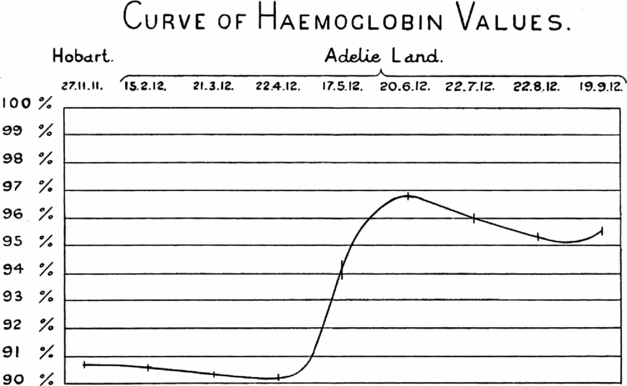
The best descriptions of blood results come from McLean who is the only person to describe his methods. He measured haemoglobin on six individuals using two ‘Haldane's modification of Gower's and Gower's (after Sahli) haemoglobinometers’ (McLean Reference McLean1919: 100–104). Haemoglobinometers measure the haemoglobin concentration by comparing the colour of the blood against a standard. The original Gowers’ haemoglobinometer used a chemical (not related to blood) as its reference colour and the Haldane and Sahli modifications used derivatives of haemoglobin for greater accuracy (Haldane Reference Haldane1901). The Sahli haemoglobinometer was more convenient but possibly less accurate (Boycott Reference Boycott1912). McLean found a difference of about 10% between measurements made in daylight and in acetylene light and he made corrections where appropriate. His results are shown in Fig. 2.
Haemoglobin concentration on the Australasian Antarctic Expedition (McLean Reference McLean1919: 101).
He attributes the slight fall between leaving Hobart in November 1911 and April 1912 to a time when they were doing very strenuous work. The white cell count and differential count were normal throughout apart from two occasions when they went up to 10,000 per cubic mm (or greater). On one occasion the individual was suffering from nasal ‘stuffiness’ and on the other, a whitlow was the cause (McLean Reference McLean1919: 100–104).
In summary, all these studies showed an increase in haemoglobin concentration in the Antarctic winter, confirming the fact that ‘polar anaemia’ is a misnomer. More recent studies have also shown an increase in haemoglobin level during the Antarctic winter (O. Wilson Reference Wilson1953) and this is the result of a reduction in plasma volume and thus haemoconcentration.
On the Southern Cross expedition, Klövstat was also reported as taking blood tests (Borchgrevink Reference Borchgrevink1980: 111), as was Dr W. Goeldel on the second German expedition (Filchner Reference Filchner1994: 146), but as far as the is author aware, these have never been published. In Klövstat's case, this was probably because of his death soon after the expedition's return.
Blood pressure and sphygmograph
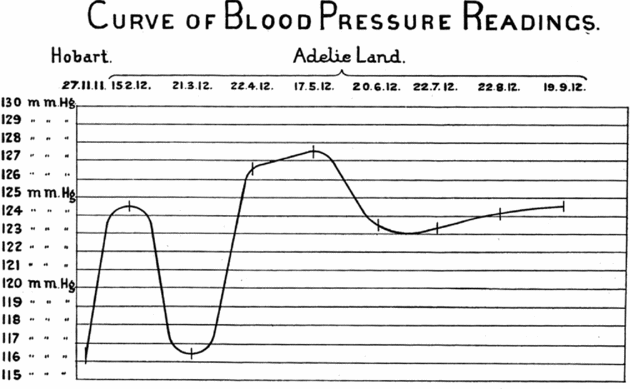
McLean took regular blood pressure (BP) measurements on six individuals using a Roger's (anaeroid) sphygmomanometer, and regretted not using a mercury one. By modern research standards (and even the standards of the time), his sample size is too small and there are no statistics to show the variability of the results and whether these are statistically significant. There is also no description of how the accuracy was determined and biases minimised. He also measured BP in two people at different altitudes and found it to be 10mmHg higher at 2,000 feet than at sea level but accepts that these are of little value. His results are shown in Fig. 3. Even if his results are taken at face value, their significance is uncertain.
Blood pressure measurements on the Australasian Antarctic Expedition (McLean Reference McLean1919: 103).
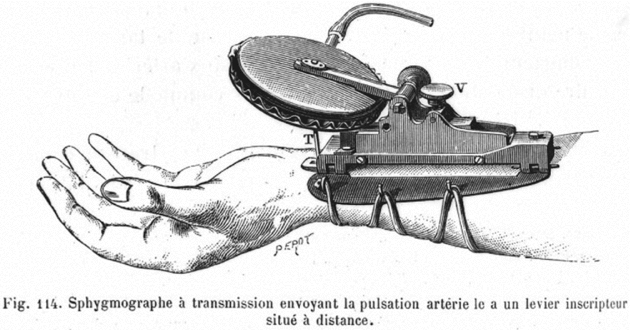
Despite this, what is interesting is that he did measure the BP. The importance of the strength of the pulse had probably been recognised for several thousand years and the first non-invasive measurement of blood pressure had been taken in 1855 using a sphygmograph. The sphygmograph, invented in 1855, was a machine primarily for recording and measuring the waveform of the pulse. It could be used to measure the blood pressure by observing the pressure required to obliterate the radial pulse, though this was not accurate. There were various types of sphygmograph but the Marey sphygmograph was perhaps the most widely used (Lawrence Reference Lawrence1978, Fig. 4). The sphygmomanometer was invented in the 1870s and the first one convenient for clinical use in 1889. The mercury sphygmomanometer, which was in common use until recent years, was invented in 1896 (Booth Reference Booth1977; Lawrence Reference Lawrence1979).
Marey sphygmograph. Reproduced by permission of the Wellcome Trust.
Measurement of BP was slow to catch on as it was thought that using measuring machines weakened clinical acuity (Booth Reference Booth1977). It is reported that the first time it was measured at the London Hospital was in 1908 (Lawrence Reference Lawrence1985) and that it was not until 1912 that BP was measured routinely in patients admitted to Massachusetts General Hospital (Porter Reference Porter1997: 344). Gazert had recommended measurement of BP as part of the medical examination before people went to the Antarctic (Gazert Reference Gazert1927) but there is no other mention of BP measurement in the medical literature of the early Antarctic expeditions. McLean was therefore a pioneer.
In 1902 Dr Wilson wrote in his diary: ‘Evening took sphygmograph tracings, that is pulse tracings of various members of the mess. This is an indication (not of much value or very reliable) of the condition of the heart and circulation and blood vessels’. (Wilson Reference Wilson and Savours1966) Wilson does not record what type of sphygmograph he took or what these tracings showed.
Neither McLean nor Wilson states any hypothesis that they are testing but as some individuals suffered cardiovascular illness and even death on a number of expeditions (Guly Reference Guly2012), studying the effects of the Antarctic winter on the cardiovascular system would have been a reasonable aim.
Tests for scurvy
Gazert regularly examined the gums and skin (presumably for the signs of scurvy), the weight, the pulse, and the heart, and also checked for oedema (Gazert Reference Gazert1927). On Discovery, there is no mention of regular gum examinations but the monthly examinations were done with the expedition members naked so ‘we knew exactly who, if any, were losing weight; who were out of sorts; or who had any spots, swellings, or oedema’ (Wilson Reference Wilson1905). However, when there were signs of scurvy, the examination included an examination of the gums and Koettlitz wrote formally to Scott with the results (Koettlitz Reference Koettlitz1902).
On the Terra Nova expedition, Atkinson did regular blood tests to measure the alkalinity of the blood which was thought to be an indication of scurvy (Wright Reference Wright1897, Reference Wright1900) and he gives the results of two days’ investigations in his paper on the expedition (Atkinson Reference Atkinson1915). The test itself was a valuable scientific advance and was used during World War I to measure the degree of metabolic acidosis in patients with shock (Wright and Colebrook Reference Wright and Colebrook1918), but Almroth Wright's theory that scurvy was caused by acidosis was wrong and so the use of the test to detect scurvy was of no value. This is described elsewhere (Guly in press b).
Immunity
The only expedition in which physiological investigation appears to have been planned was the Australasian expedition, though this seems to have been of lesser importance than bacteriology. In McLean's letter of appointment to the expedition, Mawson wrote: ‘It is well for you to discuss matters with Welsh [Professor of Pathology, University of Sydney] and arrange for any particular work you may be able to execute in the special conditions of Antarctica’ (Mawson Reference Mawson and McLean1911). McLean says that ‘specific suggestions were not wanting’ (McLean Reference McLean1919: 6).
McLean believed that polar living reduced the resistance to infection. His evidence was that explorers returning to civilisation were more susceptible to coryza and influenza and that tuberculosis and other diseases ‘made havoc with Esquimaux tribes in contact with more civilized neighbours’. To assess immunity, he measured the opsonic index. Opsonins attach to antigens (for example, on a bacterium) and facilitate phagocytosis (the absorption and killing of the bacterium by a white blood cell). They are now known to be immunoglobulins and complement. The opsonic index is the ratio of opsonin in the blood of a patient to that in a healthy person and is determined by mixing equal volumes of a suspension of bacteria, white blood cells and serum and comparing the number of bacteria killed by the patient's serum with the number killed by a healthy person's serum.
McLean's tests were done in April and May 1912 using Staphylococcus albus (epidermidis) and the tubercle bacillus. He, himself, says that the results are disappointing because of the pressure of more important work and because of technical difficulties (especially temperature control). In addition, he recognised three other main difficulties:
The control serum was pooled serum from three expedition members who would have suffered the same environmental problems as the three subjects and so they are not really controls.
No comparison was made in Australia.
All were done over a six-week period at the beginning of the winter, whereas if there were immunological deficiencies, one would expect these to be maximal at mid-winter or at the end of winter.
During the expedition, there were three whitlows, a dental abscess and a case of herpes zoster (shingles) and while McLean uses these cases in support of his hypothesis of reduced immunity in the Antarctic, this incidence of disease would not be considered excessive in a similar-sized group of people over two years. One whitlow grew Staphylococcus aureus which was not present in nose and throat swabs, nor in dust cultured in the hut. He felt that this organism was latent in the tissues (McLean Reference McLean1919: 107–108) and presumably had been re-activated by the cold or some other factor in Antarctica.
Because of the difficulties listed above, McLean draws no conclusions from his results (McLean Reference McLean1919: 107–111). Subsequent work has shown that Antarctic residency does have effects on the immune system with reductions in cell-mediated immunity and increased shedding of herpes viruses (Lugg Reference Lugg2000).
Nose, throat and skin bacteriology
Many expeditions performed experiments on the bacteriology of the soil, snow and polar animals (Guly in press c) but McLean was the only person to study human bacteriology. He examined the normal bacterial flora of the mouth, nose, throat and skin of expedition members to observe whether this changed over time. To this end, he took regular swabs from two individuals between leaving Hobart in November 1911 and the end of the first winter (August 1912). Staphylococcus aureus was not cultured after March 1912 but he says that ‘no generalizations could be made from such meager results’ and adds that it was impossible to take swabs from more individuals because of lack of culture media (McLean Reference McLean1919: 114).
In addition, the dust from the hut was frequently cultured and, while it ‘swarmed’ (McLean Reference McLean1919: 114) with various bacteria and many varieties of mould, that, too, did not grow Staphylococcus aureus after March 1912. His conclusion was that Staphylococcus aureus was not resistant to the cold.
Hair and nail growth
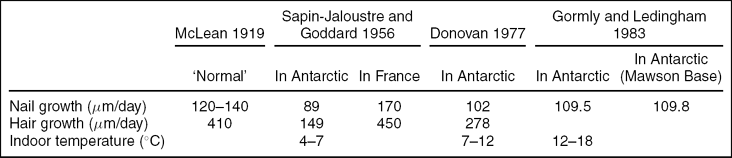
McLean measured the growth of hair in two individuals and growth of the fingernail in three. He does not have controls but quotes ‘normal’ values as defined by others. (Incidentally, it appears that he made an error as he quotes two figures for normal growth of fingernails as 1mm per week and 0.8mm per day (McLean Reference McLean1919: 106). The second figure must be per week also.) His work has been repeated by others (Sapin-Jaloustre and Goddard Reference Sapin-Jaloustre and Goddard1956; Donovan Reference Donovan1977; Gormly and Ledingham Reference Gormly and Ledingham1983), some of whom have developed it further by measuring nail growth in different digits and the variation over the course of a year. A comparison between McLean's work and more recent studies (Table 2) shows that nail growth has increased over time, probably as a result of higher indoor temperatures, though Donovan (Reference Donovan1977) points out that nutrition has also improved.
Fingernail and hair growth in McLean's and later studies
Skin and eye colour
On the Terra Nova expedition, Taylor wrote:
Members of the party were soon seized by Dr Levick in the interests of science. He was armed with a wonderful array of slips of coloured glasses, and with a simple telescope, across which the glasses could be insrted. With these he examined the colour of all our eyes, for it is maintained that there is a perceptible change in the iris after a sojourn in polar reg not suppose green eyes would change into the more popular violet, but on our return we may find we have moved up or down his scale of colours’ (Taylor Reference Taylor1916: 49).
As far as I am aware, these results were never published. The instrument used was a Lovibond tintometer. This was invented in 1891 and a modern version is still used. Its use in measuring the colour of the hair, eyes and skin was described in 1908 (Gray Reference Gray1908). The Royal Geographical Society archives contain a notebook belonging to J.W.Lovibond, the inventor of the Lovibond Colour Scale and the tintometer, which contains the colour records of the hair, skin and eyes of some of the Terra Nova expedition. Lovibond's great-granddaughter believed that the purpose of the tests was to see whether men of any particular colouring were more adventurous than their fellows (Fawcett Reference Fawcett1947).
It is interesting to speculate on the grounds for this ‘research’. While there was medical interest in the association between hair, eye and skin pigmentation and disease, the main differences in pigmentation are between racial groups. While all the Terra Nova explorers were white, even within Britain there are differences between the ‘typical’ Celt and those whose origins are Germanic or Scandinavian. That these two groups were considered to have different personalities is shown by E.R.G.R. Evans’ comments on the selection of explorers and stereotyping: ‘temperamental folk do not stand the long winter darkness or the close cooping-up well. I should think the Englishman (and I do not mean Irish or Welsh) and the Nordic races come out best in the long run’ (Evans Reference Evans1937). (One wonders what T. Crean or the relatives of Edgar Evans thought of this!) It is possible that this was the basis for the theory.
Nutrition
Most research into nutrition was done before the expeditions left. In the Antarctic, diet was experimented with but not in a genuinely scientific way and not, it would seem, under the direction of the medical personnel. Before Wilson's winter journey to Cape Crozier, the three participants ‘were asked by Scott to try certain experiments in view of the Plateau stage of the Polar Journey the following summer’. One person started with 8oz butter, 12oz pemmican and 12oz biscuit a day; a second had 16oz pemmican and 16oz biscuit; and Cherry-Garrard started with 20oz biscuit and 12oz pemmican a day. However, they adjusted their diet during the journey and all ended up with 12oz pemmican, 16oz biscuit and 4oz butter a day (Cherry-Garrard Reference Cherry-Garrard2001: 261–262). All three lost weight but this became the ration for Scott's southern journey (M. Jones Reference Jones2005: 260).
The leader of the Southern Cross expedition wrote:
when Dr Klövstat heard that the first [penguin] eggs were laid, he implored me in his calm way not to let the members eat fresh eggs just then, because he liked to study the progress of our health at the time; and seeing that we all very much required fresh albuminoids, although suffering himself from the want, he knew that the supply of eggs would detract from the valuable studies he was making at the time (Borchgrevink Reference Borchgrevink1980: 198).
I do not know the aim of these experiments. Dr Klövstat died soon after his return and, as far as I am aware, no medical report from the expedition was ever published.
Conclusions
Most of the collection of physiological data during the heroic age of Antarctic exploration was done to monitor the health of participants and so Fogg's statement ‘there was little that could be dignified by the name of medical research’ (Fogg Reference Fogg2005: 275) is largely correct, unless the aim was to prove that man could remain healthy in the Antarctic. Most of this information was not published. However, McLean, in his work on immunity, did apply scientific principles by stating a hypothesis and by describing the methods he used to try to test this. Unfortunately, due to problems with his methods and the environment, very few conclusions can be drawn from this work. His study on nail and hair growth in the Antarctic has been repeated several times and has been useful as a baseline to study how this has changed with time and improved living conditions in Antarctic bases. Since then, much valuable research has been done into human biology in the Antarctic but (even now) good human studies are difficult to do because of environmental difficulties, competing demands on time, lack of support and small numbers of subjects which make achieving statistical significance difficult.
Dr McLean laid the foundations for modern physiological research in the Antarctic
Acknowledgments
This research was made possible by a research grant from the Wellcome Trust to study medicine during the heroic age of Antarctic exploration. I would like to thank the librarians and archivists of the Royal Geographical Society, the Scott Polar Research Institute, the Natural History Museum, the Wellcome Library, Byrd Polar Research Center, Library of New South Wales, University of Edinburgh and Canterbury Museum for their help. I would also like to thank Dr P. Witt for translating parts of Dr Gazert's medical report of the first German expedition and Dr D. Lugg, Dr U Rack and Mr A.A. Jones for advice.