INTRODUCTION
The genus Kolga was described by Danielssen & Koren (Reference Danielssen and Koren1879) based on the material collected by the Norwegian North Atlantic Expedition in 1876–1878 from the lower bathyal of the Norwegian Sea. The type collection comprised more than one hundred specimens of the species Kolga hyalina. At the same time, Hjalmar Théel (Reference Théel1879) described a new species, Elpidia nana, from two ‘Challenger’ stations, one in the West Atlantic and the other in the Antarctic. This species was later assigned to Kolga (Théel, Reference Théel1882). Although Théel found the ‘Challenger’ specimens could be referred to K. hyalina, he assigned them to a new species, mainly because of the difference in location. Hansen (Reference Hansen1975) re-examined type specimens and synonymized K. nana with K. hyalina because he found no significant differences between them. However, he discussed the morphological variability of K. hyalina from different stations of the ‘Ingolf’ and the ‘Gothaab’ Expeditions.
Kolga has since been recorded from many parts of the world ocean across a wide depth-range: the Central Arctic, the north, north-eastern, north-western and the middle North Atlantic, Antarctic, and the Kurile–Kamchatka Trench in the North Pacific (Mortensen, Reference Mortensen1932; Heding, Reference Heding1942; Agatep, Reference Agatep1967; Billett & Hansen, Reference Billett and Hansen1982; Gebruk, Reference Gebruk1990, Reference Gebruk2008). Most specimens were identified as K. hyalina and some as Kolga sp. In the revision of Arctic elpidiids by Rogacheva (Reference Rogacheva2007), the species K. hyalina was re-described with designation of a lectotype. In the present paper, a taxonomic revision of the genus Kolga is given with a re-description of Kolga nana and a description of a new species, Kolga kamchatica.
MATERIALS AND METHODS
Material from the following museums and research centres was examined: the Natural History Museum, London, UK (NHM) (including the type material of Kolga nana); P.P. Shirshov Institute of Oceanology, Moscow, Russia (IORAS); National Oceanography Centre, Southampton, UK (NOCS); Sandgerdi Marine Centre, BIOICE collection, Iceland; Swedish Museum of Natural History, Stockholm, Sweden (SMNH); Natural History Museum of Denmark, Copenhagen (ZMUC); and Alfred-Wegener Institute for Polar and Marine Research, Bremerhaven, Germany (AWI). Most of the Arctic specimens, including the type series of K. hyalina, were examined previously (Rogacheva, Reference Rogacheva2007).
Ossicles from tube feet and tentacles were examined. Ossicles were extracted using a domestic liquid bleach solution, rinsed in water, dried and mounted in Canada balsam or glycerol.
Phylogenetic analysis was carried out using PAST, version 1.18 (Hammer et al., Reference Hammer, Harper and Ryan2001). As outgroups, the following two species were used: Penilpidia pacifica Gebruk, 1988 regarded as the primitive species in the subfamily Elpidiinae to which Kolga belongs, and Rhipidothuria verrucosa (Théel, Reference Théel1879), which is regarded as one of the most primitive genera among the Elpidiidae (Gebruk, Reference Gebruk1990), and possibly has a more distant relationship to Kolga. The ingroup included all three known species of Kolga.
The following twelve morphological characters were used in the analysis:
1) Velum: 0, absent; 1, present.
The velum, or dorsal ambulacral unpaired appendage, comprises two or three pairs of fused dorsal papillae and occurs in many genera of Elpidiidae.
2) Cross-shaped ossicles: 0, present; 1, absent.
In Elpidiidae, cross-shaped ossicles occur only in the subfamily Peniagoninae.
3) Ossicles of «Peniagone» type: 0, present; 1, absent.
Ossicles of Peniagone type consist of a stem with four arms curved downwards and 1–4 vertical apophyses (Gebruk, Reference Gebruk1990). They are characteristic of the genus Peniagone.
4) Ossicles of «Elpidia» type: 0, present; 1, absent.
Ossicles of Elpidia type are rods with two pairs of horizontal arms and 0–2 vertical arms (Gebruk, Reference Gebruk1990). This type of ossicle occurs in Elpidia, Penilpidia and Protelpidia.
5) Rod-shaped ossicles in the body wall skin: 0, absent; 1, present.
6) Irregular C- shaped ossicles: 0, absent; 1, present.
This type of ossicle (also known as the «Kolga» type (Gebruk, Reference Gebruk1990)) is a unique characteristic of Kolga and Irpa.
7) C-shaped ossicles: 0, absent; 1, present.
Present in many genera of elpidiids.
8) Straight rods: 0, absent; 1, present.
9) Curved rods: 0, absent; 1, present.
10) Bent rods: 0, absent; 1, present.
11) Dominant type of ossicles in tube feet: 0, ossicles of Kolga type; 1, rod-shaped ossicles.
12) Location of spines on rods: 0, up to one-third of the length from the ends, 1, up to the whole length.
Characters 1–7 were used to define the ingroup; character 11 is applicable only to Kolga. Characters were treated as unordered and non-additive. The Fitch non-additive optimization and branch and bound options were used to search for trees. Analysis started with 100,000 rearrangements.
Other abbreviations: BN 1.5/3M, bottom sledge with three nets (Jackson et al., Reference Jackson, Thurston and Rice1991); OTSB 14, semi-balloon otter trawl, 13.7 m headline, fished on a single wire; RMT 1 + 8M, multiple rectangular midwater trawl with three pairs of 1 m2 mouth area nets (RMT 1) and 8 m2 area nets (RMT 8) combined within the same frame (Roe & Shale, Reference Roe and Shale1979); RP-sledge, Rothlisberg–Pearcy sledge.
SYSTEMATICS
DIAGNOSIS
Body elongated. Skin whitish or light violet after preservation. Dorsal papillae three pairs: two anteriormost larger, posterior pair smaller; papillae fused for one-third to two-thirds of their length (in fixed material) forming a velum in anterior one-third of the body. Tube feet 6–10 pairs spaced along ventrolateral radii in posterior half or two-thirds of body; size of tube feet and distance between them decrease towards posterior end. Tentacles ten with four to seven marginal lobes secondarily subdivided, usually two lobes larger than others. Anus sub-dorsal. Rectum with caecum. Stone canal opens exteriorly. Pore of stone canal and gonopore placed in front of velum. Ossicles in body wall of two types: spinous rods 400–700 µm in length, curved or irregular, and irregular C-shaped rods, 40–75 µm in size; in ambulacral appendages spinous rods and sometime C-shaped ossicles present. Calcareous ring has five separate pieces each with four pairs of arms, which may branch.
REMARKS
Species of Kolga are best distinguished by the rod-shaped ossicles in the tube feet. On the dorsum, rods may be scarcely distributed, making them difficult to use for taxonomy. In the tube feet, rods are of the same type as on the dorsum but are more abundant. The morphology of rods in the tube feet was not previously used in the taxonomy of Elpidiidae. The following features of rod-shaped ossicles in tube feet and tentacles were revealed in the present work:
• Rods in tube feet are similar in shape, size, number and arrangement of spines, to dorsal rods, but in tube feet rods may be slightly more spinous; rods in tentacles are more curved, spinous, and often bifurcate.
• Rods in tube feet from one specimen show no significant variation, whereas ossicles in tentacles vary depending on the part of tentacle.
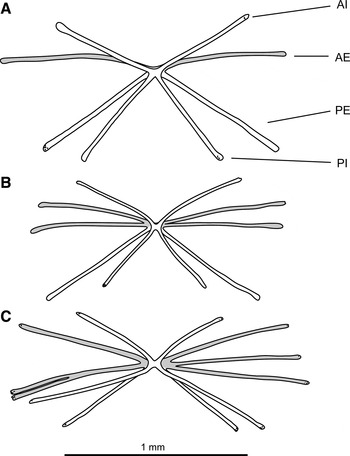
The calcareous ring consists of five disconnected pieces (Figure 1). Each piece has four pairs of arms: two anterior (one external and one internal) and two posterior (one external and one internal). The anterior external pair of arms bifurcates at the base in most specimens and generally produces two branches, giving the appearance of five pairs of arms (Figure 1B). This bifurcation is common in all three species of Kolga. Thus, the five pairs of arms discussed by Hansen (Reference Hansen1975) are in fact four pairs with anterior external arms bifurcated at the basis. In K. nana, three branches of anterior external arms occasionally occurred (Figure 1C). Undivided arms were observed only in K. hyalina (Figure 1A).
Variability of pieces of calcareous ring in Kolga. Anterior external pair of arms (shadowed): (A) with no bifurcation; (B) four branches; (C) five branches at the base; additional branching in one left arm. AI, anterior internal pair; AE, anterior external pair; PE, posterior external pair; PI, posterior internal pair.

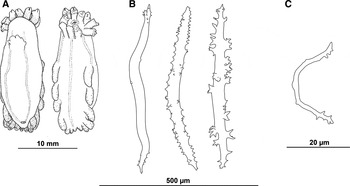
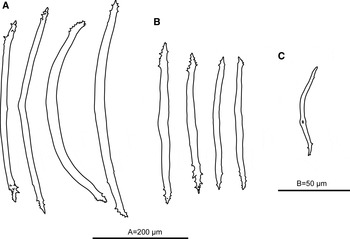
Kolga hyalina. (A) Dorsal and ventral views; (B) rods from tube feet; (C) irregular C-shaped ossicle from tube foot.

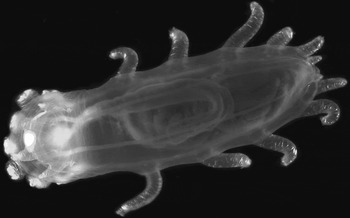
Kolga hyalina, specimen in vivo. Photograph courtesy: Bodil Bluhm.

Kolga hyalina Danielssen & Koren, Reference Danielssen and Koren1879: 83–106, Pls. I, II; 1882: 3–20, Pls. I–III; Théel, Reference Théel1882: 39; Ludwig, Reference Ludwig1898: 12; Ludwig, Reference Ludwig1901: 140; Mortensen, Reference Mortensen1927: 367; Reference Mortensen1932: 43–44, figure 5; Deichmann, Reference Deichmann1930: 132–133; Baranova, Reference Baranova1964: 368; Koltun, Reference Koltun1964: 46, 47, 53, 62, 68–69; 76, 77, 78; Agatep, Reference Agatep1967: 140 (partim.); Paul & Menzies, Reference Paul and Menzies1974: 253; Hansen, Reference Hansen1975: 170–171, figures 86 & 95(2, 3); Pls. IX(8) & XII(11); Gebruk, Reference Gebruk1990: 121–122, figure 51; Madsen & Hansen, Reference Madsen and Hansen1994: 88–89, figures 56 & 57; Anisimova & Cochrane, Reference Anisimova and Cochrane2003: 131; Smirnov & Smirnov, Reference Smirnov, Smirnov, Sirenko and Vasilenko2006, figure 14; Rogacheva, Reference Rogacheva2007: 384–391, figures 11–13, 15 & 16.
Irpa abyssicola Danielssen & Koren, 1878— Gebruk et al., Reference Gebruk, Bluhm, Soltwedel and Thiel2003: 51, figures 2 & 3.
MATERIAL EXAMINED
Norwegian North Atlantic Expedition, ‘Vøringen’, Station 295, [SMNH Type–4326], 71°59′N 11°40′E, 2030 m, 1 paralectotype; Swedish Arctic Expedition 1898: Station 26, [SMNH–97382], 78°19′N 8°41′E, 2700 m, biloculina clay, 25 July 1898, 39 specimens, Station 27, [SMNH–97379], 77°52′N 3°05′W, 2750 m, biloculina clay, 29 July 1898, 30 specimens; Swedish Arctic Expedition 1900, Station 13, [SMNH–97396], 72°01′N 8°33′W, 2400 m, mud, exact date unknown, 1 specimen; ‘Godthaab’, Station 54, [ZMUC Eh 306–834], 69°50′N 61°36W, 1880 m, 1928, 1 specimen; RV ‘Polarstern’: Cruise ARK XXI/1b, Station PS 68/247–1, AWI, Hausgarten V, 79°5,67′N 3°38,68′S, 3064,3 m, Agassiz Trawl, 20 August 2005, 18 specimens; Cruise ARK–XXIII/2, Station PS 72/56–1, Hausgarten IV, 79°3.39′N 3° 50.54′E, 2732.2 m, Agassiz Trawl, 16 July 2008, 2 specimens; BIOICE program: cruise NM–1–95, Station 18, Sample Nr 2772, 69,25683°N 14,217°W, 1633 m, detritus sledge, 3 August 1995, 1 specimen; cruise NM–1–95, Station 18, Sample Nr 2773, 69,24817°N 14,275333°W, 1629–1630 m, RP sledge, 3 August 1995, 3 specimens; cruise NM–1–01, Station 4, Sample Nr 3203, 64,85050°N 7,861167°W, 2612–2605 m, Agassiz Trawl, 8 July 2001, 67 specimens; cruise NM–1–01, Station 4, Sample Nr 3204, 64,86183°N 7,909333°W, 2613–2611 m, RP sledge, 8 July 2001, 12 specimens; cruise NM–1–01, Station 7, Sample Nr 3210, 66,22767°N 6,862833°W, 2544–2536 m, RP sledge, 9 July 2001, ~300 specimens; cruise NM–1–01, Station 7, Sample Nr 3211, 66,20150°N 6,867167°W, 2545–2527 m, Agassiz Trawl, 10 July 2001, ~350 specimens; cruise NM–1–01, Station 8, Sample Nr 3213, 67,02267°N 6,193667°W, 3006–3007 m, Agassiz Trawl, 10 July 2001, 44 specimens; cruise NM–1–01, Station 8, Sample Nr 3214, 67,02967°N 6,197167°W, 3000–3003 m, RP sledge, 10 July 2001, 142 specimens; cruise NM–1–01, Station 14, Sample Nr 3230, 68,70183°N 10,215500°W, 2108–2099 m, Agassiz Trawl, 13 July 2001, 129 specimens; cruise HM–1–04, Station 7, Sample Nr 3636, 68,8285°N 9,240333W, 1894–1849 m, RP sledge, 17 July 2004, 1 specimen; cruise HM–1–04, Station 8, Sample Nr 3637, 68,44867°N 10,145833W, 2069–2065 m, RP sledge, 17 July 2004, 2 specimens; cruise HM–1–04, Station 14, Sample Nr 3648, 68,95167°N 10,546667W, 2215–2213 m, RP sledge, 22 July 2004, 2 specimens; cruise HM–1–04, Station 14, Sample Nr 3649, 68,94083°N 10,594167W, 2213–2214 m, Agassiz Trawl, 22 July 2004, 46 specimens.
DIAGNOSIS
Body elongated, up to 52 mm in length in a preserved state. Skin whitish. Tube feet up to 10 pairs, spaced along ventrolateral radii in posterior half or two-thirds of the body; size of tube feet and distance between them decrease towards posterior end. Tentacles ten with four to seven marginal lobes secondarily subdivided, usually two lobes larger than others. Ossicles in body wall of two types: spinous rods, 400–700 µm in length, curved or irregular, and irregular C-shaped, 40–75 µm in size. In ambulacral appendages spinous rods dominant, only few C-shaped ossicles occur; rods curved, bent or rarely straight; spines may develop only at the ends of rods or also in their other parts covering up to the whole length of rod. Pieces of calcareous ring with four pairs of arms, one pair of arms usually bifurcates at the basis.
REMARKS
A detailed description of this species, including the type series, was published by Rogacheva (Reference Rogacheva2007). One new paralectotype of this species was found in the SMNH collection: the specimen from Station 295 of ‘Vøringen’, the Norwegian North Atlantic Expedition, Catalogue Nr Type–4326, 71°59′N 11°40′E, 2030 m, identified by Danielssen & Koren (Reference Danielssen and Koren1882), 26 mm in length with eight pairs of tube feet, in good condition.
The single specimen from the ‘Godthaab’ Station 54 was re-examined and found to belong to Kolga hyalina.
RELATIONSHIPS
This species differs by the dominance in tube feet and tentacles of rods (Table 2), curved, bent or rarely straight, with varying number of spines developed only at the ends of rods or also covering their other parts, up to the full length of rod (Rogacheva, Reference Rogacheva2007, Figure 11, pp. 6–14).
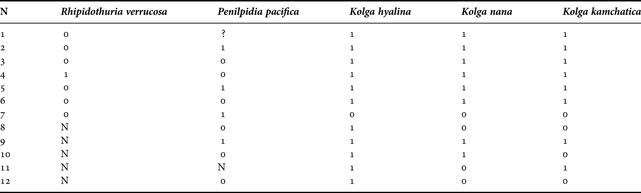
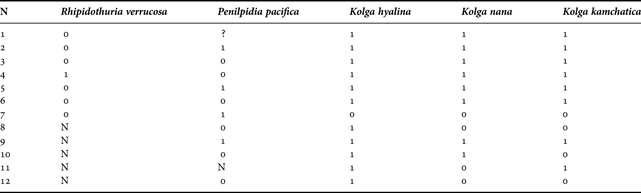
Character matrix.
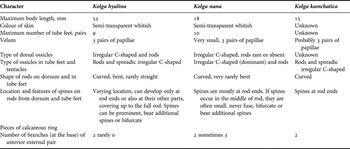
Differences in morphology between species of the genus Kolga.

DISTRIBUTION
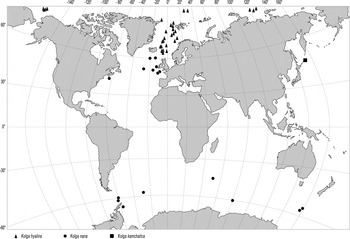
Found in the Central Arctic, Norwegian Sea and Baffin Bay. Depths 659–4106 m (Figure 9).
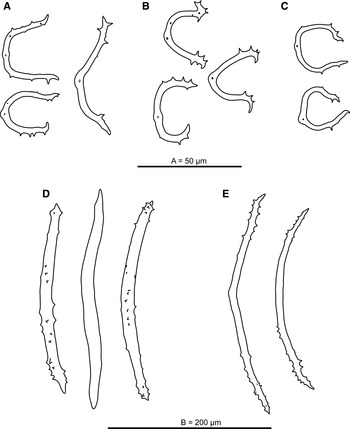
Kolga nana, ossicles of the syntype 83.6.18.19. (A–C) Irregular C-shaped ossicles (Scale A): (A) dorsal, (B) tube feet, (C) tentacles; (D–E) rods (Scale B): (D) tube feet, (E) tentacles.

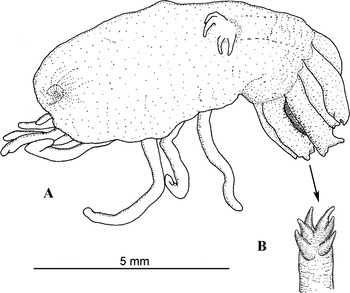
Kolga nana, RV ‘Akademik Mstislav Keldysh’, ‘Mir-2′ Dive 2/340. (A) Side view; (B) tentacle, magnified.

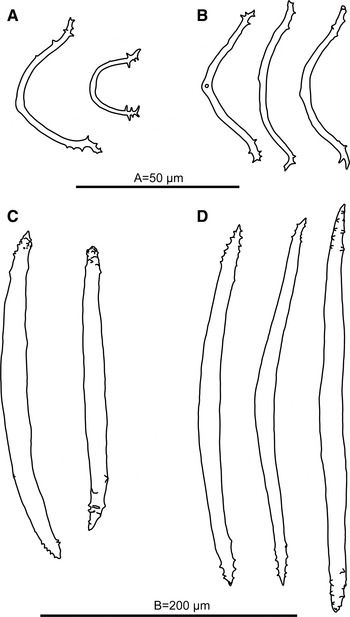
Kolga nana, RRS ‘Challenger’, Station 52403#21–23, ossicles of tube feet: (A, B) irregular C-shaped (Scale A); (C, D) rods (Scale B).

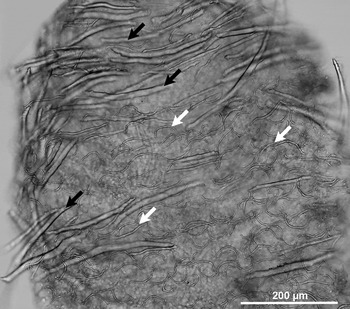
Kolga nana, RRS ‘Challenger’, Station 50603#1. Tube foot skin under the light microscope. Black arrows, rods; white arrows, irregular C-shaped ossicles.

Elpidia nana Théel, Reference Théel1879: 15–16, figures 20–22.
Kolga nana— Théel, Reference Théel1882: Pls. II (3–4), XXXIII (1–2); XXXIV (5); XXXVI (25), XLII (5, 8).
Kolga hyalina— Hansen, Reference Hansen1975: 170–171 (partim.); Billett & Hansen, Reference Billett and Hansen1982: 804–806, figures 2 (1–9), 4–6; Gage et al., Reference Gage, Billett, Jensen and Tyler1985: 200; Harvey et al., Reference Harvey, Gage, Billett, Clark and Paterson1988: 185; Gebruk, Reference Gebruk1990: 121–122 (partim.).
Kolga sp.— Gebruk, Reference Gebruk2008: 50, 51, 52, 58, figure 1C.
TYPE MATERIAL
The type series is at the Natural History Museum in London, UK and includes specimens from two stations of the HMS ‘Challenger’: three lots from Station 50 and one lot from Station 152:
[NHM 83.6.18.19] HMS ‘Challenger’, Station 50, 42°8′N 63°39′W, 2286 m, 21 May 1873, bottom temperature 2.8°C, grey ooze. Four syntypes damaged approximately 10 mm in length and numerous fragments. None of the syntypes had a complete number of tube feet and tentacles. Tentacle discs in a preserved state were bilaterally symmetrical with six lobes. Velum shrunk, only three pairs of knob-like papillae were visible. Dorsal ossicles (Figure 4A) only of irregular C-shape type («Kolga» type), rods not found. Numerous irregular C-shaped ossicles and rods in tube feet and tentacles (Figure 4B–E) were found.
[NHM 83.6.18.19–2] HMS ‘Challenger’, Station 50, 42°8′N 63°39′W, 2286 m, 21 May 1873, bottom temperature 2.8°C, grey ooze. Fragments of four specimens, identified as Kolga nana based on morphology and composition of ossicles in tentacles and tube feet.
[NHM 83.6.18.20] HMS ‘Challenger’, Station 152, 60°52′S 80°20′E, 2306 m, diatom ooze, fragments of a single specimen. Two large fragments, corresponding to the anterior and posterior parts of a body, and numerous small fragments were all in very bad condition. Ossicles are absent.
[NHM 86.10.29.10] HMS ‘Challenger’, Station 50, 42°8′N 63°39′W, 2286 m, 21 May 1873, bottom temperature 2.8°C, grey ooze. Fragments of internal organs.
TYPE LOCATION
Found in the north-western Atlantic, off Nova Scotia, 42°8′N 63°39′W, depth 2286 m; Indian sector of the Antarctic, 60°52′S 80°20′E, depth 2306 m.
OTHER MATERIAL EXAMINED
RV ‘Akademik Kurchatov’, Cruise 11, Station 898, 56°47′S 24°56′W, 6050–6150 m, 5 December 1971, 509 specimens + fragments; RV ‘Dmitry Mendeleev’, Cruise 16, Station 1292, 54°48′S 159°10′E, 5400 m, 25 January 1976, ~100 specimens + fragments; RV Dmitry ‘Mendeleev’, Cruise 16, Station 1299, 57°17′S 157°13′E, 5460–5760 m, 28 January 1976, ~100 specimens; RRS ‘Discovery’, Cruise 92, Station 9754#3, 51°8.4′N 12°1.5′W, 1484 m, BN1.5–3 m, 9 April 1978, 1 specimen; RRS ‘Discovery’, Cruise 92, Station 9756#11, 49°49.7′N 14°4.7′W, 4100–4200 m, RMT 1, 14 April 1978, 23 specimens; RRS ‘Challenger’, Cruise 9/79, Station 50603#1, 49°16′N 14°2′W, 4000 m, BN1,5–3 m, 2 July 1979, 1200 specimens and fragments; RRS ‘Discovery’, Cruise 105, Station 10113#1, 50°16′N 13°32′W, 2755–2760 m, BN1.5–3 m, 10 September 1979, 85 specimens; RRS ‘Discovery’, Cruise 105, Station 10114#1, 49°46′N 14°8′W, 4040–4060 m, BN1,5–3 m, 10 September 1979, ~4400 specimens; RRS ‘Challenger’, Cruise 8/86, Station 52403#21–23, 49°15.2′N 16°34.9′W, 4815 m, RMT 1 + 8 M, 8 December 1986, 105 specimens; BIOICE program, Cruise B–9–00, Station 442, Sample Nr 3176, 60,03383°N 22,45833°W, 2537–2546 m, RP-sledge, 29 July 2000, 13 specimens; RV ‘Polarstern’, Cruise ANT-XIX/3 ANDEEP, Station 41–3, 59,3707°S 60,0677°W, 2375–2372 m, epibenthic sledge, 26 January 2002, 4 specimens; RV ‘Polarstern’, Cruise ANT-XIX/3 ANDEEP, Station 114–4, 61,7257°S 60,7367°W, 2914–2920 m, epibenthic sledge, 18 February 2002, 628 specimens; RV ‘Polarstern’, Cruise ANT-XIX/4 ANDEEP, Station 132–2, 65,2956°S 53,3803°W, 2086 m, epibenthic sledge, 6 March 2002, 7 specimens; RV ‘Akademik Mstislav Keldysh’, Cruise 49, ‘Mir-2’, dive 2/340, 52°47′N 34°45′W, maximum depth approximately 4500 m, slurp-gun, observer E.M. Krylova, 13 June 2003, 15 specimens; RRS ‘Discovery’, Cruise D300, Station 15775#4, 48°56.21′S 51°03.90′E, 4180–4195 m, OTSB 14, 27 December 2005, ~1400 specimens; RRS ‘James Cook’, ECOMAR cruise JC048, ROV ‘Isis’ dive 165, Station JC048/24, 54°1,081′N 34°9,455 ′W, ~2500 m, 9–10 June 2010, 5 specimens.
DIAGNOSIS
Body elongated, up to 50 mm in length in freshly caught specimens and 18 mm in alcohol. Skin whitish. Tube feet up to ten pairs spaced along ventrolateral radii in posterior half or two-thirds of the body; tube feet size and distance between them decrease towards posterior end. Tentacles ten with four to eight marginal lobes secondarily subdivided, usually two lobes larger than others. Ossicles in body wall absent or random irregular C-shaped, 40–75 µm in size, and very random spinous rods 400–650 µm in length, curved or rarely bent. In ambulacral appendages irregular C-shaped ossicles dominant; rods in tube feet curved or rarely bent, with spines concentrated in terminal parts of rods and sometimes in the middle part. Pieces of calcareous ring with four pairs of arms, one rarely two pairs of arms bifurcate at the basis.
DESCRIPTION
Body elongated, up to 18 mm in length (Figure 5). Skin is thin, semi-transparent, whitish. Velum very small, three pairs of small papillae, in many specimens velum contracted and only tips of papillae are visible; the third (posteriormost) pair was often very small and barely visible. Tube feet partly lost in most specimens; maximum observed number of tube feet was ten pairs. Tube feet decrease in length towards the posterior end. Tips of largest tube feet in some specimens bore two or four processes. Processes very slender, lacking ossicles easily retracted during fixation. They were observed only in fresh specimens and specimens fixed in formalin collected with the manned submersible and the ROV in the Mid-Atlantic Ridge (Mir-2 dive 2/340 and ROV ‘Isis’ dive 165); all collected specimens were in exceptionally good condition.
Dorsal ossicles are mainly irregular C-shaped, with prominent spines on terminal parts (Figure 4A). Rods are very rare; not found in the body wall of most specimens. Irregular C-shaped ossicles also dominated in tube feet and tentacles (Figure 6A, B). They occurred in the external layer of the derma (Figure 7, white arrows). In the deeper layer, rods were dominant (Figure 7, black arrows). Rods on dorsum and in tube feet were very similar; curved and rarely bent with spines covering their terminal parts and their middle part in some rods (Figure 6C, D). Length of dorsal rods is up to 500 µm. Rods in tube feet reached 650 µm in length; rods smaller in distal parts of tube feet. Skin on tips of tube feet lacked rods and irregular C-shaped ossicles and bore perforated plates. Rods in tentacles are more slender; in tentacle discs, shorter and often more spinous and bifurcated at ends. Pieces of calcareous ring with four pairs of arms, the anterior external pair (Figure 1B, C) divided at base into two, rarely three branches in all examined specimens; pieces with different number of branches (four, rarely five or six) may occur in one specimen.
REMARKS
The original description of Théel was based on the material from Station 50 of ‘Challenger’ in the north-west Atlantic. According to Théel, the specimen from Station 152 (the Indian sector of Antarctic) was in a poor condition and it was assigned to K. nana based on general resemblance to specimens from the Atlantic. Théel noted that the Antarctic specimen could belong to a separate species. Re-examination of this specimen did not allow reliable species identification because of the absence of ossicles. However, there are no reasons to consider this specimen as a separate species, and therefore, it is considered as a syntype of K. nana in the present work.
RELATIONSHIPS
The species differs by dominance in tube feet and tentacles of irregular C-shaped ossicles and the presence of mostly curved rods bearing spines concentrated at both ends in tube feet (Table 2).
DISTRIBUTION
Found in the North Atlantic (south off Iceland, the Charlie-Gibbs Fracture Zone), north-east Atlantic, West Atlantic (Nova Scotia), off the Crozet Islands in the southern Indian Ocean, southern Pacific, southern Atlantic and Antarctic (Figure 9). Depth 1484–6235 m.
Kolga kamchatica sp. nov., RV ‘Vityaz’, Station 5625. Ossicles of tube feet. (A, B) Rods from two different specimens (Scale A); (C) irregular C-shaped (Scale B).

Kolga hyalina— Gebruk, Reference Gebruk1990: 121-122 (partim).
Holotype: specimen 14 mm in length (RV ‘Vityaz’, Cruise 39, Station 5625, 45°28N 153°46E, 6225–6236 m, Sigsbee trawl, 21 August 1966) preserved in 75% ethanol, at IORAS (Moscow).
Paratypes: five specimens 13–15 mm in length (RV ‘Vityaz’, Cruise 39, Station 5625, 45°28N 153°46E, 6225–6236 m, Sigsbee trawl, 21 August 1966), stored at IORAS (Moscow).
OTHER MATERIAL EXAMINED
RV ‘Vityaz’, Cruise 39, Station 5625, ~140 specimens and numerous fragments.
DIAGNOSIS
Body elongated, up to 15 mm in length. Skin thin, transparent. Velum three pairs of papillae retracted to small knobs. Ossicles on dorsum and ventrum lacking. Ossicles in tube feet rods (Figure 8A, B), very rarely irregular C-shaped (Figure 8C); rods up to 450 µm in length, curved, with few small or large spines covering both ends of rods. Pieces of calcareous ring with four pairs of arms, one pair divided at base into two branches.
REMARKS
All specimens including the type material lacked most of the body skin and ambulacral appendages. The number of tube feet is unknown. Ossicles on dorsum and ventrum were not found.
ETYMOLOGY
The species is named after its geographical location.
RELATIONSHIPS
Kolga kamchatica differs by dominance in tube feet of curved rods with few spines at both ends (Table 2).
DISTRIBUTION
There is a single record in the Kurile–Kamchatka Trench, northern Pacific. Depth 6225–6236 m (Figure 9).
Geographical distribution of the genus Kolga.

DISCUSSION
Comparative morphology
The main differences in the taxonomic characters between the three species are shown in Table 2. Kolga hyalina and K. nana have similar (whitish) skin. For K. kamchatica, the colour of skin is unknown. Specimens of all three species varied in length, but the greatest range, as well as the largest specimens, were found in K. hyalina. No significant differences were found in the velum morphology, number and arrangement of tube feet. The shape of the velum very much depends on the state of preservation. In small ethanol preserved specimens, the velum is often contracted and resembles a group of closely placed papillae. Ten pairs of tube feet were observed in one specimen of K. nana. Others had 7–9 pairs, as in K. hyalina. Kolga species are very similar in external morphology to some other elpidiid genera, such as Peniagone, Amperima and Ellipinion. Many of them have semi-transparent whitish skin and an elongated body with velum on the hump-like dorsal inflection. For this reason, it is often difficult to identify these holothurians on underwater images even to the generic level.
Different types of ossicles in tube feet have not been reported in other elpidiid holothurians. For the taxonomy of elpidiids, usually dorsal and ventral ossicles are the most important, whereas ossicles in tube feet remain not well known for most of the species. In the body wall of Kolga rods are not abundant. Rods are different in shape in all three species. In K. hyalina, rods are most variable and can be straight, curved or bent, with different numbers of spines that can be developed only at the ends of rods or in other parts, sometimes covering almost the entire rod. Rods in the two other species are more uniform; they are curved with spines at the ends and show little variation (Table 2). The Arctic species of the genus Elpidia also have differences in the tube feet ossicles (Rogacheva, Reference Rogacheva2007).
Small differences between the species of Kolga were found in the morphology of the calcareous rings. The anterior external pair of arms on the pieces of calcareous ring can bifurcate at the base, giving two (K. hyalina, K. nana and K. kamchatica) or three branches (K. nana) or can be undivided (K. hyalina). However, most specimens of all three species had pieces of a calcareous ring with two pairs of arms. Variability in the number of arms and branches is known for Peniagone, Penilpidia and Achlyonice.
Distribution, ecology and in situ observations
Species of the genus Kolga are allopatric (Figure 9). Kolga hyalina is distributed in the Arctic basin, Norwegian Sea (north of the Faroe–Iceland Ridge) and in Baffin Bay. Kolga nana is found across the Atlantic from 42°N to the south of Iceland. In the southern hemisphere, it is known to occur from south of 48°S to the coast of the Antarctic. Kolga hyalina and K. nana are eurybathic species: K. hyalina is found from the upper bathyal to abyssal depths; K. nana is distributed from the lower bathyal to hadal. The shallowest record (1484 m) of K. nana is in the north-east Atlantic, whereas the deepest record and the widest range of vertical distribution (2086–6150 m) were registered in the Antarctic. Kolga kamchatica is known only from the Kurile–Kamchatka Trench in the north-west Pacific.
Kolga was suggested to originate in the Antarctic, from where it invaded the North Atlantic and Arctic (Gebruk, Reference Gebruk1990). The key role of the Antarctic in the origin of the deep-sea fauna, particularly of echinoids and holothurians, was discussed by Belyaev (Reference Belyaev1975, Reference Belyaev1989), Mironov (Reference Mironov1982) and Gebruk (Reference Gebruk1983, Reference Gebruk1990, Reference Gebruk, Guille, Feral and Roux1994). Antarctic origin was suggested for many elpidiid genera as Elpidia (Belyaev, Reference Belyaev1975, Reference Belyaev1989), Scotoplanes (Gebruk, Reference Gebruk1983), Amperima and Peniagone (Gebruk, Reference Gebruk1990). These genera are thought to be represented in the Antarctic by the most primitive species.
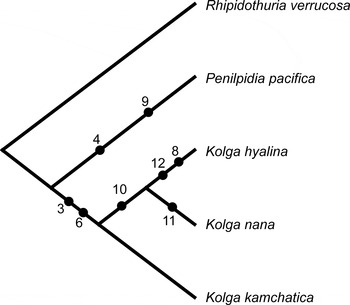
Relationships between species have been tested using a cladistic approach. Phylogenetic analysis was applied based on the character matrix given in Table 1. The analysis yielded the single most parsimonious tree (Figure 10): length = 11, CI = 1.0, RI = 1.0. This tree shows a closer relationship of the Arctic species K. hyalina to the North Atlantic and Antarctic species K. nana rather than to the Pacific species K. kamchatica.
Most-parsimonious phylogenetic tree of Kolga. Numbers correspond to characters in the matrix (Table 1).

The two genera of the family Elpidiidae, Kolga and Elpidia, have similar distribution patterns and apparently similar biogeographical history. Both genera occur in all oceans over a wide range of depths. There are eurybathic species in both genera with a bipolar distribution in the Atlantic (Elpidia gracilis Belyaev and Kolga nana). Kolga and Elpidia are the only among 13 elpidiid genera (except for Irpa) represented in the Arctic. All Arctic species of Kolga and Elpidia are endemic to this region. Kolga and Elpidia presumably penetrated the Arctic in similar ways, through the North Atlantic. Arctic representatives of Kolga and Elpidia are characterized by high morphological variability, suggesting continuing speciation and recent origin.
Kolga nana is known as an opportunistic species, forming aggregations in response to periodical fluxes of organic matter to the seafloor (Billett & Hansen, Reference Billett and Hansen1982). Aggregations of this species were first observed by these authors in the Porcupine Abyssal Plain with the mean density reaching 50 specimens per m−2. Aggregations with a similar density were also recorded using Mir submersibles in the Charlie-Gibbs Fracture Zone at depth about 4500 m (A. Gebruk, personal communication).
During the ‘James Cook’ ECOMAR cruise with the ROV ‘Isis’ in 2010 to the Mid-Atlantic Ridge, aggregations of Kolga nana were recorded in two areas. The first observation was made north-east from the Charlie-Gibbs Fracture Zone at 2500 m depth (Figure 11). The second record was made in the Charlie-Gibbs Fracture Zone (depth around 3700 m). Detailed reports on these aggregations will be published separately (C. Alt, personal communication). Specimens of K. nana occurred mainly in flat and gentle slope areas feeding on the soft sediment. Their loop-shaped guts were filled with sediment (seen through the transparent skin). The specimens were 15–20 mm in length. Feeding individuals with full guts stayed in contact with the seafloor even when disturbed, although they could be rolling over the bottom by waves caused by the ROV. At the same time, a number of specimens were observed swimming from few centimetres to approximately three metres above the seafloor. Approximately 15 individuals feeding on the seafloor were collected using the slurp-gun (sucking sampler). After few minutes, they were observed swimming in the slurp-gun chamber. It can be suggested that K. nana tend to swim after emptying their guts (defecating), thus becoming more buoyant. This behaviour was reported by Miller & Pawson (Reference Miller and Pawson1990) for the pelagothuriid holothurians, Enypniastes eximia.
Aggregation of Kolga nana, the ROV ‘Isis’ Dive 165, north-east from the Charlie-Gibbs Fracture Zone, depth 2500 m.

The manner of swimming in K. nana is similar to that in another elpidiid holothurian, Peniagone diaphana (Barnes et al., Reference Barnes, Quetin, Childress and Pawson1976; Figure 3). During swimming, the body of K. nana is oriented vertically or obliquely. The tentacle lobe and the posterior lobe formed by closely placed tube feet are used for locomotion performing S-shaped movements. The role of the velum in swimming is not obvious. Our new observations suggest that swimming in deep-sea holothurians is more common than previously thought.
ACKNOWLEDGEMENTS
Thanks to Andrey Gebruk and Alexander Mironov for their help and critical comments. For the opportunity to examine collections, I am very grateful to David Billett (NOCS), Andrew Cabrinovic (NHM), Sabine Stöhr (SMNH), Claus Nielsen (ZMUC), Guðmundur Guðmundsson, Guðmundur Helgason and Olafur Asthorsson (BIOICE, Iceland) and Melanie Bergmann (AWI). I also thank Alan Hughes, David Pawson and an anonymous referee for helpful comments and improving the manuscript. Visits to museums were funded by the MAR-ECO and CeDAMar projects. This work was partly supported by the ArcOD project and the RFBI research grants 08–05–00470a and 09–05–00868a.