INTRODUCTION
Following chemotherapy, cancer patients frequently complain about impaired memory and problems concentrating when engaged in cognitively demanding tasks. Among patients, such problems are often considered firmly established and commonly referred to as “chemo-brain.” Initially, the chemo-brain phenomenon found empirical support from the first cross-sectional studies published in the mid-nineties demonstrating higher levels of cognitive impairment in cancer patients who had received chemotherapy, when compared both to standardized test norms and to cancer patients not receiving chemotherapy (Van Dam et al., Reference Van Dam, Schagen, Muller, Boogerd, von der Wall, Fortuyn and Rodenhuis1998; Wieneke & Dienst, Reference Wieneke and Dienst1995). The results from later cross-sectional studies continued to support the possibility of cognitive impairment following chemotherapy, although a recent meta-analysis revealed that the effect sizes are generally small to moderate (Falleti et al., Reference Falleti, Sanfilippo, Maruff, Weih and Phillips2005). In contrast to the previous cross-sectional studies, results from recently published prospective studies do not show a consistent pattern of decline versus improvement in cognitive function over time in patients following chemotherapy (Jenkins et al., Reference Jenkins, Shilling, Deutsch, Bloomfield, Morris, Allan, Bishop, Hodson, Mitra, Sadler, Shah, Stein, Whitehead and Winstanley2006; Mehlsen et al., 2008; Schagen et al., Reference Schagen, Muller, Boogerd, Mellenbergh and Van Dam2006).
Previous studies (Jenkins et al., Reference Jenkins, Shilling, Deutsch, Bloomfield, Morris, Allan, Bishop, Hodson, Mitra, Sadler, Shah, Stein, Whitehead and Winstanley2006; Mehlsen et al., 2008; Schagen et al., Reference Schagen, Muller, Boogerd, Mellenbergh and Van Dam2006) of cognitive impairment in chemotherapy patients have almost exclusively focused on middle-aged women treated for breast cancer with cyclophosphamide, epirubicine, and 5-fluoro-uracil, and the possibility of cognitive impairment has only rarely been examined in patients with other cancer diagnoses and treatments (Falleti et al., Reference Falleti, Sanfilippo, Maruff, Weih and Phillips2005). Cognitive function in men with testicular cancer (TC) treated with bleomycin, etoposide, cisplatin (BEP) has to the best of our knowledge only been examined once (Schagen et al., Reference Schagen, Boogerd, Muller, Huinink, Moonen, Meinhardt and Van Dam2008). The results from this recent study revealed no differences between TC patients receiving chemotherapy and TC patients not receiving chemotherapy in cognitive performance assessed by formal neuropsychological testing. However, when analyzing the percentage of patients showing indication of cognitive impairment, a larger proportion was found in the chemotherapy group compared to patients having orchiectomy only (Schagen et al., Reference Schagen, Boogerd, Muller, Huinink, Moonen, Meinhardt and Van Dam2008).
TC is the most common solid tumor among young men between the ages of 15 and 45 years in Denmark, accounting for about 1.8% of malignant tumors in men, with an incidence rate of approximately 0.01%. The primary treatment of all patients with TC is orchiectomy, with subsequent treatment strategies of surveillance only, radiation therapy, or chemotherapy with BEP depending on histology (i.e., seminomas vs. non-seminomas) and stage (Krege et al., Reference Krege, Beyer, Souchon, Albers, Albrecht, Algaba, Bamberg, Bodrogi, Bokemeyer, Cavallin-Ståhl, Classen, Clemm, Cohn-Cedermark, Culine, Daugaard, De Mulder, De Santis, de Wit, de Wit, Derigs, Dieckmann, Dieing, Droz, Fenner, Fizazi, Flechon, Fosså, Garcia Del Muro, Gauler, Geczi, Gerl, Germa-Lluch, Gillessen, Hartmann, Hartmann, Heidenreich, Hoeltl, Horwich, Huddart, Jewett, Joffe, Jones, Kisbenedek, Klepp, Kliesch, Koehrmann, Kollmannsberger, Kuczyk, Laguna, Leiva Galvis, Loy, Mason, Mead, Mueller, Nichols, Nicolai, Oliver, Ondrus, Oosterhof, Paz Ares, Pizzocaro, Pont, Pottek, Powles, Rick, Rosti, Salvioni, Scheiderbauer, Schmelz, Schmidberger, Schmoll, Schrader, Sedlmayer, Skakkebaek, Sohaib, Tjulandin, Warde, Weinknecht, Weissbach, Wittekind, Winter, Wood and von der Maase2008). After treatment, most patients are expected to return to an active working and social life where intact cognitive function is a prerequisite. So far, there is no certain evidence concerning chemotherapy-related cognitive impairment. Most studies have focused on breast cancer treatment, and only one study examined the possible consequences of treatment with BEP; hence, further studies of cognitive function in men treated for TC with BEP are relevant. Our objective was therefore to examine whether TC patients receiving chemotherapy would show indications of long-term cognitive impairment compared to TC patients not receiving chemotherapy.
METHODS
Participants
Participants were 72 men in two groups: (a) a chemotherapy group consisting of 36 TC patients, aged 24–60 years, treated with orchiectomy and BEP and (b) a nonchemotherapy group of 36 TC patients aged 27–70 years (23 orchiectomy only and 13 orchiectomy and radiotherapy). One participant in the chemotherapy group had also received radiotherapy. Sample size was determined by statistical power analyses based on previously published studies on cognitive performance in breast cancer patients. Effect sizes up to .69 implied that statistical significant differences on relevant cognitive measures between exposed group versus control could be revealed with 27 participants in each group (Van Dam et al., Reference Van Dam, Schagen, Muller, Boogerd, von der Wall, Fortuyn and Rodenhuis1998).
All participants had been successfully treated for TC at the Department of Oncology, Aarhus University Hospital within the past 2–7 years. Exclusion criteria were (a) evidence of TC within the past 2 years, (b) a history of neurological or psychiatric disease or substance abuse that could influence performance in neuropsychological testing, and (c) inability to read and understand Danish. The chemotherapy group had been treated with three or four cycles of bleomycin (30 units intravenously on days 2, 9, and 16), etoposide (100 mg/m2 intravenously on days 1–5), and cisplatin (20 mg/m2 intravenously on days 1–5) (BEP).
Procedure
Eligible men treated for TC within the previous 2–7 years were identified using the registry of the Department of Oncology, Aarhus University Hospital, and contacted by mail or when attending regular follow-up examinations. They received written information and were asked to return a signed participation slip in a prepaid envelope if they consented to participate. Men consenting to participate were contacted by phone and received additional information about the study including the time and date for neuropsychological testing. At the arranged time, the participants signed an informed consent form and received a questionnaire package to be completed, either immediately after neuropsychological assessment or to be returned within a week in a prepaid envelope. The study was approved by the regional ethics committee and completed in accordance with the Helsinki Declaration.
Neuropsychological Assessment and Psychological Questionnaires
A battery of standardized neuropsychological tests, assessing intelligence and seven additional cognitive domains, designed to cover a broad range of cognitive abilities were used. The tests were selected for previously shown clinical sensitivity to subtle cognitive impairments similar to those seen in patients with mild cerebral affection, for example, subclinical toxic exposure or minor head injury. In addition to estimated intelligence, the cognitive domains included processing speed, working memory, visuospatial construction, verbal fluency, response inhibition, and visual and verbal learning and memory. The same battery was applied in a prospective study of cognitive side-effects in breast cancer patients receiving chemotherapy (Mehlsen et al., 2008).
The following tests were used: the Danish version of the National Adult Reading Test (Mortensen & Gade, Reference Mortensen and Gade1993); the Wechsler Adult Intelligence Scale third edition (WAIS-III) subtests Digit Symbol-Coding (CD), Symbol Search (SS), Arithmetic (A), Digit Span (DS), and Letter-Number Sequencing (LN) (Wechsler, Reference Wechsler1997a); Trail Making A and B (Reitan, Reference Reitan1958); the Rey Complex Figure Test (RCFT) (Meyers & Meyers, Reference Meyers and Meyers1995); the Rey Auditory Verbal Learning Test (RAVLT) (Nielsen et al., Reference Nielsen, Knudsen and Daugbjerg1989); and the Wechsler Memory Scale third edition subtest Logical Memory (LM) (Wechsler, Reference Wechsler1997b), category fluency—animals, phonological fluency—words beginning with F and N; and the Stroop Color and Word Test (Golden & Freshwater, Reference Golden and Freshwater2002). See Table 2 for the associations between cognitive domains and neuropsychological tests. Administration of the test battery lasted approximately 1 hr 30 min. All assessments were performed by trained research assistants and scored by the same research assistant. Administration and scoring were conducted under supervision by a registered senior specialist in clinical neuropsychology.
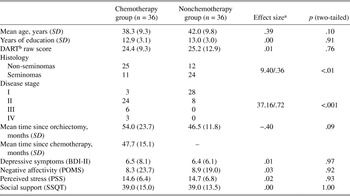
Sociodemographic and clinical characteristics of men treated for TC 2–7 years earlier with BEP (chemotherapy group) or without chemotherapy (nonchemotherapy group)

SD, standard deviation.
a Cohen’s d for continuous variables and χ2/Cramer’s V for categorical variables.
b Danish Adult Reading Test provides an estimate of pretreatment intelligence.
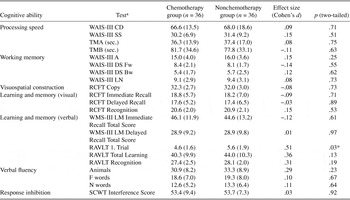
Mean scores and standard deviations of neuropsychological tests of men treated for TC 2–7 years earlier with BEP (chemotherapy group) or without chemotherapy (nonchemotherapy group)

a See Methods section for details of individual tests, including explanations of abbreviations. Lower score means lower performance, except for Trail Making A and B (TMA and TMB). Performances in WAIS-III and Wechsler Memory Scale third edition (WMS-III) subtests are presented as raw scores. The score in verbal fluency tasks was words mentioned in 90 s. By mistake, delayed recall in RAVL was not administered. SCWT, Stroop Color and Word Test.
* Significant at p < .05 level (two-tailed).
Cognitive impairment was evaluated using the method by Schagen et al. (Reference Schagen, Boogerd, Muller, Huinink, Moonen, Meinhardt and Van Dam2008). For each test, patients scoring 2 standard deviations below the mean of the nonchemotherapy group were considered impaired. An overall impairment score for each patient was calculated as the number of tests for which the patient showed impairment. The fifth percentile of the overall impairment scores of the patients in the nonchemotherapy group was used as a cutoff score. The application of this algorithm indicated that patients with test scores 2 standard deviations below mean on four or more of the 21 test measures could be classified as cognitively impaired.
Possible confounding psychological variables were measured by a number of validated questionnaires. Stress was measured with the Perceived Stress Scale (PSS) (Cohen et al., Reference Cohen, Karmarck and Mermelstein1983), depressive symptoms with the Beck Depression Inventory second edition (BDI-II) (Beck et al., Reference Beck, Steer and Brown1996), and social support with the Social Support Questionnaire of Transactions (SSQT) (Suurmeijer et al., Reference Suurmeijer, Doeglas, Briancon, Krijnen, Krol, Sanderman, Moum, Bjelle and Van Den Heuvel1995). Negative affect was measured using the Profile of Mood States (POMS) (Zevon & Tellegen, Reference Zevon and Tellegen1982).
RESULTS
Sociodemographic and Clinical Characteristics
The sociodemographic and clinical characteristics of the participants are shown in Table 1. No differences in sociodemographic and clinical variables known to influence performance in neuropsychological assessment were found between the chemotherapy group and the nonchemotherapy group. Furthermore, there were no group differences in job status (χ2(3,72) = 3.7, p = .30). Almost all participants were employed or enrolled in various educations. Only one participant in the chemotherapy group and two participants in the nonchemotherapy group received retirement benefits.
There was no between-group differences in mean follow-up time, which was approximately 4 years in both groups, and no group differences were found with respect to depressive symptoms, negative affect, stress, or social support.
Neuropsychological Test Results
The neuropsychological test results are presented in Table 2. Univariate analyses showed that men in the chemotherapy group had statistically significant (p < .05) lower scores in the RAVLT first trial, recollecting on average one word less at immediate recall than nonchemotherapy patients. This was the only significant difference out of 21 comparisons. When adjusting the level of significance for multiple comparisons (Bonferroni correction), no differences reached statistical significance.
Assessing possible cognitive impairment in individual participants revealed no difference between groups in the proportion of impaired. In the chemotherapy group, 5.6% of participants were classified as cognitively impaired, compared to 8.3% in the nonchemotherapy group (χ2(1,72) = 0.22, p = .64).
Psychological measures correlated with some of the neuropsychological test scores. Stress (PSS) was associated with poorer performance on tests on working memory (WAIS-III DS Fw) and visual memory (RCFT). Social support (SSQT) was associated with poorer performance on tests on working memory (WAIS-III DS Fw), processing speed (WAIS-III CD), and verbal fluency (F words). Depression (BDI-II) was associated with poorer performance on tests on working memory (WAIS-III LN) and negative affect (POMS) with visual memory (RCFT immediate and delayed recall) (r = −.25 to −.32, all p values <.05). None of the psychological measures were associated with the number of cognitive tests scored in the impaired range (r = −.19 to .03, p > .16), and impaired participants did not differ from the remaining participants on stress, depression, negative affect, or social support (t = −0.10 to 0.77, p > .45).
DISCUSSION
Men with TC who had orchiectomy in combination with chemotherapy 2–7 years earlier (chemotherapy group) performed similarly on neuropsychological tests as men who had orchiectomy only or orchiectomy in combination with radiotherapy (nonchemotherapy group). The chemotherapy group differed from the nonchemotherapy group in only one out of 21 univariate tests, recollecting one word less at immediate recall than the nonchemotherapy group in RAVLT first trial. When correcting for multiple comparisons, no differences in neuropsychological test performance were found. It does not seem likely that this result is attributable to weak statistical power. Effect sizes are small, and there was no sign that one group performed consistently better than the other on the neuropsychological measures. Moreover, when analyzing individual participants, there was no difference between groups in the proportion of cognitively impaired patients. Our results thus do not support the hypothesis of increased risk of long-term cognitive impairment following standard chemotherapy.
Our results are discordant with those of the only published previous study (Schagen et al., Reference Schagen, Boogerd, Muller, Huinink, Moonen, Meinhardt and Van Dam2008) where a larger percentage of cognitively impaired TC patients was found in a group receiving chemotherapy compared to TC patients having orchiectomy only. The reasons for this discordance could hypothetically be related to unknown between-study differences among participants. However, the reasons are not clear and cannot be explained by the published data.
Among the strengths of the present study are that the two investigated groups were very similar and did not differ with regard to age, years of education, intelligence, time since treatment, and psychological distress, parameters that could hypothetically influence the results of neuropsychological testing. In addition to the independent variable of chemotherapy versus no chemotherapy, the two groups only differed with respect to histology, that is, seminomas versus non-seminomas; and disease stage, chemotherapy recipients having more advanced disease. Potentially more advanced disease could in itself influence cognitive function, and it would not be possible to disentangle this effect from the possible effect of chemotherapy; however, chemotherapy recipients were not performing worse on cognitive measures. In addition, there were no between-group differences with other potential confounders of test results, that is, psychological distress.
Regardless of these strengths, the cross-sectional design is a potential limitation of our study of long-term effects, and a prospective design would enable examination of possible changes in neuropsychological test performance over time in the two groups.
Another potential weakness is that no healthy control group was included to calibrate test scores in the analysis of cognitive impairment at the individual level. As pointed out by Schretlen et al. (Reference Schretlen, Testa, Winicki, Pearlson and Gordon2008), the proportion of individuals defined as cognitively impaired will depend on various methodological and population-related factors. Thus, our data do not offer a valid rate of cognitively impaired TC patients, and both the chemotherapy and the nonchemotherapy might include a larger proportion of impaired individuals if compared to healthy controls. This limitation does, however, not concern our conclusion regarding differences between the chemotherapy and the nonchemotherapy groups of TC patients.
Cancer and cancer treatments, for example, surgery, radiotherapy, or chemotherapy, are known to cause psychological distress (van’t Spijker et al., Reference van’t Spijker, Trijsburg and Duivenvoorden1997), which in turn may influence cognitive function (Howiesen & Lezak, Reference Howiesen and Lezak2004), and previous findings of cognitive impairment could be related to this issue. TC patients, who have received chemotherapy, may, as is common among other cancer patients, worry about possible negative long-term effects on cognitive function, which in itself could influence cognitive performance as well as quality of life. In conclusion, it could therefore be important to communicate to patients that there is no consistent evidence to suggest that standard-dose chemotherapy is associated with cognitive decline and that several more recent studies, including the present, are unable to find support for such a hypothesis.
ACKNOWLEDGMENTS
Portions of the work were presented at the 36th annual meeting of the International Neuropsychological Society, Waikoloa, Hawaii. We disclose any financial or other relationships that could be interpreted as a conflict of interest including those (a) with manufacturer(s) of any commercial products(s) and/or provider(s) of commercial services and (b) with any commercial support of the research reported in the manuscript submitted for publication. The study was supported by grants from Aase og Ejnar Danielsens Fond, Augustinusfonden, Fabrikant Ejnar Willumsens Mindelegat, and Kong Christian d. X Fond.