INTRODUCTION
Savanna is a tropical or subtropical vegetation type consisting of a mixture of trees and grasses (Eiten Reference EITEN1992, Scholes & Archer Reference SCHOLES and ARCHER1997, Walter Reference WALTER1971). The co-dominance of trees and grasses in savanna has often been attributed to the consumptive effects of fire (Abbadie et al. Reference ABBADIE, GIGNOUX, LEPAGE, LE ROUX, Abbadie, Gignoux, Le Roux and Lepage2006, Bond et al. Reference BOND, WOODWARD and MIDGLEY2005, Sankaran et al. Reference SANKARAN, HANAN, SCHOLES, RATNAM, AUGUSTINE, CADE, GIGNOUX, HIGGINS, ROUX, LUDWIG, ARDO, BANYIKA, BRONN, BUCINI, CAYLOR, COUGHENOUR, DIOUF, EKAYA, FERAL, FEBRUARY, FROST, HIERNAUX, HRABAR, METZGER, PRINS, RINGROSE, SEA, TEWS, WORDEN and ZAMBATIS2005). Frequent fires inherent to the biome maintain the biomass of the vegetation below the climatically determined optimum, thereby influencing both the structure and function of savanna (Bond et al. Reference BOND, WOODWARD and MIDGLEY2005, Higgins et al. Reference HIGGINS, BOND, FEBRUARY, BRONN, EUSTON-BROWN, ENSLIN, GOVENDER, RADEMAN, O'REGAN, POTGIETER, SCHEITER, SOWRY, TROLLOPE and TROLLOPE2007, Ludwig et al. Reference LUDWIG, DE KROON, BERENDSE and PRINS2004, Sankaran et al. Reference SANKARAN, HANAN, SCHOLES, RATNAM, AUGUSTINE, CADE, GIGNOUX, HIGGINS, ROUX, LUDWIG, ARDO, BANYIKA, BRONN, BUCINI, CAYLOR, COUGHENOUR, DIOUF, EKAYA, FERAL, FEBRUARY, FROST, HIERNAUX, HRABAR, METZGER, PRINS, RINGROSE, SEA, TEWS, WORDEN and ZAMBATIS2005). It has also been suggested that sustained frequent fires cause nitrogen (N) limitation over the long term by volatilizing the nitrogen in soil, plant biomass and litter (Ojima et al. Reference OJIMA, SCHIMEL, PARTON and OWENSBY1994, Raison Reference RAISON1979, Wedin Reference WEDIN, Jones and Lawton1995). Such changes in turn may have important consequences for species composition, diversity and ecosystem functioning (Knapp et al. Reference KNAPP, BRIGGS, BLAIR, TURNER, Knapp, Briggs, Hartnett and Collins1998, Reich et al. Reference REICH, PETERSON, WEDIN and WRAGE2001, Scholes Reference SCHOLES1990, Skowno & Bond Reference SKOWNO and BOND2003).
Much work on the effects of fire on N availability has focused on short-term post-fire effects in prairie and forests (Blair Reference BLAIR1997, Briggs & Knapp Reference BRIGGS and KNAPP1995, Turner et al. Reference TURNER, BLAIR, SCHARTZ and NEEL1997, Wan et al. Reference WAN, HUI and LUO2001). There has been very little research on the long-term effects of fire on net N mineralization rates and cumulative N mineralization in savanna (Aranibar et al. Reference ARANIBAR, MACKO, ANDERSON, POTGIETER, SOWRY and SHUGART2003, Reich et al. Reference REICH, PETERSON, WEDIN and WRAGE2001). Researchers in prairie and grasslands agree that frequent burning will decrease N mineralization rates leading to a decline in the rate at which N becomes available for plant uptake (Blair Reference BLAIR1997, Fynn et al. Reference FYNN, HAYNES and O'CONNOR2003, Johnson & Matchett Reference JOHNSON and MATCHETT2001, Ojima et al. Reference OJIMA, PARTON, SCHIMEL, OWENSBY, Collins and Wallace1990, Reference OJIMA, SCHIMEL, PARTON and OWENSBY1994; Seastedt & Ramundo Reference SEASTEDT, RAMUNDO, Collins and Wallace1990, Turner et al. Reference TURNER, BLAIR, SCHARTZ and NEEL1997). Frequent fire in prairie leads to the dominance of grasses with high nitrogen use efficiency. These grasses have high C : N and lignin : N ratios and the associated slow decomposition reduces nitrogen availability and mineralization rates (Ojima et al. Reference OJIMA, PARTON, SCHIMEL, OWENSBY, Collins and Wallace1990, Reference OJIMA, SCHIMEL, PARTON and OWENSBY1994; Wedin Reference WEDIN, Jones and Lawton1995) The same may not apply in savannas, however, as fire does not always reduce available N (Jensen et al. Reference JENSEN, MICHELSEN and GASHAW2001, Knapp et al. Reference KNAPP, BRIGGS, BLAIR, TURNER, Knapp, Briggs, Hartnett and Collins1998, Raison Reference RAISON1979, Singh Reference SINGH1994).
Previous research on the effects of fire on N mineralization in frequently burned South African ecosystems has resulted in conflicting results with fire either causing a decrease in N mineralization (Fynn et al. Reference FYNN, HAYNES and O'CONNOR2003, Jones et al. Reference JONES, SMITHERS, SCHOLES and SCHOLES1990), leading to higher gross N mineralization (Aranibar et al. Reference ARANIBAR, MACKO, ANDERSON, POTGIETER, SOWRY and SHUGART2003), or having no effect on N mineralization (G. Feig, unpubl. data). These conflicting results may be attributed to the use of different methods to determine N mineralization. For instance, Aranibar et al. (Reference ARANIBAR, MACKO, ANDERSON, POTGIETER, SOWRY and SHUGART2003) collected soil once during the wet season in 2000 and used NO3−-15N and NH4+-15N pool dilution methods to calculate gross N mineralization and nitrification in the laboratory whereas Jones et al. (Reference JONES, SMITHERS, SCHOLES and SCHOLES1990) collected soil once during the late 1988 wet season and incubated the soils anaerobically in the laboratory to calculate potential N mineralization. In this study, we use the treatments of a long-term experimental burn trial, initiated in 1954 to determine the effect of fire on vegetation structure. These trails allow us to compare the long-term effects (∼50 y) of a specific fire regime on nutrient cycling and N mineralization as opposed to the short-term effects that occur immediately after a fire. We do this using three different methods, in situ incubations (Adams & Attiwill Reference ADAMS and ATTIWILL1986, Knoepp & Swank Reference KNOEPP and SWANK1998), laboratory incubations (Wedin & Pastor Reference WEDIN and PASTOR1993) and ion-exchange resin bags (Binkley & Matson Reference BINKLEY and MATSON1983, Binkley et al. Reference BINKLEY, ABER, PASTOR and NADELHOFFER1986). We also measure net N mineralization for a full growing season to account for any intra-annual variation in mineralization rates. The primary objective is to determine the long-term effects of frequent fire on N availability in a southern African savanna.
METHODS
Study area
The study site at Pretoriuskop (31.14° E, 25.08° S) is located in the southern section of the Kruger National Park (KNP) in South Africa. Rain falls mainly between October and April and the mean annual rainfall for the area is 744 mm (Gertenbach Reference GERTENBACH1983). Rainfall consists predominantly of convective thunderstorms from the north and north east or tropical cyclones off the Indian Ocean. Mean monthly temperatures are between 26.3 °C and 17.5 °C. The soils of the region are derived from the underlying Nelspruit granite suite consisting of migmatite, gneiss and granite (Barton et al. Reference BARTON, BRISTOW and VENTER1986). The soils are deep for the region (>100 cm), nutrient-poor sands. Total soil carbon ranges from 5–25 mg C g−1 soil and nitrogen 1706–5249 μg N g−1 soil (K. M. Tucker, unpubl. data) or 0.87% ± 0.18% C and 0.05% ± 0.01% N (G. M. Feig, unpubl. data) on the Shabeni and Kambeni strings of the experimental burn trials. The region is dominated by deciduous broad-leaved savanna with Terminalia sericea Burch and Dichrostachys cinerea (L) Wight & Arn. the common woody species and Hyperthelia dissoluta (Steudel) W. Clayton and Setaria sphacelata (Schum.) Moss the common grasses (Mucina & Rutherford Reference MUCINA and RUTHERFORD2006).
The experimental burn trials in the Kruger National Park are one of few such long-term experiments worldwide (Aldous Reference ALDOUS1934, Ojima et al. Reference OJIMA, SCHIMEL, PARTON and OWENSBY1994, Peterson & Reich Reference PETERSON and REICH2001, Russell-Smith et al. Reference RUSSELL-SMITH, WHITEHEAD, COOK and HOARE2003, Tainton & Mentis Reference TAINTON, MENTIS, Booysen and Tainton1983). The experiment was established in 1954 and is replicated in four of the six major vegetation types in the Kruger National Park. There are four blocks in each of these vegetation types. Each block, called a string, consists of 12 treatments. For our study we use all four strings at Pretoriuskop, referred to as Shabeni, Fayi, Numbi and Kambeni. While the experiment manipulates season and frequency of burn on each treatment, including one fire-exclusion treatment (Biggs et al. Reference BIGGS, BIGGS, DUNNE, GOVENDER and POTGIETER2003, Higgins et al. Reference HIGGINS, BOND, FEBRUARY, BRONN, EUSTON-BROWN, ENSLIN, GOVENDER, RADEMAN, O'REGAN, POTGIETER, SCHEITER, SOWRY, TROLLOPE and TROLLOPE2007), we only used four of these treatments. These include the annual and triennial August burn (dry season), triennial February burn (mid-to-late growing season), and fire-exclusion treatments. On each treatment, we established two parallel transects 100 m apart with five permanent sampling points 30 m apart (10 points per treatment).
We used three different methods for determining N mineralization. On the Shabeni string we used in situ incubations, and ion-exchange resin bags. We also determined potential N mineralization from all four Pretoriuskop strings.
Sampling and analysis
Net nitrogen mineralization – in situ cores. Net rates of N transformations were measured using the in situ core method (Knoepp & Swank Reference KNOEPP and SWANK1998, modified from Adams & Attiwill Reference ADAMS and ATTIWILL1986). Mineralization rates were determined monthly from August 2004 to June 2005 growing season at each of the sampling points in four treatments at Shabeni. At the end of each month, at each sampling point, two 25-cm-long, 4-cm-inside-diameter, steel cores were driven 10 cm into the soil. One core was removed immediately for the time zero determination of soil NO3−-N and NH4+-N concentrations. The paired core was capped with a polyethylene sheet to prevent leaching of NO3−-N, left and retrieved after incubating in the field for 28 d. After collection in the field, soils were kept cool, brought back to the laboratory and refrigerated at 4 °C for up to 48 h prior to processing. The soil from each core was mixed after which a 10-g subsample was shaken with 45 ml of 1 M KCl, made up with deionized water, for 1 h to extract NO3−-N and NH4+-N. The solution was then centrifuged and the supernatant analysed for NO3−-N and NH4+-N on a Technicon Autoanalyser (Technicon Corporation, Ardsley, New York, USA) at the Institute of Soil, Climate and Water of the Agricultural Research Council (ARC), Pretoria.
Daily net N mineralization rates were calculated as: (NF–NI)/(incubation time in days), where NF is the final concentration of total extractable N (NH4+-N + NO3−-N) in post-incubation cores and NI is the initial concentration of total extractable N in the adjacent paired core taken at the start of the incubation period. Net nitrification rates were calculated as: (NO3−-NF–NO3−-NI)/D, where NO3−-NF is the final concentration of NO3−-N in the post-incubation core, NO3−-NI is the initial concentration of total extractable NO3−-N in the adjacent core at the start of the incubation period, expressed as μg NO3–N g−1 d−1, and D is incubation time in days. Cumulative rates of mineralization and nitrification of a treatment were estimated as the sum of the daily values from the different incubation periods. Gravimetric soil water content was used with the concentration of the ion in the extract, mass of soil and volume of extract to calculate mass N concentration in the soil solution (Robertson et al. Reference ROBERTSON, WEDIN, GROFFMAN, BLAIR, HOLLAND, NADELHOFFER, HARRIS, Robertson, Coleman, Bledsoe and Sollins1999). Gravimetric soil water content was determined on a 20-g subsample (Jarrell et al. Reference JARRELL, ARMSTRONG, GRIGAL, KELLY, MONGER, WEDIN, Robertson, Coleman, Bledsoe and Sollins1999).
Potential nitrogen mineralization – laboratory incubations. In February 2005 soil samples from each of the four treatments were taken from all four Pretoriuskop strings. A 7-cm diameter soil auger was used to collect five randomly located samples per treatment to a depth of 10 cm. Before incubation the soils were air-dried and passed through a 2-mm sieve to remove roots and other large organic particles. Prior to analysis the moisture content of the soils was adjusted to 60% water-filled pore space. One of two 10-g samples from each sampling point was immediately analysed following the spectrophotometric technique of Diatloff & Rengel (Reference DIATLOFF and RENGEL2001). The paired sample was covered with Parafilm M® and kept in a humidified incubator at 25 °C for 16 d before analysing for inorganic N concentrations. The results of the two subsamples were used as the initial and final values for potential N mineralization.
Ion-exchange resin bags. Ten resin bags per treatment were placed in close proximity to the sampling points used for the in situ core method (method adapted from Binkley & Matson Reference BINKLEY and MATSON1983 and Binkley et al. Reference BINKLEY, ABER, PASTOR and NADELHOFFER1986). Every bag contained approximately 8 g of mixed bed resin (mixed anion and cation exchange Dowex MR3 resin in bags made from printers' screen). Bags were buried horizontally at 5 cm depth and left in the field for 1 y (August 2004 to August 2005). Resin bags were then collected, larger roots and stones removed by hand and the bags rinsed with deionized water to remove fine roots and soil. The bags were then transferred into glass jars and extracted overnight with 100 ml of 2 M KCl and analysed for inorganic N concentrations as previously described. The rate of inorganic N accumulation is presented as mmol per resin bag surface (i.e. 40 cm2). Inorganic N concentrations were analysed following the method of Diatloff & Rengel (Reference DIATLOFF and RENGEL2001) as described for potential N mineralization.
RESULTS
In situ net N mineralization
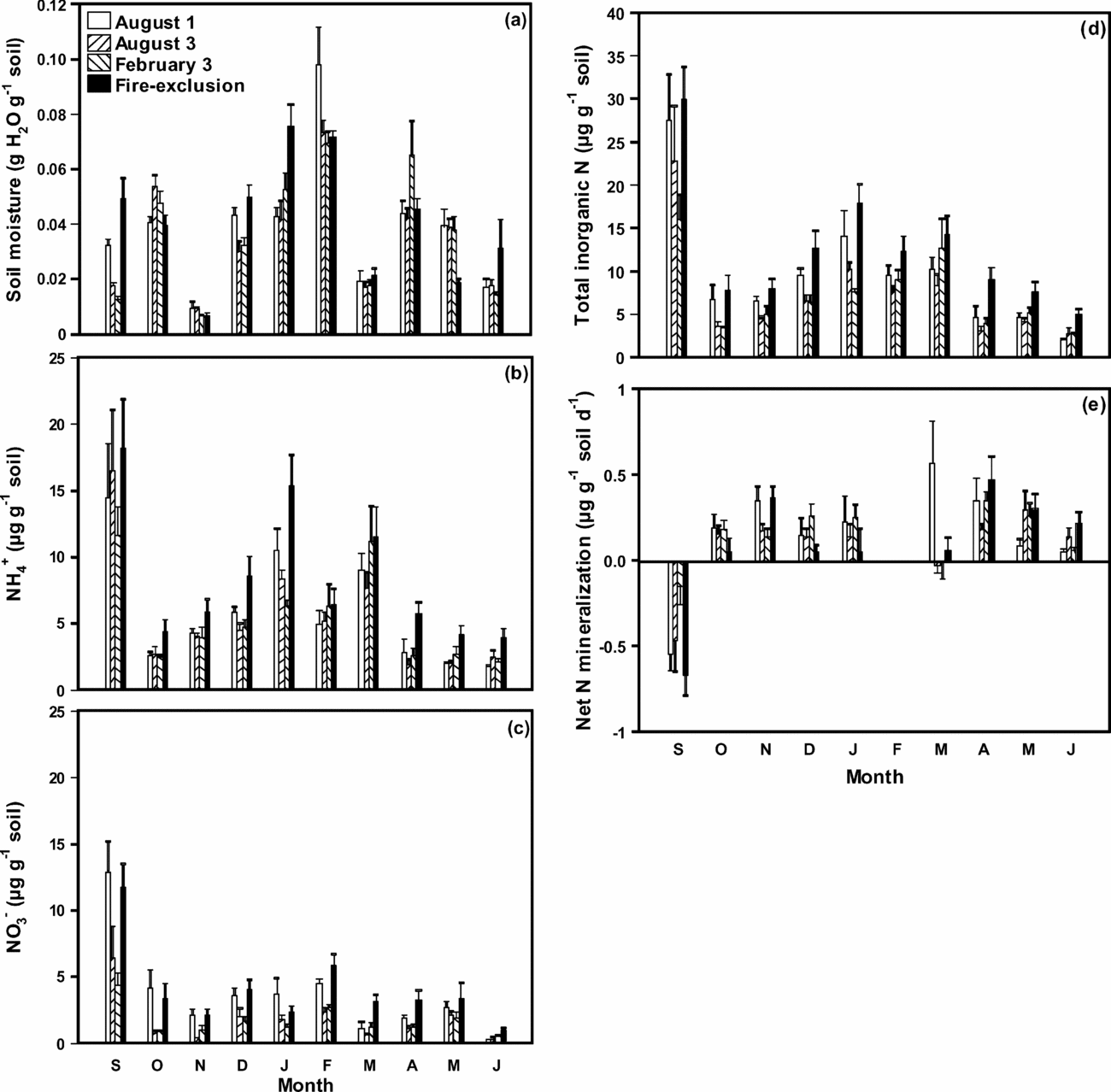
At the end of the dry season (August–September), soil moisture was higher in the fire-exclusion treatment than in the triennial burns. For the rest of the growing season, soil moisture did not vary significantly among treatments in the surface 15 cm of soil, but did vary temporally (Figure 1a). Soil moisture was greatest in January–February in the annual burn (0.17 g H2O g−1 soil) and least in October–November in the fire-exclusion treatment (0.002 g H2O g−1 soil).
The effect of four fire treatments (August 1 = August annual and August 3 = triennial burns, February 3 = February triennial burn and fire exclusion) measured at Shabeni on monthly (S to J, September to June) measurements of soil moisture, inorganic nitrogen concentrations and net N mineralization. Soil moisture (g H2O g−1 soil) (a), NH4+ concentrations (μg g−1 soil) (b), NO3− concentrations (μg g−1 soil) (c), total inorganic N concentration (NH4+ + NO3−, μg g−1 soil) (d), and net N mineralization (μg g−1 soil d−1) (e) Error bars are 1 SE.

Inorganic N concentrations were greatest at the end of the dry season (Figure 1b–d). During this time, NH4+ concentrations were the highest in the fire-exclusion treatment (18.2 ± 3.73 μg g−1 soil) and NO3− concentrations were the highest in the annual burn (12.9 ± 2.67 μg g−1 soil). At the end of the wet season (May–June), inorganic N concentrations reached their lowest concentrations. At this time, NH4+ and NO3−concentrations were the highest in the fire-exclusion treatment (3.90 ± 0.69 and 1.01 ± 0.17 μg g−1 soil respectively).
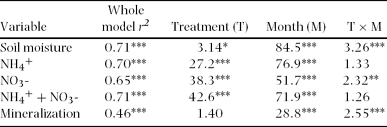
Averaged across all sampling dates, mean concentrations of NH4+ (Figure 1b) in the soil were greater in the fire-exclusion treatment than the burned treatments (Table 1, F3,317 = 27.2, P < 0.0001). However, this was not consistent for all months. The fire-exclusion treatment had higher NH4+ concentrations than the February triennial burn in January–February and higher than the August triennial burn in April–May (Figure 1b, F8,317 = 76.9, P < 0.05). NO3− concentrations, averaged across sampling dates, were greater in the August annual burn and fire-exclusion treatment than the triennial burns (Table 1, F3,317 = 38.3, P < 0.0001). NO3− concentrations were greater in the August annual burn in October–November and greater in the fire-exclusion treatment in June–July when compared to the triennial burns (Figure 1c, F8,317 = 51.7, P < 0.0001). When NO3− and NH4+ were combined for total inorganic N (Figure 1d), concentrations were high in the beginning of the season, regardless of treatment. The fire-exclusion treatment had higher N concentrations than the triennial burns in January–February and March–April and higher than the annual burn in May–June (F24,317 = 42.6, P < 0.05).
Effects of fire (annual and triennial August burn, triennial February burn and fire exclusion) and sampling month (growing season lasting from August to June) on monthly soil moisture, monthly inorganic N concentrations and daily in situ nitrogen mineralization on the Shabeni string. The results of a two-way ANOVA with F-ratios and significance levels (***P < 0.001, **P < 0.01 and *P < 0.05) are shown.

The inorganic nitrogen values obtained for February were not included in the analysis for N mineralization as the integrity of the samples at the end of incubation was questioned. Fire treatment had no significant effect on daily net N mineralization rates (Table 2, F3,300 = 1.37, P = 0.25). N mineralization did differ amongst months and was the highest in March/April (0.33 ±0.05 μg g−1 soil d−1) and lowest in August–September (−0.46 ± 0.05 μg g−1 soil d−1, Figure 1e, F8,300 = 23.7, P < 0.0001). The interaction between treatment and month was significant (F24, 300 = 2.54, P = 0.0001) with N mineralization higher in the August annual burns than the August triennial burns in March–April and higher in the February triennial burns than the fire exclusion in September–October (Tukey post hoc LSD, P = 0.0001).
The effects of fire (Aug 1 = August annual and Aug 3 = August triennial burn, Feb 3 = February triennial burn) on inorganic nitrogen concentrations and N mineralization rates as determined by different methods. The values are mean ± SE. Fire treatment had no significant effect on resin-absorbed N concentrations and N mineralization rates, but in situ total inorganic N concentrations were higher in the fire-exclusion than in annual burn and higher in the annual burn than in the triennial burns (two-way ANOVA, Tukey post hoc LSD, P < 0.0001).

Potential nitrogen mineralization
Our results show that potential net N mineralization rates with laboratory incubations are higher than in situ incubations. There were no significant differences in potential N mineralization rates with fire treatment (Table 2, F3,64 = 1.43, P = 0.16). Although the results show no significant differences among treatments, trends for potential N mineralization rates and net N mineralization rates were similar (Table 2). Potential mineralization rates, however, were measured in all four strings of the Pretoriuskop experiment while in situ net N mineralization rates were only measured in the Shabeni block. When the analysis was repeated, we found that at Shabeni the short-term laboratory incubations reflected the same trends as the long-term in situ incubations.
Ion-exchange resin bags
Although the August annual burn and the fire-exclusion treatment had higher concentrations of total inorganic N these results were not statistically significant (Table 2, F3,29 = 1.66, P = 0.19). The results show that ion exchange resin bags and in situ incubation cores reflected different amounts of inorganic concentrations. The in situ incubations show that NH4+ was more than four times that of the NO3− concentrations. NH4+ concentrations in the resin bags were, however, less than half that of NO3− concentrations.
DISCUSSION
Regardless of whether mineralization was measured by laboratory incubation or in situ incubation, our results show that there are no significant differences in daily N mineralization rates after 50 y of different burning treatments, from annual burning to complete fire exclusion. These results agree with previous research in ponderosa pine stands in the American south-west where frequent fires enhance N availability (Grogan et al. Reference GROGAN, BURNS and CHAPIN2000). Here, grasses with higher leaf N concentrations replace less nitrogen-rich pine leaves, causing N cycling and availability to increase with frequent fire (Covington & Sackett Reference COVINGTON and SACKETT1986, Kaye & Hart Reference KAYE and HART1998). On the experimental burn trials, the nitrogen concentrations of the dominant grasses Heteropogon contortus (L.) Roem. & Schult (∼11 mg N kg−1) and Panicum maximum Jacq. (∼16 mg N kg−1) have comparable values to the leaves of the dominant tree, Terminalia sericea (∼15 mg N kg−1, C. Coetsee, unpubl. data). As a result, a shift in greater grass:tree ratios with frequent fire will not cause a decrease in available N through the altered quality of litter inputs. Contrary to this, research in North American oak savanna and prairie have shown decreased N mineralization rates with increased fire frequency (Blair Reference BLAIR1997, Ojima et al. Reference OJIMA, PARTON, SCHIMEL, OWENSBY, Collins and Wallace1990, Reference OJIMA, SCHIMEL, PARTON and OWENSBY1994; Reich et al. Reference REICH, PETERSON, WEDIN and WRAGE2001). The grass species that become dominant with frequent fire in these systems are efficient in their nitrogen use with high C : N and lignin : N ratios in litter (Ojima et al. Reference OJIMA, SCHIMEL, PARTON and OWENSBY1994, Wedin Reference WEDIN, Jones and Lawton1995). The high potential for N immobilization when this litter decomposes translates into reduced N availability and turnover (Dijkstra et al. Reference DIJKSTRA, WRAGE, HOBBIE and REICH2006, Ojima et al. Reference OJIMA, SCHIMEL, PARTON and OWENSBY1994, Reich et al. Reference REICH, PETERSON, WEDIN and WRAGE2001, Wedin Reference WEDIN, Jones and Lawton1995).
Savannas have inherent ecosystem characteristics which minimize nitrogen loss with fire. These include physical adaptations such as thick, fire-resistant bark in savanna trees, greater allocation to root biomass which confers greater resprouting ability and nitrogen resorption by trees and grass roots in the dry season when fires usually take place (Bond & van Wilgen Reference BOND and VAN WILGEN1996, Hoffmann et al. Reference HOFFMANN, ORTHEN, VARGAS and NASCIMENTO2003, Kauffman et al. Reference KAUFFMAN, CUMMINGS and WARD1994). These adaptations may contribute to modest nitrogen losses with frequent fire in some savannas and ultimately little effect of frequent fire on N mineralization (Abbadie et al. Reference ABBADIE, MARIOTTO and MENAUT1992, Menaut et al. Reference MENAUT, ABBADIE, VITOUSEK, Crutzen and Goldammer1993, Singh Reference SINGH1994).
An important attribute of many African savannas such as at our study site is the presence of large mammalian herbivores. The annual burns in our study are heavily utilized by grazers such as impala (Aepyceros melampus Lichtenstein) (Mills & Fey Reference MILLS and FEY2005). Herbivores decrease fire intensity by removing biomass thereby decreasing N loss though volatilization. Grazers may also conserve up to 50% of nitrogen by moving N from above-ground to below-ground pools via urinary and faecal excretion (Hobbs et al. Reference HOBBS, SCHIMEL, OWENSBY and OJIMA1991). In prairie, frequent burning in the absence of grazers causes a reduction in net N mineralization rates but in the presence of grazers, fire-driven nitrogen losses are compensated by annual inputs from dry and wet deposition as well as microbial fixation (Anderson et al. Reference ANDERSON, FUHLENDORF and ENGLE2006, Hobbs et al. Reference HOBBS, SCHIMEL, OWENSBY and OJIMA1991, Ojima et al. Reference OJIMA, SCHIMEL, PARTON and OWENSBY1994).
For savanna, losses of N through fire are often compensated for by N deposition and N fixation (Jensen et al. Reference JENSEN, MICHELSEN and GASHAW2001, Medina Reference MEDINA1982, Menaut et al. Reference MENAUT, ABBADIE, VITOUSEK, Crutzen and Goldammer1993). In their review of nutrient dynamics in tropical savannas, Menaut et al. (Reference MENAUT, ABBADIE, VITOUSEK, Crutzen and Goldammer1993) discussed the conflicts which exist in the evaluation of the effects of fire on nitrogen pools and fluxes. They conclude that there is an inherent negative bias toward fire. Even though fire is perceived to cause a decline in N availability, frequent fires seldom decrease productivity in prairie or savanna (Abbadie et al. Reference ABBADIE, GIGNOUX, LEPAGE, LE ROUX, Abbadie, Gignoux, Le Roux and Lepage2006, Isichei Reference ISICHEI and Rosswall1980, Jensen et al. Reference JENSEN, MICHELSEN and GASHAW2001, Ojima et al. Reference OJIMA, PARTON, SCHIMEL, OWENSBY, Collins and Wallace1990, Reference OJIMA, SCHIMEL, PARTON and OWENSBY1994; Medina Reference MEDINA1982, Menaut et al. Reference MENAUT, ABBADIE, VITOUSEK, Crutzen and Goldammer1993). The perceived negative effects of fire on ecosystem functioning has curbed the use of fire as a management tool and fire has often been actively suppressed in savanna systems in the past. Widespread woody encroachment has probably been, in part, a consequence of this fire suppression. The results of this study lend credence to the idea that fire can be used much more vigorously in African savannas to manipulate tree:grass ratios without negative effects on nitrogen cycling.
ACKNOWLEDGEMENTS
This project was funded with grants from the South African NRF and the Andrew Mellon Foundation. The Skukuza Scientific Services staff from the South African National Parks provided logistical and other support. Annoit Mashele, Fiona Ballantyne and Ben Wigley assisted in field and laboratory work.