Introduction
Since their introduction into clinical practice in the 1980s, selective serotonin reuptake inhibitors (SSRIs) quickly replaced tricyclic antidepressants as the treatment of choice for many psychiatric disorders due largely to their more favourable safety profile and less toxicity in overdose.Reference Mant, Rendle and Hall1–Reference Goldstein and Goodnick3 Consequently, there has been an increase in the number of women of childbearing age taking SSRIs, many of whom continue to take them throughout pregnancy, despite limited evidence of their effects in the offspring.Reference Andrade, Raebel and Brown4
While most commonly used in the treatment of depression, SSRIs are also used in the management of a number of psychiatric disorders including social anxiety disorder, obsessive compulsive disorder and panic disorder.Reference Masand and Gupta5 SSRIs exert their pharmacological effects by selectively inhibiting the reuptake of serotonin (5-hydroxytryptamine or 5-HT) at the presynaptic junction, resulting in an increased concentration of 5-HT in the synaptic cleft and thus enhanced serotonergic neurotransmission.Reference Van Harten6 As such, SSRI use during pregnancy could alter foetal 5-HT signalling during critical periods of foetal development, the immediate and long-term consequences of which have not been well studied. To date, the collective evidence suggests that prenatal SSRI exposure is not associated with impaired neurodevelopment in the offspring; however, due to methodological differences and limitations associated with previous studies, it is difficult to draw any definitive conclusions.Reference Grzeskowiak, Gilbert and Morrison7
Given the importance of 5-HT as a neurotransmitter within the central nervous system and its role in neurogenesis, migration and differentiation of neurons in the foetal brain, the potential long-term effects of prenatal SSRI exposure remain an area of concern.Reference Lattimore, Donn and Kaciroti8, Reference Whitaker-Azmitia9 Of particular interest are the potential long-term effects of prenatal SSRI exposure on child growth, given the well-established role of the serotonergic system in regulating food intake and body weight.Reference Blundell and Halford10–Reference Sargent and Henderson12
Animal studies provide clear evidence that changes in 5-HT homeostasis during critical periods of foetal development can lead to alterations in the serotonergic system and that these alterations are sex specific.Reference Li, Wichems and Ma13–Reference Lisboa, Oliveira, Costa, Venancio and Moreira18 There is evidence to suggest that auto-inhibitory feedback restrains the maturation of the 5-HT system.Reference Oberlander, Gingrich and Ansorge19 It is therefore possible that in the situation where serotonergic tone is increased as a result of SSRI exposure, there is a resultant increase in negative feedback signalling, restraining the maturation of the serotonergic system. As such, it is possible that altered development of the serotonergic system in early foetal life modifies serotonergic regulation of food intake and body weight in later life, influencing the risk of overweight. Supporting this hypothesis is evidence from animal studies demonstrating that exposure to high levels of 5-HT in utero leads to an increased risk of late-onset obesity in males, but not in females.Reference Line, Barkus and Coyle16–Reference Lisboa, Oliveira, Costa, Venancio and Moreira18
A small number of human studies have investigated the short-term effects of SSRI use during pregnancy and/or breastfeeding on infant weight gain,Reference Chambers, Anderson and Thomas20–Reference Lewis, Galbally, Opie and Buist24 with the majority finding no association.Reference Merlob, Stahl and Sulkes21–Reference Hendrick, Smith, Hwang, Altshuler and Haynes23 Chambers et al.,Reference Chambers, Anderson and Thomas20 however, demonstrated that infants who were born to mothers who took fluoxetine during pregnancy and while breastfeeding displayed a pattern of growth that was significantly lower than that of infants who were breastfed by mothers who did not take fluoxetine.Reference Chambers, Anderson and Thomas20 Between 2 weeks and 6 months of age, infants of mothers taking fluoxetine while breastfeeding had an average weight deficit of 392 g (95% CI −5, −750).Reference Chambers, Anderson and Thomas20 It is unclear whether the observed effects were related to prenatal and/or postnatal exposure to fluoxetine. A recent study by Lewis et al.,Reference Lewis, Galbally, Opie and Buist24 specifically measured the effects of prenatal exposure to antidepressants on infant weight gain, up until 1 month of age.Reference Lewis, Galbally, Opie and Buist24 They observed a reduction in mean weight gain during the first month of life in infants exposed to an antidepressant during pregnancy compared with controls (22.71 v. 31.81 g/day; P = 0.002).Reference Lewis, Galbally, Opie and Buist24 It was not clear how many women exposed to antidepressants were using SSRIs, and no adjustments were made for breastfeeding status or sex. In addition, these studies did not control for underlying maternal illness, the effects of which are important to separate from those of prenatal SSRI exposure.
Based on available animal and human studies, there is evidence that prenatal SSRI exposure has the potential to affect growth and body weight in the offspring in later life, but no data are available from human studies that investigate this outcome beyond 6 months of age. While these infants may be smaller during early postnatal life, there is no evidence of what happens to these infants beyond this period and whether they have an increased risk of overweight as observed in animal studies. Therefore, we hypothesized that prenatal exposure to SSRIs influences growth and body weight in the offspring in a sex-specific manner, leading to an expected increased risk of overweight in males, but not in females. This study used routinely collected administrative and clinical data to examine the influence of prenatal SSRI exposure on the risk of overweight in the offspring at 4–5 years of age.
Method
This was a retrospective cohort study relating to all births in the Women's and Children's Health Network (WCHN) in South Australia between September 2000 and December 2005 that occurred at the Women's and Children's Hospital (WCH). The WCH is a specialist metropolitan tertiary-level teaching hospital and South Australia's largest maternity and obstetric service provider, caring for over 4000 pregnancies each year. The study utilized linkable health administrative data within the WCHN, which included the WCH Perinatal Statistics Collection, the WCH Hospital Pharmacy Dispensing Records and the WCHN Child Health Record, to obtain follow-up data on child weight and height. Electronic records were first matched using each individual's unique hospital identifier number, and where this was not possible, through an exact match on the following three variables: surname, sex and date of birth.
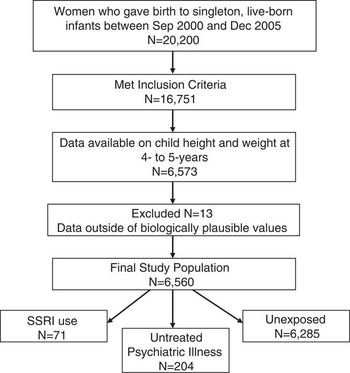
A total of 21,733 pregnancies occurred during the study period. Women who were eligible for the current analysis were those who gave birth to singleton, live-born infants (n = 20,200). We excluded women who were dispensed an antidepressant other than SSRIs during pregnancy (n = 75), antipsychotics (n = 47) and anti-epileptics (n = 123) as well as women with asthma (n = 1836), hypertension (n = 250), diabetes (n = 140), gestational diabetes (705) and thyroid disorders (n = 273), leaving a total eligible study cohort of 16,751 mother–child dyads. These women were excluded due to the potential for these medications and medical conditions to negatively impact on foetal growth during pregnancy, which in turn could be an important factor in determining the risk of overweight in later life. We further obtained height and weight data at 4–5 years of age for 6573 children, of whom 13 were considered outside of biologically plausible values based on predefined criteria. This left a final study cohort of 6560 mother–child dyads (Fig. 1).
Selection of the study population. SSRI, selective serotonin reuptake inhibitor.

Data on exposure to SSRIs during pregnancy were obtained from the WCH Pharmacy Dispensing Records, which is a record of all medications dispensed from January 2000, and has been previously validated as an indicator of late gestation exposure to antidepressants during pregnancy.Reference Grzeskowiak, Gilbert and Morrison25 In an effort to obtain a suitable control group consisting of women with similar underlying disease as those exposed to SSRIs during pregnancy, we identified a cohort of women with a reported psychiatric illness during pregnancy, but who did not receive a dispensing for any antidepressant during pregnancy (untreated psychiatric illness).
The primary outcome measure was childhood overweight at 4–5 years of age. Body mass index [BMI = weight (kg)/height (m)2] was calculated based on measured height and weight at the health check. BMI-for-age percentiles were calculated using the Centres for Disease Control and Prevention SAS Program (CDC, Atlanta, GA, USA) designed for this purpose. International cut-off scores were utilized to define overweight as a BMI at or exceeding the age- and sex-specific 85th percentile.Reference Cole, Bellizzi, Flegal and Dietz26
South Australia's WCHN (previously called Children, Youth and Women's Health Service and Child and Youth Health) provides a range of health and social services and programmes for parents, children and young people across the state. As part of these services, child and family health nurses have performed health checks on 4- to 5-year-old children at all kindergartens and preschool centres since 1995. During these visits, they have used a standard protocol to measure height with a fixed tape and weight of children dressed in underwear, and they have recorded data electronically. From 1997 through 2007, the period of child follow-up in this study, the average participation rate was ∼65% of South Australian children.
Information on maternal age, BMI, parity, race, socioeconomic status, smoking status and breastfeeding at discharge from hospital was obtained from the Perinatal Statistics Collection. Clinical Information Services at the WCH is responsible for maintaining the Perinatal Statistics Collection. Data are collected on the pregnancy and outcome of every live birth and late foetal death occurring at the WCH including on every baby admitted to the Neonatal Intensive Care Unit and Special Care Baby Unit. The data are collected according to the guidelines of the Pregnancy Outcome Unit of the South Australian Department of Health for the Supplementary Birth Records (SBRs) and in consultation with the senior clinicians at the hospital. Data collection began in the late 1980s and complete and validated data are available from 1990. Data are collected from the woman's medical records following delivery by a specially trained research midwife using a structured coding sheet. It is important to note that included in the medical record is the South Australian Pregnancy Record, which is a hand-held antenatal record carried by each woman throughout her pregnancy and contains notes by all health providers consulted during the pregnancy.27 From the medical records, information is collected on maternal illnesses (e.g. diabetes, gestational diabetes, epilepsy, asthma and psychiatric illness), lifestyle factors (e.g. smoking), obstetric history, course of delivery, pregnancy complications and newborn characteristics (e.g. birth weight). All SBRs are checked manually for completeness and data discrepancies by a senior research midwife and then subjected to a series of automated validation procedures during data entry. The information in the perinatal statistics collection has been previously validated and is reliable when compared with hospital case records.Reference McLean, Scott, Keane, Sage and Chan28
The estimated length of gestational age at delivery is recorded in the Perinatal Statistics Collection and is based on the last menstrual period and ultrasound examination. The appropriateness of intrauterine growth was assessed using percentage of optimal birth weight (POBW).Reference Blair, Liu, De Klerk and Lawrence29 POBW is the ratio of the observed to the ‘optimal’ birth weight, with the latter calculated from a regression equation that takes account of the major non-pathological determinants of intrauterine growth including gestational age, infant sex, maternal height and parity.Reference Blair, Liu, De Klerk and Lawrence29 We used a POBW score less than the 10th percentile to define small-for-gestational-age (SGA) infants and a score greater than the 90th percentile to define large-for-gestational-age (LGA) infants.
Parity was defined as no previous deliveries (nulliparity) or one or more previous deliveries. Maternal race or ethnic group was classified as Caucasian, Asian or other. Data on smoking are routinely collected during the first antenatal visit and therefore reflects smoking status during early pregnancy. The smoking variable was categorized into non-smokers and smokers and stratified according to the number of cigarettes smoked on average each day (1–9; 10–19; ⩾20). Socioeconomic status for each woman was determined using her residential postcode at the time of delivery. Women were then ranked according to their level of advantage, or relative disadvantage, based on data from the Socio-Economic Indexes for Areas, calculated from the Australian Bureau of Statistics’ 5-yearly Census of Population and Housing. These indexes are widely used measures of relative socioeconomic status.30
All data analysis was undertaken on de-identified data. We conducted univariate categorical analyses using the χ 2-test or Fisher's exact test where appropriate. Unpaired t-tests were used for two-group comparisons and one-way analysis of variance for three-group comparisons of normally distributed continuous variables. We compared the rates of overweight between groups using a generalized linear model (Poisson distribution) with robust variance estimates, with resulting prevalence ratios (prevalence of disease in exposed v. prevalence in unexposed) for the effect estimate and 95% confidence intervals (CIs). This model was chosen over a log binomial generalized linear model as the latter failed to converge. The commonly used logistic regression model for dichotomous outcomes was not used as the prevalence of overweight in the cohort was relatively common (i.e. >10–20%) and a measure approximating the relative risk was preferred to an odds ratio to enhance the interpretability of the results.Reference Greenland31 Potential confounding maternal and child covariates were categorized as shown in Table 1. All categorical variables were coded as a number of dummy variables equal to the number of categories minus 1. In the first adjusted model, we included confounders and covariates chosen a priori, which were maternal age, BMI, race, socioeconomic status, parity and smoking status. In the second adjusted model, we also included additional covariates including appropriateness of foetal growth (SGA and LGA) and breastfeeding at discharge from hospital. Interactions were investigated by stratified analyses and multivariate analyses with interaction terms. We further stratified analyses according to sex due to the possible presence of effect measure modification. Statistical analyses were performed using Stata IC 11.0 (Stata, College Station, TX, USA). Statistical significance was defined as a two-sided P-value of 0.05.
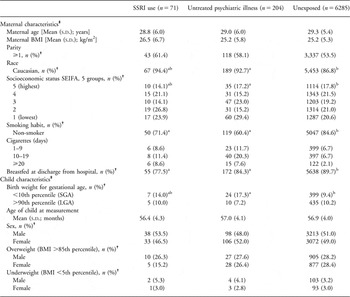
Maternal and child characteristics in each of the three comparison groups

SSRI, selective serotonin reuptake inhibitor; BMI, body mass index; SEIFA, socio-economic indexes for areas; SGA, small-for-gestational-age; LGA, large-for-gestational-age.
†Percentages are calculated from non-missing data.
‡Different superscripts (e.g. a, b) denote a statistically significant difference between groups (P < 0.05).
This project was approved by the Human Research Ethics Committees of the University of South Australia and the Women's and Children's Health Network in South Australia.
Results
Of the mother–child dyads who had follow-up data on weight and height (n = 6560), 71 received a dispensing for an SSRI (exposed), 204 had a reported psychiatric illness but did not receive a dispensing for any antidepressant (untreated psychiatric illness) and 6285 did not have a reported psychiatric illness and did not receive a dispensing for any antidepressant (unexposed).
Women exposed to SSRIs had very similar characteristics compared with women with an untreated psychiatric illness, but were less likely to have been breastfeeding their infant at the time of discharge from hospital (Table 1). Compared with unexposed women, women who were exposed to SSRIs and those with untreated psychiatric illness were more likely to be Caucasian, of lower socioeconomic status, smokers and were less likely to have been breastfeeding their infant at the time of discharge from hospital.
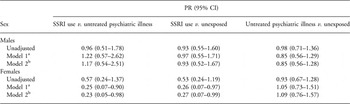
Statistically significant associations were only identified among female offspring (Table 2). Female offspring of exposed mothers were less likely to be overweight then female offspring of mothers with an untreated psychiatric illness (adjusted Prevalence Ratio (aPR) 0.23; 0.05–0.98). When compared with female infants of unexposed mothers, the observed reduced risk of overweight was similar in female offspring of exposed mothers (aPR 0.27; 0.07–0.99). In contrast to females, no association with overweight was observed among male offspring of exposed mothers compared with male offspring of mothers with an untreated psychiatric illness (aPR 1.17; 0.54–2.51) and male offspring of unexposed mothers (aPR 0.93; 0.52–1.67).
Risk of childhood overweight at 4–5 years of age following prenatal exposure to SSRIs and untreated psychiatric illness

SSRI, selective serotonin reuptake inhibitor; PR, prevalence ratio; CI, confidence interval.
aModel 1: adjusted for maternal age, socioeconomic status, smoking status, race, parity and maternal body mass index.
bModel 2: adjusted for those in model 1 as well as foetal growth and breastfeeding status at discharge from hospital.
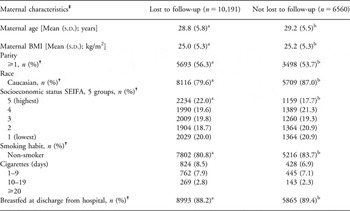
The sample size did not allow stratification according to individual type of SSRI. The age of the children at follow-up did not differ significantly between groups. While loss to follow-up was not statistically significantly different across groups, we found a number of overall differences between those lost to follow-up and those not lost to follow-up (Table 3). The mothers of those lost to follow-up were more likely to have a lower BMI, be younger, multiparous, of a higher socioeconomic status, to smoke during pregnancy and were less likely to be of Caucasian race and to have been breastfeeding at discharge from hospital.
Differences in maternal characteristics between those lost and not lost to follow-up

BMI, body mass index; SEIFA, socio-economic indexes for areas.
†Percentages are calculated from non-missing data.
‡Different superscripts (e.g. a, b) denote a statistically significant difference between groups (P < 0.05).
Discussion
Our results suggest that prenatal SSRI exposure could be associated with sex-specific long-term alterations in child growth and body weight, with a decreased risk of overweight observed among females, but not males, at 4–5 years of age. These results could reflect a persistent reduction in growth among female offspring that could be a possible continuation of that observed in the first 1–6 months of postnatal life following prenatal exposure to fluoxetine and other antidepressants in previous studies.Reference Chambers, Anderson and Thomas20, Reference Lewis, Galbally, Opie and Buist24 Notably, the results of this study appeared to be independent of the effects of untreated psychiatric illness during pregnancy, which itself was not associated with the risk of childhood overweight at 4–5 years of age.
A recent review of Australian studies that included children aged 2–18 years of age demonstrated that the prevalence of overweight among males and females has steadily increased from ∼10% in 1985 and has settled around 21–25% in recent years (up to 2008).Reference Olds, Tomkinson, Ferrar and Maher32 This is similar to the prevalence of overweight observed in this study. Some may view the reduced rate of overweight observed among female offspring with prenatal SSRI exposure as a positive; however, it is also important to consider the potential explanation and mechanism underpinning this reduced risk of overweight. Given that the effects on foetal growth are postulated to occur as a direct result of alterations in the programming of appetite control and regulatory pathways, these results are important in highlighting the potential vulnerability of the developing foetal brain to prenatal SSRI exposure. In addition, given the reported sex differences observed, these results may indicate sex differences in the susceptibility of the developing foetal brain to prenatal SSRI exposure.
Sex-specific outcomes, as observed in this study, are consistent with the literature. There are sex variations in human brain development and function, including differences in the serotonergic system.Reference Jovanovic, Lundberg and Karlsson33, Reference Cosgrove, Mazure and Staley34 In addition, sex-specific differences have been observed in many animal studies, highlighting sex differences in the susceptibility of the foetal brain to SSRI exposure.Reference Li, Wichems and Ma13–Reference Lisboa, Oliveira, Costa, Venancio and Moreira18
An association between prenatal SSRI exposure and childhood overweight could be expected, given the well-recognized role of 5-HT in regulating food intake and body weight.Reference Blundell and Halford10–Reference Sargent and Henderson12 The inhibitory effects of 5-HT on food intake have been related to its interactions with 5-HT1B and 5-HT2C receptors in the hypothalamus,Reference Blundell and Halford10, Reference Halford, Harrold, Lawton and Blundell11 while stimulatory effects of 5-HT on food intake have been reported following agonism of 5-HT1A, and 5-HT6 receptors.Reference Sargent and Henderson12, Reference Üçeyler, Schütt and Palm17, Reference Yadav, Oury and Suda35, Reference Collin, Bäckberg, Önnestam and Meister36
Animal studies provide clear evidence that changes in 5-HT homeostasis during critical periods of foetal development can lead to a number of alterations in the serotonergic system. Those studies that include females demonstrate striking sex-specific differences. For example, prenatal exposure to SSRIs has been demonstrated to result in an increase in the expression of 5-HT2A receptors in the hypothalamus in female, but not male, offspring.Reference Li, Wichems and Ma13 Given the important role of 5-HT2A in regulating food intake and body weight, an increase in expression could result in increased feelings of satiety and therefore a reduction in food intake and net reduction in body weight. This could explain the observed reduction in the risk of overweight observed in female offspring with prenatal SSRI exposure compared with those who were unexposed. Furthermore, prenatal exposure to SSRIs has been demonstrated to cause a reduction in the expression of 5-HT1A receptors in a number of brain regions.Reference Li, Wichems, Heils, Lesch and Murphy14, Reference Bouali, Evrard and Chastanet15 Given that agonism of 5-HT1A receptors has been demonstrated to result in hyperphagia,Reference Collin, Bäckberg, Önnestam and Meister36, Reference Hutson, Dourish and Curzon37 a reduction in the density of 5-HT1A receptors may result in a reduction in the usual hyperphagic response to circulation levels of 5-HT, resulting in a net reduction in food intake and body weight in females. Notably, further analysis revealed no statistically significant differences in the risk of underweight (BMI-for-age <5th percentile) in females at 4–5 years of age, suggesting that these females have lower BMI-for-age percentiles that remain in the normal range.
While male mice exposed to excessive levels of 5-HT in utero display a number of alterations in serotonergic function that could influence their susceptibility towards the development of overweight in later life, no differences in the rates of overweight were observed between the groups. In contrast to the effects observed in females, prenatal SSRI exposure has been demonstrated to cause a decrease in expression,Reference Cabrera and Battaglia38 and/or function,Reference Qu, Villacreses, Murphy and Rapoport39, Reference Moya, Fox and Jensen40 of hypothalamic 5-HT2A/2C receptors in male offspring. Therefore, a reduction in the expression and/or function of 5-HT2A/2C receptors could be expected to result in a reduction in feelings of satiety and therefore an increase in food intake and net increase in body weight. In addition, male 5-HTT knockout mice have been demonstrated to develop late-onset obesity with associated reductions in physical activity, while females have been shown to be protected from this obese phenotype.Reference Line, Barkus and Coyle16–Reference Lisboa, Oliveira, Costa, Venancio and Moreira18 The lack of a clear effect in this study of prenatal SSRI exposure on childhood overweight in male offspring could be due to the compensatory adaptive responses that could occur in alternative systems involved in energy homeostasis to maintain normal growth throughout life. Alternatively, it is also possible that functional alterations may only become apparent at later time points, necessitating the need for longer-term follow-up data.
While prenatal exposure to maternal stress has been associated with an increased risk of overweight in childhood,Reference Li, Olsen, Vestergaard, Obel and Baker41 we observed no increased risk of overweight in either male or female offspring of mothers with an untreated psychiatric illness. This may be due to the shorter follow-up period in this study (4–5 years of age), as the previously observed increased risk of overweight only became apparent in the offspring from 10 years of age.
Based on a previous validation study, the use of the hospital pharmacy dispensing records largely identifies a cohort of women with likely exposure to SSRIs during the entire or late (i.e. second and third trimester) pregnancy. The validation study highlighted that women who were exposed to an SSRI during the first trimester, and subsequently stopped taking their SSRI during the second and third trimester, are not identified. Previous research has demonstrated that anywhere from 11% to 50% of women stop taking their SSRI after finding out that they are pregnant or early during the first trimester.Reference Colvin, Slack Smith, Stanley and Bower42–Reference Kallen45 In addition, the majority of women (60–80%) who are taking an SSRI during late pregnancy have taken it during the first, second and third trimesters. Therefore, as discussed by Oberlander et al.,Reference Oberlander, Warburton, Misri, Aghajanian and Hertzman46 it was considered likely that late trimester exposure to SSRIs would identify those women with more substantial and prolonged exposure during pregnancy. Late gestation exposure increased the risk of adverse neonatal outcomes compared with those neonates with early gestation exposure.Reference Chambers, Johnson, Dick, Felix and Jones47–Reference Malm, Klaukka and Neuvonen49 There still remains, however, the potential for confounding due to differences between women who continue taking their SSRI throughout pregnancy compared with those who stop taking it in the first trimester. It is possible that women with more severe psychiatric illness may be more likely to have required continued pharmacological management during pregnancy, resulting in an increased risk of negative neonatal outcomes in the group exposed to SSRIs.
A strength of this study is that it compared outcomes in offspring of exposed mothers with those of offspring of mothers with an untreated psychiatric illness to investigate whether differences in outcomes could be attributable to confounding by indication. The presence of a psychiatric illness during pregnancy is recorded by midwives if the woman is receiving medication for their psychiatric illness or if they received psychological/psychiatric support during the pregnancy. In this manner, we were able to explore the association between prenatal SSRI exposure and childhood overweight, taking into account unmeasured factors that are associated with having a psychiatric illness and that we were not able to adjust for in the multivariate analysis. Despite these adjustments, the possibility of confounding due to underlying maternal psychiatric illness remains possible. Continued SSRI use during pregnancy may be reflective of more severe psychiatric illness, which in turn could impact on child growth outcomes. Maternal psychiatric illness during early phases on childhood development may result in suboptimal nutritional intake among these children. This may occur through negative effects on mother–child interactions or differences in feeding practices.Reference Ertel, Koenen, Rich-Edwards, Gillman and Myer50 Women with psychiatric illness may have more unhealthy behaviours (i.e. abnormal eating behaviours or physical activity levels), passing these on to their children. However, given that postnatal psychiatric illness is unlikely to be associated with the child's sex, it appears unlikely that the observed effects in females, and not males, are the result of confounding due to maternal postnatal psychiatric illness.
There are a number of limitations associated with this study. The major limitation is the relatively small sample size of infants exposed to SSRIs and untreated maternal illness during pregnancy, compared with the unexposed group. This makes it difficult to generate precise estimates for the risk of overweight, resulting in large CIs. In addition, the lack of data on postnatal factors such as the child's diet, energy intake and physical activity is a drawback. However, given the involvement of the serotonergic system in the regulation of appetite, which influences energy intake, as well as motor control, which influences physical activity in later life,Reference Barnett, Van Beurden, Morgan, Brooks and Beard51 these factors could lie in any predicted pathway between prenatal SSRI exposure and childhood overweight and so should not be adjusted for. Other potentially important covariates that could not be adjusted for include paternal BMI, pregnancy weight gain, alcohol consumption and duration of breastfeeding. There is also the potential for selection bias, with height and weight follow-up data only available for 40% of the original cohort eligible for this study.
A further limitation is that while the hospital pharmacy dispensing records utilized in this study have been validated as an efficient alternative to paper-based medical records in determining SSRI use during pregnancy, they underestimate exposure by 25%.Reference Grzeskowiak, Gilbert and Morrison25 As a result of this underestimation, it is possible that some women in the control groups were actually exposed to an SSRI during pregnancy. This is likely to underestimate any associations observed between prenatal SSRI exposure and the neonatal outcomes investigated. Furthermore, a common assumption that is necessary in studies relying on electronic dispensing data is that women who receive a dispensing for an SSRI actually take that medication during pregnancy. However, based on the hospital pharmacy dispensing records used in this study, we are actually very confident that women identified as receiving a dispensing for an SSRI were actually taking that medication during pregnancy, as supported by previous validation results, indicating 100% specificity.Reference Grzeskowiak, Gilbert and Morrison25
Finally, while the prevalence of SSRI use reported in this study (1.1%) appears to be low in comparison with studies undertaken in other countries,Reference Alwan, Reefhuis, Rasmussen and Friedman44 it is comparable to the prevalence of SSRI use reported in a recent Australian study based on data from a time period similar to this study (2002–2005).Reference Colvin, Slack Smith, Stanley and Bower42 In that study, ∼2% of women were taking an SSRI during late gestation. The lower prevalence reported in our study is likely related to the ∼25% underestimation of exposure due to the use of hospital pharmacy dispensing records (as previously described) and the exclusion of women with chronic medical conditions (e.g. asthma, diabetes) that are commonly associated with the use of SSRIs.Reference Colvin, Slack Smith, Stanley and Bower42, Reference Alwan, Reefhuis, Rasmussen and Friedman44
In conclusion, our results suggest that prenatal SSRI exposure could be associated with sex-specific long-term alterations in child growth and body weight, with a decreased risk of overweight observed among females, but not males, at 4–5 years of age. This effect appeared to be independent of the effects of untreated psychiatric illness during pregnancy, which itself was not associated with the risk of childhood overweight at 4–5 years of age. Further research is required to confirm these findings and examine the potential mechanisms behind the sex-specific differences. There is also a need for continued research with longer follow-up of offspring to see whether these observed effects persist.
Acknowledgement
J.L.M. was supported by a Heart Foundation South Australian Cardiovascular Research Network Fellowship (CR10A4988).