Pasteurized donor human milk (PDHM) is the best alternative when mothers own milk is not available for the preterm infant (Wight Reference Wight2001). However, current pasteurization practice (62·5°C for 30 min) used by most Human Milk Banks results in up to 80% loss of bioactive proteins (secretory immunoglobulin A (sIgA), lactoferrin and lysozyme; Björkstén et al. Reference Björkstén, Burman, De Château, Fredrikzon, Gothefors and Hernell1980; Wills et al. Reference Wills, Han, Harris and Baum1982). Clinical studies have not yet assessed the effect of reduced bioactivity on the incidence of adverse outcomes in the infant. However, there may be a link between human milk pasteurization and reduced growth rate of the premature infant (Schanler et al. Reference Schanler, Lau, Hurst and Smith2005) which has been attributed at least in part to reduced fat absorption of PDHM (Williamson et al. Reference Williamson, Finucane, Ellis and Gamsu1978; Andersson et al. Reference Andersson, Sävman, Bläckberg and Hernell2007).
A likely explanation for the reduced fat absorption of PDHM is the loss of bile salt stimulated lipase (BSSL) and clumping of the fat globule that occurs with heating. BSSL is required for fat absorption by the small intestine and while the infant can synthesize and secrete small quantities, the BSSL present in human milk acts to supplement this deficiency. As BSSL is inactivated at relatively low temperatures (45–55°C; Wardell et al. Reference Wardell, Wright, Bardsley and D'Souza1984) and given that fat contributes over 50% of the energy in human milk (Mitoulas et al. Reference Mitoulas, Kent, Cox, Owens, Sherriff and Hartmann2002), the lack of BSSL in pasteurized human milk is likely to be associated with reduced growth rate in premature infants compared with infants fed unpasteurized milk (Schanler et al. Reference Schanler, Lau, Hurst and Smith2005). Furthermore, while reducing the pasteurization temperature to 57°C for 30 min results in the retention of 90% of the major immunological proteins (Czank et al. Reference Czank, Hartmann, Prime, Simmer and Hartmann2009), these milder conditions would not retain BSSL activity. Thus there is a need to investigate alternative pasteurization methods capable of retaining the bioactivity of a wider range of human milk components.
Ultrasound is a proven means of homogenizing human milk which prevents fat loss during tube feeding (Martinez et al. Reference Martinez, Desai, Davidson, Nakai and Radcliffe1987) and increases fat absorption in very low birth weight infants (Thomaz et al. Reference Thomaz, Goncalves and Martinez1999). Ultrasonic pasteurization (20–100 kHz) is an emerging technology for preservation of foods through the induction of inertial cavitation. Inertial cavitation results in the formation of microscopic bubbles which rapidly collapse producing shockwaves and localized heating (Povey & Mason, Reference Povey and Mason1998; Piyasena et al. Reference Piyasena, Mohareb and McKellar2003). These mechanical forces disrupt cellular membranes leading to cell lysis (Cameron et al. Reference Cameron, McMaster and Britz2008) and homogenization of lipid vesicles such as the fat globules of milk (Povey & Mason, Reference Povey and Mason1998). Previous studies have used ultrasonic pasteurization to effectively eliminate various food borne pathogens including Listeria monocytogenes, Salmonella spp, Escherichia coli, Staphylococcus aureus and Bacillus subtilis from bovine milk and fruit juices (Piyasena et al. Reference Piyasena, Mohareb and McKellar2003). The rates of microbial inactivation using ultrasound are either equal to or better than conventional thermal methods and can be improved through combination with mild heat (thermoultrasonication) (Jacobs & Thornley, Reference Jacobs and Thornley1954; Knorr et al. Reference Knorr, Zenker, Heinz and Lee2004; Malifesi, Reference Malifesi2005; Manas & Pagan, Reference Manas and Pagan2005) with significantly greater protein retention compared with heating alone (Villamiel & de Jong, Reference Villamiel and de Jong2000). The following study evaluated the efficacy of these techniques for pasteurizing and homogenizing human milk and the quality of final product.
Methods
Samples
Six 500 ml samples, from different mothers, were obtained from a frozen store (−20°C ) of breast milk donated to the Perron Rotary Express Milk (PREM) Bank, King Edward Memorial Hospital, Subiaco, Western Australia. Mothers had given written consent for their milk to be used in research the use of these samples was approved by The University of Western Australia's Ethics Review Board. All samples were collected by the mother, immediately frozen and de-identified before use in the research laboratory.
Ultrasonic and thermoultrasonic processing
All experiments utilized an ultrasonic cell disruptor (Branson Ultrasonics, CT, USA) fitted with a 12 mm disruptor horn capable of producing acoustic waves of 20 kHz with a peak power of 150 W. In triplicate experiments, 60 ml aliquots of fluid (human milk or nutrient media) were treated in a 100 ml beaker surrounded by an ice jacket, with the disruptor horn submerged 2 cm below the surface of the liquid. For thermoultrasonic pasteurization, the unit was mounted above a precision water bath (Huber AG, Germany), such that the beaker could be submerged in the water at the same time as ultrasonic treatment. After thermoultrasonic treatment, the fluid containing beaker was transferred to an ice bath. All experiments were performed at 70% maximum power resulting in an actual output of 60 W in the fluid as displayed by the instrument. Temperature was monitored using Type T thermocouples (sampling rate of 16 hz) and the Thermes USB datalogger system (Physitemp Inc, NJ, USA) and data acquired using DASYlab10.0 (Measurement Computing Corp., MA, USA).
Bacteriology
Escherichia coli K12 (ATCC1498, Southern Biological NSW, Australia) and Staphylococcus epidermidis (ATCC1498, ATCC, VA, USA) were cultured in Nutrient Media No. 2 (Southern Biological, NSW, Australia) at 37°C for 24 h. The resulting bacterial cell suspensions were then enumerated using the optical density method (Monod Reference Monod1949). These suspensions were then diluted with nutrient media and inoculated into either samples of human milk or nutrient media (performed in triplicate for 6 different samples) to achieve a final concentration of 105 CFU/ml and subjected to ultrasonic and thermoultrasonic treatment as described above. Aliquots of samples (5–50 μl) taken before and during treatment were plated on the Nutrient Agar No. 2 (Southern Biological, NSW, Australia) and incubated at 37°C for 24 h. The numbers of colonies were then enumerated to determine the decimal reduction time (D) of each bacterium during processing.
Particle sizing
The effect of homogenization on particle size was quantified using a Mastersizer 2000 fitted with Hydro SM sample dispersion system (Malvern Instruments). Absorbance was adjusted to meet a target weighted residual of 1%, a dispersant refractive index of 1·33 was used and sample added to the dispersion unit until an obscuration target of 10–15% was achieved. Each scan was performed 10 times and averaged data was collected for further analysis with Dispersion Technology Software V4.02 (Malvern Instruments).
Protein retention measurements
The sIgA and lactoferrin content of 6 different human milk samples were quantified by the sandwich ELISA method as previously described (Prentice et al. Reference Prentice, Ewing, Roberts, Lucas, MacCarthy, Jarjou and Whitehead1987). All antibodies and standards were purchased from MP Biomedicals Australasia (NSW, Australia). Lysozyme and BSSL content of 6 human milk samples was quantified by Human Lysozyme EIA kit (Biomedical Technologies Inc, MA, USA) and by Quantichrom™ Lipase Assay Kit (BioAssay Systems, CA, USA) respectively, according to manufacturer's instructions. The rates of protein loss during processing were calculated from the mean retained proportion of each measured protein using exponential regression modeling (SigmaPlot 11.0, SigmaStat Software Inc., CA, USA).
Results
Ultrasonic and thermoultrasonic human milk pasteurization
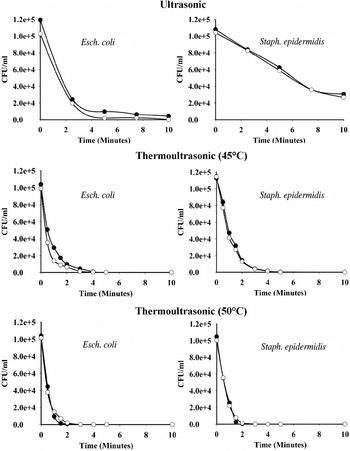
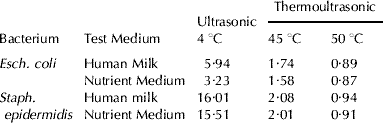
Esch. coli were the more susceptible bacteria to ultrasonic treatment (Fig. 1, Table 1) with a decimal reduction time (D) of 5·94 min compared with 16·01 min for Staph. epidermidis. As such, the 10 min treatment was sufficient to reduce levels of Esch. coli by 96% and 72% of Staph. epidermidis when treated in human milk. An inactivation of 99·9% of Esch. coli was achieved when the bacteria were cultured and treated in nutrient medium. Staph. epidermidis exhibited resistance to ultrasonic treatment in either nutrient medium or human milk (Table 1).
Comparison of bacterial susceptibility to either ultrasonic (at 4°C) or thermoultrasonic treatment in either human milk (filled circle) or nutrient medium (open circle).
All data points represent average±SD (n=6)

Decimal reduction (D) time minutes of bacterial species treated with either ultrasonic or thermoultrasonic processing in either human milk or nutrient medium
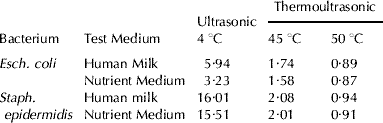
Thermoultrasonic processing at both 45 and 50°C enhanced inactivation rates of both species of bacterium compared with ultrasound alone with 99·9% inactivation of both species achieved (Fig. 1). The D value for either species was similar for thermoultrasonic treatment in human milk at 45 and 50°C (Table 1). Media type had little effect on inactivation rates during thermoultrasonic treatment with those bacteria treated in nutrient media exhibiting similar D values at 45 and 50°C (Table 1).
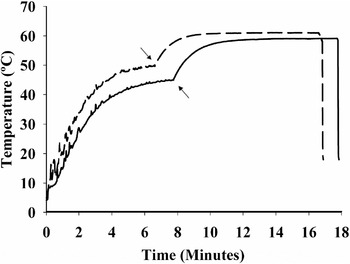
A bimodal heating profile was observed during thermoultrasonic processing. Prior to the inclusion of ultrasound in the experimental system, fluctuation in fluid temperature occurred. However, when the fluid reached the desired temperature of 45 or 50°C and ultrasound was introduced (marked with arrows in Fig. 2), a consistent and repeatable increase in temperature of 10·3±0·4°C (n=12) was measured.
Heating profile during thermoultrasonic treatment at either 45°C (solid line) or 50°C (dashed line). The time point at which the ultrasound was introduced into the experimental system is indicated by arrows.

Effect of ultrasonic and thermoultrasonic processing on the retention of human milk proteins
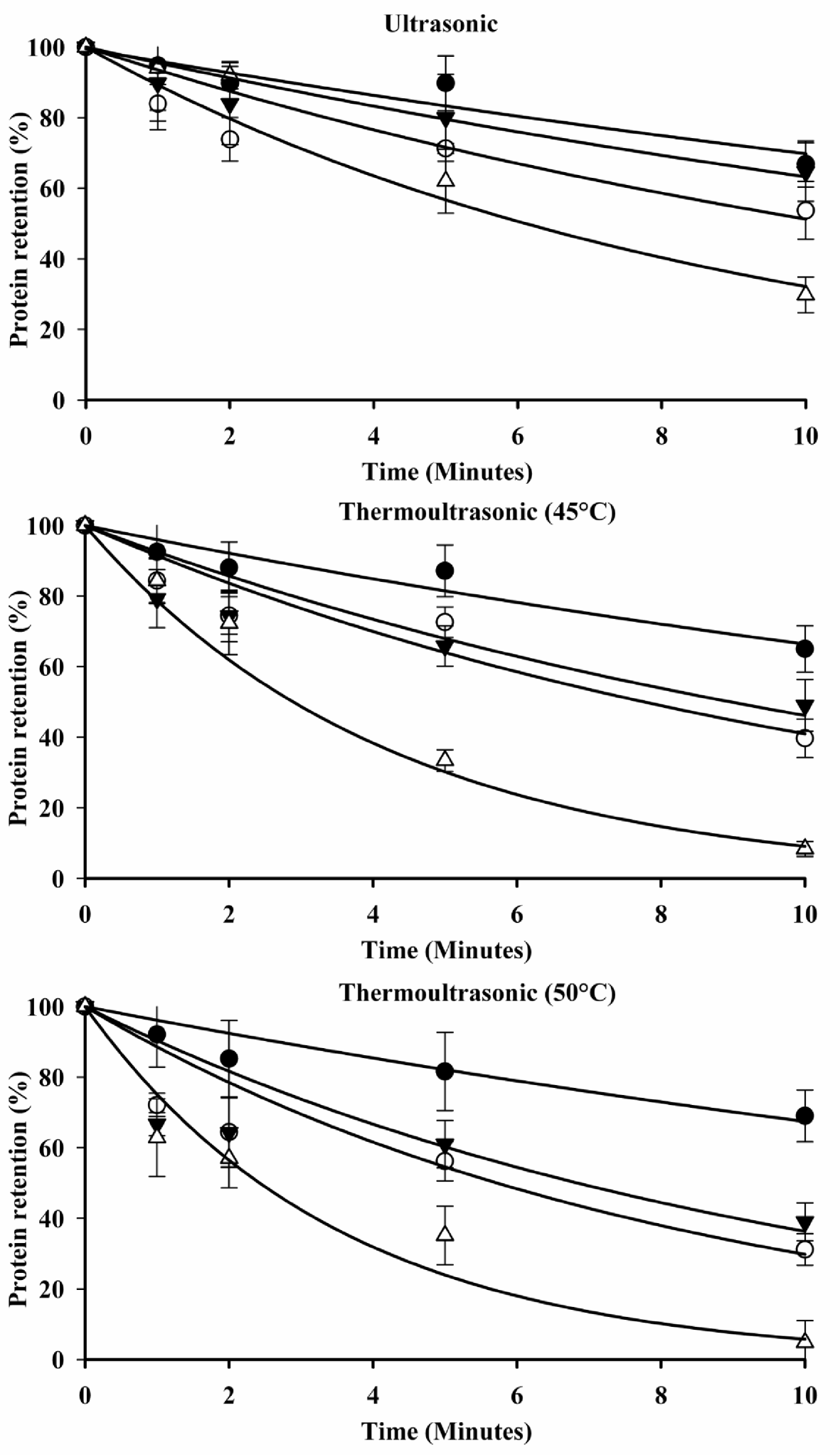
Human milk sIgA, lactoferrin, lysozyme and BSSL content decreased over the course of both ultrasonic and thermoultrasonic processing (Fig. 3). Exponential regression modelling was applied to determine the rates of individual protein loss during each of the treatment methods (Table 2). The rate of sIgA loss was similar for both ultrasonic and thermoultrasonic treatment at both temperatures and did not fall below 65±6·5% (mean±SD, n=6) after 10 min of thermoultrasound with the rate of protein loss increasing with temperature. Lysozyme was the next most susceptible protein with 64·6±8·3% remaining after ultrasonic treatment and 49·0±7·33% and 39·0±5·3% remaining after thermoultrasonic treatment at 45 and 50°C, respectively (n=6). Lactoferrin was affected similarly with 53·7±8·2% remaining after ultrasonic treatment and 39·7±5·5% and 31·2±4·5% remaining after thermoultrasonic processing at 45 and 50°C, respectively (n=6). BSSL was most sensitive to either process, exhibiting 29·7±5·2% retention after ultrasonic treatment and 8·3±2·1% and 4·8±6·2% remaining combined treatment at 45 and 50°C, respectively (n=6).
Retention of the human milk proteins over the course of ultrasonic and thermoultrasonic treatment. Secretory immunoglobulin A (sIgA -•), lysozyme (▾), lactoferrin (○) and bile salt stimulated lipase (BSSL -▵).
All data points represent mean±SD (n=6)
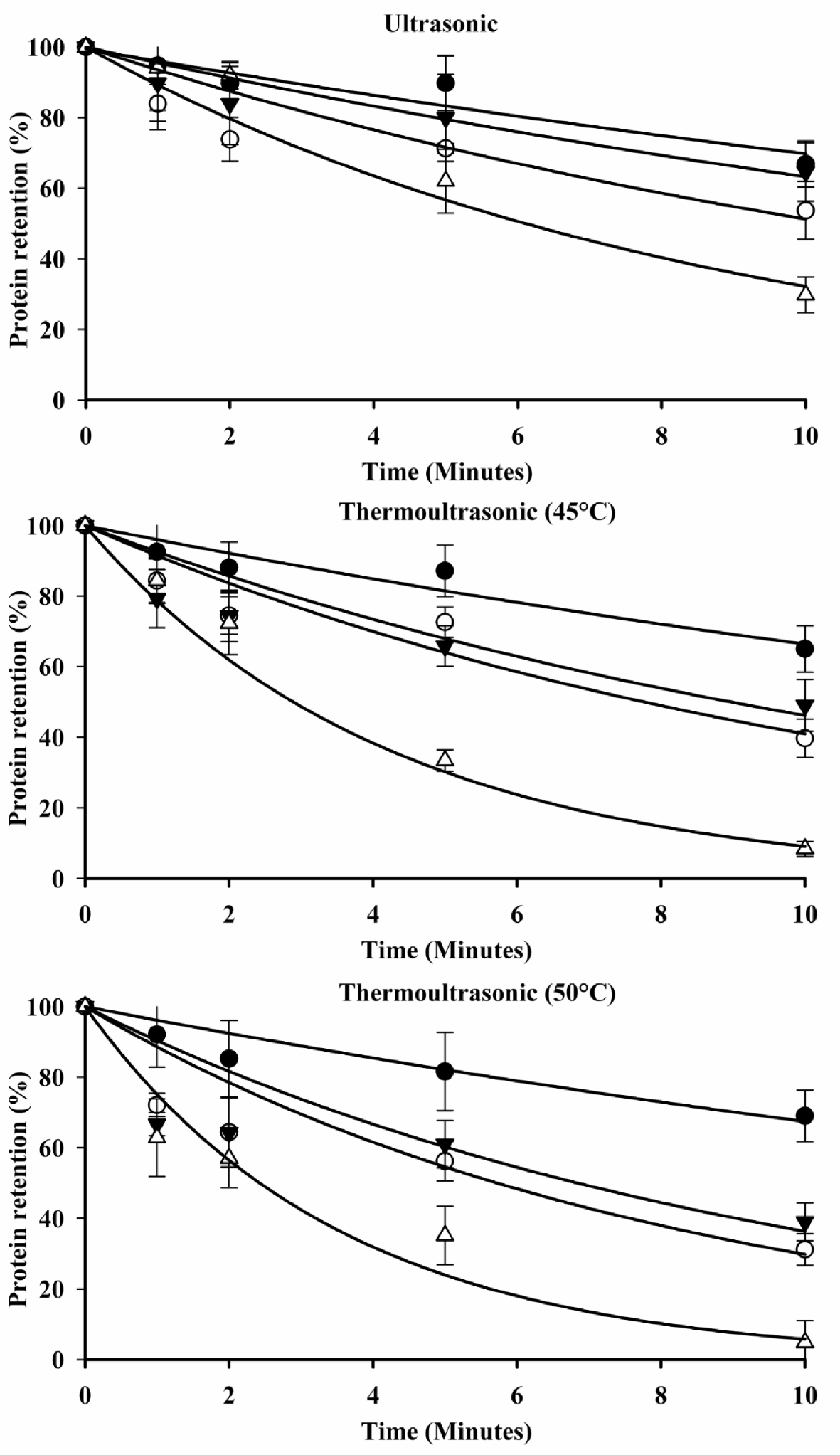
Rates of individual protein loss during the course of processing as illustrated in fig. 4. Rates are given as a constant (λ) as determined from exponential regression modelling of the equation: % protein retained=100e−λ·time. The goodness of fit of experimental data to the regression model is given by the correlation factor (R2)

Particle distribution of ultrasonic and thermoultrasonically treated samples
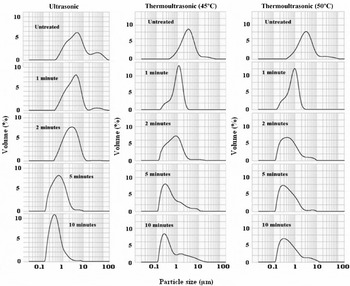
Analysis of particle size distribution was undertaken to quantify the extent of homogenization during ultrasonic and thermoultrasonic processing (Fig. 4). Human milk samples treated with ultrasound had a mean particle size of 4·6 μm prior to processing, with additional subpopulations with a mean of 0·8 and 12 μm. Ultrasonic treatment for 1 min decreased the number of larger fat globules and reduced the mean particle size to 3·3 μm whilst the smaller size subpopulation of particles (0·8 μm) remained present. A typically homogenous distribution of particles was achieved after 2 min of processing with a mean of 2·4 μm. After 5 min ultrasonic processing a tight distribution around a mean particle size of 0·6 μm was observed. Further processing to 10 min had little additional effect on mean particle size (0·4 μm), though a tighter distribution around this mean was observed (Fig. 4).
Particle size distribution of human milk over the course of ultrasonic (at 4°C) and thermoultrasonic treatment (at 45 and 50°C).

Thermoultrasonic treatment at either temperature facilitated an increased rate of homogenization (Fig. 4), compared with ultrasonication alone. The average particle size of human milk samples prior to thermoultrasonic processing was tightly distributed around a mean of 3·18 μm with a minor population at 12 μm. After 1 min of thermoultrasonic treatment at 45°C, a mean particle size of 1·06 μm with a subpopulation present at 0·4 μm in size was present. After 2 min processing at this temperature the average particle size was 0·7 μm with the presence of additional minor populations at means of 0·2 μm and 10 μm. By 5 min of simultaneous treatment, an average particle size of 0·4 μm was observed and further processing had little effect on particle size distribution. Thermoultrasonic processing at 50°C, resulted in a mean particle size of 0·9 μm after 1 min and was decreased to 0·52 m after 2 min with an additional minor population of particles at 7 μm. A tight distribution around a mean particle size of 0·43 μm was achieved after 5 min and again, further processing had little effect on the distribution after this time point.
Discussion
This study demonstrates that both ultrasound and thermoultrasound can reduce bacterial cell numbers in artificially contaminated DHM (Fig. 1). The gram negative, rod shaped Esch. coli and the gram positive cocci, Staph. epidermidis were chosen for this study as these are common bacterial species found in human milk donated to the PREM Bank. These bacteria were inoculated into human milk samples at the maximum limit defined by human milk banking guidelines (Arnold & Tully, Reference Arnold and Tully1994; Baumer, Reference Baumer2004; Hartmann et al. Reference Hartmann, Pang, Keil, Hartmann and Simmer2007). Compared with ultrasound alone, the combination of heat and ultrasound treatment resulted in 6·7 to 17 fold decrease in the bacterial inactivation time (D value) when treated in human milk and a 3·7 to 16·5 fold decrease when treated in nutrient media (Table 1). This is believed to occur due to a synergistic interaction between the two treatment processes (Piyasena et al. Reference Piyasena, Mohareb and McKellar2003).
The type of medium (human milk or nutrient medium) in which the bacteria were exposed to during ultrasonic treatment also impacted on the rate of bacterial inactivation (Fig. 1. Table 1). This may be due to structural and compositional changes in the human milk occurring as result of homogenization. For example, the release of components with antimicrobial activity (e.g. lactoferrin, fatty acids (Thormar et al. Reference Thormar, Issacs, Brown, Barshatzky and Pessolano1987)) from the previously inaccessible compartment of the fat globule and fat globule membrane are likely to affect bacterial growth. Furthermore, as thermoultrasound appeared to enhance homogenization, probably through increased lipid fluidity, this may have also contributed to this outcome.
Previous studies have demonstrated that the spherical shape of cocci bacteria imparts some resistance to cavitation (Zenker et al. Reference Zenker, Heinz and Knorr2003), which was demonstrated by the relatively long treatment time required to inactivate Staph. epidermidis (Fig. 1). Therefore, ultrasonic treatment alone is unlikely to be suitable for the routine pasteurization of human milk as protein retention is considerably reduced during prolonged ultrasonic processing (Fig. 3). In contrast, thermoultrasonic treatment at 50°C is more suited to pasteurizing human milk as it reduces the exposure of the human milk components to heat and ultrasound. Under these conditions, the time taken to inactivate 99·9% of Staph. epidermidis is the shortest of the conditions tested (2·8 min), resulting in a predicted retention of sIgA, lysozyme, lactoferrin and BSSL of 91%, 80%, 77% and 45%, respectively (Fig. 3). Though other studies have evaluated higher temperatures than those used in this study (Zenker et al. Reference Zenker, Heinz and Knorr2003; Knorr et al. Reference Knorr, Zenker, Heinz and Lee2004), it has been noted that at temperatures above 50°C, the thermal component contributes a greater influence on bacterial inactivation (Zenker et al. Reference Zenker, Heinz and Knorr2003). As thermoultrasonic treatment at higher temperatures is likely to have a greater impact on protein retention, these conditions were not considered in the current study. Nonetheless, the improved retention of sIgA, lactoferrin, lysozyme and BSSL as compared with current pasteurization practice (62·5°C for 30 min) (Björkstén et al. Reference Björkstén, Burman, De Château, Fredrikzon, Gothefors and Hernell1980; Wills et al. Reference Wills, Han, Harris and Baum1982) suggests that thermoultrasonic pasteurization has the potential for overcoming the current quality issues associated with PDHM.
In addition to the relative improvements in the quality of PDHM, there are practical and clinical benefits associated with homogenizing human milk. For example, it can be difficult to resuspend aggregates of fat that form during traditional thermal pasteurization. Fat clumping can be prevented through homogenization and homogenized human milk is associated with desirable outcomes for very low birth weight infant such as enhanced nutrient delivery and fat absorption during continuous feeding (Martinez et al. Reference Martinez, Desai, Davidson, Nakai and Radcliffe1987; Thomaz et al. Reference Thomaz, Goncalves and Martinez1999). Thermoultrasonic pasteurization also decreases processing time considerably compared with conventional pasteurization methods and would in turn decrease batch turnaround time in the Human Milk Bank. However, the current experimental system is limited to small volumes and scale up studies would need to be undertaken. Furthermore, there is currently a substantial lack of knowledge regarding the potential of this method for inactivating a wider range of microbial contaminants commonly found in DHM as well as any compositional and sensory qualities that may be affected by this form of processing. Therefore, further experimental evaluation of the efficacy of this technology is essential prior to implementation into the Human Milk Bank.
This study was funded by the Rotary Clubs of Thornlie and Belmont (Western Australia), The Women's and Infant Research Foundation, The Perron Charitable Trust and Medela AG (Switzerland). The authors would also like to acknowledge the technical assistance of Mr. Jorge Martinez in regards to the particle sizing experiments.