Introduction
Stephanitis pyrioides (Scott) (Hemiptera: Tingidae) is an important insect pest of azaleas, Rhododendron Linnaeus spp. (Ericaceae), in the eastern states of the United States of America (Nair and Braman Reference Nair and Braman2012). This pest is commonly referred to as the azalea lace bug. In the early 1900s, S. pyrioides was accidentally introduced from Japan to North America on azalea plants (Nair and Braman Reference Nair and Braman2012). In recent years, the pest has been established and reported from western states of the United States of America, including Oregon and Washington (Ciscoe Reference Ciscoe2018). As a flowering ornamental species, azaleas are widely planted and are an integral component of ornamental landscapes throughout the eastern United States of America.
Stephanitis pyrioides occurs on both shrubs planted in landscapes and container plants in production sites such as wholesale and retail nurseries (SVJ, unpublished data). The adults and nymphs of S. pyrioides colonise the abaxial side of the leaves. They access the epidermal cells of the leaves by inserting their stylets through stomatal openings and consume chlorophyll. Infested leaves appear extensively chlorotic, which affects the aesthetic appearance of azalea plants. Infested container azalea plants in nurseries are not readily sold because chlorotic leaves remain attached to the plant beyond a year (Klingeman et al. Reference Klingeman, Braman and Buntin2000). Extensive S. pyrioides–feeding injury reduces the photosynthesis and transpiration rates of azalea plants (Buntin et al. Reference Buntin, Braman, Gilbertz and Phillips1996).
In nurseries, granular formulations of neonicotinoid insecticides, especially imidacloprid, are applied to the soil in spring for S. pyrioides control (W. Hudson, personal communication). This application is essentially effective and provides year-long protection from S. pyrioides feeding. However, in recent years, there has been growing evidence that neonicotinoids contribute to the population decline of pollinators, such as Apis mellifera Linnaeus (Hymenoptera: Apidae) (Bryden et al. Reference Bryden, Gill, Mitton, Raine and Jansen2013), Bombus terrestris Linnaeus (Hymenoptera: Apidae) (Gill et al. Reference Gill, Ramos-Rodriguez and Raine2012; Gill and Raine Reference Gill and Raine2014), and ground-nesting solitary bees, such as the hoary squash bee, Eucera pruinosa Say (Hymenoptera: Apidae) (Chan and Raine Reference Chan and Raine2021), and drive potential cascading effects on the environment (Frank and Tooker Reference Frank and Tooker2020). Information about the potential impacts of neonicotinoids on beneficial insects is changing the public’s perception of the potential chemicals people are exposed to and the quality of the environment they live in. These perceptions are reflected in consumers’ demands for neonicotinoid-free plants sold in retail nurseries, garden centres, and box stores. Neonicotinoids are effective and selective insecticide tools to manage serious piercing and sucking pests, such as lace bugs (Held and Parker Reference Held and Parker2011), scales (Camacho and Chong Reference Camacho and Chong2015), and thrips (Lin et al. Reference Lin, Chen, Babendreier, Zhang, Zhang and Dai2021), in the ornamental industry. As an immediate alternative, nursery and landscape managers have resorted to pyrethroid insecticides to manage pests, which has proven to harm nontarget insects, including pollinators and beneficial insects, and enhance secondary pest outbreaks (Dutcher Reference Dutcher, Ciancio and Mukerji2007). Thus, nursery and landscape managers are actively seeking alternatives to neonicotinoids to manage key insect pests, including S. pyrioides.
Insect growth regulators are known for interrupting the development of the immature stages of insects. Similarly, insect growth regulators have also been reported to elicit transovarial effects against several insect pests, such as the codling moth Cydia pomonella (Linnaeus) (Lepidoptera: Tortricidae) (Gökçe et al. Reference Gökçe, Kim, Wise and Whalon2009), oblique banded leafroller Choristoneura rosaceana (Harris) (Lepidoptera: Tortricidae) (Kim et al. Reference Kim, Vandervoort, Whalon and Wise2014), Colorado potato beetle Leptinotarsa decemlineata (Say) (Coleoptera: Chrysomelidae) (Alyokhin et al. Reference Alyokhin, Sewell and Choban2008), vine weevil Otiorhynchus sulcatus (Fabricius) (Coleoptera: Curculionidae) (Cowles Reference Cowles2004), Tribolium castaneum (Coleoptera: Tenebrionidae) (Herbst) (Trostanetsky and Kostyukovsky Reference Trostanetsky and Kostyukovsky2008), and painted bug Bagrada hilaris (Burmeister) (Hemiptera: Pentatomidae) (Joseph Reference Joseph2017), where adults produce nonviable eggs after exposure to insect growth regulators. The transovarial activity of an insect growth regulator, novaluron, was confirmed against S. pyrioides (Joseph Reference Joseph2019a, Reference Joseph2020a). The transovarial activity of novaluron was evident when S. pyrioides adults were exposed directly or to dried residues on the leaf surface (Joseph Reference Joseph2019b) and by ingestion (Joseph Reference Joseph2020a). Novaluron also demonstrated both ovicidal properties when used along with an adjuvant (Joseph Reference Joseph2019b) and repellency of fresh residues against S. pyrioides adults without insects coming in contact (Joseph Reference Joseph2020b). Novaluron is regarded as a reduced-risk insecticide and is less toxic to mammals (Graf Reference Graf1993). It interrupts the synthesis of insect cuticle as a chitin biosynthesis inhibitor (Insecticide Resistance Action Committee 2016). The utility of novaluron against S. pyrioides can be enhanced if adults continue to elicit the transovarial effect for an extended period and residual activity of novaluron persists for a longer time.
Previous studies showed that L. decemlineata egg viability was gradually restored once the adults were not consuming foliage treated with novaluron residues (Alyokhin et al. Reference Alyokhin, Sewell and Choban2008, Reference Alyokhin, Guillemette and Choban2009). Therefore, it is not clear whether the egg viability of S. pyrioides would be restored with time after a single adult exposure. Similarly, the effect of aged novaluron residues deposited on foliage specifically eliciting transovarial transmission in S. pyrioides adults has not been documented. This information will be critical for S. pyrioides management programmes in determining the need for additional follow-up applications of novaluron for effective S. pyrioides control. Thus, the objectives of the current study were to determine (1) the persistence of the transovarial effect of novaluron for up to three weeks after a single adult exposure and (2) the residual activity of novaluron residues eliciting a transovarial effect against S. pyrioides for up to four weeks after a single application.
Methods
Plants, insects, and insecticide
Azalea plants (‘George Tabor’) were maintained in a shaded house with a 50% light filter at the University of Georgia campus in Griffin, Georgia, United States of America. The plants were planted in 3.7-L pots in pine bark potting media. They were irrigated for 10 minutes every day and fertilised using 20:20:20 (nitrogen:phosphorus:potassium) general-purpose fertiliser (Jack’s Professional, water-soluble fertiliser; JP Peters, Inc., Allentown, Pennsylvania, United States of America) at biweekly intervals. Potted plants with mature leaves were used for the trials. The rearing procedure is described in Joseph (Reference Joseph2020a). In 2017, S. pyrioides adults were field collected from azalea shrubs in Griffin, Georgia, and colonies were established. The S. pyrioides colonies were raised on live potted azalea ‘George Tabor’ plants in 47.5 × 47.5 × 93.0-cm (width:depth:height) cages in an entomological laboratory at the University of Georgia, Griffin, Georgia. The caged plants were maintained in laboratory racks under approximately 55% relative humidity at ∼39 °C and ∼22 °C (light:dark) and a 16:8-hour (light:dark) photoperiod. Incandescent lamps (40 W; Philips, Somerset, New Jersey, United States of America) were directed on the caged plants and served as heat for the insect colony and the light source for the plants and the S. pyrioides colony. Within about 30 days, S. pyrioides completed egg-to-adult cycles under these laboratory conditions. Three plants were provided in the cage at a time. The azalea plants with extensive feeding were removed and replaced with a new plant at five- to six-week intervals when all the leaves of an old plant turned completely bleached and covered with excrement. The plants were not treated with any insecticide. For the experiments, six- and seven-day-old S. pyrioides adults were used.
The insect growth regulator used in the experiments was novaluron (Pedestal, 10% active ingredient; OHP Inc., Bluffton, South Carolina, United States of America) at a rate of 58.1 g per hectare, and the water volume used was 373.9 L per hectare. The insecticide rate was the maximum label rate registered in the production nursery. Water volume was within the range typically used by nursery growers in the region. Thus, the concentration of the active ingredient in the solution was 155.4 parts per million for novaluron. Adjuvants or surfactants were not added in any of the experiments.
Length of transovarial activity after single adult exposure
For the experiment, 400 S. pyrioides adults were randomly collected from the rearing cages and split into four batches of 50 adults each. These four batches were exposed to novaluron residues. One batch was introduced onto a paper towel placed on a 33 × 22-cm plastic tray at a time. The novaluron solution was topically applied to S. pyrioides adults placed on a paper towel using a hand-operated pressure sprayer. The sprayer deposited ∼20.4 μL per square centimetre of the novaluron solution on the paper towel. Immediately after novaluron spray, the adults were carefully collected using an aspirator and caged onto two azalea branches with 10 to 14 leaves, with each cage receiving 25 adults using a 14 × 11-cm sleeve cage [length:width] on potted azalea plants. Thus, there were eight cages with novaluron-exposed adults. Similarly, the other four batches of adults were treated with tap water and were caged on eight azalea plants. Two potted plants each were used for caging novaluron-exposed and nontreated adults. The plants with caged adults were then transferred to an environmentally controlled chamber maintained with 65% relative humidity at ∼28 °C and a 16:8-hour (light:dark) photoperiod. The S. pyrioides adults were six and seven days old after eclosion and were considered sexually mature and mated. The adults were not sorted by sex. Random sampling and evaluation from the cage showed that the S. pyrioides adults in the rearing cages were at approximately a 1:1 sex ratio.
To set up the treatments, 10 S. pyrioides adults were randomly collected from novaluron-treated or nontreated cages at 7, 14, and 21 days after novaluron application and caged on to a new nontreated azalea branch terminal with 10 to 20 leaves. An azalea terminal with 10 caged S. pyrioides adults served as an experimental unit. The treatments were (1) novaluron-treated and nontreated adults and (2) intervals after adult exposure (7, 14, and 21 days). The treatments were arranged in a randomised complete block design, with five replications (i.e., five caged azalea terminals for novaluron-treated and nontreated at 7, 14, and 21 days). Each potted azalea plant received two cages on two terminals with 10 novaluron- and non-novaluron-exposed adults. These plants with 10 novaluron- and non-novaluron-exposed adults were maintained at 65% relative humidity, approximately 28 °C, and a 16:8-hour (light:dark) photoperiod in an environmentally controlled chamber for seven days for oviposition. Seven days is a sufficient time interval for oviposition (Joseph Reference Joseph2020a). After seven days, the adults were removed from the branch terminals and then remained caged for an additional 14 days for egg hatching. After 21 days, the branch terminals were removed and the numbers of nymphs (first- through fifth-instar stages) and exuviae (old skins) on the leaves were quantified under a dissecting stereomicroscope (10×). The entire experiment was repeated with the same protocol. The first and second experiments were initiated on 15 April and 16 July 2019 and were evaluated on 28 May and 27 August 2019, respectively.
Aged residues of novaluron and transovarial activity
The azalea branch terminals on the potted azalea plants were selected for the application of novaluron treatments. Novaluron solution was sprayed on the selected branch terminals at 32, 17, 7, and 0 days before the terminals were caged with S. pyrioides adults. Both adaxial and abaxial sides of the leaves were treated with novaluron residues, simulating the best insecticide coverage practices in nurseries. The caged potted azalea plants were maintained at 65% relative humidity, ∼28 °C, and a 16:8-hour (light:dark) photoperiod in an environmentally controlled chamber. For the 0-day treatment, S. pyrioides adults were caged two hours after novaluron application. The treatments were (1) 0-, (2) 7-, (3) 17-, and (4) 32-day-old novaluron residues deposited on the azalea leaves, and (5) a nontreated control. The treatments were replicated three times with a completely randomised block design. The experimental unit was an azalea branch terminal with 15 to 20 leaves.
Ten six- to seven-day-old nontreated S. pyrioides adults were collected from the rearing colony and caged with the branch terminal for seven days, and the plants were maintained at 65% relative humidity, ∼28 °C, and a 16:8-hour (light:dark) photoperiod in an environmentally controlled chamber for oviposition. After seven days, the adults were removed from all the cages and the caged potted plants were placed again in the same environmentally controlled chamber for an additional 14 days for egg hatching. After 21 days, the leaves in each cage were removed and the numbers of first- and second-instar nymphs, third-, fourth-, and fifth-instar nymphs, and exuviae were quantified under a dissecting stereomicroscope (10 ×). Typically, S. pyrioides eggs hatch within seven days, and young nymphs can be found on the foliage. The entire experiment was repeated with the exact same treatments and replications. The assays were evaluated on 24 February and 2 March 2020 for trials 1 and 2, respectively.
Statistical analyses
All the data from the various assays were analysed in SAS (SAS Institute 2012). For the experiment to determine the effects of length of transovarial activity after a single adult exposure, the nymphs (first to fifth instars) and exuviae were examined for normality assumptions and then transformed for analysis. Thus, these data were square-root-transformed and subjected to two-way analysis of variance with interaction using a general linear model (PROC GLM; SAS). The variables included in the model were treatment (novaluron applied and not applied), time, treatments × time, and replication. The data from experiments 1 and 2 were not pooled, as they had sufficient replications. To understand the effects of treatments, data were further subjected to one-way analysis of variance using a general linear model (PROC GLM). The variables included in the model were treatment (novaluron applied and not applied) and replication. The means (the nymphs and exuviae) were separated using Tukey’s honestly significant difference test for treatment comparisons. All statistical comparisons were considered significant at α = 0.05.
To determine the effect of age of novaluron residues and transovarial activity, first- and second-instar nymphs, third-, fourth-, and fifth-instar nymphs, and the exuvia data were examined for normality assumptions; the data were then square-root-transformed and subjected to one-way analysis of variance using a general linear model (PROC GLM). The data from experiments 1 and 2 were pooled before analysis, and each experiment had only three replications. The variables included in the model were treatment (age of novaluron) and replication. The means (the nymphs and exuviae) were separated using Tukey’s honestly significant difference test for treatment comparisons. All statistical comparisons were considered significant at α = 0.05.
Results
Length of transovarial activity after single adult exposure
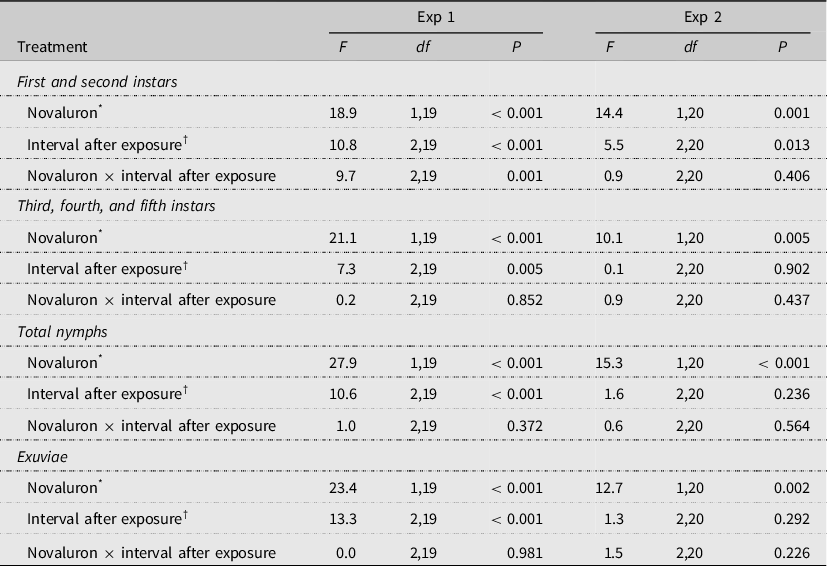
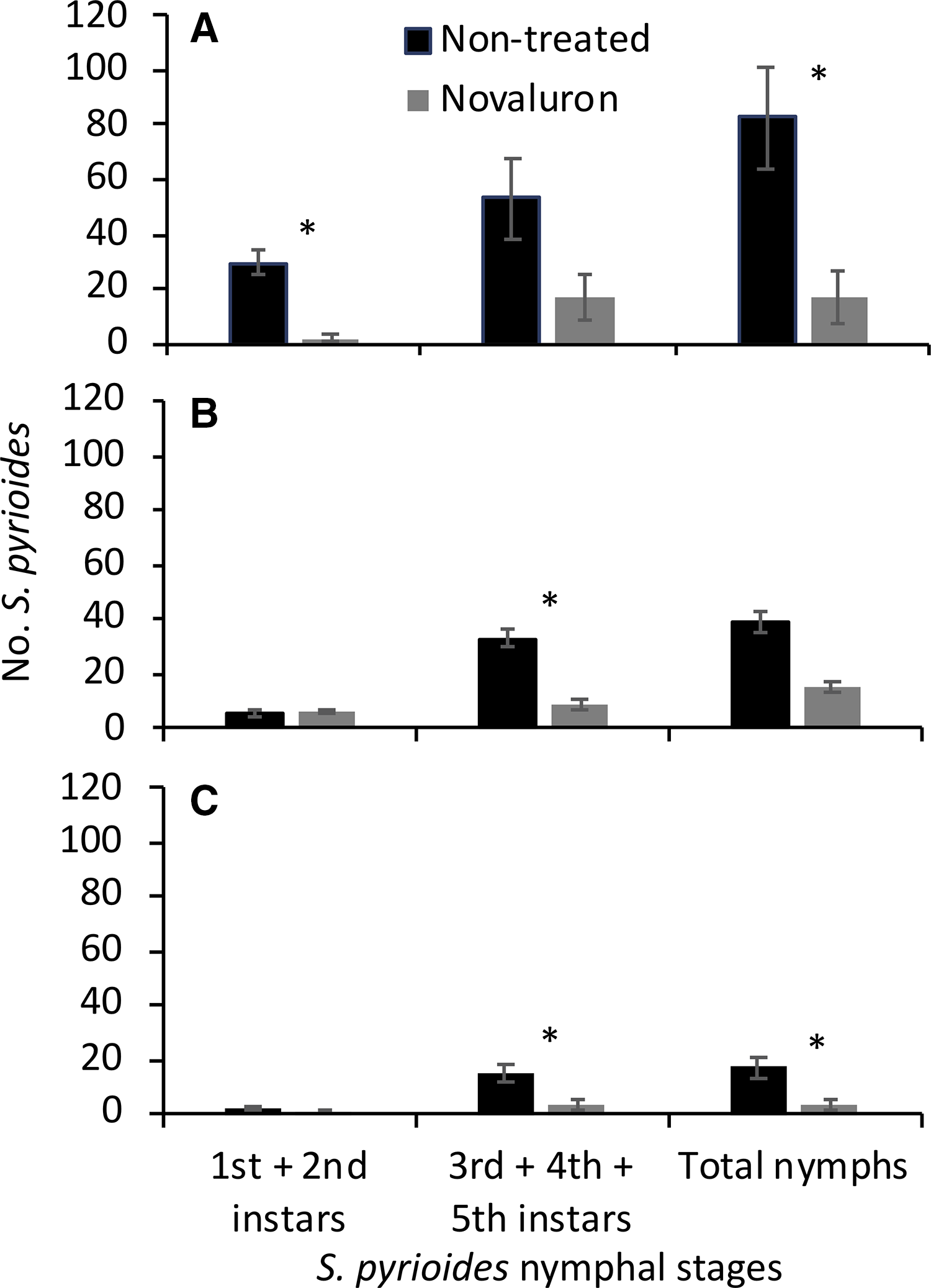
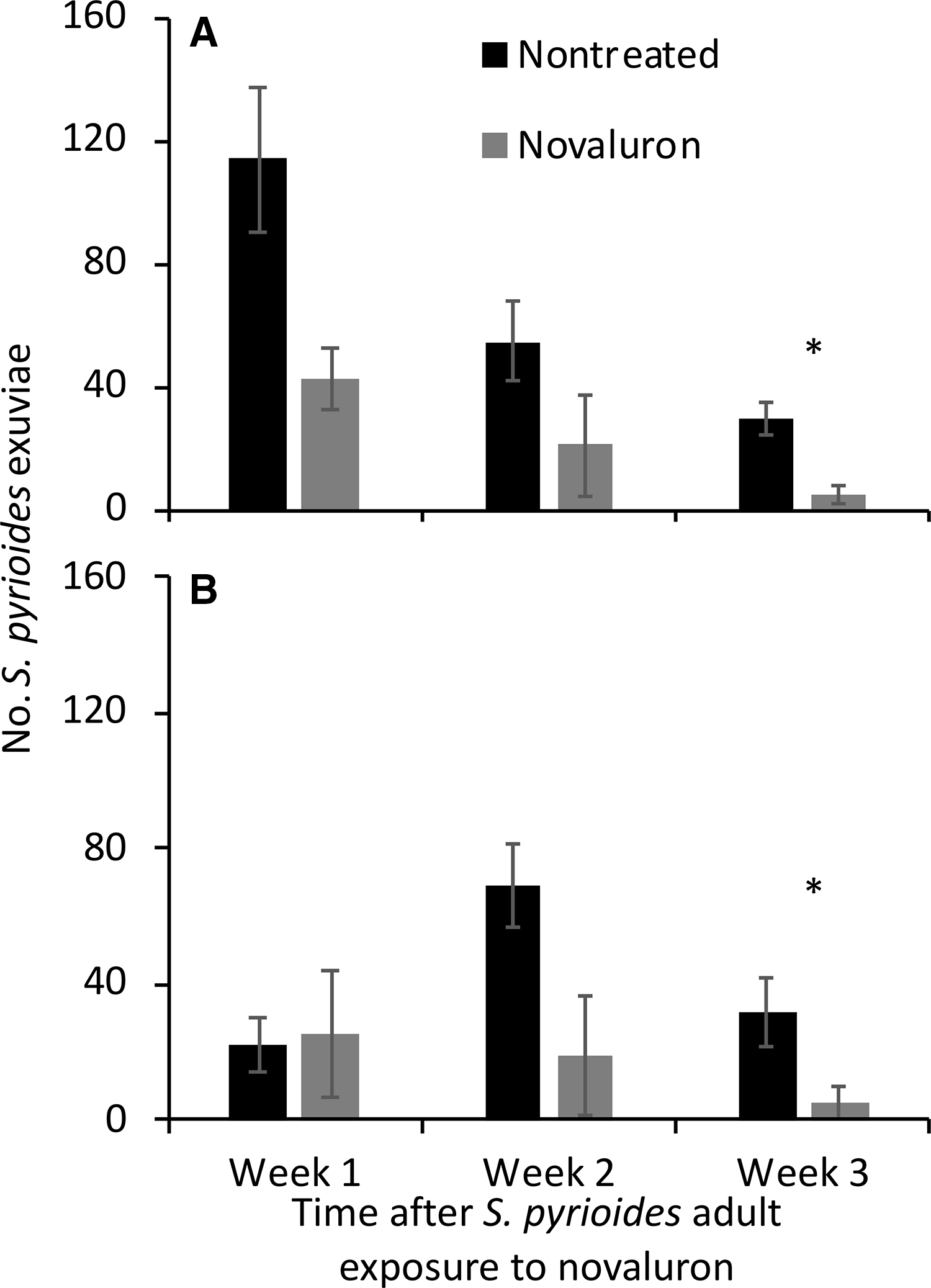
In experiment 1, the novaluron treatment (novaluron and nontreated) and interval of exposure (7, 14, and 21 days after exposure) had a significant effect on the number of young (first- and second-instar nymphs) and later-stage (third-, fourth-, and fifth-instar nymphs) S. pyrioides nymphs and exuviae (Table 1). However, there were no significant interaction effects between novaluron treatment and interval of exposure on nymphs and exuviae. To further understand the treatment effects, the data were analysed by interval of exposure. At seven days after exposure, the numbers of first- and second-instar nymphs (F 1,4 = 41.7, P = 0.003; Fig. 1A) and all nymphs combined (F 1,4 = 12.2, P = 0.025; Fig. 1A) were significantly lower in novaluron treatments than in nontreated treatments. The densities of third- to fifth-instar nymphs (F 1,4 = 6.1, P = 0.069; Fig. 1A) and exuviae (F 1,4 = 5.9, P = 0.072; Fig. 3A) were similar between the novaluron treatments and nontreated treatments. At 14 days after exposure, significantly lower numbers of third- to fifth-instar nymphs (F 1,3 = 24.7, P = 0.016; Fig. 1B) and exuviae (F 1,3 = 4.9, P = 0.011; Fig. 3A) were observed in the novaluron treatments than in the nontreated treatments. However, the numbers of young nymphs (F 1,3 = 0.3, P = 0.623; Fig. 1B) and all nymphs combined (F 1,3 = 7.0, P = 0.076; Fig. 1B) did not significantly differ between the novaluron treatments and the nontreated treatments. At 21 days after exposure, except first- and second-instar nymphs (F 1,4 = 3.7, P = 0.126; Fig. 1C), the numbers of third- to fifth-instar nymphs (F 1,4 = 16.6, P = 0.015; Fig. 1C), all nymphs combined (F 1,4 = 16.9, P = 0.016; Fig. 1C), and exuviae (F 1,4 = 19.6, P = 0.012; Fig. 3A) were significantly lower in the novaluron treatments than in the nontreated treatments.
Analysis of variance of S. pyrioides nymphs and exuviae after a single adult exposure to novaluron in experiments 1 and 2.

* Novaluron-treated and nontreated S. pyrioides adults; †7, 14, and 21 days after novaluron exposure.
Mean (± standard error; SE) numbers of first- and second-instar nymphs, third-, fourth-, and fifth-instar nymphs, and all S. pyrioides nymphs combined after A, seven days, B, 14 days, and C, 21 days post-treatment, when novaluron was topically applied to adults in experiment 1. Pairs of bars within each category (instars or combined nymphs) without asterisks are not significantly different (Tukey’s honestly significant difference test, α = 0.05).

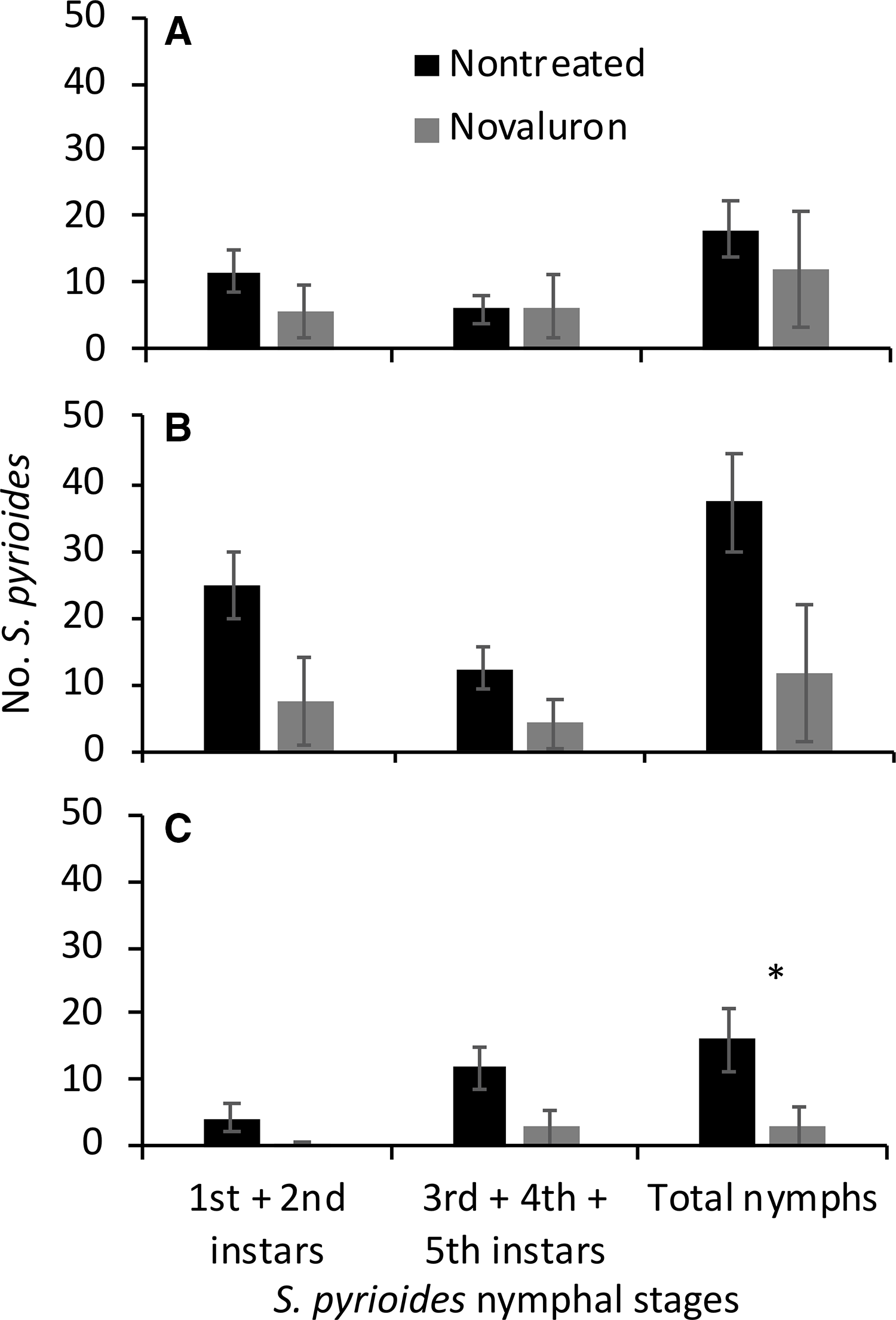
In experiment 2, the novaluron treatment (novaluron and nontreated) had a significant effect on the number of young and late stages of S. pyrioides nymphs and exuviae (Table 1). The interval of exposure (7, 14, and 21 days after exposure) differed significantly only for young instars. No significant interaction effects occurred between the novaluron treatment and interval of exposure for any of the independent variables. At seven days after exposure, no significant effects were apparent on young instars (F 1,4 = 2.4, P = 0.198; Fig. 2A), late instars (F 1,4 = 0.3, P = 0.596; Fig. 2A), all nymphs combined (F 1,4 = 1.3; P = 0.317; Fig. 2A), or exuviae (F 1,4 = 0.3, P = 0.641; Fig. 3B). Similarly, at 14 days after exposure, the numbers of young instars (F 1,4 = 4.6, P = 0.097; Fig. 2B), late instars (F 1,4 = 2.6, P = 0.182; Fig. 2B), all nymphs combined (F 1,4 = 3.9, P = 0.118; Fig. 2B), and exuviae (F 1,4 = 4.7; P = 0.097; Fig. 3B) did not significantly differ. At 21 days after exposure, the numbers of all nymphs combined (F 1,4 = 9.3, P = 0.038; Fig. 2C) and exuviae (F 1,4 = 9.4; P = 0.037; Fig. 3B) were significantly lower in the novaluron treatments than in the nontreated treatments, whereas the numbers of young instars (F 1,4 = 6.8, P = 0.060; Fig. 2C) and late instars (F 1,4 = 6.6, P = 0.062; Fig. 2C) were similar between the novaluron treatments and the nontreated treatments.
Mean (± standard error; SE) numbers of first- and second-instar nymphs, third-, fourth-, and fifth-instar nymphs, and all S. pyrioides nymphs combined after A, seven days, B, 14 days, and C, 21 days post-treatment, when novaluron was topically applied to adults in experiment 2. Pairs of bars within each category (instars or combined nymphs) without asterisks are not significantly different (Tukey’s honestly significant difference test, α = 0.05).

Mean (± standard error; SE) number of S. pyrioides exuviae after seven days (week 1), 14 days (week 2), and 21 days (week 3) post-treatment, when novaluron was topically applied to adults in experiments A, 1 and B, 2. Pairs of bars within each category (week) without asterisks are not significantly different (Tukey’s honestly significant difference test, α = 0.05).

Aged residues of novaluron and transovarial activity
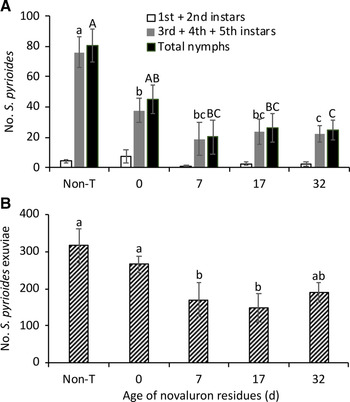
The age of novaluron residues did not affect the number of young instars (F 4,19 = 1.5, P = 0.258; Fig. 4A). The number of late instars was significantly lower in all the novaluron-exposed treatments, regardless of age, than in the nontreated control (F 4,19 = 7.6, P < 0.001). Among the aged novaluron treatments, the number of late instars was significantly lower in the 32-day-old residue treatments than in 0-day-old residue treatments. No significant difference was apparent in the number of late instars among the 0-, 7-, and 17-day-old novaluron residues or the 7-, 17-, and 32-day-old residues.
Mean (± standard error; SE) numbers of A, first- and second-instar nymphs, third-, fourth- and fifth-instar nymphs, and all S. pyrioides nymphs combined, and B, exuviae developed after exposure to aged novaluron residues deposited on azalea foliage. Within each category (instars or combined nymphs), bars within the same fill colour with the same letter types (upper or lower case) are not significantly different (Tukey’s honestly significant difference test, α = 0.05). Not significant data have no letters.

When all the nymphs were combined, all the novaluron treatments, regardless of age, had significantly lower densities than the nontreated control treatment did (F 4,19 = 7.1, P = 0.001; Fig. 4A). Within aged novaluron residue treatments, the numbers of nymphs were significantly lower at 32 days than at 0 days. No significant differences were apparent in the number of nymphs among the 0-, 7-, and 17-day-old novaluron residues or the 7-, 17-, and 32-day-old residues. The numbers of exuviae were significantly lower for the 7-day-old and the 17-day-old novaluron residues compared to the nontreated and 0-day-old residues (F 4,19 = 3.4, P = 0.030; Fig. 4B).
Discussion
The results showed that the viability of S. pyrioides eggs was not restored after a single exposure to novaluron in adults for up to 21 days after exposure. Previously, Joseph (Reference Joseph2019a) showed that S. pyrioides adults elicited transovarial effects for up to seven days following a single adult exposure to novaluron. This is important information for developing an alternate management strategy for S. pyrioides. The data suggest that repeated applications of novaluron may not be necessary for S. pyrioides control, as a single adult exposure to novaluron caused effective suppression of S. pyrioides through reduced egg viability. However, studies on other insect pests, such as Sitophilus spp. (Coleoptera: Curculionidae), T. castaneum Herbst (Coleoptera: Tenebrionidae), and L. decemlineata, have shown that reduced egg viability was restored to normal levels once the adults of those species were switched from novaluron-treated to nontreated diet (Desmarchelier and Allen Reference Desmarchelier and Allen1992; Kostyukovsky and Trostanetsky Reference Kostyukovsky and Trostanetsky2006). Similar signs of restoration of egg viability were observed in O. sulcatus, when adults were transferred from diflubenzuron-treated diets (Sol Reference Sol1985) and azadirachtin-treated diets (Cowles Reference Cowles2004) to nontreated diets.
In the current study, a reduction in nymphal densities was consistently documented when S. pyrioides adults were exposed to novaluron residues on foliage that were up to 32-days-old. This suggests that adults that evaded topical exposure because of inadequate spray coverage can still succumb to aged residues of novaluron deposited on the foliage and elicit transovarial activity. In this assay, there was a chance that more than one S. pyrioides life stage in addition to adults – that is, eggs and nymphs – may have contacted aged novaluron residues deposited on the foliage. However, it is less likely that residues affected the survival of eggs and nymphs, as fresh novaluron residues had a minimal detrimental effect on S. pyrioides adults (Joseph Reference Joseph2019a) as well as on eggs and nymphs (Joseph Reference Joseph2020b). In addition, assays in the current and previous studies (Joseph Reference Joseph2019a, Reference Joseph2019b, Reference Joseph2020b) revealed moderate densities of third- to fifth-instar nymphs of S. pyrioides, suggesting that novaluron likely had minimal effects on the development of S. pyrioides nymphs when they contacted the residues deposited on leaf surfaces.
Understanding the persistence and stability of the transovarial effect on an insect pest is crucial before a management programme is developed. The insect pests that reversed the transovarial effects when the active insect growth regulator ingredients were removed from their diet were mostly coleopterans (Sol Reference Sol1985; Desmarchelier and Allen Reference Desmarchelier and Allen1992; Kostyukovsky and Trostanetsky Reference Kostyukovsky and Trostanetsky2006). Coleopterans have chewing and biting mouthparts, and they acquire insect growth regulators through ingestion of treated foliage. This phenomenon may not apply to hemipterans, as they have a different feeding habit using piercing and sucking mouthparts. The hemipterans that exhibited evidence of reduced egg viability were in contact with insect growth regulators by direct topical spraying or indirectly through residues deposited on a substrate (Joseph Reference Joseph2017, Reference Joseph2019a). The current study shows that the transovarial effect persisted for at least 21 days after a single topical exposure of S. pyrioides adults and for at least 32 days after adults were exposed to aged and dry residues of novaluron deposited on azalea foliage. Under field conditions, the residual activity of insecticides may deteriorate faster than in the laboratory, as the residues are subjected to fluctuations and extremes of abiotic factors such as ultraviolet radiation, temperature, relative humidity, and precipitation. A previous study showed that S. pyrioides adults elicited a transovarial effect when exposed to lower label rates (e.g., 0.25 × the full label rate) of novaluron after a topical spray (Joseph Reference Joseph2019a). This suggests that novaluron residues could still trigger the transovarial effect even though the residues are breaking down. Moreover, S. pyrioides adults elicited transovarial effects through ingestion of novaluron residues, especially when an adjuvant was tank-mixed (Joseph Reference Joseph2020a), although the persistence of the transovarial effect after ingestion of novaluron warrants further research.
As a reduced-risk insecticide, novaluron can be an alternative to neonicotinoids used on azaleas for S. pyrioides management. In Georgia, United States of America, S. pyrioides undergoes four generations a year (Braman et al. Reference Braman, Pendley, Sparks and Hudson1992). In March, overwintering S. pyrioides eggs begin to hatch when they accumulate 211 degree days (Braman et al. Reference Braman, Pendley, Sparks and Hudson1992). This suggests that adults begin to emerge from late April to early May. Monitoring and documenting adult emergence patterns starting in late March is critical to determine the window of peak adult emergence for timing novaluron application. The adults emerging after the peak emergence phase are more likely to be exposed to novaluron residues deposited on the leaf surface through crawling on the treated surface or through ingestion. Data suggest that novaluron residues aged at least 32 days consistently affect adults by eliciting transovarial activity.
In summary, the results show that novaluron elicited a transovarial effect for up to 21 days after a single adult exposure to novaluron, with the densities of nymphs being lower in the novaluron-treated group than in the nontreated control group. Additionally, the residual activity of novaluron persisted for 32 days, eliciting a transovarial effect on adult S. pyrioides. Novaluron can be an alternative to neonicotinoids and pyrethroids, which have been the traditional tools used for managing S. pyrioides populations. More studies are warranted to demonstrate the manifestation of the transovarial effect on S. pyrioides under field conditions. Although novaluron is considered a reduced-risk insecticide, previous studies have indicated that novaluron can elicit detrimental reproductive effects on Bombus terrestris (Mommaerts et al. Reference Mommaerts, Sterk and Smagghe2006) and the predatory bug Podisus maculiventris (Hemiptera: Pentatomidae) (Cutler et al. Reference Cutler, Scott-Dupree, Tolman and Harris2006). Thus, applicators should strictly follow the label precautionary statements before using novaluron and be cautious when applying novaluron so as to reduce nontarget effects.
Acknowledgements
The author appreciates the technical assistance with the experiments provided by C. Julian. Funding was provided by the University of Georgia.