INTRODUCTION
Life-limiting parental illness is understood to have a profound impact on young people, resulting in increased psychological distress (Huizinga et al., Reference Huizinga, Visser and Zelders-Steyn2011; Rainville et al., Reference Rainville, Dumont and Simard2012) and a prevalence of negative emotional responses including shock, anger, despair, and guilt (Beale et al., Reference Beale, Sivesind and Bruera2004). Identification of factors that may help ameliorate the effects of living with a parent who is dying has been the focus of a growing body of research.
Previous studies have indicated that the quality of communication between family members is important in determining how families accommodate life-limiting parental illness (Morris et al., Reference Morris, Martini and Preen2016). In particular, adopting an open style of communication whereby parents talk honestly to young people about their parent's illness and do not seek to protect them from difficult or potentially distressing information has been identified as beneficial in helping young people to get on with their lives (Chowns, Reference Chowns2013; Kennedy & Lloyd-Williams, Reference Kennedy and Lloyd-Williams2009). The value of communicating honestly and openly about parental illness is increasingly promoted in end-of-life care policy and practice (e.g., Cancer Research UK, 2017). The present paper draws on an in-depth qualitative study of young people whose parent is at the end of life to assess the generalizability of open communication as a protective factor when a parent is dying. We consider young people's views on open communication between family members and explore young people's own involvement in determining family communication style. The implications for healthcare professionals (HCPs) who are in a position to support young people during these difficult circumstances are also discussed.
First, the research literature on open communication in the context of end-of-life care is summarized. Parents' and young people's perspectives on open communication, the beneficial effects attributed to open communication, and the role of HCPs in promoting open communication between family members are briefly described.
YOUNG PEOPLE, OPEN COMMUNICATION, AND END-OF-LIFE CARE
Some studies on the benefits of open communication for young people when a parent is dying have drawn on the perspectives of the ill parent (Asbury et al., Reference Asbury, Lalayiannis and Walshe2014; Meriggi et al., Reference Meriggi, Andreis and Liborio2016) or of the parent who is not ill (MacPherson, Reference MacPherson2005). Although parents are aware that an open and honest approach to communication is recommended, the desire to protect young people is strong, and it sometimes results in more ambiguous and indirect attempts at knowledge transfer (Kopchak Sheehan et al., Reference Kopchak Sheehan, Burke Draucker and Christ2014).
Other research has involved talking to young people themselves about their experiences of living with advanced parental illness (Melcher et al., Reference Melcher, Sandell and Henriksson2015; Phillips, Reference Phillips2015). In some studies, young people attest the benefits of knowing “as much as possible” about their parent's diagnosis, treatment, and prognosis (Alvariza et al., Reference Alvariza, Lövgren and Bylund-Grenklo2016). However, in other studies young people refer to sometimes avoiding discussion of parental illness rather than risk causing distress to themselves or other family members (Phillips & Lewis, Reference Phillips and Lewis2015). This absence of communication can result in young people receiving little or no support in dealing with the changes in their family circumstances, leading Helseth and Ulfsaet (Reference Helseth and Ulfsaet2003) to conclude that “more effort should be made to approach the children on this and make them open up” (p. 360).
Studies advocating the benefits of open communication have proposed a number of reasons why it may be beneficial for young people. It has been proposed that open communication increases young people's sense of agency and control when living in the difficult circumstances engendered by parental ill health (Finch & Gibson, Reference Finch and Gibson2009). Open communication has been associated with reduced anxiety and better psychological well-being in young people (Lindqvist et al., Reference Lindqvist, Schmitt and Santalahti2007). Young people who are kept well-informed are regarded as better able to contribute to discussions and decisions regarding their parent's treatment and care (Thastum et al., Reference Thastum, Johansen and Gubba2008). Open communication is also attributed with enhancing the sense of closeness between family members, thereby strengthening bonds and facilitating exchange of mutual support (Phillips, Reference Phillips2015).
While the responsibility for opening up conversations with young people is generally attributed to parents, it is acknowledged that some parents may require or appreciate the support of HCPs (Asbury et al., Reference Asbury, Lalayiannis and Walshe2014; Turner et al., Reference Turner, Clavarino and Yates2007). HCPs are advised to adopt a strategy of open communication with young people and to offer clear, thorough, and detailed information (Alvariza et al., Reference Alvariza, Lövgren and Bylund-Grenklo2016). However, Golsäter et al. (Reference Golsäter, Henricson and Enskär2016) found that some HCPs did not recognize a responsibility for approaching the children of patients. Others lacked confidence in talking to young people or said they had little time or opportunity to do so.
It appears that, while there is an emerging consensus in the research literature on how to talk to young people when a parent is dying, being honest and open about such a sensitive subject may sometimes be difficult for both parents and HCPs. This raises questions regarding whether open communication may sometimes be experienced as difficult by young people as well, whether all young people want “the whole truth” about their parent's illness, and what young people themselves do to manage the flow of information between family members.
This paper seeks to further interrogate young people's perspectives on open communication through reporting on an in-depth qualitative study of young people living with a parent thought to be in the last year of life. The Caring to the End study explored how family life is affected for young people when a parent has a life-limiting illness, young people's experiences of giving and receiving care in this context, and how young people make sense of their own lives both now and in the future.
Young people's accounts of everyday family life generated a number of insights regarding their perspectives on family communication in the context of living with a life-limiting parental illness. These findings will be discussed following presentation of the research methods.
METHOD
Study Design and Setting
The study used individual semistructured interviews to explore the experiences of young people (aged 13–21) with a parent who had been assessed by an HCP as “likely to die in the next twelve months” (National Council for Palliative Care, 2011, p. 4). Working within a model of childhood as socially and historically constructed (Prout & James, Reference Prout, James, James and Prout1997), the study included young people aged 13–21, as this is the age at which young people are required to engage in a series of deliberations through the education system regarding their plans for the future. This constitutes a period of significant change for young people, which may be further impacted upon by the changes wrought by parental illness.
Young people who were eligible for the study were identified by practitioners working at one of eight research sites comprising three young caregivers' projects, two NHS end-of-life care service providers, and three hospices. Young people were assessed as being aware of their parent's prognosis, albeit research indicates that people at the end of life and their family members may move in and out of a state of awareness as a means of coping with a life-limiting illness (Copp & Field, Reference Copp and Field2002; Richards et al., Reference Richards, Ingleton and Gardiner2013).
The decision to approach young people via a practitioner who was already in contact with them and/or their family was introduced as a measure to mitigate the potential for distress. Practitioners were regarded as professionals who could act as “safety nets” (Notko et al., Reference Notko, Jokinen and Malinen2013) and who would better enable a sensitive introduction to the research context (Turner & Almack, Reference Turner and Almack2016). Prior approval for the study was granted by an NHS research ethics committee.
Participant Recruitment
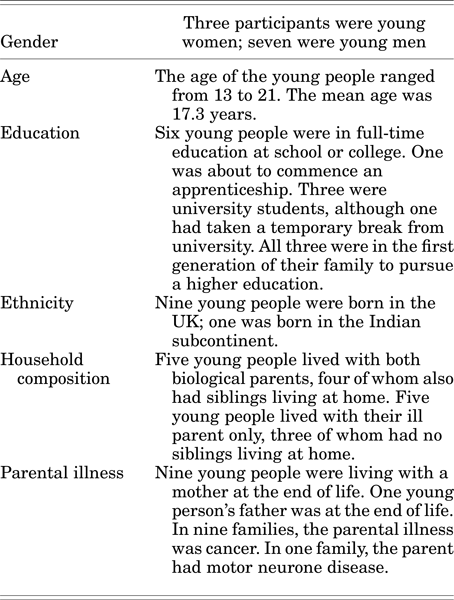
Following initial contact by a practitioner, all study participants were met by the researcher, who explained the research process and obtained signed consent. The 10 young people were drawn from 6 families living in the United Kingdom (UK); 2 of the young people had siblings who also took part in the study. The characteristics of the young people are outlined in Table 1.
Characteristics of the young people included in the study (N = 10)

Data Collection and Analysis
An individual face-to-face interview was carried out with each study participant. A semistructured approach was adopted, beginning with a broad question—“Tell me about your family”—and using an outline interview schedule as “a set of starting points for discussion, or specific stories” (Mason, Reference Mason2002, p. 62). Interviews were digitally recorded and transcribed in full.
Analysis was carried out using the voice-centered relational method (Gilligan et al., Reference Gilligan, Spencer, Weinberg and Camic2003), a narrative approach focusing on different aspects of the young person's “voice” as it appears in their interview transcript. Initial coding of the data concentrated on capturing what the young person said about living with a parent at the end of life and how they talked about their experiences. Doucet and Mauthner (Reference Doucet and Mauthner2008) refer to combining the grounded theory question of “What is happening here?” (Charmaz, Reference Charmaz2006) with elements of narrative analysis (Riessman, Reference Riessman, Gubrium and Holstein2002), such as an interest in recurring words, imagery, characters, and plot.
The “whats” and “hows” of each young person's account were summarized, and initial themes were identified, which were added to after reading each transcript. The individual summaries and emerging themes were shared with colleagues in regular research meetings, providing an opportunity for ongoing and reflexive discussion of the interpretive process. These discussions also informed the grouping of themes under broader headings related to the overarching research questions on young people's experiences of family life and of family care.
In discussing their everyday family lives, relationships, and experiences of care, young people frequently alluded to communication both within the family and beyond the family with others such as friends and HCPs. The following section focuses on the study findings in relation to within-family communication in order to assess the applicability of previous research regarding open communication as beneficial to young people when their parent has a life-limiting illness (Phillips, Reference Phillips2015). All of the names attributed to young people are pseudonyms.
RESULTS
Young people's accounts of everyday family life indicated that some valued open communication and the sharing of information about parental illness because it provided reassurance of their close family relationships:
I can always just go up to my family and talk to them about it, and even if it's something that so deeply involves them, it's not a problem … That's in this situation one of the things that's been most important to me about my family.
— ElliotHowever, others presented a more circumspect approach to communication between family members:
We don't talk about it as a family. No, not really. [Mum and Dad] said that they'd tell us if, like, anything changed, and like … if things got worse or they got better, they said they'd tell us.
— JoeThis lends support to the research finding that parents may sometimes find it difficult to communicate openly with young people, albeit guidance recommends it as the “proper” thing to do (Semple & McCance, Reference Semple and McCance2010).
Some young people reported that they did not always respond to parents' attempts at open communication by fully acknowledging what had been said to them:
They did tell me and I didn't— I think I vaguely remember the conversation when my Mum was saying, “This could be bad.” I remember it not affecting me that much ‘cause I thought, “Okay, it could be bad, but bad has— There's a lot of variation within the definition of ‘bad.’ ””
— ElliotIt appeared that, far from being the passive recipients of parental communication, young people actively interpreted the information their parents gave them, sometimes subverting the intent of open communication. In this way, young people presented themselves as active agents, choosing to find out about their parent's illness on their own terms:
I ask a lot more questions … I keep making myself seem as interested as possible. I always want to know when there's, if there's a problem or something's happened. I want to know, sort of thing, so I keep myself as close to it as possible.
— LukeSome young people were careful to calibrate the amount of information they received and to determine when they knew as much as they wanted to know at that time:
I knew enough for me, well— I don't necessarily ask but, you know, she always just lets me know … She lets me know when she's going for a meeting and stuff, and that's all right, you know. I don't— I don't really push for any information. I feel that I could ask, but— I just don't really.
— JamesI don't want to understand like everything to do with it. It's not something I really wanted to know. I don't really want to know what the— like what cells or whatever it is that's killing my Mum.
— JoeUnlike his brother (Luke), Joe did not “always want to know,” demonstrating the different perspectives on open communication sometimes expressed by siblings living in the same household. It cannot be assumed, therefore, that family members share a consensus on preferred style of communication or value honesty and openness for the same reasons.
Some young people wanted less open communication from their parents, which may have been intended to facilitate their ability to move between states of acceptance and denial.
Furthermore, young people's accounts provided numerous examples of their own deliberations with regard to communication with family members. For example, Dan explained how he tried to assess his parents' emotional state before talking to them:
When you're with the family, you have to be careful what you say because it can upset Mum, or you don't realize what you've said, and that's the main reason why arguments get caused … When Dad's in a bad mood, then you're quiet. You don't say anything. Whereas when he's in a good mood, you can speak to him. Same with my Mum, really.
— DanElliot chose not to talk to his dad about his illness because he thought it might be difficult for him:
I've tended to speak more to my Mum about it, because it's much easier for him to not talk about what's happening to him … I haven't spoken to my Dad about how he feels in a while. I think I've only ever done it properly once, ‘cause I've never really known when to time it.
— ElliotYoung people took care over the timing and content of their communication with family members, reinforcing the relationship between communication style and the manifestation of care in families with a parent at the end of life.
Overall, the present study indicated that young people's experiences of, and attitudes toward, communication between family members when a parent has a life-limiting illness are more varied and nuanced than an emphasis on the importance of open communication implies. The current study found that young people did not universally or unequivocally endorse a preference for openness and honesty. Furthermore, young people's own actions were shown to be highly instrumental in determining their family's communication style.
DISCUSSION
The Caring to the End study explored how young people respond to a life-limiting parental illness in their everyday family lives and the impact of living with dying on young people's experiences of giving and receiving care. In this context, communication between family members emerged as a significant expression of care by, for, and between young people and their family members.
Openness and honesty between family members was valued by some young people, reinforcing a sense of closeness and belonging in the face of the existential challenge posed by parental illness (Phillips, Reference Phillips2015). However, open communication was not invariably regarded as positive. Some young people chose not to ask questions or avoided pursuing conversations about the aspects of parental illness they preferred not to discuss.
Furthermore, differences emerged between the knowledge given by a parent to a young person and the young person's acknowledgment of information, or the way in which meanings are absorbed and incorporated into everyday life. Previous research indicates that some people who are dying resist attempts to instigate a state of open awareness in which the certainty of death in the foreseeable future is confirmed (Almack et al., Reference Almack, Cox and Moghaddam2012; Richards et al., Reference Richards, Ingleton and Gardiner2013). The accounts of young people in the current study point toward a similar process of young people maintaining a sense of ambivalence through their communication with family members when a parent is dying, bringing into question the extent to which all young people want to “know” about their parent's illness, and whether such knowledge is always experienced as helpful.
Young people's accounts in the current study suggest that young people prefer to exercise some control over their knowledge of parental illness and prognosis. Having a choice over how much information they receive may facilitate the ability to move in and out of a state of open awareness and enable young people to better accommodate the experience of parental illness in their everyday lives. Young people appeared to shift their position along a dimension of talking/not talking to family members in order to facilitate getting on with their lives, and thereby participated in shaping family communication styles. In doing so, young people demonstrated their active involvement in the fine-tuning of family life in response to the difficult circumstances of living with a life-limiting parental illness.
In making ongoing judgments about when to talk about what, to whom, and how, young people revealed the dynamics of communication as a form of both caring for and caring about (Ungerson, Reference Ungerson, Finch and Groves1983) their family members. Understanding family communication as the giving and receiving of care, as well as information, may better enable HCPs to assess how to support young people and their parents when they are dealing with a life-limiting parental illness. However, the suggestion that HCPs are well-positioned to support young people by facilitating open communication between family members (Alvariza et al., Reference Alvariza, Lövgren and Bylund-Grenklo2016) may not always be appropriate. Not all of the young people in the current study wanted or felt that they required the intervention of services to enable them to make sense of their experiences. It is therefore perhaps more advisable for HCPs to seek to open a channel of communication with a young person and to make clear their availability to offer accurate information as far as possible while respecting the young person's agency in deciding what they want to know, when, and how.
However, it is acknowledged that the recommendation to make oneself available to communicate with young people may not always be feasible for HCPs to implement. In common with Melcher et al. (Reference Melcher, Sandell and Henriksson2015), the current study found that HCPs did not play a significant role in supporting young people with a life-limiting parental illness. Most young people reported that they had very limited or no contact with HCPs because they were seldom present when HCPs visited the family home. HCPs appear well placed to support parents with family communication, but there may be more scope for working with staff in schools and colleges to open up spaces where young people can talk about their experiences of life-limiting parental illness—should they wish to do so.
Methodological Considerations
The sample size for this qualitative study was small, albeit in line with other similar studies of this hard-to-reach group (Melcher et al., Reference Melcher, Sandell and Henriksson2015; Phillips, Reference Phillips2015). One aim of the present paper was to reevaluate the dominant narrative of open communication as essential to the support of young people when a parent is dying, and by drawing attention to variant perspectives on open communication between family members the study has opened up alternative accounts that merit consideration. A more significant limitation is that only young people who were prepared to talk about their parent's illness were included. As has been stated, young people with a parent at the end of life often have little contact with HCPs or other practitioners, and the views of those who are not known to service staff remain largely hidden.
CONCLUSIONS
This examination of family communication in the context of living with parental life-limiting illness has drawn attention to how end-of-life care policy and practice seeks to influence family communication by emphasizing the importance of providing open and honest information to young people. The emergence of broader cultural narratives concerning how family members should behave toward each other in this context reinforces family communication as a moral practice, one that is concerned with the “proper” thing to do. However, striving to “do the right thing” for young people when a parent is dying need not preclude recognizing and attending to the unique circumstances of each family affected by a life-limiting parental illness.
The current study found that, in contrast with some other research studies in this area, young people do not necessarily want “not just the truth, but the whole truth” (Chowns, Reference Chowns2013, p. 28) about their parent's illness. One reason for this difference in findings may be that some previous studies have been conducted with young people whose parent had already died (Alvariza et al., Reference Alvariza, Lövgren and Bylund-Grenklo2016; Melcher et al., Reference Melcher, Sandell and Henriksson2015) and who had therefore experienced the certainty of parental loss.
In contrast, the prospective accounts of young people in the current study tended to reflect the ambiguity and uncertainty that is often associated with prediction of life-limiting illness trajectories and end-of-life prognoses. In such circumstances, it is difficult to determine with accuracy what might constitute “the truth” or to provide anticipatory “knowledge” of how the progression of parental illness may be experienced. Instead, there is a risk that attempting to provide “the whole truth” to a young person at any given point in their parent's illness trajectory may confront them with information that is inaccurate or that they are simply not ready to receive.
The analysis of family communication presented here has drawn attention to the importance of recognizing young people's agency in determining the flow of information between family members. For some young people, being able to exercise choice and control over when and how to acknowledge facets of their parent's illness may be a more significant factor than openness and honesty per se in enabling them to accommodate the experience of parental illness in their everyday lives.
ACKNOWLEDGMENTS
I thank the young people and family members who took part in the study for their willingness to share their experiences. Thanks are also due to the practitioners who supported the study by making their knowledge and expertise available to me and to the families who took part.
FUNDING
Funding was provided by the University of Nottingham from the School of Health Sciences and the School of Sociology and Social Policy. There are no conflicts of interest to disclose.