Phonetic training has proven successful for improving phoneme identification and production for second-language (L2) learners. Although the specific paradigms have varied, most successful techniques have emphasized presenting listeners stimuli with natural variability (multiple speakers in multiple phonetic contexts), asking listeners to make a forced-choice judgment (e.g., /r/ vs. /l/), and providing feedback indicating whether their response was correct or incorrect (e.g., Hazan, Sennema, Iba, & Faulkner, Reference Hazan, Sennema, Iba and Faulkner2005; Iverson, Hazan, & Bannister, Reference Iverson, Hazan and Bannister2005; Logan, Lively, & Pisoni, Reference Logan, Lively and Pisoni1991; Pruitt, Jenkins, & Strange, Reference Pruitt, Jenkins and Strange2006). Much of this work has involved training Japanese adults to distinguish English /r/ and /l/ (e.g., Bradlow, Pisoni, Yamada, & Tohkura, Reference Bradlow, Pisoni, Yamada and Tohkura1997; Lively, Logan, & Pisoni, Reference Lively, Logan and Pisoni1993; Logan et al., Reference Logan, Lively and Pisoni1991), but such training has also been used for other consonantal contrasts (e.g., English speakers learning Hindi, Pruitt, et al., Reference Pruitt, Jenkins and Strange2006), tones (e.g., Wang, Spence, Jongman, & Sereno, Reference Wang, Spence, Jongman and Sereno1999), and has most recently been adapted for L2 vowels (Iverson & Evans, Reference Iverson and Evans2009; Kingston, Reference Kingston2003; Lambacher, Martens, Kakehi, Marasinghe, & Molholt, Reference Lambacher, Martens, Kakehi, Marasinghe and Molholt2005; Nishi & Kewley-Port, Reference Nishi and Kewley-Port2007). In general, 5–10 sessions of high-variability training tends to improve the identification of novel stimuli (i.e., not in the training set) on the order of 15 percentage points, in a way that is long lasting (e.g., Bradlow, Akahane-Yamada, Pisoni, & Tohkura, Reference Bradlow, Akahane-Yamada, Pisoni and Tohkura1999; Iverson & Evans, Reference Iverson and Evans2009). There is also evidence that this perceptual training transfers to speech production (Bradlow et al., Reference Bradlow, Pisoni, Yamada and Tohkura1997).
This training work has focused almost entirely on individuals that have had relatively little experience with nativelike speech in the L2. That is, individuals who learned English in school without having spent much time in an English-speaking country (e.g., Bradlow et al., Reference Bradlow, Pisoni, Yamada and Tohkura1997; Hazan et al., Reference Hazan, Sennema, Iba and Faulkner2005; Iverson et al., Reference Iverson, Hazan and Bannister2005; Lambacher et al., Reference Lambacher, Martens, Kakehi, Marasinghe and Molholt2005; Lively et al., Reference Lively, Logan and Pisoni1993) or individuals who are being trained on an entirely new contrast (i.e., used in a language that they do not speak; e.g., Hirata, Reference Hirata2004; Kingston, Reference Kingston2003; Pruitt et al., Reference Pruitt, Jenkins and Strange2006). It can be hypothesized that auditory training would be unsuccessful for more experienced L2 speakers, because this line of research has emphasized the importance of exposing listeners to natural variability. That is, natural variability from multiple speakers in multiple phonetic contexts is thought to be effective because it teaches listeners which cues are most robust in a wide range of situations, whereas training with smaller sets promotes learning individual stimuli in a way that does not generalize as well (e.g., Lively et al., Reference Lively, Logan and Pisoni1993; Logan et al., Reference Logan, Lively and Pisoni1991). However, for individuals who have daily experience using their L2 (e.g., L2 English speakers who are living in an English-speaking country), one would think that they would receive a much richer array of phonetic experience than could be delivered in a few hours of computer-based training, and they thus would receive little training benefit.
It is unknown exactly how computer-based phonetic training relates to learning in more natural situations. Some experiments have suggested that individuals do not learn contrasts such as /r/–/l/ as well in situations where the lexicon or sentence context disambiguates phonetic identity, and learn better when they need to focus on the phonetic information (e.g., Ikuma & Akahane-Yamada, Reference Ikuma and Akahane-Yamada2006). Listeners may thus learn poorly in natural situations (e.g., a conversation) because there is enough other linguistic information to make it unnecessary for the listener to discern a specific phonetic context (e.g., there are few minimal pairs for /r/ and /l/, and fewer situations still where the minimal-pair words would fit equally well in the conversation). However, training work in other domains (e.g., transforms of the acoustic signal in cochlear implant simulations) has suggested that the lexicon can provide a feedback mechanism that can aid learning (e.g., Davis, Johnsrude, Hervais-Adelman, Taylor, & McGettigan, Reference Davis, Johnsrude, Hervais-Adelman, Taylor and McGettigan2005; Norris, McQueen, & Cutler, Reference Norris, McQueen and Cutler2003); listeners can learn how to understand acoustically transformed speech faster when they are understanding real words rather than nonwords, presumably because word recognition can provide implicit feedback about whether the listener is successful in making sense of the speech signal. It is worth noting, however, that first-language (L1) listeners may use lexical feedback differently from L2 listeners, because the form-based lexicon of L1 listeners is likely better specified (i.e., with less phonetic ambiguity).
Several studies indicate that the underlying changes in phonetic processing due to training may differ from the kinds of changes that occur due to long-term experience. For example, Heeren and Schouten (Reference Heeren and Schouten2008) found that Dutch listeners could be trained to improve their identification of Finnish /t/–/t:/, but they do not improve in their ability to discriminate acoustic changes in these consonants. That is, the training does not give them the sensitivity peak at the category boundary that is typical of native Finnish speakers (as well as highly fluent L2 speakers of Finnish). Likewise, individual differences on a variety of phonetic measures (e.g., identification, perceptual best exemplar maps, production) tend to be correlated among individuals with long-term experience with an L2, but training does not affect all of these measures equally. For example, Bradlow et al. (Reference Bradlow, Pisoni, Yamada and Tohkura1997) found that pretraining individual differences in Japanese /r/–/l/ perception are correlated with production ability, but the degrees of improvement in perception and production due to training are not correlated. Moreover, our previous work has found that individual differences in vowel recognition ability are correlated with the accuracy of perceptual vowel space maps (i.e., how similar their chosen best exemplars of English vowels are to those of native speakers; Iverson & Evans, Reference Iverson and Evans2007), but auditory training improves identification without changing the accuracy of these best exemplars (Iverson & Evans, Reference Iverson and Evans2009), suggesting that their representations for vowel categories have not fundamentally changed. It may be that long-term experience with an L2 tends to improve a range of phonetic abilities, but auditory training improves specific parts of the underlying processes (see Iverson & Evans, Reference Iverson and Evans2009).
The present study trained L1 French speakers on English vowels, with the aim of evaluating whether L1 French speakers who lived in England and used English daily would have a different training benefit compared to those with relatively little exposure to native English speakers (i.e., learned English at school). One complication is that extremely experienced L2 English speakers can often be very accurate at identifying English vowels, and it makes little sense to train subjects who are already near a ceiling in performance. We therefore adopted a somewhat low minimum experience criteria (6 months living in England) and screened based on their pretest English vowel identification accuracy (less than 85% correct), forming an “experienced” group who all had a significant period of immersion in an English speaking country, even though not all were long-term residents.
All listeners were given eight sessions of high-variability phonetic training on English vowels, and were tested before and after training in terms of English vowel identification, category discrimination, and production accuracy. These pre- and posttests were designed to further examine how listeners are affected by auditory training. The English vowel identification task was a baseline assessment of whether their identification training generalized to new words and talkers. The category discrimination task assessed whether their phonetic perception of stimuli was affected by training. Listeners heard three stimuli produced by three different talkers, two of the same phoneme (e.g., /i/) and one different (e.g., /i/), and listeners had to choose the one that sounded different. This task examined the ability to attend to the relevant phonetic dimensions, ignoring talker variation and other irrelevant variability, but it did not require listeners to explicitly label the stimuli. The production task examined whether improvements in spoken accent were related to changes in perception, both in terms of the overall intelligibility of their spoken vowels and in terms of which specific vowels improved.
METHOD
Subjects
A total of 36 subjects completed the experiment (21 inexperienced and 15 experienced with spoken English; 15 men, 21 women). Four additional subjects began the experiment but did not complete; three were dropped because their English vowel identification was greater than 85% correct in the pretest and one was not able to complete all training sessions. None of the subjects self-reported that they had hearing problems.
The inexperienced subjects were recruited and tested in northeastern France, and all but one had not lived in an English speaking country (the one exception had visited Australia in the past, but had had limited recent use of spoken English). The experienced subjects were all recruited and tested in London; they were residents of London who had lived in English-speaking countries for 6 months to 10 years (median = 18 months). In all other respects, the listener groups had similar English-language learning histories. Both groups began to learn English at school when they were 8–14 years old (median = 11 years). At test, their ages were 19–53 years (median = 25 years) for inexperienced and 19–54 years (median = 24 years) for experienced.
All subjects were given the written grammar portion of the Oxford Placement Test I (Allan, Reference Allan1992) in order to measure their fluency with English. The experienced French subjects (mean = 69%) were more accurate at making judgments of English grammar than were inexperienced French listeners (mean = 43%), t (34) = −5.27, p < .001. On this measure, the experienced subjects had a midintermediate level of written English understanding, whereas the inexperienced listeners were at a basic/foundational level (i.e., were able to comprehend written English but had a poor command of grammar).
Apparatus and stimuli
The pre- and posttests were conducted in quiet rooms, with stimuli played over headphones at a user-controlled comfortable level, and computers (PC and PDA) producing the stimuli and collecting responses. All training was conducted by subjects on their own; they borrowed PDAs, or the training software was installed on their own laptops. The training software created password-protected log files that the subjects could not access, so that we could verify that they completed all sessions. All stimulus recordings were made in an anechoic chamber; vowel production recordings of the subject were made in quiet rooms.
The training stimuli were the same as in Iverson and Evans (Reference Iverson and Evans2009). Recordings of English words were made from eight speakers of British English (four male, four female). The words were groups of minimal pairs selected by dividing 14 British English vowels into four clusters: /ɛ/, /ɑ/, /a/, /ʌ/ (e.g., pet, part, pat, putt); /i/, /ɪ/, /aɪ/, /eɪ/ (e.g., feel, fill, file, fail); /ɒ/, /əʊ/, /ɔ/ (e.g., was, woes, wars); and /u/, /aʊ/, /ɜ/ (e.g., shoot, shout, shirt). The clusters were selected by conducting a hierarchical cluster analysis on previous English vowel identification data by L2 English speakers (Iverson & Evans, Reference Iverson and Evans2007); the first three clusters comprised vowels that were mutually confusable by many listeners, and the last cluster (i.e., /u/, /aʊ/, /ɜ/) was formed of remainders (i.e., vowels that were not strongly clustered with others). There were 10 sets of minimal pair words for each for the four clusters, for a total of 140 words. Each speaker recorded each word twice, and both recordings were used during training. All words were displayed to speakers one at a time in a random order during the recording session, to avoid list intonation.
The pre- and posttest stimuli comprised recordings of English /b/-V-/t/ words from 10 speakers of British English (5 male, 5 female). None of these speakers and words were used in the training corpus, such that all pre- and posttests measured generalization to new stimuli. The speakers read the words beat /i/, bit /ɪ/, bet /ɛ/, Bert /ɜ/, bat /a/, Bart /ɑ/, bot /ɒ/, but /ʌ/, bought /ɔ/, boot /u/, bait /eɪ/, bite /aɪ/, bout /aʊ/ and boat /əʊ/ English vowels that would create nonwords in the /b/-V-/t/ context (e.g., /ʊ/) were not included in the study.
Procedure
Training. There were eight sessions of high-variability phonetic training (i.e., vowel identification with feedback), and an initial 14-trial practice session. The entire course of training was completed over 1–2 weeks, and the sessions typically lasted about 45 min. There was a different talker each session, as is typical of high-variability phonetic training procedures (e.g., Logan et al. Reference Logan, Lively and Pisoni1991).
On each trial, subjects heard a stimulus word and clicked on three or four minimal-pair alternatives (depending on vowel; see stimulus description). For example, they could hear slit and be asked whether it sounded like sleet, slit, slight, or slate. The stimulus word was played before the response alternatives were shown, with the intent that their initial recognition of the word would be open set (e.g., not primed by the response alternatives), even though they gave a closed-set response. Every response word was accompanied by a more common word that had the same vowel (e.g., seed, sit, night, eight) in case the response word was unfamiliar to the subjects. These example words were the same whenever that vowel appeared as a response. The subjects were shown these written example words during the initial instruction of the experiment (i.e., during the first practice), and we verified that each subject knew these words.
If subjects gave a correct response, they saw “Yes!” on the computer screen accompanied by a cash register sound, then heard the word one more time. If subjects gave a wrong response, they saw “Wrong” on the computer screen accompanied by two tones with descending pitch, heard the correct word played, then heard a four-stimulus alternating series of the correct word, the incorrect response, the correct word, and the incorrect response. For example, if the stimulus word was slit and they clicked on the sleet response, they would hear an alternating series of slit, sleet, slit, sleet so that they could learn the contrast between these two words.
Within each 225-trial training session, the first 70 trials were five repetitions of the 14 vowels in a random order, the next 85 trials were chosen adaptively based on the subject's errors, and the last 70 trials were five repetitions of the 14 vowels in a random order. This design ensured that all subjects were trained on all vowels at the beginning and end, while allowing some of the training to be customized to fit the needs of each individual subject. The adaptive trials were selected randomly, with the selection probability of an individual vowel being weighted by combining the proportions of misses and false alarms for that vowel. That is, the probability of a vowel being selected increased when it was identified incorrectly or when that vowel was chosen incorrectly as a response when another stimulus had been played.
The stimulus words on each trial were chosen randomly for each vowel. That is, if the trial was intended to have an /i/ stimulus, the computer program randomly chose one of the 10 minimal-pair stimulus words that had this vowel. This random selection was blocked, such that each of the 10 minimal-pair word sets was used once before the list was recycled.
Pre- and posttests
VOWEL IDENTIFICATION. Subjects heard one English /b/-V-/t/ word on each trial and gave a closed-set identification response (all 14 words as response options). To give their response, they mouse clicked on a button that listed the stimulus word (e.g., bot) as well as a common English word that had the same vowel (e.g., hot). They received no feedback and were not able to replay the stimulus. There were six repetitions of the 14 vowels for a total of 84 trials. The speakers were randomly selected on each trial (i.e., all 10 were mixed within the same block). They were randomly mixed to make the task more equivalent to the category discrimination task described below, which necessarily requires having stimuli from different talkers.
CATEGORY DISCRIMINATION. Subjects heard three English /b/-V-/t/ words on each trial, which were spoken by three different talkers; two words were the same and one was different. Listeners had to judge which of the three stimuli was a different English word (i.e., an oddity task). They received no feedback and were not able to replay the stimulus. There were 17 pairs of words (e.g., /i/–/ɪ/), with each played six times (e.g., half with /i/ and half with /ɪ/ as the odd stimulus, with the odd stimulus played first, second, or third).
The vowel pairs were /i/–/ɪ/, /eɪ/–/ɪ/, /eɪ/–/aɪ/, /eɪ/–/ɛ/, /ɑ/–/a/, /ɑ/–/ɒ/, /ɒ/–/ʌ/, /ɜ/–/ʌ/, /ɜ/–/əʊ/, /ɜ/–/ɔ/, /ɑ/–/ɔ/, /ɒ/–/ɔ/, /ɔ/–/aʊ/, /əʊ/–/ɔ/, /əʊ/–/ɒ/, /əʊ/–/aʊ/, /u/–/aʊ/. The pairs were selected based on previous English vowel identification data by L1 French speakers (Iverson & Evans, Reference Iverson and Evans2007); the most frequently confused vowel pairs were selected in descending order until each of the 14 stimulus vowels appeared at least once.
VOWEL PRODUCTION. Each of the subjects was recorded reading each of the /b/-V-/t/ words three times. The recordings for all subjects in the pre- and posttest were then given to four British English listeners for identification judgments, following the vowel identification procedure described above. Listeners heard each of the 3,024 recordings once in a random order, divided into 18 blocks that were completed over several days.
RESULTS AND DISCUSSION
Vowel identification
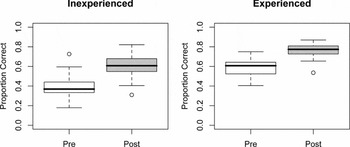
Figure 1 displays the identification accuracy of inexperienced and experienced subjects before and after training. A repeated-measures analysis of variance (ANOVA) analysis on arc-sin transformed scores demonstrated that there was a significant main effect of training, F (1, 34) = 147.42, p < .001, with inexperienced listeners improving from an average of 40% correct pretest to 61% posttest, and experienced listeners improving from 59% to 76%. There was also a significant main effect of experience, F (1, 34) = 22.65, p < .001, with experienced listeners being more accurate at identifying English vowels than inexperienced listeners. However, there was no significant interaction of training and experience, p > .05. Thus, both subject groups were able to benefit from training, and they learned to similar extents.
Boxplots of identification accuracy for English vowels, pre- and posttraining, for first-language French speakers who were inexperienced or experienced with English. The boxplots display the distribution of scores divided into quartiles, with circles marking outliers.

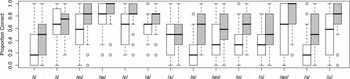
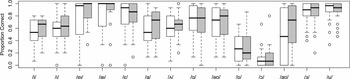
Figure 2 displays the pre- and posttraining identification accuracy for each vowel. Paired t tests for each vowel demonstrated that the improvement was quite broad; 11 of the 14 vowels significantly improved with training (p < .05), all except for /ɪ/, /aɪ/, and /ʌ/.
Boxplots of identification accuracy across all subjects, presented separately for each English vowel pre- (white boxes) and posttraining (gray boxes).

Category discrimination
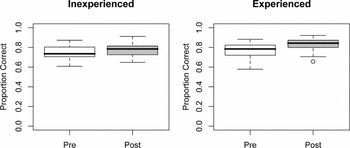
Figure 3 displays the category-discrimination accuracy of inexperienced and experienced subjects before and after training. There was a very small effect of training, with inexperienced listeners improving from 75% correct pretraining to 77% posttraining and experienced subjects improving from 76% pretraining to 83% posttraining. Nonetheless, the main effect of training was significant, F (1, 34) = 20.52, p < .001, in a repeated-measures ANOVA on arc-sin transformed scores. There was no significant main effect of experience, and no significant interaction of training and experience (p > .05).
Boxplots of category discrimination accuracy for pairs of similar English vowels, pre- and posttraining, for first-language French speakers who were inexperienced or experienced with English.

Pearson correlations on arc-sin transformed scores demonstrated that the individual differences in category discrimination were significantly correlated with identification accuracy, both at the pretest (r = .46, p = .005) and posttest (r = .63, p < .001). However, the individual differences in improvement in category discrimination accuracy (i.e., post–pre) were not significantly correlated with the improvement in identification accuracy (r = .02, p > .05).
Figure 4 displays the category discrimination accuracy for each pair. The results demonstrate that most pairs hardly improved at all; paired t tests demonstrated that three of the pairs (/ɑ/–/ɒ/, /ɔ/–/aʊ/, /ǝʊ/–/ɔ/) were significantly different after training (p < .05).
Boxplots of category discrimination accuracy across all subjects, presented separately for each stimulus pair pre- (white boxes) and posttraining (gray boxes).

The results thus demonstrate that this more perceptual ability to distinguish phonetic contrasts is relatively unaffected by auditory training, improving significantly but to a small enough degree to be conceivably due to procedural learning (i.e., becoming familiar with the task and testing situation), not being correlated with the larger improvements in identification accuracy, and not changing significantly for many of the vowel pairs. Despite these findings, it is clear that this type of discrimination ability is related to the ability to identify vowels, given that individual differences on these measures were correlated.
Vowel production
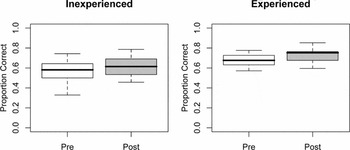
Figure 5 displays how accurately native English speakers identified the subjects’ productions before and after training. The improvement in production was relatively modest, changing from 57% before to 61% after for inexperienced subjects and from 68% before to 72% after for experienced subjects. A repeated-measures ANOVA on arc-sin transformed scores demonstrated that this main effect of training was significant, F (1, 34) = 13.68, p < .001. There was also a significant main effect of experience, F (1, 34) = 15.60, p < .001, demonstrating that more experienced listeners produced vowels that were easier to identify. There was, however, no significant interaction (p > .05), demonstrating that the amount of improvement did not differ depending on listener experience.
Boxplots of production accuracy (i.e., the identification of second-language productions by native speakers), pre- and posttraining for first-language French speakers who were inexperienced or experienced with English.

Pearson correlations on arc-sin transformed scores revealed that individual differences in production were significantly related to identification accuracy both before (r = .74, p < .001) and after training (r = .67, p < .001). However, the individual differences in production improvement (i.e., post–pre) were not significantly related to the improvements in identification accuracy (r = −.06, p > .05). Compared to category discrimination, individual differences in production were not correlated before training (r = .31, p = .06) but were afterward (r = .66, p < .001); differences in improvement on these two measures were not significantly correlated (r = −.21, p > .05).
Figure 6 displays the vowel production accuracy for each vowel. Paired t tests demonstrated that the production improvement was only significant for three vowels (/i/, /eɪ/, and /aʊ/, p < .05). For these three vowels, there was little change in the scores of the upper quartile of subjects (i.e., the most accurate listeners) but there were improvements among the lower quartiles of subjects. We examined the productions of the listeners who improved the most, and it appeared that the errors could have been driven by the orthography (i.e., reading errors) rather than by more subtle errors in the production of vowels. When they made errors they often produced entirely different vowels from trial to trial (e.g., speaking bout as if it were the same as English boot /u/, boat /əʊ/, or the correct /aʊ/), and became more consistent at producing the vowel after training. That is, they became more consistent at producing the correct vowel when they saw this orthographic form, rather than making finer-grained improvements in the vowels that they produced.
Boxplots of production accuracy across all subjects, presented separately for each English vowel pre- (white boxes) and posttraining (gray boxes).

The results thus demonstrate that, although vowel production improved with training, it improved in ways that were distinctly different from the improvements in identification accuracy. That is, listeners improved in production for a few vowels that may have had difficult orthographies, rather than having the broader improvements found in identification, and the individual differences in production improvements were not correlated with improvements in identification accuracy.
GENERAL DISCUSSION
The experiments reveal that experienced and inexperienced English speakers receive similar benefit from training, even though the exposure to English stimuli during this study was much less than experienced listeners would hear in their daily interactions with L1 English speakers. This supports a conclusion that it is not the exposure alone to natural variable speech that improves performance in auditory training. Rather, there is some aspect of the focused attention to phonetic differences in an identification task that improves L2 vowel perception, in a way that supplements the learning that they experience while using the language. This finding parallels results in the cochlear implant literature, even though the origin of their difficulties are different; cochlear implant users with poor to moderate speech recognition accuracy can benefit from focused auditory training even though they use their device in daily communication (Fu, Galvin, Wang, & Nogaki, Reference Fu, Galvin, Wang and Nogaki2005).
The comparison of the different pre- and posttests helps illustrate how auditory training differs from normal language learning. Before training, individual differences in identification accuracy were correlated with their ability to perform the category discrimination task and the accuracy with which native speakers could understand their vowel productions. Although this finding alone could be interpreted to indicate that all tasks rely on the same underlying processes and representations, the effects of training were very different for these three tasks. That is, individual differences in improvement on all three measures were uncorrelated with each other, and the item analysis revealed fundamentally different patterns of learning, with improvements in identification accuracy that were significant for most vowels, degrees of improvement in category discrimination that were very small and significant for only three contrasts, and small degrees of improvement in production that were isolated to a few diphthongs. The training results thus help expose that these tasks tap into different aspects of L2 vowel perception and production. Natural experience with speech likely improves speech perception and production at multiple levels simultaneously, which may tend to make the underlying processes appear to be more related than they are.
In terms of methodology, the differences between identification and category discrimination tasks are notable because category discrimination tasks have been thought to measure many of the same abilities as identification tasks (e.g., Flege, Reference Flege, Fava and Mioni2003; Højen & Flege, Reference Højen and Flege2006). The problem with identification tasks is that a listener must know the language well enough to use the response labels correctly. Category discrimination tasks, however, require no knowledge of the response labels. Category discrimination tasks nonetheless are thought to tap into phonological or phonetic levels of encoding because they cannot be performed based on acoustic similarity (i.e., listeners must ignore the variation introduced by the differences between talkers, and attend specifically to dimensions that can distinguish phonetic categories) and because the high degree of stimulus variability would be thought to encourage listeners to use a more abstract, phonological, encoding of the stimuli in short-term memory (e.g., Flege, Reference Flege, Fava and Mioni2003; Højen & Flege, Reference Højen and Flege2006). It does appear that the category discrimination task taps into processes that are relevant to L2 learning, because L2 listeners can have difficulty with phoneme pairs that are easy for L1 listeners (e.g., Højen & Flege, Reference Højen and Flege2006), and the present study demonstrates that category discrimination is correlated with individual differences in L2 identification accuracy. However, the task seems to compress individual differences; experienced and inexperienced listeners did not differ significantly on this task and improved very slightly after training. It is possible that the category discrimination task taps into relatively low levels of phonetic processing that change little due to experience during adulthood (e.g., Iverson et al., Reference Iverson, Kuhl, Akahane-Yamada, Diesch, Tohkura and Kettermann2003; Iverson, Ekanayake, Hamann, Sennema, & Evans, Reference Iverson, Ekanayake, Hamann, Sennema and Evans2008), rather than tapping into higher levels of phonological encoding that are akin to identification. The level of phonetic processing that is measured by category discrimination tasks is thus likely important to L2 learning, but category discrimination clearly assesses perception differently than identification tasks.
The differences in perceptual identification and production correspond to those found by Bradlow et al. (Reference Bradlow, Pisoni, Yamada and Tohkura1997) for the identification of English /r/–/l/ by Japanese listeners (i.e., a correlation between production and perception in the pretest, improvement in perception and production after training, but no correlation in the degree of perception and production improvement). However, the individual vowel data demonstrates this difference further, with production learning being isolated to a few vowels. Most recently we found that giving Japanese adults production training for English /r/ and /l/ successfully improves production, but it has no effect on perception (Hattori & Iverson, Reference Hattori and Iverson2008). The emerging view is that production and perception rely on quite different factors, and perhaps even on different underlying representations. That is, individual differences in production and perception may become correlated because both rely on experience, but training reveals that the processes are quite distinct.
If we conclude that auditory training affects a relatively specific level of processing, then what is this level of processing that is improved? Our previous hypothesis (Iverson & Evans, Reference Iverson and Evans2009) was that training affects the application of category knowledge to highly variable speech, without necessarily changing the representations themselves. This was based on a finding that we could achieve improvements in identification performance by L1 Spanish and German listeners who were learning English vowels, without finding changes in their perceptual vowel space maps (i.e., best exemplar locations). That is, we concluded that subjects did not change their introspective notions of how good English vowels sound, but they improved in how they were able to put this knowledge into practice when identifying vowels in natural variable speech. This hypothesis is also in accord with our previous findings with training Japanese speakers to identify English /r/–/l/ (Iverson et al., Reference Iverson, Hazan and Bannister2005); listeners improved when trained on highly variable speech, but they appeared to learn by more systematically applying their L1 flap /r/ category to English (i.e., labeling stimuli that were close to their flap as English /l/) rather than learning new categories based on this acoustic variability. In the present study, this account fits with our finding that listeners did not substantially change their basic perception of the phonetic dimensions that distinguished these vowels (i.e., category discrimination task) even though they improved in identification.
One could hypothesize that this type of learning (i.e., improving the application of category knowledge to variable speech) is merely an improvement in learning the response labels. However, if that kind of learning had occurred, we would have expected a pattern of learning that was more like that which was found in production, with learning occurring mostly for categories that had difficult orthographies (e.g., bout), but we found a much more pervasive pattern of learning. Moreover, the word responses were accompanied by example words that were expected to be known to both groups of listeners, and all listeners were familiarized with these example words before training. Although we did not test orthographic knowledge, the more experienced listeners had a better command of written English (as tested by the grammar test) and they thus would be expected to benefit less from further learning of the orthographic forms used in the experiment; instead, we found that they learned as much as inexperienced listeners. Our conclusion is that auditory training improves the efficiency of categorization in a nonsuperficial manner (e.g., generalizes to new stimuli and is retained over time; Bradlow et al., Reference Bradlow, Akahane-Yamada, Pisoni and Tohkura1999; Lively et al., Reference Lively, Logan and Pisoni1993; Logan et al., Reference Logan, Lively and Pisoni1991) and provides a useful addition to real-world L2 experience.
ACKNOWLEDGMENTS
This research was funded by Grant RES-000–23-0838 from the Economic and Social Research Council of the United Kingdom.