INTRODUCTION
One in five Americans die before or shortly after discharge from an intensive care unit (ICU) (Angus et al., Reference Angus, Barnato and Linde-Zwirble2004), and the majority of these deaths are preceded by a decision to limit life-sustaining therapy (Prendergast & Luce, Reference Prendergast and Luce1997; Prendergast & Puntillo, Reference Prendergast and Puntillo2002). Clinicians ask family members to participate in these decisions as surrogate decision makers, guided by their understanding of the patient's values and wishes (Berger, DeRenzo et al., Reference Berger, DeRenzo and Schwarz2008). This process places a burden on surrogates (Vig et al., Reference Vig, Taylor and Starks2006; Reference Vig, Starks and Taylor2007; Braun et al., Reference Braun, Beyth and Ford2008; Reference Braun, Naik and McCullough2009; Wendler & Rid, Reference Wendler and Rid2011; Schenker et al., Reference Schenker, Crowley-Matoka and Dohan2012) and has long-lasting adverse mental health consequences, including posttraumatic stress disorder (PTSD), anxiety, depression, and persistent complex bereavement disorder (Pochard et al., Reference Pochard, Azoulay and Chevret2001; Jones et al., Reference Jones, Skirrow and Griffiths2004; Azoulay et al., Reference Azoulay, Pochard and Kentish-Barnes2005; Lautrette et al., Reference Lautrette, Darmon and Megarbane2007; Anderson et al., Reference Anderson, Arnold and Bryce2008; Reference Anderson, Arnold and Angus2009; Siegel et al., Reference Siegel, Hayes and Vanderwerker2008; Gries et al., Reference Gries, Engelberg and Kross2010; Kross et al., Reference Kross, Engelberg and Gries2011). In one study conducted in 21 French ICUs, 81.8% of surrogates involved in a decision to limit life-sustaining treatment exhibited PTSD symptoms 90 days after a loved one's death that were perceived as distinct from the normal processes of grief and bereavement (Azoulay et al., Reference Azoulay, Pochard and Kentish-Barnes2005). In 2010, a task force of the Society of Critical Care Medicine proposed a new term for the cluster of symptoms experienced by families after an ICU experience: Post–Intensive Care Syndrome–Family (PICS–F) (Davidson et al., Reference Davidson, Jones and Bienvenu2012).
Increasing recognition of surrogate distress has led to the promotion of more family-centered treatment for dying patients in the ICU, including interventions to support surrogates (Thompson et al., Reference Thompson, Cox and Antonelli2004; Truog et al., Reference Truog, Campbell and Curtis2008). To date, these interventions have principally fallen into two main categories: (1) decision support (i.e., informational pamphlets, pen-and-paper decision aids, or values clarification exercises) (Scheunemann et al., Reference Scheunemann, McDevitt and Carson2011; Mitchell et al., Reference Mitchell, Tetroe and O'Connor2001; Lautrette et al., Reference Lautrette, Darmon and Megarbane2007; Kryworuchko, Reference Kryworuchko2009; Peigne et al., Reference Peigne, Chaize and Falissard2011; Cox et al., Reference Cox, Lewis and Hanson2012) or (2) psychological and communication support from an ICU professional (i.e., structured family meeting or additional family support from a patient navigator, nurse, or social worker) (McCormick et al., Reference McCormick, Curtis and Stowell-Weiss2010; Scheunemann et al., Reference Scheunemann, McDevitt and Carson2011; Murphy et al., Reference Murphy, Kreling and Kathryn2000). Such efforts conceptualize the problem as one that requires better prognostic information, values clarification, and clinician–surrogate communication in the ICU, and they have shown some benefit (Scheunemann et al., Reference Scheunemann, McDevitt and Carson2011). For example, one proactive communication strategy included longer family conferences with more time for family members to talk and provided family members with a brochure on bereavement decreased PTSD, anxiety, and depression at 90 days by roughly a third in a French cohort (Lautrette et al., Reference Lautrette, Darmon and Megarbane2007). However, despite this substantial relative reduction, prevalence rates of symptoms of PTSD (45%), anxiety (45%), and depression (29%) in the intervention group remained high. Furthermore, implementation and scaling of such interventions may prove difficult. A recent multicenter trial of a quality-improvement intervention for end-of-life care in the ICU through clinician education, local champions, academic detailing, clinician feedback of quality data, and system supports did not improve family outcomes (Curtis et al., Reference Curtis, Nielsen and Treece2011).
Post-ICU interventions offer a promising new frontier for reducing PICS–F (Davidson et al., Reference Davidson, Jones and Bienvenu2012). Such interventions may provide additional benefit by allowing family members at the greatest risk of long-term psychological sequelae to process their experience as surrogates during the acute bereavement period. However, to the best of our knowledge, no post-ICU interventions have been systematically evaluated for their ability to reduce adverse mental health consequences among family members involved in decisions to limit life-sustaining treatment. We therefore sought to develop and pilot test a novel intervention during the early bereavement period for this high-risk population. Based on data from our prior descriptive work (Schenker et al., Reference Schenker, Crowley-Matoka and Dohan2012), we posited that allowing surrogates to tell the story of their involvement in the decision to limit life-sustaining treatment for a loved one in the ICU would help them find meaning in this difficult experience, preempt rumination and behavioral avoidance, and promote sleep quality, thereby facilitating the normal work of acute grief and improving mental health outcomes. Our storytelling intervention draws on the theory of narrative ethics and prior empiric work demonstrating the health benefits of narrative self-disclosure after stressful experiences (Pennebaker et al., Reference Pennebaker, Barger and Tiebout1989; White & Epston, Reference White and Epston1990; Petrie et al., Reference Petrie, Booth and Pennebaker1995; Charon & Montello, Reference Charon and Montello2002; Niederhoffer & Pennebaker, Reference Niederhoffer, Pennebaker, Snyder and Lopez2002; Noble & Jones, Reference Noble and Jones2005).
In this article, we discuss the conceptual framework underlying the beneficial effects of storytelling. We then present our formative work developing a storytelling intervention for recently bereaved surrogates who participated in life-sustaining treatment decisions. Next, we describe the final components of our intervention and report initial data on feasibility and acceptability from an open-label case series.
METHODS
Conceptual Framework
The conceptual framework of narrative ethics posits that the act of telling one's story allows patients and families to understand events in ways that make it possible to process them and move on (Charon & Montello, Reference Charon, Montello, Charon and Montello2002). As the psychologist Jerome Bruner argued, we employ stories to help us understand our plight as humans and what Aristotle termed “peripeteia,” or sudden reversals of our circumstances (Bruner, Reference Bruner, Charon and Montello2002). Stories help us deal with surprises and upsets, make meaning out of chaos, clarify values, and build connections between past and future events. As Rita Charon posits in her seminal work Narrative Medicine, stories combat loneliness and build communities, as we “discover the deep, nourishing bonds that hold us together.” We are all storytellers, continually creating and reshaping our identities in the tales we tell each other (Charon, Reference Charon2006).
An expanding body of research supports the benefits of storytelling on physical and emotional health. Writing about a broad range of emotional topics over multiple sessions has been associated with improved immune responses among healthy students receiving hepatitis B vaccinations (Petrie et al., Reference Petrie, Booth and Pennebaker1995) and among patients with HIV (Petrie et al., Reference Petrie, Fontanilla and Thomas2004). After loss or traumatic experiences, similar narrative interventions have been associated with fewer physician visits and improved subjective health (Pennebaker et al., Reference Pennebaker, Barger and Tiebout1989; Greenberg et al., Reference Greenberg, Wortman and Stone1996; Cameron & Nicholls, Reference Cameron and Nicholls1998). Stories have also been employed successfully to bridge cultural divides between physicians and patients and to combat racial/ethnic disparities in health behaviors and outcomes (Larkey & Gonzalez, Reference Larkey and Gonzalez2007; Curtis & White, Reference Curtis and White2008; Larkey et al., Reference Larkey, Lopez and Minnal2009; Houston et al., Reference Houston, Allison and Sussman2011). For example, in one study an interactive storytelling intervention distributed on DVDs produced significant improvements in medication adherence and blood pressure control among African-American patients with hypertension (Houston et al., Reference Houston, Allison and Sussman2011).
Three theoretical processes purport to explain the salutary effects of storytelling after traumatic events (Niederhoffer & Pennebaker, Reference Niederhoffer, Pennebaker, Snyder and Lopez2002) (see Fig. 1). The emotional disclosure framework posits that the benefit of storytelling derives from the opportunity to disclose emotional trauma, counteracting the psychological stress of inhibiting important thoughts and feelings (Pennebaker, Reference Pennebaker and Berkowitz1989; Pennebaker et al., Reference Pennebaker, Barger and Tiebout1989; Trau & Deighton, Reference Trau and Deighton1999). Further examination of the storytelling experience has revealed the importance of cognitive processing, that is, providing needed closure, order, and a sense of control through construction of a coherent narrative about a stressful life event (Clark, Reference Clark1993; Pennebaker et al., Reference Pennebaker, Mayne and Francis1997). Finally, storytelling is an opportunity to establish richer social connections through sharing difficult experiences, counteracting the feelings of loneliness and social isolation associated with poor mental health (Holahan et al., Reference Holahan, Moos and Holahan1996). Mechanistically, we posited that these three processes may preempt the rumination and behavioral avoidance of reminders of the deceased that are core features of persistent complex bereavement disorder (see DSM-5). Thus, a storytelling intervention may allow surrogates to articulate painful feelings associated with a decision to limit life-sustaining treatment and with their loved one's death that may be shunted aside during the acute bereavement period. Decreasing dysphoric arousal could in turn facilitate better sleep quality, thereby reducing an important risk factor for the development of subsequent mental disorders.
Proposed mechanisms to explain the beneficial mental health effects of storytelling.

In summary, supported by a strong conceptual framework with applicability to recently bereaved surrogates, storytelling interventions have demonstrated benefit in multiple clinical research settings. However, prior interventions have not been tailored to the unique needs and circumstances of surrogates during the acute post-ICU bereavement period or tested in this vulnerable population. We therefore sought to develop a novel storytelling intervention for recently bereaved surrogates who participated in a decision to limit life-sustaining treatment for a loved one in the ICU.
Intervention Content and Development
We assembled an interdisciplinary development team with experts from the fields of critical care, palliative care, health services research, psychiatry, psychology, decision science, social work, and epidemiology and biostatistics. The team provided expertise in the surrogate experience, mood disorders, bereavement, and behavioral intervention research.
Overview
We conceptualized the intervention as an opportunity for surrogates to tell the story of their experience participating in a decision to limit life-sustaining treatment for a loved one in the ICU within 2 to 4 weeks of the patient's death. We chose this timeframe to balance our likelihood of affecting subsequent development of adverse mental health outcomes while not posing too great a burden during the immediate bereavement period. We chose a single, rather than a multi-session, intervention in order to maximize feasibility and scalability within this timeframe. We initially designed the storytelling session as a face-to-face intervention in order to ensure the facilitator's ability to recognize and respond to surrogates' emotions, though we are now developing a telephone-based version (see Discussion section, below). We offered to conduct the storytelling session either in the surrogate's home or at a private research office to ensure participant comfort and convenience. In this formative work, the principal investigator (AB) conducted all intervention sessions because we viewed it as critical to have an expert facilitator while we worked on intervention development and refinement. After each session, the facilitator debriefed the subject regarding the experience of study participation, including questions about burdensomeness, acceptability, and perceived value.
Eliciting the Story
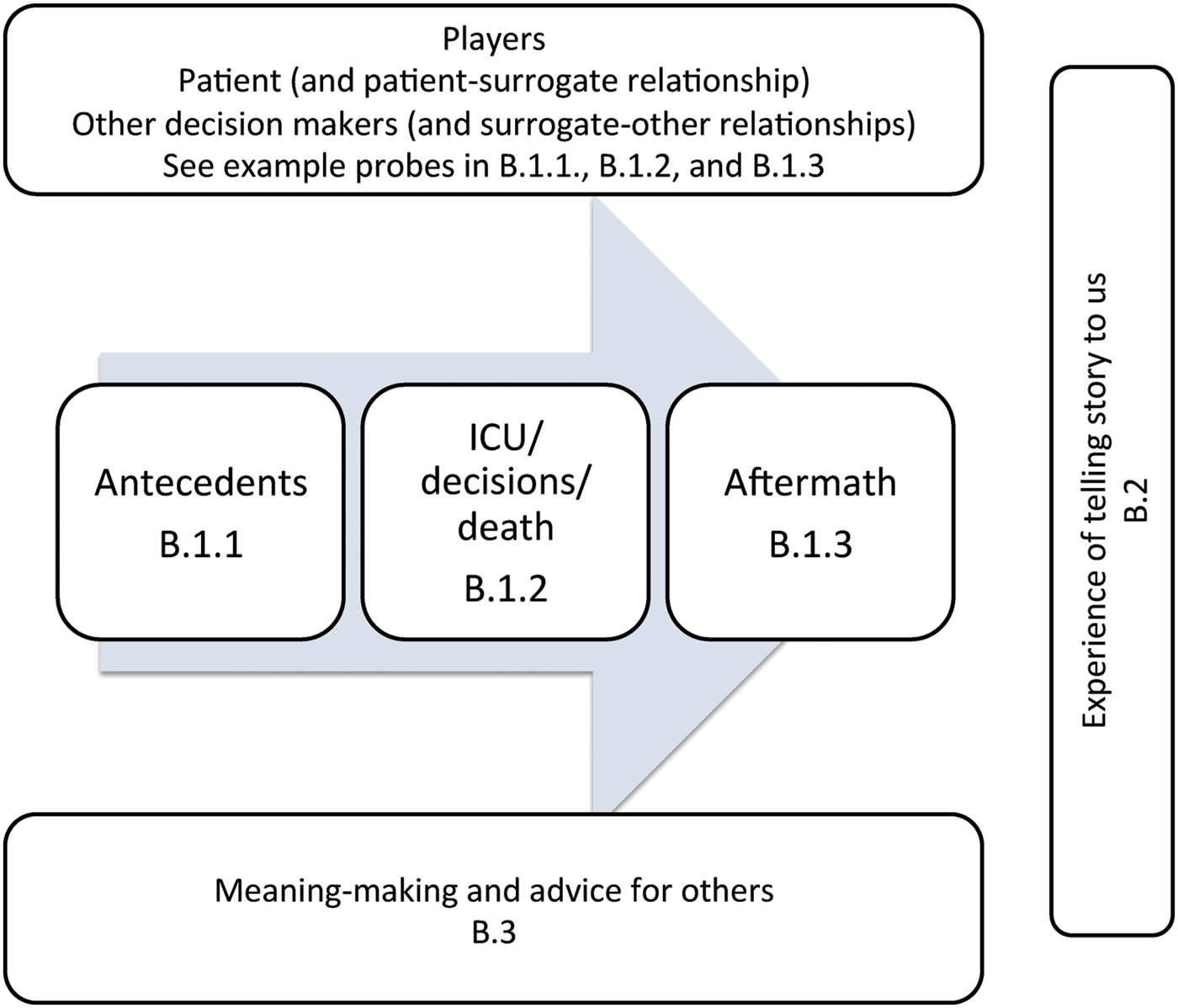
The initial semistructured guide included questions to elicit three key domains of the story: the antecedents (the illness that brought the patient to the ICU), the ICU experience (including the decision to limit life-sustaining treatment and the patient's death), and the aftermath (the surrogate's feelings or thoughts about the decedent, the ICU experience, and the decision to limit life-sustaining treatment). We conceptualized the story as a narrative with multiple characters—including the decedent and other decision makers—with relationships to the surrogate. Because some surrogates perhaps did not view themselves as having “made” a decision (Schenker et al., Reference Schenker, Crowley-Matoka and Dohan2012), we used general probes to elicit this experience, such as, “At what point did you realize that your [relationship] might not survive?” and “Were there any major decisions that had to be made once you realized that?”
Rather than forcing a linear narrative, our goal was to create a safe setting for surrogates to describe experiences and feelings that they may have pushed aside during the acute bereavement period. Historical events provided a scaffold for the interview guide, but we iteratively modified the guide to preferentially probe elements of the story with the strongest emotional valence, identified using nonverbal cues (crying, changes in voice). We conceptualized the intensity of emotion during the storytelling interview as a key active ingredient of the intervention and therefore used probes to elicit how events affected surrogates, rather than the historical events themselves. Examples of these types of probes include, “Tell me how that experience was for you?” and “What was it like for you to see your [loved one] like that?”
Emotional Disclosure and Distress
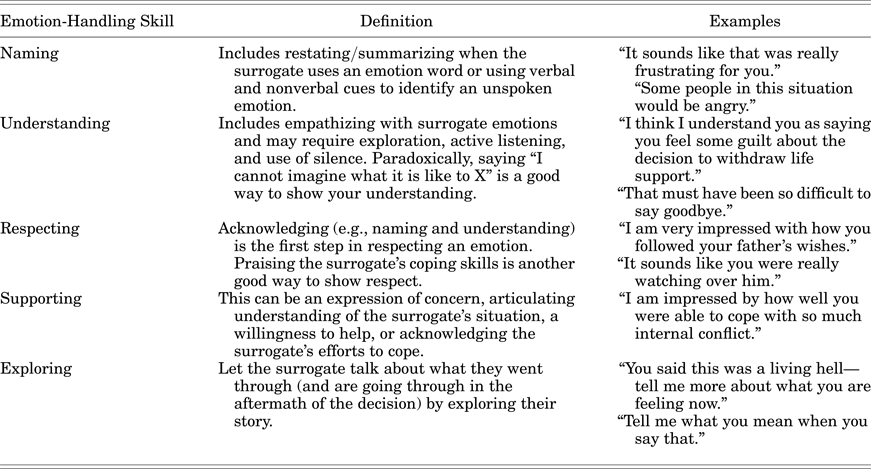
Throughout the storytelling experience, the facilitator attended to surrogate emotions using NURSE (Naming, Understanding, Respecting, Supporting, and Exploring) statements (Back, Reference Back, Arnold and Tulsky2009). Definitions adapted from prior work (Pollak et al., Reference Pollak, Arnold and Jeffreys2007; Back, Reference Back, Arnold and Tulsky2009) and sample probes for each type of NURSE statement are shown in Table 1. Emotion-handling statements were nonjudgmental and did not presume that surrogates were experiencing any particular emotion. Rather, the facilitator sought to provide direct support for the surrogate and facilitate the process of acute grief by responding to empathic opportunities.
We also asked surrogates to rate their distress using the subjective units of distress (SUDS) scale (range 0–100) (Tanner, Reference Tanner2012), with 0 being completely calm and 100 being the worst distress that a participant could imagine before, during, or after the storytelling session. The purpose of eliciting SUDS scores was to provide feedback to the participant and facilitator about the strength of the surrogates' emotional experiences.
Emotion handling during storytelling

Cognitive Processing and Social Connection
To facilitate cognitive processing and social connections through storytelling, we also asked participants to reflect on what they learned from the experience of being a surrogate in the ICU and what advice they might have for others. Probes to encourage meaning making included, “What have you shared with other people about this experience?” “Who needs to hear your story?” “What advice might you have for others in similar situations?” “What did you learn through this experience?” “What do you wish you had known beforehand?” and “What do you wish you had done differently?”
Closure
At the end of the storytelling session, the facilitator identified key themes that had emerged and drew attention to positive aspects of the surrogate's experience, delivering a validation statement to show respect for the surrogate's role. This was often that s/he was an attentive caretaker. For example, “I just, I can't tell you how impressed I am with your willingness to tell us this story, but even more so, the respect I have for you for the way that you took care of your brother.” The facilitator expressed thanks and an understanding of how difficult it is to share one's story. Finally, the facilitator reviewed a pamphlet with community bereavement resources with the subject and encouraged self-care.
Participants and Recruitment
We conducted a case series in a single medical ICU in our tertiary care academic medical center. We included recently bereaved surrogates who participated in a decision to limit life-sustaining treatment that resulted in the inpatient death of an adult ICU patient. Surrogates who were present in the ICU during recruitment hours met initial (screening) eligibility criteria if they were the family member or friend of a patient who lacked capacity and for whom the ICU team anticipated a family meeting about life-sustaining treatment decisions. We included only surrogates who were able to participate in English. To ensure our ability to conduct sessions face to face, we excluded surrogates who did not live within two hours' driving distance from Pittsburgh. Based on prior experience (Schenker et al., Reference Schenker, Crowley-Matoka and Dohan2012; Reference Schenker, White and Crowley-Matoka2013), we approached family members prior to a decision to limit life-sustaining treatment in order to build sufficient rapport to recruit surrogates of patients who later died. On this approach, we explained the study in general terms and obtained proxy consent for medical record review to assess eligibility and recontact. For surrogates who met subsequent (storytelling) eligibility criteria (participation in a life-sustaining treatment decision for an incapacitated ICU patient who died in the hospital), we mailed a condolence letter one week after the patient's death, followed by a telephone call approximately two weeks after the patient's death. At this time, surrogates were given the opportunity to learn more about the study and schedule a storytelling visit. We obtained consent to make an audio recording of this session.
Iterative Modification
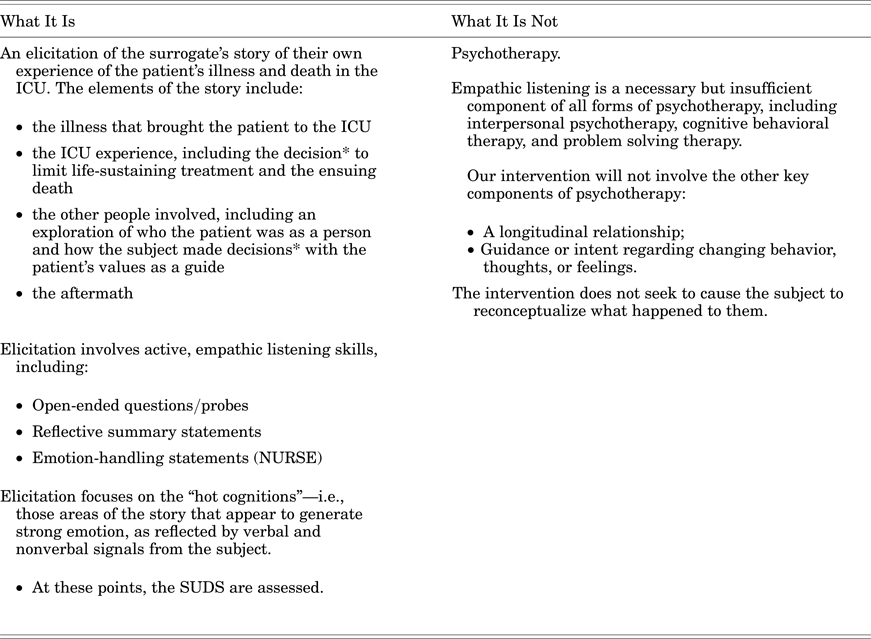
We iteratively modified the storytelling guide during multiple team meetings during which team members listened to audio recordings of role-played storytelling sessions (between a team member and surrogates played by standardized patients, palliative and critical care fellows, and other members of the research team) and, later, to six real storytelling sessions in the case series of study participants. The final guide clarifies key characteristics of the storytelling intervention and distinctions between story elicitation and psychotherapy (see Table 2). We include the final storytelling intervention guide as an appendix (see attached guide).
Key characteristics of the storytelling intervention

* Do not assume the subject conceptualizes the process as involving active decisions.
Human Subject Protections
The University of Pittsburgh institutional review board reviewed and approved the study protocol. All subjects provided written informed consent for participation. Subjects completing a storytelling interview received $50 in payment for their time.
RESULTS
Enrollment
We found that 28 of 61 (46%) screened subjects met our initial (screening) eligibility criteria. The most common reasons for ineligibility were that the surrogate was not available during recruitment hours (45%) or that the surrogate lived more than a two-hour drive from Pittsburgh (30%).
Of the 28 surrogates who met the initial eligibility criteria, 20 (71%) consented to be followed. Surrogates who declined to participate most commonly cited feeling overwhelmed by the ICU experience. Based on medical record review, 10 of the 20 met subsequent (storytelling) eligibility criteria for the intervention phase, 6 of whom completed the storytelling intervention.
Characteristics of Participants
Surrogate participants were the spouse (two of six), parent (two of six), or sibling (two of six) of a deceased patient. Two thirds (four of six) were women, consistent with the gender demographics of surrogates nationally. Their mean age was 54 years old, and all were Caucasian.
Location and Timing of Storytelling Sessions
Storytelling sessions most commonly took place in a surrogate's home (three of the six participants), while two chose a private research office and another chose a public library near their home. Sessions took place on average 37 days after the patient's death (range 22–70). Storytelling sessions lasted an average of 62 minutes (range 40–92).
Emotional Distress
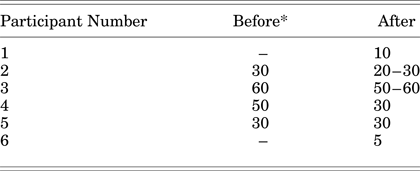
The Subjective Units of Distress scores (SUDS) before and after the storytelling sessions are shown in Table 3. Post-intervention SUDS ranged from 5 to 60 and were no higher than the scores prior to the intervention.
Subjective units of distress (SUDS) before and after storytelling

* Missing data indicate that the SUDS questions were not asked.
Acceptability
In debriefing interviews after each intervention session, all subjects endorsed acceptability; five of the six participants in the storytelling intervention reported that it was helpful to talk about their experience; while one said he enjoyed the opportunity to “help others” through his participation, although he did not himself think that he needed any help because he had experience dealing with trauma. One participant said, “I think that that helped me to talk to somebody that wasn't judging me or something,” and later noting, “There's a lot of things I didn't even know that were hurting me, you know? This is feeling good.” Another subject said, “For me, it helps to talk about it and to tell the story, because it's my way of going through it again. (. . .) I think sometimes you have to look back and understand and walk through it to get past and move on.”
DISCUSSION
In this formative study, we developed and pilot tested a novel storytelling intervention for recently bereaved surrogates who faced life-sustaining treatment decisions for a loved one in the ICU, a population known to have adverse psychological outcomes. Our intervention was informed by a conceptual model and related empirical evidence supporting the beneficial mental effects of storytelling after traumatic events. Our storytelling guide facilitated elicitation of the surrogate's story through active, empathic listening and probing of emotional responses. Recruitment was feasible, and participants overwhelmingly viewed the intervention as helpful.
While increased understanding of the challenges faced by surrogates has been shown to result in more support for family members facing decisions in the ICU (Davidson et al., Reference Davidson, Powers and Hedayat2007), little attention has been paid to the needs of surrogates after a decision is made to limit life-sustaining treatment. Post-ICU interventions represent an important opportunity for selective prevention to improve mental health outcomes and reduce disability in this vulnerable and high-risk group. We chose a storytelling intervention in part based on prior descriptive work in which storytelling emerged as a key coping mechanism among surrogates in the ICU (Schenker et al., Reference Schenker, Crowley-Matoka and Dohan2012). Comments from participants after each session in the current study supported our conceptual model of storytelling as an intervention that facilitates emotional disclosure and cognitive processing after traumatic events. We also noted that storytelling sessions allowed participants to articulate feelings and memories from the ICU that they may have ignored in the weeks since their loved one's death, thereby facilitating the work of normal grieving.
A further consideration at this stage was to ensure that our intervention was both practical and sustainable. We posited that a single storytelling session conducted in a surrogate's home might be less burdensome, stigmatizing, and/or costly than other potential preventive mental health strategies such as psychotherapy or medication. Intervention expenses might be offset by a decrease in downstream healthcare utilization, as demonstrated by a prior ICU-based intervention study in which surrogate mental healthcare utilization was halved in the intervention group (Lautrette et al., Reference Lautrette, Darmon and Megarbane2007). However, it is possible that a multi-session intervention may be more effective; additional work is needed to determine the optimal storytelling “dose.”
While we conducted all initial sessions in person, we are now developing plans to pilot the surrogate storytelling intervention by telephone, supported by accumulating evidence for the beneficial effects of telephonic mental health interventions in other settings (Rollman et al., Reference Rollman, Belnap and Mazumdar2005; Reference Rollman, Belnap and Le Menager2009). Given the significant proportion of surrogates who lived far away from the medical center where their loved one died, we anticipate that a telephone-based intervention would greatly expand our potential reach. In the “real world,” storytelling sessions could be conducted by a social worker, nurse, or chaplain with ICU and/or bereavement experience.
Our work has limitations. We were unable to recruit a racially/ethnically diverse group of surrogates for this pilot phase. Additional work is needed to ensure that our intervention is safe for and acceptable to participants from diverse racial/ethnic groups. Because our aim was to develop the storytelling intervention, we found it infeasible to simultaneously train an interventionist; the principal investigator (AB) conducted all intervention sessions. Our intervention guide, developed by an experienced and interdisciplinary group through an iterative process of conducting, reviewing, and critiquing these storytelling sessions, and including exemplar interviews conducted by a skilled clinician, provides an important starting point for future interventionist training.
In summary, we have described an innovative post-ICU intervention designed by a multidisciplinary team and refined through an open-label case series of recently bereaved surrogate decision makers. This work supports further evaluation of the safety and acceptability of the surrogate storytelling intervention in a phase II study and, ultimately, a larger randomized trial to assess efficacy.
ACKNOWLEDGMENTS
Our work was supported by the National Palliative Care Research Center (NPCRC) (P30 MH090333), the National Center For Advancing Translational Sciences of the National Institutes of Health (KL2TR000146), and the University of Pittsburgh Department of Medicine's Junior Scholar Award. The content is solely the responsibility of the authors and does not necessarily represent the official views of the National Institutes of Health.
APPENDIX
Surrogate Storytelling
Storytelling Intervention Interview Guide
11/27/2013
OVERVIEW
As is customary with semistructured interview guides, this guide describes the topics that we will explore during the interview. The exact direction of the interview will vary, depending upon the conversation. The keys to the interview are:
-
• to elicit honest, personal narratives about the experience of making a decision to limit life-sustaining treatment for a loved one in the ICU and its emotional aftermath, and
-
• to identify and respond to empathic opportunities using NURSE statements (Naming, Understanding, Respecting, Supporting, and Exploring emotions).
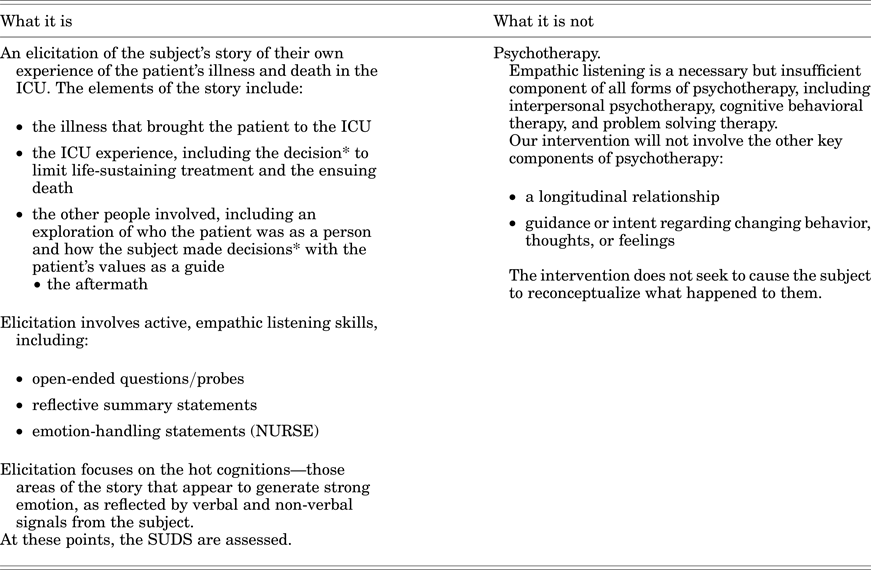
The following box summarizes what the storytelling intervention is and is not.

Storytelling Intervention
A. INTRODUCTION
A.1. Orientation
“We will start with informed consent and completing the paperwork to activate your gift card. Then I'd like to hear your story about the ICU experience.”
A.2. Consent and We-Pay Card
-
✓ Go over the consent information sheet; elicit additional questions and document consent, including whether the subject provides permission to reuse their audio interview for future research.
-
✓ Suggested language regarding the purpose of the intervention: “The purpose of my visit today is to be a listening ear. Many people go through this difficult experience and we never ask them about how it was for them. I'd like to do that today.”
-
✓ Provide the participant with a copy of the information sheet for their records.
-
✓ Complete the We-Pay form, provide the card and the instructions, and explain the ways to use the card and how to obtain information about the balance.
A.3. SUDS Instructions
“Throughout our conversation I will ask you the same question several times to report your distress on a scale of 0 to 100, where 0 is completely calm and 100 is the worst distress that you can imagine. It's called the subjective units of distress, or SUDS for short.”
A.4. Request Permission to Begin Audio Recorder
“May I have your permission to start the audio recorder?”
-
✓ Turn on the recorder.
-
✓ State: “This is _______(name). I am talking with subject [study ID #] and today is [date].”
A.5. SUDS (Pre)
-
✓ Document SUDS (pre)
A.6. Interview Guidelines
“Now I'd like to give you the chance to tell your story. Throughout our conversation you may find yourself getting emotional—that is just what we would expect. If at any point you feel too upset to continue the conversation, please let me know. When I notice that you are distressed, I will ask you to tell me where you are on the SUDS from 0 to 100. Any questions?”
B. ELICITING THE SURROGATE'S STORY
The purpose of the conversation is to elicit the story of the surrogate's experience of participating in a decision to limit life-sustaining treatment in the ICU for their loved one and its emotional aftermath. The story can be seen as a narrative with lots of characters involved, including the decedent. Of note, because some surrogates may not perceive that they “made” a decision, we use general probes. The figure below illustrates the key domains of the story (antecedents, the ICU experience—including decision-making process and the death—and the aftermath) and the related topics that we will probe (the players involved—including the decedent—their meaning making and advice for others, and their experience of telling the story to us). On pages 3 to 5, we summarize the principles of eliciting the story. On pages 6–7, we provide specific questions to encourage/facilitate storytelling that correspond to the story elements summarized in the figure, below.
Storytelling components.

Typically, the conversation will not follow these semistructured questions exactly, because the conversation will flow using probes such as “tell me more,” simple reflections, and complex reflections. A key “active ingredient” of the storytelling is the intensity of emotion, which allows the surrogate to process the acute grief in a safe setting. The interviewer will probe how things affected them at an emotional level—their experience of the events—rather than probe the historical events themselves.
Examples:
“Tell me how that experience was for you?”
“What was it like for you to be spending so much of your time in the hospital?”
“What was it like for you to see your daughter like that?”
“Tell me why it was important for you that the nurses knew what kind of a person your brother was?”
The participant may not tell the story in a chronologic manner; therefore, the interviewer must be flexible and probe the issues of strongest emotional valence that the surrogate volunteers rather than forcing a linear narrative. After probing the strongest or most proximate emotion, the interviewer can redirect the surrogate as needed.
Example:
“I wanted to go back to something you said earlier . . .”
The interviewer must attend to emotion throughout the interview. This provides direct support to the surrogate and may facilitate processing the acute grief. We do not assume that the surrogate is feeling any particular emotions (guilt, regret, etc.). Emotion-handling statements should be nonjudgmental and acknowledge that the person holds their own views and feelings. They will avoid premature/false reassurance, rebuttal, agreement, or solutions. Below we provide a guide for emotion-handling statements, using the NURSE mnemonic:
N—Naming. This includes restating/summarizing when the surrogate uses an emotion word or using verbal and nonverbal cues to identify an unspoken emotion. In this latter situation, be careful to avoid declarative statements. For example, try, “I wonder if you're feeling angry,” or “Some people in this situation would be angry,” rather than “I can see you are angry.”
Examples:
“It sounds like that was really frustrating for you.”
“This must be incredibly difficult for you.”
“That must have been exhausting for you.”
“It sounds like there are some things that you are angry about.”
“That must have been so hard.”
“That sounds incredibly stressful.”
U—Understanding. This may require exploration, active listening, and use of silence. Paradoxically, saying “I cannot imagine what it is like to X” is a good way to show your understanding.
Examples:
“I think I understand you as saying you feel some guilt about the decision to withdraw life support.”
“That must have been so difficult to say goodbye.”
“So it sounded like you really wanted to be making the decisions for your husband.”
“That must have been a relief to feel like other people were helping to care for him.”
“You must really miss him.”
“So that wasn't a surprise for you . . . to hear that from the doctors?”
“So it sounds like relationships with his family were really difficult.”
“So this is something you've been facing for a really long time.”
“So it sounds like you blame the surgeons for this.”
“So it sounds like you feel he is not the only one who was put through this.”
“So it sounds like even though he was sick for years, this felt sudden, in a way.”
“Little things are reminders for you.”
“You were really hoping he'd just wake up.”
“That's the kind of thing that a mom's never supposed to have to worry about.”
R—Respecting. Acknowledging (e.g., naming and understanding) is the first step in respecting an emotion. Praising the surrogate's coping skills is another good way to show respect.
Examples:
“I am very impressed with how you followed your father's wishes.”
“So it sounds like you were really your husband's guardian.”
“So you were really watching over him and protecting him.”
“You were really making sure he was never alone.”
“So it sounds like you were really his guardian for so many trips to the hospital.”
“It sounds like you really took good care of him.”
“It sounds like you knew him really well.”
“It sounds like the two of you had a really special bond.”
“It sounds like you were really watching over him.”
S—Supporting. This can be an expression of concern, articulating understanding of the surrogate's situation, a willingness to help, or acknowledging the surrogate's efforts to cope.
Example:
“I am impressed by how well you were able to cope with so much internal conflict.”
E—Exploring. Let the surrogate talk about what they went through (and are going through in the aftermath of the decision) by exploring their story.
Examples:
“What was that like for you?”
“Tell me more about your relationship.”
“Tell me more about your relationship with his family.”
“You said this was a living hell—tell me more about what you are feeling now.”
“Tell me more about how you are feeling now.”
“Tell me what you mean when you say that.”
“You mentioned seeing her as an angel. Tell me more about your faith.”
Throughout the interview, whenever the surrogate demonstrates strong emotion (crying, anger, etc.) we will ask the participant to estimate their SUDS in the moment.
Example:
“This is a really tough part of the story for you. Where would you rate yourself now on the 0 to 100 SUDS scale?”
B.1. The Story
B.1.1. Antecedents
“Tell me about the events that led to your [relationship]'s admission to the intensive care unit.”
Probe:
“Tell me more.”
B.1.2. ICU Experience and Death
“Tell me about what happened once your [relationship] was in the intensive care unit.”
Probes to guide conversation to limitation of life-sustaining treatment:
“At what point did your realize that your [relationship] might not survive?”
“Were there any major decisions that had to be made once you realized that?”
Probes:
“Tell me about that process.”
“What happened next?”
“What was your role in the process?”
“How did your relationship with your [relationship] . . .
“How did your role in your family . . .”
“. . . influence the process?”
“What about the process was most difficult?”
“Often people think about what their loved would have thought about being so sick in the ICU. What would your [relationship] have thought about stopping life support, or about never starting life support in the first place?”
“Was there anything about the experience that was different from what you had expected?”
B.1.3. “Tell me about major thoughts and feelings you've had about the ICU experience in the last [X] weeks since [name] died?”
Probes:
“Any thoughts or feelings about your [relationship]?
“Any thoughts or feelings about particular aspects of the ICU experience?”
“Any disturbing dreams?”
Probe:
“Any thoughts, feelings, or dreams that are recurring over and over?
B.1.4. “What—or who—has helped you to cope during this difficult time?”
B.1.5. “Is anything else you can think of that you want to tell me about your experience? Any final thoughts about your experience in the intensive care unit or its aftermath?”
B.2. Reflection on Storytelling Experience
B.2.1. How do you feel after telling me the story of your [insert relationship]'s death?
Probe:
“On that scale of distress from 0 to 100, how do you rate yourself at this moment?”
-
✓ Document SUDS (post)
B.2.2. Looking back, what was most the most difficult part of the story to tell? How would you rate yourself at that most difficult point on that 0–100 scale?”
-
✓ Document SUDS (retrospective—most difficult)
B.2.3. What was positive about the telling this story?
B.3. Meaning Making and Advice for Others
B.3.1. “What have you shared with other people about this experience?”
Probe:
“Who needs to hear your story?”
B.3.2. “What advice might you have for others in similar situations?”
Probes:
“What did you learn through this experience?”
“What do you wish you had known beforehand?”
“What do you wish you had done differently?”
C. CLOSE
C.1. Validation Statement
Deliver a validation statement expressing respect for their courage to tell you the story.
Example:
“I just, I can't tell you how impressed I am with your willingness to tell us this story, but even more so, the respect I have for you for the way that you took care of your brother. I mean, you were with [Name], just like you said, you were with him from first grade, through high school, and when this time came, you were with him in the ICU, you stayed with him while he died, and you even rode with his body back down to your mom. And I just, I'm really impressed with that kind of commitment to your brother. I'm sure it means a lot to him, and it sounds like it was important to you.”
C.2. Express Thanks
“I want to thank you very much for taking the time to speak with me and to share your experience, it is deeply appreciated. I can tell that this was very hard work for you.”
C.3. Encourage Self-Care
Review community resources guide.