

At the time of this writing, approximately three years have passed since November 30, 2022, when OpenAI publicly released ChatGPT. This moment has been widely considered the catalyst for the current generative AI revolution, which archaeology is also navigating (Gattiglia Reference Gattiglia2025). As Cobb (Reference Cobb2023) notes, generative AI tools such as ChatGPT are unlikely to displace the archaeological profession completely given that archaeological work relies on sophisticated types of pattern recognition that take years of physical and intellectual training to develop (Cobb Reference Cobb2023:364). Although this conversation about the utility of LLMs in archaeological practice is still relatively new, some initial case studies have demonstrated that generative AI may be a fruitful tool for archaeological research: some found that LLM training data provided a generally accurate overview of specialized archaeological topics (Agapiou and Lysandrou Reference Agapiou and Lysandrou2023; Cobb Reference Cobb2023:364; Lapp and Lapp Reference Lapp and Lapp2024). However, other studies have shown that AI repeats common misrepresentations of the past and dated knowledge about archaeological subjects (Magnani and Clindaniel Reference Magnani and Clindaniel2025). There are many potential applications of the large umbrella that AI encompasses, and studies such as Ciccone (Reference Ciccone2024) and Zakirov and colleagues (Reference Zakirov, Yanbukhtin, Stele, Musaev and Fassbinder2026) have also shown that LLMs can be powerful coding and data analysis assistants—as Cobb discussed (Reference Cobb2023:368). However, as we demonstrate here, the quality of the data, images, and prompts inputted greatly affects the products of AI-generated processes (Agapiou and Lysandrou Reference Agapiou and Lysandrou2023; Zakirov et al. Reference Zakirov, Yanbukhtin, Stele, Musaev and Fassbinder2026).
As archaeologists committed to advancing collaborative and community-accountable approaches before the so-called AI revolution, we engage with LLMs within the framework of our partnerships with local and descendant peoples. There is a growing literature around digital archiving and community-based work (Caswell et al. Reference Caswell, Harter and Jules2017; Marsh et al. Reference Marsh, Punzalan and Johnston2019; Norton-Wisla and Wynne Reference Norton-Wisla, Wynne and Marshall2018) and particularly how it intersects with AI (Gupta and Kapoor Reference Gupta and Kapoor2020; Jaillant Reference Jaillant2022). Mirroring our commitments, the title of our article deliberately subordinates the revolutionary potential of generative AI to the transformative reality of community-engaged archaeology (Atalay Reference Atalay2012; Montgomery and Fryer Reference Montgomery and Fryer2023). Studies in this space have shown a potential for growth: in a recent review of AI and Indigenous communities and research, Perera and colleagues (Reference Perera, Vidanaarachchi, Chandrashekeran, Kennedy, Kennedy and Halgamuge2025) discuss how many Indigenous communities around the globe are harnessing AI, broadly defined, to execute community goals such as language preservation (Lothian et al. Reference Lothian, Akçayir, Sparrow, Mcleod and Demmans Epp2020), land- management planning (Taylor et al. Reference Taylor, Sigona and Kelly2023), and increasing awareness of Indigenous cultures. However, they also point to potential issues, such as the cultural biases of AI, concerns over open data sharing, and potential marginalization of Indigenous peoples due to the biases of training data.
We recognize the ethical implications of LLM use in and beyond archaeology—from privacy concerns and copyright violations to overuse of natural resources (Chauhan et al Reference Chauhan, Bahad and Jain2024; Tenzer et al. Reference Tenzer, Pistilli, Brandsen and Shenfield2024; Yan et al Reference Yan, Li, Xu, Dong, Zhang, Ren and Cheng2025). Environmental concerns and related ethical dilemmas in particular are ever present in the proliferation of AI. Data centers that train and host AI models are disproportionately being planned and built in rural, economically disadvantaged, and racialized communities, creating concerns for environmental impacts to those communities (Brockovich Data Center Reporting 2026). As is well discussed in the mainstream media, data centers use significant amounts of water to cool their servers, which create heat as they run and divert water from communities, water systems, and food production. In addition to water, these large data centers—and therefore the training and processing of AI models—also use significant amounts of power, which worsens climate impacts and exacerbates global climate change. Technology companies and software engineers are currently working on reducing the processing times and energy required to run these programs by creating more efficient algorithms (Whitman Reference Whitman2026). Despite strides toward improvement, environmental concerns regarding LLMs and the energy costs of training these models are not minor and are worth careful consideration when completing even targeted uses of LLMs in community-engaged research, such as the ways described here. Although we share these concerns, we can also recognize value in the way generative AI tools enable research, writing, and data analysis and interpretation in a time of shrinking budgets and diminished enrollment, and in the face of the persistent problem of legacy data in archaeological practice.
One of the roles of archaeologists who work with local and descendant peoples is to interface between local concerns and disciplinary expertise, which is what unites the case studies presented in this article. These case studies show how LLMs were used to address the need to analyze large amounts of textual data—a circumstance that similarly arose in our community-oriented contexts. In this respect, our contribution resonates with community-based digital archiving and the use of AI by archival practitioners who are also addressing this problem (e.g., Jaillant and Rees Reference Jaillant and Rees2023; Popple et al. Reference Popple, Prescott and Mutibwa2020; Teel Reference Teel2024). Our case studies all spotlight slightly different points of engagement with AI. In the first, Cootsona explored transcription of legacy documentation from Picuris Pueblo using LLMs. When she was confronted with a specific problem working with undergraduate apprentices, she leveraged a small request for a targeted solution. In the second case study, Castillo, spurred on in part by Cootsona’s application, applied an LLM using materials from his work at Querétaro. Castillo’s use case was less successful, creating tables that ultimately were not usable; however, we outline approaches that could have been successful. Finally in the third case study, Sunseri’s work with the Mountain Messenger speculates on the ways that work done before the widespread use of LLMs could have been improved upon with AI, and it served to test the potential for locally hosted applications of LLMs based on community and stakeholder mandates.
Methods
Large language models fall under the wide umbrella of AI, under the branch of generative AI and text prediction. Models such as ChatGPT are trained from large datasets inputted by software engineers to facilitate machine learning (ML). In turn, ML is designed to recognize and then use algorithms that fit the input to predict language patterns and generate text based off of that pattern. Although AI is a term to describe ChatGPT and other generative AI chatbots, the term LLM is preferred because it more accurately describes the ways in which these models are generating information. Like any form of data analysis, chatbots and generative AI are only as good as the data from which they are trained, and they are susceptible to the biases within that data.
For our examples, we utilized three main functions of the LLM: the translation of the request and then the creation of the response, which is generative; the transcription of the document—essentially, optical character recognition (OCR); and the translation of those documents into new formats such as tables. Many laypeople are already familiar with OCR, given that it is the process that occurs in making a portable document format file (PDF) readable with Adobe Acrobat or similar software. However, there are many versions of OCR that all work slightly differently and, as many can attest, imperfectly. AI can bridge the gap to help predict the missing pieces when the OCR does not capture all the data. Additionally, models such as ChatGPT analyze the data and then select the most appropriate OCR model based on the data inputted, rather than simply using one model for every dataset. Document extraction is an evolving field, and there are companies such as LandingAI that are specifically invested in this issue of creating better OCR and using AI and LLMs to recognize critical nontext information such as checkboxes, embedded images, and/or different forms of document layout, including columns or handwritten additions.
LLMs and OCR models function differently based on their training data and structure. Consequently, there are some models that work better for typewritten tables and some models that work better for newspaper broadsheets, as one example. It is important when approaching any dataset with AI that multiple models are investigated and evaluated, because there are no “one-size-fits-all” solutions. Within each of the case studies here, we describe our specific models and how they articulated with the datasets and problems in question.
The limitations of AI and LLMs are well documented (e.g., Burke and Akhtar Reference Burke and Akhtar2023; Cobb Reference Cobb2023), including the fact that AI is not particularly skilled at consistently producing accurate data, particularly in less-documented subspecialties. These models are prone to “hallucinations,” a term describing LLM-created information not based on fact but rather on text prediction. In our case studies, the chat function of the LLMs acts as predicative language packaging for programming functions that human-created code could often easily replicate. We asked LLMs to act as our coders—to run functions that could be created in a coding language such as Python, but without the necessity of needing those programming skills. In OpenAI’s blog post about the ChatGPT’s process (OpenAI 2025), when analyzing data, they describe four steps:
1. Access the uploaded data in a code execution environment.
2. Write Python code to process the data and to produce the required analytical output.
3. Execute code and examine the results.
4. Integrate the results into the response visible in the chat window.
For those wishing to circumvent using GenAI, models such as ChatGPT can be bypassed in many circumstances using Python code (or other coding languages), but it requires expertise and tailoring to the exact documents used. Additionally, there are open-source, locally hosted LLMs, such as the one we describe in the third case study, which minimize environmental impact and can potentially avoid privacy and internet access issues. The advantage to using an LLM is that many archaeologists, museum curators, and citizen scientists are not advanced at writing code. The chat function of many LLMs simplifies the process of converting files and simplifying tables, reducing the need to be highly technically trained.
Three Case Studies
To work with communities and multiple layers of citizen scientists, community-engaged researchers must be flexible in how they approach what they were recruited to do, especially in light of how priorities may shift over the course of the project. For example, work at Querétaro began as archaeological survey—as it did in rural Downieville (where the Mountain Messenger has been based for 170 years)—but as community partners identified emergent risks to cultural patrimony, requests to attend to archival research blossomed into new workflows and long-term, seven-generations thinking about the possibilities of the archives to supplement or surpass the ability of archaeological fieldcraft to serve community interests. Likewise, the utility of documentary resources linked to archaeological analysis at Picuris became newly expanded, in that densely packed and typed text could now be put into new forms that allow more fluid and community aligned inquiry, as is the case with family histories and probate records within the Messenger.
All three case studies articulate with the function of OCR models within LLMs, mobilized in differing ways. Case Study 1 (Cootsona) transformed a simplistic, scanned, English-language dendrochronology data table into a CSV file. Case Study 2 (Castillo) attempted to transcribe a longer, photographed, Spanish-language census into a CSV file. Case Study 3 (Sunseri) sampled a scanned, poorly preserved newspaper broadsheet for data transcription and parsing into text. These case studies are exploratory, yet we argue that small-scale, intentional use of LLMs has potential in collaborative and community-engaged archaeologies to mobilize community members, students, and practitioners as citizen scientists in new and expanded ways.
Case Study 1: Picuris Pueblo
Picuris Pueblo is a Northern-Tiwa-speaking nation in northern New Mexico and currently has around 300 tribal members. In the 1960s, Herbert Dick worked with Pueblo members to excavate parts of their ancestral and modern pueblo, in part due to both utility-line mitigation and Dick’s personal scientific goals. The excavations produced hundreds of thousands of artifacts that are now owned by the Pueblo and that are currently in the process of being transferred from Southern Methodist University’s collections space at Fort Burgwin, New Mexico, to the Pueblo’s museum, which has been remodeled and restored. Like many small museums, tribal or otherwise, it has a small staff responsible for performing many roles, which can make dealing with large legacy collections difficult.
Community Engagement
As part of her dissertation research on a portion of the legacy collection from Picuris Pueblo, Cootsona worked with Picuris council, governor, and elders to design the research and determine the goals, methods, and parameters. She was first introduced to community partners in 2017, and a formal research agreement was established in 2021. Cootsona and Picuris stakeholders have met periodically to discuss next steps, permissions, and community priorities. In the case of Picuris Pueblo, the use of LLMs such as ChatGPT was only used on previously published or otherwise nonsensitive information.
In this community-accountable research with legacy collections from Picuris Pueblo, Cootsona studied avifaunal collections and documentation from 1960s excavations and subsequent 1960s and 1970s analyses (Adler and Dick Reference Adler and Dick1999; Cootsona and Montgomery Reference Cootsona and Montgomery2025). Much of the documentation from the site is scanned, handwritten and typewritten documents, with various levels of intelligibility. As part of Cootsona’s reanalysis of the avifauna, her team of undergraduate research apprentices through Berkeley’s Undergraduate Research Apprentice Program (URAP) worked with printouts and readable PDFs of the collection’s notes to add information such as datable materials to the faunal database. The role of the URAP program is twofold: to create learning opportunities for Berkeley undergraduates and to give faculty and graduate students assistance on research projects. The aim is to minimize time completing menial tasks for the benefit of student learning.
Using searchable PDFs and printouts had its downsides: undergraduate apprentices frequently missed potential information when looking through the binders of documentation, and even when they were made readable through OCR, the PDF’s search functions routinely missed search terms due to the typewritten and handwritten nature of the documents. Additionally, the original document was not organized with respect to the spatial orientation of the site’s archaeological loci, which meant that finding pertinent information took more time. This required the principal investigator (PI) to double-check results from the collections—which is normal and expected, especially when working with apprentices—but it produced a significant number of false negatives for dating methods.
LLM Application
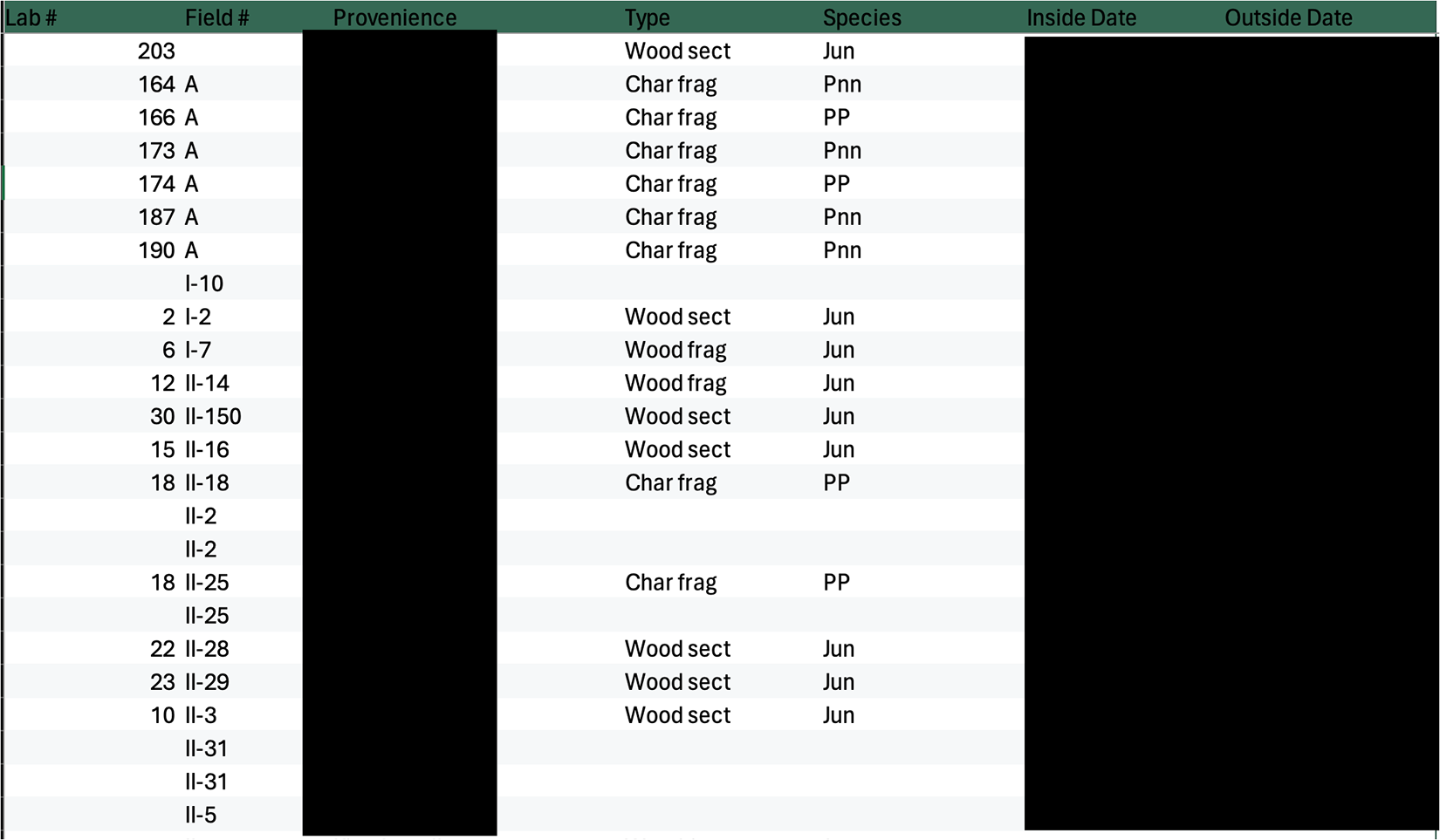
The initial file used to pilot the LLM processing of a PDF into CSV was a 3.3 MB, 13-page PDF document, primarily composed of dendrochronological dating samples from Picuris Pueblo. Cootsona utilized Open AI’s ChatGPT-4o model with a very simple prompt: “Can you turn this PDF into a CSV file?” The model successfully turned the PDF into a CSV file, which Cootsona then reviewed in Microsoft Excel and double-checked (Figure 1). The model had condensed duplicate entries, which was not a part of the prompt yet was done correctly. Checking the CSV was quick (five minutes) and greatly reduced total time spent converting the documents into tables. Overall, the result was a valuable resource for the research goals of the analysis. Instead of typing up the Excel spreadsheet manually (an estimated two-hour process) or word searching for entries—which, as described earlier, was problematic—Cootsona was able to create a more packageable version of those excavation notes to share with undergraduate research apprentices.
CSV table produced by ChatGPT of the dendrochronological information from Picuris Pueblo’s excavations compiled by Melanie Cootsona.

In the case of the work from Picuris Pueblo, undergraduate apprentices were not tasked with creating a spreadsheet version of the dating information from the site. However, undergraduates are often asked to take on these types of tasks in research projects. Research opportunities for undergraduates at larger universities can be difficult to find and get involved in, and some may argue that removing some of these tasks (such as digitization) could take opportunities away from undergraduates. However, we argue that this creates new avenues and opportunities for learning rather than mobilizing rote digitization labor, which a machine can easily do nearly or just as well as an apprentice. As a result, students can spend more time working with the database, double-checking the efficacy of the digitization, and learning at higher levels of inference how their researcher mentors work with archival and legacy documents and collections.
In addition, this application potentially allows for small institutions such as Picuris’s museum to maximize the staff they do have and still find new ways to organize and analyze their collections using LLMs such as ChatGPT to digitize heritage resources documentation and create new types of documentation, as in the example from the legacy collection work. Migrating data from legacy formats is time consuming for many museums and archives, and LLMs can potentially hasten this process. In turn, this leveraging of an LLM can make queries and research more rapid and more accurate. This small sample was a simple task but, we argue, an optimal use of an LLM. Rather than utilize the model for a large task, which is prone to hallucinations, small applications combined with human oversight often yield the most promising results.
Case Study 2: Historical Transcriptions from Querétaro
In Querétaro, Castillo’s community-accountable research focused on the study of the formation of a Revolutionary ejido community in the municipality of Amealco. In particular, the research focused on the formation of the namesake ejido of the Hñähño-speaking pueblo of San Ildefonso Tultepec. In Querétaro, San Ildefonso Tultepec was one of the first Indigenous communities to participate in Revolutionary land reform (Garcia Ugarte Reference Garcia Ugarte1997; Miller Reference Miller1983). In 1937, the Revolutionary government granted pueblo petitioners two noncontiguous tracts of expropriated hacienda territory adjacent to the community and enrolled them into the pueblo’s namesake ejido. Meanwhile, the newly enrolled ejido members occupied an additional adjacent tract of hacienda land (Castillo Reference Castillo2024). From the mid to late twentieth century, this third tract of the ejido became the core of the Revolutionary community and is where the colonia of Veinte de Noviembre—a small urban residential settlement descended from the efforts of these ejidatarios—is presently located.
Community Engagement
Castillo pursued a partnership with the members of the Veinte de Noviembre ejido community to study the settlements built on the third tract of land after it was occupied. Castillo approached ejidatarios where sites were located, recognizing the informal nature of community-accountable research in Latin American contexts (Montgomery and Fryer 2023). While doing this work, Castillo acquired a collection of scans of historical documents produced by a preservation initiative at the Archivo Historico de San Juan del Río near Amealco (Sáenz Bárcenas Reference Sáenz Bárcenas and Bárcenas2018:25–28). Within this vast collection was a digitized typewritten electoral roll for the 1924 presidential election listing eligible male voters from Amealco municipality, which included individuals who participated in the Revolutionary land-reform process in pueblo San Ildefonso Tultepec.
LLM Application
The electoral roll contains columns for name, marital status, occupation, age, literacy capacity, and street address. However, street addresses are only noted for residents of the municipal head town of Santa Maria Amealco. Parsing through the information in this electoral roll can reveal important aspects about the class composition of adult males in Amealco during a critical time in the Revolutionary land-reform process. The problem, however, is that the 1924 electoral roll is 63 pages long. Before the advent of LLMs, Castillo’s approach to transcribing historic documents involved recruiting a team of native-Spanish-speaking undergraduate assistants to complete the task. This is a labor-intensive approach, with many rote tasks that can be automated. To test whether or not LLMs would be helpful in this kind of work, Castillo then used ChatGPT5 to transcribe the 1924 Amealco electoral roll.
For obvious reasons related to confidentiality and lack of transparency on the part of OpenAI regarding the use of customer inputs on the training of its models, Castillo limited this examination to the first page of the electoral roll. Castillo then evaluated ChatGPT5’s transcription capabilities of the electoral roll utilizing the macOS ChatGPT desktop application with the paid subscription model over two chat sessions. In the first chat session, ChatGPT5 was prompted to “convert the image into a CSV,” emulating Cootsona’s prompt above. In response, ChatGPT initiated its Python code execution environment. It attempted to convert the image into a CSV executing standard document image-processing methods. Consequently, Castillo abandoned the session to develop another prompt. In the second session, Castillo prompted ChatGPT5 to use its vision capabilities to transcribe the text in the image (Figure 2).
Screenshot of the second ChatGPT session, in which the LLM was prompted to use its vision capabilities to transcribe the text in the image.

Upon receiving the image and prompt, ChatGPT5 returned the transcription. In addition, ChatGPT offered to produce a “clean, table-formatted transcription.” After receiving an affirmative reply, or “yes,” ChatGPT returned the table (Figure 3).
Screenshot of the second ChatGPT session, in which the LLM produced a clean, formatted table of the transcribed text.

Interestingly, the CSV table provided by ChatGPT5 recognized the ditto marker “id” in the name column. This is shorthand Latin notation often used to avoid having to type the same information multiple times. In the name column, ChatGPT5 replaced the marker with the last name following the logic of the shorthand. That said, however, the model did not do so for marital status and occupation columns. Another interesting behavior was the correct assumption about literacy capacity. ChatGPT5 assumed (correctly) that the literacy-capacity columns marked yes or no in Spanish were about the ability to read and write, even though they were not in the original source. Finally, ChatGPT5 seemed to correctly recognize that not all text was transcribed and informed the user of this in the response. Although the transcription seemed to happen instantaneously, upon closer inspection, ChatGPT5’s transcription was not up to the standard of other methods mentioned above. Even in the first 15 lines, it became clear that the transcription was riddled with errors, omissions, and hallucinated names (Figure 4). Although LLM products such as ChatGPT are becoming more capable, this small case study demonstrates that usable outputs for the transcription of historic documents may require considerable human intervention to achieve the quality and control of more labor-intensive methods (Gattiglia Reference Gattiglia2025). Better prompting may have improved the quality of the output; however, the larger issue was the quality of the scanned documents. Even in the context of generative AI, the cliche of “garbage in and garbage out” still holds. Castillo was not responsible for the production of the scans, and if the scans had been of a higher quality, it is possible that ChatGPT would have transcribed the documents with more accuracy. A related issue is the Spanish-language nature of the document, which might be another factor in the transcription output. Currently, many LLMs are trained primarily on the English language, which impedes the models’ ability to function well in other languages (Zhang et al. Reference Zhang, Senyu, Hauer, Shi, Kondrak, Bouamor, Pino and Bali2023).
Side-by-side zoomed-in screenshots of the first 15 lines of text, which clearly show mistakes in spelling, omissions, and hallucinations.

Case Study 3: The Mountain Messenger
The rural town of Downieville, nestled high in California’s Sierra Nevada mountains, was a Gold Rush boomtown of tens of thousands in the mid-nineteenth century. The collapse of mining and logging reduced the population to only a few hundred today. Community leaders and activists contacted Sunseri for help with preserving Sierra County history by using geophysical surveys to outline and protect early gravesites and other Ancestral Places on historic properties around the town. As the relationship between Sunseri and community leaders grew, the community indicated that the preservation of the iconic local newspaper, the Mountain Messenger, was how that Sunseri and his team could be useful, given that it remains a critical local resource and chronicle of record.
As the oldest continuously operating weekly newspaper in California, the Mountain Messenger had luminaries such as Samuel Clemens (better known as Mark Twain) and Brett Harte as writers, and the paper published reporting and comments from several sides of major debates such as California’s role in the Civil War, the Chinese Exclusion Act, and many other important historical controversies. The office on Main Street has a physical copy of almost every issue since the newspaper’s inception, but some of these issues are barely held together, because the paper itself is so old and was stored exclusively on aged wooden shelves lining the upstairs editor’s office. Handling the issues without the delicate and yellowed broadsheets turning to dust is very challenging. Pressingly, worsening wildfires ripping through the county continue to endanger the town and the repository itself—a 162-year-old, all-wood building.
Community Engagement
Under mentorship from the publisher of the Mountain Messenger and the board of the local Sierra County Historical Society, Sunseri and the team developed preservation goals for this critical community resource. In the effort to build a website for an online presence and digital archive of all the broadsheets, the Historical Society wanted to create a resource for genealogists, historians, descendants, and other members of the public that would allow them to do their own research. Sunseri’s team was specifically recruited to help find methods to increase public access to the Historical Society’s archives through digitization and organization. In particular, the Historical Society wanted to help locals and diasporic descendant community members find information on their ancestors, as represented in the Mountain Messenger’s long coverage of Sierra County history.
Sunseri’s team developed workflows and tool kits for the express purpose of capacity building, skills transfer, and intergenerational knowledge exchange localized to Downieville and Sierra County. Rather than moving the Mountain Messenger from its historic home, the focus of the coalition was keeping the broadsheets, information, and digital archive locally coupled with maintaining redundant archives off-site. Local citizen scientists were trained as data collectors and digitizers, and they used simple but robust tools such as digital cameras and cell phones to create images of the broadsheets. In the process, they also began to index some of the information from the newspaper, in part based on their own local knowledge of the history, families, and lore of the area. This human element of local knowledge is critical in projects such as these, which cannot be easily replicated by an LLM. The pilot project has only been able to digitize and OCR some years of the Mountain Messenger so far, but community members, descendants, and agency researchers began accessing these resources almost immediately and continue to use them for historical and family research. Due to university data-storage reorganization and disruption, public web links to these historical broadsheet scans were temporarily unavailable, and the number of email inquiries about when the resources might be available again happily surprised the research cluster.
Nonetheless, initial image capture digitization is not enough, and small community organizations might not have the person hours or software licenses needed to accomplish a searchable or usable digital archive. The coalition wanted to avoid purchasing large commercial licenses or bandwidth intensive resources, given that the county has sparse high-speed-internet coverage and limited funding. A locally based program running at the offices of the Messenger and the Historical Society, or even on the laptops of citizen scientists volunteering or working from stipends at home, might alleviate some of the work of turning JPEG images of broadsheets into searchable digital surrogates—a faithful digital reproduction—of the Messenger. Therefore, a locally hosted LLM was employed by Sunseri and Cootsona to explore new approaches while controlling how the inputs, process, and outputs of LLM-driven work might be kept under local supervision with limited resources.
LLM Application
To test the potential of using LLM-powered OCR and text parsing, we deployed a locally hosted LLM, Qwen3-VL-30B, from the open-source model repository Hugging Face (https://huggingface.co/). On a local desktop (62 GB of RAM, NVIDIA GeForce RTX 3070 8GB VRAM), Sunseri and Cootsona asked the model to “Extract all the text you can from this PDF” from one page of broadsheet (Figure 5). The model evaluated existing OCR, vetted the accuracy, and returned a structured extraction of the information contained, including legal notices, business advertisements, and personal announcements. Helpfully, Qwen3-VL-30B also makes the model’s “thought” process visible to the user (Figure 6). There were some issues with sorting extracted data. For example, it conflated two separate advertisements, but it was successful overall. Reflecting community constraints, this LLM did not require the internet once downloaded. However, the model does require larger-than-average Video Random Access Memory (VRAM) to function, so it is constrained by hardware requirements. Additionally, unlike user-friendly models such as Claude or ChatGPT, some technical knowledge is required to find and initially deploy Qwen3-VL-30B. Although this application does not yet apply community goals to build a complete database of Mountain Messenger information that can be accessed and queried by local community members, it does create a new pathway to attain those goals.
Scanned PDF of the Mountain Messenger broadsheet used to evaluate the effectiveness of locally hosted model, Qwen3-VL-30B.

Figure 5 Long description
This is a scanned page from a newspaper featuring multiple columns of text. The page includes various advertisements and public notices. Prominent sections include a large advertisement for •CASTORIA•, a product for children, with the phrase •In Use For Over Thirty Years•. Another section titled •Taxes! Taxes!• provides a notice to taxpayers. There are also notices of application for patents and a section titled •Sherman•s Definition•. The layout is dense, with small print and boxed advertisements, typical of a broadsheet format. The page is primarily text-based, with a formal tone and is organized into distinct columns for easy reading.
Sample of extracted information from the Mountain Messenger via Qwem3-VL-30B (bottom) alongside Qwem3-VL-30B’s “thought” process (top).

Figure 6 Long description
The image shows two sections. The top section is labeled Thought for 43.7 seconds and contains visible reasoning text in a shaded panel. The bottom section is labeled with a heading I. Legal Notices and Land Claims. Under this heading, item 1 is titled Mining Claim Notice (Yuba Placer Claim No. 3553). Below the title, four bullet points are visible. The first reads Notice Type: Land claim publication (per U. S. government regulations). The second reads Claimant: Unspecified individual claiming Yuba Placer Claim No. 3553. The third is a sub-grouped entry labeled Conflict with two nested bullets. The first nested bullet reads Conflicts with Quartz Mine Claim No. 3553 (stated as •conflict with Quartz Mine, amounting to 204 acres•). The second nested bullet reads Also conflicts with •occupied government land• (as per U. S. Land Office regulations). The layout is a single-column structured list with bold section headings and indented bullet points. Text is printed in a standard sans-serif font on a white background.
In the case of the Mountain Messenger, a real-time threat to the archival materials in Downieville spurred community action to request allied researchers to transport and scan the historic broadsheets. As the archive of record for Sierra County, the information from the earliest Gold Rush years is also critical for families, agencies, and municipalities that refer to the ongoing postings (e.g., notice of policy) in administering the rural county and its resources. LLM applications that can do more with scanned documents than OCR alone, providing search aids for genealogical accounts, court cases, claims, locations, and water and mineral rights, which may be a more powerful way to meet growing community demands for historical information that would otherwise take far more time than the Historical Society, County Registrar, or allied researchers can offer. More than one county is served by the Mountain Messenger, but in the application of LLM to these emergent forms of archival inquiry, we see the work there as having great potential for other rural communities with similar archival resources. However, a project of this size may be better served by the combination of human programmers working with LLMs because of the scale of creating a searchable database of newspaper broadsheets and the potential therein for hallucinations without proper oversight.
Discussion
When taken as a whole, the greatest utility of the three case studies is to identify opportunities not only for allied researchers to serve community priorities in co-crafted research design but also for community partners to leverage newly created protocols to pursue generational access to otherwise difficult archival resources. With intentional use and human oversight, the reproducibility of these protocols for targeted purposes is where the power of citizen science and community-led inquiries can flourish using extant archives. The use of targeted LLM protocols can be leveraged by both community-engaged researchers and communities who may be operating at or near capacity with research time and resources. We argue that particularly with the use of the locally hosted model from the Mountain Messenger case study, there is a promising avenue for preserving the privacy of community archives while harnessing new technological advances.
The most successful use of the LLM-powered data conscription among the case studies was for the smallest task: using high-quality scans written in the English language. Castillo’s transcription in Case Study 2, as he describes it, did not ultimately create a satisfactory output, despite only encompassing one page of the electoral roles. In Case Study 3, Sunseri successfully transcribed the broadsheets with the correct model, which took several attempts and research to find. Although the work ultimately falls short of the community’s goal of a searchable database, we argue that this test demonstrates the capabilities of LLMs to be a part of the archivist’s and community-engaged archaeologist’s toolbox. Cootsona’s use case in Case Study 1 successfully shortened the time the digitization process would usually take, while creating an accurate CSV of the information. For many communities, this time-saving measure could create new capacities for research and analysis. For other communities, the potential of small-scale and targeted uses of LLMs may not outweigh the ethical concerns of environmental and data sovereignty impacts.
The thrust of our argument is that LLMs may be used productively to expedite various forms of analysis for archaeologists using textual data, potentially increasing the ability of smaller teams or individual researchers to increase the processing rate and efficacy of information from such materials. With this kind of image digestion into more searchable and therefore more useable surrogates, archaeologists may organize them more effectively for comparison with the material and oral records. Though LLMs are one entry point, issues arise with the democratization of the tool for those outside of high-speed-internet service areas and access to updated computing or scanning equipment, or for those with concerns about data sovereignty and the environmental impacts of AI. In our case studies, many of our community mentors do not have access to high-speed internet; most rely instead on a mixture of cell phones, tablets, and occasional use of Wi-Fi at government centers, clinics, libraries, and other public spaces. Cloud-dependent computing in these cases may be unstable for continuous use. The lack of infrastructure in the communities we work with is illustrative of the digital divide between those who have easy access to modern technologies and connectivity and those that do not (Lythreatis et al. Reference Lythreatis, Singh and El-Kassar2022).
In addition to these stated concerns, once data is uploaded to these cloud-based models, it may be used for further model training, potentially without the consent and cooperation of communities and community leadership. Few guarantees are available for issues of data sovereignty when the business models of these online providers are vested in mining these uses of translation and transcription as they pass through corporate servers. Conversely, if the tools we suggest here are wielded by community-accountable teams, then it (1) increases the potential for local citizen scientists to build research and institutional repository capacity within the bounds and customs of their communities and (2) empowers those citizen scientists to engage in local peer-training and intergenerational knowledge transfer. One potential intervention could be the inclusion of programmers in creating custom-designed packages of scripts for the goals of local archival work in lieu of large-scale LLMs or even locally hosted LLMs. While locally hosted models may assuage many concerns in regards to LLMs, bespoke programs could be further tailored and the throughputs more carefully controlled. With both locally hosted models and tailored programs, the transcription, translation, and storage of the digital surrogates and their analytical products could remain within the communities, on computers, which could help prevent exposure of sensitive documents and images to anyone outside of those communities inappropriately. Additionally, as Haile (Reference Haile2024) suggested, these databases could reflect community languages—and therefore structure—in ways that prioritize cultural settings, which generic large-scale systems may not.
Community-structured protocols may be strengthened by CARE (Collective benefit, Authority to control, Responsibility, and Ethics) principles for Indigenous Data Governance, which highlight Indigenous values (Carroll et al. Reference Carroll, Herczog, Hudson, Russell and Stall2021). These practices can be carried across into other situations in which local data rights and privacy are foregrounded to keep control in local hands (Taitingfong et al. Reference Taitingfong, Martinez, Hudson, Lovett, Maher, Prehn and Rowe2024). The decentering of academic institutions as repositories is an explicit intent within the methodologies explored in this article to create local archives for research purposes explicitly aligned with local authorities (Cummins et al. Reference Cummins, Soto, Anderson, Gosart, Ward and Carroll2023). Decentering requires a radical shift in the role of the researcher—a concept with which community-engaged scholars are already familiar—but the result has the potential to create even richer “participatory archives” (Huvila Reference Huvila2008). Rayburn et alia (Reference Rayburn, Punzalan and Thomer2024) expand on a locus of community disenfranchisement that is persistent and systemic in their description of friction within heritage collecting and collections that conflict with local goals and priorities. As a source of decoupling power between knowledge infrastructure and the lasting effects of forces such as colonialism, racism, sexism, and—we might add—technocratic ableism, systemic frictions can be less visible to practitioners of archival creation and management (Rayburn et al. Reference Rayburn, Punzalan and Thomer2024:66).
In previous work, Sunseri’s team co-created an archival system for real-time information sharing and monitoring with, by, and for community mentors during excavations that community leaders had mandated at the Pueblo de Abiquiú in northern New Mexico (Laluk et al. Reference Laluk, Montgomery, Tsosie, McCleave, Miron, Carroll and Aguilar2022:673). This system, described by Sunseri’s then-graduate student (Danis Reference Danis2019), was an early attempt to address concerns about co-crafting appropriate technologies that elevate Indigenous sovereignty and local control of heritage knowledge—ideas highlighted well most recently by Morgan et alia (Reference Morgan, Litts, Tehee, Haws and Brayboy2025). However, to create a digital archive that might have lives and versions beyond the local level is a different kind of risk, especially given that coalitions might explore the uses of LLMs in their research as proposed here. In such contexts, a coalition should, as aligned with community priorities, elevate locally controlled community archives in ways that “promote local cultural flows of information, storytelling, and memory keeping” to ensure that gifted stories and information are cared for through appropriate “local ways of knowing, being, and doing” (Thorpe Reference Thorpe2024:132).
We propose that this work fundamentally has tremendous potential for citizen science–based participatory research. As a team of scholars whose work is foundationally focused on the direct mentorship of community leaders for our research, all three of us have learned to pivot to follow their directives and priorities. Research that is aligned with a community mandate is, by necessity, centered on elevating local control, local empowerment, and local deliverables. Given that work plans are always tentative and subject to change as we codevelop the project with partners, a principal goal is to have disparate and distant teams of people working together toward shared goals, building capacity for the use of rare documents and empowering local teams of scholars to take the lead for research priorities and products.
Conclusion
Ethical concerns over data sovereignty, linguistic bias, environmental impacts, uneven access to technologies, and the biases of AI are not necessarily abated by our suggested interventions with targeted uses of AI and even locally hosted LLMs. Stakeholders should hold open conversations to discuss these risks, and some may decide that this level of impact does not align with community values. This pilot project into LLMs as a tool for data transcription of text-based documents yielded mixed but—we argue—promising results. We foresee that with ever-evolving forms and uses of technologies such as AI becoming part of the fabric of society, the access to and mastery of digital tools may increase local opportunities for control of historical narratives. The use of these tools as they improve and evolve may be a critical source of capacity building and provide an increased awareness of communities’ histories in broader forums. Community-accountable archaeologists may then proactively train and learn alongside citizen scientists, archivists, historians, and other knowledge holders to find new ways to utilize and reassess digitized sources as a form of empowerment for the communities in which we work.
Acknowledgments
The authors would like to acknowledge the communities that they have been working with to design and execute this research. The authors also thank James Miners-Webb for technical support and expertise in programming and AI functions. Cootsona thanks governors Craig Quanchello and Wayne Yazza, Picuris’s council members, and Lindsay Montgomery, Severin Fowles, and Michael Adler for their guidance and support in the overall project within which this case study took place. She thanks her URAP apprentices for their time and assistance and Dr. Rosemary Joyce for helpful comments during the revision process. Castillo thanks the residents of Veinte de Noviembre and ejido San Ildefonso Tultepec. He also thanks the staff of the Archivo Histórico de San Juan del Rio and the municipal chronicler of San Juan del Rio, as well as the URAP apprentices for their time and assistance. Sunseri offers heartfelt thanks to Carl Butz, Kurt Gensheimer, Ryan Steinwert, Feather Ortiz, Lee Adams, the Sierra County Historical Society, Susan Brazer, the amazing crew of the Bear Bones Lab for community-accountable archaeology, and the students of Anthro 128M – Community Archaeology who contributed to work in Downieville and with the Mountain Messenger. AI/LLMs were used for the described data transcription and translation within the article.
Funding Statement
We thank the Stahl Fund of the UC Berkeley Archaeological Research Facility for supporting travel to and from Downieville.
Data Availability Statement
Data from these case studies are redacted in some cases due to copyright and privacy concerns. Data from Picuris Pueblo will be curated by the Picuris Pueblo Tribal government and museum. Mountain Messenger digitized historical broadsheets are currently hosted by University of California Berkeley. Historic documents in the Archivo Historico de San Juan del Río digital repository are curated by the Archivo Historico de San Juan del Rio.
Competing Interests
The authors declare none.


 Open access

