Introduction
Sodium nitroprusside (SNP) is a medication used in intensive-care medicine as an antihypertensive. Its main mechanism of action is through the release of nitric oxide (NO) leading to vasodilation. A recent study by Hallak and colleagues reported that SNP may exert an antipsychotic effect in patients with schizophrenia (Hallak et al. Reference Hallak, Maia-de-Oliveira, Abrao, Evora, Zuardi, Crippa, Belmonte-de-Abreu, Baker and Dursun2013). They reported that a 4 h infusion of 0.5 µg/kg per min SNP led to a significant reduction in psychotic symptoms, as measured by the 18-item Brief Psychiatric Rating Scale (BPRS-18), and the negative subscale of the Positive and Negative Syndromes Scale (PANSS), which persisted for 4 weeks following the infusion.
The interest in SNP as a potential antipsychotic agent arose from studies in animals that showed that SNP could reverse the effect of the N-methyl-d-aspartate (NMDA) receptor antagonist phencyclidine (suggested to be a glutamatergic model of schizophrenia), and also that mice with reduced NO synthase did not show the normal response to phencyclidine administration (Bujas-Bobanovic et al. Reference Bujas-Bobanovic, Bird, Robertson and Dursun2000; Bird et al. Reference Bird, Bujas-Bobanovic, Robertson and Dursun2001). These findings led to the hypothesis that the effect of SNP might occur via the NMDA receptor or downstream pathways. Interestingly, SNP has been reported to act directly on NMDA receptor function – although it is not clear whether this is related to its function as an NO donor, or through the action of Fe(II) ions (Hoyt et al. Reference Hoyt, Tang, Aizenman and Reynolds1992; Manzoni et al. Reference Manzoni, Prezeau, Desagher, Sahuquet, Sladeczek, Bockaert and Fagni1992; Oh & McCaslin, Reference Oh and McCaslin1995; Shuto et al. Reference Shuto, Ogita, Minami, Maeda and Yoneda1997).
Cognitive impairment is a significant problem in schizophrenia and, given the suggested therapeutic mechanism of SNP in patients with psychosis via NMDA-dependent glutamatergic neurotransmission, we hypothesized that SNP may improve functioning in tasks dependent on this mechanism. We chose spatial working memory (SWM) as a cognitive function that has been shown to be impaired in patients with schizophrenia (Piskulic et al. Reference Piskulic, Olver, Norman and Maruff2007), and that is thought to be related to NMDA receptor function via a NO-depenent mechanism (Wass et al. Reference Wass, Archer, Palsson, Fejgin, Alexandersson, Klamer, Engel and Svensson2006). We hypothesized that treatment with a single dose of SNP would lead to a significant improvement in SWM in patients with schizophrenia, and that this improvement would be accompanied by a similar improvement in psychotic symptoms, as previously reported (Hallak et al. Reference Hallak, Maia-de-Oliveira, Abrao, Evora, Zuardi, Crippa, Belmonte-de-Abreu, Baker and Dursun2013).
Method
This was a double-blind, placebo-controlled clinical trial. Ethical approval was obtained from the National Research Ethics Service (Dulwich Research Ethics Committee). This study was carried out according to the principles of the Declaration of Helsinki (Amendment, 2008), and all applicable regulatory requirements. As there are no reported studies on the effect of NMDA receptor modulation on SWM in schizophrenia, the study was designed to provide information about likely effect size, in order to facilitate power calculations for future studies. The sample size was chosen based on a recent study of SNP in patients with schizophrenia (Hallak et al. Reference Hallak, Maia-de-Oliveira, Abrao, Evora, Zuardi, Crippa, Belmonte-de-Abreu, Baker and Dursun2013). We planned to recruit up to 30 participants, with an interim analysis after the recruitment of 20. Criteria for discontinuing the study at the interim analysis stage were non-significant (p > 0.2) superiority of SNP over placebo for the BPRS-18 (Overall & Goram, Reference Overall and Goram1962), the PANSS negative subscale (Kay et al. Reference Kay, Fiszbein and Opler1987), and SWM performance using the Cambridge Neuropsychological Test Automated Battery (CANTAB; Sahakian et al. Reference Sahakian, Morris, Evenden, Heald, Levy, Philpot and Robbins1988).
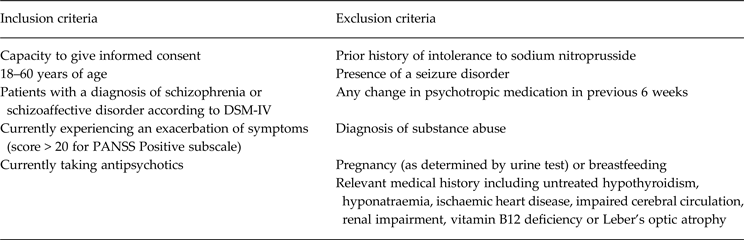
Patients with a diagnosis of schizophrenia or schizoaffective disorder were recruited from the South London and Maudsley NHS Trust. Potential participants were approached via their treating consultants based in first episode psychosis teams and in continuing care community mental health teams. Following both verbal and written explanation of the study, potential participants were invited to give written consent to the study. Following this, evaluation of their suitability according to the inclusion and exclusion criteria was made (Table 1).
Inclusion/exclusion criteria

PANSS, Positive and Negative Syndrome Scale.
The study took place at the Clinical Research Facility based at King's College Hospital. This is a clinical trials unit based in a general hospital setting, with full medical and nursing cover, as well as in-patient beds available. Participants attended on three occasions.
At the screening visit written informed consent was obtained by one of the study doctors. The participants then underwent psychiatric evaluation including assessment with PANSS and BPRS-18. Current antipsychotic medication, drug, alcohol and smoking history were obtained, and a physical examination was performed to establish the patients’ eligibility for the trial. Routine bloods (FBC, U&Es, LFTs, TFTs and B12), urine testing (blood, protein, glucose, drug and, in females, pregnancy), height and weight, blood pressure, heart rate and ECG were completed. Participants then underwent SWM assessment using the CANTAB SWM task.
On their second visit to the Clinical Research Facility (‘randomization visit’), which occurred within 3 weeks of their screening visit, dipstick testing for illicit substances and pregnancy was completed prior to randomization and an intravenous cannula was sited in the right arm. Baseline PANSS and BPRS-18 assessments were completed.
Randomization of participants was via an independent web-based service hosted at the King's Clinical Trials Unit (http://www.ctu.co.uk). Participants were randomized 1:1 to SNP or placebo using the method of block randomization, with randomly varying block sizes of 2 and 4. Researchers entered the participants detail to the randomization and received an automatic blinded confirmation email that randomization had occurred. Unblinded emails were automatically sent to the dispensing pharmacists, with details of treatment allocation. The pharmacy issued either SNP solution and isotonic 5% glucose solution or isotonic 5% glucose solution only (i.e. placebo) in accordance with the randomization email. In the case of a SNP treatment, an unblinded clinical research nurse diluted the SNP with isotonic glucose solution to achieve the required dose of SNP to be delivered over 4 h. The prepared solution or placebo was concealed in an opaque encasing to protect the SNP from ultraviolet light and to ensure blinding of the study team. The infusion was run at a rate to achieve 0.5 µg/kg per min (SNP) or the equivalent volume-per-minute infusion rate for placebo over the course of 4 h. The unblinded clinical research nurse did not take part in any of the ratings.
During the infusion of SNP or placebo, blood pressure and heart rate measurements were taken every 5 min for the first 20 min of the infusion and then every 10 min until the end of the infusion. PANSS and BPRS-18 assessments, and the CANTAB SWM task were repeated immediately after completing the infusion. Full medical and nursing support, including emergency cardiac team support were available on site at all times.
Participants attended for a third appointment 4 weeks after the randomization visit at which time they repeated the CANTAB SWM task, and PANSS and BPRS-18 assessment were repeated.
The change in the CANTAB SWM task, PANSS negative subscale and BPRS-18 ratings over time between participants in the SNP and placebo group was analysed using repeated-measures ANOVA.
Results
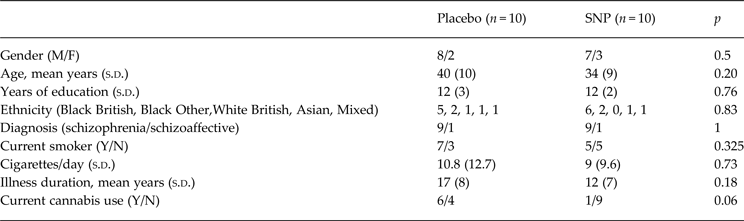
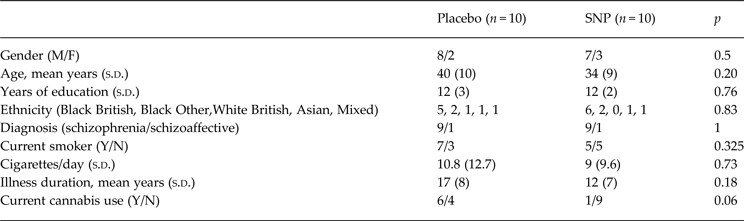
Forty participants were screened for suitability. Twenty-one were randomized (19 were excluded as they did not fulfil the inclusion/exclusion criteria at the time of screening). One subject was excluded from analysis after randomization because their PANSS Positive subscale score was <20 at the time of starting the infusion (Fig. 1). Participants were well matched for demographic details (Table 2). All patients were treated with a wide variety of different antipsychotic medications, with one patient on aripiprazole (SNP), one patient on aripiprazole and olanzapine (SNP), three patients on clozapine (two placebo, one SNP), one patient on clozapine and aripiprazole (placebo), one patient on clozapine and amisulpride (placebo), one patient on clozapine and haloperidol (placebo), one patient on flupentixol and olanzapine (placebo), one patient on haloperidol (SNP), three patients on olanzapine (one placebo and two SNP), one patient on paliperidone depot (SNP), one patient on paliperidone depot, olanzapine and sulpiride (SNP), one patient on pipotiazine (placebo), two patients on quetiapine (one placebo and one SNP), and two patients on risperidone depot (one placebo and one SNP).
Recruitment flow diagram.

Demographic details
SNP, Sodium nitroprusside.
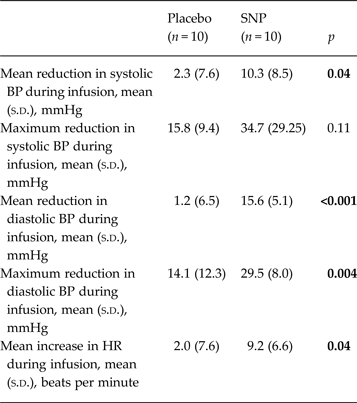
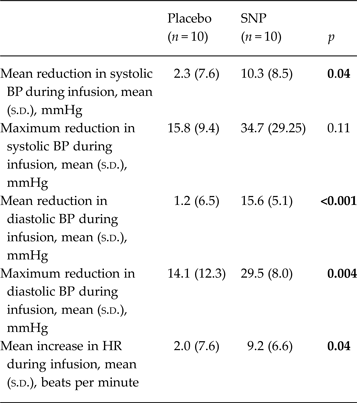
SNP led to a significant reduction in systolic (df = 18, t = 2.21, p < 0.05, Cohen's d = 1.04) and diastolic blood pressure during the infusion (df = 18, t = 5.49, p < 0.005, Cohen's d = 2.58) and an increase in heart rate (df = 18, t = 2.29, p < 0.05, Cohen's d = 1.08; Table 3; Fig. 2). During the study, There were six recorded adverse events – two in patients on SNP (muscular spasm in left upper arm in one; mild suprapubic tenderness at time of infusion, and psychiatric admission approximately 4 weeks after the infusion judged unrelated to the study in one), and three in patients on placebo (asymptomatic but clinically relevant hypotension (86/36) in one requiring interruption of infusion between 121–227 min, with mild dizziness between 50–60 min after stopping infusion; drowsiness in one; and psychiatric admission approximately 3 weeks after the infusion judged unrelated to the study in one).
Change in systolic and diastolic blood pressure with time (minutes) following commencement of placebo or sodium nitroprusside (SNP) infusion.

Change in blood pressure and heart rate during SNP and placebo infusions
SNP, Sodium nitroprusside; BP, blood pressure; HR, heart rate.
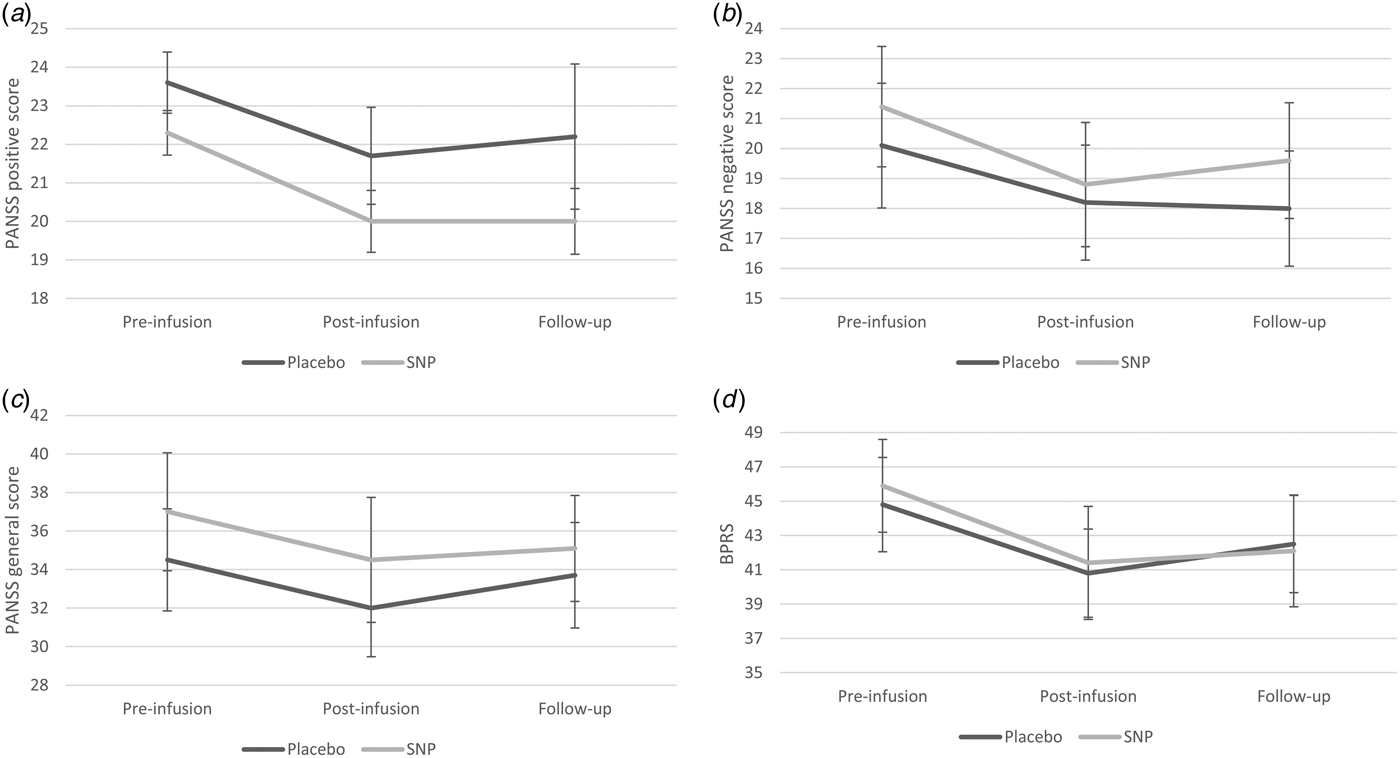
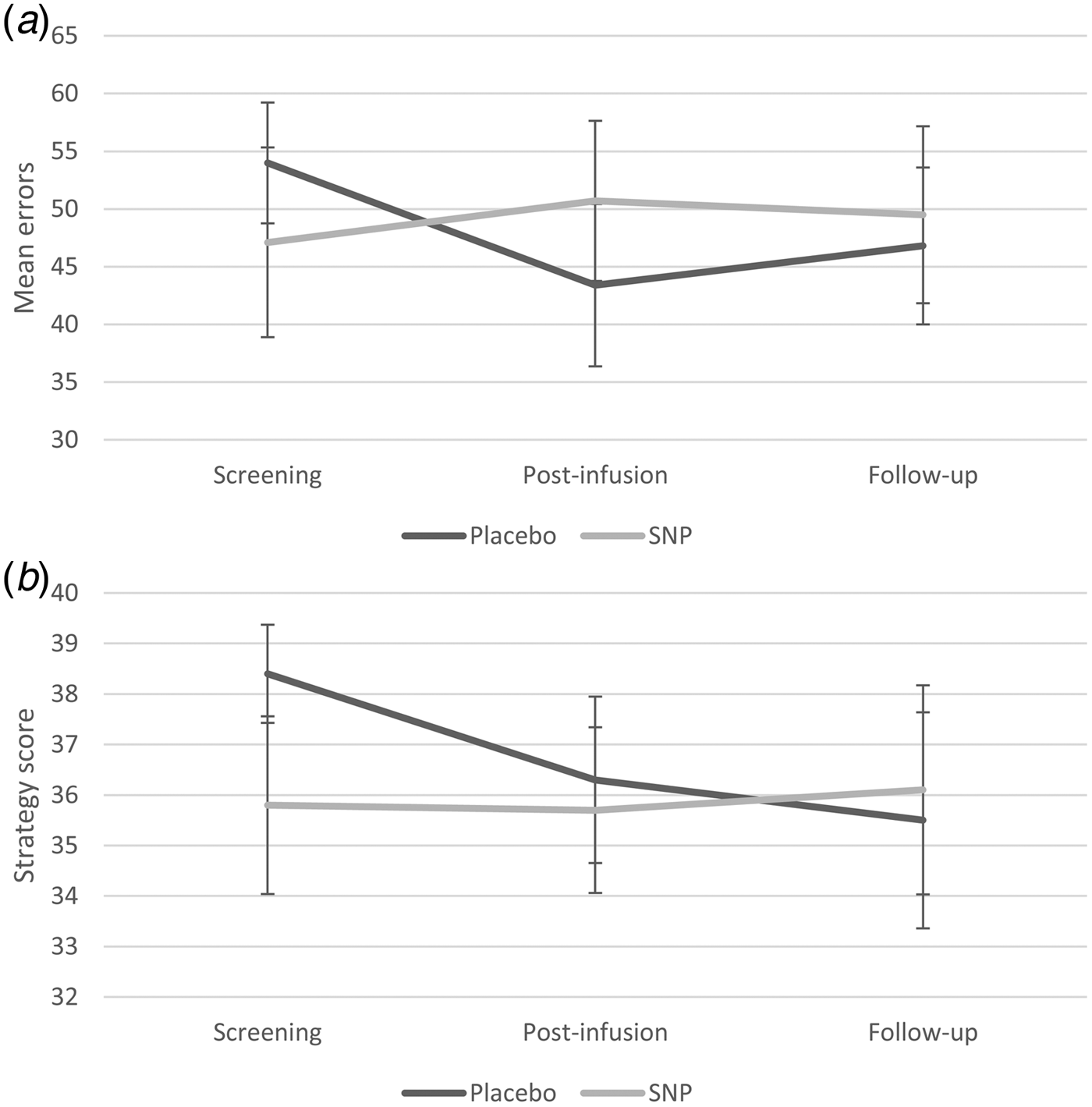
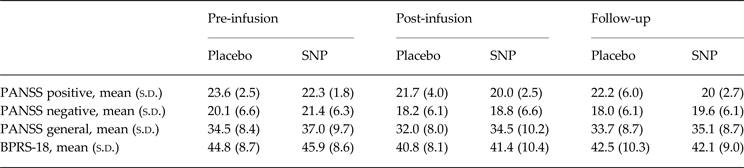
With repeated-measures ANOVA for the three time-points (baseline, post-infusion, follow-up), there was no significant group × time effect for BPRS-18 (df = 2,17, F = 0.17, p = 0.81, Cohen's f = 0.11) or for PANSS negative subscale (df = 2,17, F = 0.21, p = 0.75, Cohen's f = 0.095; Table 4, Figs 3 and 4). There was also no significant group × time effect for CANTAB SWM errors (df = 2,17, F = 1.7, p = 0.2, Cohen's f = 0.3) or strategy (df = 2,17, F = 1.5, p = 0.23, Cohen's f = 0.28; Table 5, Fig. 5). Post-hoc analyses of other PANSS subscales did not reveal any significant group × time effect for either PANSS positive (df = 2,17, F = 0.25, p = 0.78, Cohen's f = 0.11) or general (df = 2,17, F = 0.12, p = 0.88, Cohen's f = 0.08; Table 4) subscales. Excluding the participant in whom we had to interrupt the placebo infusion from the analysis did not significantly affect the results.
Positive, negative and general subscales of the Positive and Negative Syndrome Scale (PANSS), and 18-item Brief Psychiatric Rating Scale (BPRS-18) scores before and 4 h after placebo or sodium nitroprusside (SNP) infusion, and at 4 weeks follow-up.

Individual patient data for 18-item Brief Psychiatric Rating Scale (BPRS-18) before and 4 h after placebo or sodium nitroprusside (SNP) infusion, and at 4 weeks follow-up.

Mean errors and strategy score for Cambridge Neuropsychological Test Automated Battery spatial working memory task at screening, 4 h after placebo or sodium nitroprusside (SNP) infusion, and at 4 weeks follow-up.

Mean ( s.d. ) scores on PANSS and BPRS-18 rating scales on the day of SNP or placebo infusion immediately before the infusion, 4 h after the infusion, and at 4 weeks follow-up
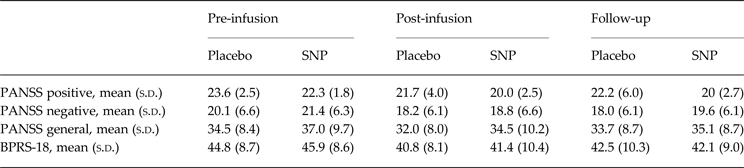
SNP, Sodium nitroprusside; PANSS, Positive and Negative Syndrome Scale; BPRS-18, 18-item Brief Psychiatric Rating Scale.
Mean ( s.d. ) scores on CANTAB spatial working memory tasks at 1 week before, 4 h after and 4 weeks after sodium nitroprusside or placebo infusion.

CANTAB, Cambridge Neuropsychological Test Automated Battery; SNP, sodium nitroprusside.
Discussion
In this study, we sought to investigate the effect of SNP infusion on psychotic symptoms measured with the PANSS negative subscale and BPRS-18. In addition, we investigated the effect of SNP on the CANTAB SWM task in patients with schizophrenia. In contrast to an earlier study (Hallak et al. Reference Hallak, Maia-de-Oliveira, Abrao, Evora, Zuardi, Crippa, Belmonte-de-Abreu, Baker and Dursun2013), we did not find any effect of SNP over placebo on reducing symptoms measured using the BPRS-18, PANSS negative or other PANSS subscales. Furthermore, we did not find any effect of SNP on improving performance on SWM.
The most marked difference between the current study compared to the earlier clinical trial is that, although we found a reduction in symptoms on SNP, there was a similar improvement in those on placebo, whereas the earlier study did not find any placebo effect (Hallak et al. Reference Hallak, Maia-de-Oliveira, Abrao, Evora, Zuardi, Crippa, Belmonte-de-Abreu, Baker and Dursun2013). Another difference between this study and the first clinical trial of SNP in schizophrenia (Hallak et al. Reference Hallak, Maia-de-Oliveira, Abrao, Evora, Zuardi, Crippa, Belmonte-de-Abreu, Baker and Dursun2013), is that the patients in the present study were significantly older, with a longer history of illness. If SNP does act via glutamatergic mechanisms, as hypothesized (Hallak et al. Reference Hallak, Maia-de-Oliveira, Abrao, Evora, Zuardi, Crippa, Belmonte-de-Abreu, Baker and Dursun2013), it may be predicted that it would work most effectively in patients earlier on in the illness (Stone, Reference Stone2011) where basal ganglia glutamatergic abnormalities are more prominent (Merritt et al. Reference Merritt, Egerton, Kempton, Taylor and McGuire2016). It may also be more effective in those with a demonstrable glutamatergic abnormality who have been found to be less responsive to dopamine D2 blocking antipsychotic drugs (Egerton et al. Reference Egerton, Brugger, Raffin, Barker, Lythgoe, McGuire and Stone2012). In keeping with this hypothesis, a recent exploratory analysis suggested that the mGlu2/3 agonist pomaglumetad was effective only in patients who were <3 years after the onset of schizophrenia, and in those who had previously been treated with, but not fully responded to, D2 blocking drugs (Kinon et al. Reference Kinon, Millen, Zhang and McKinzie2015). In contrast, one case study has suggested that SNP may be effective in more chronic patients who have not responded to clozapine (Maia-de-Oliveira et al. Reference Maia-de-Oliveira, Belmonte-de-Abreu, Bressan, Cachoeira, Baker, Dursun and Hallak2014), but it should be noted that in the case report, there was no placebo arm.
Another difference between this and the earlier clinical trial of SNP in schizophrenia is that our sample had less severe negative symptoms (Hallak et al. Reference Hallak, Maia-de-Oliveira, Abrao, Evora, Zuardi, Crippa, Belmonte-de-Abreu, Baker and Dursun2013). The reason for this is not clear, as neither study had negative symptoms as a specific inclusion criteria, but it is possible that SNP may be more effective in populations with higher levels of negative symptoms.
No other groups have studied SWM performance, but a recent study examined the effect of SNP on Stroop colour word test, verbal fluency and n-back. Although not corrected for multiple comparisons, the SNP group had fewer n-back errors after treatment compared to placebo, and also performed better than the placebo group on one of the Stroop colour word test cards (Maia-de-Oliveira et al. Reference Maia-de-Oliveira, Abrao, Evora, Zuardi, Crippa, Belmonte-de-Abreu, Baker, Dursun and Hallak2015). Again, this may be due to differences in the length of illness of the patients studied, or in the sensitivities of different cognitive domains to the effects of SNP.
Regarding adverse events, SNP was relatively well tolerated, but we did find a significant effect of SNP on blood pressure and heart rate despite using the lowest infusion rate used clinically, a finding that had not previously been reported when SNP was used in patients with schizophrenia (Hallak et al. Reference Hallak, Maia-de-Oliveira, Abrao, Evora, Zuardi, Crippa, Belmonte-de-Abreu, Baker and Dursun2013). The reason why we found a more marked effect of SNP on blood pressure compared to the earlier study is not clear, but may be due to the fact that our sample comprised an older group of patients, who were on a wider variety of antipsychotic medication than had previously been studied. Despite this, the effect on blood pressure was mild and well tolerated, and the only patient in whom we stopped the infusion because of concerns about low blood pressure was in the placebo arm.
One criticism of this study is that the sample size is too small for it to be a definitive negative trial. We chose the sample size for this study based on the report by Hallak and colleagues (Hallak et al. Reference Hallak, Maia-de-Oliveira, Abrao, Evora, Zuardi, Crippa, Belmonte-de-Abreu, Baker and Dursun2013), which was powered to detect an effect size of Cohen's f = 0.7. In this study, we increased the planned sample size to 30, which has power to detect an effect size of Cohen's f = 0.55, although we stopped at the interim analysis stage according to predefined futility criteria. In this study, we did not have adequate power to detect more moderate treatment effects, which may, nonetheless, be clinically meaningful.
In summary, we did not find any evidence that SNP improved SWM function or psychotic symptoms in patients with relatively chronic schizophrenia. Further work is required to clarify whether an effect is present in a younger cohort of patients, including those with demonstrable brain glutamate abnormalities.
Acknowledgements
This work was supported by the NIHR Biomedical Research Centre for Mental Health at the South London and Maudsley NHS Foundation Trust and Institute of Psychiatry, King's College London. It did not receive any external funding.
Declaration of Interest
S.K. has received grant support from Lundbeck and Roche and has served as a one-off consultant and/or speaker for Otsuka, Sunovion and Takeda and served on the Scientific Advisory Boards for Forum, Acadia, Lundbeck and Roche. J.M.S. has received honoraria for speaking appointments from Janssen and Roche.