Introduction
In patients with established schizophrenia, recreational cannabis use has been reported to increase relapse and symptom severity (Linszen et al. Reference Linszen, Dingemans and Lenior1994; Baigent et al. Reference Baigent, Holme and Hafner1995). In addition, administration of the principal psychoactive substance in cannabis, Δ9-tetrahydrocannabinol (Δ9-THC), transiently exacerbates the positive, negative and cognitive symptoms in stabilized patients with schizophrenia (D'Souza et al. Reference D'Souza, Abi-Saab, Madonick, Forselius-Bielen, Doersch, Braley, Gueorguieva, Cooper and Krystal2005).
There is also evidence that cannabis use is a risk factor for the initial onset of psychosis. In a longitudinal community study, van Os et al. (Reference van Os, Bak, Hanssen, Bijl, de Graaf and Verdoux2002)demonstrated that baseline cannabis use predicted the emergence of psychotic symptoms and need for care due to psychotic symptoms at follow-up. A recent review of the longitudinal studies to date reported that regular cannabis seems to increase the risk of developing schizophrenia (Degenhardt & Hall, Reference Degenhardt and Hall2006). However, these studies do not determine the nature of the relationship between cannabis and psychosis: are those who are psychosis prone attracted to using cannabis (an association model), does cannabis use directly increase proneness to psychosis (a causal model), or is there another factor that links psychosis proneness and cannabis use (an indicator-variable model; Dumas et al. Reference Dumas, Saoud, Bouafia, Gutknecht, Ecochard, Dalery, Rochet and d'Amato2002)? A number of reviews have tried to address the evidence for causal and association models (e.g. Hall et al. Reference Hall, Degenhardt and Teesson2004; Verdoux et al. Reference Verdoux, Tournier and Cougnard2005; Degenhardt & Hall, Reference Degenhardt and Hall2006; Fergusson et al. Reference Fergusson, Poulton, Smith and Boden2006). The conclusion reached by authors on the basis of current data is that, in individuals with an underlying predisposition to psychosis, cannabis use may precipitate a psychotic episode, but it is difficult to argue for a direct and large causal role for cannabis use in psychosis. However, Ferdinand et al. (Reference Ferdinand, Sondeijker, van der Ende, Selten, Huizink and Verhulst2005)also highlight the possibility that the nature of the relationship between cannabis use and psychotic symptoms may be bidirectional. This is a conclusion that could be reached by most association studies, particularly those that do not attempt to control for baseline levels of psychotic symptoms or psychosis proneness.
One way to explore the relationship between psychotic symptoms and cannabis use is to examine the impact of cannabis use in healthy individuals with psychometrically defined psychosis proneness, or schizotypy. Schizotypal trait has been reported to be higher in relatives of patients with schizophrenia (e.g. Appels et al. Reference Appels, Sitskoorn, Vollema and Kahn2004), may share some of the same risk genetic loci as schizophrenia (Fanous et al. Reference Fanous, Neale, Gardner, Webb, Straub, O'Neill, Walsh, Riley and Kendler2007) and may also lead to increased cognitive deficits in relatives of patients with schizophrenia (Diwadkar et al. Reference Diwadkar, Montrose, Dworakowski, Sweeney and Keshavan2006). Schizotypy is characterized by attenuated psychotic symptoms that comprise both positive (unusual beliefs and perceptual experiences) and negative (social anxiety and withdrawal) features. Pre-existing schizotypy has been reported to increase the risk of psychotic states from cannabis use (Henquet et al. Reference Henquet, Krabbendam, Spauwen, Kaplan, Lieb, Wittchen and van Os2005) and also modulate sensitivity to the effects of Δ9-THC (Henquet et al. Reference Henquet, Rosa, Krabbendam, Papiol, Fananas, Drukker, Ramaekers and van Os2006). Although cannabis use per se has been reported to increase schizotypy scores (Kwapil et al. Reference Kwapil1996; Williams et al. Reference Williams, Wellman and Rawlins1996; Moss et al. Reference Moss, Bardang, Kindl and Dahme2001; Skosnik et al. Reference Skosnik, Spatz-Glenn and Park2001; Dumas et al. Reference Dumas, Saoud, Bouafia, Gutknecht, Ecochard, Dalery, Rochet and d'Amato2002), these results have not been consistent (Schiffman et al. Reference Schiffman, Nakamura, Earleywine and LaBrie2005; Earleywine, Reference Earleywine2006).
An alternative and perhaps more ecologically valid approach is to examine the experiences that individuals report after using cannabis rather than placing any emphasis on full psychotic syndromes. Henquet et al. (Reference Henquet, Rosa, Krabbendam, Papiol, Fananas, Drukker, Ramaekers and van Os2006)and D'Souza et al. (Reference D'Souza, Perry, MacDougall, Ammerman, Cooper, Wu, Braley, Gueorguieva and Krystal2004)tested the effects of Δ9-THC in healthy individuals; however, Δ9-THC is only one component of cannabis, and other ingredients may be involved in the recreational effects of cannabis. In addition, the effects of cannabis may be environmentally modulated and administration of the Δ9-THC in a controlled and artificial environment may not produce the same effects as when it is used naturalistically. This naturalistic approach has been taken in two previous studies. First, Verdoux et al. (Reference Verdoux, Gindre, Sorbara, Tournier and Swendsen2003)used experience sampling, a method of charting subjective experience at random points during the day to demonstrate that those with high psychosis vulnerability (defined by a structured interview) were more likely than those with low psychosis proneness to report unusual perceptual experiences and thoughts following recreational cannabis use. Second, we have previously reported an association between high schizotypy score, a measure of psychosis proneness, and recreational cannabis-induced psychosis-like experiences and subsequent ‘after-effects’, using the newly developed Cannabis Experiences Questionnaire (CEQ; Barkus et al. Reference Barkus, Stirling, Hopkins and Lewis2006). Given that there are individual differences in people's self-reported responses to cannabis, it is important to try to determine the possible mechanisms that may underpin these differences in experience; particularly as it is becoming clear that individuals differ in their risk for experiencing psychotic symptoms following cannabis.
The current study aimed to replicate the findings of Barkus et al. (Reference Barkus, Stirling, Hopkins and Lewis2006)in a larger sample and also to refine the psychometric properties of the CEQ. Specifically, we were interested in comparing the effects of extreme schizotypy scores on experiences from cannabis use. We hypothesized (i) that schizotypy score would not be related to patterns of cannabis use in terms of whether used or not, age at first use, or frequency of use, but that (ii) individuals with high schizotypy scores would report increased levels of psychosis-like symptoms and subsequent after-effects with cannabis use compared to mean- or low-scoring schizotypes.
Method
Participants
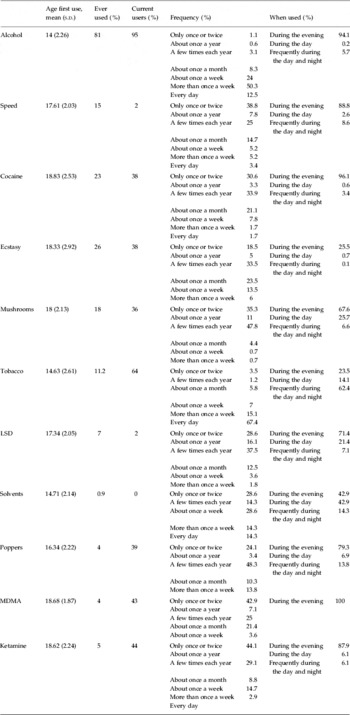
Participants were drawn from a sample of 760 university students [mean age 22 (s.d.=4) years; males 38%] recruited using electronic advertisements either emailed to them or as pop-up messages when they logged onto their university system. The sample for this study comprised 532 university students who reported they had used cannabis at least once in their lifetime. A total of 49.7% of the sample were current users of cannabis, while 50.3% classed themselves as past users of cannabis. The frequency of cannabis use for the whole sample was: once or twice only 13.4%; no more than a few times each year 22%; at least once a month 12.6%; at least once a week 27.2%, and every day 24.9%. The majority of the participants smoked cannabis during the evening (82.4%), while 14.6% smoked cannabis frequently during the day and night, and only 3.1% reported smoking cannabis only during the day. Other drugs used by participants are displayed in Table 1. Participants were completing a variety of undergraduate or postgraduate studies at one of three universities in North-West England. Participants were not asked about psychiatric diagnosis or previous mental health problems.
The use of other recreational drug and alcohol in the sample

Measures
Schizotypy (psychosis proneness)
Participants completed the Schizotypal Personality Questionnaire (SPQ; Raine, Reference Raine1991) online. The questionnaire is based on the diagnostic criteria for schizotypal personality disorder and produces a total score and scores on three dimensions: Cognitive Perceptual (CP), Interpersonal (I) and Disorganized (D).
Cannabis Experiences Questionnaire (CEQ; Barkus et al. Reference Barkus, Stirling, Hopkins and Lewis2006)
The CEQ is a 55-item self-report scale that is divided into three subscales. The Pleasurable Experiences (18 items) and Psychosis-Like Experiences subscales (25 items) examine immediate responses to cannabis and an After-Effects subscale once the initial ‘high’ from the cannabis has abated (12 items). Participants indicated how frequently they had had the experiences on the CEQ by responding on a five-point scale (Rarely or never, From time to time, Sometimes Yes Sometimes No, More often than not, Almost always or always). The frequency of cannabis use and age at first use were also assessed.
Procedure
Participants were initially contacted using remote means (either email or pop-up message). The initial recruitment email requested participants to take part in research addressing personality, unusual experiences and cannabis use. The recruitment email stated that the researchers wanted both cannabis and non-cannabis users to approach the web page. Participants approached the web-mounted SPQ and CEQ questionnaires under their own volition. All participants completed the SPQ first, and then followed with details of previous drug use before completing the CEQ. Participants completed the questionnaires in their own time, under conditions determined by the participant; no researchers were present at the time participants completed the questionnaires. Participants were told that the information they provided would be anonymous and confidential and collected for research purposes only. Participants were not paid to complete the questionnaires. The questionnaires were used as the recruitment for a multi-staged study so participants were asked to provide an email address. They were provided with the first author's email address for any questions that they had. Participants were able to give informed consent and were told that by submitting their results they were agreeing to the use and storage of their responses.
Statistical analysis
The results were analysed using SPSS version 12 (SPSS Inc., Chicago, IL, USA). A conservative Bonferroni approach to significance levels was taken, where multiple tests were used to examine a research question. The required significance level to be reached and the sample size used are stated separately for each analysis. The normality of the data was assessed by examining histograms, skewness and kurtosis figures. For the group analysis where there were two groups, t tests were used, and for group differences with three groups, independent variable ANOVAs were used. Taking a conservative approach, Scheffé post-hoc comparisons were performed to determine which groups were significantly different from one another.
The subscales for the CEQ reported in the paper by Barkus et al. (Reference Barkus, Stirling, Hopkins and Lewis2006)were produced on the basis of face validity rather than statistical analysis. Therefore, to determine the structure of the questionnaire items from a statistical perspective, principal components analysis (PCA) was used. A scree plot was used to determine the number of components or factors to be extracted from the data. An oblimin rotation was used because conceptually we would expect the experiences to be related to one another. Cronbach's α coefficient was used to determine the internal consistency of the items for the new subscales, with a value of 0.7 being considered adequate.
Results
Patterns of cannabis and drug use and schizotypy
There was no relationship between frequency of cannabis use and scores on the SPQ for the total score or the subscales. There was no relationship between age of first cannabis use and SPQ total. The relationship between having smoked cannabis and current/past cannabis use and psychosis proneness were examined using independent t tests; the Bonferroni-corrected significance value required to be reached to qualify for significance was 0.013. Participants who had smoked cannabis at least once (n=532) had a higher mean score on the Disorganized dimension from the SPQ than those who had not (n=228) [t=4.05, df=758, p<0.001; had smoked cannabis: 7.36 (s.d.=4.10); had not smoked cannabis: 6.03 (s.d.=4.24)]. Additionally, there was a trend for participants who described themselves as current (rather than past) cannabis users (n=263) to have higher scores on the Disorganization dimension than those who had stopped smoking cannabis (n=266) [t=2.40, df=527, p=0.017; past smokers: 6.96 (s.d.=4.05); current smokers: 7.81 (s.d.=4.08)].
To determine whether there was a relationship between other recreational drugs used by participants and schizotypy score, the effects of use of the drugs displayed in Table 1 on schizotypy score were investigated. In line with correction for multiple comparisons, the significance level to be reach for these analyses was 0.005. There was only a significant effect upon the Disorganized dimension for speed [t=2.86, df=758, p=0.004; users: 7.98 (s.d.=4.01); non-users: 6.78 (s.d.=4.19)] and cocaine [t=2.80, df=758, p=0.005; users: 7.72 (s.d.=4.11); non-users: 6.73 (s.d.=4.18)].
Schizotypy score and Barkus et al. (Reference Barkus, Stirling, Hopkins and Lewis2006)cannabis experiences
Participants were divided into three groups according to their total SPQ score: more than 1 s.d. above the mean (n=86), more than 1 s.d. below the mean (n=95), and those around the mean (n=351). The group differences on the CEQ were examined using a series of one-way ANOVAs [means (and standard deviations)]: Pleasurable Experiences [High 50.49 (11.01), Mean 46.30 (10.85), Low 44.23 (11.68)]; Psychosis-Like Experiences [High 61.40 (16.88), Mean 50.72 (16.26), Low 42.42 (13.44)]; After-Effects [High 31.74 (11.15), Mean 26.34 (9.64), Low 22.08 (7.82)]. The p value required to be reached for this analysis was 0.016. There was a significant effect of psychosis proneness group on all the subscales from the CEQ. For the Pleasurable Experiences subscale [F(2, 529)=7.66, p=0.001], the High group reported more than the Mean (p=0.007) and the Low (p=0.001) psychosis proneness groups. All the three groups scored significantly different from one another on the Psychosis-Like Experiences subscale [F(2, 529)=32.27, p<0.001] at above the 0.001% level of significance. For the After-Effects subscale [F(2, 529)=22.86, p<0.001], the High and Mean groups and Low and High groups differed at above the 0.001% level, while the Mean and Low differed significantly from one another at the 0.001% level.
Psychometric properties of the CEQ
All the items from the CEQ were entered into an exploratory PCA with data from 532 participants who had used cannabis at least once in their lifetime. From examination of a scree plot of the eigenvalues for the data, it seemed that four components would appropriately explain the data. The PCA was performed with an oblique rotation to allow the components to correlate. The analysis accounted for 47.5% of the total variance. The items from the After-Effects subscale all loaded onto one component, and as these items are examining the period following the high from cannabis, unlike the rest of the items, it seemed appropriate to enter the After-Effects items in a separate analysis.
Immediate effects of cannabis
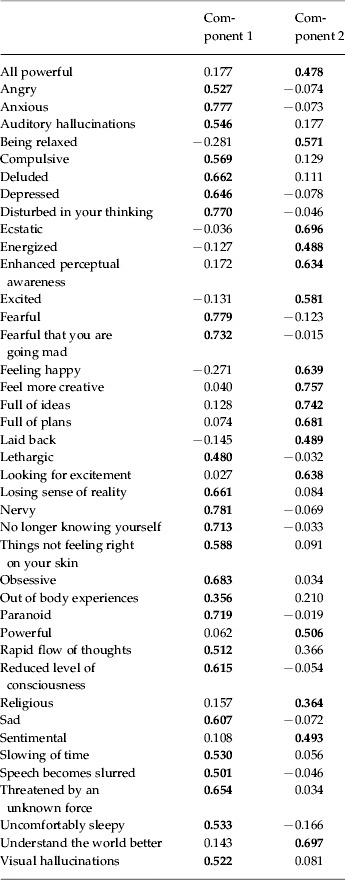
The PCA was repeated with the After-Effects items removed. From examining a scree plot it seemed that two or three components described the data. The third component comprised four items and only contributed 5.52% to the total variance. Additionally, when the internal consistency of the items were examined, Cronbach's α only reached 0.57. Therefore, the two-component solution was judged to be most effective explanation of the data. The items are presented in Table 2. Loadings above 0.3 were taken to be significant and a simple solution was sought with the highest loading being taken as significant if an item loaded onto both components. The Pattern Matrix was used to determine the pattern of loadings because this matrix presents the loadings independent of the correlation between the two components.
The item loadings for the two components extracted from the items comprising immediate responses to cannabis

Bold values indicate factor loadings taken to be significant.
The solution accounted for 39.2% of the total variance, with Component 1 contributing 25.2% and Component 2 14.0% of the variance. Only the item of ‘Sleepy’ did not load significantly on to either of the components. Component 1 had a Cronbach's α coefficient of 0.93 and Component 2 had an α of 0.88; therefore, both the components display more than adequate internal consistency. The items on Component 1 contain many of the symptoms that were previously on the Psychosis-Like Experiences subscale. The items on Component 2 seem to represent largely pleasant experiences, which may be an excessive of everyday occurrence of emotions. The items on Component 1 can be characterized by the title ‘Paranoid-dysphoric Experiences’ whereas Component 2 items are explained by the term ‘Euphoric Experiences’.
After-Effects
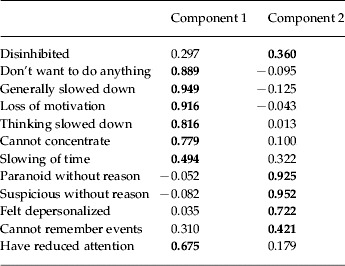
The items from the After-Effects subscale were entered into a separate PCA. Examination of a scree plot determined that the items would be adequately explained by extracting two components from the data. An oblique rotation was used to allow the components to correlate with one another. As with the previous analysis, the Pattern Matrix was used to determine which items loaded significantly onto each component, loadings above 0.3 were taken as significant and a simple solution was sought. The results from the analysis are presented in Table 3.
The component loadings for the items from the After-Effects subscale from the Cannabis Experiences Questionnaire (CEQ)

Bold values indicate factor loadings taken to be significant.
The PCA explained 64.5% of the variance, with Component 1 accounting for 51.9% of the variance and Component 2 contributing 12.5% of the total variance. Cronbach's α coefficients demonstrated that the components had adequate internal consistency (Component 1, 0.92; Component 2, 0.80). However, collapsing both components into the original After-Effects subscale still produced an α value of 0.92. The items on Component 1 can be characterized as ‘Amotivational after-effects’ whereas Component 2 items can be appropriately labelled ‘Psychosis-like after-effects’.
To examine the intercorrelations between the subscales, two-tailed levels of significance are presented for the Pearson's correlation coefficients in order to take a conservative approach, considering the size of the sample being used. The intercorrelations between the subscales were as follows (Pearson's r): Amotivational after-effects significantly correlated with Psychosis-like after-effects (0.63), Euphoric (0.18) and Paranoid-dysphoric (0.54) experiences; Psychosis-like after-effects significantly correlated with Euphoric (0.25) and Paranoid-dysphoric (0.69) experiences; and Paranoid-dysphoric and Euphoric experiences (0.16) significantly correlated with one another. All the correlations are significant above the 1% level.
Relationship between schizotypy and CEQ factors
As reported above, we have shown that those who score highly on the psychosis score significantly different from Mean or Low schizotypes on their reported experience with cannabis. A similar analysis was performed with the PCA-derived subscales for the CEQ. As before, participants were grouped according to being ±1 s.d. or around the mean on the total score on the SPQ. The ANOVAs were significantly different for the four subscales. However, the F values were larger for the subscales for the immediate and after-effects that had the psychotic items on. Scheffé post-hoc comparisons were performed to determine which groups scored significantly different from one another on the subscales. The means (and standard deviations) for this analysis were: Paranoid-dysphoric subscale [High 59.44 (16.72), Mean 48.74 (16.21), Low 40.42 (13.69)]; Euphoric subscale [High 45.07 (10.76); Mean 40.94 (10.39); Low 39.42 (11.05)]; Amotivational after-effects [High 20.02 (7.36), Mean 17.57 (6.98), Low 14.75 (5.96)]; and Psychosis-like after-effects [High 11.70 (4.80), Mean 8.77 (3.71), Low 7.34 (2.62)]. For the Paranoid-dysphoric Experiences subscale [F(2, 529)=32.52, p<0.001], the groups all differed significantly from one another above the 1% level of significance. On the Euphoric Experiences subscale [F(2, 529)=7.17, p=0.001] the High and Mean (0.005) and the High and Low (0.002) differed significantly from one another. The High and Mean (0.012), High and Low (>0.001) and Mean and Low (0.002) groups differed significantly from one another on the Amotivational after-effects subscale [F(2, 529)=13.53, p<0.001]. For the Psychosis-like after-effects subscale [F(2, 529)=32.32, p<0.001], the Mean and Low groups differed from one another with a significance value of 0.004, but the other groups differed at above the 0.001% level of significance.
Discussion
Cannabis use and schizotypy
There was no relationship between schizotypy score and frequency of cannabis use nor the age of first use of cannabis. However, those who had smoked cannabis at least once had higher scores on the Disorganized dimension from the SPQ than those who had not smoked cannabis. There was also a trend for those current cannabis users to have higher scores on the Disorganized dimension compared to previous users. This was against our initial hypothesis that schizotypy status would not be related to patterns of cannabis use. Two previous studies have reported a relationship between cannabis use and disorganized schizotypal symptoms (Dumas et al. Reference Dumas, Saoud, Bouafia, Gutknecht, Ecochard, Dalery, Rochet and d'Amato2002; Schiffman et al. Reference Schiffman, Nakamura, Earleywine and LaBrie2005). The Disorganized dimension of the SPQ comprises items that measure odd behaviour and odd speech. Dumas et al. (Reference Dumas, Saoud, Bouafia, Gutknecht, Ecochard, Dalery, Rochet and d'Amato2002)reported that gender differences could account for the relationship between disorganized schizotypal trait and cannabis use. Therefore, gender was placed in an ANOVA as a covariate, with cannabis use as the independent variable and the Disorganized subscale as the dependent variable. However, the difference between those who had and those who had not smoked cannabis remained significant. The relationship between disorganized schizotypal traits and cannabis use deserves further study especially because Schiffman et al. (Reference Schiffman, Nakamura, Earleywine and LaBrie2005)not only replicated these findings but also reported that the disorganized symptoms preceded cannabis use. It is also interesting that the two other recreational drugs (speed and cocaine) that showed a lead to a significant difference on the Disorganized dimension from the SPQ both elevate levels of dopamine in the brain. Perhaps the disorganized features of schizotypy are particularly sensitive to fluctuations in dopamine, even at levels that may not produce unusual perceptual experiences. The disorganized features of schizotypy are relatively underinvestigated, with greater emphasis being placed on the positive features; however, the current data suggest they may warrant further investigation.
Schizotypy and cannabis experiences
The PCA for the immediate effects from cannabis use produced two components, Paranoid-dysphoric Experiences and Euphoric Experiences, both with high internal consistency. The items on each subscale are reflected by their title, with the symptomatic effects from cannabis use appearing on the Paranoid-dysphoric Experiences subscale and the more expansive experiences from cannabis use characterizing the Euphoric Experiences subscale. The internal consistency scores for the two subscales for the after-effects from cannabis use also had high α values, although when they were combined, the Cronbach's α coefficient for the after-effects items was equally as high. The two subscales produced were: Amotivational after-effects and Psychosis-like after-effects.
Using the original subscales reported in Barkus et al. (Reference Barkus, Stirling, Hopkins and Lewis2006), participants with high schizotypy scores reported higher levels of subjective experiences on all factors. The previous findings were largely replicated, with the exception that the high schizotypes also reported higher levels of pleasurable experience, although the mean difference between the three groups is small and considerably less than that shown for psychosis-like experiences.
However, examining the schizotypy group differences on the new subscales demonstrated an interesting finding. Although the ANOVAs were all significant for the four new subscales, the largest F values and differentiation between the three groups can be seen on the subscales that contain the psychotic symptoms, that is the Paranoid-dysphoric from the immediate experiences and the Psychosis-like after-effects from cannabis use. These results suggest that, although there appears to be no psychometric advantage to the two components that comprise the after-effects experiences, it may be informative from a hypothesis testing perspective to use the PCA-derived subscales.
From the results in this paper it is possible to argue for a causal relationship between cannabis use and psychotic symptoms in those who express high schizotypy. We cannot comment on associations with diagnosable psychotic disorders as these data were not available for the sample collected. In line with Henquet et al. (Reference Henquet, Krabbendam, Spauwen, Kaplan, Lieb, Wittchen and van Os2005), those with high schizotypy seemed to be more sensitive to the effects from cannabis use because they scored higher on all the subscales from the CEQ. In the light of previous research, perhaps our results point towards dopamine sensitization as being a possible mechanism for high schizotypes having more experiences with cannabis per se and particularly more psychomimetic effects.
Validation of cannabis experiences as expression of psychosis proneness
It is now accepted that the psychotic experiences reported in those who score highly on schizotypy measures are qualitatively similar to those reported in patient samples (e.g. Honig et al. Reference Honig, Romme, Ensink, Escher, Pennings and deVries1998). A similar argument could be applied to the clinical relevance and validity for the psychotic experiences associated with cannabis use. There is emerging clinical and experimental evidence to suggest that the psychotic symptoms that result from cannabis use are of clinical relevance and may indicate risk of underlying psychopathology. The administration of the psychoactive substance Δ9-THC to healthy volunteers was reported to induce psychotic-like symptoms when given intravenously (D'Souza et al. Reference D'Souza, Perry, MacDougall, Ammerman, Cooper, Wu, Braley, Gueorguieva and Krystal2004) and a psychosis prodrome-like state when giving orally (Koethe et al. Reference Koethe, Gerth, Neatby, Haensel, Thies, Schneider, Emrich, Klosterkotter, Schultze-Lutter and Leweke2006). Sensitivity to the effects of Δ9-THC is modulated by psychometric psychosis liability and genetic polymorphism (COMT) determined dopamine turnover in the cortex (Henquet et al. Reference Henquet, Rosa, Krabbendam, Papiol, Fananas, Drukker, Ramaekers and van Os2006). Taken together, these studies point to the manipulation of dopamine by Δ9-THC underpinning the psychotic experiences associated with recreational cannabis use and also indicate that Δ9-THC would be a useful experimental model of psychosis. From a clinical perspective, 47.1% of those seeking help for cannabis-induced psychosis were diagnosed with schizophrenia-spectrum disorder 1 year after initial presentation (Arendt et al. Reference Arendt, Rosenberg, Foldager, Perto and Munk-Jorgensen2005), suggesting that psychotic responses to cannabis may also have some predictive validity.
Limitations
The data from the current study were self-reported and collected using the internet. Remote collection of data has been questioned in terms of its validity and reliability. The population means for the SPQ in the current sample are similar to those reported by Raine (Reference Raine1991). Additionally, we have previously used internet data collection and validated responses at interview (e.g. Barkus et al. Reference Barkus, Stirling, Hopkins, McKie and Lewis2007). Although participants had the option to provide an email address (to take part in later phases of the study), the results were largely anonymous, which should have encouraged honest reporting of schizotypal traits and cannabis experiences. Self-reported rates of cannabis use have been shown to be highly correlated with biological measures (Fendrich et al. Reference Fendrich, Johnson, Wislar, Hubbell and Spiehler2004). It was also made clear to participants there would be no consequences for any reported drug use. The high internal consistency values for the CEQ subscales suggest that random responding was not taking place, or at least if it did, it did not influenced the results. Internet data collection permits the accumulation of a large number of responses in a relatively short period of time, which holds both for psychometric validation and for identifying individuals who score at the extremes of a personality trait. Extreme high-scoring schizotypes are more likely to approach remote data collection methods. There is a possibility that such individuals would have high levels of social anxiety and therefore avoid face-to-face interactions but a computer interface would appear more controllable and less intimidating to them.
The validation of the items on the CEQ to date has taken place in relatively young student samples. Therefore, the measure needs to be considered in a more heterogeneous general public sample next. In particular, the patterns of cannabis use may be different in a general population sample because its use may have greater impact on daily life outside a student culture. Additionally, although the predictive value of the CEQ has been speculated upon here, this needs to be formally tested in differentiating schizophrenia-spectrum disorder patients from other clinical groups, as well as being examined in terms of predicting transition to psychosis in prodrome samples.
The current study has replicated previous findings of an association between schizotypy and psychopathological experiences and increased after-effects from recreational cannabis use. The new PCA-derived subscales suggest that it is the psychotic-like experiences in response to cannabis use that differentiate high-scoring schizotypes from mean- and low-scoring schizotypes most strikingly. The results suggest that the CEQ is a valid and useful instrument to further elucidate the relationship between cannabis and psychosis.
Declaration of Interest
None.