Introduction
How do people spend their time in a world where work becomes optional? It is well known that basic income policies generate some working time reductions (Burtless Reference Burtless and Munnell1986; Calnitsky & Latner Reference Calnitsky and Latner2017; Hum & Simpson Reference Hum and Simpson1993; Keeley Reference Keeley1981; Widerquist Reference Widerquist2005). Less clear is what people go on to do with their time. As basic income moves into the center of debates on the future of social policy around the world (Martin-West et al Reference Martin-West, Baker, Balakrishnan, Rao and Tan2019; Kangas Reference Kangas2016; McFarland Reference McFarland2017; Knight Reference Knight2015), a key question concerns the day-to-day activities of prospective basic incomerecipients. In particular, policy makers, activists, academics, and the general public will be eager to know whether basic income recipients who withdraw from the labor market engage in socially valuable activities outside of paid employment. Basic income may reduce overall work hours by a few percentage points, but the greater lacuna of knowledge concerns how people spend their time. The question is salient because a shift toward education and a shift toward leisure may take on very different social valences, even if both activities are worthwhile.
This article grapples with these issues by examining an understudied basic income or guaranteed annual income (GAI) experiment from the 1970s called the Manitoba Mincome experiment. Conducted by the Canadian and Manitoba governments, Mincome tested the viability of a three-year GAI that gave participants access to substantial cash payments unconditional on work requirements. While Mincome took place in three sites, this research focuses on the Winnipeg site, where a randomized controlled trial was conducted with 609 individuals who received Mincome payments, as well as 317 control subjects.
One theory about the impact of basic income posits that our deepest desire in life is to relax at home. An alternate hypothesis predicts that a host of valuable activities, from care work and education to collective action and artistic endeavors, may be unleashed when people’s basic needs are secured outside the market. Mobilizing evidence on these issues will have a direct bearing on the debates about the costs and benefits of this much-discussed proposal designed to abolish poverty.
To gain new insight into people’s daily activities and endeavors during the Mincome years, this article analyzes the experiment’s panel survey of treatment and control groups. The survey inquires into people’s main activities when they were not in the labor market. In particular, we analyze the reasons respondents gave for not working. While this is not direct evidence on time use, it offers valuable indirect evidence on what people were doing with their time. The principal statistical method employed here is a “difference-in-difference” (DiD) approach, which compares the baseline-study period change internal to treatment and control groups. Corresponding to the wide range of possible nonemployment activities, this article has a variety of findings. The intervention led to growth in some socially valuable activities, especially unpaid care work. This effect is strong among women, and moderately positive for men. With respect to education, women, but not men, reported increases in not working due to schooling. Young people, however, show the strongest growth in nonemployment due to schooling. One of the stronger results is found in nonemployment connected to dissatisfaction with work/job conditions. We also find growth in the portion of men and women simply reporting that they did not want to work. Also worth noting is a moderate increase in people reporting to be not working due to self-employment, an effect that is most visible at the highest guaranteed payment level and among older respondents. Finally, the primary nonemployment category that declines as a result of the experiment is health-related reasons for not working, an effect that is strongest among older participants. That is, fewer people were out of the labor market due to illness and disability.
The second section below frames the question of the labor market and its alternatives, and provides an overview of theory and evidence on the question of people’s nonlabor market activities. Next, we introduce the Mincome experiment and offer some historical context. The middle sections describe the data and methods used and present our results. We conclude with some remarks about the relevant differences between the context of Mincome and contemporary labor markets, and point to aspects of our question demanding further research.
Life outside the Labor Market
The overall finding from basic income experiments of moderate declines in working time (Burtless Reference Burtless and Munnell1986; Hum & Simpson Reference Hum and Simpson1993; Keeley Reference Keeley1981; Widerquist Reference Widerquist2005) and labor market participation (Calnitsky & Latner Reference Calnitsky and Latner2017) is not sufficiently meaningful without additional analyses of what people did outside the labor market. In fact, the best way to clarify the stakes of the guaranteed income is to understand people’s alternative pursuits. On the one hand, it is often hoped and hypothesized that socially valuable activities would be encouraged if people’s basic needs were secured outside the labor market (Goodin Reference Goodin2001). On the other hand, for some advocates, the virtue of basic income is its potential to expand people’s leisure activities (Block Reference Block1990; see also relevant discussions in Levine Reference Levine1995).Footnote 1 While valuable nonemployment activities such as education and care work are important objectives, so too is the growth of free time. On this normative vision, a rational society ought to better distribute its leisure, and basic income may be a workable device to convert historic productivity increases into free time rather than consumption (see Schor Reference Schor1993, Reference Schor1998).
However, directing societal resources to increasing leisure may have short-term political costs. This is what led Atkinson (Reference Atkinson1996, Reference Atkinson2015) to propose a “participation income” in place of basic income – the participation income would provide a stream of income conditional on participation in some socially valuable activity. Although “social value” is not well defined, the philosophical reasoning is clear enough. Basic income proponents take one of two positions: (1) they expect basic income to foster socially valuable activities, and if empirical evidence suggests otherwise their support will weaken; or (2) they support basic income irrespective of how people use their time.Footnote 2 Nonetheless, even those who take the strict moral position in (2) should be able to see that answers to concerns posed by position (1) will bear on the public debate about these policies. This section will therefore elaborate on the question of people’s potential nonemployment activities. Although not all these activities show up in the data we use, a deeper understanding of basic income and its consequences entails enumerating the range of possibilities.
What might people do outside the labor force? In truth, this residual category is also called “life,” and it is therefore difficult to categorize neatly. By way of a roadmap, however, we attempt to divide activities into individually and socially valuable endeavors. Activities can be reasonably understood as socially valuable insofar as they generate benefits to those beyond the individuals who choose to undertake them. This includes a wide swath of human activity: education, training, and care work, but it also ought to include a range of artistic and intellectual endeavors, political activism, community engagement, charity, and various forms of volunteer work. The potential growth of self-employment might also be included as a socially valuable pursuit, although it is clearly not outside the labor force. Then there are those activities that do not fit neatly into the category of socially valuable pursuits, but are important to identify. Exiting work to engage in leisure time might have socially positive spillover effects, but it is reasonable to identify the benefits as largely individual. The same is likely true for people who exit work because of an illness or disability that makes work difficult. In the case of early retirement, there are clear individual benefits, and likewise, there are concerns about broader economy-wide costs. Peter Lindert (Reference Lindert2004), however, has pointed to the very limited GDP cost of early retirement because it has the effect of taking the least productive workers out of the labor market.
Next, there is a range of other activities that are hard to categorize but might emerge as some people exit work. People may leave work because of a labor dispute or bad work conditions. This could have positive social benefits – it might empower labor movements and potentially dovetail with broader social movements – even if it does not quite fit as a nonwork pursuit (Calnitsky Reference Calnitsky2017, Reference Calnitsky2018a, Reference Calnitsky2018b). Many of the previously mentioned activities could be conceptualized as socially valuable even if they fall outside the purview of the broadest measures of alternative national accounts designed to estimate the use-value generated outside of normal GDP figures (Bridgman et al. Reference Bridgman, Dugan, Lal, Osborne and Villones2012). We elaborate on a number of these activities in the text that follows.
Although the existing evidence on the question of nonemployment activity is limited and uneven, it is worth taking stock of prior research emerging in particular from previous guaranteed income experiments. Although their chief aim was to track changes in labor supply in treatment and control subjects, some research has inquired into certain nonlabor market activities. Education stands out in particular. In her analysis of the Dauphin site of the Mincome experiment, co-author Evelyn Forget (Reference Forget2011, Reference Forget2013) used aggregate data from the Department of Education to show that during the Mincome years, Dauphin students were more likely than their rural or urban counterparts to enroll in high school. Mallar (Reference Mallar, Watts and Rees1977) studied the New Jersey/Pennsylvania guaranteed income experiment and found that in at least one period of the 12-period study, 18-year-olds had a 22 percent higher probability of school enrollment than controls. McDonald and Stephenson (Reference McDonald and Stephenson1979), studying the Gary, Indiana GAI experiment, found that treatment male teenagers increased school enrollment and reduced labor force participation; female teenagers responded similarly only when income maintenance was generous. Weiss et al. (Reference Weiss, Hall and Dong1980) studied the Seattle/Denver experiment and found some schooling declines among adult men alongside increases among children. All these studies found positive schooling effects on nonhead family members. Hanushek’s summary of the literature notes that work withdrawal for youth in treatment families was “almost perfectly offset by increased school attendance” (Reference Hanushek and Munnell1986: 117). The remaining papers on education tended to examine school performance rather than enrollment (Maynard Reference Maynard1977; Maynard and Murnane Reference Maynard and Murnane1979; Rea Reference Rea1977; Venti Reference Venti1984).
To a far lesser extent, the guaranteed income experiments produced some analyses of leisure activity. In one paper on the New Jersey experiment by Ladinsky and Wells (Reference Ladinsky, Wells, Watts and Rees1977), the authors report a significant, positive experimental effect on church attendance, as well as significant, positive experimental effects on a scale of “family leisure” activities and “hobbies.” However, these results are confined to specific survey waves and appear not to hold across the entire experiment.
As a theoretical category, “leisure” deserves further empirical exploration and in fact might be decomposed into socially and individually valuable leisure activities. We do not pursue this matter further in this article, but it is apparent that if church participation and community-based projects are socially valuable, then rollerblading and video games might confer benefits of a more solitary nature.Footnote 3 As of yet, the theory of basic income as rollerblading dystopia finds little evidence one way or the other.
Apart from schooling and minimal examinations of leisure activity, the guaranteed income experiments inquired little into the nonwork activities of participants. There have been potentially relevant empirical studies of inheritance (Holtz-Eakin et al. Reference Holtz-Eakin, Joulfaian and Rosen1993) and lottery winners (Furaker and Hedenus Reference Furaker and Hedenus2009; Hedenus Reference Hedenus2012); however, these tend to track employment effects rather than nonemployment pursuits.
Despite the dearth of evidence, on theoretical grounds there is a range of interesting questions about the possible impacts of basic income on people’s daily activities. Most of these exist in the form of unexplored hypotheses. For example, a variety of artistic endeavors could be made feasible with a basic income. Writers, artists, actors, and musicians often find they are unable to put their life plans into effect because these activities rarely generate enough income to maintain a decent standard of living. Basic income in this sense is an art subsidy without the arts council: instead of an arts council determining which artists will be funded, the artists decide. People working at nonprofit agencies or community-based organizations, activists of all stripes, and many others engaged in socially valuable pursuits are similarly situated.
Basic income may also provide a way to foster a variety of decommodified care-giving activities such as elder care, child care, and home health care. While this is one of the most important of the socially valuable activities that basic income might foster, there is little hard evidence on the matter. For example, while there is evidence from the guaranteed income experiments that women were more likely than men to reduce work hours (Hum & Simpson Reference Hum and Simpson1993; Widerquist Reference Widerquist2005), there is little data on their nonemployment activities. Two papers inquired into the impact of the Seattle-Denver experiment on child care activities, though they were primarily examinations of the child care subsidies provided through the experiment rather than the impact of the guaranteed income (Munson et al. Reference Munson, Robins, Stieger, Robins, Spiegelman and Weiner1980; Robins and Spiegelman Reference Robins and Spiegelman1978).
Although there is limited empirical evidence on this question, there is a good deal of theoretical speculation. It is possible that basic income could entrench an existing gendered division of labor (Gheaus Reference Gheaus2008), where women in particular are more likely to increase care work activities. While this is no doubt possible, and it was women in the GAI experiments from the 1970s who disproportionately reduced work hours, the effect would likely be muted in a world with a narrower gender wage gap, shifted norms, and a wider range of employment opportunities for women. Apart from the danger of an entrenched gendered division of unpaid care work, basic income is widely viewed as a way to recognize as socially valuable those activities that typically go unremunerated (Weeks Reference Weeks2011). In fact, more than any other potentially socially valuable nonemployment activity, it is care work that has received special attention in the attempts to construct alternative national accounting schemes that take seriously the use-values produced through the unpaid provision of domestic services (Bridgman et al. Reference Bridgman, Dugan, Lal, Osborne and Villones2012; Folbre and Wagman Reference Folbre and Wagman1993).
Not yet discussed is another oft-cited effect of basic income, namely that people may exit work as an employee to reenter as a self-employed proprietor or perhaps as members of newly founded cooperatives. Erik Olin Wright (Reference Wright2010) makes the point that producer-owned cooperatives often struggle at the outset to get off the ground, establish an internal organization, and generate income for members. Basic income could provide collateral for loans to cooperative members and offer a cushion for new businesses that cannot easily or quickly generate a stream of revenue. In this sense, basic income can be seen as a way to direct credit downward to underwrite otherwise unfunded independent business plans. These activities are, of course, not outside of the labor force, but they are outside of the usual channels available to people without easy access to capital. Moreover, basic income might help keep afloat the existing stock of self-employment that, however unprofitable, may for some be preferable to working under someone else.
As we shall see in the following text, our data allows us ask about some but not all these activities. The data is indirect, but nonetheless sheds light on people’s activities outside the labor market. Before outlining the details of the existing Mincome data, it is important to describe the nature and context of the experiment.
The Mincome Experiment
Mincome was conceived in response to a parade of influential reports that publicized the extent and depth of poverty in Canada in the late 1960s and early 1970s. The Economic Council of Canada (1968) and the Department of National Health and Welfare (Canada, 1970) presented the guaranteed annual income as an intriguing idea meriting serious consideration. The “Croll” Report (1971) and The Real Poverty Report (Adams et al. Reference Adams, Cameron, Hill and Penz1971) posed the guaranteed income as the central policy solution of the era, an idea “whose time has come” (Information Canada 1971: 175). Inspired directly by four similar experiments in the United States, it was hoped that Mincome would demonstrate the feasibility of the guaranteed income to the Canadian public.
As with the US experiments, the primary axis of the demonstration concerned the potential effects on the labor supply: the hope was that the labor supply would be largely unaffected and work withdrawal would be rare. There was thus little focus on the question of what families might do with their time after withdrawing from work.
However, archival materials and early project documents provide a few hints about hypotheses on this score. One early planning document discusses a range of secondary research topics that would be studied, including “individual self-development, including effects of GAI on aspirations, investment in education, investment in job-related training, and feelings of individual competence and self-worth” (Hikel and Harvey Reference Hikel and Harvey1973: 10). Likewise, when Manitoba’s New Democratic Party Premier Ed Schreyer introduced the experiment, he noted: “There are a number of areas we will be looking at in relation to the impact of a guaranteed income once the pilot project has been completed. Incentive to work is important but it is not the whole picture. … Will children of low-income families stay in school longer because of a supplemented income? In so many cases, tragically, as it is now, the older children must leave school as soon as they can to try to earn whatever they can to help out” (Schreyer, Reference Schreyer1971: 7).
As might be expected, education was the main nonemployment activity of interest. However, as we will discuss in the next section, the data we examine inquires into a range of possible activities among the non-employed.
Before moving on, it is important to describe some of the details about how Mincome was designed and orchestrated in Winnipeg (see Hum et al. Reference Hum, Laub and Powell1979, for further details). Mincome selected low-income participants at random and assigned them either to one of eight guaranteed annual income treatment programs (these plans had combinations of high, medium, or low guarantee levels, and high, medium, or low tax-back rates, excluding the high guarantee/low tax-back rate plan) or a control group.Footnote 4 Treatment families received monthly payments for three years (1975–77), and both groups were interviewed three times a year during the study period. Participants also completed two preexperimental interviews, the “baseline” and “enrolment” interviews. This survey data eventually formed the datasets used in this article.
Data and Methods
Our analysis merges two datasets from Mincome’s original survey collection. The first contains “baseline” information on Mincome treatment and control participants assembled from the preexperimental survey administered by Mincome staff in 1974. This baseline survey was merged with a longitudinal panel survey of participants, which contains information on individual adults nested in families across 11 periodic survey waves (the survey was administered three times annually, plus the baseline and enrollment interviews). While information on participating Manitoba households is included in the baseline, the panel data includes Winnipeg households only, and we therefore remove non-Winnipeg households from the baseline survey.
Mincome employed an income-stratified random sampling strategy whereby selected Winnipeg families with incomes below approximately $13,000 (we use 1974 dollars throughout) were randomly assigned to a treatment or control plan for three years (see note 4). We examine 920 households (1,428 adults), of which 604 were assigned to the treatment group and 317 were assigned to the control group.Footnote 5 It should be noted that the possibility of significance in our results is limited given the small sample. Of the 920 households, 590 households (926 adults) are present in each the experiment’s 11 survey periods. This group breaks down into 389 households (609 adults) in the treatment group and 201 households (317 adults) in the control. The other 330 households dropped out at some point during the course of the experiment. The result is two possible panel datasets, a “balanced” panel where participants were present at each survey wave, and an “unbalanced” panel where at least some participants did not complete all 11 survey waves. To retain consistency in the individuals under study, the analysis herein uses the balanced panel.Footnote 6
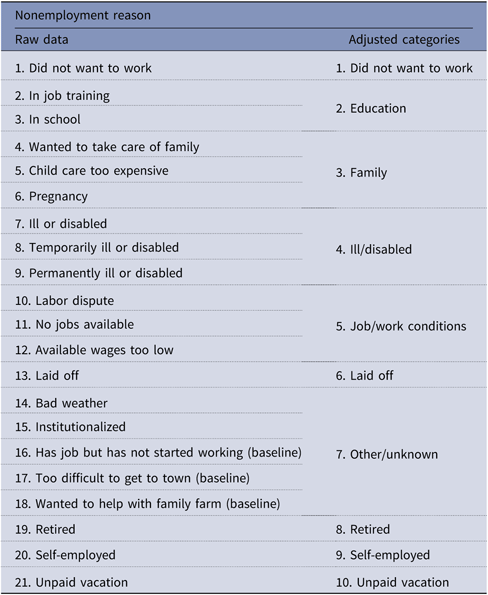
This study focuses primarily on one categorical variable with 18 possible responses occurring at the baseline and most survey waves – the question was not asked during the second and third survey waves, leaving nine survey waves, including the baseline. The question was put to men and women who were nonemployed at some point between the previous and current survey, and asked the following: “What is/was the main reason you were not working?” Possible values for this variable include the following: “laid off”; “labor dispute”; “unpaid vacation”; “no jobs available”; “bad weather”; “wanted to take care of family”; “child care too expensive”; “pregnancy”; “in job training”; “in school”; “institutionalized”; “available wages too low”; “did not want to work”; “ill or disabled”; “self-employed”; “retired”; “temporarily ill or disabled”; and “permanently ill or disabled.”Footnote 7 Given the presence of numerous answer categories, we aggregate the original 18 into 10 outcomes on the basis of qualitative similarity and similarity of result: “laid off”; “did not want to work”; “education”; “family”; “ill/disabled”; “job/work conditions”; “retirement”; “self-employed”; “unpaid vacation”; and “other/unknown.” Table A.1 in the Appendix illustrates how the 18 categories in the raw data translate into the 10 categories used here.
From the key question of interest, we derived ten categorical dependent variables. Each categorical variable is defined as 0 if a respondent is employed and 1 if a respondent identifies one of the ten particular reasons for being nonemployed. It is also worth noting that participants could list up to three discrete periods of nonemployment for each survey. That is, in the four months between surveys each respondent could report up to three separate reasons for nonemployment pertaining to up to three separate periods; however, individuals with multiple discrete periods of nonemployment between surveys are few, and we examine only the first period for each survey, if present.
This analysis uses a difference-in-difference (DiD) model to capture the effect of Mincome on reasons for not working; the model is an oft-used nonparametric method of policy analysis (Card and Krueger Reference Card and Krueger1994; Gangl Reference Gangl2010).Footnote 8 It compares before-after changes internal to the treatment group with before-after changes internal to the control for each of our ten variables. The first difference is the before-aftercontrol group difference in the percentage of individuals who identify a particular reason for not working. The second is the equivalent before-after difference in the treatment group. Finally, the DiD is the difference between the first and second differences, which expresses the treatment effect of Mincome on reasons for not working.
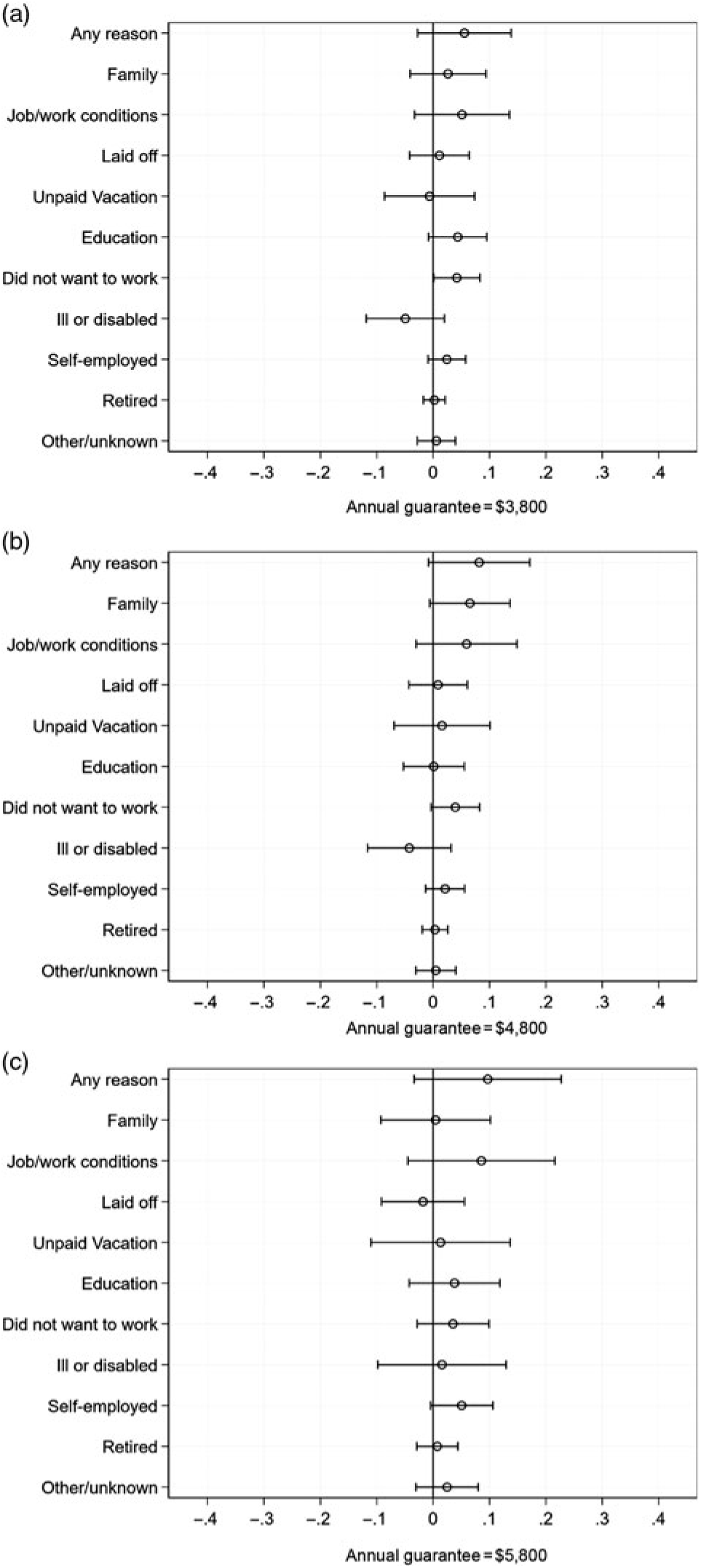
We perform additional DiD analyses using a variety of subgroups, disaggregated by gender, age category (≤ 25; 26–49; ≥ 50), and guaranteed payment amounts (low = $3,800, mid = $4,800, high = $5,800).Footnote 9 Although the number of observations decline in subgroup analyses, further limiting the possibility of statistical significance with 95 percent confidence intervals, the differential effect of Mincome on reasons for not working helps us isolate the source of the effects. It is informative, for example, to determine the degree to which participants citing “education” or “family” as reasons for not working corresponds to women or men. The DiD results are presented in graphical form for ease of interpretation; however, the before and after frequencies for the treatment and control groups for each of the ten variables for each of the eight subgroups, as well as the full sample, are available upon request.
Results
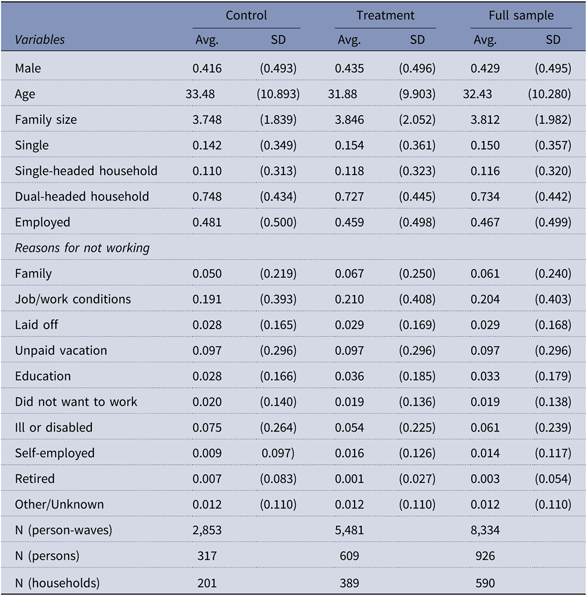
Table 1 provides baseline descriptive statistics for 5,481 treatment and 2,853 control person waves, derived from 609 treatment and 317 control individuals. It is worth noting that treatment and control group means are quite similar across a range of baseline social and demographic variables, including gender, age, family size, family type, and employment status. Table 1 also displays descriptive statistics on reasons for nonemployment, our dependent variables, again showing a high level of similarity between treatment and control groups.
Descriptive statistics

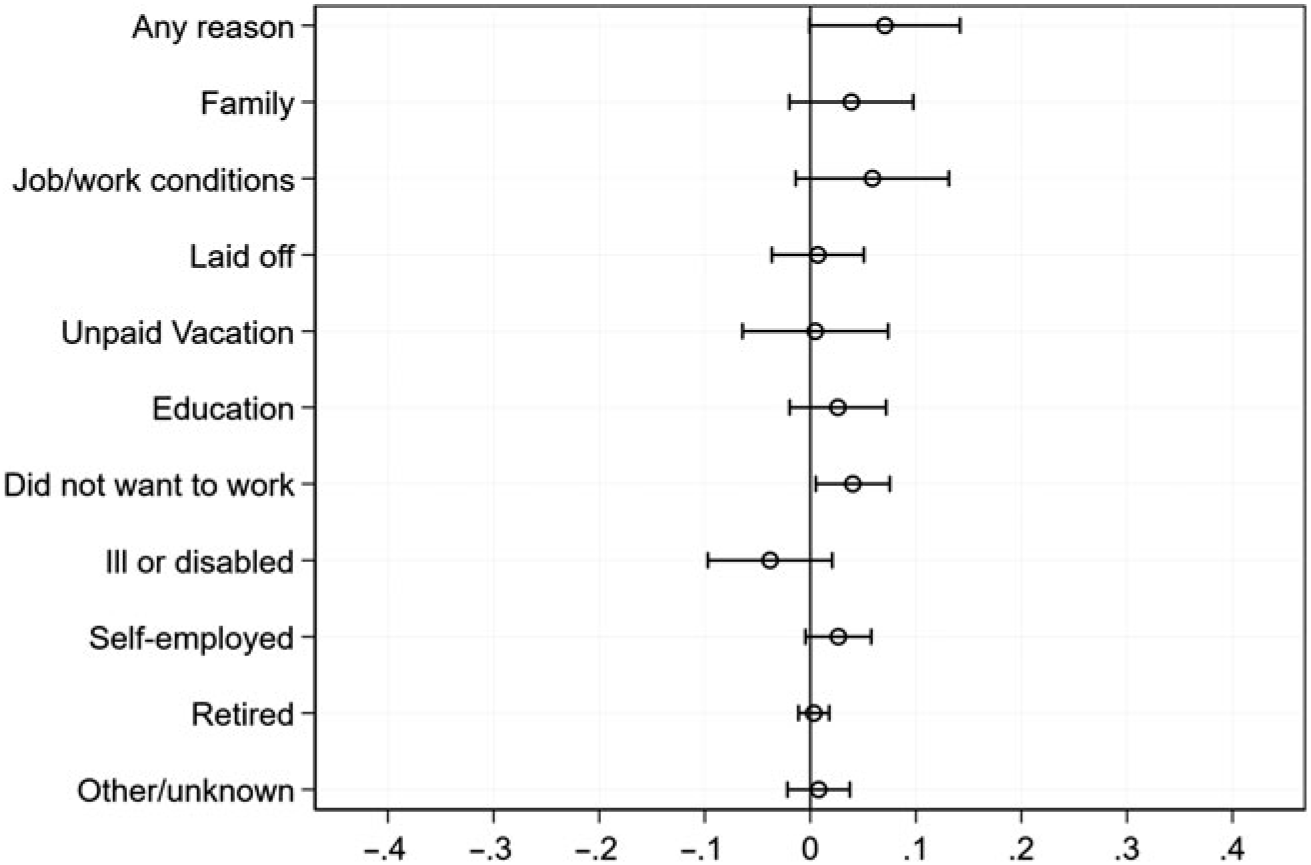
Figure 1 presents the treatment effects of the experimental intervention in the form of DiDs for the full sample regarding the reason for nonemployment. The DiDs are calculated from the difference between the baseline-study period change in the frequency of selecting particular answer categories within the treatment group and the baseline-study period change within the control group. This figure, and those that follow, display both point estimates and their 95 percent confidence intervals.
Difference-in-difference for full sample: Reasons for nonemployment.

A positive number under “any reason,” for example, indicates that the intervention led to a growth in nonemployment for any of the available reasons after the change internal to the control group is subtracted from the change internal to the treatment group. The treatment effect, or DiD, for “any reason” is a 7.1 percentage point increase for the full sample. Likewise, a negative number of –3.8 percentage points under the subcategory “ill or disabled,” for example, indicates that the intervention led to a decline in health-related nonemployment reasons. Thus, fewer people were out of the labor market for reasons of illness and disability. It is worth noting that this result stands out as the only negative effect.
The largest positive effects are found in the “family” (3.9 percentage points), “job/work conditions” (5.9 percentage points), and “did not want to work” (4.0 percentage points) categories for not working. Family-related answers include “wanted to take care of the family,” “child-care too expensive,” and “pregnancy,” the first of which having the largest singular effect among them. The “job/work conditions” category decomposes into “no jobs available,” “available wages too low,” and “labor dispute,” the first of which showing the largest effect. Each of these answer categories points to possible changes in the circumstances or meaning of what counts as acceptable work. “No jobs available” rarely means that there are literally no jobs; rather it means that there were no jobs deemed good enough – and this answer is arguably close to the idea of “wages being too low.” Likewise, “labor dispute” straightforwardly implies that participants did not like the conditions of their work. The positive treatment effect in the subcategory “did not want to work” is notable as one of the significant findings. The meaning of this answer is open to interpretation, and will be disaggregated further in the text that follows, but the result is striking, nonetheless. Two final effects worth pointing to are positive DiD effects in “self-employment” (2.7 percentage points) and “education” (2.6 percentage points). Within the education category, “in school” sees a positive effect, but “in job training” has none at all. We elaborate on these responses in the decompositions later.
It is worth noting that while the point estimates may be positive or negative in the full sample and in the decompositions, the 95 percent confidence intervals often cross the zero line. However, as noted above, the small number of observations in our sample limits the amount of significance one may be able to expect from our analysis.
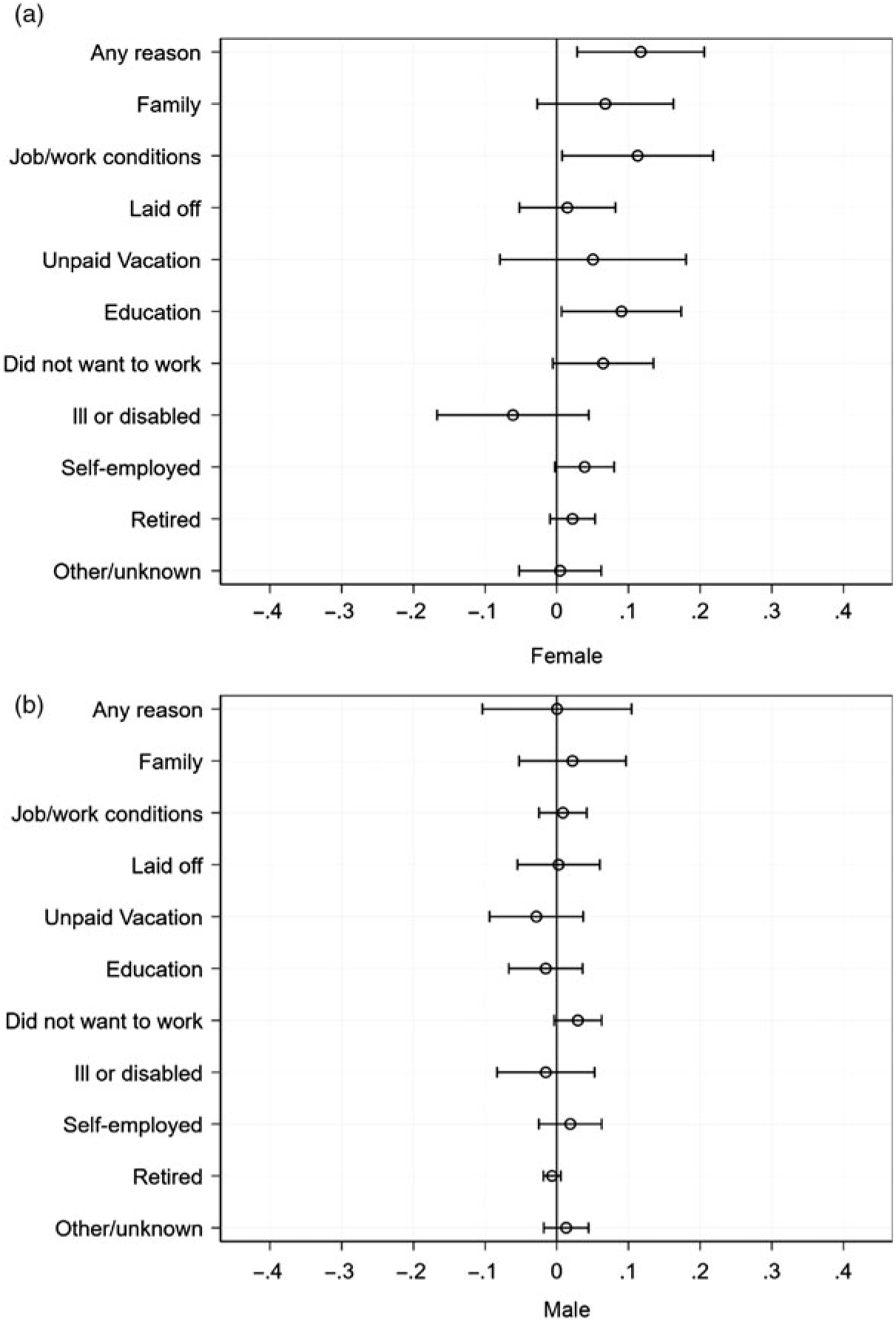
Figure 2 decomposes the full sample by gender, which reveals some of the underlying dynamics that drive the results seen in the full sample. For example, the point estimate for “any reason” is 11.7 percentage points for women, but zero for men. Examining the other variables for women, the largest positive reasons for not working are due to “job/work conditions” (11.3 percentage points), “education” (9 percentage points), “family” (6.8 percentage points), “did not want to work” (6.5 percentage points), “unpaid vacation” (5.1 percentage points), and “self-employment” (3.9 percentage points). Among women, the only reason for not working that declines is the “ill or disabled” (–6.1 percentage points) category. Although the “did not want to work,” “self-employment,” and “family,” categories show moderately positive treatment effects for men, the moderately negative treatment effects in other categories bring the point estimate for “any reason” to zero. For men, moreover, the results tend to hover around zero, and it is reasonable to conclude the full experimental effect is derived disproportionately from its impact on women.
Difference-in-difference by gender: Reasons for nonemployment.

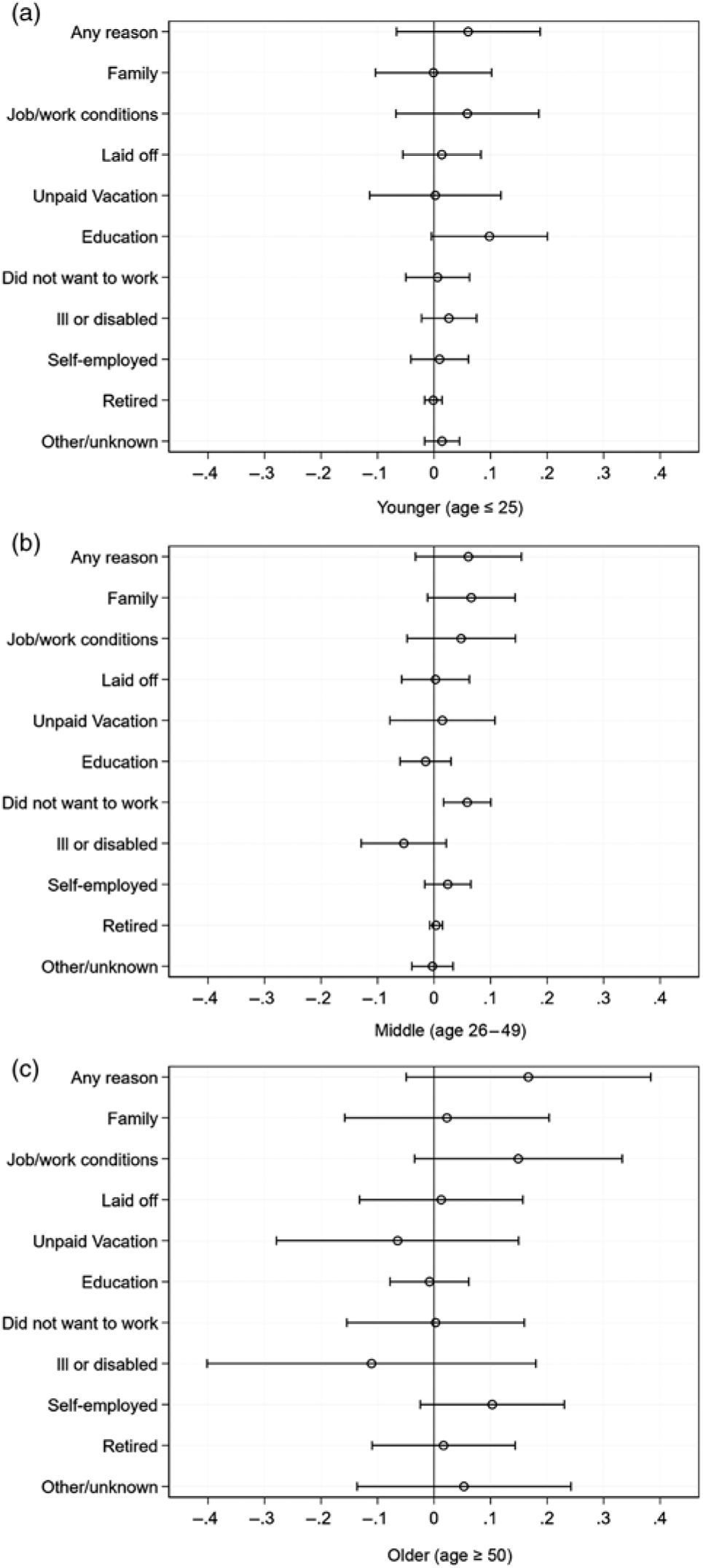
Figure 3 decomposes the full sample by age category. One notable pattern is visible in “any reason,” where the oldest age group displays the largest positive treatment effect of 16.7 percentage points. Disaggregating the particular reasons by age, the largest positive effects are “education” (9.8 percentage points) and “job/work conditions” (5.9 percentage points) for younger participants; “did not want to work” (5.9 percentage points) and “family” reasons (6.6 percentage points) for middle-aged participants; and “job/work conditions” (14.9 percentage points) and “self-employment” (10.3 percentage points) for older participants. Also notable is the large negative effect in the “illness and disability” category (–11.1 percentage points) for older participants.
Difference-in-difference by age: Reasons for nonemployment.

Disaggregating by size of guaranteed income payments ($3,800, $4,800, $5,800), shown in Figure 4, reveals only a few relevant distinctions. One pattern worth remarking on is that the point estimate for not working for “any reason” rises with payment level (5.4 percentage points, 8.1 percentage points, and 9.6 percentage points), as one might expect. Although not shown, there is no equivalent pattern for our three tax-back rates. In the next section we attempt to put some of these results in their historical context and reflect on the changes that have occurred since the 1970s.
Difference-in-difference by payment amount: Reasons for nonemployment.

Discussion: Then and Now
From Canada to Finland, policy makers, academics, and activists are currently engaged in an escalating debate on basic income as a potential future social policy. One crucial aspect of this discussion hinges on the degree to which people engage in socially valuable activities when their basic needs are met outside the market. More important than simple quantitative changes in labor market participation are the substantive changes in people’s daily lives and endeavors. Mincome was an unprecedented and remarkably understudied multi-million-dollar experiment. In the absence of implemented examples of basic income, it is a rare source of information on the ways this oft-debated antipoverty policy might operate once it makes contact with the real world. Analyzing the impact of Mincome on participants’ nonlabor market activities infuses empirical insight into the mechanics of a controversial policy proposal that continues to be marked by a dearth of solid evidence.
However, 40 years on, what are we to make of this antiquated evidence? The two most profound differences between the Mincome period and the present relate to the ways in which women organize their lives, on the one hand, and the range and generosity of social programs, on the other hand. The two are closely related, and perhaps account for the results shown.
In 1974, as the experiment ramped up, the Canadian labor force participation rate for men aged 25 to 54 was 94.5 percent, while for women it was 48.3 percent. By 2014, the participation rate for men fell to 90.5 percent, while that for women rose to 81.9 percent. These statistics locate the Mincome period at the beginning of a profound change in family organization. Men were still the primary earners, and both spouses expected them to be. Lone mothers were more often widows than divorced or never married. Younger women were beginning to flood into the labor market and to regard their work as more than a temporary period before motherhood or an opportunity to buy extras for their families. Yet older women were still living with a set of values and expectations forged in a period of male breadwinners and stay-at-home wives. Winnipeg, a major urban center, reflected the median Canadian experience (Ferrao Reference Ferrao2010).
Our findings, then, are what one might expect. Most men were employed most of the time, and expected to be. The net treatment effect for men is zero; the overall effect is negligible while the specific reasons given for nonemployment vary between treatment and control groups. For women, the experimental effect is larger, as one would expect because most women perceived themselves to be secondary earners. There was no social expectation of work for married women, especially among older age groups, and therefore no stigma associated with a decision to not work for “any reason.” Interestingly, “family” reasons for not working account for a smaller proportion of the difference than do “job/work conditions” or “education,” no doubt because to begin with most of those with significant family obligations were not participating in the labor force. Women who “did not want to work” or desired an “unpaid vacation” perhaps felt no obligation to say otherwise. The small panel makes further disaggregation difficult, but one might speculate that the treatment effect would be particularly large for lone mothers and older women. In an age with far less generous social programs overall, larger age differences between spouses and earlier mortality for men, many women found themselves widowed before age 65, often with young children to support.Footnote 10 Mincome would have allowed these women, many of whom never expected or trained to work outside the home, to leave the workforce with less financial hardship and no social stigma.
For men and women taken together, periods of nonemployment due to poor health – “ill or disabled” – declined by 3.8 percentage points in the treatment group relative to the controls, and declined most for women (6.1 percentage points) and those in the oldest age group (11.1 percentage points). If Mincome improved health outcomes, as has been argued (Forget Reference Forget2011, Reference Forget2013), this is as one would expect. The greater effect among women and older workers reflects the higher prevalence of poor health in these groups. In cases for which there might be multiple or somewhat unclear reasons for not working, identifying ill health as the precipitating cause would carry benefits that other reasons might not.
Since the 1970s, social programs have expanded in scope and size. More generous income support for lone mothers means fewer must work due to financial necessity. Senior support, in the form of more lucrative Old Age Security and Guaranteed Income Supplement payments, coupled with the Canada Pension Plan for some workers, has eased the life of young widows. These changes together account for the fact that since 1986 lone mothers are less likely to work than married mothers, and that older workers leave the workforce earlier. The greater support for seniors has also substantially reduced the employment rate for men aged 55 to 64 since the 1970s (Ferrao, Reference Ferrao2010).
All these changes suggest avenues for research in the latest round of basic income experiments. One of the concerns expressed is that a basic income might slow the trend toward greater labor market participation among women, thereby discouraging gender equality (Bergmann Reference Bergmann2008; Gheaus Reference Gheaus2008). Others highlight the increased agency for women associated with a basic income (Regehr Reference Regehr2014). Time-use studies would go a long way toward establishing how women allocate their time when freed from the necessity of working for wages. It is difficult to imagine that the disproportionately large labor market effects observed for women in the Mincome study would be replicated today, after four decades of significant social change during which women’s work has been fundamentally transformed.
One thing that few studies do, however, is to acknowledge the very different labor market experiences of different women. High-income women, whose future earnings would be most affected by time out of the workforce, would be those least likely to take time out of work to participate in nonmarket labor; the opportunity costs are simply too high. Moreover, the trend toward assortative mating means that most of these women, if married, are likely married to high-income spouses; if the basic income depends on family income, she would not qualify for support in any case (Schwartz Reference Schwartz2013). But what of the low-income single mother? Time out of the labor market for a low-income worker is unlikely to have the same high personal costs as it would for her high-income counterpart. A second potential area of further study, then, is the differential labor market decision making and the different consequences for a variety of workers.
Some basic income designs are such that income entitlement during working years is equal to the entitlement for those beyond the traditional retirement age. If there is no discontinuity in entitlement, a basic income experiment offers the opportunity to study unconstrained retirement from the labor market. What is the distribution of retirement age by occupation and gender when income is not a constraint? Mincome did not allow for such an analysis, partly because the focus of the experiment was on those of working age, and partly because an age of retirement at 65 was socially ingrained. New experiments might offer us the chance to better understand the natural history of working life.
Finally, we can learn a great deal by asking questions in slightly different ways. Mincome, focused as it was on the labor market, asked: “Why were you not working during this period?” A somewhat less structured and perhaps more interesting question might be: “What did you do with your time during this period?” The first asks why you were not engaged in an activity in which you ought to have been engaged – work for pay. The second inquires into your interests, passions, preoccupations, and idiosyncrasies. The purpose of a basic income is to eliminate some of the punitive aspects of existing social policies, yet the Mincome experiment was conceived in a world in which the desire to ensure that people would continue to behave appropriately was paramount. If the purpose of newly conceived basic income experiments is to find out how people will behave if offered real freedom, the second question is far more engaging.
Conclusion
A central constraint in modern economic life is that without ownership of wealth or productive assets, most people have no decent alternative to working in the formal labor market. This stylized fact is the underlying basis for a good deal of coercion in people’s working lives, even if it is largely taken for granted. When the argument for basic income is pitched at this level, it can be asked whether the question of what people do when that constraint is loosened even matters.
Put differently, the foundational argument for basic income is perhaps a moral one. Insofar as a society produces sufficient wealth to make it possible, this view says that people ought to have the real freedom to spend their days as they wish. To this it is added that, following Herbert Simon (Reference Simon, Rogers and Cohen2001), our individual productivity in large part is an accidental consequence of the brute luck of being born into a rich society. Through no contribution of our own we have been endowed with highly developed levels of technology, infrastructure, language, and culture, all of which permit high individual incomes, and the morally arbitrary nature of that income is a powerful reason to redistribute a good amount of it. On this view, even if people end up using their time in ways that others might grouse about, the matter is subordinate to a deeper moral argument.
Another view argues that support for basic income ought to be conditional on our confidence that people end up pursuing socially productive activities, be they inside or outside of the formal labor market.Footnote 11 To this it is added that, on pragmatic grounds, a policy facilitating large increases in socially unproductive activity may ultimately prove to be politically or economically unfeasible. At the limit, so the argument goes, if we all engaged exclusively in leisure activities, there would be no resources at all to fund a basic income. Additionally troubling would be a scenario in which a vulnerable group was publicly accused of being idle, dependent, or socially unproductive; the resulting political dynamic set in motion could make a basic income equally unsustainable.
These concerns might in fact be overstated, and moreover, the automatic and universalistic nature of basic income may provide stigma protection (Calnitsky Reference Calnitsky2016) for potentially vulnerable groups. At the very least, however, those committed to the strict moral case ought to see that their moral arguments are conditional on passing pragmatic tests. For this reason, the question of what people do with their time in a basic income world is unavoidable.
This article provides evidence on both sides of the balance sheet. On the one hand, we find that the intervention led to growth in unpaid care work and education for some groups. On the other hand, we find growth in the portion of people reporting that they did not want to work. It is possible that this is code for not wanting to work where they were working at the time, but it is also possible that these individuals simply did not want to work at all. A good deal rides on these details, and future research ought to explore them. It would not be overly surprising to imagine a future world of basic income where some moderately sized group is not particularly interested in working or partaking in socially valuable activities. In the case of this research, it is important to note that the absolute numbers in this group are not large; it is equally unlikely that they would be overwhelming in a future basic income regime. So long as the growth in persons doing no socially valuable labor is not explosive, the moral argument – that self-chosen idleness ought not be the sole province of the rich – can hold its own.
Appendix
Reasons for not working