Introduction
Conotruncal anomalies (CTA), the most common subgroup of CHDs,Reference Anderson, Mohun and Henderson1,Reference Baumgartner, De Backer and Babu-Narayan2 comprise malformations arising from abnormal development of the ventricular outflow tracts, arterial roots, and intrapericardial arterial trunks.Reference Anderson, Mohun and Henderson1 Although biventricular repair is the preferred strategy when anatomy permits, the frequent coexistence of ventricular hypoplasia, atrioventricular valve anomalies, or unfavourable septal defect configurations may necessitate single-ventricle palliation.Reference Lacour-Gayet, Bove, Hraška, Morell and Spray3 Therefore, these anomalies account for a substantial proportion of patients who ultimately undergo total cavopulmonary connection.Reference Rychik, Atz and Celermajer4
The Australia and New Zealand Fontan Registry recently reported that CTA was present in nearly half of 1835 Fontan patients.Reference Daley, Cordina and Alphonso5 Transplant-free survival did not differ between conotruncal and non-conotruncal patients, although higher rates of outflow tract reintervention and pacemaker implantation were observed in the conotruncal cohort. Because the conotruncal category aggregates anatomically heterogeneous lesions with widely varying ventricular morphology, it remains unclear whether the prognostic patterns attributed to CTA reflect the diagnostic category itself or the underlying distribution of ventricular morphology. Moreover, the haemodynamic and functional consequences of CTA within the Fontan circulation, including filling pressures and exercise capacity, have not been systematically evaluated.
We therefore analysed 650 consecutive total cavopulmonary connection patients at a single-centre to determine whether CTA independently influences long-term Fontan outcomes and haemodynamic performance and to disentangle their effect from that of dominant ventricular morphology.
Materials and methods
Study design and patients
This was a retrospective, single-centre cohort study. All patients who underwent total cavopulmonary connection at the TUM University Hospital German Heart Center between May 1994 and October 2023 were reviewed. Patients who underwent conversion from a prior atriopulmonary Fontan or atrioventricular Fontan (Björk) to total cavopulmonary connection were excluded. Follow-up data were obtained from our institutional single-ventricle patient database, outpatient clinic records, and communications from referring institutions. The follow-up period for each patient was defined as the interval between total cavopulmonary connection and the most recent clinical examination. Loss to follow-up was defined as no clinical contact for more than 2 years.
Definitions
CTA were defined as CHDs with abnormal ventriculo-arterial alignments and connections, including transposition of the great arteries (d-transposition of the great arteries and l-TGA/congenitally corrected transposition of the great arteries), double outlet right ventricle, tetralogy of Fallot, truncus arteriosus, and interrupted aortic arch type B.Reference Lacour-Gayet, Bove, Hraška, Morell and Spray3 To capture all patients with conotruncal involvement regardless of the underlying single-ventricle anatomy, we additionally classified the following lesions as CTA: double inlet left ventricle with ventriculo-arterial discordance, tricuspid atresia with transposition of the great arteries, and unbalanced atrioventricular septal defect with conotruncal involvement. Non-CTA diagnoses included hypoplastic left heart syndrome (including patients with borderline left ventricular dimensions), tricuspid atresia without transposition of the great arteries, pulmonary atresia with intact ventricular septum, unbalanced atrioventricular septal defect without conotruncal involvement, double inlet left ventricle without ventriculo-arterial discordance, and other single-ventricle lesions. Each patient was classified into one of these two mutually exclusive groups based on their primary cardiac diagnosis. Dominant ventricular morphology was classified as dominant right ventricle or dominant left ventricle based on echocardiographic and angiographic assessment. The operative techniques have been detailed in our previous report.Reference Ono, Kasnar-Samprec and Hager6 Fenestration was not routinely performed but was reserved for high-risk patients.
Endpoints
Four endpoints were analysed: (i) transplant-free survival (freedom from death or heart transplantation); (ii) Fontan failure, defined using the multimodal scoring system by Kramer et al.,Reference Kramer, Schleiger and Schafstedde7 encompassing advanced heart failure (NYHA class III–IV), recurrent heart failure hospitalisations, transplant referral, protein-losing enteropathy, and plastic bronchitis; (iii) tachyarrhythmia (first sustained episode requiring treatment); and (iv) ventricular dysfunction, defined as at least moderately impaired systemic ventricular function on qualitative echocardiographic grading (none, mild, moderate, or severe).Reference Dahmen, Heinisch and Staehler8
Cardiac catheterisation
Post-total cavopulmonary connection catheterisations were performed when clinically indicated. Haemodynamic measurements included right atrial pressure, left atrial pressure, and systemic ventricular end-diastolic pressure. Pulmonary artery indices (total, right, left, and symmetry index) were measured at catheterisation.
Cardiopulmonary exercise capacity test
Cardiopulmonary exercise testing was performed on an upright bicycle ergometer using a symptom-limited ramp protocol with continuous breath-by-breath gas exchange analysis.Reference Müller, Christov, Schreiber, Hess and Hager9 Peak oxygen uptake (peak VO2) was defined as the highest 30-second averaged value during exercise. Percent-predicted peak VO2 was calculated using age-and sex-adjusted reference values.Reference Cooper and Storer10 The ventilatory efficiency slope (VE/VCO2 slope) was derived by linear regression of minute ventilation against carbon dioxide output.
Statistical analysis
Categorical variables are presented as absolute numbers and percentages, and continuous variables as medians with interquartile ranges. Group comparisons were performed using the Mann–Whitney U test for continuous variables and the chi-squared or Fisher’s exact test for categorical variables. Survival estimates were calculated using the Kaplan–Meier method and compared using the log-rank test. Cox proportional hazards regression was used to identify independent predictors of each endpoint. Twelve candidate variables were considered: CTA, sex, dominant right ventricle, heterotaxy, prior Norwood/Damus–Kaye–Stansel, age at total cavopulmonary connection, extracardiac conduit, fenestration, prior bidirectional cavopulmonary shunt, pre-Fontan ventricular dysfunction, pre-Fontan atrioventricular valve regurgitation, and surgical era (Fontan year >2010 versus ≤2010). Variables with univariable p-values < 0.10 entered the multivariable model. Three sensitivity analyses were performed to test the robustness of these findings. First, inverse probability of treatment weighting was applied to create a pseudo-population balanced on 10 baseline covariates. Second, four-group interaction analysis stratified patients by CTA status and dominant ventricular morphology. Third, a shared-diagnosis subgroup analysis was performed to eliminate confounding by hypoplastic left heart syndrome in the non-CTA group, restricted to diagnoses present in both cohorts (double inlet left ventricle, tricuspid atresia, unbalanced atrioventricular septal defect, and univentricular heart).Reference Daley, Cordina and Alphonso5 A p-value less than 0.05 was considered statistically significant. Analyses were performed using SPSS version 28.0 (IBM) and R statistical software (R Foundation for Statistical Computing).
Results
Patient characteristics
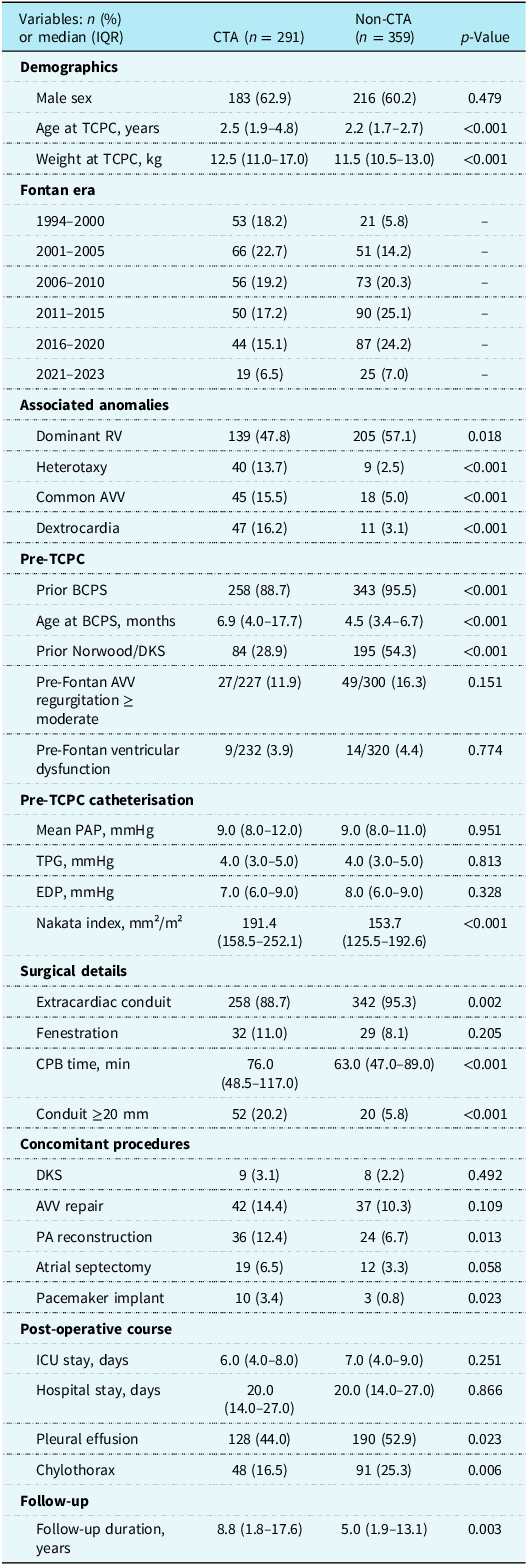
A total of 650 patients underwent total cavopulmonary connection (CTA 291 [44.8%], non-CTA 359 [55.2%]; Table 1). The CTA group was older at total cavopulmonary connection (median 2.5 versus 2.2 years, p < 0.001) and operated in an earlier era (median 2008 versus 2012, p < 0.001), with longer follow-up (median 8.8 versus 5.0 years, p = 0.003). Dominant right ventricle was less prevalent in the CTA group (47.8% versus 57.1%, p = 0.018), whereas heterotaxy (13.7% versus 2.5%, p < 0.001) and prior Norwood/DKS (28.9% versus 54.3%, p < 0.001) differed substantially. In the non-CTA group, hypoplastic left heart syndrome was the most frequent diagnosis (49.0%). The distribution of CTA subtypes and their event rates are summarised in Supplementary Table S1.
Patient characteristics

Table 1. Long description
The table compares patient characteristics between CTA (n = 291) and non-CTA (n = 359) groups. It includes demographics, associated anomalies, pre-TCPC details, surgical details, concomitant procedures, post-operative course, and follow-up information. The table has 10 columns and 30 rows, including headers. Column headers are Variables: n (%) or median (IQR), CTA (n = 291), Non-CTA (n = 359), and p-Value. Row labels include categories such as Demographics, Fontan era, Associated anomalies, Pre-TCPC, Pre-TCPC catheterisation, Surgical details, Concomitant procedures, Post-operative course, and Follow-up. Each row provides specific data points for both groups and p-values indicating statistical significance. Notable trends include differences in age at TCPC, weight at TCPC, prevalence of dominant right ventricle, heterotaxy, common AVV, dextrocardia, prior BCPS, age at BCPS, prior Norwood/DKS, pre-Fontan AVV regurgitation, pre-Fontan ventricular dysfunction, Nakata index, extracardiac conduit, CPB time, conduit size, pleural effusion, chylothorax, and follow-up duration.
AVV = atrioventricular valve; BCPS = bidirectional cavopulmonary shunt; CPB = cardiopulmonary bypass; CTA = conotruncal anomaly; DKS = Damus–Kaye–Stansel; EDP = end-diastolic pressure; PA = pulmonary artery; PAP = pulmonary artery pressure; RV = right ventricle; TCPC = total cavopulmonary connection; TPG = transpulmonary gradient.
Transplant-free survival and Fontan failure
During a median follow-up of 6.3 years (interquartile range: 1.9–15.3), 29 transplant-free survival events occurred (CTA 18, non-CTA 11). These comprised 27 deaths, of which 2 occurred after heart transplantation, and 2 additional patients who underwent heart transplantation and survived to the most recent follow-up. Transplant-free survival did not differ between groups (log-rank p = 0.136; Figure 1 a , Supplementary Table S2). Fontan failure developed in 76 patients (CTA 40, non-CTA 36) with no significant difference (log-rank p = 0.717; Figure 1 b , Supplementary Table S2). At 10 and 15 years post-total cavopulmonary connection, 137 and 96 CTA patients and 122 and 70 non-CTA patients remained under follow-up. Curves for CTA and non-CTA remained essentially parallel throughout follow-up (freedom from Fontan failure 85.4% versus 87.0% at 10 years, 82.3% versus 82.0% at 15 years; Supplementary Table S2), whereas curves stratified by ventricular morphology diverged progressively (freedom from Fontan failure for dominant right ventricle versus dominant left ventricle: 80.0% versus 92.5% at 10 years, 73.7% versus 90.0% at 15 years, 60.5% versus 87.3% at 20 years). When stratified into four groups by conotruncal status and dominant ventricular morphology, freedom from Fontan failure clustered by ventricular morphology rather than by conotruncal status (Figure 2; 4-way log-rank p < 0.001).
Kaplan–Meier curves. ( a ) Transplant-free survival in patients with and without conotruncal anomalies. ( b ) Freedom from Fontan failure in patients with and without conotruncal anomalies. ( c ) Freedom from tachyarrhythmia in patients with and without conotruncal anomalies, restricted to the shared-diagnosis subgroup (double inlet left ventricle, tricuspid atresia, unbalanced atrioventricular septal defect, and univentricular heart).

Kaplan–Meier curves of freedom from Fontan failure stratified by the four groups (CTA + dominant RV, Non-CTA + dominant RV, CTA + dominant LV, Non-CTA + dominant LV). CTA = conotruncal anomaly; RV = right ventricle; LV = left ventricle.

Figure 2. Long description
Panel: A line graph showing the freedom from Fontan failure over years after TCPC for four groups. The horizontal axis represents years after TCPC ranging from 0 to 20. The vertical axis represents the percentage of freedom from Fontan failure ranging from 40 percent to 100 percent. The graph includes four lines representing different groups: CTA plus dominant RV, Non-CTA plus dominant RV, CTA plus dominant LV, and Non-CTA plus dominant LV. The CTA plus dominant RV group shows the lowest freedom from Fontan failure over time, while the Non-CTA plus dominant LV group shows the highest. The log-rank p value is less than 0.001, indicating a significant difference among the groups. The number at risk table below the graph shows the number of participants at risk at different time points for each group.
Arrhythmia
Tachyarrhythmia occurred in 32 patients (CTA 21, non-CTA 11; log-rank p = 0.280). Sinus node dysfunction was more frequent in the CTA group (10.9% versus 6.5%, p = 0.049). Overall, pacemaker implantation showed a trend (10.8% versus 6.5%, p = 0.055), but rates after total cavopulmonary connection were comparable (6.1% versus 5.0%, p = 0.547), suggesting that the excess was driven by pre-Fontan conduction abnormalities, particularly in congenitally corrected transposition of the great arteries.
Ventricular dysfunction
Ventricular dysfunction developed in 102 patients and was more frequent in the CTA group on unadjusted analysis (log-rank p = 0.033). When stratified by ventricular morphology, the difference was confined to the dominant left ventricle subgroup (CTA 19.7% versus non-CTA 8.4%, p = 0.004; dominant RV: 20.9% versus 14.6%, p = 0.133). However, CTA did not enter the multivariable model (univariable p = 0.127), and inverse probability of treatment weighting confirmed no association (hazard ratio 1.06, 95% confidence interval 0.67–1.66; p = 0.814).
Other complications
Plastic bronchitis was less common in CTA patients (1.0% versus 3.5%, p = 0.046), with events concentrated in dominant right ventricle patients. No differences were observed in protein-losing enteropathy (5.8% versus 4.4%, p = 0.441) or atrioventricular valve regurgitation ≥grade 3 (10.1% versus 10.4%, p = 0.911).
Multivariable Cox regression
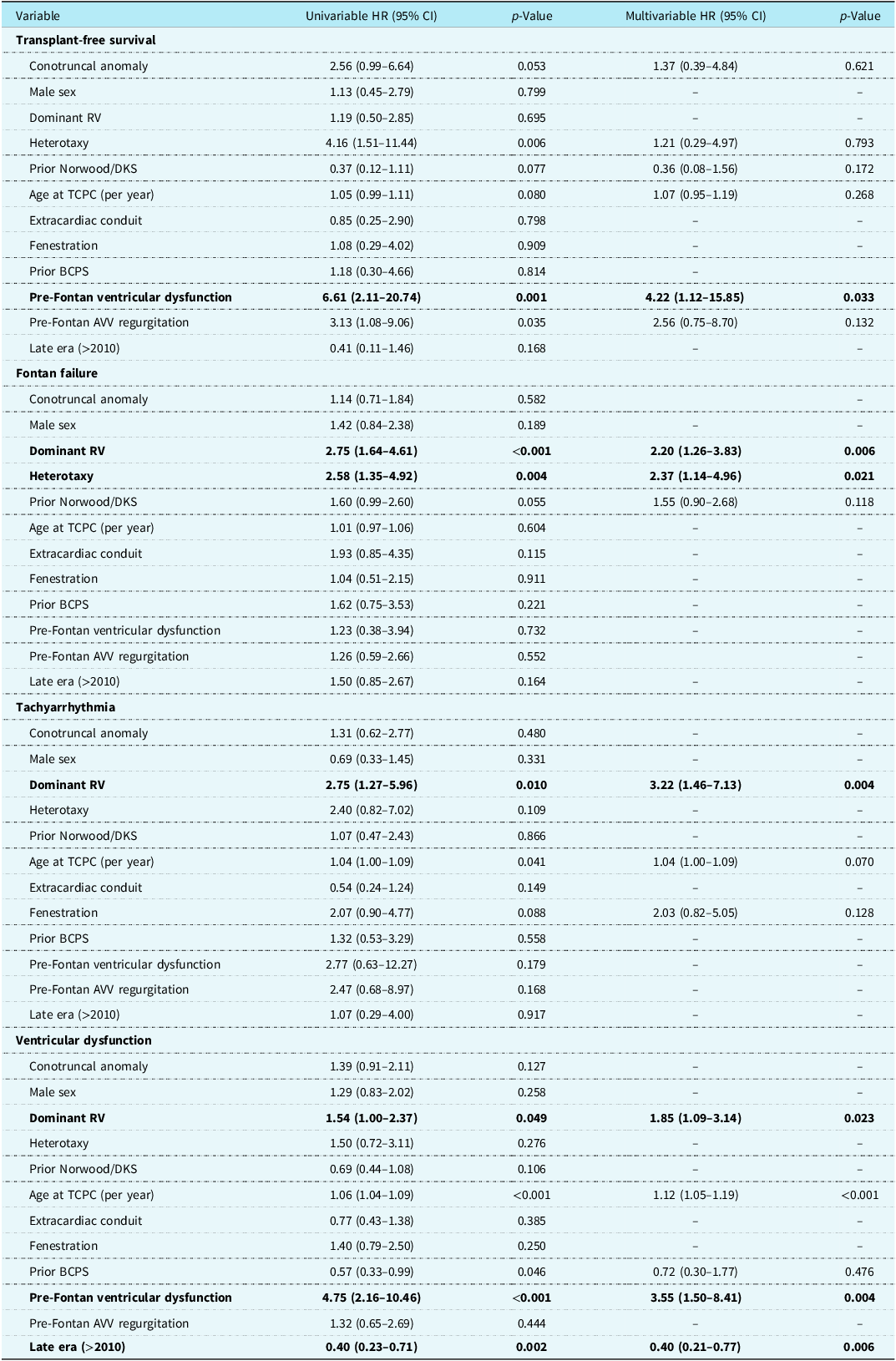
CTA entered the multivariable model only for transplant-free survival (univariable hazard ratio: 2.56, 95% CI: 0.99–6.64; p = 0.053) but was not significant (hazard ratio: 1.37, 95% CI: 0.39–4.84; p = 0.621; Table 2). Pre-Fontan ventricular dysfunction was the only independent predictor of transplant-free survival (hazard ratio: 4.22; p = 0.033). CTA did not meet the selection threshold for Fontan failure (p = 0.582), tachyarrhythmia (p = 0.480), or ventricular dysfunction (p = 0.127). Dominant right ventricle independently predicted Fontan failure (hazard ratio: 2.20; p = 0.006) and tachyarrhythmia (hazard ratio: 3.22; p = 0.004). Heterotaxy was also an independent predictor of Fontan failure (hazard ratio: 2.37; p = 0.021). For ventricular dysfunction, dominant right ventricle (hazard ratio: 1.85; p = 0.023), age at total cavopulmonary connection (hazard ratio: 1.12 per year; p < 0.001), pre-Fontan ventricular dysfunction (hazard ratio: 3.55; p = 0.004), and late surgical era (hazard ratio: 0.40; p = 0.006) were independent predictors.
Cox proportional hazards analysis

Twelve candidate variables were considered. Variables with univariable p < 0.10 entered multivariable models. Bold indicates statistically significant multivariable predictors (p < 0.05).
AVV = atrioventricular valve; BCPS = bidirectional cavopulmonary shunt; CI = confidence interval; CTA = conotruncal anomaly; DKS = Damus–Kaye–Stansel; HR = hazard ratio; RV = right ventricle; TCPC = total cavopulmonary connection.
Sensitivity and subgroup analyses
Three sensitivity analyses confirmed the robustness of these findings. After balancing baseline differences between groups using inverse probability of treatment weighting (all standardised mean differences < 0.10; Supplementary Table S3-A), CTA was not associated with any endpoint (Supplementary Table S3-B). When patients were stratified into four groups by CTA status and ventricular morphology, outcomes were comparable within the same morphological subgroup regardless of CTA status. In the shared-diagnosis subgroup (n = 344; CTA 208, non-CTA 136), no significant differences were observed for transplant-free survival, Fontan failure, or ventricular dysfunction. Freedom from tachyarrhythmia showed a trend that did not reach significance (p = 0.08; Figure 1 c ).
Haemodynamics and exercise capacity
In 226 patients with post-total cavopulmonary connection catheterisation (CTA: 109, non-CTA: 117; median 5.5 years post-total cavopulmonary connection), no significant differences were observed in filling pressures, cardiac index, or pulmonary vascular resistance (Supplementary Table S4-A). Similarly, cardiopulmonary exercise testing in 161 patients (CTA: 100, non-CTA: 61) showed no differences in peak VO2 (25.2 versus 25.5 mL/kg/min, p = 0.442) or VE/VCO2 slope (34.0 versus 34.0, p = 0.508; Supplementary Table S4-B). These results were consistent across dominant left ventricle and dominant right ventricle strata. Key cardiopulmonary exercise testing and post-total cavopulmonary connection pulmonary artery geometry parameters stratified by conotruncal status and dominant ventricular morphology are summarised in Supplementary Table S5.
Pulmonary artery development
CTA patients had a significantly larger pre-total cavopulmonary connection pulmonary artery index (191 versus 154 mm2/m2, p < 0.001) and, at the latest post-total cavopulmonary connection catheterisation, a larger left pulmonary artery index (p = 0.005) with greater symmetry (p = 0.011; Supplementary Table S4-C).
Discussion
In this single-centre study of 650 total cavopulmonary connection patients, conotruncal anomalies were not independently associated with transplant-free survival, Fontan failure, tachyarrhythmia, or ventricular dysfunction. This finding was corroborated by equivalent haemodynamic performance and exercise capacity between groups. Dominant right ventricle morphology, not diagnostic category, was the principal determinant of long-term outcomes.
The primary role of ventricular morphology
Dominant right ventricle independently predicted Fontan failure and tachyarrhythmia. CTA subtypes with a high prevalence of dominant right ventricle, such as double outlet right ventricle, had worse outcomes, but this difference disappeared after adjustment for ventricular morphology. These findings suggest that the prognostic heterogeneity within CTA is entirely attributable to ventricular morphology. The adverse impact of dominant right ventricle in the Fontan circulation is increasingly recognised: Moon et al.Reference Moon, Shen and Likosky11 demonstrated in 1162 patients that progressive atrioventricular valve regurgitation precedes ventricular dysfunction, particularly in dominant right ventricle, and Gaebert et al.Reference Gaebert, Schaeffer and Palm12 identified dominant right ventricle and elevated pre-total cavopulmonary connection pulmonary artery pressure as significant risk factors for failing Fontan. This adverse impact appeared progressive in our cohort, with the gap in freedom from Fontan failure between dominant right ventricle and dominant left ventricle widening with extended follow-up. Our data extend these observations by showing that, once ventricular morphology is accounted for, the anatomical complexity inherent to conotruncal anomalies does not confer additional risk. Notably, our institutional approach has progressively shifted towards biventricular repair or one and a half ventricular repair for selected conotruncal anatomies with borderline left ventricles, contributing to the concentration of these patients in the earlier surgical era. The absence of an independent prognostic disadvantage despite this negative selection further reinforces that ventricular morphology, rather than diagnostic category, drives long-term outcomes.
Ventricular dysfunction: role of the surgical era
Ventricular dysfunction was more frequent in CTA patients on unadjusted analysis, but this was largely attributable to their earlier surgical era (median 2008 versus 2012); the late era was independently protective. Within the dominant left ventricle stratum, however, the higher crude rate in CTA patients was not fully resolved after era adjustment, suggesting that CTA may confer a residual risk for late ventricular dysfunction that merits ongoing surveillance.
Haemodynamics, exercise capacity, and pulmonary artery development
Haemodynamic and exercise data showing no differences between groups reinforce the conclusion that CTA does not compromise Fontan circulatory efficiency. Notably, CTA patients had more favourable pulmonary artery development, with a larger pre-total cavopulmonary connection pulmonary artery index and better post-total cavopulmonary connection left pulmonary artery growth and symmetry. The lower prevalence of prior Norwood palliation in the CTA group is a likely explanation, as the Norwood procedure is known to distort pulmonary artery geometry.Reference Zaqout, Assar and Fashion13
Comparison with the Australia and New Zealand Fontan Registry
The Australia and New Zealand Fontan Registry reported equivalent transplant-free survival between conotruncal and non-conotruncal patients in 1835 Fontan recipients, despite higher rates of outflow tract reintervention and pacemaker implantation in the CTA group.Reference Daley, Cordina and Alphonso5 Our single-centre, total cavopulmonary connection-exclusive cohort confirms this absence of a survival disadvantage and refines the picture in two ways: the prognostic heterogeneity within the CTA group is fully explained by ventricular morphology rather than diagnostic category, and post-total cavopulmonary connection catheterisation and cardiopulmonary exercise testing data, which were unavailable in the registry, show that these equivalent clinical outcomes are underpinned by equivalent circulatory performance. These results establish an important benchmark for CTA managed via the single-ventricle pathway.Reference Miyairi and Sinha14
Limitations
This single-centre study has several limitations. Event counts for transplant-free survival and tachyarrhythmia limit multivariable power; the shared-diagnosis subgroup was underpowered for small differences. CTA patients were concentrated in the earlier surgical era; although the era was included in the Cox models and the inverse probability of treatment weighting propensity score, residual confounding cannot be excluded. However, this imbalance biases against CTA, making our null findings conservative. Ventricular dysfunction was assessed by qualitative echocardiographic grading, which may be less reproducible in morphologically complex ventricles. Cardiopulmonary exercise testing and catheterisation data were available for subsets only (catheterisation was clinically indicated rather than protocol-mandated, and cardiopulmonary exercise testing required sufficient age and cooperation), and with a median follow-up of 6.3 years, very late complications may not yet have manifested.
Conclusions
CTA is not independently associated with impaired transplant-free survival, Fontan failure, tachyarrhythmia, or ventricular dysfunction following total cavopulmonary connection. Dominant right ventricle morphology, not diagnostic category, is the principal morphological determinant of long-term Fontan outcomes. Haemodynamic performance and exercise capacity are equivalent between groups, with CTA patients demonstrating notably more favourable pulmonary artery development. Prognostic evaluation should focus on ventricular morphology and haemodynamic status rather than broad diagnostic categories.
Supplementary material
The supplementary material for this article can be found at https://doi.org/10.1017/S1047951126113766.
Acknowledgements
The authors thank Mrs Doris Kienmoser for their help in performing this study.
Financial support
This study was supported by grants from the Förderverein des Deutschen Herzzentrums München.
Competing interests
The authors declare no potential conflicts of interest concerning the research, authorship, or publication of this article.
Ethical standard
The authors assert that all procedures contributing to this work comply with the ethical standards of the relevant national guidelines on human experimentation and with the Helsinki Declaration of 1975, as revised in 2008, and has been approved by the Institutional Review Board of the Technical University of Munich (approval number 2025-232-S-NP, May 05, 2025). The requirement for individual patient consent was waived due to the retrospective design.