With the Supreme Court ruling of Obergellfell v. Hodges on June 26, 2015 effectively legalising same-sex marriage across the United States, coupled with growing media coverage, same-sex couples have taken an increasingly prominent place in U.S. public discourse (U.S. Supreme Court, 2015). Despite this mainstream spotlight, some of the most basic questions typically addressed in heterosexual marital research remain largely unexplored for male-male couples. Among these questions is the impact of financial imbalance on relationship conflict in male-male couples.
In the context of heterosexual couples, financial inequity and division of labour have been established as risk factors for relationship conflict (Claffey & Mickelson, Reference Claffey and Mickelson2009; Ether & Jose, Reference Ether and Jose2000; Frisco & Williams, Reference Frisco and Williams2003; Kluwer, Heesink, & Van de Vliert, Reference Kluwer, Heesink and Van de Vliert1996; Papp, Cummings, & Goeke-Morey Reference Papp, Cummings and Goeke-Morey2009). Papp et al. (Reference Papp, Cummings and Goeke-Morey2009) found that within female-male relationships, financial issues were associated with men being more aggressive, which led to longer, more intense, and more significant conflicts. However, there is a paucity of research that has examined this for male-male couples. In the existing research that does address the topic, it appears that there are commonalities between male-male and male-female couples. In a study comparing gay men in civil unions to heterosexual men in male-female relationships, there was no overall difference in the division of finances, though differences in incomes appeared to be narrower for male-male couples than for male-female couples (Solomon, Rothblum, & Balsam Reference Solomon, Rothblum and Balsam2005). Sharing material possessions and receiving material and/or financial support from a partner has been found to be a deterrent for ending a relationship among both male-male and male-female couples (Kurdek Reference Kurdek2006), and other studies have found no statistical difference in the amount of conflict due to finances in male-male couples versus male-female couples (Solomon et al., Reference Solomon, Rothblum and Balsam2005). Even with findings suggesting that there is no difference in the amount of conflict due to finances
between male-male and male-female couples, it is not known whether this conflict is operating through the same mechanisms for male-male couples as for their male-female counter parts. In an Atlanta-based qualitative sample, Goldenberg, Stephenson, Freeland, Finneran, and Hadley (Reference Goldenberg, Stephenson, Freeland, Finneran and Hadley2016) found that inequalities, including education, employment and money, were perceived to be associated with tension and even increase in violence for gay and bisexual men (Goldenberg, Stephenson et al., Reference Goldenberg, Finneran, Andes and Stephenson2016). In their analysis, Goldenberg, Stephenson et al. (Reference Goldenberg, Finneran, Andes and Stephenson2016) conceptualised dyadic difference (such as imbalance of finances) as sources of tension, as well as factors contributing to imbalance in power and dominance (Goldenberg, Stephenson et al., Reference Goldenberg, Finneran, Andes and Stephenson2016).
Findings on conflict in relation to finances is in line with Conger et al.’s (Reference Conger, Ge, Elder, Lorenz and Simons1994) family stress theory, which posits that insufficient finances within a relationship are associated with increased stressors and therefore lead to increased conflict and coercion (Conger, Ge, Elder, Lorenz, & Simons, Reference Conger, Ge, Elder, Lorenz and Simons1994; Conger, Rueter, & Elder Jr., Reference Conger, Rueter and Elder1999; Tolman & Rosen, Reference Tolman and Rosen2001; Papp et al., Reference Papp, Cummings and Goeke-Morey2009). In a mediational analysis of longitudinal data on 400 couples, Conger et al. (Reference Conger, Rueter and Elder1999) found that economic pressure was associated with stress for couples and marital distress. In a 2009 analysis of male-female couple's diaries, Papp et al. found that finances were not the most frequent source of conflict; however, it was pervasive, recurrent, and often remained unresolved. This approach focuses more on financial strain conceptualised as an overall lack of adequate income for a couple, but does not necessarily address the nuances of financial imbalance within the relationship. Alternatively, one can apply exchange theory to relationships to understand the possible influences of internal differences in financial contribution to power. It posits that the power over one partner by another is related to how much the first partner is dependent on the resources of the second (Emerson, Reference Emerson1962; McDonald, Reference McDonald1981; Munsch, Reference Munsch2015). Bargaining power is increased by a higher share of resources and lower level of dependency (Cook & Emerson, Reference Cook and Emerson1978; Munsch, Reference Munsch2015). Goldenberg, Stephenson et al.’s (Reference Stephenson and Finneran2016) findings underline this in how participants linked a larger share of financial resources within a same-sex relationship with a gain in power and control. Additionally, participants linked financial dependence to limited ability to exit relationships (Goldenberg, Stephenson et al., Reference Goldenberg, Finneran, Andes and Stephenson2016). Exchange theory does not necessarily address the intersection of financial roles and gender roles. Although participants in Goldenberg, Stephenson et al.’s (Reference Stephenson and Finneran2016) study suggested that same-sex couples cannot rely on gender stereotypes for participant roles, dependence is traditionally linked to female roles, and providing is traditionally linked to male roles in male-female relationships (Connell & Messerschmidt, Reference Connell and Messerschmidt2005). Thus, the possible divorcing of these financial roles from gender scripts in same-sex relationships may require further examination. Applying exchange theory, it may be anticipated that power will differentially favour the provider regardless of their gender. Alternatively, conceptualisation of exchange theory may be complicated by conceptions of masculinity.
One factor that has been linked to roles relating to finances in heterosexual relationships is the concept of hegemonic masculinity, in which dominant gender scripts emphasise financial or material provision as one dimension of masculinity (Connell & Messerschmidt, Reference Connell and Messerschmidt2005). Although Connell and Messerschmidt's (Reference Connell and Messerschmidt2005) concept of hegemonic masculinity emphasises that there are variations in expressions of masculinity among men, it posits that hegemonic masculinity dominates social narrative and subordinates other forms of masculinity that deviate from the normative constructions of masculinity. Connell and Messerschmidt (Reference Connell and Messerschmidt2005) describe gender as relational, in which ‘emphasised femininity’ is the subordinated counterpart to hegemonic masculinity. Although the authors leave room for sexual minority forms of masculinities, it is unclear exactly how these scripts function in a male-male relationship. That is, when both partners in a relationship are male, it is unclear how the representation of this hegemonic masculinity has the potential to influence relationship conflict stemming from differences or imbalances in financial roles.
In heterosexual relationships, traditional masculine scripts have been linked to a man's privilege, power, self-worth, self-esteem, ability to make money, and material provision for his family (Papp et al., Reference Papp, Cummings and Goeke-Morey2009; Tichenor, Reference Tichenor1999; Waters & Moore, Reference Waters and Moore2002). The lack of money in a relationship can act as a challenge to the male partner's masculinity, and this challenge may lead to stress or even violence as a way to reassert his masculinity (Bourgois, Reference Bourgois1996; Jewkes, Reference Jewkes2002). Research suggests that even in a context of dual incomes in male-female couples, men still tend to view themselves in a provider role (Townsend, Reference Townsend2010), and in some cases, men even report compensating with extra work hours to maintain a higher share (Deutsch & Saxon, Reference Deutsch and Saxon1998). In addition, men's unemployment increases the likelihood that either men or women will leave a marriage (Sayer, England, Allison, & Kangas, Reference Sayer, England, Allison and Kangas2011). Thus, traditional masculine scripts have been linked to individual heterosexual men's expression of gender through finances.
The operation of gendered scripts in male-male relationships has not been fully examined, though gendered scripts have been linked to sexual positioning and partner selection (Bailey, Kim, Hills, & Linsenmeier, Reference Bailey, Kim, Hills and Linsenmeier1997; Johns, Pingel, Eisenberg, Santana, & Bauermeister, Reference Johns, Pingel, Eisenberg, Santana and Bauermeister2012; Peplau & Cochran, Reference Peplau, Cochran, McWhirter, Sanders and Reinisch1990). Some researchers suggest that at least some same-sex couples enact gender norms that are similar to male-female dynamics; however, in the absence of normative same-sex scripts, male-male couples may need to negotiate roles in a way that male-female couples do not (Goldenberg, Stephenson et al., Reference Goldenberg, Finneran, Andes and Stephenson2016; Peplau & Cochran, Reference Peplau, Cochran, McWhirter, Sanders and Reinisch1990). Some gay/bisexual men express masculinity as the most desirable trait in a partner (Bailey et al., Reference Bailey, Kim, Hills and Linsenmeier1997; Phua, Reference Phua2002), though stereotypically feminine men may be more likely to be desirable to other stereotypically feminine men or by men who typically prefer to partner with women (Bailey et al., Reference Bailey, Kim, Hills and Linsenmeier1997). It is possible that a potential partner's financial status may be conceptually linked to both traditional masculine norms and mate selection. Though some research has addressed aspects of masculinity among male-male relationships, ultimately the extent to which ideas of a traditional masculine ‘provider’ role is salient in the context of male-male relationships is not well established.
Subgroups of masculinities such as gay/bisexual masculinity has been described as ‘compensatory’ or ‘subordinate’ masculinities (Connell & Messerschmidt, Reference Connell and Messerschmidt2005; Fields et al., Reference Fields, Bogart, Smith, Malebranche, Ellen and Schuster2015). Some researchers have suggested that a preference for hypermasculinity is one reaction from gay communities in response to subordination by a dominant paradigm of heterosexual masculinity (Asencio, Reference Asencio2011; Clarkson, Reference Clarkson2007; Fields et al., Reference Fields, Bogart, Smith, Malebranche, Ellen and Schuster2015). In a qualitative study of Black men who have sex with men (MSM) in New York state, Fields describes ‘discrepancy strain’, which is when a person is unable to meet internal or external masculine roles, and ‘dysfunction strain’, which is the negative consequence of conforming to hypermasculine behaviours or the state of vigilance necessary to maintain a perception of masculinity (Fields et al., Reference Fields, Bogart, Smith, Malebranche, Ellen and Schuster2015). In their analysis, Goldenberg, Stephenson et al. (Reference Goldenberg, Finneran, Andes and Stephenson2016) identified the perception of some gay/bisexual men ascribing to hegemonic masculine norms, which was linked to striving for dominance and the potential for violence. Though it has been linked to conflict, it is not known to what extent financially imbalanced relationships may activate masculine stress for same-sex couples.
Relationship discord, gender scripts, and non-equalitarian relationships have been established as a risk factors for intimate partner violence (IPV) among male-female couples (Capaldi, Knoble, Shortt, & Kim, Reference Capaldi, Knoble, Shortt and Kim2012; Jewkes, Reference Jewkes2002). While estimates of IPV among male same-sex couples range as high as 29.1% to 48%, these aforementioned risk factors have not been examined in depth (Craft & Serovich, Reference Craft and Serovich2005; Finneran & Stephenson, Reference Finneran and Stephenson2013, Reference Finneran and Stephenson2014; Goldenberg, Stephenson et al., Reference Goldenberg, Finneran, Andes and Stephenson2016; Stephenson & Finneran, Reference Stephenson and Finneran2016; Tran et al., Reference Tran, Lin, Nehl, Talley, Dunkle and Wong2014). Established forms of IPV among same-sex couples include a range of behaviours, including sexual violence, physical violence, emotional violence, financial abuse, controlling behaviours, and coercion (Finneran & Stephenson, Reference Finneran and Stephenson2013; Stephenson, Hall, Williams, Sato, & Finneran, Reference Stephenson, Hall, Williams, Sato and Finneran2013). Research suggests that gay and bisexual men have inadequate social resources and formal resources to address IPV (Freeland, Goldenberg, & Stephenson, Reference Freeland, Goldenberg and Stephenson2016). Qualitative examination of the dynamics of gender scripts, financial imbalance, and relationship conflict among male-male couples may elucidate upstream factors related to the range of IPV behaviours experienced among male-male couples.
Despite the fact that financial imbalance and division of household labour have been widely examined as a contributing factor to conflict in female-male relationships, little is known about how male-male relationships are influenced by finances and financial imbalances, including expectations around finances and how financial imbalance contributes to partner conflict. It is also unknown the extent to which finances and financial imbalance relate to conceptualisations of masculinity in male-male relationships. The masculine scripts that link financial gain with power in female-male relationships are heteronormative, meaning that they are grounded in the structure of relationships defined by heterosexuality, and therefore it is not clear how these extend to male-male relationships. In this qualitative study, we examine financially imbalanced male-male relationships, including expectations and patterns of financial imbalance, gendered experiences of financial roles, and the influence on control, conflict, and coercion.
Methods
This study was approved by the Emory University Institutional Review Board and consisted of three phases: a baseline in-depth interview (IDI), personal relationship diaries (PRD) and a debrief IDI. Participants were recruited in the Metro Atlanta area at Emory University. All participants had participated in previous cohort studies at Emory University and had indicated that they would like to be contacted to participate in further research. Potential participants were contacted via email and screened for eligibility; participants were considered eligible if they self-reported gay or bisexual identity, resided in the Metro Atlanta area, were over the age of 18, and reported condomless anal intercourse with a man in the past 3 months. We enrolled 25 participants, with all 25 completing all three phases of the study. Participants are labelled ‘P101’ through ‘P125’ throughout the results and discussion. Participants were enrolled until the primary domains of the study approached saturation. Participants who described current or previous relationships that were characterised by financial imbalance were included in the analysis, which resulted in 20 participants. Recent research of same-sex couples, including studies examining couples’ voluntary counselling and testing, and relationship agreements sometimes use more encompassing definitions of relationships or self-identification of relationships (Bauermeister, Ventuneac, Pingel, & Parsons, Reference Bauermeister, Ventuneac, Pingel and Parsons2012; Hoff & Beougher, Reference Hoff and Beougher2010; Stephenson et al., Reference Stephenson, Sullivan, Salazar, Gratzer, Allen and Seelbach2011). In this study, participants were asked to self-define their relationships in reporting up to five memorable partners and continued to qualify these relationships throughout the interview (Goldenberg, Finneran, Andes, & Stephenson, Reference Goldenberg, Finneran, Andes and Stephenson2016). This analysis represents a range of self-identified relationship types.
Baseline IDIs
All participants completed a baseline survey that consisted of 25 self-report items, including basic demographic information, most recent sexual partner, current relationships, commitment level of current relationship, and sexual positioning. Participants were also asked to indicate goals in their relationship, such as independence, dating someone they can fall in love with, planning for the future, and taking care of their boyfriend. Baseline IDIs were conducted by a trained interviewer and lasted approximately one hour per participant. During the IDI, participants constructed a visual timeline of up to five of their most significant or memorable relationships and examined five domains: relationship definitions; feelings about the relationship; love; frequency of anal sex and condom use; and level of perceived risk for HIV and STIs (Goldenberg, Finneran et al., Reference Goldenberg, Finneran, Andes and Stephenson2016). The interviewer guided the participant through the timeline by having participants select a series of five colour-coded sets of stickers with predetermined labels representing a wide variety of responses within domains of each relationship and placing them on the timeline. These domains included relationship labels, positive emotions, negative emotions, love, sexual experiences, and perceived risk (Goldenberg, Finneran et al., Reference Goldenberg, Finneran, Andes and Stephenson2016). The predetermined options represented a wide range and participants also had the option to write in their own words if none of the predetermined labels were appropriate. During each point in constructing the timeline, participants were asked to explain their reasoning for their selections of stickers. After completing the process for each relationship, the participant was asked to review the timeline and identify any patterns that they recognised in the relationships.
Debrief IDIs
Over the next 9 weeks, participants completed three PRDs, one every 3 weeks. PRDs were quantitative web-based surveys that asked about the participant's relationship with male sex partners (including both anal and oral sex partners) that they had during that 3-week period. For each partner, the PRD asked about the details of the relationship (how they met, how long they were together), qualities of the relationship (descriptions of how they felt in the relationship were chosen from a list of predetermined statements). Data from each participant's PRDs were extracted and presented on timelines to participants during a debrief IDI, with each partner having a separate timeline. The debrief guide was tailored to each participant's PRD data; a separate interview guide was used for individuals based on whether they had multiple partners versus one partner and whether they had PRDs in which they reported not having sex. During the debrief IDI, participants discussed the domains of the PRDs that were already on the timelines and added to each timeline using predetermined stickers with labels for the relationship definition, descriptions of sex with each partner, and feelings that they had during sex. Similarly to the baseline IDIs, participants were able to write in their own words if none of the predetermined labels were appropriate. Most participants (20 of 24) described at least one relationship that was characterised by financial imbalance while responding to questions, though finances and financial imbalance were not specifically indicated for the baseline or debrief IDIs in the predetermined stickers or interview guide. When discussion of finances and financial imbalance arose, interviewers used probing questions to explore these themes. More details on methodology can be found in Goldenberg, Finneran et al. (Reference Goldenberg, Finneran, Andes and Stephenson2016).
Data Analysis
All IDIs were audio-recorded, transcribed verbatim, and analysed as individual life-stories through a thematic analysis using MaxQDA 11 software (Verbi GMBH, Berlin). Transcripts were first summarised to understand each individual's experience and then thematic codes were applied to all transcripts. During the code development phase, a preliminary codebook was developed based on recurrent themes in the data. Inductive codes were added to the codebook throughout the preliminary coding process. Economics was an inductive code that emerged from the data during this process. Six study analysts applied the codes independently. These coded transcripts were merged in order to discuss any applications that were inconsistent. The codes that were not consistently applied across coders were reviewed and revised. This process was repeated until coding was consistent among all six analysts, at which point the codebook and definitions were finalised. The finalised codebook consisted of 21 inductive and deductive codes, which were applied to all transcripts by at least two coders per transcript; coding was then reconciled by the study coordinator.
This analysis specifically focuses on segments of text that had been coded with the inductive code ‘economics’. Of the original sample, 20 participants discussed these themes and were included in analyses. This code was defined as anything pertaining to ‘Money, material issues, material inequalities, work, being the financial provider, Sugar Daddy, transactional sex, forming a joint household/partnership/economies, dependent economies and personal finances’. Analysts systematically reviewed all text with this code and then developed economic profiles for each participant. Demographic characteristics were not collected for participants’ partners, so categorisation was based on the demographics of the participant alone. Each relationship was categorised by the nature of economic imbalance, as described by the participant. Relationships were then examined along reoccurring subthemes within financial imbalance, including masculinity, control, conflict, and sexual risk.
Results
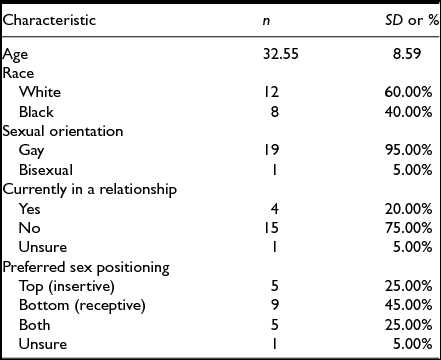
Of the 20 participants, approximately 40% of the participants identified as non-Hispanic African American/Black and 60% were non-Hispanic Caucasian/White. The mean age for all participants was 32.6 years, ranging from 19–50. Almost all participants identified as gay/homosexual (95%), with one identifying as bisexual. Most participants were not in a committed relationship (75%) at the time of enrolment, which we defined as answering ‘no’ to the question: ‘Are you currently in a relationship with a man you feel committed to above all others? Some people might call this a boyfriend, life partner, husband, or significant other.’ Demographic characteristics are indicated in Table 1.
Demographic Characteristics

Of the 76 relationships discussed in this study, 67 of them were coded with ‘economics’. When economics was discussed, it was mostly in the context of financial imbalance, with 47 of those 67 relationships being characterised by financial imbalance. There were some examples of balanced economic relationships and economically unstable relationships, but most discussions of economics were in the context of an income differential or an expectation of income differential.
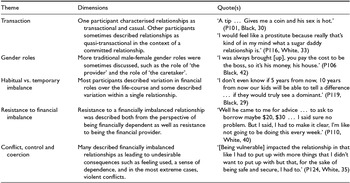
Descriptions of financial imbalance in relationships included relationships where one partner provided money, where one partner provided material goods, where one partner had control of assets, and in some cases where one partner did not have employment. This imbalance often created a dichotomy where the participant described themselves as either a financial/material provider or a financial/material dependent. This imbalance was also described in relationships as situations where the participant could become a financial provider or financially dependent. These imbalances were described as existing across a spectrum that ranged from brief, purely transactional encounters where sex was given in exchange for monetary or material compensation on one end to highly dependent long-term relationships that are not explicitly transactional, but were still characterised by financial imbalance. Financially imbalanced relationships were defined by a transactional nature, but also according to a certain extent, perceptions of gender roles. Participants described their experiences of seeking or resisting financial imbalance in relationships; these habitual patterns or resistance were often based on perceptions of gender roles and a desire for or resistance to filling the role of the ‘husband’ or ‘wife’. According to participants, these constructs of financial imbalance also resulted in an imbalance of control in the relationship, ultimately leading to conflict and experiences of increased sexual risk. For a summary of themes explored in this analysis see Table 2.
Summary of Themes and Their Dimensions

Transaction
Financial imbalance was characterised by some form of financial transaction occurring in a relationship. Only one participant described relationships that were explicitly built upon transactional sex for money or goods. This participant did not describe negotiating prices, but rather described ‘a tip’, which can be ‘maybe 15, 20 dollars’ or ‘to stop by McDonalds’ (P101, Black, 30). He described the sex as ‘a hook up’ or ‘friends with benefits’, but asserted that the sex is often enjoyable and it is at his ‘convenience’ because his sex partner ‘gives [him] a coin and his sex is hot’ (P101, Black, 30).
While other participants were not as explicit about exchanging sex for money or goods, several participants described quasi-transactional sex in the context of their economically imbalanced relationships:
I don't know what this means but there was one time he got a refund check from school and I think I was a little light on money that week, and he came in and he put a house full of groceries, a full tank of gas, I think he bought our meal that night, and I think he paid in something else. And I felt like I should give him awesome head tonight. (P119, Black, 29)
The quasi-transactional nature of economically imbalanced relationships was also explicitly identified by participant 116 when he compares this type of relationship to sex work:
He had more money than I did (laughing) . . . he had made some comment once and I was like, no, I don't want you to be my sugar daddy, thanks . . . I just have a feeling that if I ever got a sugar daddy I would feel like a prostitute because really that's kind of in my mind what a sugar daddy relationship is. You're having sex with somebody, they give you an allowance. It's like, so you're not sleeping with bunches of people but you're still being kind of paid to sleep with somebody. (P116, White, 33)
Gender Roles
In several cases, participants described financial imbalances as gendered. These relationship roles mirrored traditional female-male relationships where one partner takes on the role of ‘wife’ and is expected to take care of household duties (e.g., cooking, cleaning), while the other is the financial provider. Some participants used terms such as ‘suzie homemaker’ or ‘caretaker’ to describe the partner who took on more household duties. In addition, many participants who were the primary financial contributors in a dependent relationship described their role as being a ‘provider’ or ‘protector’. Participant 119 linked the role of provider to being the head of the household: ‘I guess in my mind, I fundamentally believe if you provide, you are the leader, you are the dominant’ (P119, Black, 29). Some participants who were financial recipients also recognised this archetypal role in their partners who were financial contributors. Participant 124 links being provided for with a sense of security:
Well security comes from not necessarily having to worry about the immediate future for me. And so like with security, I, I felt like, it's tough to distinguish [between safety and security]. They kind of go together. They kind of go hand in hand but as a distinguishing factor, I think like safety is, to me, like a, a feeling of not feeling danger. So it's the opposite side of that. And security is more like, in a way, like a state of, or a condition that comes from, I think, feeling safe. Because I feel safe, I can also feel secure. So it's almost like, with security, there's a dependency on being safe. And, and I kind of saw, I saw him in like an archetypal sense maybe a subconscious sense of, of being like my protector. And, and so I think that is, like that sort of speaks to the safety aspect of it and I think like the day-to-day act of like waking up with someone, having a home like doing the laundry and whatnot, like the consistencies of the domestic life was what brought on the security. (P124, White, 35)
Participant 124 not only finds security from being provided for, but also for taking on the domestic role in the household, which seems to be a byproduct of the financial imbalance. Other participants also described either their partners or themselves in this archetypically feminine role of the homemaker or caretaker. Participant 115 discusses how he gravitates to the role of caretaker and how his partner's financial contribution allows him to fill that role:
I'm very much a caretaker. He does have an occupation that would allow us to live very comfortably, me, and me not have to work and I can, and I can raise kids because that would just be part of the reason why I got in teaching because I love kids after fashion merchandising. My mom was a special ed. teacher for my whole life and that's what I do now and my sister does. And so it's kind of, it made sense to me after I follow my dream and made it work out, it made sense. So I very much want to take care of, of two kids and raise them and, and take care of my husband. And so he would allow for me to do that. And, for the most part, does allow me to do it day to day. So yes, he kind of gives me that life and a status. (P 115, White, 28)
Habitual Versus Temporary Financial Imbalance
Participants described varying patterns of these experiences of financial imbalance and gendered roles of finances. While some participants described habitually playing a specific role in economic relationships across their lifespan or a static role within a given relationship, some described playing different roles across their lifespan or even within a given relationship. Perpetually playing the role as a financial provider is described as a negative habitual pattern by several participants, including Participant 111, who describes showing love to multiple partners through providing financial and material support:
Interviewer: How did the, when you were with [partner 1], how did you show that you were in love with him?
Participant 111: Just by the things I would do. I think I would take, sometimes just show up at work and take him to lunch or if he didn't have any money I would, you know, we go on trips or whatever because I worked for [an airline company] so I fly free. So we can go on different places and so I just (laughing deeply) I'm gonna take you me all the time, you must have stock in this. But just, that was basically it. Just, you know, just showing different things.
Interviewer: How did you show that you were in love with [this partner]?
Participant: Basically about the same way. Just being there for him or giving him or, because I always, I always, always get needy people. I don't know why I attract needy folks but I do and so just kind of being there or giving, I think it was just giving him when he needed the most. (P111, Black, 45)
Some participants who demonstrated a pattern of relationships that are marked by financial imbalance recognised the negative consequences of these relationships, but continued to seek them anyway.
More than half of the other participants described being in different financial roles (dependent or provider) over time, or even within a single relationship. For example, participant 119 identified different financially imbalanced relationships, serving both roles of the primary financial contributor and as the dependent partner. He described how the financial roles within his current relationship are not static and how that causes him stress in the insecurity of his role:
I think I'm really attracted to a softer man. I'm attracted to a kind, soft man and so [this partner] is slowly and surely morphing out of that. He was extremely soft . . . if I put him next to the person I met it's very different and so, but I think once you're in love, it's kind of hard. So who knows? I mean, I don't even know if 5 years from now, 10 years from now our kids will be able to tell a difference, like, if they would truly see a dominant. I mean, maybe because I'm older but, and I don't know what that, how that makes me feel because I've always imagined being the head of my house. So I don't know, if [my partner] owns a dental practice and he's making a couple hundred thousand a year. I don't know, it makes me want to, it makes me, it push me to make sure that I negotiated, I, I cannot explain it. It makes me want to go to law school now. Like it makes me want to make sure that I can either be equal or because I think I'm afraid of being in this position that he's in and what that's going to make me feel like. (P119, Black, 29)
Participant 119 is an example of someone who demonstrated patterns of financial imbalance and who specifically sought financial imbalance in his relationships and therefore a shift from a more imbalanced to a more balanced relationship was described as scary.
Resistance to Imbalance
While some participants displayed patterns of financial imbalance and specifically sought financially imbalanced relationships, others resisted filling the role of financial provider or financial dependent. More than half of participants expressed resistance to being in a financially dependent relationship. Sometimes this resistance to financial imbalance was due to a gendered perception of ascribing to the role of being a provider or a dependent. For example, participant 106 describes being directly confronted with a proposal to transition into a financially dependent relationship and refusing to allow his partner to play a more archetypical husband role:
Again, he was more financially stable than I was. I mean, I was working and I had a pretty stable job, but he always, he made more money than I did. So when he bought the house he wanted me to move [to a town] way out [of Atlanta] and I was like I can't move out to [that town] . . . Then he was like well you need to just quit and I'll take care of you and I was just like, no, because then that means, I was always brought, you pay the cost to be the boss so it's his money, his house, and then I would be stuck and I was never, I'm not the type of person to let somebody else take care of me because to me that kind of, you kind of lose control. Maybe I have control issues. [Laughing] Well, not maybe, I have control issues because, so I think that, I think that had we stayed together it would have been, he would have been more my husband and that's the kind of the role he took, opening doors, making sure I was all right, making sure the tyres were on the car and that kind of stuff. (P106, Black, 42)
Participants also described situations where they were in the role of the provider or were starting to fall into the role of the provider despite not desiring to fill this role. Participants described avoiding such situations or trying to rectify situations where they become the financial provider. Participant 110 describes how one partner started relying on him for support and he made it clear that he didn't want to play the role of financial provider, particularly because his partner seemed to spend money on luxury items and ask to be provided for in terms of necessities:
Well he came to me for advice, on what he should do and came to me for, to ask to borrow maybe $20, $30 or something like that to get the bus ticket or whatever, the MARTA ticket and to come to, come to and from work. I said sure, no problem. But I said, I had to make it clear, I'm like I'm not going to be doing this every week because you're putting your money here somewhere else buying all this other stuff on these video games or buying, things that are not, you know, and that's another thing, the mentality. Buying things that he, his wants. He wants this, he wants that. You need groceries, you need a MARTA ticket. So why can't you, put those things down and, he just wouldn't do it. (P110, White, 40)
Conflict, Control, and Coercion
The data suggest that a primary consequence of a long-term dependent relationship is the potential for increased conflict over the financial imbalance. Many financially dependent relationships were characterised by increased conflict originating from the imbalance itself. In some cases, the financial provider described this conflict as feeling ‘used’ or feeling ‘strain’:
[I am] unhappy. And the reason I would choose that sort of I guess description — description for this point is just, because it's kind of like he doesn't work, I understand the economical constraint behind that but it puts a lot of strain on me and I think the relationship that we do have. Because, obviously, finances come into play at some point any time we date. (P103, White, 24)
The conflict over finances within financially imbalanced relationships was described by participants as leading to the deterioration of these relationships:
So we, it was just supposed to, had been friends, like at the time he came to me and he told me like his problems and his issues and he winded up living with me because I felt bad because of his situation. He got put out of where he was staying in, like he explained this all to me and I felt bad for him, and he winded up moving in and then it winded up being more than just us being friends and then we winded up being lovers and, of course, that didn't last long either because it was like a competition thing with him, too. Like he, I don't know, I guess, like he would get a job but he wouldn't hold on to his job and I would always be the one that maintained my job and like it was a lot just paying the bills by yourself and that's, our relationship ended kind of towards that end also. He wanted to fight, argue, be abusive and I wasn't with that. So that ended our relationship. (P109, Black, 29)
Some financially dependent participants described the conflict as causing a sense of insecurity because if the relationship was to end, the financial support would end; in some cases, this was linked to abusive control dynamics. Some participants described financial control in terms of how the dependent partner relies on or needs the partner who contributes financially. Participants described a direct link between financial contribution and power within the relationship, which was often defined as ‘dominance’. Those who were the financial contributor were seen as having more of a right to power or control within the financially dependent relationship. In one example, Participant 124 worked for his partner, so his job security was linked directly to his partner. This created tension and a power imbalance in the relationship, which Participant 124 described as violent. Participant 124 explained that he dealt with the violence in order to continue having financial security:
[Being vulnerable] impacted the relationship in that like I had to put up with more things that I didn't want to put up with but that, for the sake of being safe and secure, I had to do. And so in a way, I subjugated my own, my own feelings and in a way my own happiness. I sort of sacrificed, in a sense, my own happiness, just for safety and security and that along, that's, that's where the vulnerability came from. Like knowing that I depended on him for certain things and in particular like, in a way, like my own emotional stability, which is something that I very much needed at that time. I was willing to put up with more than I otherwise, in the past, would not have dealt with. And so, yes, that's, that's what vulnerable sort of felt like in the relationship. (P124, White, 35)
As a financially dependent partner, Participant 124 also linked the issue of control directly to his inability to advocate for his own desire to end the sexual relationship. Participant 124 described how working with his partner conflicted with wanting to end their sexual relationship and how his partner ultimately coerced him into continuing to have sex:
We were exclusive for a period of time and then basically, I sort of backed away. My emotions weren't vested in him and unfortunately, my job was vested in him. And so he was more like the dominant person in the relationship and I was more the follower and we continued to have sex. We had a very like sexual energy between the two of us. But it wasn't something that I really honestly enjoyed. (P124, White, 35)
Other participants also described how financial dependency created reliance and a level of security that made it difficult to exit relationships, even when they were problematic. Despite being lied to by his partner and contracting HIV, Participant 120 tried to continue a relationship with his partner because of financial dependence:
I'm HIV positive, this is the guy that, uh, got me positive and lied about it . . . Yeah, so, that really sucks, kind of like, his lover and then when that kind of came out, but I still like wanted to stay with him after the fact. But what I found out that he was an alcoholic. And what he did to manage his HIV was that he drank and just like kind of like, kept drinking himself into stupors just to forget about it . . . And I kept asking him like what I do about having this, what is there, and how do I live this life. And he didn't have any information because he just drank. And then over time it kind of sunk in like what had actually happened. And then it wound up being a pretty bad scene and I left . . . there was a part of myself that wanted to stay with him after the fact because he had money. And then I kind of like tried that out because everybody has a little fantasy about like somebody taking care of them and having money . . . and of course, in those fantasies it's not about love, and I'm like, well, that doesn't work, for people. (P120, White, 32)
Discussion
While financial imbalance was not a universal experience across participants in the study, the majority of passages that were coded with the inductive code ‘economics’ discussed some form of financial imbalance. Thus, when participants identified finances as having a salient impact on relationships, it was often within the context of financial inequalities between partners. Relationships that were characterised by financial imbalance ranged from purely transactional to financially dependent relationships. The results suggest that patterns of financially imbalanced relationships, especially longer-term financially dependent relationships, are often dynamic, with variation between relationships, but also within relationships, with roles shifting within the relationship over time. Sometimes, this dynamic shift was linked with increased stress or conflict within the relationship, especially if one partner had a preference for the imbalance to occur in a certain way (i.e., if the partner had a specific desire to be the financially dependent or the financially providing partner). While some participants described a preference for relationships characterised by financial imbalance, resistance was also a salient theme. While this would appear to be consistent with research that suggests that gay and bisexual men may be more likely than their heterosexual counterparts to reject rigid prescriptive roles (Riggle, Whitman, Olson, Rostosky, & Strong Reference Riggle, Whitman, Olson, Rostosky and Strong2008), this resistance was often in response to a partner who was interested in these more rigid roles, indicating a source of stress for the relationship. In relationships where either the participant or the partner resisted the financial imbalance, this caused stress and conflict, which sometimes resulted in the termination of the relationship (or the inability to terminate the relationship due to financial vulnerability and coercion).
These results also suggest that financially imbalanced male-male relationships may sometimes create a power imbalance that exists within gendered constructs. Financial stress and financial inequalities have been examined within female-male relationships as being linked with gendered roles and definitions of masculinities (Bourgois, Reference Bourgois1996; Coston & Kimmel, Reference Coston and Kimmel2012; Jewkes, Reference Jewkes2002; Papp et al., Reference Papp, Cummings and Goeke-Morey2009; Tichenor, Reference Tichenor1999; Waters & Moore, Reference Waters and Moore2002) and according to these results, there is a similar phenomenon occurring for some male-male relationships; however, much like Goldenberg et al. (Reference Goldenberg, Finneran, Andes and Stephenson2016), suggested applications of gender scripts among MSM were not consistent across the sample. Many participants ascribed gendered roles to their financial imbalance based on roles that are stereotypically ascribed to female-male relationships where the woman is the ‘caretaker’ and the man is the ‘provider’. Given these ascribed roles, the financial imbalance can create a threat to masculinity for the financially dependent partner; previous research has identified this threat as a factor contributing to IPV in male-male relationships (Finneran & Stephenson, Reference Finneran and Stephenson2014). Furthermore, these gendered discussions support previous literature about financial imbalance and gender, which identify ‘masculine gender role conflict’ (Dworkin, Reference Dworkin2005; O'Neil, Reference O'Neil1981; O'Neil, Helms, Gable, David, & Wrightsman, Reference O'Neil, Helms, Gable, David and Wrightsman1986; Simonsen, Blazina, & Watkins Jr., Reference Simonsen, Blazina and Watkins2000; Wester, Pionke, & Vogel, Reference Wester, Pionke and Vogel2005). These results suggest that men may fear the negative consequences of being considered feminine and therefore try to prove their success through the expected male role of being the ‘provider’; however, as with other aspects of masculine gender role conflict, this can lead to experiences of psychological dysfunction (Good et al., Reference Good, Robertson, O'Neil, Fitzgerald, Stevens, DeBord, Bartels and Braverman1995; O'Neil, Reference O'Neil1981) and conflict within relationships. While the masculine gender role conflict is an issue for men in female-male relationships, this conflict may be heightened for gay and bisexual men because the stereotypical scripts of masculinity are heteronormative and are therefore perceived as unattainable for men in male-male relationships. While literature has begun to address the role of masculinity in gay and bisexual men's relationship health (Sánchez, Greenberg, Liu, & Vilain Reference Sánchez, Greenberg, Liu and Vilain2009; Wade & Donis, Reference Wade and Donis2007; Wester et al., Reference Wester, Pionke and Vogel2005), specific roles such as ‘the provider’ have not been explored in depth among male-male relationships.
Limitations
This study primarily explored the inductive theme of economics. Data were not collected on the partners described in the interviews, so further exploration of income differences was not possible. While the data collected in this study represents a wide range of types of relationships, further studies are needed to compare financial imbalance across relationship types or to further examine financial imbalance within a specific relationship type. Most participants did not report being in a long-term committed relationship at the time of study, thus much of the data reflecting long-term committed relationships is retrospective. This is also a sample of MSM who had condomless anal sex in the 3 months prior to study enrolment, so this sample was of MSM who are at higher risk for HIV. In 2015, national estimates of condomless sex in the past 12 months among MSM in the United States was 61.24% among HIV-negative men and 72.24% among HIV-positive MSM (Sanchez, Sineath, Kahle, Tregear, & Sullivan, Reference Sanchez, Sineath, Kahle, Tregear and Sullivan2015); thus, men who engage in condomless sex still represent a large portion of MSM. Despite these limitations, we were still able to analyse participants’ descriptions and perceptions of financial imbalance in relationships.
Conclusions
This study suggests that links between financial imbalance and strictly ascribed gender roles are relevant for male-male relationships, though not universal. Although the results examined conflict and control more generally (rather than focusing specifically on IPV), these findings do suggest that a financial imbalance in male-male relationships can contribute to a power imbalance, resulting in financial control and an inability to exit violent or unhealthy relationships. Further studies are warranted to examine whether financial dependence or resulting conflict from financial imbalance contribute explicitly to experiences of IPV (both victimisation and perpetration) among male-male couples. Additionally, a deeper understanding of the extent to which prescriptive roles are present in male-male relationships and whether the presence of prescriptive roles is predictive of negative relationship and health outcomes would aid our understanding of the triggers for IPV in male-male relationships. Potential avenues of research include examining predictors of gay and bisexual men's adherence to strict gender norms and how these norms contribute to perceptions of power imbalance, conflict within the relationship, and IPV. As presented here, the results illustrate that financial imbalance may be a significant source of conflict in male-male relationships and that interventions to allow same-sex couples to talk through or reflect on both their financial and gender roles are warranted.
Acknowledgments
This study was funded by the Emory University Research Committee.
Conflict of Interest
None.
Ethical Standards
The authors assert that all procedures contributing to this work comply with the ethical standards of the relevant national and institutional committees on human experimentation and with the Helsinki Declaration of 1975, as revised in 2008.