Introduction
The nomadic Turks were influential over a vast geographical area and left behind various traces. The First Turkic Khaganate (First Köktürk Khaganate), which emerged with the name ‘Türk’ for the first time, was officially established in 552 when Bumin took the title of Il Khagan. Before this, starting in 545, the Turks, who had been working as blacksmiths for the Ruan Ruan (Juan Juan), began to grow in strength and rise in the region. Notably, Muqan Khagan (553–572), who succeeded Bumin, gained significant power in the region and asserted dominance over China. Meanwhile, Istemi Yabgu (552–576) governed the western territories as a subordinate to the eastern khagan and consolidated the region under the state’s control. However, after the reigns of these strong rulers, the state began to deteriorate quickly and eventually split into two: east and west. Following this, from 630 onwards, China became dominant in the region, although affiliated administrations in the west continued to exist for a while longer.
In 682, under the leadership of Qutlug, the Turkic state was re-established, marking the period known as the Second Turkic Khaganate (Second Köktürk Khaganate). During this founding period, when Tunyuquq served as vizier, Qutlug became khagan with the title Ilterish (682–692). After Ilterish, his brother Kapghan Khagan (692–716) took the throne, followed by Ilterish’s son, Bilge Khagan (716–734). After Bilge, the order began to deteriorate, and the Ashina Dynasty was overthrown in 744 by an alliance of the Basmyls, Karluks, and Uyghurs. Following internal conflicts, the Uyghurs took control of Ötüken and the region’s governance. In 840, the Kyrgyz ended Uyghur rule and rose to power in the region (840–920). The Türgesh, who had been present since 656, played a significant role in the area around present-day Kyrgyzstan from 690 to 756. However, after this period, as the Oghuz migrated farther west, the Karluks began to gain strength in the region.Footnote 1
During these stages of historical development, the first known written works of the Turkic language emerged. The language of this period is classified by Róna-Tas as follows:Footnote 2
Old Turkic (OT)
Early OT (EOT) 400–550
Late OT I. (LOT I) 550–700
Late OT II. (LOT II) 700–1000
Late OT III. (LOT III) 1000–1200
Firstly, no Turkic text has survived from the First Turkic Khaganate. However, inscriptions such as the Bugut and Khüis-Tolgoi steles, which were erected in the region during this period, do exist.Footnote 3 The oldest known Turkic text with a recorded date belongs to the era of the Second Turkic Khaganate. The Choir inscription and the Nomgon inscription (689, 701, 713) are the earliest known dated Turkish texts. In addition, there are many inscriptions that cannot be precisely dated. These texts were carved onto stones, rocks, and various objects. Old Turkic inscriptions are found in countries such as Mongolia, the Russian Federation, Kyrgyzstan, Kazakhstan, Uzbekistan, and the People’s Republic of China. The most well-known and complete inscriptions are the Köl Tegin, Bilge Khagan, and Tunyuquq inscriptions located in Mongolia. In contrast, the inscriptions found on rocks are often composed of short texts. Thus, as can be seen, the written texts belonging to the Turks are spread across a wide geography.
These texts are valuable for understanding the Turkic language. However, at the same time, they shed light on many topics related to the Old Turks. Of course, there are problems caused by some reading difficulties. Nevertheless, it is possible to make inferences in many areas such as social structure, religious beliefs, and mindset. One of the striking expressions in the inscriptions is used in relation to women. Alongside the khagans, the khatuns (queens) were also sanctified. Additionally, many words were used to refer to women. From this, it is crucial to examine the inscriptions to understand the value of women, as well as their role in politics and society from the perspective of the Old Turks. Assorted studies have been conducted on women in Old Turkic society up to today. However, no study has presented and evaluated all the expressions related to women in Old Turkic inscriptions as a whole. When looking at the studies and inscriptions, it is understood that women played an important and active role in Old Turkic society. The rulers were superior, wise, sacred, and even divine. They founded the state and established order. The main issue of this study is to understand the role of women in the Old Turkic inscriptions and why women, along with rulers, were sanctified and deified in state administration. This study argues, through runic inscriptions and Chinese sources, that women in Old Turkic society were active in socio-economic life, yet the political power of the khatuns remained largely confined to symbolic roles. Additionally, the aim of the study is to reveal the place of women, according to the Turks’ own texts, during the period of Old Turkic khaganates, and to identify the sources of the political power of female leaders in Old Turkic society.
For this study, a comprehensive review of Old Turkic inscriptions with the Old Turkic script has been conducted, and all data containing references to women have been tabulated and presented to researchers. Evaluation of these expressions has been carried out, and the place and value of women among the Old Turks, who spanned a vast geography, have been demonstrated. Additionally, by focusing on the divine queens mentioned in the inscriptions, the issue of the divinity of the khagan and the khatun in Old Turkic society has been explored. Works from periods in which the Turks were influenced by different religions and cultures have been examined as supplementary sources, but they have not been included in this study. The study is restricted to the periods of the Ötüken Turkic (Köktürk), Uyghur, and Kyrgyz khaganates and runic texts. This is because, especially from the Uyghur period onwards, the number of translated works and intercultural texts, in conjunction with other religions, began to increase.
An overview of research on women in Old Turkic society
Assorted studies have been conducted and perspectives presented on women in Old Turkic societies up until today. When these studies are reviewed, it is emphasised that women were valued in Old Turkic societies, and they are discussed in terms of their place within the family and their influence on state governance. Referring to Turkic kinship terminology, Arsal argues that kinship ties were strong among the Turks and that they were not matriarchal. He further states that women held an important role, apart from military service and civil administration, and participated actively in social life.Footnote 4 Aksan noted that respect for women increased when they became mothers and tried to explain the role of women in Turkic societies with examples from texts from different periods of the Turkic language.Footnote 5
Rásonyi stated that there was a male-centred family structure in which the woman was considered the property of her husband and thus, in the event of his death, she would be kept within the family through an internal family marriage (levirate). He also noted the importance of the ruler’s wife among the Köktürks and Uyghurs, and mentioned that the woman’s duties could include responsibilities within the yurt (encampment) and, more generally, tasks within the tribe.Footnote 6
Sevinç noted that, amongst pre-Islamic Turks, women were respected and honoured. He attempted to present this by comparing the statuses of women in other societies. However, the use of original sources was insufficient, and the approach to the topic appears to be debatable in terms of objectivity.Footnote 7 Özdener addressed the views of various researchers, provided examples from numerous sources, and tried to demonstrate that women were strong both socially and politically.Footnote 8
Roux’s work on Turkic women in the Middle Ages focused on expressions found in Old Turkic texts, providing an examination and interpretation of the inscriptions. Particularly relying on the Yenisei inscriptions, Roux addressed concepts such as wife and mother. The study also explored expressions found in the Orkhon and Shine Us inscriptions.Footnote 9 While the work is significant for the period it covers and draws from various sources, it does not encompass all of the Old Turkic inscriptional materials. Nonetheless, the two-part article remains extremely valuable.
Esin, discussing the use of the term ‘khatun’, has noted that, in Old Turkic societies, rulers and khatuns were depicted together on some coins. She highlighted that women had a role in public life and touched upon political marriages.Footnote 10
Camuzcuoğlu, who wrote a master’s thesis examining the status of women in Turkic societies up to the sixteenth century, indicated that women held a significant position both socially and politically. She discussed the portrayal of women in epics and their role within the family. Additionally, she included expressions used in Old Turkic related to women.Footnote 11
İzgi, discussing the status of women in pre-Islamic Turkic societies, addressed Old Turkic words related to women and stated that monogamy was prevalent in society, except among rulers and the wealthy. He attributed this practice to the custom known as ‘kalıŋ’. İzgi noted that Turkish women participated in state affairs alongside the khagan and held a high social status. According to his additional information, a woman, considered the property of her husband, was responsible for family matters, childcare, and daily household tasks.Footnote 12 Furthermore, İzgi endeavoured to illustrate the role of women in state administration during the Hun, Köktürk, and Uyghur periods through various sources. He discussed the status of women in epics and poems, and mentioned their attire. İzgi pointed out that the scattered nature of existing sources and the tendency of Chinese records to focus on rulers made it challenging to ascertain the exact role of women in societal life.Footnote 13
User focused on whether funeral ceremonies (yog) were held and inscriptions erected for khatuns and qun͡čuys. She examined whether the wives of khagans held the official title of khatun. User demonstrated that the title ‘khatun’ was indeed used as an official designation and suggested that funeral ceremonies might have been conducted for women. She also discussed inscriptions that could have been erected for women.Footnote 14
Useev examined references to women in the inscriptions from the Yenisei region, noting that the word ‘äbči’ described a woman who stayed at home and was responsible for household affairs. By analysing the use of the word ‘kiši’ (person), he concluded that there was no distinction made between men and women. He also focused on the terms khatun, kelin, and ög. Overall, Useev emphasised that women were not looked down upon and that there was no discrimination, as men and women were not differentiated by separate terms.Footnote 15
Tokyürek compared references to women in runic texts with those in Old Uyghur texts, noting that some of the expressions related to women in the runic texts corresponded to titles and revealed a hierarchical structure.Footnote 16
Yazıcı evaluated expressions related to women in terms of status terms, kinship terms, title-related words, and mythological expressions. Additionally, he examined verbs and reduplications associated with women. He highlighted the richness of references to women in the Orkhon inscriptions, drawing attention to the variety of kinship terms and other expressions used for women.Footnote 17
Tellioğlu examined records related to women starting from the Huns, utilising previous studies, and highlighted that women held significant roles and could exert influence in political matters.Footnote 18
Berbercan studied expressions related to girls and women in Old Turkic during the pre-Islamic period, categorising them into three groups: terms for wives, family members, and general expressions. He also pointed out that, apart from inherent characteristics, there were no differences between men and women, with both holding equal status.Footnote 19
Gültepe, on the other hand, sought to illustrate the role of women in governance during the Hun, Köktürk, and Uyghur periods. He noted that the khatun collaborated with the khagan and held a significant position in administration. He also provided examples from the Orkhon and Talas inscriptions.Footnote 20
In his book on the daily lives of the Old Turks, Aydın discusses the words used for mother, woman, elder sister, and younger sister in the chapter on Old Turkic social life. He also provides examples from Old Turkic inscriptions.Footnote 21
In her book on the status of Turkic women in the eleventh century, Kükrer also discusses the position of pre-Islamic Turkic women. She argues that relying on a single example is not feasible due to the broad range of cultural interactions. Kükrer notes that sources related to the Chinese, Uyghurs, Köktürks, and Oghuz are among the most valuable. She highlights that Central Asian excavations have uncovered artefacts related to women and female mummies, indicating that women were regarded as spouses, children, and family members rather than merely as reproductive tools. Women were positioned centrally within the home and family. Kükrer also points out that, in the Old Turkic states, the khagan’s wife had a significant role and influence on state protocol. By referencing certain expressions in the Orkhon inscriptions, she discusses the role of women. Additionally, she infers that, among the Turks, there was no distinction between protecting the family and protecting the homeland.Footnote 22
Expressions related to women and the status of khatuns in Old Turkic inscriptions
The first information regarding the inscriptions of the Old Turks belongs to Juvayni, from the thirteenth century. While describing the cities of the Uyghurs, Juvayni mentions the inscribed stones found in Ordu-Balyk.Footnote 23 After Juvayni, no significant records concerning inscriptions were made for a long period of time. The breakthrough in the study of these inscriptions—initially referred to as texts written in an unknown alphabet due to the inability to read them—came with Vilhelm Thomsen’s deciphering of the characters used in the Köl Tegin and Bilge Khagan inscriptions.Footnote 24 Subsequently, Radloff published his work, which included the Köl Tegin, Bilge Khagan, and Yenisei inscriptions.Footnote 25 This publication is important, as it marks the first attempt at reading Old Turkic inscriptions. Thomsen later published his own interpretations.Footnote 26
Melioransky translated the Köl Tegin inscription into RussianFootnote 27 and Heikel published a study on the Talas inscriptions in Kyrgyzstan.Footnote 28 Németh followed with his readings of the Talas inscriptions, also found in Kyrgyzstan.Footnote 29 Orkun produced a comprehensive four-volume study on runic texts (1936–1941).Footnote 30 During the 1950s, Malov’s Russian-language works on Old Turkic inscriptions were published.Footnote 31 Works by Aalto, Ramstedt, and Granö on the same subject were also made available.Footnote 32
Giraud published a French study of the Tunyuquq inscription,Footnote 33 while Jumagulov produced a work that included inscriptions found in Kyrgyzstan.Footnote 34 Vasilyev published a study on the Yenisey inscriptionsFootnote 35 and Kyzlasov authored a book containing inscriptions from the Russian Federation.Footnote 36 Rybatzki also published a study on the Tunyuquq inscription,Footnote 37 while Klyashtorny released works focusing on the inscriptions in Kyrgyzstan.Footnote 38
By the 2000s, research on the subject had accelerated. Sertkaya, Alyılmaz, and Battulga prepared an album featuring the Orkhon inscriptions,Footnote 39 and Amanjolov published a work that included the Orkhon, Yenisei, and Talas inscriptions.Footnote 40 Berta’s study focused on readings of the Orkhon inscriptions.Footnote 41 It is also worth noting Rogozhinskiy’s workFootnote 42 on inscriptions in Kazakhstan and User’s contributions.Footnote 43 Lastly, Vasilyev’s study of the Mountainous Altai inscriptions should be acknowledged.Footnote 44
The works briefly mentioned above represent only a fraction of the studies conducted on Old Turkic inscriptions. Beyond these important studies on Old Turkic and runic texts, numerous contemporary works have also been produced. While compiling the data and preparing the tables below, particular attention was given to selecting up-to-date research. For the inscriptions in Mongolia, Tekin’sFootnote 45 readings of the Orkhon inscriptions and the Tunyuquq inscription were used as a primary source. The works of Alyılmaz,Footnote 46 Ölmez,Footnote 47 and AydınFootnote 48 on the subject were also taken into consideration. For other inscriptions in Mongolia, studies by Battulga,Footnote 49 Badam,Footnote 50 Mert,Footnote 51 Aydın,Footnote 52 and UseevFootnote 53 were reviewed.
Regarding the Yenisei inscriptions, Useev’s workFootnote 54 was used as the main reference, along with the studies by KormushinFootnote 55 and Aydın.Footnote 56 For the inscriptions in the Mountainous Altai region, the studies by Tybykova, Nevskaya, and ErdalFootnote 57 were compared with those by Konkobayev, Useyev, and Shabdanaliyev,Footnote 58 and the findings are presented in Tables 1–5. For the inscriptions in Kyrgyzstan, publications by researchers such as KyzlasovFootnote 59 and AlimovFootnote 60 were considered. For the inscriptions found in Kazakhstan, works by Amanjolov,Footnote 61 Kyzlasov,Footnote 62 Rogozhinskiy, Footnote 63 and BazilhanFootnote 64 were consulted, although no relevant findings were identified.
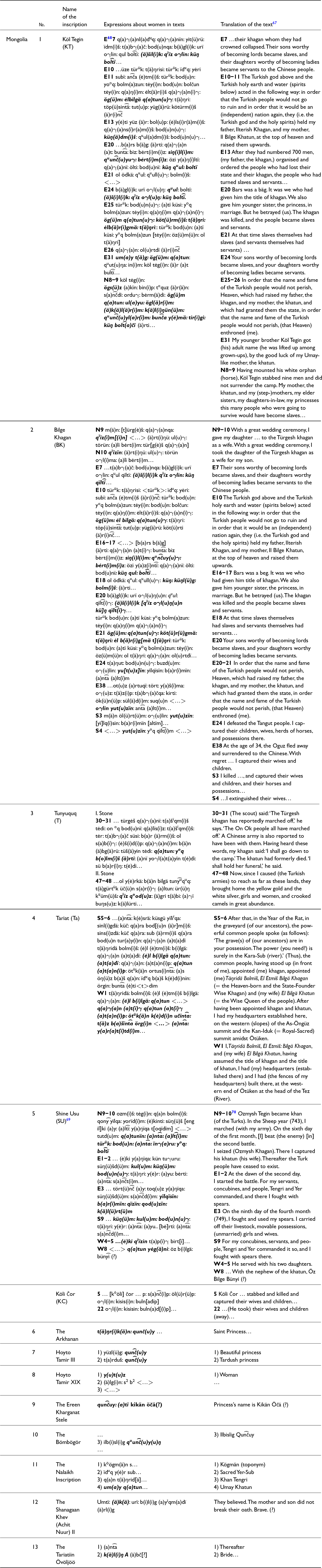
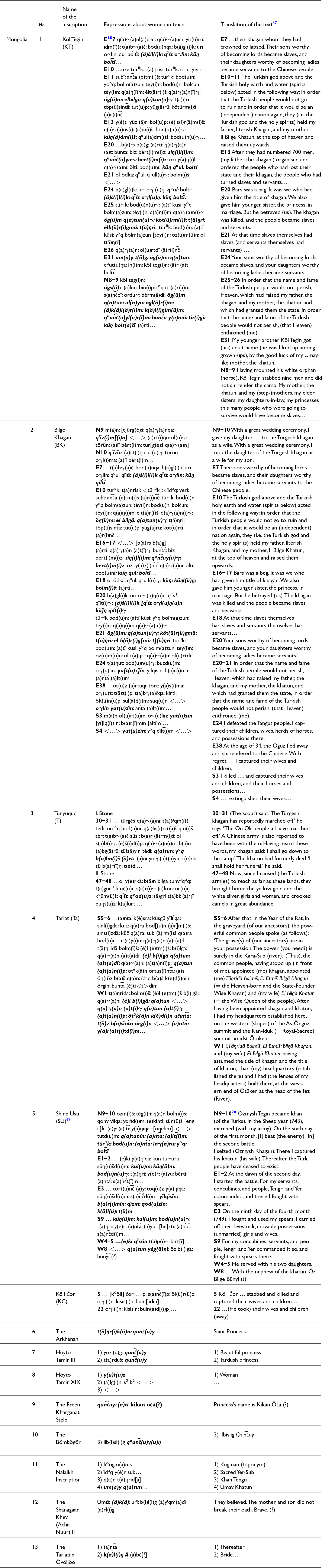
Expressions related to women, seen in the inscriptions in Mongolia
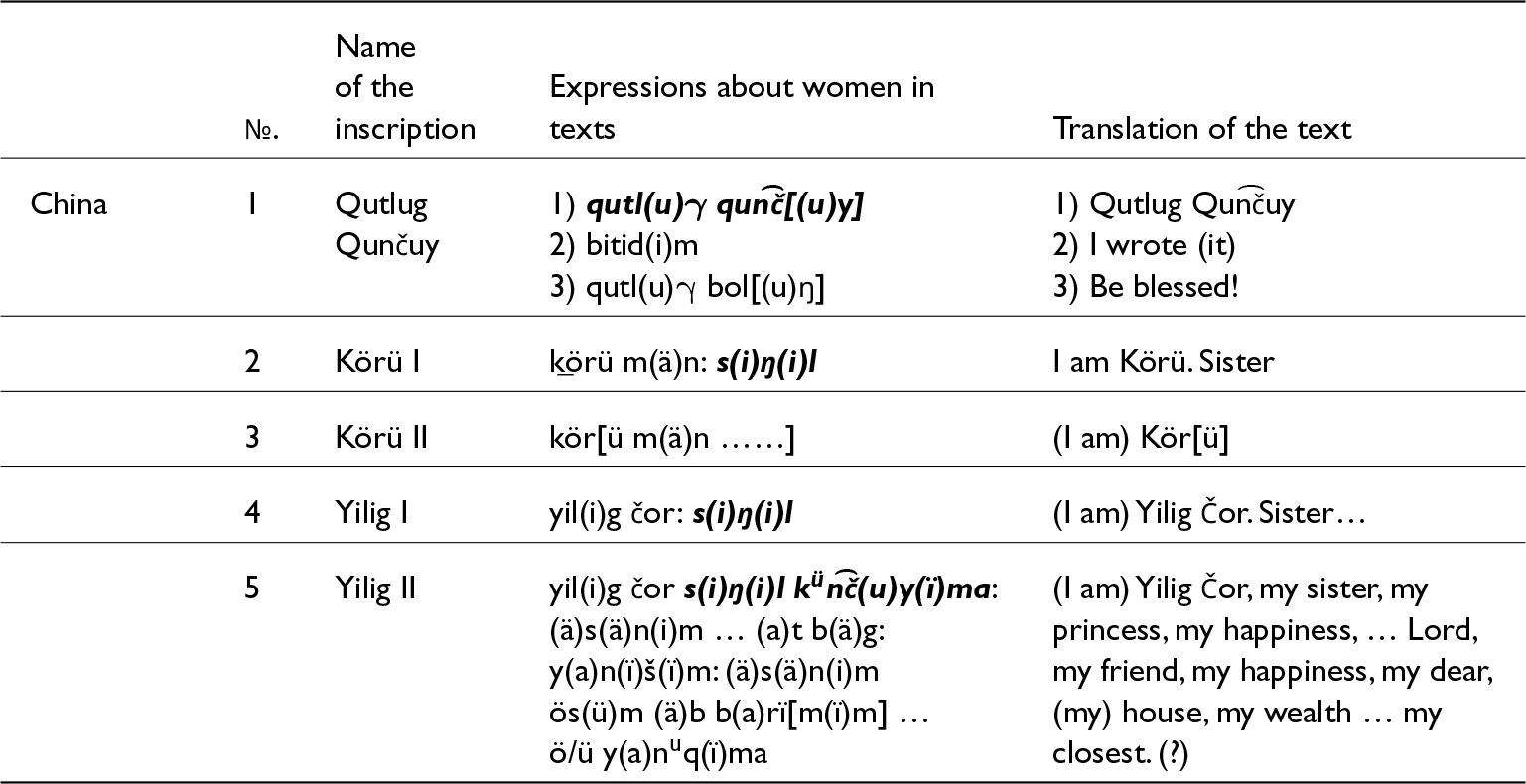
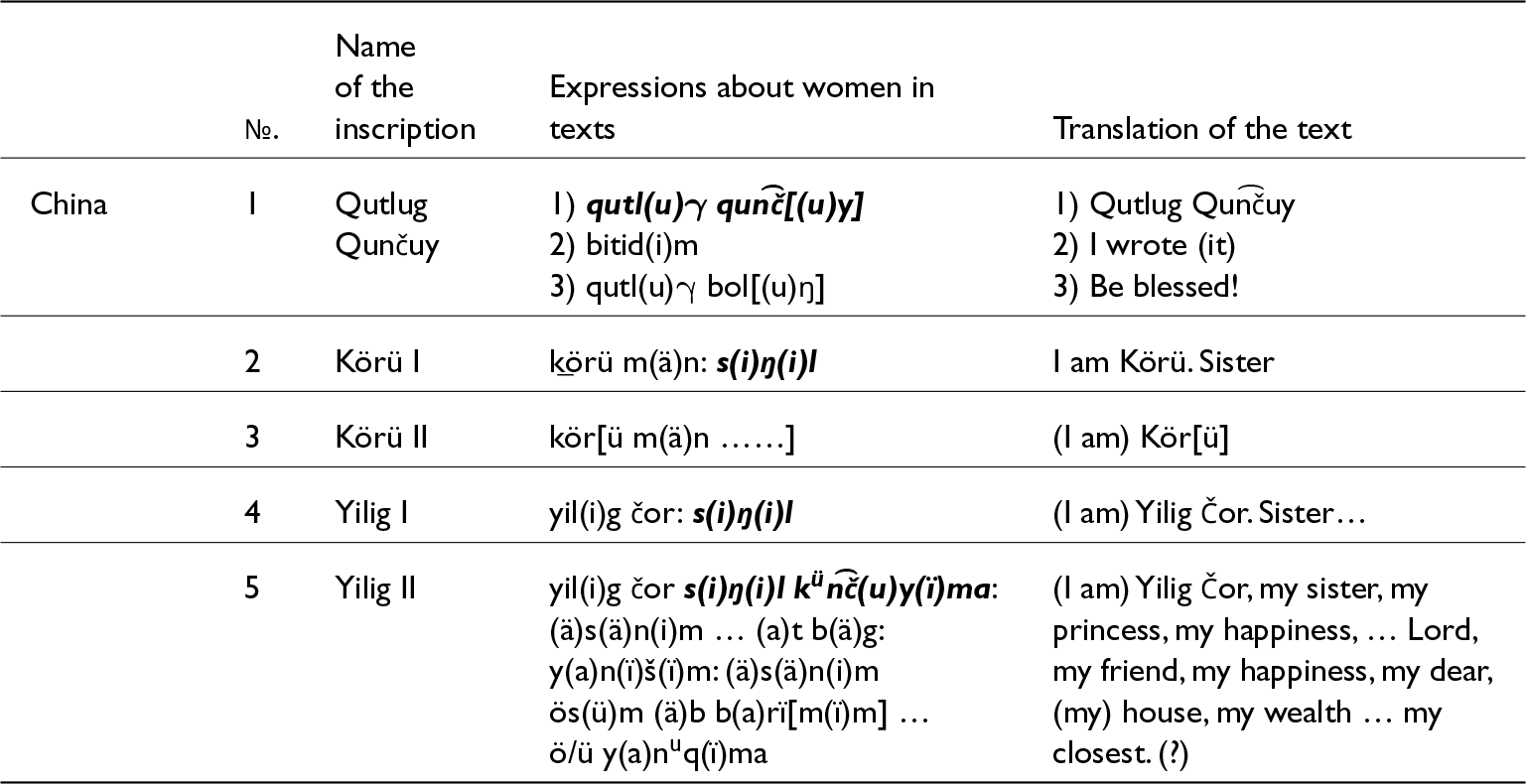
In relation to the inscriptions in China, the studies of ErdalFootnote 65 and AlyılmazFootnote 66 were reviewed, with Alyılmaz’s work being used as the primary reference.
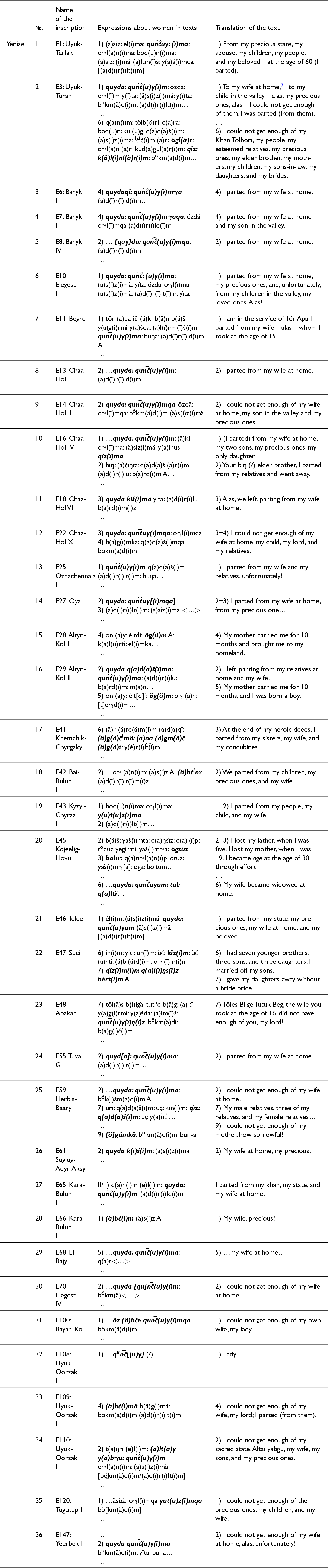
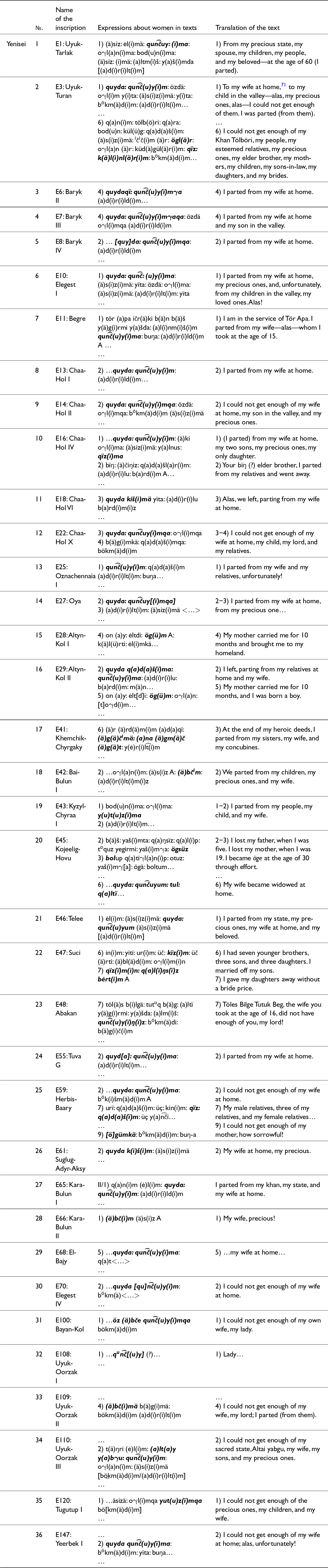
Expressions related to women, seen in the inscriptions in Yenisei
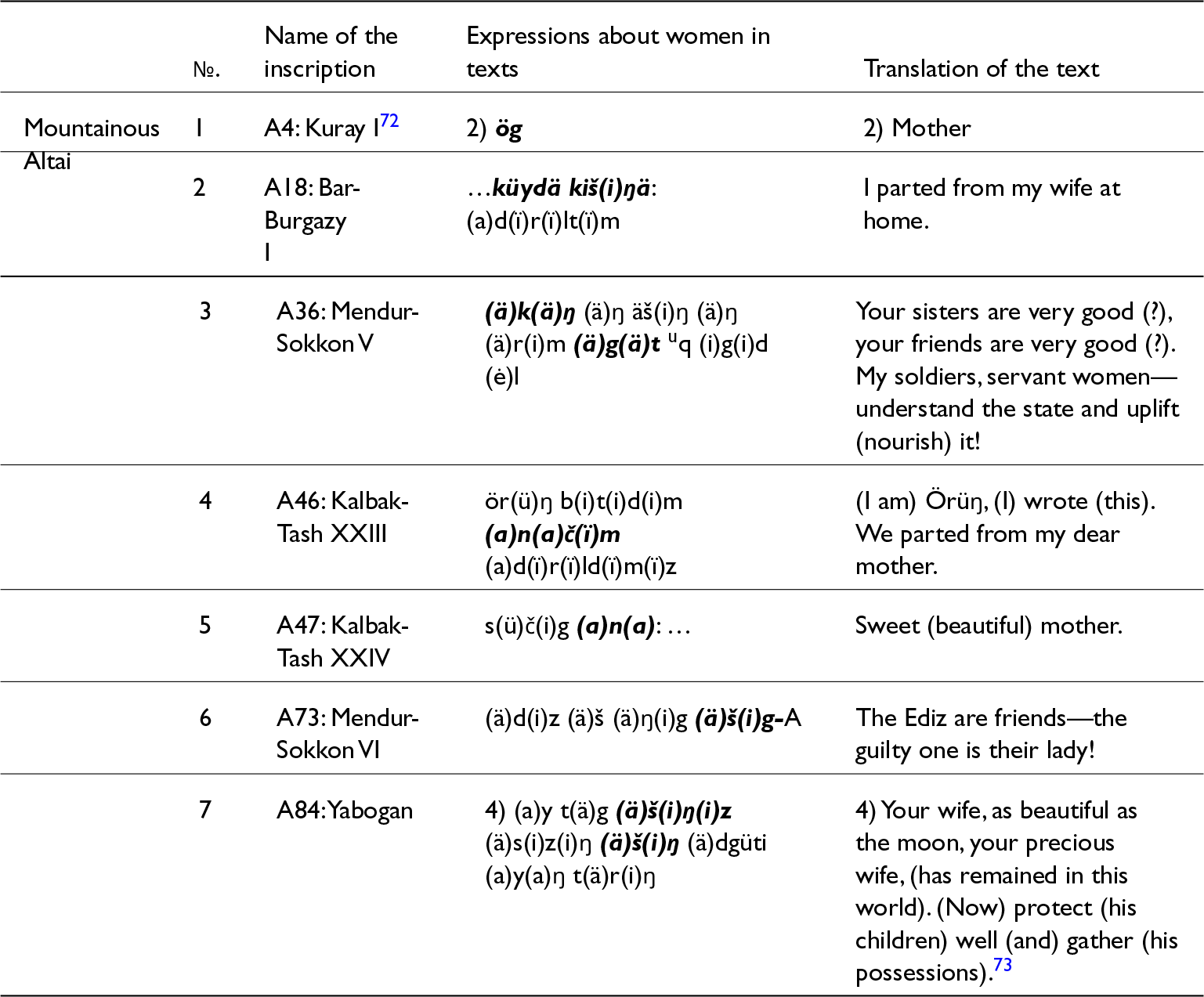
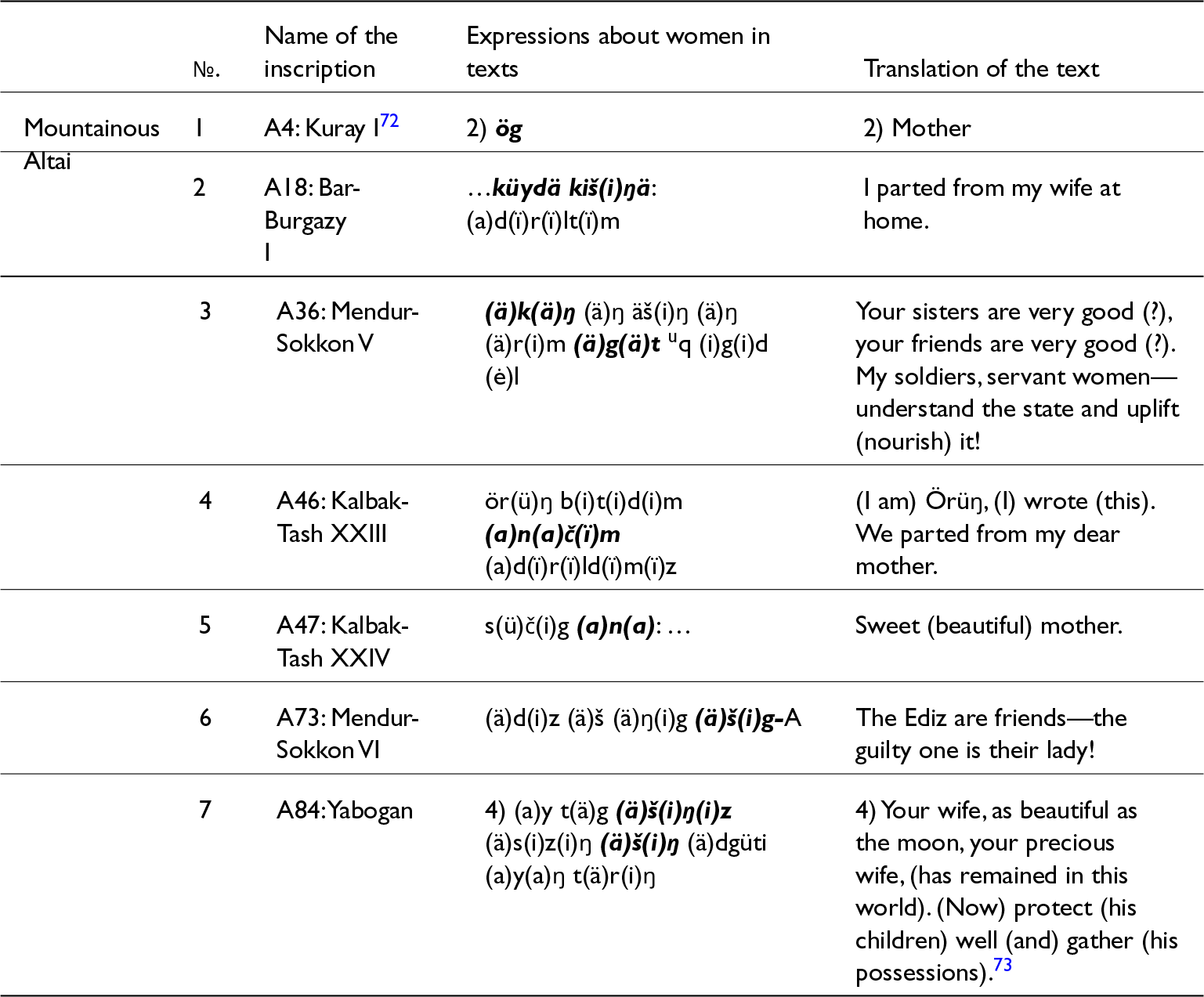
Expressions related to women, seen in the inscriptions in Mountainous Altai
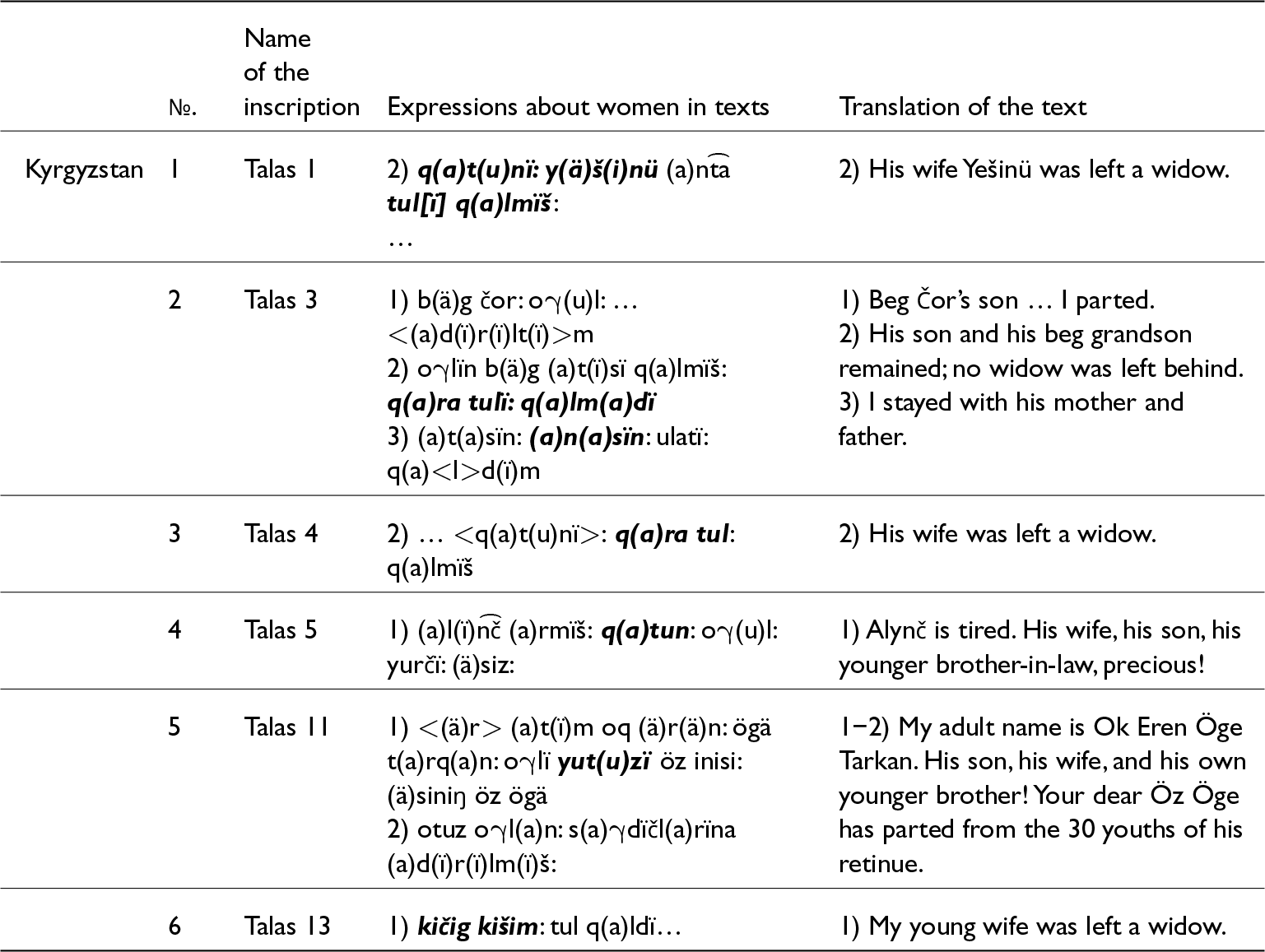
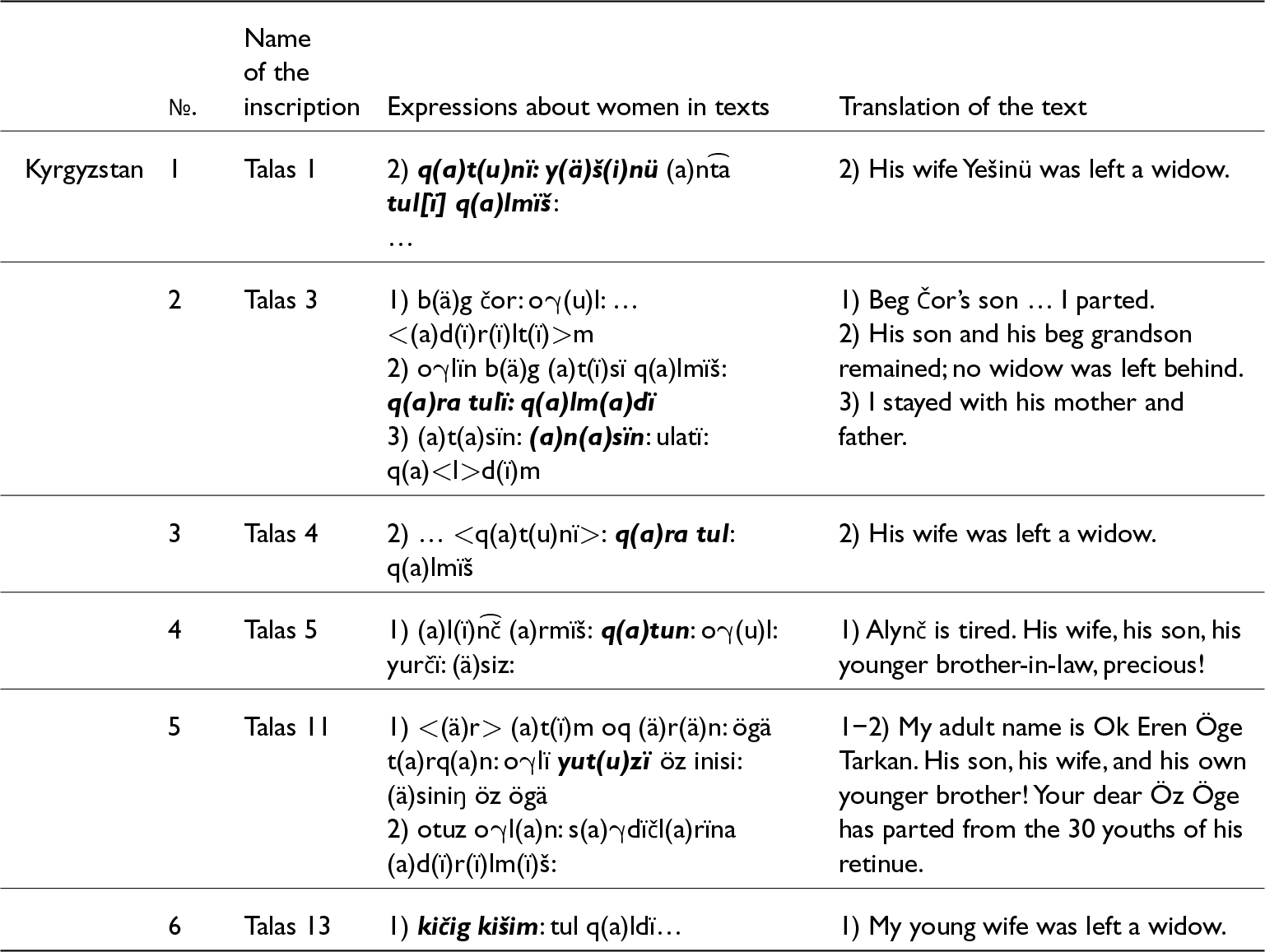
Expressions related to women, seen in the inscriptions in Kyrgyzstan
Expressions related to women seen, in the inscriptions in the People’s Republic of China
The word ‘äbči’ has been interpreted by Nadelyayev et al. as ‘жена, женщина’ (wife, woman),Footnote 74 by Clauson as ‘with the specific connotation of housewife, hence more generally, wife, woman’,Footnote 75 and by Wilkens as ‘woman, female, feminine; spouse, wife’.Footnote 76
The word ‘ägät’ appears in the inscription coded A36 among the Mountainous Altai inscriptions and in the inscription coded E41 in the Yenisei region. This word has been interpreted as meaning ‘female servant’.Footnote 77
The word ‘äkä’ means ‘older sister’.Footnote 78 It is important, as it reflects the family structure and shows that girls are positioned differently within the family hierarchy according to their age. The word ‘siŋil’ is used to refer to younger sisters. This not only highlights the importance of the family and its internal order but also underscores the visibility of girls and women within the family. Both boys and girls are distinguished by age and are referred to with different terms based on their seniority.
The word ‘äši’ means ‘lady, wife’.Footnote 79 It is likely that this usage is attested in the inscriptions from Mountainous Altai. According to the reading of the inscription coded A73, the recording of Ediz’s wife as guilty is significant in terms of the woman’s role and influence. The word ‘äšilik’, found in the inscriptions in Mongolia, appears as ‘äšilik qïz’ and is used to mean ‘a noble girl, a young girl who will become a lady’. A similar usage may have occurred in Mountainous Altai, although this is uncertain due to differences in interpretation. This is important in terms of the value placed on girls, as they are seen as future ladies. However, it is noted that mistakes could lead them to become concubines instead. The hope is for girls to be raised as future ladies.
Both ‘ana’Footnote 80 and ‘ög’Footnote 81 mean ‘mother’. The word ‘ana’ has been encountered in the inscriptions from the Mountainous Altai and Kyrgyzstan regions, while ‘ög’ has been observed in the inscriptions from Mongolia, Yenisei, and Mountainous Altai. Bilge Khagan used the term ‘ög’ when referring to his own mother, in the forms ‘ögüm khatun’ (my mother the queen) and ‘ögüm Il Bilge Khatun’ (my mother Il Bilge Queen). Additionally, in the Yenisei inscription coded E41, terms associated with motherhood, such as ‘ägäč’ and ‘ägmäč’, have also been found.
The word ‘käliŋ’ is used to mean ‘bride’.Footnote 82 This usage, found in the inscriptions from Mongolia and Yenisei, is significant in terms of family relationships and the importance of defining everyone’s position within the family structure. Brides are mentioned in the inscriptions as valued family members. In Yenisei, they are counted among the cherished family members left behind after someone’s death. In Mongolia, specifically in the Köl Tegin inscription, they are also listed among the family members for whom there is concern about becoming concubines.
The word ‘kiši’,Footnote 83 meaning ‘woman, wife’, appears in the Yenisei, Mountainous Altai, and Talas inscriptions. It is generally used in the phrase ‘quyda qun͡čuy’ (my wife in the village), where it is seen as a substitute for ‘qun͡čuy’. When associated with the word ‘kiši’, which means ‘person’, its significance lies in its usage as a term common to both men and women, highlighting its shared meaning across genders.
The word ‘küŋ’ means ‘concubine, female slave’ and is found in the Orkhon inscriptions.Footnote 84 It is noteworthy that even women at the lowest levels of society were identified. There was a general concern about girls becoming concubines, losing their freedom, and, instead of becoming ladies, being reduced to the status of slaves.
The term ‘khatun’ has been used with meanings such as ‘the khagan’s wife, queen, goddess, lady, woman’.Footnote 85 Clauson and Wilkens have recorded the origin of the word as Sogdian.Footnote 86 There are various opinions regarding the origin of the word.Footnote 87 In the Talas inscriptions, the term ‘khatun’ was used to refer to a woman in the sense of a ‘spouse’. This title is also found in Chinese sources: ‘Bumin (Tu-men) took the title Il (I-li) Khagan, which corresponds to the ancient [Hun] title chan-yu. His wife took the title Khatun (ke-he-dun), which corresponds to the ancient [Hun] title yan-zhi.’Footnote 88 The existence, use, and appearance of this title in various sources alone indicate that women played a role as political figures.
The word ‘qïz/qïïz’ means ‘girl’. It has been found in inscriptions from Mongolia and the Yenisei region. The phrase ‘qïïz oγul’ was also used to refer specifically to a female child.
The word ‘qoduz’Footnote 89 means ‘woman’.Footnote 90 It was used in the Shine Us inscription in Mongolia. In the Dīwān Lughāt al-Turk, it is defined as a ‘widowed woman’.Footnote 91
The term ‘qun͡čuy’Footnote 92 means ‘daughter, consort, wife’. This word is borrowed from Chinese, in which it originally meant ‘princess’. Over time, its meaning expanded regionally to also refer to a ‘consort’ or ‘wife’, likely due to the practice of sending princesses from China as consorts. Additionally, when the khagan referred to his sister, he used the term ‘siŋil qun͡čuy’ (princess sister). This usage indicates that the title was accepted and used within the royal family.
The term ‘siŋil’Footnote 93 has been used to mean ‘sister, younger sister’. It is found in inscriptions from Mongolia and the People’s Republic of China. Additionally, this term is seen in inscriptions in which sisters with the title ‘qun͡čuy’ (princess) were used in political marriages.
The term ‘tul’Footnote 94 means ‘widow’. It appears in the Yenisei inscriptions and is notably used in the Talas inscriptions in Kyrgyzstan. The frequent use of this term to refer to a woman whose spouse has died is noteworthy. This term is especially found in epitaphic inscriptions dedicated to the deceased. Additionally, there is a usage of ‘qaraFootnote 95 tul’, which means ‘mourning, grief-stricken widow’. This indicates a person who is grieving or a sorrowful spouse. The use of this concept reflects the role of women in society, as it shows the need to describe the status of a woman who has lost her husband. Tokyürek has highlighted the significance of the terms khatun, qun͡čuy, and tul used for women, noting that women with hierarchical roles might come to share a common social status referred to as ‘tul’ once they become widows.Footnote 96
The term ‘yutuz’ means ‘lady, wife, married woman’.Footnote 97 It is found in inscriptions from Mongolia, Yenisei, and Kyrgyzstan. Although this term appears in the Bilge Khagan inscription, it is not found in the Köl Tegin inscriptions. Bilge Khagan uses this term when he mentions capturing the children and wives of his enemies and destroying their wives. In inscriptions from Yenisei, such as the E120 inscription, and in the Talas 11 inscription, the term appears as ‘oγul-yutuz’ (children and wives), indicating that such a usage pattern was common during that period.
In general, in the inscriptions left by the Old Turks, women are described by using terms such as wife, woman, mother, daughter, sister, elder sister, bride, queen, princess, lady, mistress, concubine, and widow. These terms illuminate the roles women played within society. It is evident that a significant majority of the inscriptions are attributed to men, while women are mentioned with these various terms. This usage highlights the important role women played within the family. From the expressions related to family, it is understood that, while women are valued and loved within the family, they are also considered important. In inscriptions related to death, it is frequently mentioned that the deceased is always separated from their spouse. This expression, which has become a tradition, is notable in most death-related inscriptions. The deceased are separated from their beloved wives and never had enough time with them. References to mothers are also found. Additionally, titles such as ‘qun͡čuy’ and ‘khatun’, meaning princess, queen, and lady, indicate that these titles were used to refer to women and their roles as wives, reflecting the importance placed upon them. However, these titles suggest that those who held them were perceived primarily as wives and women rather than as high-status individuals. ‘Qun͡čuy’ essentially refers to a wife sent from China. ‘Khatun’ denotes the wife of the khagan. These terms indicate that women were valued, as titles came to represent them. Nevertheless, the perception of women as primarily wives is prominent. The extensive and detailed terminology related to relatives and family underscores the importance of strong family bonds and the value placed on each person’s role within the family. The roles of women in the family and society—such as mother, wife, daughter, elder sister, sister, bride, and widow—are clearly defined. Terms such as ‘äbči’ and ‘quyda qun͡čuy/kiši’ offer a clearer understanding of the status of women in society.
Radloff stated that he did not come across the word ‘quy’ in the Orkhon inscriptions and suggested that it might mean ‘house and camp’, as it was used in front of expressions related to women. He also speculated that it could be related to a word in the Abakan and Altai dialects meaning ‘cave, riverbed, shore’. As he was unable to definitively determine its meaning, he regarded it as a foreign word and did not translate it.Footnote 98 Orkun rejected Thomsen’s interpretation of ‘quy’ as ‘harem’ and, based on Mahmud al-Kashgari’s work, accepted its meaning as ‘river plain, riverside’.Footnote 99 Malov interpreted this word as the area in which the women of a high-ranking family lived,Footnote 100 while Batmanov considered it to be a room belonging to women.Footnote 101 Nadelyayev and others, who claimed that the word was borrowed from Chinese, understood it as a room in which the women lived.Footnote 102 Clauson interpreted ‘kuy’ as ‘women’s apartments’ and ‘ku:y’ as ‘a secluded spot’.Footnote 103 Kormushin used it to refer to the women’s quarters of the house (harem),Footnote 104 while Useev noted that it meant ‘house and village’ and pointed out that the word had been preserved in the Manas Epic.Footnote 105 Aydın interpreted it as ‘encampment, village’.Footnote 106 The phrase ‘quyda qun͡čuy’ means ‘the lady, the wife in the encampment or yurt’. This expression, frequently found in the Yenisei inscriptions, suggests a general understanding that a woman’s place is in the encampment or yurt. Based on this information, the preference for the word ‘quy’ aligns with the use of the word ‘äbči’.
The word ‘äbči’ is formed by adding the suffix +čI, which denotes a profession, to the word ‘äb’ (house, home).Footnote 107 Accordingly, the meaning of this word should be understood as ‘the one responsible for the home, the one who handles household duties’. Ögel stated that, in Old Turkic societies, the woman was the owner of the house.Footnote 108 The verb ‘äblä-’ also points to this situation. In Old Turkic culture, marriage was associated with the word ‘äb’ and people getting married were seen as acquiring a home (äb). Once the action of ‘äblä-’ (to marry) is completed, the living space is the ‘äb’ (home). The one responsible for this living space is the ‘äbči’—that is, the woman. All these statements indicate the woman’s domain of responsibility, authority, and work. While a woman who is ‘äbči’ is a wife, she may also be a mother. It is understood that women had active responsibility in matters related to the household. The necessities of nomadic life also made this a requirement:
In pastoral nomadic society, labor was divided according to age and gender. The male’s responsibilities included grazing the cattle as well as making bows and arrows and other tools. The rest of the time they busied themselves with hunting, archery, and military campaigns. All other labor fell to the women—housework, milking and preparing other products from livestock, and raising the children. When the men were absent, the women had to take on the entire burden.Footnote 109
All of this makes it clear that women also participated in the workforce to some extent. Additionally, it is understood from the inscriptions that women also served as slaves:
KT E7 q(a)γ(a)nl(a)duq: q(a)γ(a)nïn: yit(ü)rü: ïdm(ï)š: t(a)bγ(a)č: bod(u)nqa: b(ä)gl(i)k: urï oγlin: qul bo͡ltï: (ä)šil(i)k: qïïz oγlin: küŋ bo͡ltï… türük: b(ä)gl(ä)r: türük: (a)tin: ıt(t)ı: t(a)bg(a)čγı: b(ä)gl(ä)r: t(a)bγ(a)č: (a)tin: tut(u)p(a)n: t(a)bγ(a)č: q(a)γ(a)nqa: körm(i)š: (e)l(i)g yïl: iš(i)g küč(ü)g: birm(i)š…
BQ E7–8 …q(a)γ(a)nl(a)duq: q(a)γ(a)nin: yit(ü)rü ïdm(ï)š: t(a)bγ(a)č: bod(u)nqa: b(ä)gl(i)k: urï oγlin: quul qïltï: (ä)š(i)l(i)k qïïz oγlin: küŋ qïl͡tï: türük: b(ä)gl(ä)r: türük: (a)tin: ıt(t)ı: t(a)bγ[(a)čγı]: b(ä)gl(ä)r: t(a)bγ[(a)č: (a)tin: tut(u)p(a)n: t(a)bγ(a)č: q(a)γ(a)nqa: körm(i)ş: (e)l(i)g yïl] iš(i)g: küč(ü)g: birm(i)š…
SU W4–5 … (ė)kiqïïzin t(a)p(ï)γ birt[i]…
As described in these statements, when the Turkic people submitted to the Chinese emperor, the men became ‘qul’ (slaves) and the women became ‘küŋ’ (female slaves). For 50 years, Turkic nobles, bearing Chinese titles, gave their ‘work and labour’ to China, meaning they worked for them. From this, it can be understood that enslaved individuals, regardless of gender, were exploited. Both men and women served under nobles with Chinese and/or Turkic titles. In cases in which the Turks were subordinated to China, this was considered slavery.
Despite all this, the responsibilities undertaken by women increased their visibility in the male-dominated world. The need for labour and effort also shaped the societal understanding of women. Undoubtedly, the increased visibility and active identity of women in society also influenced the role and effectiveness of the wives of khagans. Chinese records indicate that both men and women participated in funerals dressed in fine clothes, that boys played in marshes and wooded areas, and that girls kicked leather balls.Footnote 110 Such examples point to the visibility of women in society. However, it is important to note the limitations of this visibility. The prevailing social and familial structure was patriarchal in nature.
A similar situation applies to khatuns and political female figures as it does to women in general. The information concerning political women is also recorded by men in the inscriptions. Bilge, who refers to himself as ‘t(ä)ŋri t(ä)g: t(ä)ŋridä: bolm(ï)š: türük: bilgä: q(a)γ(a)n’,Footnote 111 indicates that he organised the people under his authority.Footnote 112 He enhanced the welfare of his impoverished people and enriched them.Footnote 113 However, in both inscriptions, the name of his divinely chosen queen is not mentioned, and her existence is not acknowledged. The inscriptions describe the heroism and deeds of men, but do not mention the actions of any women. This is a significant indicator. It is the men who are depicted as the organisers, rulers, and heroes.
The information provided in the inscriptions concerning the power and spheres of influence of khatuns is limited. Based on the inscriptions, Mutlu states that khatuns were chosen by Tengri, governed the state together with the khagan—who ascended the throne in accordance with törü (law, rule, custom, tradition)—and played an influential role in state affairs.Footnote 114 Referring to Bar Hebraeus’s account that, following the death of the khatun, wife of Toghrul, it was noted that she had handled all affairs of the kingdom, Golden argues that, in contrast to the Islamic Middle East, women in steppe societies held a more significant political position.Footnote 115 Gömeç asserts that, in the Turkic state, the khatun ranked second only to the khagan and ruled jointly with him.Footnote 116 Similarly, Kafesoğlu also remarks that the khatun had a voice in matters of state.Footnote 117 Kuzakçı Bölükbaşı, who makes reference to the influential role of khatuns, states that the heir to the throne had to be born of a woman of Turkic noble descent and that, for this reason, such women bore the title of khatun.Footnote 118 There is a general scholarly consensus that khatuns held significant power in Old Turkic society. However, the expressions used in the runic inscriptions do not fully corroborate this view. As discussed above, women were acknowledged to hold an important place in society, to share the burden of labour, and to be responsible for domestic, tribal, and household affairs. Yet, the fact that women shared in labour, bore responsibilities in specific domains, and appeared beside the khagan occurred within a patriarchal, male-dominated worldview.
As far as is known, the inscriptions were composed by men and primarily feature male figures. Female names are mentioned only rarely. Nonetheless, certain women’s names and titles—such as Il Bilge Khatun, Kiken Öče, Yešinü, and Qutluγ Qun͡čuy—are recorded in the inscriptions. The inclusion of such titles is significant. The title Il Bilge Khatun is indeed a title. This woman, who was the mother of both Bilge Khagan and Köl Tegin, is mentioned in the inscriptions of Köl Tegin and Bilge Khagan. Moreover, the same title is found in the Tariat inscriptions, in which it is also held by the queen of Moyun Chor, the khagan of the Ötüken Uyghurs. It is beneficial to recall that, in both inscriptions, these rulers and their consorts are indicated as having been chosen by the deity.
Köl Tegin received his adult name through the ‘qut’ (divine favour or sacred fortune) of his mother. Notably, the persistent use of the title khatun in this context merits attention. Bilge Khagan refers to his mother as ‘ögüm khatun’. The significance of emphasising his mother’s title deserves further discussion. However, it is highlighted that she is distinguished from other women, emphasising that he is the son of a chosen queen. A similar expression to ‘ögüm khatun’ is ‘siŋil qun͡čuy’. Thus, among the nobility, words expressing family are used alongside titles.
The concept of statehood in Old Turkic societies is a distinct topic of discussion, but, as indicated in the inscriptions, a patriarchal understanding is present. According to these inscriptions, God created people, and it was Bumin and Istemi, the brothers, who established the order among these people. They seized power and established order.Footnote 119 However, those who came after them did not possess the same nature, and the state gradually declined.Footnote 120 People were disturbed by their subjugation to China and failed to succeed because they could not reorganise.Footnote 121 It is implied here that, firstly, God needed to desire their salvation and bestow ‘qut’ (divine favour). Without God’s command, qut, and fortune, it was impossible for them to succeed. Authority is granted to those chosen by God. Subsequently, to prevent the annihilation of the Turkic people and the Yer-Sub, Bilge Khagan’s father Ilterish and his mother Il Bilge were chosen by God,Footnote 122 and they were given the titles of khagan and khatun. Ilterish, having been empowered by God, organised the state.Footnote 123 However, the actions of Bilge’s mother are not mentioned here.
The emphasis placed on Il Bilge Khatun—highlighted primarily in her role as a mother—appears to reflect a political and pragmatic usage. The throne, after the reign of his uncle, was expected to pass to Bilge Khagan, the son of the divinely appointed ruler and his equally divinely sanctioned consort. His right to rule is thus reinforced through this sacred lineage. Kormushin has argued that references to wives in the epigraphic tradition play a significant role—a fact he supports by noting the relatively high frequency of such references.Footnote 124 Furthermore, he has considered why women from the Eastern tradition are so frequently mentioned in inscriptions, associating this with the privileged inheritance status of children born to the principal wife. He notes that sons are mentioned following their mothers, although this structure primarily serves to emphasise the sons rather than the mothers themselves.Footnote 125 Useev, however, challenges this interpretation, pointing out that the inscriptions do not provide information regarding the number of wives. Consequently, he does not fully endorse Kormushin’s view. He further argues that, if such a hierarchy among wives had existed, then other spouses would also have been mentioned to highlight and distinguish the primary wife more explicitly.Footnote 126 Despite Useev’s critique, Kormushin’s approach remains relevant. It is not necessary for other wives to be named to underscore the distinct status of the principal consort. The woman referred to in the inscriptions as ‘khatun, qun͡čuy, or äbči’ stands apart as the only one acknowledged and valued—regardless of whether she is named. Nevertheless, even though these consorts were clearly held in esteem, their names were not considered essential to include. Broadly speaking, Kormushin’s interpretation aligns with the idea that Bilge Khagan’s mother was presented as a figure of sanctity. In the inscriptions, although Il Bilge is referred to as both a mother and a sacred queen, her actions are not detailed. Rather, her presence alone is utilised as a source of political power and legitimacy.
At this point, three fundamental reasons can be identified concerning the khatun’s divine selection: belief, lineage, and political marriages. Firstly, each of these elements influences and is interconnected with the others. In the context of Old Turkic belief systems, deities such as Tengri and Umay are mentioned in the inscriptions. These divine figures appear with both masculine and feminine attributes and are referred to as Tengri Khan and Umay Khatun. As indicated by the expressions Tengri Khan and Umay Khatun, there is a duality. Tengri Khan represents a khagan, while Umay Khatun represents a khatun. To mirror the divine feminine principle embodied by Umay within this dual structure, the khatun—as the khagan’s consort—must also have been perceived as sacred. Accordingly, the offices of khagan and khatun are seen as earthly embodiments of the supreme god and goddess. This association implies that their claim to the throne was divinely sanctioned, thereby conferring a privileged and legitimised status upon them. Moreover, as seen in expressions such as ‘tengriken qun͡čuy’ (Saint Princess), the sanctification of women through divine associations is evident. The deification of the khatun, in turn, elevates the importance of her lineage.
The importance of the sacredness of lineage is clear. The lineage blessed by divine favour (qut) has the right to rule. Consequently, the throne is passed to individuals from the same lineage. The right to rule is typically inherited from father to son or brother. However, the lineage of the mother is also extremely significant. For instance, in Chinese sources, after the death of Ta-po, Ta-lo-pien’s mother was deemed unsuitable for the throne because she came from a lower class.Footnote 127 To preserve the sanctity of lineage, marriages must occur with brides from high-ranking families. A woman’s nobility is related to being both the ruler’s wife and the mother of the heir.
In chapter 50 of the Zhou-Shu, the continuation of lineage from a wolf is described. The Turks, who belonged to the A-shi-na clan and were a branch of the Huns, were devastated by a neighbouring state, leading to the destruction of their people. The only survivor, a 10-year-old boy, was abandoned after his feet were severed. However, this boy was raised by a she-wolf and later joined her. The she-wolf became pregnant and gave birth to 10 boys. Each of these 10 boys married foreign women, creating distinct lineages. A-shi-na was one of them.Footnote 128 A similar narrative applies to the wives of Oghuz Khagan. One wife came from the heavens with divine light, while another was seen in a tree hollow in the middle of a lake.Footnote 129 Elements such as the sky and trees evoke divine associations, and the children born from these women continued the lineage. Thus, a lineage blessed with divine favour begins with a sanctified, mythic mother and continues through her descendants. This shows that the lineage’s origins and continuation through the mother and wife are also important in ancient narratives, epics, and myths. The wolf represents both the mother of the lineage and the wife of the noble child, demonstrating care and protection, and reflecting the dual role of the woman as both mother and spouse.
The deification of the mother and the sanctity of her lineage were crucial in determining the rightful heir. It appears that the divine lineage of the father—täŋri täg—was not deemed sufficient on its own to legitimise a claim to the throne; efforts were also made to establish the legitimacy of the heir through the khatun, by invoking Umay täg—divine descent from the goddess Umay. In this way, succession disputes may have been intended to be confined to the children of both a divine father and a divine mother. However, the extent to which this principle was consistently applied remains debatable. Kapghan ascended to the throne following his elder brother, rather than Bilge himself. Nevertheless, Bilge’s repeated emphasis on his mother’s presence and sanctity in the inscriptions must be interpreted in relation to his own legitimacy, divine status, and political authority. Neither the founders nor Bilge himself—nor any other ruler—referred to a divinely sanctioned khatun in such explicit terms. Taken together, these elements suggest that the khatun’s divine and noble status held significant political value both for the reigning khagan and for the heir to the throne.
In this context, the noble status of women was not only a matter of lineage and divine legitimacy, but it also served as a foundation for political alliances through marriage. The nobility of the women in a marriage directly facilitates political marriages. Such an understanding is present beyond Turkic culture and is evident in the broader region. Marriages between dynasties are common. A notable example of the importance of nobility and marital equality is the rejection of Tuman’s marriage proposal by the Ruan Ruan. The Ruan Ruan ruler dismissed Tuman’s proposal, saying ‘He is my blacksmith’, indicating that he did not regard him as an equal and rejected him outright.Footnote 130 This illustrates that nobility is closely related to power, status, and position. Such marriages signify legitimacy and the acquisition of power.
Political marriages can be divided into internal and external political marriages. External political marriages are frequently encountered in Chinese sources. From the time of the Xiongnu, marital diplomacy was conducted with the Chinese. Taşbaş, in her study of Heqin diplomacy during the Köktürk and Uyghur periods, discusses matrimonial alliances involving the Western Wei (Northern Zhou), Sui, Tang, and Ashina Dynasties, as well as Uyghur–Tang marital diplomacy. She asserts that, from a historical perspective, these diplomatic marriages were closely tied to China’s intention to control its relations with the nomadic peoples of the north, and that they were also used to establish strategic alliances.Footnote 131 The implementation of such diplomatic marriages led to various forms of interaction between the two sides. Mackerras notes that, as claimed by several Chinese scholars, these diplomatic marriages encouraged cultural and economic relations between the Tang court and surrounding peoples—a view he agrees with.Footnote 132 Rothschild remarks that steppe women were active and powerful figures; like men, they hunted, were skilled horse riders and archers, and enjoyed significantly more social and sexual freedom than Chinese women. He further argues that steppe culture influenced Confucian culture and that, with the spread of Buddhism, Chinese women began to play a more empowered role in society. Unlike in China, there was no strict spatial segregation between men and women in the steppe, which allowed women to be more visibly active. Rothschild also notes that, due to the long-term rule of steppe peoples in China—especially during the reign of Empress Wu—the Confucian restrictions on women loosened, allowing them to become more prominent.Footnote 133 As a result of these interactions, the lifestyle of Old Turkic women had a positive influence on the condition of women in China. However, due to limited data, it is difficult to determine whether the situation of Chinese women had any negative impact on Turkic women in return.
The Turks, in turn, sought brides from the Chinese imperial family for a variety of political purposes—such as forging relations with the Chinese emperor, deriving power from China, gaining recognition within the Chinese political sphere, and facilitating peace and trade. These women had an impact on Turkic Khaganate politics. Naturally, the brides were expected to have a level of respect and influence commensurate with the status and position of their family. An example of this is the Queen of the Zhou nobility of Muqan, who was able to initiate an attack following the fall of the Zhou Dynasty.Footnote 134 Additionally, the Chinese princess I-cheng Khatun was able to prevent Ch’u-lo’s son from ascending the throne because she did not approve of him.Footnote 135 These examples demonstrate that external political marriages had mutual impacts on both parties, and historical records clearly indicate that some of these brides exercised considerable influence.
Women also appear to have exerted a similar degree of influence within internal political marriages. An example of internal political marriages is Bilge Khagan’s marriage to Tunyuquq’s daughter. It is noted that Bilge Khagan’s wife was indeed Tunyuquq’s daughter and that she helped save him when supporters of Bögü Chor were being killed.Footnote 136 Furthermore, after Bilge Khagan’s death, Tengri Khagan, being a minor, had his mother involved in state affairs.Footnote 137 As understood from the inscriptions, marriages were based on pragmatic reasons. Just as foreign brides were chosen, so too were the daughters of prominent individuals preferred in internal marriages. Ceremonial marriages made by Bilge Khagan for his sisters and children are also recorded.Footnote 138 From the above, it becomes evident that women could indeed exert influence; however, this influence was often indirect and limited in scope. Compared with female rulers in other regions of the same period, the political agency of these women was considerably narrower. While some figures, such as Il Bilge or the mother of Tengri Khagan, held respected positions, women in other parts of the world during the same era were able to assume full authority and proclaim themselves as sovereigns.
Throughout the entirety of China’s imperial history (from 221 BCE to 1912 CE), it is widely acknowledged that Chinese society was predominantly patriarchal and patrilineal.Footnote 139 Nevertheless, a significant female sovereign emerged in Chinese history: Wu Zetian. Wu Zhao entered the Tang court in 638 CE at the age of 14, during the reign of Emperor Taizong (r. 626–649), as one of his concubines. After his death, she developed a close relationship with his successor, Emperor Gaozong. Despite facing opposition, she succeeded in becoming empress in 655 CE and gave birth to four sons and one daughter. Having gained the emperor’s trust, Wu began to exercise power during his periods of illness. Upon Gaozong’s death in 683 CE, his son Li Xian ascended the throne, only to be deposed by his mother within a month and replaced by his brother Li Dan. Six years later, at the age of 65, Wu herself seized the throne and ruled for 15 years.Footnote 140 Wu constructed her own pantheon of women, drawing on mythological and religious elements to legitimise her reign. This pantheon was eclectic and diverse: it included figures from mythology and folklore, Confucian models of virtuous womanhood, Buddhist divine devis, Daoist goddesses, and her own political female ancestors:Footnote 141
The scope of her selection of female ancestors, canvassing each of the ‘three faiths’ of the time—Confucianism, Buddhism, and Daoism—enabled her a certain ideological exibility in keeping with her cosmopolitan, multiethnic, and religiously diverse empire. Wu Zhao maintained political and personal ties with each of these ‘faiths’.Footnote 142
Moreover, the emphasis on wisdom and divinity in Wu’s titles, as reflected in the phrase ‘sage and divine’, evokes the epithets of Old Turkic khatuns, such as bilgä and Umay täg. However, Wu made extensive use of mythical and religious elements, strongly highlighting them. Some of the titles Wu held at various stages of her career are as follows:Footnote 143
Sage (Saintly) Mother, Divine Sovereign, 688–690,
Sagely and Divine Emperor, 690–693,
Sagely and Divine Emperor, Cakravartin of the Golden Wheel, 693–694,
Maitreya, Sagely and Divine Emperor, Cakravartin of the Golden Wheel Transcending Antiquity, 694–695.
Rather than merely the similarity of these titles, their very use in historical records indicates that khatuns were symbolic figures. Wu actively assumed these titles and employed them as a head of state and sole authority. In contrast, Il Bilge’s title was recorded by her son, and it is not possible to speak of her reign or regency.
In the Byzantine empire, prominent women such as Irene and Theodora emerged. Irene, who was chosen as a bride for Leo IV by Emperor Constantine V Copronymos of Isauria, ruled as the regent of the young Constantine VI after Leo IV’s short reign (AD 775–780). She later deposed her own son and became the first woman to officially rule as emperor (797–802). However, Irene eventually lost her throne in a coup.Footnote 144 Similarly, Theodora served as the official ruler for 14 years during the minority of Michael III and entrusted state affairs to Theoktistos. When Michael came of age, he had Theoktistos executed and forced his mother into monastic life.Footnote 145 There are numerous similarities between Theodora and Irene. Both were iconophile empresses married to iconoclast emperors. Each acted as regent for her son and relied on eunuchs. Moreover, both emperors sought to free themselves from their mothers’ influence. While Theodora did not attempt to depose her son as Irene had, she was involved in an assassination plot against her brother Bardas, who had sidelined her from power.Footnote 146 Garland also notes that, by the late sixth and early seventh centuries, veneration of Theotokos had increased within the empire, and she was recognised as the protector of Constantinople: ‘This expansion of the cult of the Virgin was at least in part the result of women’s devotion to the mother of God, to whom Irene was to dedicate her convent on the island of Prinkipo.’Footnote 147 It can be argued that the use of religious elements in Byzantine, Chinese, and Turkic traditions followed a common pattern. In Byzantium, the Virgin Mary, in China, deified female ancestors and, in Turkic culture, Umay were all associated with the sacredness of women. The key distinction, however, lies in how these elements were employed: while, in Byzantium and China, women themselves strategically utilised these religious symbols for political purposes, among the Turks, such sacred associations were reflected in a limited number of titles bestowed upon khatuns by male rulers.
When examining these women, it becomes evident that all of them established a connection with power during their husbands’ reigns, assumed the position of regent, and, later, Irene and Wu ascended to the throne as sovereign rulers. Theodora, on the other hand, managed to govern for approximately 14 years. By contrast, khatuns such as Il Bilge and the mother of Tengri Khagan did not attain a comparable level of power. When Ilterish passed away, Bilge was too young to ascend the throne and, instead, his uncle Kapghan took power.Footnote 148 It appears that Il Bilge lacked the political influence and alliances necessary to secure the throne for her son and rule as regent in his stead, despite the succession traditionally favouring him.
After I-Jan Khagan, Tengri Khagan ascended the throne. Historical records indicate that Tengri Khagan’s mother was involved in state affairs due to her son’s young age, had a relationship with a statesman, and was not respected by cross-border tribes.Footnote 149 Although she played a role in governance, her influence was insufficient to prevent rebellions or the eventual collapse of the khaganate. Additionally, sources mention that she and her son Tengri deceitfully won over the Western Shad to their side. Given this, it is difficult to characterise her as an authoritative regent in her own right.
It is evident that Bilge Khagan utilised his mother as a political instrument, highlighting the notion that women primarily functioned as symbolic figures and were often used as tools for political power. However, this dynamic may have varied across different periods. Thus, it is natural that these women had powerful relatives and, consequently, connections that would allow them to be influential in politics. However, it is challenging to view women as being equal to men despite their significant roles in social and political life. Their power in political life, as mentioned, likely stemmed from marriages to individuals in high positions, or at least partly from such reasons. In societal life, the visibility of women is related to geography, lifestyle, task-sharing, and the evolving culture. This visibility seems to be limited to the oba (nomadic camp), yurt, and boy (clan) that they were part of. During a raid, women, like other spoils, were either captured or destroyed, which also served as a form of humiliation for the opposing side. The capture of women along with the spoils suggests that a woman’s freedom and the value she is given are confined to her own tribe and clan.Footnote 150
As seen in KT N9, women were protected by men. Additionally, in SU, when Moyun Chor took Ozmysh Tegin’s khatun, he declared that he had finished off the Turkic people there.Footnote 151 The capture of the khagan and khatun signifies the fall of the encampment. Women were captured as part of the spoils of war. There are also verbs related to women being enslaved, such as küŋ bol-, küŋ qïl-, küŋlüg bol-, and küŋed-. If wars were lost or the encampment could not be protected, then women were captured and enslaved.
Conclusion
In Mongolia, references to women are found in 13 inscriptions, in Yenisei in 36 inscriptions, in the Mountainous Altai in seven inscriptions, in Kyrgyzstan in six inscriptions, and in China in five inscriptions. However, no references to women have been found in the few inscriptions in Kazakhstan. Generally, the inscriptions reflect the roles of women within the family. In Old Turkic inscriptions, women are described as mothers, wives, women, widows, sisters, and daughters. Additionally, it has been observed that women held titles such as princess and queen, which, over time, began to represent terms such as wife and woman among the people.
Overall, women were visible due to geographical, lifestyle, and cultural reasons. However, this visibility exists within a male-dominated world, as indicated by the inscriptions. Women are depicted as needing protection and being responsible for the household and the encampment. Men and women are valued within their own ‘oba’ and ‘boy’ units. They must remain loyal to the khaganate or the powerful leader and not deviate from their path. If they lack sufficient power, then their disloyalty or rebellion results in the plundering of the ‘oba’ and everything valuable within it, leading to men becoming ‘qul’ (slaves) and women becoming ‘küŋ’ (concubines).
In addition, the inscriptions related to the khaganate also include titles of exceptional women in positions of authority. In these inscriptions, it is also evident that the khan and his wife, the khatun, were chosen by Tengri. While a relationship is established between the khagan and Tengri, a similar connection is made between the khatun and Umay. It is intriguing that both the khagan and his wife are deified together. However, this situation points to the cultural and religious perspectives of the Old Turks.
Chinese sources also show that women played significant roles in politics and that political marriages were frequently conducted in the region. These political marriages were conducted in two ways: internal and external.
The power of women in politics is linked to geographical, economic, and living conditions. Women’s participation in daily responsibilities alongside men brings them into prominence. Due to factors such as motherhood, the importance of the spouse, the lineage of the heir, and the power derived from their social class through both internal and external political marriages, women emerge as political figures and are sanctified alongside the khagan. Additionally, the divinisation of khatuns alongside the khagan appears to have been a means of reinforcing the heir’s divine legitimacy. However, khatuns were not as independent or free as men. There is no historical record from this period of a woman ruling alone as a sovereign or holding absolute authority. On the contrary, women were primarily instruments of political marriage. While some gained power and influence due to their social class, marital status (as a khagan’s wife), or motherhood (as the mother of the heir), this did not guarantee a similar influence for all women. Women—particularly Chinese princesses—leveraged their status to advance the interests of their kin or their male offspring. As mentioned earlier, this made them occasional key actors in a male-dominated world. However, this does not contradict the fact that women were respected and valued both socially and politically. Women were visible in society, relatively free, and regarded as significant figures.
In this study, expressions related to women in runic texts have been examined collectively. However, future research should include comparative analyses of women’s roles across different ethnic groups in the region, as well as comparisons of the status of women in Old Turks with their status in various periods of Turkic history. It would also be beneficial to explore how different religions, cultures, geographic, and economic conditions have influenced the position of Turkic women over time. Such comprehensive studies would contribute to a more holistic understanding of the subject.
Conflicts of interest
None.